Cisco BAC Architecture
This chapter describes the basic Cisco BAC architecture and includes the following sections:
For more information on each of the components, see the Cisco Broadband Access Center 3.7 Administrator Guide.
Regional Distribution Unit
The Regional Distribution Unit (RDU) is the primary server in the Cisco BAC provisioning system. It is installed on a server running Solaris 10 or Linux 5 operating system.
The functions of the RDU include:
• Managing preprovisioned and discovered data from devices.
•Generating instructions for DPEs and distributing them to DPE servers for caching.
•Cooperating with DPEs to keep them current.
•Processing API requests for all Cisco BAC functions.
•Managing the Cisco BAC system.
The RDU enables you to add new technologies and services through an extensible architecture.
Device Provisioning Engine
The Device Provisioning Engine (DPE) communicates with the CPE on behalf of the RDU to perform any provisioning or management functions.
The RDU generates instructions that the DPE must carry out on the device. These instructions are distributed to the relevant DPE servers, on which they are cached. These instructions are then used during interactions with the CPE to accomplish tasks, such as device configuration, firmware upgrade, and data retrieval.
The DPE manages the following tasks:
•Synchronization with the RDU to retrieve the latest set of instructions for caching.
•Communication with the CPE, using CWMP and HTTP for file download services.
•Authentication and encryption of communication with the CPE.
Provisioning Group
A provisioning group is a logical (typically geographic) grouping of servers that usually consist of one or more DPEs. Each DPE in a given provisioning group, caches identical sets of instructions from the RDU, thus enabling redundancy and load balancing.
Client API
The client API provides total client control over Cisco BAC capabilities. The API enables the client on a remote host to communicate with the RDU.
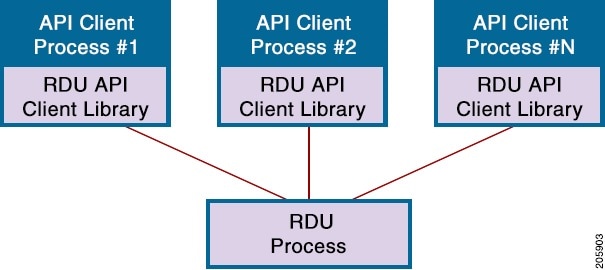
The API client library exposes the client to a single logical interface. For information on the objects and functions of this interface, see the API Javadocs in the Cisco BAC installation directory. Figure 2-1 shows three remote clients accessing the RDU through the API client library.
Figure 2-1 Embedded Client Library
The API client library is packaged in the bpr.jar and bacbase.jar files, located at BPR_HOME/lib, where BPR_HOME refers to the home directory on which you install Cisco BAC.
For client communication with the RDU to be successful, ensure that both .jar files are available in the Java classpath and compile against these libraries using the standard Java compilation process.
We recommend that you use Java version 1.6.0_05 or later to support the client API in Cisco BAC.
 Feedback