- MPLS Virtual Private Networks
- Multiprotocol BGP MPLS VPN
- MPLS VPN OSPF PE and CE Support
- MPLS VPN Support for EIGRP Between PE and CE
- IPv6 VPN over MPLS
- Assigning an ID Number to an MPLS VPN
- Remote Access MPLS VPNs
- Multi-VRF Support
- Multi-VRF Selection Using Policy-Based Routing
- MPLS VPN VRF Selection Using Policy-Based Routing
- MPLS VPN per Customer Edge (CE) Label
- VRF Aware System Message Logging
- MPLS VPN Show Running VRF
- MPLS VPN Half-Duplex VRF
- MPLS VPN BGP Local Convergence
- MPLS VPN VRF CLI for IPv4 and IPv6 VPNs
- MPLS over GRE
- MPLS VPN 6VPE Support Over IP Tunnels
- IPv6 VRF Aware System Message Logging
- Finding Feature Information
- Prerequisites for MPLS VPN L3VPN over GRE
- Restrictions for MPLS VPN 3VPN over GRE
- Information About MPLS VPN L3VPN over GRE
- How to Configure MPLS VPN L3VPN over GRE
- Configuration Examples for MPLS VPN L3VPN over GRE
- Additional References
- Feature Information for MPLS VPN L3VPN over GRE
MPLS over GRE
The MPLS over GRE feature provides a mechanism for tunneling Multiprotocol Label Switching (MPLS) packets over a non-MPLS network. This feature utilizes MPLS over generic routing encapsulation (MPLSoGRE) to encapsulate MPLS packets inside IP tunnels. The encapsulation of MPLS packets inside IP tunnels creates a virtual point-to-point link across non-MPLS networks.
- Finding Feature Information
- Prerequisites for MPLS VPN L3VPN over GRE
- Restrictions for MPLS VPN 3VPN over GRE
- Information About MPLS VPN L3VPN over GRE
- How to Configure MPLS VPN L3VPN over GRE
- Configuration Examples for MPLS VPN L3VPN over GRE
- Additional References
- Feature Information for MPLS VPN L3VPN over GRE
Finding Feature Information
Your software release may not support all the features documented in this module. For the latest caveats and feature information, see Bug Search Tool and the release notes for your platform and software release. To find information about the features documented in this module, and to see a list of the releases in which each feature is supported, see the feature information table at the end of this module.
Use Cisco Feature Navigator to find information about platform support and Cisco software image support. To access Cisco Feature Navigator, go to www.cisco.com/go/cfn. An account on Cisco.com is not required.
Prerequisites for MPLS VPN L3VPN over GRE
-
Ensure that your Multiprotocol Label Switching (MPLS) virtual private network (VPN) is configured and working properly.
-
For PE-to-PE tunneling, configure tunnels with the same source address if you are running a release earlier than Cisco IOS Release 15.2(1)S.
-
For PE-to-PE tunneling, configure tunnels with the same destination address.
-
Ensure that the following routing protocols are configured and working properly: -
Before configuring a GRE tunnel, configure a loopback interface (that is not attached to a VRF) with an IP address so that the internally created tunnel interface is enabled for IPv4 forwarding by unnumbering itself to this dummy loopback interface. You do not need to configure a loopback interface if the system has at least one interface that is not attached to VRF and that is configured with an IPv4 address.
Restrictions for MPLS VPN 3VPN over GRE
The MPLS VPN L3VPN over GRE feature does not support the following:
Information About MPLS VPN L3VPN over GRE
Overview of MPLS VPN L3VPN over GRE
The MPLS VPN L3VPN over GRE feature provides a mechanism for tunneling Multiprotocol Label Switching (MPLS) packets over non-MPLS networks. This feature allows you to create a generic routing encapsulation (GRE) tunnel across a non-MPLS network. The MPLS packets are encapsulated within the GRE tunnel packets, and the encapsulated packets traverse the non-MPLS network through the GRE tunnel. When GRE tunnel packets are received at the other side of the non-MPLS network, the GRE tunnel packet header is removed and the inner MPLS packet is forwarded to its final destination.
PE-to-PE Tunneling
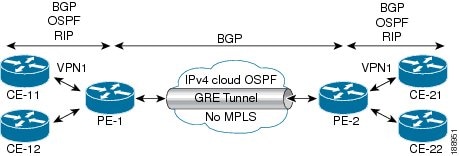
The provider-edge-to-provider-edge (PE-to-PE) tunneling configuration provides a scalable way to connect multiple customer networks across a non-MPLS network. With this configuration, traffic that is destined to multiple customer networks is multiplexed through a single generic routing encapsulation (GRE) tunnel.
 Note | A similar nonscalable alternative is to connect each customer network through separate GRE tunnels (for example, connecting one customer network to each GRE tunnel). |
As shown in the figure below, the PE devices assign virtual routing and forwarding (VRF) numbers to the customer edge (CE) devices on each side of the non-MPLS network.
The PE devices use routing protocols such as Border Gateway Protocol (BGP), Open Shortest Path First (OSPF), or Routing Information Protocol (RIP) to learn about the IP networks behind the CE devices. The routes to the IP networks behind the CE devices are stored in the associated CE device’s VRF routing table.
The PE device on one side of the non-MPLS network uses the routing protocols (that operate within the non-MPLS network) to learn about the PE device on the other side of the non-MPLS network. The learned routes that are established between the PE devices are then stored in the main or default routing table.
The opposing PE device uses BGP to learn about the routes that are associated with the customer networks that are behind the PE devices. These learned routes are not known to the non-MPLS network.
The following figure shows BGP defining a static route to the BGP neighbor (the opposing PE device) through the GRE tunnel that spans the non-MPLS network. Because routes that are learned by the BGP neighbor include the GRE tunnel next hop, all customer network traffic is sent using the GRE tunnel.
P-to-PE Tunneling
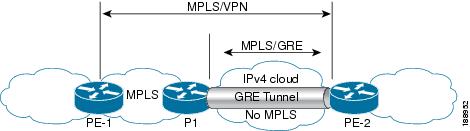
As shown in the figure below, the provider-to-provider-edge (P-to-PE) tunneling configuration provides a way to connect a PE device (P1) to a Multiprotocol Label Switching (MPLS) segment (PE-2) across a non-MPLS network. In this configuration, MPLS traffic that is destined to the other side of the non-MPLS network is sent through a single generic routing encapsulation (GRE) tunnel.
P-to-P Tunneling
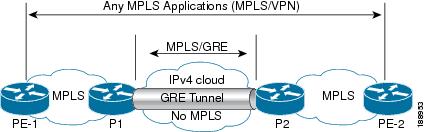
As shown in the figure below, the provider-to-provider (P-to-P) configuration provides a method of connecting two Multiprotocol Label Switching (MPLS) segments (P1 to P2) across a non-MPLS network. In this configuration, MPLS traffic that is destined to the other side of the non-MPLS network is sent through a single generic routing encapsulation (GRE) tunnel.
How to Configure MPLS VPN L3VPN over GRE
Configuring the MPLS over GRE Tunnel Interface
To configure the MPLS over GRE feature, you must create a generic routing encapsulation (GRE) tunnel to span the non-MPLS networks. You must perform the following procedure on the devices located at both ends of the GRE tunnel.
1.
enable
2.
configure terminal
3.
interface tunnel
tunnel-number
4.
ip address
ip-address mask
5.
tunnel source
source-address
6.
tunnel destination
destination-address
7.
mpls ip
8.
end
DETAILED STEPS
Configuration Examples for MPLS VPN L3VPN over GRE
- Example: Configuring a GRE Tunnel That Spans a non-MPLS Network
- Example: MPLS Configuration with MPLS VPN L3VPN over GRE
Example: Configuring a GRE Tunnel That Spans a non-MPLS Network
The following example shows a generic routing encapsulation (GRE) tunnel configuration that spans a non-MPLS network. This example shows the tunnel configuration on the provider edge (PE) devices (PE1 and PE2) located at both ends of the tunnel:
PE1 Configuration
Device# configure terminal
Device(config)# interface Tunnel 1
Device(config-if)# ip address 10.1.1.1 255.255.255.0
Device(config-if)# tunnel source 10.0.0.1
Device(config-if)# tunnel destination 10.0.0.2
Device(config-if)# mpls ip
PE2 Configuration
Device# configure terminal
Device(config)# interface Tunnel 1
Device(config-if)# ip address 10.1.1.2 255.255.255.0
Device(config-if)# tunnel source 10.0.0.2
Device(config-if)# tunnel destination 10.0.0.1
Device(config-if)# mpls ip
Example: MPLS Configuration with MPLS VPN L3VPN over GRE
The following basic Multiprotocol Label Switching (MPLS) configuration example uses a generic routing encapsulation (GRE) tunnel to span a non-MPLS network. This example is similar to the configuration shown in the first figure above.
PE1 Configuration
!
mpls ip
!
ip vrf vpn1
rd 100:1
route-target import 100:1
route-target export 100:1
!
 interface loopback 0
 ip address 10.2.2.2 255.255.255.255
!
 interface GigabitEthernet 0/1/2
 ip address 10.1.1.1 255.255.255.0
!
 interface Tunnel 1
 ip address 10.0.0.1 255.255.255.0
 tunnel source 10.1.1.1
 tunnel destination 10.1.1.2
 mpls ip
!
 interface GigabitEthernet 0/1/3
 ip vrf forwarding vpn1
 ip address 10.10.0.1 255.255.255.0
!
router bgp 100
neighbor 10.5.5.5 remote-as 100
neighbor 10.5.5.5 update-source loopback0
!
address-family vpnv4
neighbor 10.5.5.5 activate
neighbor 10.5.5.5 send community-extended
!
address-family ipv4 vrf vpn1
neighbor 10.10.0.2 remote-as 20
neighbor 10.10.0.2 activate
!
PE2 Configuration
!
mpls ip
!
ip vrf vpn1
rd 100:1
route-target import 100:1
route-target export 100:1
!
 interface loopback 0
 ip address 10.5.5.5 255.255.255.255
!
 interface GigabitEthernet 0/1/1
 ip address 10.1.1.2 255.255.255.0
!
 interface Tunnel 1
 ip address 10.0.0.2 255.255.255.0
 tunnel source 10.1.1.2
 tunnel destination 10.1.1.1
 mpls ip
!
 interface GigabitEthernet 0/0/5
 ip vrf forwarding vpn1
 ip address 10.1.2.1 255.255.255.0
!
router bgp 100
neighbor 10.2.2.2 remote-as 100
neighbor 10.2.2.2 update-source loopback0
!
address-family vpnv4
neighbor 10.2.2.2 activate
neighbor 10.2.2.2 send community-extended
!
address-family ipv4 vrf vpn1
neighbor 10.1.2.2 remote-as 30
neighbor 10.1.2.2 activate
!
Additional References
Related Documents
|
Related Topic |
Document Title |
|---|---|
|
Cisco IOS commands |
|
|
Multiprotocol Label Switching (MPLS) commands |
|
|
Setting up MPLS VPN networks for Multiprotocol Border Gateway Protocol (MP-BGP) |
“Multiprotocol BGP MPLS VPN" module |
|
Label Distribution Protocol |
“Label Distribution Protocol” module in the MPLS Label Distribution Protocol Configuration Guide |
|
Configuring L3 VPN over mGRE tunnels |
“Dynamic Layer 3 VPNs with Multipoint GRE Tunnels” module |
Technical Assistance
|
Description |
Link |
|---|---|
|
The Cisco Support and Documentation website provides online resources to download documentation, software, and tools. Use these resources to install and configure the software and to troubleshoot and resolve technical issues with Cisco products and technologies. Access to most tools on the Cisco Support and Documentation website requires a Cisco.com user ID and password. |
Feature Information for MPLS VPN L3VPN over GRE
The following table provides release information about the feature or features described in this module. This table lists only the software release that introduced support for a given feature in a given software release train. Unless noted otherwise, subsequent releases of that software release train also support that feature.
Use Cisco Feature Navigator to find information about platform support and Cisco software image support. To access Cisco Feature Navigator, go to www.cisco.com/go/cfn. An account on Cisco.com is not required.|
Feature Name |
Releases |
Feature Information |
|---|---|---|
|
MPLS VPN L3VPN over GRE feature |
12.0(22)S 12.0(26)S 12.2(33)SRE 15.0(1)S 15.2(1)S 15.2(4)S Cisco IOS XE Release 2.1 |
The MPLS VPN L3VPN over GRE feature provides a mechanism for tunneling Multiprotocol Label Switching (MPLS) packets over a non-MPLS network. Depending on your release, you can configure tunnels with the same source address in a PE-to-PE tunneling configuration. No commands were introduced or modified. |
 Feedback