Preparing to Install a SIP, SSC, or SPA
This chapter describes the general equipment, safety, and site preparation requirements for installing SIPs, SSCs, and SPAs. This chapter contains the following sections:
Required Tools and Equipment
You need the following tools and parts to install SIPs and SPAs. If you need additional equipment, contact a service representative for ordering information.
• Shared port adapter interface processor (SIP)
•Shared port adapter (SPA)
•SPA Services Card (SSC)
•Number 1 Phillips and a 3/16-inch flat-blade screwdriver
•Number 2 Phillips screwdriver
•Torque screwdriver with range from 8 to 12 inch-pounds (90 to 135 Newton-centimeters)
•Your own electrostatic discharge (ESD)-prevention equipment or the disposable grounding wrist strap supplied with the SIP or SPA
•Antistatic mat
•Antistatic container
Safety Guidelines
This section provides safety guidelines that you should follow when working with any equipment that connects to electrical power or telephone wiring. This section contains the following topics:
•Electrical Equipment Guidelines
•Preventing Electrostatic Discharge Damage
Safety Warnings
Safety warnings appear throughout this publication in procedures that may harm you if performed incorrectly. A warning symbol precedes each warning statement. The warnings below are general warnings that are applicable to the entire publication.

Warning Only trained and qualified personnel should be allowed to install, replace, or service this equipment. Statement 1030
Warning During this procedure, wear grounding wrist straps to avoid ESD damage to the card. Do not directly touch the backplane with your hand or any metal tool, or you could shock yourself. Statement 94
Electrical Equipment Guidelines
Follow these basic guidelines when working with any electrical equipment:
•Before beginning any procedures requiring access to the chassis interior, locate the emergency power-off switch for the room in which you are working.
•Disconnect all power and external cables before moving a chassis.
•Do not work alone when potentially hazardous conditions exist.
•Never assume that power has been disconnected from a circuit; always check.
•Do not perform any action that creates a potential hazard to people or makes the equipment unsafe; carefully examine your work area for possible hazards such as moist floors, ungrounded power extension cables, and missing safety grounds.
 This equipment is suitable for intrabuilding wiring only.
Telephone Wiring Guidelines
Use the following guidelines when working with any equipment that is connected to telephone wiring or to other network cabling:
•Never install telephone wiring during a lightning storm.
•Never install telephone jacks in wet locations unless the jack is specifically designed for wet locations.
•Never touch uninsulated telephone wires or terminals unless the telephone line has been disconnected at the network interface.
•Use caution when installing or modifying telephone lines.
Preventing Electrostatic Discharge Damage
Electrostatic discharge (ESD) damage, which can occur when electronic cards or components are improperly handled, results in complete or intermittent failures. SIPs, SPAs, and processor modules comprise printed circuit boards that are fixed in metal carriers. Electromagnetic interference (EMI) shielding and connectors are integral components of the carrier. Although the metal carrier helps to protect the board from ESD, use a preventive antistatic strap during handling.
Following are guidelines for preventing ESD damage:
•Always use an ESD wrist or ankle strap and ensure that it makes good skin contact.
•Connect the equipment end of the strap to an unfinished chassis surface.
•When installing a component, use any available ejector levers or captive installation screws to properly seat the bus connectors in the backplane or midplane. These devices prevent accidental removal, provide proper grounding for the system, and help to ensure that bus connectors are properly seated.
•When removing a component, use any available ejector levers or captive installation screws to release the bus connectors from the backplane or midplane.
•Handle carriers by available handles or edges only; avoid touching the printed circuit boards or connectors.
•Place a removed board component-side-up on an antistatic surface or in a static shielding container. If you plan to return the component to the factory, immediately place it in a static shielding container.
•Avoid contact between the printed circuit boards and clothing. The wrist strap only protects components from ESD voltages on the body; ESD voltages on clothing can still cause damage.
•Never attempt to remove the printed circuit board from the metal carrier.
For safety, periodically check the resistance value of the antistatic strap. The measurement should be between 1 and 10 megohms (Mohms).
Laser/LED Safety
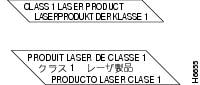
An optical single-mode transmitter uses a small laser to transmit the light signal to the network ring. Keep the transmit port covered whenever a cable is not connected to it. Although multimode transceivers typically use LEDs for transmission, it is good practice to keep open ports covered and avoid staring into open ports or apertures. The single-mode aperture port contains a laser warning label, as shown in Figure 4-1. The multimode aperture contains a Class 1 LED warning label, as shown in Figure 4-1. These warnings apply to SPAs and SFP modules that transmit signals via an optical carrier signal.
Figure 4-1 Class 1 Laser Warning Labels for Single-Mode Port
Warning












Class 1 laser product. Statement 1008

|

|

|

|

|

|

|

|

|

|

|

|
|
Warning |
Invisible laser radiation may be emitted from disconnected fibers or connectors. Do not stare into beams or view directly with optical instruments. Statement 1051 |
|
Warning |
Class 1 LED product. Statement 1027
|
 Feedback