


 Feedback
Table Of Contents
MGX 8230 Command Line Interface
MGX 8230 Command Line Interface
Introduction
The preferred tools for configuring, monitoring, and controlling an MGX 8230 multiservice gateway are the CiscoView and Cisco WAN Manager (CWM) applications for equipment management and connection management, respectively. (The Cisco WAN Manager application is the former Cisco StrataView Plus application with the equipment management removed.) The command line interface (CLI) also provides access to an MGX 8230 and is highly applicable during initial installation, troubleshooting, and any situation where low-level control is useful.
The MGX 8230 commands in the tables that follow are divided by major functional group. Each table shows the complete name of the command and the cards for which the command is valid. For further reference, check the Cisco MGX 8230 Multiservice Gateway Installation and Configuration reference document. This document provides conceptual information about how the Cisco MGX 8230 multiservice gateway can best implement network services in your network configuration.
The command line prompt shows the name of the MGX 8230, the number of the multiservice gateway (which is always "1"), the slot number and type of the current card, and whether the card is in the active ("a") or standby state ("s"). The following is an example of the command line prompt:
excel.1.6.AUSM.a >In this case, the current card is an active AUSM in slot 6, and the name of the node is "excel."
The command notation and argument parameters follow standard programming convention: a space separates the command and each parameter; variables have an italicized typeface; required arguments appear within "<>" marks; optional parameters appear within square brackets ("[ ]"); and a vertical bar (|) represents the logical OR function.
Note
You must type all command arguments then press Return or Enter rather than enter one parameter at a time.
When you enter a command without parameters, a usage message appears. This message shows syntax and ranges for the applicable command parameters.
List of Commands
The list of commands for the common equipment cards PXM and SRM appear in Table 1-1. These commands are available when you log into the PXM. The node connectivity commands appear in Table 1-2. Applicable service module commands become available when you switch to a card by executing the cc command. The list of service module commands appear in Table 1-3. Many commands apply to both the common equipment cards and the service modules.
?
Help
Use the ? command to view all commands associated with the current card, and to view a list of commands associated with a truncated command entry.
Card(s) on Which This Command Executes
PXM, FRSM, AUSM, CESM
Syntax
? [command]
Syntax Description
Related Commands
Attributes
Examples
This section contains the following examples:
•
•
Example 1-1 View all commands associated with a partial command entry string
raviraj.1.1.PXM.a > ? conAvailable commands------------------addconclrconcntclrconcntscnfcondcondbdelcondspcondspconcntdspconsshellConntstcontstconsegraviraj.1.1.PXM.a >Example 1-2 View all commands associated with the current card
System response for the ? command is identical to that when executing the help command. See the examples in the help section beginning on page 465.
abort
Abort
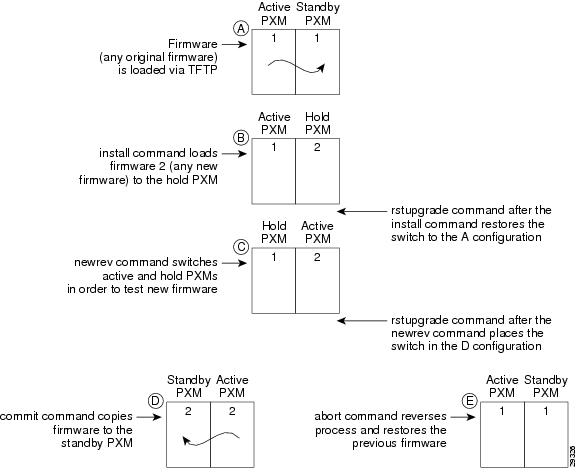
Use the abort command to stop the upgrade process and return to the previous firmware version.
•
•
See Figure 1-1 to see the relationship of the abort command compared with other firmware commands.
Figure 1-1 Firmware-Related Commands
Card(s) on Which This Command Executes
PXM
Syntax
abort <version>
Syntax Description
A system response does not occur unless an error is detected.
Related Commands
dspupgrade, rstupgrade, newrev, dspfwrevs, printrev, commit, copy, install
Attributes
Example 1-3 Abort loading firmware 1.1.10
NODENAME.1.1.PXM.a > abort 1.1.10this may take a while ...abort command completed okThis card will be reset, the other will become active.Example 1-4 Display errors loading firmware (multiple cases)
NODENAME.1.2.PXM.a > abort 1.1.11cannot be in 'upgrade idle', must be in 'upgrade' or 'upgradeinstall'ERR: command "abort" failedNODENAME.1.1.PXM.a > abort 1.1.111.1.11 is not the old version 1.1.10aaERR: command "abort" failedacqdsx3bert
Acquire DS3 BERT
Use the acqdsx3bert command to find out if a bit error rate test (BERT) session already exists on the selected MGX 8230 bay.
Card(s) on Which This Command Executes
FRSM 2CT3, CESMT3
Syntax
acqdsx3bert
Related Commands
cnfdsx3bert, dspdsx3bert, moddsx3bert, startdsx3bert, xcnfdsx3bert, xdspdsx3bert
Attributes
Example 1-5 Acquire current BERT session
NODENAME1.1.4.FRSM2CT3.a > acqdsx3bertdspdsx3BertCntrs :BCRunning : 00BCStorage : 0BECRunning : 00BECStorage : 0DSX3 BERT in SyncNODENAME1.1.4.FRSM2CT3.a >addapsln
Add APS to a Line
Use the addapsln command to set Automatic Protection Switching (APS) on a specified line for the current PXM.
APS is a SONET switching mechanism that routes traffic from working lines to protect them in case of a line card failure or fiber cut.
To set APS parameters, use the cnfapsln command following the addapsln command.
Card(s) on Which This Command Executes
PXM
Syntax
addapsln <workline> <workslot> <protectline> <protectslot> <archmode>
Syntax Description
Related Commands
cnfapsln, delapsln, dspapsln, switchapsln
Attributes
Example 1-6 Add APS Protection line 1 on slot 2 to APS Working line1 on slot 1. Set the APS architect mode on the working/protection line pair to 1+1.
spirit4.1.2.PXM.a > addapsln 1 2 1 1 2spirit4.1.2.PXM.a >addaimgrp
Add IMA Group
Use the addaimgrp command to set an AIMUX group on the current AUSM.
Card(s) on Which This Command Executes
AUSM
Syntax
addaimgrp <group_num> <port_type> <list_of_links> <minNumLinks>
Syntax Description
Related Commands
delaimgrp, cnfaimgrp, dspaimgrp, dspaimgrps
Attributes
Example 1-7 Add IMA group 2 as UNI with lines 3, 4, and 5
spirit4.1.3.AUSM.a > addaimgrp 2 3.4.5spirit4.1.3.AUSM.a >A system response does not occur unless an error is detected. Possible errors include:
•
•
•
•
addcdrscprtn
Add Card Resource Partition
Use the addcdrscprtn command to set card-level resource partitions.
Note
The resource you can partition at the card level is the number of connections available to a network controller.
With card-level partitioning:
•
•
Table 1-4 describes the effects of each of three usages of addcdrscprtn.
Table 1-4 Degrees of Card-Level Resource Partitioning
Card-level partitioning is inactive. You must partition resources at the port level. (See also cnfcdrscprtn.)
Default.
Card-level partitioning is on, but no allocation for a specific controller is specified. The maximum number of connections on a port is available to each controller. Each controller therefore competes for the connections.
Same as addcdrscprtn, except x, y, and z represent the number of connections per port available to the PAR, PNNI, and Tag controllers, respectively.
In addition to the definitions in Table 1-4, note the following characteristics of this command:
•
•
•
Card(s) on Which This Command Executes
PXM, FRSM, CESM
Syntax: PXM
addcdrscprtn <ctrlr_num> <num_lcns>
Syntax Description
ctrlr_num
Controller type.
•
•
•
num_lcns
Number of available global logical connection numbers (GLCNs), in the range 0-32767.
Syntax: FRSM
addcdrscprtn <controller> <numOfLcnAvail>
Syntax Description
Syntax: CESM
addcdrscprtn <controller> <numOfLcnAvail>
Syntax Description
controller
Controller type.
•
•
•
numOfLcnAvail
Maximum number of LCNs, in the range 0-248.
Related Commands
cnfcdrscprtn, dspcdrscprtn, delcdrscprtn
Attributes
Example 1-8 On current PXM, change card-level partitioning to give 10000 GLCNs to PAR and 10000 GLCNs to Tag. Note that the value for PNNI currently is 0.
spirit4.1.2.PXM.a > addcdrscprtn 10000 0 10000spirit4.1.2.PXM.a >addchan
Add Channel
Use the addchan command to configure channels on the current PXM, FRSM, AUSM, or CESM. The syntax for using addchan on an AUSM differs from that used on all other cards. See Syntax: AUSM for guidelines.
Card(s) on Which This Command Executes
PXM, FRSM (8T1/E1, HS1/B, VHS), AUSM, CESM
Syntax: PXM
addchan <LCN> <if_num> <conn_type> <vpi> <vci> <serv_type> <y_vpi> <y_vci> <y_nsap> <chan_master>
Syntax Description
Syntax: FRSM-8T1/E1
addchan <chan> <port> <dlci> <cir> <chan_type> [CAC] <mastership> <locnsap> <rmtvpi> <rmtvci> <rmtnsap>
Syntax Description
Syntax: FRSM-HS1/B
addchan <chan_num> <port_num> <dlci_num> <cir> <chan_type> [CAC] <mastership> <locnsap> <rmtvpi> <rmtvci> <rmtnsap>
Syntax Description
Possible errors include:
•
•
•
Syntax: FRSM-VHS
addchan <chan> <port> <dlci> <cir> <chan_type> <serv_type> [CAC_enable] <mastership> <locnsap> <rmtvpi> <rmtvci> <rmtnsap>
Syntax Description
Syntax: AUSM
addchan <channel number> <connection type> <port number> <vpi> <vci> <service type> <mastership> <locnsap> <rmtvpi> <rmtvci> <rmtnsap>
Syntax Description
Example 1-9 Add a VCC connection to channel 16 on port 1 with vpi=1, vci=1, ABR service type, and an egress queue number of 1
spirit4.1.18.AUSM.a > addchan 16 2 1 1 1 3 1
spirit4.1.18.AUSM.a >
Syntax: CESM-8T1E1
addchan <chan_num> <port_num> <sig_type> <partial_fill> <cond_data> <cond_signal> [mastership | locnsap | rmtvpi | rmtvci | rmtnsap]
Syntax Description
Possible errors include:
•
•
•
Syntax: CESM-T3E3
addchan <chan_num> <port_num> <cond_sig> <mastership> <locnsap> <rmtvpi> <rmtvci> <rmtnsap>
Syntax Description
A system response does not occur unless an error is detected. Possible errors include:
•
•
•
Related Commands
Attributes
addchanloop
Add a Channel Loopback
Use the addchanloop command to configure a channel loopback to the current FRSM or AUSM card. This command causes the channel to loop at the segmentation and reassembly (SAR) stage.
Card(s) on Which This Command Executes
FRSM, AUSM
Syntax: FRSM
addchanloop <chan_num>
Syntax Description
chan_num
Channel number to be used for the loopback on the current card.
•
•
•
•
Syntax for AUSM-8T1E1
addchanloop <port.VPI.VCI | ChanNum>
Syntax Description
Related Commands
Attributes
Example 1-10 Add channel loopback onto channel number 21
s1.1.12.AUSMB8.a > addchanloop 21
Example 1-11 Add channel loopback onto port 2, VPI 1, VCI 1
s1.1.12.AUSMB8.a > addchanloop 2.1.1addcon
Add Connection
Use the addcon command to configure connectivity to the current card. The addcon command is preferable to addchan for adding a connection because addcon does not require the NSAP addresses.
Command execution includes a specification of the endpoint as either the master or the slave. Execute addcon first at the slave end, then the master end. Note the syntax for the master end includes a parameter SlaveConID. Rather than a single number, SlaveConID is the node name, slot number, port number, and connection identifier (if applicable) of the slave end.
Note
Card(s) on Which This Command Executes
PXM, FRSM, CESM, AUSM
Syntax: PXM
addcon <port_no> <conn_type> <local_VPI> <local_VCI> <service> [CAC] [mastership] [remoteConnId]
Syntax Description
Syntax: FRSM-8T1/8E1
addcon <port number> <DLCI> <CIR> <channel type> [Adm_cntrl] <controller_type> [mastership] <RemoteEndConID>
Syntax Description
A system response does not occur unless an error is detected. Possible errors include:
•
•
•
Syntax: FRSM-2CT3
addcon <port number> <DLCI> <CIR> <channel type> <egress service type> [Adm_cntrl] <controller_type> <mastership> <RemoteEndConID>
Syntax Description
Syntax: FRSM-2T3/2E3
addcon <port number> <DLCI> <CIR> <channel type> <egress service type> [Adm_cntrl] <controller_type> <mastership> <RemoteEndConID>
Syntax Description
Syntax: FRSM-HS2
addcon <port number> <DLCI> <CIR> <channel type> <egress service type> [Adm_cntrl] <controller_type> <mastership> <RemoteEndConID>
Syntax Description
Syntax: AUSM
addcon slave | master <port number> <vpi> <vci> <Conn type> <Service Type>
Syntax Description
Example 1-12 Add a VCC connection to channel 16 on port 2 with vpi=1, vci=1, ABR service type, and an egress queue number of 1
spirit4.1.12.AUSM.a > addcon 16 2 1 1 1 3 1
spirit4.1.12.AUSM.a >
A system response does not occur unless an error is detected. Possible errors include:
•
•
•
Syntax: CESM 8T1/E1
addcon <port_num> <sig_type> <partial_fill> <cond_data> <cond_signalling> [controller_type] [mastership] [RemoteEndConID]
Syntax Description
A system response does not occur unless an error is detected. Possible errors include:
•
•
•
Related Commands
Attributes
addendpt
Add End Point
Use the addendpt command to set the endpoints on the VISM card. An endpoint is a logical port that consists of one or more DS0s. It resembles the logical port on the channelized FRSM or CESM card. The ds1_num and the ds0_list are used to create the endpoint ID. The SU requires the endpoint ID to send the Create Connection (CRCX) command of the SGCP protocol to the VISM.
Card(s) on Which This Command Executes
VISM
Syntax
addendpt <endpoint_num> <ds1_num> <ds0_list>
Syntax Description
Related Commands
None
Attributes
Example 1-13 Add endpoint number 1 to physical line 1. This endpoint uses DS0 1.
spirit4.1.28.VISM.a > addendpt 1 1 1spirit4.1.28.VISM.a >A system response does not occur unless an error is detected.
addimagrp
Add IMA Group
Use the addimagrp command to configure an IMA group for the current AUSM.
Card(s) on Which This Command Executes
AUSM
Syntax
addimagrp <group_num> <port_type> <list_of_links><minNumLinks>
Syntax Description
Related Commands
dspimagrp, dspimagrpcnt, dspimagrps, dspimainfo, dspimalncnt
Attributes
Example 1-14 Add IMA group 2 as UNI with lines 3, 4, and 5
spirit4.1.12.AUSM.a > addimagrp 2 1 3.4.5
spirit4.1.12.AUSM.a >
A system response does not occur unless an error is detected. Possible errors include:
•
•
•
•
addlink
Add Link
Use the addlink command to configure a link between a T1 line within a T3 line on an SRM-3T3 card and a slot and line number on a T1 service module.
Card(s) on Which This Command Executes
PXM
Syntax
addlink <T3LineNum> <T1Slot> <Numberof T1s> <TargetSlotNum> <TargetSlotLineNum>
Syntax Description
Related Commands
Attributes
Example 1-15 Add a link between the T1 line 1 within T3 line 2 on the SRM-3T3 card in slot 7 and T1 line number 5 on the T1 service module in slot 3
spirit4.1.2.PXM.a > addlink 7.2 1 3 5spirit4.1.2.PXM.a >addlmiloop
Add Loopback Line
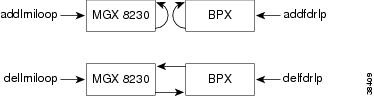
Use the addlmiloop command to stop sending LMI connection status messages to the BPX feeder trunk. This command should be used in conjunction with addfdrlp on the BPX (see Figure 1-2). This command can be used only if a feeder trunk exists.
After you have executed the addlmiloop command on the MGX 8230 switch and the addfdrlp command on the BPX series switch, use the dsplmistats command on the BPX switch. The dsplmistats command shows the LMI messages exchanged between the BPX series switch and the MGX 8230 switch. The LMI messages will not show an increase after LMI looping is implemented.
Figure 1-2 Status Messages Halted between an MGX 8230 and a BPX
Card(s) on Which This Command Executes
PXM
Syntax
addlmiloop <slot.port>
Syntax Description
Related Commands
Attributes
Example 1-16 Add an LMI loopback line numbered 1 to the current card (PXM in slot 1)
spirit4.1.1.PXM.a > addlmiloop 1
spirit4.1.1.PXM.a >
Example 1-17 Add a feeder loop on the BPX
spirit4.1.1.PXM.a > addfdrlp 5.5spirit4.1.1.PXM.a >Example 1-18 Display LMI loop
spirit4.1.1.PXM.a > dsplmiloopTRK IN LMI LOOP-------------------1.1 YesExample 1-19 Display LMI statistics for the BPX; number of LMI messages in the statistics does not increase
VPI.VCI: 3.31 Lmi enabled Lmi polling enabledInvalid Pdu Rx: 0 Status Polling Timer (T396) : 10Invalid Pdu Len Rx: 14 Status Enquiry Timer (T393) : 10Unknown Pdu Type Rx: 0 Max Status Enquiry Retry (N394): 5Unknown IE Type Rx: 4 Update Status Timer (T394) : 10Bad Transaction Rx: 0 Max Update Status Retry (N395) : 5Status Rx: 46504 Spc Polling Timer : 2Status Enq Tx: 46546 Spc Retry Timer : 0Status Enq Rx: 92014 Spc Retry Counter : 1Status Tx: 92014 Node Status Retry Timer : 0Status Ack Rx: 185 Node Status Retry Counter : 0Update Status Tx: 297 Node Status Polling Timer : 8Update Status Rx: 203Status Ack Tx: 203VPI.VCI: 3.31 Lmi enabled Lmi polling enabledInvalid Pdu Rx: 0 Status Polling Timer (T396) : 10Invalid Pdu Len Rx: 14 Status Enquiry Timer (T393) : 10Unknown Pdu Type Rx: 0 Max Status Enquiry Retry (N394): 5Unknown IE Type Rx: 4 Update Status Timer (T394) : 10Bad Transaction Rx: 0 Max Update Status Retry (N395) : 5Status Rx: 46511 Spc Polling Timer : 0Status Enq Tx: 46553 Spc Retry Timer : 0Status Enq Rx: 92028 Spc Retry Counter : 1Status Tx: 92028 Node Status Retry Timer : 0Status Ack Rx: 185 Node Status Retry Counter : 0Update Status Tx: 297 Node Status Polling Timer : 9Update Status Rx: 203Status Ack Tx: 203addln
Add Line
Use the addln command to activate an OC-12, OC-3, T3, or E3 line on the current card.
Card(s) on Which This Command Executes
PXM, FRSM-series, AUSM, SRM-3T3, CESM-series
Syntax: PXM
addln -ds3 <LineNum> | -e3 <LineNum> | -sonet <LineNum>
Syntax Description
Note
Syntax: FRSM, AUSM, SRM, CESM
addln <line_num>
Syntax Description
line_num
Line number, in the range appropriate for the card.
•
–
–
•
–
–
•
Related Commands
Attributes
Example 1-20 Add a line numbered 1 to current card (the PXM in slot 2)
spirit4.1.2.PXM.a > addln 1
spirit4.1.2.PXM.a >
A message does not appear unless an error occurs. Possible errors include:
•
•
addlnloop
Add Line Loop
Use the addlnloop command to set a specified line in loopback state on the current card.
Card(s) on Which This Command Executes
PXM, FRSM, AUSM, CESM
Syntax: PXM
addlnloop -ds3 <LineNum> | -e3 <LineNum> | -sonet <LineNum>
Syntax Description
Syntax: FRSM, AUSM, CESM
addlnloop <line_num>
Syntax Description
Related Commands
Attributes
addlns2aimgrp
Add Lines to an AIM Group
Use the addlns2aimgrp command to add lines to an existing AIMUX group.
Card(s) on Which This Command Executes
AUSM
Syntax
addlns2aimgrp <grp_num> <list_of_lines>
Syntax Description
Related Commands
Attributes
Example 1-21 Add lines 1 and 2 to IMA group 2
spirit4.1.12.AUSM.a > addlns2aimgrp 2 1.spirit4.1.12.AUSM.a >A message does not appear unless an error occurs. Possible errors include:
•
•
•
•
addport
Add Port
Use the addport command to add a service port to the shelf's configuration.
Card(s) on Which This Command Executes
PXM, FRSM, CESM
Syntax: PXM OC-3
addport <port_number> <line_number> <percent_bandwidth> <min_vpi> <max_vpi>
Syntax Description
Syntax: PXM OC-12 back cards
addport <port_number> <line_number> <percent_bandwidth> <min_vpi> <max_vpi>
Syntax Description
Syntax: PXM T3/E3 back cards
addport <port_number> <line_number> <percent_bandwidth> <min_VPI> <max_VPI>
Syntax Description
Syntax: FRSM-8T1E1 cards
addport <port_num> <line_num> <ds0_speed> <begin_slot> <num_slot> <port_type>
Syntax Description
Syntax: FRSM-2T3E3 cards
addport <port_num> <line_num> <ds0_speed> <begin_slot> <num_slot> <port_type>
Syntax Description
Syntax: FRSM-2CT3
addport <port_num> <line_num> <ds0_speed> <begin_slot> <num_slot> <port_type>
Syntax Description
Syntax: FRSM-HS1/B
addport <port_num> <port_type>
Syntax Description
Syntax: FRSM-HS2
addport <port_num> <line_num> <ds0_speed> <begin_slot> <num_slot> <port_type>
Syntax Description
Syntax: CESM-8T1E1 cards
addport <port_num> <line_num> <begin_slot> <num_slot> <port_type>
Syntax Description
Syntax: CESM-T3E3 cards
addport <port_num> <line_num>
Syntax Description
Related Commands
cnfport, delport, dspport, dspports
Attributes
Example 1-22 Add port 1 on line 1 with DS0 timeslots 1 through 24 assigned as structured
node501.1.11.CESM.a > addport 1 1 1 24 1node501.1.11.CESM.a >addred
Add Redundancy
Use the addred command to link two MGX 8230 slots (a primary slot and a secondary slot) so that the switch treats the cards in these slots as a redundant pair of cards.
Redundancy can be 1:1 or 1:N. If the redundancy is 1:N, you must link one secondary slot to N primary slots through multiple executions of this command.
Card(s) on Which This Command Executes
PXM
Syntax
addred <redPrimarySlotNum> <redSecondarySlotNum> <redType>
Syntax Description
Related Commands
Attributes
Example 1-23 Add 1:1 redundancy between card in slot 4 and card in slot 11
node501.1.1.PXM.a > addred 11 4 1node501.1.1.PXM.a >A system response does not occur unless a system error is detected.
addrscprtn
Add Resource Partition
Use the addrscprtn command to configure resource partitions for the current PXM.
A resource partition on a PXM consists of a percentage of bandwidth, a VPI/VCI range, and the number of global logical connection numbers (GLCNs) available to a network control application. The network control applications are Portable AutoRoute (PAR) and Tag switching.
Note
Card(s) on Which This Command Executes
PXM
Syntax
addrscprtn <if_num> <ctrlr_num> <ingr_pct_bw> <egr_pct_bw> <min_vpi> <max_vpi> <min_vci> <max_vci> <max_chans>
Syntax Description
Related Commands
cnfrscprtn, delrscprtn, dspifrsc, dspifs, dsprscprtns, dsprscprtn, dsplnrsc
Attributes
addserialif
Add Serial Interface
Use the addserialif command to add a serial interface.
Card(s) on Which This Command Executes
PXM
Syntax
addserialif <serial_port_num>
Syntax Description
Related Commands
Attributes
Example 1-24 Configure speed on SLIP for 19200 bps
NODENAME.1.1.PXM.a > addserialif 1NODENAME.1.1.PXM.a >addtrapmgr
Add Trap Manager
Use the addtrapmgr command to set up an SNMP trap manager for use with stand-alone applications. A trap manager registered (added) and reregistered through the SNMP interface by Cisco WAN Manager is deregistered (deleted) after 30 minutes if it is not reregistered. Trap managers that are added using the addtrapmgr command do not age, and are not deleted after 30 minutes.
Card(s) on Which This Command Executes
PXM
Syntax
addtrapmgr <ip_addr> <portnum>
Syntax Description
Related Commands
deltrapmgr, dsptrapmgr, xcnftrapmgr
Attributes
Example 1-25 Add a trap manager with the IP address of 161.10.144.56 to port 162
node501.1.1.PXM.a > addtrapmgr 161.10.144.56 162node501.1.1.PXM.a >addtrk
Add Trunk
Use the addtrk command to activate a specified trunk on the current PXM.
The addtrk command applies only to routing node implementation. Execute addtrk after you have configured the broadband interface as a trunk by using cnfifastrk.
Note
Card(s) on Which This Command Executes
PXM
Syntax
addtrk <slot.port>
Syntax Description
slot.port
Port identifier of the trunk to activate, using the format slot.port.
•
•
Related Commands
cnftrk, dsptrkcnf, dsptrkload, dsptrks
Attributes
Example 1-26 Activate trunk on port 4 in the card in slot 1
node501.1.1.PXM.a > addtrk 1.4node501.1.1.PXM.a >adduser
Add User
Use the adduser command to configure a user name and associated access level on the PXM.
Card(s) on Which This Command Executes
PXM
Syntax
adduser <user_ ID> <accessLevel>
Syntax Description
Related Commands
Attributes
Example 1-27 Add a user named fin with privilege level ANYUSER
spirit.1.1.PXM.a > adduser fin ANYUSEREnter password:Re-enter password:spirit.1.1.PXM.a >agetrapmgr
Age Trap Manager
Use the agetrapmgr command to activate or deactivate aging on trap managers.
Card(s) on Which This Command Executes
PXM
Syntax
agetrapmgr <ip_addr> <aging>
Syntax Description
Related Commands
Attributes
aimhelp
AIM Help
Use the aimhelp command to display the Help screen for the AUSM service module.
Card(s) on Which This Command Executes
AUSM
Syntax
aimhelp
Related Commands
Attributes
Example 1-28 Display Help screen for AUSM service module
raviraj.1.4.AUSM8.a > aimhelpAUSM-8P Commandsaddcon : Add a Connectionaddimagrp : Add an IMA groupaddln : Add a lineaddlnloop : Configure a line in local loopbackaddlns2imagrp : Add lines to an existing IMA groupclralmcnt : Clear DS1 alarm countclralmcnts : Clear alarm count for all DS1 linesclralm : Clear the DS1 line alarmsclrchancnt : Clear Channel Countersclrchancnts : Clear Channel Counters for all channelsclralms : Clear DS1 alarms on all linesclrimagrpcnt : Clear IMA group Countersclrimalncnt : Clear IMA counters on a particular lineclrportcnt : Clear Port Countersclrportcnts : Clear Port Counters for all portsclrsarcnt : Clear SAR channel countersclrsarcnts : Clear SAR counters for all channelsclrslftst : Clear self test resultsclrimatst : clear IMA test procedureType <CR> to continue, Q<CR> to stop:cnfchanfst : Configure the channel foresight parameterscnfchanq : Configure the channel queue parameterscnffst : Configure foresight params of a cardcnfportq : Configure Egress queue parameterscnfimagrp : Configure an IMA groupcnfilmi : Configure ILMI parameters of a portcnfln : Configure DS1/E1 linecnflnloop : Configure DS1/E1 linecnfplpp : Configure DS1/E1 linecnfslftst : Configure self test parameterscnfsvcrange : Partition Resource between PVCs & SVCscnfupccbr : Configure UPC parameters of CBR connectioncnfupcvbr : Configure UPC parameters of VBR connectioncnfupcabr : Configure UPC parameters of ABR connectioncnfupcubr : Configure UPC parameters of UBR connectioncnfimatst : Enable the IMA test procedurecnfimaalmparm : COnfigure the IMA alaram Integration UP and DOWN timescopychans : Copy a template connectiondelimagrp : Delete an IMA groupType <CR> to continue, Q<CR> to stop:delcon : Delete a connectiondelln : Delete DS1 linedellnloop : Remove a DS1 line from local loopbackdellnsfmimagrp : Delete lines from an existing IMA groupdnport : Down an ATM portdspalm : Display DS1 alarms on a linedspalmcnf : Display DS1 alarm configurationdspalmcnt : Display alarm count for DS1 linedspalms : Display DS1 alarms on all linesdspcd : Display card informationdspchancnt : Display channel countersdspcon : Display connection configurationdspcons : Display all the configured connectionsdspfeature : Display the featuresdspfst : Display the card Foresight paramsdspilmi : Display ILMI parms of a portdspilmicnt : Display ILMI counters of a portdspimagrp : Display all parms configured for an IMA groupdspimagrpcnt : Display IMA group CountersType <CR> to continue, Q<CR> to stop:dspimagrps : Display the configured IMA groupsdspimalncnt : Display IMA counters on a particular linedspimatst : Display IMA test statusdspimaln : Display IMA link statusdspimaalmparm : Display IMA alaram integration timesdspln : Display DS1 linedsplns : Display all DS1 linesdsploads : Display the total bandwidth used up in each portdspplpp : Display the PLPP configuration of each linedspport : Display the configured ATM/IMA portdspportcnt : Display Port Countersdspportq : Display the egress queue configurationdspportqs : Display configuration of all egress queuesdspports : Display the configured ATM/IMA portsdspsarcnt : Display the SAR counters of a connectiondspsarcnts : Display the SAR counters of all connectionsdspslftst : Display self test configurationdspslftsttbl : Display the self test resultsdspsttatparms : Display the statistics params configuredType <CR> to continue, Q<CR> to stop:dspsvcrange : Display the resource partition between PVCs & SVCsdsptotals : Display the total connections configured per portrunslftstno : Run a particular self testtstcon : Test the connection towards the N/W sidetstconseg : Test the connection towards the CPE sidetstconsti : Test the connection towards the N/W side using STI supervisory celltstdelay : Measure the delay towards the N/W sidetstdelaysti : Measure the delay towards the N/W side using STI supervisory cellupport : Up an ATM portxcnfalm : Configure alms of a DS1 linexcnfln : Configure a DS1 linexcnfln : Configure a DS1 lineraviraj.1.4.AUSM8.a >arpAdd
Add Address Resolution Protocol Entry
Use the arpAdd command to add an Address Resolution Protocol (ARP) entry to the ARP table. This Internet protocol is used to map an IP address to a MAC address, and the ARP table contains these translations.
Card(s) on Which This Command Executes
PXM
Syntax
arpAdd <ip_address> <mac_address>
Syntax Description
ip_address
IP address in dotted decimal format.
mac_address
Standardized data link layer address, six bytes long. Also known as a hardware address, MAC-layer address, and physical address.
Related Commands
Attributes
Example 1-29 Add an ARP entry on current PXM, then show ARP entry
NODENAME.1.1.PXM.a > arpAdd 172.29.36.102 0:e0:4f:5c:6c:5aNODENAME.1.1.PXM.a > arpShow172.29.36.28 at 8:0:20:a6:80:3b190.29.36.255 at 0:e0:4f:5c:6c:20172.29.36.102 at 0:e0:4f:5c:6c:5a171.71.54.104 at 0:e0:4f:5c:6c:20NODENAME.1.1.PXM.a >arpDelete
Delete Address Resolution Protocol Entry
Use the arpDelete command to delete an entry in the Address Resolution Protocol (ARP) table. The ARP protocol is used to map an IP address to a MAC address, and the ARP table contains these translations.
Card(s) on Which This Command Executes
PXM
Syntax
arpDelete <ip_addr>
Syntax Description
Related Commands
Attributes
Example 1-30 Delete ARP entry for IP address 172.29.36.102
NODENAME.1.1.PXM.a> arpDelete 172.29.36.102172.29.36.102 (172.29.36.102) deletedNODENAME.1.1.PXM.a>arpFlush
Flush Address Resolution Protocol Table
Use the arpFlush command to remove nonpermanent entries from the ARP table. The ARP protocol is used to map an IP address to a MAC address, and the ARP table contains these translations.
Card(s) on Which This Command Executes
PXM
Syntax
arpFlush
Related Commands
Attributes
Example 1-31 Flush ARP table, then show ARP table
NODENAME.1.1.PXM.a > arpFlushNODENAME.1.1.PXM.a > arpShow171.71.54.104 at 0:e0:4f:5c:6c:20NODENAME.1.1.PXM.a >arpShow
Show Address Resolution Protocol Table
Use the arpShow command to display the Address Resolution Protocol (ARP) table. The ARP table contains IP address-to-MAC address translations mapped by the ARP protocol.
Card(s) on Which This Command Executes
PXM
Syntax
arpShow
Related Commands
Attributes
Example 1-32 Show ARP table on current PXM
NODENAME.1.1.PXM.a > arpShow190.29.36.255 at 0:e0:4f:5c:6c:20172.29.36.28 at 8:0:20:a6:80:3b171.71.54.104 at 0:e0:4f:5c:6c:20NODENAME.1.1.PXM.a >bootChange
Boot Change
Use the bootChange command to change to the boot IP address and gateway address of a PXM card. The IP address you define will be used only when the PXM is in boot state. Use the cnfifip command to assign IP addresses for the PXM and the shelf. Note that the bootChange values are sent and automatically updated on the standby card, and bootlines are synchronized.
The PXM tries to correct bad entries when it boots up. This information is copied to the standby card. If the bootChange IP address is different from the shelf IP address, then it will bring the Ethernet interface up on the standby with the bootChange IP address.
The shellconn version of this command updates only the local bootline values.
Note that several parameters are necessary for the network to function; specifically:
•
•
•
Note
If the CLI prompt is not there or if the switch is not enabled and in backup boot, you can use the usrEnetEnable command to bring up the Ethernet interface.
Card(s) on Which This Command Executes
PXM
Syntax
bootChange
Related Commands
Attributes
Example 1-33 Execute bootChange on current PXM
raviraj.1.1.PXM.a > bootChange'.' = clear field; '-' = go to previous field; ^D = quitboot device : lnPciprocessor number : 0host name :file name :inet on ethernet (e) : 172.29.37.41 : ffffff00inet on backplane (b):host inet (h) :gateway inet (g) : 172.29.37.1user (u) :ftp password (pw) (blank = use rsh):flags (f) : 0x0target name (tn) :startup script (s) :other (o) :raviraj.1.1.PXM.a >bye
Bye
Use the bye command to exit the current CLI shell.
Card(s) on Which This Command Executes
PXM, FRSM, AUSM, VISM
Syntax
bye
Related Commands
Attributes
Example 1-34 Exit current CLI shell
spirit.1.1.PXM.a > bye(session ended)cc
Change Card
Use the cc command to navigate from card to card on the shelf.
Card(s) on Which This Command Executes
PXM, FRSM, AUSM, CESM, VISM
Syntax
cc <slotNumber>
Syntax Description
Related Commands
None
Attributes
Example 1-35 Switch from AUSM in slot 4 to PXM in slot 2
node1.1.4.AUSM8.a > cc 2(session redirected)node1.1.2.PXM.a >A system message does not occur unless an error is detected or the card slot is empty.
cd
Change Directory
Use the cd command to change the current directory on the PXM hard disk.
Card(s) on Which This Command Executes
PXM
Syntax
cd <directory_name>
Syntax Description
Related Commands
ls, pwd, rename, deltree, copy
Attributes
Example 1-36 Change directory to FW
raviraj.1.1.PXM.a > cd FWraviraj.1.1.PXM.a >Verify the current directory by using the pwd command.
Example 1-37 Return to Root directory
raviraj.1.1.PXM.a > pwdC:FWraviraj.1.1.PXM.a > cd ..raviraj.1.1.PXM.a > pwdC:raviraj.1.1.PXM.a >clraimgrpcnt
Clear AIM Group Counters
Use the clraimgrpcnt command to clear all the AIMUX-related counters for all lines in the specified AIMUX group.
Card(s) on Which This Command Executes
AUSM
Syntax
clraimgrpcnt <imagroup>
Syntax Description
imagroup
Number of the AIMUX group number on which you want to clear the AIMUX counters, in the range 1-8.
Related Commands
None
Attributes
Example 1-38 Clear all AIM group counters in AIM group 8
node1.1.4.AUSM8.a > clraimgrpcnt 8node1.1.4.AUSM8.a >clraimlncnt
Clear AIM (or Clear IMA) Line Counters
Use the clraimlncnt command to clear all the AIMUX line counters for the specified IMA group.
Card(s) on Which This Command Executes
AUSM
Syntax
clraimlncnt (or clrimalncnt) <imagroup> <linenum>
Syntax Description
imagroup
Number of the AIMUX group on which you want to clear the line counters associated with an IMA group, in the range 1-8.
linenum
Line number, in the range 1-8.
Related Commands
Attributes
Example 1-39 Clear all AIM line counters in AIM group 8
node1.1.4.AUSM8.a > clraimlncnt 8node1.1.4.AUSM8.a >clrallcnf
Clear All Configurations
Use the clrallcnf command to clear all configuration elements for all the cards in the node. The system queries for confirmation before executing the clrallcnf command.
Caution
Card(s) on Which This Command Executes
PXM
Syntax
clrallcnf
Related Commands
None
Attributes
Example 1-40 Clear configuration confirmation query
node1.1.1.PXM.a > clrallcnfAll SM's config will be deleted, andthe shelf will be reset.Do you want to proceed (Yes/No)? No(command not executed)node1.1.1.PXM.a >clralm
Clear Alarm
Use the clralm command to clear alarms on a specified line on the current card. Alarms occurring after this command executes are not affected. If alarms on a line are cleared with this command, the results may be observable through the dspalm command.
This command can clear alarms caused by the collection of statistical data only. Alarms caused by network failure cannot be cleared. For example, an alarm caused by a collection of bipolar errors can be cleared, but an alarm caused by a card failure cannot.
Card(s) on Which This Command Executes
PXM, FRSM, AUSM, CESM
Syntax: PXM
clralm -ds3 <LineNum> | -e3 <LineNum> | -sonet <LineNum> | -plcp <PLCPNUM>
Syntax Description
Syntax: FRSM, AUSM, CESM
clralm -ds1 <LineNum>
Syntax Description
Syntax: SRM-3T3
clralm -srmds3 <LineNum>
Syntax Description
Syntax: FRSM-HS1
clralm -hs1 <LineNum>
Syntax Description
Related Commands
Attributes
Example 1-41 Clear all alarms caused by the collection of statistical data for line 1 on current card
node1.1.4.AUSM8.a > clralm -ds1 1node1.1.4.AUSM8.a >clralmcnt
Clear Alarm Counters
Use the clralmcnt command to clear all the alarm counters and statistics on the specified line on the current card. All counters are reset to 0. The terminal does not display a response unless an error exists in the syntax.
Card(s) on Which This Command Executes
PXM, FRSM, AUSM, CESM
Syntax: PXM
clralmcnt -ds3 <LineNum> | -e3 <LineNum> | -sonet <LineNum> | -plcp <PLCPNUM>
Syntax Description
Syntax: FRSM, AUSM, CESM
clralmcnt -ds1 <LineNum>
Syntax Description
-ds1
Command delineator that precedes the LineNum entry.
LineNum
Line number, in the range appropriate for the card.
•
•
•
Related Commands
Attributes
Example 1-42 Clear all alarm counters and statistics collected for line 1 on current card
node1.1.4.AUSM8.a > clralmcnt -ds1 1node1.1.4.AUSM8.a >clralmcnts
Clear All Alarm Counters/Statistics on Current Card
Use the clralmcnts command to clear all the alarm counters and statistics on the current card. All counters are reset to 0. The terminal does not display a response unless an error exists in the syntax.
Card(s) on Which This Command Executes
FRSM, AUSM, CESM
Syntax
clralmcnts
Related Commands
Attributes
Example 1-43 Clear all alarm counters and statistics collected for current card
node1.1.4.AUSM8.a > clralmcntsnode1.1.4.AUSM8.a >clralms
Clear Alarms on Card
The clralms command clears alarms on the current card. Alarms occurring after this command executes are not affected.
This command can clear alarms caused by the collection of statistical data only. Alarms caused by network failure cannot be cleared. For example, an alarm caused by a collection of bipolar errors can be cleared, but an alarm caused by a card failure cannot be cleared.
Card(s) on Which This Command Executes
FRSM, AUSM, CESM
Syntax
clralms -ds1 <LineNum>
Syntax Description
-ds1
Command delineator that precedes the LineNum entry.
LineNum
Line number on which to clear alarms, in the range 1-N, as appropriate for the physical installation.
Related Commands
Attributes
Example 1-44 Clear all alarms triggered by the collection of statistics for line 1 on current card
node1.1.4.AUSM8.a > clralms -ds1 1node1.1.4.AUSM8.a >clratmlncnt
Clear All ATM Line Counters on Specified Line Number
Use the clratmlncnt command to clear the ATM event counters for the specified line on the PXM.
Card(s) on Which This Command Executes
PXM
Syntax
clratmlncnt <line_num>
Syntax Description
Related Commands
Attributes
Example 1-45 Clear all ATM event counters for line 1 on the PXM
node1.1.1.PXM.a > clratmlncnt 1node1.1.1.PXM.a >clratmlncnts
Clear All ATM Line Counters on All Lines
Use the clratmlncnts command to remove all ATM counters on all the lines on the current card.
Card(s) on Which This Command Executes
PXM
Syntax
clratmlncnts
Related Commands
Attributes
Example 1-46 Clear all ATM event counters on the PXM
node1.1.1.PXM.a > clratmlncntsnode1.1.1.PXM.a >clrbertcntrs
Clear BERT Counters
Use the clrbertcntrs command to remove all counters associated with bit error rate testing (BERT).
Card(s) on Which This Command Executes
FRSM 2CT3, CESMT3
Syntax
clrbertcntrs
Related Commands
acqdsx3bert, cnfdsx3bert, deldsx3bert, dspdsx3bert, startdsx3bert, xcnfdsx3bert, xdspdsx3bert
Attributes
Example 1-47 Clear all BERT counters on the current FRSM
raviraj.1.13.VHS2CT3.a > clrbertcntrsraviraj.1.13.VHS2CT3.a >clrcderrs
Clear Hardware/Reset Errors in BRAM
Use the clrcderrs command to clear all card-related errors on an MGX 8230 card. Refer to the dspcderrs description to see an example of the errors that this command clears, or execute the dspcderrs command before and after executing the clrcderrs command.
Card(s) on Which This Command Executes
FRSM, AUSM
Syntax
clrcderrs
Related Commands
Attributes
Example 1-48 Clear all card-related errors on the FRSM in slot 4
node1.1.4.FRSM.a > clrcderrsnode1.1.4.FRSM.a >A system response does not occur unless an error is detected.
clrchancnt
Clear Channel Counters on Specified Channel
Use the clrchancnt command to clear the channel counters for the specified channel on the current card. Counting resumes after the command executes.
The Frame Relay counters for each channel are:
•
•
•
•
•
•
•
•
•
•
•
Card(s) on Which This Command Executes
PXM, FRSM, AUSM, CESM
Syntax: PXM
clrchancnt -cnt <chan_num> -cc <clrButton>
Syntax Description
Syntax: FRSM, CESM
clrchancnt <chan_num>
Syntax Description
chan_num
Channel number, in the range appropriate for the card.
•
•
Syntax: AUSM
clrchancnt <Port.VPI.VCI | Chan_num>
Syntax Description
Port.VPI.VCI
Connection number, in the format port.VPI.VCI.
Chan_num
Channel number, in the range 16-1015.
Related Commands
dspchan, clrchancnts, dspchancnt
Attributes
Example 1-49 Clear all channel counters for channel 16 on the FRSM in slot 4
node1.1.4.FRSM.a > clrchancnt 16node1.1.4.FRSM.a >clrchancnts
Clear All Channel Counters on Card
Use the clrchancnts command to clear all channel counters for all channels on the current service card. The counters resume accruing after the command executes. To view a list of the Frame Relay counters, refer to the description of clrchancnt.
Card(s) on Which This Command Executes
PXM, FRSM, AUSM, CESM
Syntax
clrchancnts
Related Commands
dspchan, clrchancnt, dspchancnt
Attributes
Example 1-50 Clear all channel counters for all channels on the FRSM in slot 4
node1.1.4.FRSM.a > clrchancntsnode1.1.4.FRSM.a >clrconcnt
Clear Connection Counters for Specified Connection Identifier
Use the clrconcnt command to clear the counters for the specified connection identifier on the current PXM card. Counting resumes after the command executes.
Card(s) on Which This Command Executes
PXM
Syntax
clrconcnt <conn_ID>
Syntax Description
Related Commands
Attributes
Example 1-51 Clear all counters for connection on port 1 with a VPI of 2 and a VCI of 2
node4.1.2.PXM.a > clrconcnt 1.2.2node4.1.2.PXM.a >clrconcnts
Clear Connection Counters for All Connections on Card
Use the clrconcnts command to clear the counters for all the connections on the current PXM card. Counting resumes after the command executes.
Card(s) on Which This Command Executes
PXM
Syntax
clrconcnts
Related Commands
Attributes
Example 1-52 Clear all counters for all connections on the PXM card
node4.1.2.PXM.a > clrconcntsnode4.1.2.PXM.a >clrerr
Clear Error Log Counters for All Connections on Card
Use the clrerr command to remove specified or all error log files. This command queries for confirmation prior to clearing the error log files from the system.
Card(s) on Which This Command Executes
PXM
Syntax:
clrerr [-en <error slot>]
Syntax Description
-en
Command delineator that precedes the error slot entry.
error slot
Number of the log file to clear, which is identical to the slot number of the card.
Related Commands
Attributes
Example 1-53 Show clrerr confirmation query
wilco.1.1.PXM.a > clrerrDo you want to proceed (Yes/No)? No(command not executed)wilco.1.1.PXM.a >clrifcnt
Clear Interface Counters for Specified Interface
Use the clrifcnt command to clear the counters for a specified broadband interface.
Card(s) on Which This Command Executes
PXM
Syntax
clrifcnt <if_num>
Syntax Description
Related Commands
Attributes
Example 1-54 Clear counters for the specified broadband interface (1)
wilco.1.1.PXM.a > clrifcnt 1wilco.1.1.PXM.a >clrifcnts
Clear All Interface Counters
Use the clrifcnts command to clear the counters for all the broadband interfaces.
Card(s) on Which This Command Executes
PXM
Syntax
clrifcnts
Related Commands
Attributes
Example 1-55 Clear counters for all broadband interfaces on the PXM card
wilco.1.1.PXM.a > clrifcntswilco.1.1.PXM.a >clrimagrpcnt
Clear Inverse Multiplexing ATM Group Counters
Use the clrimagrpcnt command to clear Inverse Multiplexing ATM (IMA) group counters on the current AUSM card for a specified IMA group.
Card(s) on Which This Command Executes
AUSM
Syntax
clrimagrpcnt (or clraimgrpcnt) <imagroup>
Syntax Description
Related Commands
dspimagrp, dspimagrpcnt, dspimagrps, dspimainfo, dspimalncnt
Attributes
Example 1-56 Clear all inverse multiplexing ATM group counters for IMA group 1 on the AUSM card in slot 11
flyers01.1.11.AUSM.a > clrimagrpcnt 1flyers01.1.11.AUSM.a >clrimalncnt
Clear AIM (or Clear IMA) Line Counters
Use the clrimalncnt command to clear all AIMUX line counters for a specified line in an IMA trunk.
Card(s) on Which This Command Executes
AUSM
Syntax
clrimalncnt (or clraimlncnt) <imagroup> <linenum>
Syntax Description
Related Commands
Attributes
Example 1-57 Clear all inverse multiplexing ATM line counters for IMA group 1 on the AUSM card in slot 11
flyers01.1.11.AUSM.a > clrimalncnt 1flyers01.1.11.AUSM.a >clrlmistats
Clear All LMI Statistics
Use the clrlmistats command to clear the local management interface (LMI)-related statistics
on the PXM.Card(s) on Which This Command Executes
PXM
Syntax
clrlmistats
Related Commands
Attributes
Example 1-58 Clear LMI statistics on the PXM card
penguin.1.1.PXM.a > clrlmistatsEnabled : 1 Port Status : 1VPI.VCI : 3.31Polling enable : 1T393 : 10 N394 : 5T394 : 10 N395 : 5WaitStatus : 0 WaitStAck : 0Retry Timer : 0 Retry Count : 1Poll Timer : 6 Trans Num : 86Status Rx : 0 Status Tx : 0UpdtStatus Rx : 0 UpdtStatus Tx : 0Status Enq Rx : 0 Status Enq Tx : 0Status Ack Rx : 0 Status Ack Tx : 0NodeStatus Rx : 0 NodeStatus Tx : 0NodeStaAck Rx : 0 NodeStaAck Tx : 0Bad PDU Rx : 0 Bad PDU Len Rx : 0Unknown PDU Rx : 0 Invalid I.E. Rx: 0Invalid Trans : 0BPX IP Addr : 172.3.3.62penguin.1.1.PXM.a >clrlog
Clear Log
Use the clrlog command to clear specified or all event log files. The log resumes accumulating event log messages after the command executes. This command queries for confirmation prior to removing all event log files.
Card(s) on Which This Command Executes
PXM
Syntax
clrlog [-log <log slot>]
Syntax Description
-log
Command delineator that precedes the log slot entry.
log slot
Number of the file that you want to clear from the event log file.
Related Commands
Attributes
Example 1-59 Clear all event log files on the PXM card
wilco.1.1.PXM.a > clrlogDo you want to proceed (Yes/No)? Yeswilco.1.1.PXM.a >clrmsgcnt
Clear Control Message Counters
Use the clrmsgcnt command to clear the control message counters. The control message counters are for the total numbers of:
•
•
•
•
•
•
•
This message also clears the control cell header received on the last unknown channel.
Card(s) on Which This Command Executes
FRSM, AUSM, CESM
Syntax
clrmsgcnt
Related Commands
Attributes
Example 1-60 Clear all control message counters on the AUSM card in slot 11
flyers01.1.11.AUSM.a > clrmsgcnt 1flyers01.1.11.AUSM.a >clrportcnt
Clear Port Counters
Use the clrportcnt command to clear counter values on a specified port associated with the current PXM, FRSM, or AUSM.
Card(s) on Which This Command Executes
PXM, FRSM, AUSM
Syntax
clrportcnt <port_ number>
Syntax Description
port_ number
Port number, as appropriate for the current card.
•
•
•
–
–
–
–
–
Related Commands
Attributes
Example 1-61 Clear port counters on port 1 on the AUSM card in slot 11
flyers01.1.11.AUSM.a > clrportcnt 1flyers01.1.11.AUSM.a >clrportcnts
Clear Port Counters
Use the clrportcnts command to clear all port counters on the current PXM, FRSM, or AUSM.
Card(s) on Which This Command Executes
PXM, FRSM, AUSM
Syntax
clrportcnts
Related Commands
Attributes
Example 1-62 Clear all port counters on all ports on the AUSM card in slot 11
flyers01.1.11.AUSM.a > clrportcntsflyers01.1.11.AUSM.a >clrsarcnt
Clear SAR Counters
On an FRSM or CESM, use the clrsarcnt command to clear the segmentation and reassembly (SAR) counters for the particular channel in the argument. On an AUSM, use the clrsarcnt command to clear the SAR counters for the particular port.VPI.VCI connection.
The SAR counters are:
•
•
•
•
•
•
•
•
•
•
•
•
•
•
•
•
Card(s) on Which This Command Executes
FRSM, AUSM, CESM
Syntax: FRSM-8T1E1
clrsarcnt -chn <ChanNum>
Syntax Description
-chn
Command delineator that precedes the ChanNum entry.
ChanNum
Channel number in the range 16-1015.
Syntax: CESM-8T1E1
clrsarcnt -chn <ChanNum>
Syntax Description
-chan
Command delineator that precedes the ChanNum entry.
ChanNum
Channel number in the range 0-279.
Syntax: AUSM-8T1E1
clrsarcnt <port.VPI.VCI>
Syntax Description
port.VPI.VCI
Port and identifier values.
•
•
•
Related Commands
Attributes
Example 1-63 Clear SAR counters for channel number 20 on the FRSM card
NODENAME.1.12.FRSM.a > clrsarcnt -chn 20NODENAME.1.12.FRSM.a >clrsarcnts
Clear SAR Counters
Use the clrsarcnts command to clear the segmentation and reassembly (SAR) counters for all the channels or connections on the card from which the command is executed.
Syntax
clrsarcnts
Card(s) on Which This Command Executes
FRSM, AUSM, CESM
Related Commands
clrsarcnt, dspsarcnt, dspsarcnts
Attributes
Example 1-64 Clear all SAR counters on all cards in the node
flyers01.1.11.AUSM.a > clrsarcntsflyers01.1.11.AUSM.a >clrscrn
Clear Terminal Screen
Use the clrscrn command to clear the control terminal screen. After this command executes, only the current command line prompt appears on the screen.
Card(s) on Which This Command Executes
PXM, FRSM, AUSM, CESM
Syntax
clrscrn
Related Commands
None
Attributes
Example 1-65 Clear the screen
flyers01.1.11.AUSM.a > clrscrnflyers01.1.11.AUSM.a >clrslftst
Clear Self-Test
Use the clrslftst command to clear the results of the last self-test on the current card.
Card(s) on Which This Command Executes
FRSM, AUSM, CESM
Syntax
clrslftst
Related Commands
cnfslftst, dspslftst, runslftstno
Attributes
Example 1-66 Clear results of last self-test for the AUSM card in slot 11
flyers01.1.11.AUSM.a > clrslftstflyers01.1.11.AUSM.a >clrsmcnf
Clear Service Module Configuration
Use the clrsmcnf command to clear the following configuration elements for the selected service card:
•
•
•
•
Note
Card(s) on Which This Command Executes
PXM
Syntax
clrsmcnf <slot num>
Syntax Description
Related Commands
Attributes
Example 1-67 Clear all configuration elements on the AUSM card in slot 11
flyers01.1.1.PXM.a > clrsmcnf 11flyers01.1.1.PXM.a >clrsrmcnf
Clear SRM-3T3 Configuration
Use the clrsrmcnf command to clear SRM-3T3 card information and to remove all T1 link mappings. All links are switched back to their respective service modules.
Card(s) on Which This Command Executes
PXM
Syntax
clrsrmcnf <slot num>
Syntax Description
Related Commands
addlink, dsplink, xcnfsrmlink, xdspsrmlink
Attributes
Example 1-68 Clear all configuration information and remove all T1 link mappings on the SRM-3T3 card in slot 7
flyers01.1.1.PXM.a > clrsrmcnf 7flyers01.1.1.PXM.a >cmdhistory
Display Command History
Use the cmdhistory command to view the last ten commands executed on the current card.
Card(s) on Which This Command Executes
PXM
Syntax
cmdhistory
Related Commands
Attributes
Example 1-69 Display previous ten commands executed on the PXM card
spirit4.1.2.PXM.a > cmdhistorySize of cmdHistory is currently 10 line(s)1 dspconcnt 2.39.452 dsplmistats3 dsplmiloop4 dsplm5 clrportcnt6 dspportcnts7 dspportcnt8 dspportcnt 19 dsplmistats10 cmdhistoryspirit4.1.2.PXM.a >cnfaimgrp
Configure AIM Group
Use the cnfaimgrp command to configure an AIMUX group on the AUSM.
Card(s) on Which This Command Executes
AUSM
Syntax
cnfaimgrp <grp> <max_diff_delay> <min_num_links>
Syntax Description
Related Commands
addaimgrp, delaimgrp, dspaimgrp, dspaimgrps
Attributes
Note
The <read_wr_ptr_diff> value cannot be decreased from its existing value—it can be increased only. This is because decreasing the <read_wr_ptr_diff> in an established AIMUX group involves dropping cells that are stored in the delay compensation buffer.Example 1-70 Configure AIMUX group 1 on the AUSM card in slot 11 to have a read/write pointer differential of 5, a link loss severity of 2, a maximum tolerable differential delay of 5, and 2 redundant links
flyers01.1.11.AUSM.a > cnfaimgrp 1 -rwdiff 5 -severity 2 -maxdiff 3 -red 2flyers01.1.11.AUSM.a >cnfapsln
Configure APS Line
Use the cnfapsln command to set automatic protection switching (APS) parameters for a line on the current PXM. APS is a standard that provides a means for SONET line redundancy. APS involves switching between working (active) and protection (standby) SONET lines in the event of a hardware failure detected by the receiving end or by the far end.
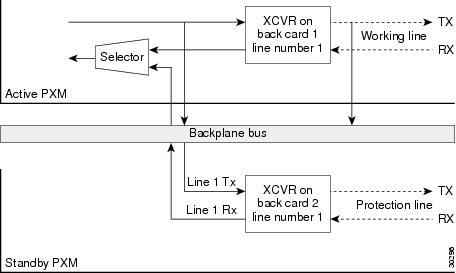
Software Release 1.1.24 provides support for the SONET Linear APS 1+1 mode with two back cards. The SONET Linear APS 1+1 standard specifies that for every working line there must exist a redundant protection line. Traffic protected by the redundant line is carried simultaneously on both the working line and the protection line. The line switch-over to the protection line has to be completed within
60 ms.
Note
Figure 1-3 illustrates a "dual back card" redundancy configuration. This design requires two PXM front cards and two SONET back cards. Port 1 of the active PXM is paired with port 1 of the standby PXM.
Figure 1-3 SONET APS 1+1 with Two Back Cards
SONET 155 also can be configured to have this redundancy configuration. Ports are paired as follows:
•
•
•
•
Switching of the paired port on the pair back card can be done independently of the other paired ports.
You must add an APS line with the addapsln command before using the cnfapsln command.
Card(s) on Which This Command Executes
PXM
Syntax
cnfapsln <workline> <SFBER> <SDBER> <WTR> <direction> <revertive> <K1K2>
Syntax Description
Related Commands
addapsln, delapsln, dspapsln, dspapscfg
Attributes
Example 1-71 Configure APS working line 1 on the active PXM card in slot 1 to have a signal failure BER threshold of 10^^5, a signal degrade BER threshold of 10^^5, to enable switch back after signal failure or degradation has cleared, to wait 2 minutes before attempting to switch back, to make switching bidirectional, and to enable the K1/K2 inband interface on the protection line
flyers01.1.1.PXM.a > cnfapsln 1 5 5 1 2 1 1flyers01.1.1.PXM.a >cnfatmln
Configure ATM Line
Use the cnfatmln command to configure a UNI or NNI cell header for a PXM trunk. UNI cell headers are typically used on the line that connects to a workstation rather than a switch.
Note
Card(s) on Which This Command Executes
PXM
Syntax
cnfatmln <line_num> <type>
Syntax Description
line_num
OC-3 or OC-12 line number, in the range appropriate for the interface.
•
•
type
Cell header type for either UNI or NNI.
•
•
Related Commands
Attributes
Example 1-72 Set cell header type for trunk 1 on the PXM to NNI
flyers01.1.1.PXM.a > cnfatmln 1 3flyers01.1.1.PXM.a >cnfbctype
Configure Back Card Type
Use the cnfbctype command to specify the interface of the 12in1 dual-personality back card. The back card can be configured with either an X.21 or a V.35 interface. The default interface is V.35.
Note
Card(s) on Which This Command Executes
FRSM-HS1B
Syntax
cnfbctype <cardType>
Syntax Description
Related Commands
Attributes
Example 1-73 Configure interface type on the current FRSM card
man.1.12.FRSM.a > cnfbctype 1Example 1-74 Display interface type on the current FRSM
man.1.12.FRSM.a > dspbctypeBackcard Personality: X.21cnfbert
Configure BERT
Use the cnfbert command to configure bit error rate testing (BERT) parameters on the PXM.
A BERT session does not time out automatically. Use the delbert command to end the test.
Caution
Card(s) on Which This Command Executes
PXM
Syntax: PXM
cnfbert <slot>
Syntax Description
Related Commands
delbert, dspbert, modbert, xcnfbert
Attributes
cnfcbclk
Configure Cell Bus Clock
Use the cnfcbclk command to set the cell bus (CB) operating clock rate to high (42 MHz) or low
(21 MHz). An MGX 8230 shelf contains eight cell buses. Use the cnfcbclk command to set the cell bus to different operating clock rates to take advantage of high-speed service modules whenever possible. Note that not all service modules can support the high clock rate.
Note
Card(s) on Which This Command Executes
FRSM_2CT3, FRSM_2T3, FRSM_2E3, FRSM_HS2, CESM_T3, CESM_E3, PXM
Syntax
cnfcbclk <cellBus> <clockRate>
Syntax Description
Related Commands
Attributes
Example 1-75 Display cards in the chassis, display current clock settings, configure CB2 for 42 MHz, and display clock settings with new setting for CB2
NODENAME12.1.2.PXM.a > dspcdsCommand Executed :dspcdsSlot CardState CardType CardAlarm Redundancy---- ----------- -------- --------- -----------1.1 Empty Clear1.2 Active PXM1-OC3 Clear1.3 Empty Clear1.4 Empty Clear1.5 Empty Clear1.6 Active FRSM-8T1 Clear1.7 Active Clear1.8 Empty Clear1.9 Empty Clear1.10 Empty Clear1.11 Empty Clear1.12 Empty Clear1.13 Empty Clear1.14 Empty ClearType <CR> to continue, Q<CR> to stop: qNODENAME12.1.2.PXM.a > dspcbclkCommand Executed :dspcbclkCellBus Rate (MHz) Slot-------------------------------CB1 21 1, 2CB2 21 3, 4CB3 21 5, 6CB4 21 17 - 22CB5 21 9, 10CB6 21 11, 12CB7 21 13, 14CB8 21 25 - 30NODENAME12.1.2.PXM.a > cnfcbclk cb2 42Command Executed :cnfcbclkNODENAME12.1.2.PXM.a > dspcbclkCommand Executed :dspcbclkCellBus Rate (MHz) Slot-------------------------------CB1 21 1, 2CB2 42 3, 4CB3 21 5, 6CB4 21 17 - 22CB5 21 9, 10CB6 21 11, 12CB7 21 13, 14CB8 21 25 - 30Possible errors include:
•
•
Example 1-76 Execute the cnfcbclk command with an invalid clock rate to display the error messages
popeye12.1.2.PXM.a > cnfcbclk cb1 41Command Executed :cnfcbclkSet failed due to illegal option value(s)Syntax: cnfcbclk <cellBus> <clockRate>cellBus -- a string CB1..CB8clockRate -- a number 21 or 42 (MHz)WARNING: Certain Service Modules will not operate at the clock rate youspecified. Please check the Service Modules in the slots where the Cell Bus clockrate is effected by this commandcnfcdprtntype
Configure Card Resource Type
Use the cnfcdprtntype command to configure the type of partition to serve as the basis for sharing global logical connection numbers (GLCNs). The GLCNs are shared by the network controller applications on a logical broadband interface.
Card(s) on Which This Command Executes
PXM, FRSM, AUSM, CESM
Syntax
cnfcdprtntype <prtn_type>
Syntax Description
Related Commands
Attributes
Example 1-77 Allow all controllers access to all (G)LCNs available for the card
spirit3.1.10.AUSMB8.a > cnfcdprtntype 1spirit3.1.10.AUSMB8.a >cnfcdrscprtn
Configure Card Resource Partition
Use the cnfcdrscprtn command to modify card-level resource partitions on the current card. This command creates a template of available connections among the network controllers to provide card-level partitioning for PAR, PNNI, or Tag. With card-level partitioning:
•
•
The matrix in Table 1-5 describes the effects of each of three usages of cnfcdrscprtn.
Note
Additional characteristics of this command are:
•
•
Card(s) on Which This Command Executes
PXM, FRSM, AUSM, CESM
Syntax
cnfcdrscprtn <number_PAR_conns> <number_PNNI_conns> <number_Tag_conns>
Syntax Description
Related Commands
addcdrscprtn, delcdrscprtn, dspcdrscprtn
Attributes
Example 1-78 On current PXM, change card-level partitioning to give 10000 GLCNs to PAR and 10000 GLCNs to Tag. The value for PNNI is 0.
spirit.1.1.PXM.a > cnfcdrscprtn 10000 0 10000spirit.1.1.PXM.a >cnfchan
Configure Channel
Use the cnfchan command to configure channels on the current service card.
Card(s) on Which the Command Executes
PXM, AUSM, CESM
Syntax: PXM
cnfchan <LCN> <chan_rte_pri> <chan_max_cost> <chan_restrict_trk_type>
Syntax Description
Syntax: AUSM-8T1E1
cnfchan <chan_num> <RoutingPriority> <MaxCost> <RestrictTrunkType> <PCR> <MCR> <PctUtil>
Syntax Description
Syntax: CESM-8T1E1
cnfchan <chan_num> <CDVT> <CLIP> <bufsize> <clockmode> <IdleSuppEnable> <ForceIS>
Syntax Description
Syntax: CESM-T3E3
cnfchan <chan_num> <CDVT> <CLIP> <bufsize>
Syntax Description
Related Commands
Attributes
Example 1-79 On current AUSM in slot 11, change the configuration for channel 16 to set a routing priority of 1, a maximum cost of 5, restrict trunk routing for this channel to terrestrial trunks only, set the peak cell rate to 655525 cells per second, set the minimum cell rate to 655525 cells per second, and set the percent utilization to 100 percent
spirit.1.11.AUSM.a > cnfchan 16 1 5 2 65525 65525 100spirit.1.11.AUSM.a >A system response does not occur unless an error is detected. Possible errors include:
•
•
cnfchancacoff
Configure Channel CAC Off
Use the cnfchancacoff command to turn off the connection admission control (CAC) function for a channel.
Card(s) on Which This Command Executes
FRSM
Syntax
cnfchancacoff <chan_num>
Syntax Description
chan_num
Channel number, in the range appropriate for the interface type.
•
•
•
•
Related Commands
None
Attributes
Example 1-80 On current FRSM in slot 12, change configuration for channel 16 to turn off connection admission control (CAC) function
spirit.1.12.FRSM.a > cnfchancacoff 16spirit.1.12.FRSM.a >cnfchanegressq
Configure Channel Egress Queue
Use the cnfchanegressq command to configure the egress queue for a specified channel.
Card(s) on Which This Command Executes
FRSM
Syntax
cnfchanegressq <ChanNum> <QSel> <QDepth> <QDEThresh> <QECNThresh>
Syntax Description
Related Commands
Attributes
Example 1-81 On current FRSM in slot 12, change configuration of egress queue for channel 16 to set the priority to high, the maximum queue depth to 65535, the discard eligible threshold to 32767, and the ECN threshold to 65535
spirit.1.12.FRSM.a > cnfchanegressq 16 1 65535 32767 65535spirit.1.12.FRSM.a >cnfchaneir
Configure Channel EIR
Use the cnfchaneir command to configure the Frame Relay policing parameter excess information rate (EIR), which is the second bucket leak rate for a channel. No messages appear on the screen unless an error occurs.
Available
Release 1.1.23 and higher
Card(s) on Which the Command Executes
FRSM-8T1/E1, FRSM-VHS
Syntax
cnfchaneir <chan_num> <zerocireir>
Syntax Description
Related Commands
Attributes
cnfchanfst
Configure Channel ForeSight
Use the cnfchanfst command to configure ForeSight parameters for a Frame Relay or ATM channel.
Card(s) on Which This Command Executes
FRSM, AUSM
Syntax: FRSM
cnfchanfst <chan_num> <fst_enable> <mir> <pir> <qir>
Syntax Description
Syntax: AUSM
cnfchanfst <port.VPI.VCI | channel number> <enable | disable> <fgcra_enable> <ibs> <pcr> <mcr> <icr>
Syntax Description
Related Commands
Attributes
Example 1-82 On current FRSM in slot 12, change configuration of the ForeSight for channel 16 to enable ForeSight, to set the minimum information rate to 1000 cells per second, the peak information rate to 1000 cells per second, and the quiescent information rate
to 1000 cells per secondspirit.1.12.FRSM.a > cnfchanfst 16 1 1000 1000 1000spirit.1.12.FRSM.a >A system response does not occur unless an error is detected.
Example 1-83 On current AUSM in slot 12, change the configuration using the port.VPI.VCI argument
s1.1.12.AUSM8.a > cnfchanfst 2.1.5 2 1 2000 4000 2000 2000s1.1.12.AUSM8.a >Example 1-84 On current AUSM in slot 12, change the configuration using the channel number argument
s1.1.12.AUSM8.a > cnfchanfst 31 2 1 2000 4000 2000 2000s1.1.12.AUSM8.a >
Note
cnfchaningressq
Configure Channel Ingress Queue
Use the cnfchaningressq command to configure the ingress queue for a specified channel.
Card(s) on Which This Command Executes
FRSM
Syntax
cnfchaningressq <ChanNum> <QSel> <QDepth> <QDEThresh> <QECNThresh>
Syntax Description
Related Commands
Attributes
Example 1-85 On current FRSM in slot 12, change configuration of the ingress queue for channel 16 to set the priority to high, set the maximum queue depth to 65535, the Discard Eligible threshold to 32767, and the ECN threshold to 65535
spirit.1.12.FRSM.a > cnfchaningressq 16 1 65535 32767 65535spirit.1.12.FRSM.a >cnfchanmap
Configure Channel Map
Use the cnfchanmap command to configure interworking field mapping for a specified channel.
Card(s) on Which This Command Executes
FRSM
Syntax
cnfchanmap <chan_num> <chanType> <FECN/EFCI> <DE to CLP> <CLP to DE>
Syntax Description
Related Commands
Attributes
Example 1-86 On current FRSM in slot 12, change configuration of the interworking channel mapping for channel 16 to set the channel type to network interworking, to set EFCI equal to 0, the DE to CLP mapping to map DE to CLP, and the CLP to DE mapping to map CLP to DE
spirit.1.12.FRSM.a > cnfchanmap 16 1 1 1spirit.1.12.FRSM.a >cnfchanpol
Configure Channel Policing
Use the cnfchanpol command to configure the Frame Relay policing parameters for a channel.
Card(s) on Which This Command Executes
FRSM
Syntax
cnfchanpol <chan_num> <cir> <bc> <be> <ibs> <detag> <egrat>
Syntax Description
Related Commands
Attributes
Example 1-87 On current FRSM in slot 12, change the configuration of the ForeSight for channel 16 to enable ForeSight, to set the committed information rate to 100000 cells per second, the committed burst size to 65535 bytes, the burst excess to 65535 bytes, the initial burst size to 1000 bytes, and to enable discard eligible tagging
spirit.1.12.FRSM.a > cnfchanpol 16 1 100000 65535 65535 1000 1spirit.1.12.FRSM.a >A system response does not occur unless an error is detected.
cnfchanq
Configure Channel Queue
Use the cnfchanq command configure queue parameters for a specified channel on the current PXM or AUSM.
Card(s) on Which This Command Executes
PXM, AUSM
Syntax: PXM
cnfchanq <LCN> <discard_option> <clp_thresh_high> <clp_thresh_low> <efci_thresh> <update_code> <max_cell_cnt>
Syntax Description
Syntax: AUSM
cnfchanq <port.VPI.VCI> <discard_option> <vc_q_depth> <clp_thresh_high> <clp_thresh_low> <efci_thresh>
Syntax Description
Related Commands
Attributes
Example 1-88 On current AUSM in slot 11, change the configuration of the channel queue for channel 16 to set the ingress queue depth to 16000, the CLP high threshold to 16000, the CLP Low threshold to 10000, and the EFCI threshold to 12000
spirit.1.11.AUSM.a > cnfchanq 16 16000 16000 10000 12000spirit.1.11.AUSM.a >cnfchansrvrate
Configure Channel Service Rate
Use the cnfchansrvrate command to provision the service rate of a channel independent of the CIR rate of the connection. This feature separates the policing parameters (CIR, BC, BE, IBS) from the service rate, providing you with more traffic management control over the connection.
Card(s) on Which This Command Executes
FRSM 2T3/E3, FRSM HS2, FRSM-8
Syntax
cnfchansrvrate <LCN> <ena | dis> <srvrate>
Syntax Description
Related Commands
Attributes
Example 1-89 Configure the SAR on current FRSM, service connection 16, at 4000 cells per second, even though the CIR for the connection may be set to 0
NODENAME.1.13.VHS2CT3.a > cnfchansrvrate 16 1 4000NODENAME.1.13.VHS2CT3.a >cnfclksrc
Configure Clock Source
Use the cnfclksrc command to configure an interface as a clock source. Available clock sources are shown in Table 1-6. Any combination of clock sources are configurable in any order (primary or secondary). For example, you can configure an external clock source as the primary clock source and a line as the secondary clock source. If the primary and secondary clock sources fail, the internal oscillator becomes the source.
Before using the cnfclksrc command, the PXM broadband interfaces and the service module lines must be configured; therefore, run the addln command, then the addport command. Configure only one clock source each time you execute cnfclksrc, and run the command from the active PXM.
Card(s) on Which This Command Executes
PXM, FRSM, CESM. AUSM
Syntax: PXM, FRSM, CESM, AUSM
cnfclksrc <slot.port> <clktyp>
Syntax Description
Related Commands
dspclksrc, dspclkinfo, cnfextclk
Attributes
Example 1-90 Configure inband (trunk) interface as the primary clock source and an external clock device as the secondary source
spirit.1.1.PXM.a > cnfclksrc 1.1 Pspirit1r.1.1.PXM.a > cnfclksrc 1.35 Scnfcon
Configure Connection
Use the cnfcon command to configure connectivity parameters on the PXM, AUSM, FRSM, or CESM. The applicable parameters were previously specified by the addcon command.
Card(s) on Which This Command Executes
PXM, FRSM, AUSM, CESM
Syntax: PXM
cnfcon <conn_ID> <route_priority> <max_cost> <restrict_trunk_type> [CAC]
Syntax Description
Syntax: FRSM, AUSM
cnfcon <Port.Dlci> <chan_type> <cir> [CAC]
Syntax Description
Syntax: CESM
cnfcon <port_num> <CDVT> <CLIP> <bufsize> <clockmode> <IdleSuppEnable> <ForceSuppression>
Syntax Description
Related Commands
addcon, dspcon, dspcons, delcon
Attributes
Example 1-91 Configure connection on port 1 with a VCI of 2 and a VPI of 5 to use routing priority 15, a maximum routing cost of 255, to not use satellite trunks, and to enable connection admission control
spirit01.1.1.PXM.a > cnfcon 1.2.5 15 255 3 2spirit01.1.1.PXM.a >cnfdate
Configure Date
Use the cnfdate command to set the system date.
Card(s) on Which This Command Executes
PXM
Syntax
cnfdate <mm/dd/yyyy>
Syntax Description
mm/dd/yyyy
Month, day, year.
•
•
•
Related Commands
None
Attributes
Example 1-92 Set date to be 03/29/2000
excel.1.1.PXM.a > cnfdate 03/29/2000Date = 03/29/2000excel.1.1.PXM.a >cnfdsx3bert
Configure DS3 BERT
Use the cnfdsx3bert command to specify a pattern for bit error rate testing (BERT) on the FRSM.
Card(s) on Which This Command Executes
FRSM 2T3E3, CESMT3
Syntax
cnfdsx3bert <test pattern>
Syntax Description
Related Commands
None
Attributes
Example 1-93 Set double alternating ones-and-zeroes pattern for BERT
popeye1.1.5.CESMT3.a > cnfdsx3bert 4popeye1.1.5.CESMT3.a >cnfegrservtype
Configure Egress Servicing Type
Use the cnfegrservtype command to change the egress port servicing algorithm. Egress port queue servicing type is a card-level option. You can choose either four-queue, weighted fair queuing (WFQ) algorithm with Quality of Service (QoS) guaranteed, or simple ratio-based, two-queue algorithm without QoS.
Card(s) on Which This Command Executes
FRSM-VHS (2CT3/2T3/2E3/HS2)
Syntax
cnfegrservtype <servicing type>
Syntax Description
servicing type
Servicing type.
•
•
Related Commands
Attributes
Example 1-94 Configure egress service type to queue ratio
raviraj.1.4.VHS2CT3.a > cnfegrservtype 99The card will be reset, Do you want to proceed (Yes/No)? YesErr: card reset/removed/failed on slot 4slot 3 (cardInx 3) is present, insertion msg from PXM 1cnfenetgw
Configure Ethernet Gateway
Use the cnfenetgw command to establish the Ethernet gateway route permanently.
Card(s) on Which This Command Executes
PXM
Syntax
cnfenetgw <IPaddress>
Syntax Description
Related Commands
Attributes
Example 1-95 Configure gateway 172.29.37.1 and add necessary routes
excel.1.2.PXM.a > cnfenetgw 172.28.37.1excel.1.2.PXM.a >cnfextclk
Configure External Clocking
Use the cnfextclk command to configure the line type and impedance of the external clocking source.
Card(s) on Which This Command Executes
PXM
Syntax
cnfextclk <ClockType> <Impedance>
Syntax Description
ClockType
Clock source on the line.
•
•
Impedance
Impedance for the line selected as the external clocking source.
•
•
•
Related Commands
None
Attributes
Example 1-96 Configure clocking to be extracted from an E1 line with an impedance of
100 ohmsexcel.1.2.PXM.a > cnfextclk 2 2excel.1.2.PXM.a >cnffst
Configure ForeSight
Use the cnffst command to configure ForeSight parameters for the current card.
Card(s) on Which This Command Executes
FRSM, AUSM
Syntax
cnffst <rate_up> <rate_down> <rate-fast_down> <qir_time_out> <rtd_interval>
Syntax Description
Related Commands
Attributes
cnfif
Configure Broadband Interface
Use the cnfif command to modify parameters for an existing broadband interface on a PXM. System software does not allow you to conflict with existing configurations. Reduce the bandwidth allocation or VPI/VCI range on one or more interfaces before expanding the resources for an interface. Refer to the upif command description for more information on resource partitioning.
Card(s) on Which This Command Executes
PXM
Syntax
cnfif <if_num> <pct_bw> <min_vpi> <max_vpi>
Syntax Description
Related Commands
Attributes
Example 1-97 Configure broadband interface number 1 to use 10% of the line bandwidth for both ingress and egress, have a minimum VPI of 0, and a maximum VPI of 19
wilco.1.1.PXM.a > cnfif 1 10 0 19wilco.1.1.PXM.a >Example 1-98 Confirm configuration for the broadband interface
wilco.1.1.PXM.a > dspififNum Status Line ingrPctBw egrPctBw minVpi maxVpi------------------------------------------------------1 Ena 1 10 10 0 19wilco.1.1.PXM.a >cnfifastrk
Configure Interface as Trunk
Use the cnfifastrk command to configure a logical interface on the PXM as a trunk. Before configuring the interface as a feeder trunk, the option must be activated with the cnfswfunc command.
Card(s) on Which This Command Executes
PXM
Syntax
cnfifastrk <slot.port> <ftrk | rtrk | vtrk>
Syntax Description
Related Commands
Attributes
Example 1-99 Configure line 1 on PXM in slot 1 as a feeder trunk
wilco.1.1.PXM.a > cnfifastrk 1.1 ftrkwilco.1.1.PXM.a >cnfifip
Configure Interface Address
Use the cnfifip command to configure the interface address for LAN, SLIP, or ATM on the PXM. In addition, you can specify an interface to be up or down dynamically. No reboot is required to bring an interface up or down, and interfaces set to down are persistent across resets.
A shelf can have one or two IP addresses for Ethernet. The shelf IP address set using the cnfifip command is the IP address of the active card.
The bootChange IP address is used for the standby card and backup boot if it is different from the shelf IP address. If the bootChange IP address is same as the shelf IP address, then the Ethernet interface on the standby card or in backup boot is left in the down state.
Card(s) on Which This Command Executes
PXM
Syntax
cnfifip <Interface> <IPaddr> [<NetMask> [BroadcastAddr]] <InterfaceFlag>
Syntax Description
Related Commands
Attributes
Example 1-100 Configure ATM interface and bring it up
wilco.1.1.PXM.a > cnfifip atm 192.9.200.1 255.255.255.128wilco.1.1.PXM.a >A system response does not occur unless an error is detected. To confirm your configuration for the interface address, use the dspifip command.
Example 1-101 Configure ATM interface with the current information in the database
wilco.1.1.PXM.a > cnfifip atm upwilco.1.1.PXM.a >Example 1-102 Remove ATM interface and preserve the information in the database
wilco.1.1.PXM.a > cnfifip atm downwilco.1.1.PXM.a >cnfilmi
Configure ILMI
Use the cnfilmi command to configure the local management interface port on the PXM or AUSM. A system response does not occur unless an error is detected.
Card(s) on Which This Command Executes
PXM, AUSM
Syntax: PXM
cnfilmi <ifNum> <bbIfSigPortNum> <ilmiEnable> <sigProtocolType> <signallingVPI> <signallingVCI> <iLMITrap> <minTrapInterval> <keepAlive> <errorThresholdN491> <pollingIntervalT491> <eventThresholdN492> <minEnquiryIntervalT493> <addrRegEnable>
Syntax Description
Syntax: AUSM
cnfilmi <port_num> <signal_type> <vpi> <vci> <trap_enable> <min_trap_int> <keep_alive>
Syntax Description
Related Commands
Attributes
cnfimagrp
Configure IMA Group
Use the cnfimagrp command to configure delay and resilient links for inverse multiplexing ATM (IMA) parameters on the current AUSM card.
Card(s) on Which This Command Executes
AUSM
Syntax
cnfimagrp <grp> <max_diff_delay> <min_num_links>
Syntax Description
Related Commands
dspimagrp, dspimagrps, dspimagrpcnt
Attributes
Example 1-103 Configure AIMUX group 1 on the AUSM card in slot 11 to have a read/write pointer differential of 5, a link loss severity of 2, a maximum tolerable differential delay of 5, and 2 redundant links
flyers01.1.11.AUSM.a > cnfimagrp 1 -rwdiff 5 -severity 2 -maxdiff 3 -red 2flyers01.1.11.AUSM.a >cnfln
Configure Line
Use the optional cnfln command to configure line characteristics after the line becomes active (see addln). Applicable cards are the core cards and service modules. For the PXM1 and optional SRM, a syntax switch or command delineator is necessary to identify the interface type as well as the parameters. (See syntax descriptions that follow.)
Note
Card(s) on Which This Command Executes
PXM, FRSM, AUSM, CESM
Note
On all PXM interfaces, a loopback is available. The local loopback exists between the daughter card and the back card. The remote loopback exists between the CPE or switch and the PXM daughter card. With a remote loopback, the data originates on the CPE or external switch, arrives at the PXM daughter card, then returns to the remote equipment. (See Figure 1-4.)
Figure 1-4 Local and Remote Loopbacks on the PXM
Syntax: PXM (SONET)
cnfln -sonet <LineNum> -slt <LineType> -lpb <LoopCmd> -smask <HCSmasking>
-sps <PayloadScramble> -sfs <FrameScramble>Syntax Description
Syntax: PXM (T3)
cnfln -ds3 <LineNum> -lc <LineCoding> -ltp <LineType> -len <LineLength> -oof <LineOOFCriteria>
-cb <LineAIScBitsCheck> -lpb <LoopCmd> -rfeac <LineRcvFEACValidation>Syntax Description
Syntax: PXM E3
cnfln -e3 <LineNum> -lc <LineCoding> -len <LineLength> -lpb <LoopCmd>
-topt <TrailTraceOption> -txtt <txTrailTrace> -txma <txTimingMarker>
-rxma <rxTimingMarker> -txpt <txPayloadType>Syntax Description
Syntax: FRSM 8T1, 8E1, 2CT3
cnfln <line_num> <line_code> <line_len> <clk_src>[E1-signalling]
Syntax Description
Syntax: FRSM 2T3, 2E3, 2CT3, HS2
cnfds3ln <line_num> <line_type> <line_len> <clk_src>
Syntax Description
Syntax: FRSM HS1/B
cnfln <line_num> <line_type> <line_rate>
Syntax Description
AUSM, CESM, VISM (for T1 or E1)
cnfln <line_num> <line_code> <line_len> <clk_src> [E1-signalling]
Syntax Description
Related Commands
Attributes
Example 1-104 Configure line 4 on the current card (an AUSM in slot 4) to be T1 with B8ZS line coding, have a length of 10, and use the loop clock as a clock source
wilco.1.4.AUSM.a > cnfln 4 2 10 1wilco.1.4.AUSM.a >A system response does not occur unless an error is detected. Possible errors include:
•
•
•
cnflnsubrate
Configure Line Subrate
Use cnflnsubrate to configure the T3/E3 line subrate mode. This command provides T3/E3 line subrates for Digital Link and ADC Kentrox DSUs.
Card(s) on Which This Command Executes
FRSM-2T3/2E3
Syntax
cnflnsubrate <line_num> <dsu_subrate_ena> <dsu_select> <dsu_scramble_ena> <dsu_line_rate >
Syntax Description
.
A system response does not occur unless an error is detected. Possible errors include:
•
•
•
Related Commands
None
Attributes
cnfname
Configure Name
Use the cnfname command to set the switch name. The name can consist of letters, special characters "_" and "-" and numbers. It must begin with a letter and cannot contain spaces. The name is case-sensitive.
Card(s) on Which This Command Executes
PXM
Syntax
cnfname <node name>
Syntax Description
Related Commands
None
Attributes
Example 1-105 Set the switch name. The prompt returns with the new name. However, on the command line, the name is truncated to eight characters because of the information displayed in the prompt.
NODENAME.1.1.PXM.a > cnfname kanchendzongakanchend.1.1.PXM.a >cnfoamlpbk
Configure OAM Loopback
Use the cnfoamlpbk command to configure the operation, administration, and maintenance (OAM) cell loopback test. This nonintrusive test sends OAM cells to an idle PVC, one not receiving data for a one minute, to verify connection continuity. OAM cells are automatically recognized and returned without the need for the remote end to be looping back all data. If the endpoints reside in FastPacket cards, then test delay cells are transmitted instead of OAM loopback cells.
The OAM cell is initiated at an endpoint and sent into the network, where it is returned by the card at the remote end of the connection. The cells do not go through NNI trunks.
If ten consecutive cells are not received, the PVC is declared failed. The test logs alarms when significant continuous cell loss is encountered.
Once a failed PVC is detected, the local end from which the test started sends a network message, indicating a failure, to the endpoint node.
Card(s) on Which This Command Executes
FRSM 2T3/E3, FRSM HS2
Syntax
cnfoamlpbk <action> <frequency>
Syntax Description
action
One of the following actions:
•
•
frequency
Frequency at which the loopback cells should be sent, in the range 1 to
10 minutes.
Related Commands
Attributes
Example 1-106 Send OAM cells every 10 minutes on an FRSM-2CT3 card
NODENAME.1.13.VHS2CT3.a > cnfoamlpbk 1 10NODENAME.1.13.VHS2CT3.a >cnfpasswd
Configure Password
Use the cnfpasswd command to set the password for the specified User ID. Enter the command without arguments to change your own password. Prompts are presented to let you enter the new password and to confirm it.
Card(s) on Which This Command Executes
PXM
Syntax
cnfpasswd [<user_id>]
Syntax Description
Related Commands
None
Attributes
Example 1-107 Change your password. Prompts appear for you to enter the new password and confirm it.
spirit4.1.2.PXM.a > cnfpasswdEnter password:Re-enter password:spirit4.1.2.PXM.a >cnfplpp
Configure PLPP
Use the cnfplpp command to set physical layer protocol process (PLPP) parameters on the current AUSM card.
Card(s) on Which This Command Executes
AUSM
Syntax
cnfplpp <phy_port_num> <loopback> <scramble> <singlebit_errcorr_ena>
Syntax Description
Related Commands
Attributes
Example 1-108 Configure PLPP parameters on port 1 on current AUSM card in slot 5 to disable cell scramble, to disable PLPP loopback, and to disable single-bit error correction
spirit3.1.5.AUSM8.a > cnfplpp 1 1 1 1spirit3.1.5.AUSM8.a >A system response does not occur unless an error is detected. To confirm your configurations for PLPP parameters, use the dspplpp command.
Example 1-109 Confirm PLPP configuration
spirit3.1.5.AUSM8.a > dspplpp 1PhysicalPortNumber: 1CellFraming: ATMCellScramble: No ScramblePlpp Loopback: No LoopbackSingle-bit error correction: Disabledspirit3.1.5.AUSM8.a >cnfport
Configure Port
Use the cnfport command to configure service port on a PXM or FRSM. The configuration can be verified using the dspport command.
Card(s) on Which This Command Executes
PXM, FRSM
Syntax: PXM
cnfport <port_number> <percent_bandwidth> <min_VPI> <max_VPI>
Syntax Description
Syntax: FRSM
cnfport <port_num> <lmi_sig> <asyn> <ELMI> <T391> <T392> <N391> <N392> <N393>
Syntax Description
Related Commands
addport, delport, dspport, dspports
Attributes
Example 1-110 Configure port parameters on PXM port 1, in slot 2, to allocate all bandwidth and to set VPI range for 0-4095
spirit3.1.2.PXM.a > cnfport 1 100 0 4095spirit3.1.2.PXM.a >A system response does not occur unless an error is detected. Possible errors include:
•
•
•
cnfportcllm
Configure Port CLLM
Use the cnfportcllm command to set consolidated link layer management (CLLM) parameters for a specified port on the current card. Use CLLM to pass ForeSight to another Cisco WAN switching network using NNI.
Card(s) on Which This Command Executes
FRSM
Syntax
cnfportcllm <port_num> <CLLMEN> <CLLMTM>
Syntax Description
A system response does not occur unless an error is detected. Possible errors include:
•
•
•
Related Commands
None
Attributes
cnfportq
Configure Port Queue
Use the cnfportq command to configure queue parameters for a specified port on the current AUSM.
Card(s) on Which This Command Executes
AUSM
Syntax
cnfportq <port_num> <q_num> <q_algo> <q_depth> <clp_high> <clp_low> <efci_thres>
Syntax Description
Related Commands
None
Attributes
cnfportrscprtn
Configure Port Resource Partition
Use the cnfportrscprtn command to configure the resources each controller application receives at a port.
Configure partitions at the port level if:
•
•
Card(s) on Which This Command Executes
PXM, AUSM, FRSM, CESM, VISM
Syntax: PXM
cnfportrscprtn <port_no> <controller> <ingress_%BW> <egress_%BW> <min_VPI> <max_VPI> <min_VCI> <max_VCI> <max_GLCNs>
Syntax Description
Syntax: AUSM, FRSM, CESM, VISM
cnfportrscprtn <port_num> <controller-name> <pct _bw> <min_vpi> <max_vpi> <min_vci> <max_vci> <max_glcn>
Syntax Description
Related Commands
Attributes
cnfprfparam
Configure Preference Parameters
Use the cnfprfparam command to configure the bucket interval.
Card(s) on Which This Command Executes
PXM
Syntax
cnfprfparam <bucket interval>
Syntax Description
Related Commands
Attributes
Example 1-111 Set bucket interval for two seconds
popeye3.1.2.PXM.a > cnfprfparam 2The bucket interval will be effective after the current bucket interval is over.popeye3.1.2.PXM.a >cnfrscprtn
Configure Resource Partition
Use the cnfrscprtn command to modify an existing resource partition. For information on resource partitions, see addrscprtn.
A resource partition on a PXM consists of the following:
•
•
•
Card(s) on Which This Command Executes
PXM
Syntax
cnfrscprtn <if_num> <ctrlr_num> <ingr_pct_bw> <egr_pct_bw> <min_vpi> <max_vpi> <min_vci> <max_vci> <max_GLCNs>
Syntax Description
Related Commands
addrscprtn, delrscprtn, dspifrsc, dspifs, dsprscprtns, dsprscprtn, dsplnrsc
Attributes
Example 1-112 Modify resource partition on current PXM card
MGX-01.1.2.PXM.a > cnfrscprtn 1 1 100 100 0 4095 0 65535 32767MGX-01.1.2.PXM.a >cnfserialif
Configure Serial Interface
Use the cnfserialif command to configure the speed of a serial port.
Card(s) on Which This Command Executes
PXM
Syntax
cnfserialif -if <serial_port_num> -sp <serial_port_speed>
Syntax Description
Related Commands
Attributes
Example 1-113 Configure speed on slip for 19200 bps
NODENAME.1.1.PXM.a > cnfserialif -if 2 -sp 3NODENAME.1.1.PXM.a > dspserialif -if 2SerialPortNum : 2SerialPortType : mainSerialPortEnable : EnableSerialPortBps : 19200bpscnfslftst
Configure Self-Test
Use the cnfslftst command to configure the self-test routine on the current card.
Card(s) on Which This Command Executes
FRSM, AUSM, CESM
Syntax
cnfslftst -en <SelftestEnable> -tm <SelftestPeriod>
Syntax Description
Related Commands
clrslftst, dspslftst, runslftstno
Attributes
Example 1-114 Enable self-test for the AUSM in slot 12, with a self-test period of five minutes
spirit3.1.12.AUSM8.a > cnfslftst -en 2 -tm 5spirit3.1.12.AUSM8.a >cnfsnmp
Configure SNMP
Use the cnfsnmp command to view the community strings configured on a service module.
Card(s) on Which This Command Executes
PXM
Syntax
cnfsnmp <community string>
Syntax Description
Related Commands
Attributes
Example 1-115 Configure SNMP community string
spirit3.1.1.PXM.a > cnfsnmp SPIRITSTspirit3.1.1.PXM.a > dspsnmpCommunity String:SPIRITSTcnfsrmclksrc
Configure SRM Clock Source
Use the cnfsrmclksrc command to configure the SRM clock source to be acquired from either the PXM or from an SRM-3T3 T3 line.
Card(s) on Which This Command Executes
PXM
Syntax
cnfsrmclksrc -ds3 <LineNum> -srmclk <ClockSource>
Syntax Description
Related Commands
Attributes
cnfstatsmgr
Configure Statistics Manager
Use the cnfstatsmgr command to specify the IP address of the workstation with the statistics manager to the MGX 8230. If the MGX 8230 does not have this IP address, it refuses requests for statistical information from the workstation that is running Cisco WAN Manager.
Card(s) on Which This Command Executes
PXM
Syntax
cnfstatsmgr <IP_Addr>
Syntax Description
Related Commands
Attributes
cnfswfunc
Configure Software Function
Use the cnfswfunc command to set certain node-level, paid features on an MGX 8230. The features are the feeder implementation of the switch and virtual source/virtual destination (VSVD) control for ABR traffic. The defaults are disabled for VSVD and the routing implementation of the MGX 8230.
Card(s) on Which This Command Executes
PXM
Syntax
cnfswfunc -vsvd <enable(yes) | disable(no)> -ndtype <routing | fdr>
Syntax Description
Note
Related Commands
Attributes
Example 1-116 Set the VSVD to enable and the node implementation to routing
wilco.1.1.PXM.a > cnfswfunc -vsvd yes -ndtype routingwilco.1.1.PXM.a >cnftime
Configure Time
Use the cnftime command to set the time on the PXM. The node uses a 24-hour clock.
Card(s) on Which This Command Executes
PXM
Syntax
cnftime <hh:mm:ss>
Syntax Description
hh:mm:ss
Hour, minutes, seconds.
•
•
•
Related Commands
Attributes
Example 1-117 Set time for 2 p.m. plus 11minutes and 22 seconds
excel.1.1.PXM.a > cnftime 14:11:2204/03/00-14:11:22 3 tDbgCmdTask 1220 informational : TIME/DATE updatedexcel.1.1.PXM.a >cnftmzn
Configure Timezone
Use the cnftmzn command to configure the time zone for the switch.
Card(s) on Which This Command Executes
PXM
Syntax
cnftmzn <timezone>
Syntax Description
timezone
Time zone.
1 = GMT (Greenwich Mean Time)
2 = EST (Eastern Standard Time)
3 = CST (Central Standard Time)
4 = MST (Mountain Standard Time)
5 = PST (Pacific Standard Time)
Related Commands
Attributes
Example 1-118 Configure time zone in the node to U.S. Central Standard Time
excel.1.1.PXM.a > cnftmzn 3excel.1.1.PXM.a >cnftmzngmt
Configure Timezone Relative to GMT
Use the cnftmzngmt command to configure the time zone for the shelf relative to GMT.
Card(s) on Which This Command Executes
PXM
Syntax
cnftmzngmt <timeoffsetGMT>
Syntax Description
Related Commands
Attributes
Example 1-119 Set time zone in shelf to GMT plus 4 hours
excel.1.1.PXM.a > cnftmzngmt 4excel.1.1.PXM.a >cnftrafficgen
Configure Traffic Generation Test
Use the cnftrafficgen command to configure a traffic generation test. This test is used for troubleshooting cell loss and is intended for use with defective PVCs. This test is enabled or disabled at a connection level, not at a card level.
Card(s) on Which This Command Executes
FRSM-VHS (2CT3/2T3/2E3/HS2)
Syntax
cnftrafficgen <Port.DLCI/pvc_num> <action> <num_frames> <pattern_type >
Syntax Description
Related Commands
Attributes
Example 1-120 Start traffic generation test on connection 16 for 100 frames with a pattern type of 1
spirit.1.4.VHS2CT3.a > cnftrafficgen 16 1 100 1Wait......Starting TestExample 1-121 Stop traffic generation test on connection 16
spirit.1.4.VHS2CT3.a > cnftrafficgen 16 2Wait....Stopping Testcnftrapip
Configure Trap IP Address
Use the cnftrapip command to configure the IP address to be used in all out-going traps from the shelf. This should be configured to one of the interface addresses. The system displays errors if they occur.
Card(s) on Which This Command Executes
PXM
Syntax
cnftrapip <ip_addr>
Syntax Description
Related Commands
None
Attributes
Example 1-122 Configure the IP address for outgoing traps to 192.169.3.102
spirit4.1.2.PXM.a > cnftrapip 192.169.3.102spirit4.1.2.PXM.a >cnftrk
Configure Trunk
Use the cnftrk command to configure various trunk parameters. Execute this command after you have configured the interface as a routing trunk using the cnfifastrk command and activated the trunk on a node through the addtrk command.
Card(s) on Which This Command Executes
PXM
Syntax
cnftrk -slot.port slot.port [-stres <Stats Reserve> | -ccRstr <CC Restrict> | -lnTyp <Line Type> | -passSync <yes/no> | -drtdly <Deroute Delay(ms)> | -fst <yes/no> |
-fr <yes/no> | -nts <yes/no> | -ts <yes/no> | -voice <yes/no> | -cbr <yes/no> | -vbr <yes/no> |
-abr <yes/no> | -rtcost <Routing_Cost> | -vpcconid <Max VPC Con IDs>
Note
Syntax Description
Related Commands
addtrk, dsptrks, dsptrkcnf, dsptrkload
Attributes
Example 1-123 Configure trunk parameters on port 1
tango1.1.2.PXM.a > cnftrk 2.1-stres 1000 -ccrstr no -lntyp s -passsync yes -drtdly 0 -fst
yes -fr yes -nts yes -ts yes -voice yes -cbr yes -vbr yes -abr yes -rtcost 10 -vpcconid
255
tango1.1.2.PXM.a >cnfupcabr
Configure Parameter Control for ABR
Use the cnfupcabr command to configure bandwidth control parameters for available bit rate (ABR) connections on the current AUSM.
Card(s) on Which This Command Executes
PXM, AUSM-8T1/E1
Syntax for PXM
cnfupcabr <conn_ID> <polType> <pcr[0+1]> <cdvt[0+1]> <mcr> <mbs> <IngPcUtil> <EgSrvRate> <EgPcUtil>
Syntax Description
Syntax for AUSM-8T1E1
cnfupcabr <port.VPI.VCI | chan_num> <enable> <pcr[0+1]> <cdvt[0+1]> <scr> <scr_police> <mbs> <clp_tag> <IngPcUtil> <EgSrvRate> <EgPcUtil>
Syntax Description
Related Commands
dspcon, dspcons, cnfupccbr, cnfupcvbr
Attributes
Example 1-124 Configure bandwidth control parameters for ABR connections on the current AUSM (using port.VPI.VCI argument)
s1.1.12.AUSMB8.a > cnfupcabr 2.1.5 2 3000 250000 2000 1 1000 50 4000 50 2Example 1-125 Configure bandwidth control parameters for ABR connections on the current AUSM (using channel number argument)
s1.1.12.AUSMB8.a > cnfupcabr 31 2 3000 250000 2000 1 1000 50 4000 50 2A system response does not occur unless an error is detected.
cnfupccbr
Configure User Parameter Control Constant Bit Rate
Use the cnfupccbr command to set connection bandwidth control parameters for the constant bit rate (CBR) connection type on the current AUSM. No messages appear unless an error occurs.
Card(s) on Which This Command Executes
PXM, AUSM
Syntax for PXM
cnfupccbr <conn_ID> <polType> <pcr[0+1]> <cdvt[0+1]> <IngPcUtil> <EgSrvRate> <EgPcUtil>
Syntax Description
Syntax for AUSM-8T1E1
cnfupccbr <port.VPI.VCI | ChanNum> <enable|disable> <pcr[0+1]> <cdvt[0+1]> <IngPcUtil> <EgSrvRate> <EgPcUtil>
Syntax Description
Related Commands
dspcon, dspcons, cnfupcabr, cnfupcvbr
Attributes
Example 1-126 Set connection bandwidth control parameters CBR connection type on the current AUSM (using port.VPI.CVI argument)
s1.1.12.AUSMB8.a > cnfupccbr 2.1.1 2 4528 250000 50 4528 50Example 1-127 Set connection bandwidth control parameters for the CBR connection type on the current AUSM (using channel number argument)
s1.1.12.AUSMB8.a > cnfupccbr 21 2 4528 250000 50 4528 50A system response does not occur unless an error is detected.
cnfupcubr
Configure User Parameter Control Unspecified Bit Rate
Use the cnfupcubr command to configure the usage parameter control (UPC) parameters for unspecified bit rate (UBR) on the current AUSM8 card.
Card(s) on Which This Command Executes
PXM, AUSM-8T1E1
Syntax for PXM
cnfupcubr <conn_ID> <polType> <pcr[0+1]> <cdvt[0+1]> <IngPcUtil>
Syntax Description
Syntax for AUSM-8T1E1
cnfupcubr <port.VPI.VCI | chan_num> <enable> <pcr[0+1]> <cdvt[0+1]> <IngPcUtil> <clp_tag>
Syntax Description
Related Commands
dspcon, dspcons, cnfupcabr, cnfupcvbr
Attributes
Example 1-128 Configure the UPC parameters for UBR on the current AUSM8 card (using port.VPI.VCI argument)
s1.1.12.AUSMB8.a > cnfupcubr 2.1.7 2 4528 250000 50 2Example 1-129 Configure the UPC parameters for UBR on the current AUSM8 card (using channel number argument)
s1.1.12.AUSMB8.a > cnfupcubr 37 2 4528 250000 50 2A system response does not occur unless an error is detected.
cnfupcvbr
Configure User Parameter Control Variable Bit Rate
Use the cnfupcvbr command to configure channel bandwidth control parameters for a variable bit rate (VBR) connection type on the current AUSM. No messages appear unless an error occurs.
Card(s) on Which This Command Executes
PXM, AUSM-8T1E1
Syntax for PXM
cnfupcvbr <conn_ID> <polType> <pcr[0+1]> <cdvt[0+1]> <scr> <scr_police> <mbs> <IngPcUtil> <EgSrvRate> <EgPcUtil>
Syntax Description
Syntax for AUSM-8T1E1
cnfupcvbr <port.VPI.VCI | chan_num> <enable> <pcr[0+1]> <cdvt[0+1]> <scr> <scr_police> <mbs> <IngPcUtil> <EgSrvRate> <EgPcUtil> <clp_tag>
Syntax Description
Related Commands
dspcon, dspcons, cnfupcabr, cnfupccbr
Attributes
Example 1-130 Configure channel bandwidth control parameters for a VBR connection type on the current AUSM (using port.VPI.VCI argument)
s1.1.12.AUSMB8.a > cnfupcvbr 2.1.3 2 3000 250000 2000 1 1000 50 4000 50 2Example 1-131 Configure channel bandwidth control parameters for a VBR connection type on the current AUSM (using channel number argument)
s1.1.12.AUSMB8.a > cnfupcvbr 26 2 2 3000 250000 2000 1 1000 50 4000 50 2cnfvismip
Configure VISM IP Address
Use the cnfvismip command to configure the VISM IP address and the signalling unit (SU) IP address on the VISM card. An IP address for each VISM is necessary for it to communicate with the SU and serves as the identifier for VoIP endpoints. Together, the VISM IP address and the local RTP port identify the bearer channel of each VoIP connection.
Any of the above three parameters can be configured with the cnfvismip command. It is possible to configure all of them in a single command invocation or separate invocations. Once configured, these IP addresses will be stored on the hard disk on the PXM and will be retrieved from there for subsequent reboots of the card.
Note
Card(s) on Which This Command Executes
VISM
Syntax
cnfvismip -cuip <VISM IP address> | -mask <net mask> | -suip <SU IP address>
Syntax Description
Related Commands
None
commit
Confirm Copying Firmware Load
Use the commit command to confirm copying the selected firmware file into the PXM.
Card(s) on Which This Command Executes
PXM
Syntax
commit <version>
Syntax Description
Related Commands
dspupgrade, rstupgrade, newrev, dspfwrevs, printrev, copy, install, abort
Attributes
Example 1-132 Load firmware version 1.1.24
NODENAME.1.2.PXM.a > commit 1.1.24this may take a while ...commit command completed okExample 1-133 Commit command errors (multiple cases)
NODENAME.1.2.PXM.a > commit 1.1.25in 'upgrade idle', must be in 'upgrade newrev'ERR: command "commit" failedNODENAME.1.1.PXM.a > commit 1.1.251.1.25 is not the currently running version 1.1.24HuERR: command "commit" failedExample 1-134 Load firmware on a service module
golden1.1.1.PXM.a > commit sm 11 10.0.05Do you want to proceed (Yes/No)? yesExample 1-135 Display errors loading firmware on a service module
golden1.1.1.PXM.a > commit sm 11 10.0.04Incorrect version : 10.0.04usage: commit [sm <slot>] <version>ERR: command "commit" failedcopy
Copy Firmware Load
Use the copy command to replicate the selected firmware file into the PXM.
Card(s) on Which This Command Executes
PXM
Syntax
copy <fw_load>
Syntax Description
Related Commands
Attributes
Example 1-136 Copy loading firmware file named pxm_1.0.00Ef.fw
spirit4.1.2.PXM.a > copy pxm_1.0.00Ef.fwspirit4.1.2.PXM.a >copychans
Copy Channels
Use the copychans command to copy a channel configuration onto one or more channels. This command enables you to create and configure multiple channels from a specified "template" channel.
Card(s) on Which This Command Executes
FRSM, AUSM
Syntax
copychans <template chan #> <start chan #> <start dlci> <start vci> <start vpi> <# of chans>
[<start remote VPI> <start remote VCI>]Syntax Description
Related Commands
Attributes
copyports
Copy Ports
Use the copyports command to copy a port configuration to one or more ports. The purpose of this command is to create and configure multiple ports from a single port that serves as a template.
Card(s) on Which This Command Executes
FRSM (not on the HS1/B)
Syntax
copyports <template port #> <start port #> <start time slot> <# of ports>
Syntax Description
Related Commands
Attributes
cp
Copy Firmware Load
Use the cp command to replicate the selected firmware file into the PXM.
Card(s) on Which This Command Executes
PXM
Syntax
cp <fw_load>
Syntax Description
Related Commands
Attributes
Example 1-137 Copy loading firmware file named pxm_1.0.00Ef.fw
spirit4.1.2.PXM.a > copy pxm_1.0.00Ef.fwspirit4.1.2.PXM.a >cth
Clear Transaction Handler
Use the cth command to clear the transaction handler trace buffer.
Card(s) on Which This Command Executes
PXM
Syntax
cth
Related Commands
Attributes
Example 1-138 Clear the transaction trace handler
spirit4.1.2.PXM.a > cthspirit4.1.2.PXM.a >cvsi
Clear VSI
Use the cvsi command to clear the VSI trace buffer.
Card(s) on Which This Command Executes
PXM
Syntax
cvsi
Related Commands
Attributes
Example 1-139 Clear VSI on current PXM
spirit4.1.2.PXM.a > cvsispirit4.1.2.PXM.a >dcct
Display Connection
Use the dcct command to display connection information.
Card(s) on Which This Command Executes
PXM
Syntax
dcct <slot.port.vpi.vci>
Syntax Description
slot.port.vpi.vci
Connection identifier.
•
•
•
•
Related Commands
None
Attributes
Example 1-140 Show connection information for card in slot 6
porky.1.1.PXM.a > dcct 6.2.100.100Connection does not existporky.1.1.PXM.a >dcondb
Display Connection Database
Use the dcondb command to view a connection database.
Card(s) on Which This Command Executes
PXM
Syntax
dcondb <dbtype> <index>
Syntax Description
dbtype
Database type.
•
•
•
•
index
Index type.
•
•
Related Commands
None
Attributes
del
Delete
Use the del command to remove a file or directory from the PXM hard drive.
Card(s) on Which This Command Executes
PXM
Syntax
del <path_name>
Syntax Description
Related Commands
None
Attributes
delaimgrp
Delete AIMUX Group
Use the delaimgrp command to delete an AIMUX group.
Card(s) on Which This Command Executes
AUSM
Syntax
delaimgrp <group_num>
Syntax Description
Related Commands
addaimgrp, dspaimgrp, dspaimgrps
Attributes
Example 1-141 Delete AIMUX group 2 on current AUSM card
spirit3.1.12.AUSM8.a > delaimpgrp 2spirit3.1.12.AUSM8.a >delapsln
Delete APS Line
Use the delapsln command to delete an automatic protection switching (APS) line configuration.
Card(s) on Which This Command Executes
PXM
Syntax
delapsln <workingline>
Syntax Description
Related Commands
addapsln, cnfapsln, dspapsln, switchapsln
Attributes
delbert
Delete BERT
Use the delbert command to conclude a bit error rate testing (BERT) session in a specified location on the shelf.
Card(s) on Which This Command Executes
PXM
Syntax
delbert <slot>
Syntax Description
Related Commands
cnfbert, dspbert, modbert, xcnfbert
Attributes
delcdrscprtn
Delete Card Resource Partition
Use the delcdrscprtn command to delete global logical connection numbers (GLCNs) allocated to a controller. This command applies if the card partition type is controllerBased.
Card(s) on Which This Command Executes
PXM, FRSM, AUSM, CESM, VISM
Syntax
delcdrscprtn <controller-name>
Syntax Description
Related Commands
addcdrscprtn, cnfcdrscprtn, dspcdrscprtn
Attributes
Example 1-142 Delete allotment of connections on current card for Tag controller
spirit4.1.2.PXM.a > delcdrscprtn 3spirit4.1.2.PXM.a >delchan
Delete Channel
Use the delchan command to delete a channel. No messages appear unless the command cannot execute as entered.
Card(s) on Which This Command Executes
PXM, FRSM, AUSM, CESM
Syntax
delchan <channel number>
Syntax Description
channel number
Channel number, as appropriate for the card.
•
•
•
–
–
Related Commands
Attributes
delchanloop
Delete Channel Loopback
Use the delchanloop command to delete a channel loopback from the current FRSM or AUSM.
No messages appear unless the command cannot execute as entered.
Card(s) on Which This Command Executes
FRSM, AUSM
Syntax: FRSM
delchanloop <chan_num>
Syntax Description
chan_num
Channel number, in the range appropriate for the FRSM card.
•
•
•
•
Related Commands
Syntax for AUSM-8T1E1
delchanloop <port.VPI.VCI | ChanNum>
Syntax Description
Related Commands
Attributes
Example 1-143 Delete channel loopback on a channel number for the current AUSM
s1.1.12.AUSMB8.a > delchanloop 26Example 1-144 Delete channel loopback on port 2, VPI 1, VCI 3 on the current AUSM
s1.1.12.AUSMB8.a > delchanloop 2.1.3delchans
Delete Channels
Use the delchans command to delete a range of Frame Relay or ATM channels.
Card(s) on Which This Command Executes
FRSM, AUSM
Syntax
delchans <start chan #> <# of chans>
Syntax Description
Related Commands
None
Attributes
delcon
Delete Connection
Use the delcon command to remove a connection from a card.
Card(s) on Which This Command Executes
PXM, FRSM, CESM, AUSM
Syntax: PXM, CESM
delcon <conn_ID>
Syntax Description
conn_ID
Connection number, as appropriate for the card.
•
•
–
–
Syntax: FRSM
delcon <port.DLCI>
Syntax Description
Syntax: AUSM
delcon <port.VPI.VCI>
Syntax Description
Related Commands
Attributes
deldsx3bert
Delete DSX3 BERT
Use the deldsx3bert command to end the current bit error rate test (BERT). Counters remain until you execute the clrbertcntrs command.
Card(s) on Which This Command Executes
FRSM 2T3E3, CESMT3
Syntax: PXM, CESM, AUSM
deldsx3bert
Related Commands
acqdsx3bert, clrbertcntrs, cnfdsx3bert, dspdsx3bert, moddsx3bert, startdsx3bert
Attributes
Example 1-145 Stop current BERT session
popeye1.1.13.CESMT3.a > deldsx3bertpopeye1.1.13.CESMT3.a >Example 1-146 Display results
popeye1.1.13.CESMT3.a > dspdsx3bertBert Control: Default stateBert Resource Status State: FreeBert Owner: CLIBert Status: InactiveBert Test Medium: LineBert Port: 1Line Number : 1Bert Mode : bertPatternTestBert Pattern : allOnesLoopback type: No loopbackStart time (secs.) Not Configured YetStart Date Not Configured YetBit countupper: 80Bit countlower: 1054968191Bit Error Countupper 0Bit Error Countlower 1655197832Error Insertion Rate: Error injection disabledError Insertion count: 0DSX3 BERT in Syncpopeye1.1.13.CESMT3.a >delifip
Delete a Management Interface
Use the delifip command to delete a management interface, clearing the database information.
Card(s) on Which This Command Executes
PXM
Syntax
delifip <Interface>
Syntax Description
Related Commands
Attributes
Example 1-147 Delete ATM interface (indicated by the number 37)
spirit1.1.2.PXM.a > delifip 37spirit1.1.2.PXM.a >dellink
Delete Link
Use the dellink command to remove a link between a T1 line within a T3 line on an SRM-3T3 card and a slot and line number on a service module.
Card(s) on Which This Command Executes
PXM
Syntax
dellink <T3 line number> <T1 line number>
Syntax Description
T3 line number
SRM-3T3 T3 line number in the format slot.line.
•
•
T1 line number
Starting T1 line number, in the range 1-28.
Related Commands
Attributes
Example 1-148 Delete link between first T3 line on SRM-T3 in slot 7 and T1 line 1
spirit1.1.2.PXM.a > dellink 7.1 1spirit1.1.2.PXM.a >dellmiloop
Delete LMI Loop
Use the dellmiloop command to delete a current local management interface (LMI) configuration and resume sending LMI connection status messages to the BPX feeder trunk. This command should be used in conjunction with the delfdrlp command on the BPX module, shown in Figure 1-5. First, use dellmiloop on the MGX 8230. Then, use delfdrlp on the BPX module. Be aware that there is no display command for the feeder loop on the BPX.
Use the dsplmistats command after executing the dellmiloop command on the MGX 8230 and the delfdrlp command on the BPX module to verify the delete commands. The LMI statistics table shows an increase in statistics.
Figure 1-5 Status Messages Halted Then Enabled Again Using dellmiloop and delfdrlp
Card(s) on Which This Command Executes
PXM
Syntax
dellmiloop <slot.port>
Syntax Description
Related Commands
cnfilmi, dspilmi, dspilmicnt, dspilmis, addlmiloop
Attributes
The examples that follow illustrate:
•
•
•
Example 1-149 Delete feeder loop on BPX
NODENAME.1.1.PXM.a > delfdrlp 5.5Example 1-150 Display LMI loop (LMI loop added)
NODENAME.1.1.PXM.a > dsplmiloopTRK IN LMI LOOP-------------------1.1 YesExample 1-151 Delete LMI loop
NODENAME.1.1.PXM.a > dellmiloop 1.1Example 1-152 Display LMI loop (LMI loop deleted)
NODENAME.1.1.PXM.a > dsplmiloopTRK IN LMI LOOP-------------------1.1 Nodelln
Delete Line
Use the delln command to remove a line from the current card.
Card(s) on Which This Command Executes
PXM, FRSM, AUSM (8T1/E1;IMATM-T3T1/E3E1), CESM, VISM
Syntax
delln <LineNum>
or
delln <-ds3 | -e3 | -sonet> <LineNum>
(on the PXM)Syntax Description
Note
Related Commands
Attributes
Example 1-153 Delete line 4 from current card
spirit1.1.2.PXM.a > delln 4spirit1.1.2.PXM.a >dellnloop
Delete Line Loop
Use the dellnloop command to remove a T1 or E1 line loopback state for the current card.
Card(s) on Which This Command Executes
PXM, AUSM, FRSM, CESM, VISM
Syntax
dellnloop -ds3 | -e3 | -sonet <line number>
Syntax Description
Related Commands
Attributes
dellnsfmaimgrp
Delete Lines from an AIM Group
Use the dellnsfmaimfrp command to remove lines from an existing IMA group.
Card(s) on Which This Command Executes
AUSM
Syntax
dellnsfmaimgrp <group_num> <list_of_lines>
Syntax Description
group_num
IMA group number, in the range 1-8.
list_of_lines
List of lines to be deleted from the IMA group. Type a period between each group number in the entry string.
Related Commands
Attributes
Example 1-154 Delete lines 3 and 5 from IMA group 2
spirit1.1.2.PXM.a > dellnsfmaimgrp 2 3.5spirit1.1.2.PXM.a >A system response does not occur unless an error is detected. Possible errors include:
•
•
•
•
delport
Delete Port
Use the delport command to remove a port from a PXM, FRSM, or a CESM.
Card(s) on Which This Command Executes
PXM, FRSM, CESM
Syntax: PXM
delport <port_number>
Syntax Description
Syntax: FRSM, CESM
delport <port_num>
Syntax Description
Related Commands
addport, cnfport, dspport, dspports
Attributes
A system response does not occur unless an error is detected. Possible errors include:
•
•
•
delports
Delete Ports
Use the delports command to remove a specified number of contiguous port configurations.
Card(s) on Which This Command Executes
FRSM, CESM
Syntax
delports <start port #> <# of ports>
Syntax Description
Related Commands
Attributes
delred
Delete Redundancy
Use the delred command to remove a redundancy link for the specified primary card slot.
Card(s) on Which This Command Executes
PXM
Syntax
delred <redPrimarySlotNum>
Syntax Description
Related Commands
Attributes
delrscprtn
Delete Resource Partition
Use the delrscprtn command to remove a resource partition. For information on resource partitions, see the command description of addrscprtn.
Card(s) on Which This Command Executes
PXM, FRSM (not on HS1/B)
Syntax
delrscprtn <if_num> <ctrlr_num>
Syntax Description
if_num
Interface Number, in the range 1-14.
ctrlr_num
Controller number.
•
•
•
Related Commands
Attributes
delslotlink
Delete Slot Link
Use the delslotlink command to remove SRM-3T3 link information for a specified slot.
Card(s) on Which This Command Executes
PXM
Syntax
delslotlink <slotNum> <lineNum>
Syntax Description
Related Commands
Attributes
deltrapmgr
Delete Trap Manager
Use the deltrapmgr to delete the specified trap manager associated with the specified IP address.
Card(s) on Which This Command Executes
PXM
Syntax
deltrapmgr <ip_addr>
Syntax Description
Related Commands
Attributes
deltree
Delete Tree
Use the deltree command to remove a directory and all files below.
Card(s) on Which This Command Executes
PXM
Syntax
deltree <path_name>
Syntax Description
Related Commands
None
Attributes
deluser
Delete User
Use the deluser command to remove a user from the list of users on the MGX 8230. You cannot delete a user with a privilege level higher than the level at which you execute the command. For example, if the current user privilege is Group 2, you cannot delete a user at Group 1. No output appears unless
an error occurs.Card(s) on Which This Command Executes
PXM
Syntax
deluser <user ID>
Syntax Description
Related Commands
Attributes
dir
Directory
Use the dir command to view the firmware files on the PXM.
Card(s) on Which This Command Executes
PXM
Syntax
dir
Related Commands
Attributes
Example 1-155 List firmware on current PXM
raviraj.1.1.PXM.a > dirsize date time name-------- ------ ------ --------512 MAY-03-2000 19:20:44 . <DIR>512 MAY-03-2000 19:20:44 ..<DIR>2089064 MAY-03-2000 13:54:08 pxm_rmenon.old.fw896020 MAY-18-2000 14:18:50 sm130.fw794280 MAY-03-2000 14:56:42 sm35.fw1136684 MAY-03-2000 16:04:50 sm50.fw2094828 MAY-16-2000 14:29:06 pxm_rmenon.fwIn the file system :total space : 819200 K bytesfree space : 742625 K bytesraviraj.1.1.PXM.a >dlmi
Display LMI Trace
Use the dlmi command to display the data captured as a result of executing the lmitrace command. First, use the lmitrace command to capture the data, then execute the dlmi command to display the data.
Card(s) on Which This Command Executes
PXM
Syntax
dlmi
Related Commands
lmitrace (to capture lmi messages) clmi (to clear lmi buffer)
Attributes
Example 1-156 Display the empty LMI trace buffer
NODENAME.1.2.PXM.a > dlmiLMI Trace Buffer is emptyExample 1-157 Display the LMI trace buffer that contains data (resulting from the lmitrace command)
NODENAME.1.2.PXM.a > dlmiNo. Time(mSecs) AbsTime Ltrk Dir MsgType Length Data0 0 171519360 1 Rx 76 28[ 09 03 ff ff ff 76 80 00 13 66 80 00 01 04 5a 80 00 05 80 00 03 00 1f 64 80 00 01 d3 ]1 0 171519360 1 Tx 7e 32[ 09 03 ff ff ff 7e 80 00 13 66 80 00 01 04 65 80 00 05 00 03 00 1f 82 64 80 00 01 d3 0d 0000 00 ]2 +26 171519880 1 Tx 76 32[ 09 03 ff ff ff 76 80 00 13 66 80 00 01 04 5a 80 00 05 80 00 03 00 1f 64 80 00 01 1b 0d 0000 00 ]dncon
Down Connection
Use the dncon command to temporarily deactivate a connection. The dncon command is typically used when performing operational modifications or troubleshooting. Use the upcon command to reactivate the connection.
Card(s) on Which This Command Executes
AUSM, VISM, CESM
Syntax
dncon <slot>.<port>.<vpi>.<vci>
Syntax Description
Related Commands
Attributes
dnif
Down Interface
Use the dnif command to deactivate the specified broadband interface.
Note
Card(s) on Which This Command Executes
PXM
Syntax
dnif <if_num>
Syntax Description
Related Commands
Attributes
dnilmi
Down ILMI
Use the dnilmi command to deactivate the integrated local management interface (ILMI) on a specified PXM port number.
Card(s) on Which This Command Executes
PXM
Syntax
dnilmi -ifNum <bbIfSigPortNum>
Syntax Description
-ifNum
Command delineator that precedes the bbIfSigPortNum entry.
bbIfSigPortNum
Broadband interface signal port number, in the range 1-32.
Related Commands
cnfilmi, dspilmi, dspilmicnt, dspilmis
Attributes
dnport
Down Port
Use the dnport command to deactivate a port.
Card(s) on Which This Command Executes
FRSM, AUSM
Syntax
dnport <PortNum>
Syntax Description
Related Commands
Attributes
A system response does not occur unless an error is detected. Possible errors include:
•
•
•
•
downloadflash
Download the Flash
Use the downloadflash command to load the first boot code found by the PXM hard drive into EEPROM (flash memory). A downloadflash session concludes the sequence of tasks for performing a PXM boot code load. Prior to executing the downloadflash command, access the boot code by transferring the file (using the put command) to the PXM hard drive.
Using various arguments with the put command enables boot code load onto both the standby and active PXM, to the active PXM only, or to the standby PXM only.
Note
Once firmware is installed in slot 1, the firmware file is mirrored to a PXM subsequently installed in slot 2. However, to ensure the correct firmware version is used, manually download the boot code using the downloadflash command onto the standby PXM.
Card(s) on Which This Command Executes
PXM
Syntax
downloadflash
Related Commands
None
Attributes
Example 1-158 Load boot code, starting with a TFTP to the boot code source, and ending with the download to standby and active PXM
tftp <dest_addr> (of the switch)
bin
put pxm_bkup_version>.fw POPEYE@PXM.BT
quit
wilco.1.1.PXM.a > downloadflash
Note
Example 1-159 Place boot code on the active PXM only, using the put string
put pxm_bkup_version>.fw POPEYE@PXM_ACTIVE.BTExample 1-160 Place boot code on the standby PXM only, using the put string
put pxm_bkup_version>.fw POPEYE@PXM_STANDBY.BTdspaimgrp
Display AIM Group Status and Configuration
Use the dspaimgrp command to view detailed status and configuration information for a specified AIMUX group.
Card(s) on Which This Command Executes
AUSM
Syntax
dspaimgrp <imagroup_number>
Syntax Description
Related Commands
addaimgrp, delaimgrp, dspaimgrps
Attributes
Example 1-161 Display all detailed status and configuration information for AIMUX group 1 on current card
spirit.1.12.AUSM8.a > dspaimgrp 1IMA Group number : 1Port type : NNILines configured : 1.2.3Enable : EnabledIMA Port state : Sig. FailureIMA Group Ne state : StartupPortSpeed (cells/sec) : 13470GroupTxAvailCellRate (cells/sec) : 0ImaGroupTxFrameLength(cells) : 128LcpDelayTolerance (IMA frames) : 1ReadPtrWrPtrDiff (cells) : 4Minimun number of links : 2MaxTolerableDiffDelay (msec) : 200Lines Present :ImaGroupRxImaId : 0x100ImaGroupTxImaId : 0x0Observed Diff delay (msec) : 0Clock Mode : CTCGroupAlpha : 2GroupBeta : 2GroupGamma : 1Type <CR> to continue, Q<CR> to stop:GroupConfiguration : 1IMAGrp Failure status : Ne StartUpTiming reference link : 1Syntax : dspimagrp (or dspaimgrp) "imagroup_number"IMA group number -- value ranging from 1 to 8spirit.1.12.AUSM8.a >dspaimgrpcnt
Display AIM Group Count
Use the dspaimgrpcnt command to view all AIMUX-related counters for a line in an AIMUX group.
Card(s) on Which This Command Executes
AUSM
Syntax
dspaimgrpcnt <imagroup>
Syntax Description
Related Commands
Attributes
Example 1-162 Display all AIMUX related counters for AIMUX group 1 on current card
spirit.1.12.AUSM8.a > dspaimgrpcnt 1IMA Group number: 1Ne Number of failures : 0Syntax : dspimagrpcnt (or dspaimgrpcnt) imagroupIMA group number -- value ranging from 1 to 8spirit.1.12.AUSM8.a >dspaimgrps
Display Status and Configuration of All AIM Groups
Use the dspaimgrps command to view the status and configuration information for all current AIMUX groups.
Card(s) on Which This Command Executes
AUSM
Syntax
dspaimgrps
Related Commands
addaimgrp, delaimgrp, dspaimgrp
Attributes
Example 1-163 Display status and configuration information for all AIMUX groups on current card
spirit.1.12.AUSM8.a > dspaimgrpsList of IMA groups:===================ImaGrp PortType Speed Lines configured Lines present Tol Diff Port StateDelay(ms)------ -------- ----- ---------------- ------------- --------- ----------12.1 NNI 13470 1.2.3 200 Sig. FailureNextPortNumAvailable: 6Syntax : dspimagrps (or dspaimgrps)spirit.1.12.AUSM8.a >dspaimlncnt
Display AIM (or Display IMA) Line Count
Use the dspaimlncnt command to view all the AIMUX line counters for the specified line in an IMA trunk.
Card(s) on Which This Command Executes
AUSM
Syntax
dspaimlncnt <imagroup> <linenum>
Syntax Description
Related Commands
clraimlncnt, clrimalncnt, dspilmicnt
Attributes
Example 1-164 Display line counters for line 1 of IMA group 1
spirit.1.12.AUSM8.a > dspaimlncnt 1 1IMA group number : 1Line number : 1Acp Cells Received : 0Acp Errored Cells Recvd : 0Port changed from LDS : 0# HEC errored cells : 0# HEC errored seconds : 0# Severely HEC errored seconds : 0Syntax : dspimalncnt (or dspaimlncnt) imagroup linenumIMA group number -- value ranging from 1 to 8line number -- value ranging from 1 to 8spirit.1.12.AUSM8.a >dspalm
Display Alarms for a Line
Use the dspalm command to view the alarms associated with a specified line.
Card(s) on Which This Command Executes
PXM, FRSM, AUSM, CESM, VISM
Syntax
dspalm -ds1 <LineNum> | -ds3 <LineNum> | -e3 <LineNum> | -plcp <PLCPNum> | -sonet <LineNum> |
-hs1 <LineNum>
Syntax Description
Related Commands
Attributes
Examples
This section contains the following examples:
•
•
•
•
•
•
Example 1-165 Display alarms on PXM T3 line number 2
spirit.1.1.PXM.a > dspalm -ds3 1.2LineNum: 2LineAlarmState: No AlarmsLineStatisticalAlarmState: No Statistical Alarmsspirit.1.1.PXM.a >Example 1-166 Display alarms on PXM OC-3 line 1
spirit.1.1.PXM.a > dspalm -sonet 1.1LineNum: 1SectionCurrentStatus: ClearLineCurrentStatus: ClearPathCurrentStatus: ClearSectionStatAlarmStatus: ClearLineStatAlarmStatus: ClearPathStatAlarmStatus: Clearspirit.1.1.PXM.a >Example 1-167 Display alarms on PXM E3 line 1
wilco.1.1.PXM.a > dspalm -e3 1.1LineNum: 1LineAlarmState: XmtRAI,RcvLOSLineStatisticalAlarmState: UAS15minAlarm,UAS24hrAlarmwilco.1.1.PXM.a >Example 1-168 Display alarms on AUSM T1 line 1
spirit.1.12.AUSM8.a > dspalm -ds1 1LineNum: 1LineAlarmState: Alarm(s) On --RcvLOSLineStatisticalAlarmState: Alarm(s) On --UAS15minAlarmUAS24hrAlarmspirit.1.12.AUSM8.a >Example 1-169 Display alarms on VISM line 1
spirit.1.5.VISM8.a > dspalm -ds1 1LineNum: 1LineAlarmState: No AlarmsLineStatisticalAlarmState: No Statistical Alarmsspirit.1.5.VISM8.a >Example 1-170 Display alarms on FRSM line 3
man.1.4.FRSM.a > dspalm -hs1 3LineNum: 3LineAlarmState: Alarm(s) On --Cabletype mismatch - either (DTE/DCE) or (X.21/V.35)is wrongdspalmcnf
Display Alarm Configuration
Use the dspalmcnf command to view the threshold information about the alarm statistics being collected.
Card(s) on Which This Command Executes
PXM, FRSM, AUSM, CESM, VISM
Syntax
dspalmcnf -ds1 <LineNum> | -ds3 <LineNum> | -e3 <LineNum> | -plcp <PLCPNum> | -sonet <LineNum>
Syntax Description
Syntax for FRSM-HS1
dspalmcnf -hs1 <LineNum>
Syntax Description
Related Commands
Attributes
Examples
This section contains the following examples:
•
•
•
•
Example 1-171 Display alarm configuration on the current FRSM for line 4
spirit.1.11.FRSM.a > dspalmcnf -ds1 11.4Severity AlarmUpCount AlarmDnCount AlarmThresholdLine Red / RAIS NE / FE NE / FE NE / FE---- ----- ----- ----- ----- ----- ----- ----- -----11.4 Major/Minor 6/1 1500/6 1/1500spirit.1.11.FRSM.a >Example 1-172 Display alarm configuration on the current PXM
spirit.1.1.PXM.a > dspalmcnf -ds3 1.1LineNum: 1RedSeverity: MajorRAISeverity: MinorNEAlarmUpCount: 6NEAlarmDnCount: 1NEAlarmThreshold: 150FEAlarmUpCount: 6FEAlarmDnCount: 1FEAlarmThreshold: 150StatisticalAlarmSeverity: MinorLCV15minThreshold: 3870LCV24hrThreshold: 38650LES15minThreshold: 86LES24hrThreshold: 864 PSES24hrThreshold: 40LSES15minThreshold: 4 SEFS15minThreshold: 120LSES24hrThreshold: 40 SEFS24hrThreshold: 1200PCV15minThreshold: 382 AISS15minThreshold: 120PCV24hrThreshold: 3820 AISS24hrThreshold: 1200PES15minThreshold: 86 UAS15minThreshold: 120PES24hrThreshold: 864 UAS24hrThreshold: 1200PSES15minThreshold: 4Example 1-173 Display alarm configuration on current AUSM for E1 line 1
spirit.1.12.AUSM8.a > dspalmcnf -ds1 1LineNum: 1RedSeverity: MajorRAISeverity: MinorNEAlarmUpCount: 6NEAlarmDnCount: 6NEAlarmThreshold: 1FEAlarmUpCount: 1FEAlarmDnCount: 1500FEAlarmThreshold: 1500StatisticalAlarmSeverity: MinorlCV15minThreshold: 14lCV24hrThreshold: 134lES15minThreshold: 12lES24hrThreshold: 121lSES15minThreshold: 10lSES24hrThreshold: 100cRC15minThreshold: 14cRC24hrThreshold: 134cRCES15minThreshold: 12cRCES24hrThreshold: 121cRCSES15minThreshold: 10cRCSES24hrThreshold: 100SEFS15minThreshold: 2SEFS24hrThreshold: 17AISS15minThreshold: 2AISS24hrThreshold: 17UAS15minThreshold: 10UAS24hrThreshold: 10spirit.1.12.AUSM8.a >Example 1-174 Display alarm configuration on current VISM for E1 line 1
spirit.1.5.VISM8.a > dspalmcnf -ds1 1Severity AlarmUpCount AlarmDnCount AlarmThresholdLine Red / RAIS NE / FE NE / FE NE / FE---- ----- ----- ----- ----- ----- ----- ----- -----5.1 Major/Minor 6/6 1/1 1500/1500spirit.1.5.VISM8.a >Example 1-175 Display alarm configuration on current FRSM-2T3 for line 1
spirit.1.13.VHS2T3.a > dspalmcnf -ds3 1LineNum: 1RedSeverity: MajorRAISeverity: MinorNEAlarmUpCount: 4NEAlarmDnCount: 3NEAlarmThreshold: 1200FEAlarmUpCount: 4FEAlarmDnCount: 3FEAlarmThreshold: 1200StatisticalAlarmSeverity: MinorLCV15minThreshold: 3870LCV24hrThreshold: 38650LES15minThreshold: 86LES24hrThreshold: 864LSES15minThreshold: 4LSES24hrThreshold: 40PCV15minThreshold: 382PCV24hrThreshold: 3820PES15minThreshold: 86PES24hrThreshold: 864PSES15minThreshold: 4PSES24hrThreshold: 40CCV15minThreshold: 382CCV24hrThreshold: 3820CES15minThreshhold: 86CES24hrThreshold: 864CSES15minThreshold: 4CSES24hrThreshold: 40SEFS15minThreshold: 120SEFS24hrThreshold: 1200AISS15minThreshold: 120AISS24hrThreshold: 1200UAS15minThreshold: 120UAS24hrThreshold: 1200spirit.1.13.VHS2T3.a >dspalmcnt
Display Alarm Counters
Use the dspalmcnt command to view the alarm counters and statistics.
Card(s) on Which This Command Executes
PXM, FRSM, AUSM, CESM, VISM
Syntax
dspalmcnt -ds1 <LineNum> | -ds3 <LineNum> | -e3 <LineNum> | -plcp <PLCPNum> | -sonet <LineNum>
Syntax Description
Related Commands
Attributes
Examples
This section contains the following examples:
•
•
•
•
•
•
Example 1-176 Display alarm count for line 1 (T3) of a PXM
wilco.1.1.PXM.a > dspalmcnt -ds3 1.1LineNum: 1LCVCurrent: 0LCVLast15minBucket: 0LCVLast24hrBucket: 0LESCurrent: 0LESLast15minBucket: 0LESLast24hrBucket: 0LSESCurrent: 0LSESLast15minBucket: 0LSESLast24hrBucket: 0PCVCurrent: 0PCVLast15minBucket: 0PCVLast24hrBucket: 0PESCurrent: 0PESLast15minBucket: 0PESLast24hrBucket: 0PSESCurrent: 0PSESLast15minBucket: 0PSESLast24hrBucket: 0SEFSCurrent: 0SEFSLast15minBucket: 0SEFSLast24hrBucket: 0AISSCurrent: 0AISSLast15minBucket: 0AISSLast24hrBucket: 0UASCurrent: 0UASLast15minBucket: 0UASLast24hrBucket: 0PercentEFS: 0RcvLOSCount: 1RcvOOFCount: 0RcvRAICount: 0RcvCCVCount: 0RcvFECount: 0spirit.1.1.PXM.a >Example 1-177 Display alarms and counters for line 1 on current FRSM
spirit.1.11.FRSM.a > dspalmcnt -ds1 1Line RcvLOSCount RcvOOFCount RcvRAICount RcvFECount---- ----------- ----------- ----------- ----------11.1 1 2 17 2spirit.1.11.FRSM.a >Example 1-178 Display alarms and counters for line 1 on PXM with OC-3
spirit11.1.1.PXM.a > dspalmcnt -sonet 1.1SonetLineNum: 1SectionCurrentValidFlag: validSectionCurrent15minTimeElapsed: 429sSectionCurrentESs: 0SectionCurrentSESs: 0SectionCurrentSEFSs: 0SectionCurrentCVs: 0SectionCurrentDayValidFlag: validSectionCurrentDayESs: 100SectionCurrentDaySESs: 100SectionCurrentDaySEFSs: 100SectionCurrentDayCVs: 5149776SectionCounterLOSs: 2SectionCounterLOFs: 2LineCurrentValidFlag: validLineCurrent15minTimeElapsed: 429sLineCurrentESs: 0LineCurrentSESs: 0LineCurrentCVs: 0LineCurrentUASs: 0FarEndLineCurrentValidFlag: validFarEndLineCurrent15minTimeElapsed: 429sFarEndLineCurrentESs: 0FarEndLineCurrentSESs: 0FarEndLineCurrentCVs: 0FarEndLineCurrentFCs: 0FarEndLineCurrentUASs: 0FarEndLineCurrentDayValidFlag: validFarEndLineCurrentDayESs: 2FarEndLineCurrentDaySESs: 2FarEndLineCurrentDayCVs: 46FarEndLineCurrentDayFCs: 0FarEndLineCurrentDaySEFSs: 0LineCurrentDayValidFlag: validLineCurrentDayESs: 100LineCurrentDaySESs: 100LineCurrentDayCVs: 100LineCurrentDaySEFSs: 0LineCounterAISs: 2LineCounterRFIs: 0PathCurrentValidFlag: validPathCurrent15minTimeElapsed: 429sPathCurrentESs: 0spirit11.1.1.PXM.a >Example 1-179 Display alarms and counters for line 1 (E3) on PXM
spirit11.1.1.PXM.a > dspalmcnt -e3 1.1LineNum: 1LCVCurrent: 0LCVLast15minBucket: 0LCVLast24hrBucket: 0LESCurrent: 0LESLast15minBucket: 0LESLast24hrBucket: 0LSESCurrent: 0LSESLast15minBucket: 0LSESLast24hrBucket: 0SEFSCurrent: 0SEFSLast15minBucket: 0SEFSLast24hrBucket: 0AISSCurrent: 0AISSLast15minBucket: 0AISSLast24hrBucket: 0UASCurrent: 572UASLast15minBucket: 900UASLast24hrBucket: 4496BIP8CVCurrent: 0BIP8CV15MinBucket: 0BIP8CV24HrBucket: 0BIP8ESCurrent: 0BIP8ES15MinBucket: 0BIP8ES24HrBucket: 0BIP8SESCurrent: 0BIP8SES15MinBucket: 0BIP8SES24HrBucket: 0PercentEFS: 100RcvLOSCount: 0RcvOOFCount: 0RcvRAICount: 0RcvCCVCount: 0RcvFECount: 0Example 1-180 Display alarms and counters for line 1 on VISM
spirit.1.5.VISM8.a > dspalmcnt -ds1 1Line RcvLOSCount RcvOOFCount RcvRAICount RcvFECount---- ----------- ----------- ----------- ----------5.1 0 0 0 4095spirit.1.5.VISM8.a >Example 1-181 Display alarms and counters for line 1 on FRSM-2T3
spirit.1.13.VHS2T3.a > dspalmcnt -ds3 1LineNum: 1LCVCurrent: 0LCVLast15minBucket: 0LCVLast24hrBucket: 0LESCurrent: 0LESLast15minBucket: 0LESLast24hrBucket: 0LSESCurrent: 0LSESLast15minBucket: 0LSESLast24hrBucket: 0PCVCurrent: 0PCVLast15minBucket: 0PCVLast24hrBucket: 0PESCurrent: 0PESLast15minBucket: 0PESLast24hrBucket: 0PSESCurrent: 0PSESLast15minBucket: 0PSESLast24hrBucket: 0CCVCurrent: 0CCVLast15minBucket: 0CCVLast24hrBucket: 0CESCurrent: 0CESLast15minBucket: 0CESLast24hrBucket: 0CSESCurrent: 0CSESLast15minBucket: 0CSESLast24hrBucket: 0SEFSCurrent: 0SEFSLast15minBucket: 0SEFSLast24hrBucket: 0AISSCurrent: 0AISSLast15minBucket: 0AISSLast24hrBucket: 0UASCurrent: 0UASLast15minBucket: 0UASLast24hrBucket: 0PercentEFS: 0RcvLOSCount: 0RcvOOFCount: 0RcvRAICount: 0RcvCCVCount: 0RcvFECount: 0spirit.1.13.VHS2T3.a >dspalms
Display All Alarms on a Card
Use the dspalms command to view all alarms for the selected line type on the card.
Card(s) on Which This Command Executes
PXM, FRSM, AUSM, SRM-3T3, CESM, VISM
Syntax: PXM
dspalms <alarmTable> <slot number>
Syntax Description
alarmTable
Type of line on which you want to display alarms.
•
•
•
•
•
slot number
Slot number = 1, 2, 7, 14
Enter the value either 1 or 2 for SONET.
Syntax: FRSM, AUSM, SRM-3T3, CESM, VISM
dspalms <lineType>
Syntax Description
Related Commands
Attributes
Examples
This section contains the following examples:
•
•
•
•
Example 1-182 Display alarms on current FRSM
spirit.1.11.FRSM.a > dspalms -ds1Line AlarmState StatisticalAlarmState---- ----------- ---------------------11.1 Alarm(s) On No Statistical Alarms11.2 No Alarms No Statistical Alarms11.3 No Alarms No Statistical Alarms11.4 No Alarms No Statistical Alarms11.5 Alarm(s) On No Statistical Alarms11.6 No Alarms No Statistical Alarms11.7 No Alarms No Statistical Alarms11.8 No Alarms No Statistical Alarmsspirit.1.11.FRSM.a >Example 1-183 Display alarms on the 2 E3 lines on current PXM
wilco.1.1.PXM.a > dspalms e3 7Line : 1AlarmState : XmtRAI,RcvLOSStatisticalAlarmState : UAS15minAlarm,UAS24hrAlarmLine : 2AlarmState : No AlarmsStatisticalAlarmState : No Statistical Alarmswilco.1.1.PXM.a >Example 1-184 Display alarms on the 3 E1 lines on current VISM
spirit.1.5.VISM8.a > dspalms -ds1Line AlarmState StatisticalAlarmState---- ----------- ---------------------5.1 No Alarms No Statistical Alarms5.2 No Alarms No Statistical Alarms5.3 No Alarms No Statistical Alarmsspirit.1.5.VISM8.a >Example 1-185 Display alarms on the 2 T3 lines on current FRSM-2T3
spirit.1.13.VHS2T3.a > dspalms -ds3Line AlarmState StatisticalAlarmState---- ----------- ---------------------13.1 No Alarms No Statistical Alarms13.2 No Alarms No Statistical Alarmsdspapscfg
Display APS Configuration
Use the dspapscfg command to display more automatic protection switching (APS) parameters. APS is a standard that provides a means for SONET line redundancy. APS involves switching between working (active) and protection (standby) SONET lines in the event of a hardware failure detected by the transmitting end or by the far-end.
Note
Card(s) on Which This Command Executes
PXM
Syntax
dspapscfg
Related Commands
Attributes
Example 1-186 Display APS configuration on current PXM
DENAME.1.1.PXM.a > dspapscfgSlotLine Type SFBER SDBER WTR Direc Revert------------------------------------------------------------------------------1.1&2.1 1+1_2 3 5 1 UNI NRVDENAME.1.1.PXM.a >Data Components
dspapsln
Display APS Line
Use the dspapsln command to display the automatic protection switching (APS) line status.
APS is a SONET switching mechanism that routes traffic from working lines to protect them in case of a line failure, card failure, or fiber cut.
Card(s) on Which This Command Executes
PXM
Syntax
dspapsln
Related Commands
addapsln, cnfapsln, dspapscfg, delapsln
Attributes
Example 1-187 Display APS line on current PXM
NODENAME.1.1.PXM.a > dspapslnSlotLine Type Act W_LINE P_LINE APS_ST CDType Dirc Revt LastUsrSwReq------------------------------------------------------------------------1.1&2.1 1+1_2 7.1 OK OK OK OC-12 UNI NRV NO_REQUESTNODENAME.1.1.PXM.a >Data Components
dspatmlncnf
Display ATM Line Configuration
Use the dspatmlncnf command to view the cell header configuration for the line. The display indicates NNI or UNI cell headers. The configuration is the result of cnfatmln execution. This command applies to standalone configurations of the MGX 8230.
Card(s) on Which This Command Executes
PXM
Syntax
dspatmlncnf <line_num>
Syntax Description
Related Commands
Attributes
Example 1-188 Display line configuration for line 2 of PXM
wilco.1.1.PXM.a > dspatmlncnf 2lineNum atmLineInterfaceFormat----------------------------------2 NNIwilco.1.1.PXM.a >dspatmlncnt
Display ATM Line Counters
Use the dspatmlncnt command to view the ATM cell counters for the specified line. The display shows the total number of cells received, the total number of cells transmitted, and the number of cells received with HEC errors.
Card(s) on Which This Command Executes
PXM
Syntax
dspatmlncnt <line_num>
Syntax Description
Related Commands
cnfatmln, clratmlncnt, clratmlncnts
Attributes
Example 1-189 Display ATM line counters for line 1 of the PXM
wilco.1.1.PXM.a > dspatmlncnt 1Line Number : 1Total Rcvd. Cells : 5214310Total Xmtd. Cells : 368687Rcvd. HEC Error Cells : 0wilco.1.1.PXM.a >dspbctype
Display Back Card Type
Use the dspbctype command to display the current interface of the 12IN1 dual-personality back card. The back card can be configured with either a V.35 or an X.21 interface.
Card(s) on Which This Command Executes
FRSM-HS1B
Syntax
dspbctype
Related Commands
Attributes
Example 1-190 Display back card type on current FRSM
man.1.11.FRSM.a > dspbctypeBackcard Personality: X.21dspbert
Display BERT
Use the dspbert command to view the current bit error rate test (BERT) configuration.
Card(s) on Which This Command Executes
PXM
Syntax
dspbert <slot>
Syntax Description
Related Commands
Attributes
dspcbclk
Display Cell Bus Clock
Use the dspcbclk command to display the current clock rate setting. The output shows the service modules that are set for a high cell bus (CB) operating clock rate (42 MHz) or a low rate (21 MHz).
Note
Card(s) on Which This Command Executes
FRSM_2CT3, FRSM_2T3, FRSM_2E3, FRSM_HS2, CESM_T3, CESM_E3, VISM_8T1, VISM_8E1, PXM
Syntax
dspcbclk
Related Commands
Attributes
dspcd
Display Card
Use the dspcd command to view the hardware and firmware characteristics of the current card and information on the card's status.
Card characteristics include serial number and hardware and firmware revision levels. Status might include the reason for the last reset (FunctionModuleResetReason) and state of the integrated alarm (cardIntegratedAlarm), useful in debugging the card or an MGX 8230, respectively. Some of the information is common to the version command display.
Card(s) on Which This Command Executes
PXM, FRSM, AUSM, CESM, VISM
Syntax
dspcd [slot number]
Syntax Description
slot number
If logged into a PXM, enter the slot number of the service module you want to view.
Slot number is not necessary when logged into a service module.
Related Commands
Attributes
Examples
This section contains the following examples:
•
•
•
•
•
•
•
•
Example 1-191 Display current PXM card characteristics
popeye3.1.2.PXM.a > dspcdModuleSlotNumber: 2FunctionModuleState: ActiveFunctionModuleType: PXM1-OC3FunctionModuleSerialNum: SBK02420044FunctionModuleHWRev: 09FunctionModuleFWRev: 1.1.01HiFunctionModuleResetReason: Reset From ShellLineModuleType: PXM-UILineModuleState: PresentSecondaryLineModuleType: MMF-4-155SecondaryLineModuleState: PresentmibVersionNumber: 0.0.00configChangeTypeBitMap: No changescardIntegratedAlarm: MajorcardMajorAlarmBitMap: Line AlarmcardMinorAlarmBitMap: Line Statistical Alarmpopeye3.1.2.PXM.a >Example 1-192 Display current FRSM-8T1 card characteristics
node1.1.4.FRSM.a > dspcdModuleSlotNumber: 4FunctionModuleState: ActiveFunctionModuleType: FRSM-8T1FunctionModuleSerialNum: 622758FunctionModuleHWRev: bbFunctionModuleFWRev: 5.0.00akFunctionModuleResetReason: Power resetLineModuleType: LM-RJ48-8T1LineModuleState: PresentmibVersionNumber: 20configChangeTypeBitMap: CardCnfChng, LineCnfChngcardIntegratedAlarm: Clearfab number: 282069-01node1.1.4.FRSM.a >Example 1-193 Display current FRSM-2CT3 card characteristics
spirit.1.11.FRSM.a > dspcdModuleSlotNumber: 11FunctionModuleState: ActiveFunctionModuleType: FRSM-2CT3FunctionModuleSerialNum: CAB024804K8FunctionModuleHWRev: exFunctionModuleFWRev: 5.0.00_11Jan99_1_ttiFunctionModuleResetReason: Reset by ASC from Cell BusLineModuleType: LM-BNC-2T3LineModuleState: PresentmibVersionNumber: 20configChangeTypeBitMap: CardCnfChng, LineCnfChngcardIntegratedAlarm: Clearpcb part no-(800 level): 800-02910-04pcb part no-(73 level): 73-02265-04spirit.1.11.FRSM.a >Example 1-194 Display current FRSM-8E1 card characteristics
popeye3.1.13.FRSM.a > dspcdModuleSlotNumber: 13FunctionModuleState: ActiveFunctionModuleType: FRSM-8E1FunctionModuleSerialNum: 782908FunctionModuleHWRev: abFunctionModuleFWRev: 5.0.00_21Dec98FunctionModuleResetReason: Power resetLineModuleType: LM-RJ48-8E1LineModuleState: PresentmibVersionNumber: 20configChangeTypeBitMap: CardCnfChng, LineCnfChngcardIntegratedAlarm: MajorcardMajorAlarmBitMap: Line AlarmcardMinorAlarmBitMap: Channel failurefab number: 28-2069-02popeye3.1.13.FRSM.a >Example 1-195 Display current CESM-8T1 card characteristics
popeye3.1.10.CESM.a > dspcdModuleSlotNumber: 10FunctionModuleState: ActiveFunctionModuleType: CESM-8T1FunctionModuleSerialNum: 786327FunctionModuleHWRev: abFunctionModuleFWRev: 5.0.00bqFunctionModuleResetReason: Reset by ASC from Cell BusLineModuleType: LM-RJ48-8T1LineModuleState: PresentmibVersionNumber: 20configChangeTypeBitMap: CardCnfChng, LineCnfChngcardIntegratedAlarm: MajorcardMajorAlarmBitMap: Line AlarmcardMinorAlarmBitMap: Channel failurefab number: 28-2199-02popeye3.1.10.CESM.a >Example 1-196 Display current AUSM-8T1 card characteristics
spirit.1.12.AUSM8.a > dspcdModuleSlotNumber: 12FunctionModuleState: ActiveFunctionModuleType: AUSM-8T1FunctionModuleSerialNum: FNTYPEFunctionModuleHWRev: fkFunctionModuleFWRev: model-A 2.0.00FunctionModuleResetReason: Reset by PXM from PIOLineModuleType: LM-DB15-8T1LineModuleState: PresentmibVersionNumber: 4configChangeTypeBitMap: CardCnfChng, LineCnfChngcardIntegratedAlarm: MinorcardMinorAlarmBitMap: Channel failurespirit.1.12.AUSM8.a >Example 1-197 Display current VISM-8E1 card characteristics
spirit.1.5.VISM8.a > dspcdModuleSlotNumber: 5FunctionModuleState: ActiveFunctionModuleType: VISM-8E1FunctionModuleSerialNum: CAB0246014WFunctionModuleHWRev: 0.0FunctionModuleFWRev: rangarFunctionModuleResetReason: Power resetLineModuleType: LM-RJ48-8E1LineModuleState: PresentmibVersionNumber: 20configChangeTypeBitMap: CardCnfChng, LineCnfChngcardIntegratedAlarm: Clearpcb part no - (800 level): 800-04399-01pcb part no - (73 level): 73-03618-01Fab Part no - (28 level): 28-02791-01PCB Revision: 05Daughter Card Information:Daughter Card Serial Number: CAB024601FUpcb part no - (73 level): 73-03722-01Fab Part no - (28 level): 28-02905-01PCB Revision: 02spirit.1.5.VISM8.a >Example 1-198 Display characteristics of SRM-T3E3 in slot 7
tinky.1.1.PXM.a > dspcd 7ModuleSlotNumber: 7FunctionModuleState: ActiveFunctionModuleType: SRM-3T3FunctionModuleSerialNum: 785324FunctionModuleHWRev: beFunctionModuleFWRev: 1.0.00FunctionModuleResetReason: Reset From ShellLineModuleType: LM-SRM-3T3LineModuleState: PresentSecondaryLineModuleType: MissingSecondaryLineModuleState: InvalidmibVersionNumber: 0.0.06configChangeTypeBitMap: No changescardIntegratedAlarm: ClearcardMajorAlarmBitMap: ClearcardMinorAlarmBitMap: Cleartinky.1.1.PXM.a >dspcderrs
Display Card Errors
Use the dspcderrs command to view information about card errors.
Card(s) on Which This Command Executes
PXM, FRSM, AUSM, VISM, CESM
Syntax
Related Commands
None
Attributes
Example 1-199 Display card errors on PXM module in slot 1
wilco.1.1.PXM.a > dspcderrsdspcderrs08/05/99-18:53:05 tRootTask 3 Task failed : scm09/05/99-09:14:08 tRootTask 3 Task failed : scmvalue = 0 = 0x0wilco.1.1.PXM.a >dspcdprtntype
Display Card Resource Type
Use the dspcdprtntype command to view partition type on the current card.
Card(s) on Which This Command Executes
PXM, FRSM, AUSM, CESM
Syntax
dspcdprtntype
Related Commands
Attributes
Example 1-200 Display card resource partition type on current PXM
spirit.1.1.PXM.a > dspcdprtntypecardLcnPartitionType : controllerBasedspirit.1.1.PXM.a >dspcdrscprtn
Display Card Resource Partition
Use the dspcdrscprtn command to view allocated resource information to a controller.
Note
Card(s) on Which This Command Executes
PXM, FRSM, AUSM, VISM
Syntax
dspcdrscprtn
Related Commands
None
Attributes
Examples
This section contains the following examples:
•
•
•
•
Example 1-201 Display number of LCNs available for each of the three possible partitions on the
FRSM 2CT3spirit.1.13.VHS2CT3.a > dspcdrscprtnUser Status NumOfLcnAvail------ ------ -------------PAR Add 1000TAG Add 1000spirit.1.13.VHS2CT3.a >Example 1-202 Display number of LCNs available for each of the three possible partitions on the
CESM 8T1spirit.1.4.CESM.a > dspcdrscprtnUser Status NumOfLcnAvail------ ------ -------------PAR Mod 248TAG Mod 248spirit.1.4.CESM.a >Example 1-203 Display number of LCNs available for each of the three possible partitions on the
FRSM 8T1spirit.1.11.FRSM.a > dspcdrscprtnUser Status NumOfLcnAvail------ ------ -------------PAR Add 1000TAG Add 1000spirit.1.11.FRSM.a >Example 1-204 Display number of LCNs available for each of the three possible partitions on the
PXM T1spirit.1.1.PXM.a > dspcdrscprtnController Status Number of Available LCNs-----------------------------------------------PAR Enabled 32767TAG Enabled 32767spirit.1.1.PXM.a >dspcds
Display Card Shelf Information
Use the dspcds command to view the status of all the cards in the MGX 8230.
Card(s) on Which This Command Executes
PXM
Syntax
dspcds
Related Commands
Attributes
Example 1-205 Display all cards currently installed in the MGX 8230
wilco.1.1.PXM.a > dspcdsSlot CardState CardType CardAlarm Redundancy---- ----------- -------- --------- -----------1.1 Active PXM1-T3E3 Major1.2 Empty Clear1.3 Active FRSM-2CT3 Clear1.4 Empty Clear1.5 Active CESM-8E1 Clear1.6 Empty Clear1.7 Empty Clear1.8 Empty Clear1.9 Empty Clear1.10 Empty Clear1.11 Empty Clear1.12 Empty Clear1.13 Empty Clear1.14 Empty ClearNodeName: wilcoDate: 04/27/2000Time: 07:32:41TimeZone: PSTTimeZoneGMTOff: -8StatsMasterIpAddress: 0.0.0.0shelfIntegratedAlarm: MajorBkplnSerialNum: 12345BkplnType: 2BkplnFabNumber: 73-0123-01BkplnHwRev: 80wilco.1.1.PXM.a >dspchan
Display Channel
Use the dspchan command to view a channel on a PXM, FRSM, AUSM, CESM, or VISM.
Card(s) on Which This Command Executes
PXM, FRSM, AUSM, CESM, VISM
Syntax
dspchan <chan_num>
Syntax Description
chan_num
Channel number, as appropriate for the card.
•
•
•
•
Related Commands
Attributes
Examples
This section contains the following examples:
•
•
•
•
•
Example 1-206 Display channel characteristics of channel 69 on the current FRSM
spirit.1.11.FRSM.a > dspchan 69ChanNum: 69ChanRowStatus: ModChanPortNum: 1ChanDLCI: 100EgressQSelect: 1IngressQDepth: 65535IngressQDEThresh: 32768IngressQECNThresh: 65535EgressQDepth: 65535EgressQDEThresh: 32768EgressQECNThresh: 6553DETaggingEnable: DisabledCIR: 24000Bc: 5100Be: 5100IBS: 100ForeSightEnable: EnabledQIR: 260MIR: 62PIR: 500ChanLocalRemoteLpbkState: EnabledChanTestType: TestOffChanTestState: NotInProgressChanRTDresult: 65535 msChanType: NIWChanFECNmap: setEFCIzeroChanDEtoCLPmap: mapCLPChanCLPtoDEmap: mapDEChanFrConnType: PVCChanIngrPercentUtil: 100ChanEgrPercentUtil: 100ChanEgrSrvRate: 1536000ChanOvrSubOvrRide: EnabledChanLocalVpi: 0ChanLocalVci: 100ChanLocalNSAP: 535052494e543031000000000000000002000100ChanRemoteVpi: 10ChanRemoteVci: 134ChanRemoteNSAP: 535052494e543031000000000000000000000100ChanMastership: MasterChanVpcFlag: VccChanConnServiceType: ATFRChanRoutingPriority: 1ChanMaxCost: 255ChanRestrictTrunkType: No RestrictionChanConnPCR: 4000ChanConnMCR: 4000ChanConnPercentUti: 100ChanNumNextAvailable: 17spirit.1.11.FRSM.a >Example 1-207 Display channel characteristics of channel 16 on the current AUSM
spirit.1.12.AUSM8.a > dspchan 16ChanNum: 16RowStatus: DelConnectionType: VCCServiceType: CBRChanSvcFlag: PVCPortNum: 1VPI: 0VCI (For VCC): 0Local VPId(for VPC): 0EgressQNum: 0IngressQDepth(cells): 1000IngressDiscardOption: CLP hysterisisIngressFrameDiscardThreshold 1000IngressQCLPHigh(cells): 900IngressQCLPLow(cells): 800QCLPState: LOWIngressEfciThreshold(cells): 1000UPCEnable: EnabledPeakCellRate[0+1](cells/sec): 50CellDelayVariation[0+1]: 10000 (micro secs)PeakCellRate[0](cells/sec): 50CellDelayVariation[0]: 10000 (micro secs)SustainedCellRate(cells/sec): 50MaximumBurstSize(cells): 1000SCRPolicing: CLP[0]CLPTagEnable: EnabledFrameGCRAEnable: DisableForesightEnable: DisableInitialBurstSize(cells): 0ForeSightPeakCellRate(cells/sec): 50MinimumCellRate(cells/sec): 0InitialCellRate(cells/sec): 1LocalRemoteLpbkState: DisableChanTestType: No TestChanTestState: Not In ProgressChanRTDresult: 65535 msIngress percentage util: 100Egress percentage util : 100Egress Service Rate: 50LocalVpi: 0LocalVci: 0LocalNSAP: 5468697320697320612064756d6d79204e534150RemoteVpi: 0RemoteVci: 0RemoteNSAP: 5468697320697320612064756d6d79204e534150Mastership: SlaveVpcFlag: VccConnServiceType: CBRRoutingPriority: 1MaxCost: 255RestrictTrunkType: No RestrictionConnPCR: 50ConnMCR: 0ConnPercentUtil: 100ChanNumNextAvailable : 17Local VpId NextAvailable : 2spirit.1.12.AUSM8.a >Example 1-208 Display channel characteristics of channel 32 on the current CESM
MGX-01.1.4.CESM.a > dspchan 32ChanNum: 32ChanRowStatus: AddChanLineNum: 1ChanMapVpi: 1ChanMapVci: 32ChanCBRService: structuredChanClockMode: SynchronousChanCAS: BasicChanPartialFill: 47ChanMaxBufSize: 6144 bytesChanCDV: 6000 micro secondsC L I P: 2500 millisecondsChanLocalRemoteLpbkState: DisabledChanTestType: TestOffChanTestState: NotInProgressChanRTDresult: 65535 msChanPortNum 1ChanConnType PVCISDetType DetectionDisabledCondData 255CondSignalling 0ExtISTrig DisableIdleSupressionISIntgnPeriod 4095 secondsISSignallingCode 0OnHookCode 1ChanLocalVpi: 0ChanLocalVci: 1ChanLocalNSAP: 535052494e543031000000000000000001000100ChanRemoteVpi: 10ChanRemoteVci: 132ChanRemoteNSAP: 535052494e543031000000000000000000000100ChanMastership: MasterChanVpcFlag: VccChanConnServiceType: CBRChanRoutingPriority: 1ChanMaxCost: 255ChanRestrictTrunkType: No RestrictionChanConnPCR: 4128ChanConnMCR: 4128ChanConnPercentUtil: 100ChanNumNextAvailable: 32MGX-01.1.4.CESM.a >Example 1-209 Display channel characteristics of channel 16 on the current PXM
MGX-01.1.1.PXM.a > dspchan 16bbChanCnfNum : 16bbChanRowStatus : 1bbChanConnType : 2bbChanServiceType : 1bbChanConnDesc : 0x828d4e30bbChanSvcFlag : 2bbChanSvcConnId : 0bbChanIfNum : 1bbChanVpi : 10bbChanVci : 134bbChanUpcEnable : 1bbChanUpcPCR : 50bbChanUpcCDVT : 10000bbChanUpcSCR : 0bbChanUpcMBS : 0bbChanGcra1Action : 1bbChanGcra2Action : 1bbChanEfciThreshold : 98304bbChanDiscardOption : 1bbChanFrmDiscardThreshold : 0bbChanClpHiThreshold : 0bbChanClpLoThreshold : 0bbChanCongstUpdateCode : 1bbChanMaxCellMemThreshold : 131072bbChanIngrPercentUtil : 100bbChanEgrPercentUtil : 100bbChanEgrSrvRate : 50bbChanOvrSubOvrRide : 2bbChanLocalVpi : 10bbChanLocalVci : 134bbChanLocalNsapAddr : 0x828d4a20bbChanRemoteVpi : 0bbChanRemoteVci : 100bbChanRemoteNsapAddr : 0x828d49f0bbChanMaster : 2bbChanRtePriority : 1bbChanMaxCost : 255bbChanRestrictTrkType : 1bbChanTestType : 3bbChanTestState : 4bbChanTestResult : 0bbChanTestTypeCPESide : 2bbChanTestStateCPESide : 4bbChanUpcSCRPolicing : 3bbConnVpcFlag : 2bbConnServiceType : 1bbConnPCR : 50bbConnSCR : 0bbConnPercentUtil : 100bbRemoteConnPCR : 50bbRemoteConnSCR : 0bbRemoteConnPercentUtil : 100MGX-01.1.1.PXM.a >Example 1-210 Display channel characteristics of channel 37 on the current VISM
spirit.1.5.VISM8.a > dspchan 37ChanNum: 37ChanRowStatus: AddChanLocalRemoteLpbkState: DisabledChanTestType: TestOffChanTestState: NotInProgressChanRTDresult: 65535 msChanPortNum: 1ChanPvcType: VoIPChanConnectionType: PVCChanLocalVpi: 0ChanLocalVci: 1ChanLocalNSAP: 4e4f44454e414d45000000000000000005000100ChanRemoteVpi: 58ChanRemoteVci: 59ChanRemoteNSAP: 4e4f44454e414d45000000000000000000000100ChanMastership: MasterChanVpcFlag: VccChanConnServiceType: CBRChanRoutingPriority: 1ChanMaxCost: 255ChanRestrictTrunkType: No RestrictionType <CR> to continue, Q<CR> to stop:ChanConnPCR: 100000ChanConnPercentUtil: 100ChanNumNextAvailable: 34Syntax : dspchan "chan_num"channel number -- values : 32 - 255spirit.1.5.VISM8.a >dspchancnt
Display Channel Counters
Use the dspchancnt command to view the contents of the statistical counters for a channel.
Card(s) on Which This Command Executes
PXM, AUSM, FRSM, CESM
Syntax for PXM, CESM
dspchancnt <channel number>
Syntax Description
channel number
Channel number, in the range appropriate for the card.
•
•
–
–
Syntax for FRSM, AUSM
dspchancnt <port.VPI.VCI | ChanNum>
Syntax Description
Related Commands
Attributes
Examples
This section contains the following examples:
•
•
•
Example 1-211 Display counters for channel 69 of the current FRSM
wilco.1.11.FRSM.a > dspchancnt 69ChanNum: 69ChanState: okayChanUpTime: 10186Tx Rx--------------- ---------------AbitState: Sending A=1 Receiving A=1ATMState: Not sending any state Not receiving any stateTotal Frames: 0 0Total Bytes: 0 0Frames DE: 0 0Bytes DE: 0 0Frames Discarded: 0 0Bytes Discarded: 0 0FramesDiscXceedQDepth: 0 0BytesDiscXceedQDepth: 0 0FramesDiscXceedDEThresh: 0 0Frames FECN: 0 0Frames BECN: 0 0FramesTagged FECN: 0 0FramesTagged BECN: 0 0KbpsAIR: 0 0FramesTaggedDE: 0 0BytesTaggedDE: 0 0RcvFramesDiscShelfAlarm: 0XmtFramesDiscPhyLayerFail: 0XmtFramesDiscCRCError: 0XmtFramesDiscReAssmFail: 0XmtFramesDiscSrcAbort: 0XmtFramesDuringLMIAlarm: 0XmtBytesDuringLMIAlarm: 0RcvFramesDiscUPC: 0XmtFramesInvalidCPIs: 0XmtFramesLengthViolations: 0XmtFramesOversizedSDUs: 0XmtFramesUnknownProtocols: 0RcvFramesUnknownProtocols: 0wilco.1.11.FRSM.a >Example 1-212 Display counters for channel 16 of the current AUSM
wilco.1.12.AUSM.a > dspchancnt 16ChanNum: 16ChannelState: ActiveChannelEgressRcvState: NormalChannelEgressXmitState: NormalChannelIngressRcvState: NormalChannelIngressXmtState: NormalChanInServiceSeconds: 1126725ChanIngressPeakQDepth(cells): 1ChanIngressReceiveCells: 41160574ChanIngressClpSetCells: 0ChanIngressEfciSetRcvCells: 0ChanIngressUpcClpSetCells: 0ChanIngressQfullDiscardCells: 1ChanIngressClpSetDiscardCells: 0ChanIngressTransmitCells: 41160574ChanShelfAlarmDiscardCells: 0Syntax : dspchancnt "chan_num"channel number—value ranging from 16 to 1015wilco.1.12.AUSM.a >Example 1-213 Display counters for channel 32 of the current CESM-8E1
MGX-01.1.4.CESM.a > dspchancnt 32ChanNum: 32Chan State: alarmChan RCV ATM State: Receiving AIS OAMChan XMT ATM State: Sending AIS OAMCell Loss Status: Cell LossReassembled Cells: 0Generated Cells: 1134344Header Errors: 0Seqence Mismatches : 0Lost Cells: 0Channel Uptime (secs.) 277Signalling Status OffhookSyntax : dspchancnt "chan_num"channel number -- values : 32 - 279MGX-01.1.4.CESM.a >dspchanmap
Display Channel Map
Use the dspchanmap command to view interworking field mapping for a specified channel.
Card(s) on Which This Command Executes
FRSM
Syntax
dspchanmap <port.VPI.VCI> or <ChanNum>
Syntax Description
Related Commands
Attributes
dspchans
Display Channels
Use the dspchans command to view all current channels on the card.
Card(s) on Which This Command Executes
FRSM, PXM, VISM, AUSM
Syntax
dspchans
Related Commands
Attributes
Examples
This section contains the following examples:
•
•
•
•
Example 1-214 Display channels on the current FRSM
spirit.11.11.FRSM.a > dspchansDLCI Chan EQ I/EQDepth I/EQDEThre I/EECNThre Fst/DE Type Alarm------------- ---- -- ----- ----- ----- ----- ----- ----- --- --- ----- -----11.11.1.100 69 1 65535/65535 32768/32768 65535/6553 Ena/Dis NIW No11.11.1.101 70 1 65535/65535 32768/32768 65535/6553 Ena/Dis NIW No11.11.1.102 71 1 65535/65535 32768/32768 65535/6553 Ena/Dis NIW No11.11.1.103 72 1 65535/65535 32768/32768 65535/6553 Ena/Dis NIW No11.11.1.104 73 1 65535/65535 32768/32768 65535/6553 Ena/Dis NIW No11.11.1.105 74 1 65535/65535 32768/32768 65535/6553 Ena/Dis NIW No11.11.1.106 75 1 65535/65535 32768/32768 65535/6553 Ena/Dis NIW No11.11.1.107 76 1 65535/65535 32768/32768 65535/6553 Ena/Dis NIW No11.11.1.108 77 1 65535/65535 32768/32768 65535/6553 Ena/Dis NIW No11.11.1.109 78 1 65535/65535 32768/32768 65535/6553 Ena/Dis NIW No11.11.1.110 79 1 65535/65535 32768/32768 65535/6553 Ena/Dis NIW No11.11.1.111 80 1 65535/65535 32768/32768 65535/6553 Ena/Dis NIW No11.11.1.112 81 1 65535/65535 32768/32768 65535/6553 Ena/Dis NIW No11.11.1.113 82 1 65535/65535 32768/32768 65535/6553 Ena/Dis NIW No11.11.1.114 83 1 65535/65535 32768/32768 65535/6553 Ena/Dis NIW No11.11.1.115 84 1 65535/65535 32768/32768 65535/6553 Ena/Dis NIW No11.11.2.100 85 1 65535/65535 32768/32768 65535/6553 Ena/Dis NIW Nospirit.11.1.FRSM.a >Example 1-215 Display channels on the current PXM
wilco.1.1.PXM.a > dspchansChan Stat Intf locVpi locVci conTyp srvTyp PCR[0+1] Mst rmtVpi rmtVci State----------------------------------------------------------------------------16 Ena 1 10 134 VCC CBR 50 Slv 0 100 normal32 Ena 1 10 132 VCC CBR 50 Slv 0 1 alarmwilco.1.1.PXM.a >Example 1-216 Display channels on the current VISM
spirit.1.5.VISM8.a > dspchansChannel ChanNum Status------------ ------- ------5.0.1.37 37 AddNumber of channels: 1ChanNumNextAvailable: 33Syntax : dspchansspirit.1.5.VISM8.a >Example 1-217 Display channels on the current AUSM-8T1E1
s1.1.12.AUSMB8.a > dspchansChan Port.VPI.VCI ConnType Service Type PCR[0+1] Q-Depth State---- ------------ ------- ------------ --------- ------- -------21 2.1.1 VCC CBR 4528 1000 Active26 2.1.3 VCC VBR 4528 1000 Active31 2.1.5 VCC ABR 4528 1000 Alarm37 2.1.7 VCC UBR 4528 1000 Alarmdspchstats
Display Channel Statistics
Use the dspchstats command to view current statistics associated with the specified channel.
Card(s) on Which This Command Executes
FRSM
Syntax
dspchstats <line>.<1stDS0>.<DLCI>
Syntax Description
line
Line number, in the range 1-8.
1stDS0
First DS0, in the range appropriate for the interface.
•
•
DLCI
Connection for which the statistics are to be displayed.
Related Commands
Attributes
Example 1-218 Display counters for line 1, 1stDS0 of 4, and DLCI of 1000 for the current FRSM
wilco.1.11.FRSM.a > dspchstats 1.4.1000lineNum: 1Physical Port Num: 4Logical Port Num: 2ChanDLCI: 1000ChanNum: 1ChanState: okayChanUpTime: 10186Tx Rx--------------- ---------------AbitState: Sending A=1 Receiving A=1ATMState: Not sending any state Not receiving any stateTotal Frames: 0 0Total Bytes: 0 0Frames DE: 0 0Bytes DE: 0 0Frames Discarded: 0 0Bytes Discarded: 0 0FramesDiscXceedQDepth: 0 0BytesDiscXceedQDepth: 0 0FramesDiscXceedDEThresh: 0 0Frames FECN: 0 0Frames BECN: 0 0FramesTagged FECN: 0 0FramesTagged BECN: 0 0KbpsAIR: 0 0FramesTaggedDE: 0 0BytesTaggedDE: 0 0RcvFramesDiscShelfAlarm: 0XmtFramesDiscPhyLayerFail: 0XmtFramesDiscCRCError: 0XmtFramesDiscReAssmFail: 0XmtFramesDiscSrcAbort: 0XmtFramesDuringLMIAlarm: 0XmtBytesDuringLMIAlarm: 0RcvFramesDiscUPC: 0XmtFramesInvalidCPIs: 0XmtFramesLengthViolations: 0XmtFramesOversizedSDUs: 0XmtFramesUnknownProtocols: 0RcvFramesUnknownProtocols: 0wilco.1.11.FRSM.a >dspclkinfo
Display Clock Information
Use the dspclkinfo command to view detailed information about all the configured clock sources in the node.
Card(s) on Which This Command Executes
PXM
Syntax
dspclkinfo
Related Commands
Attributes
Example 1-219 Display detailed clock information for the MGX 8230 shelf
spirit3.1.1.PXM.a > dspclkinfo****** Clock HW registers ********SEL_T1 = t1 SEL100 = ON SEL120 = ON SEL120 = ONNOEXTCLK = ONpriMuxClockSource = INTERNAL_OSCprevPriMuxClockSource = INTERNAL_OSCprimaryInbandClockSourceLineNum = 0secMuxClockSource = EXTERNAL_CLOCKprevSecMuxClockSource = EXTERNAL_CLOCKsecondaryInbandClockSourceLineNumber = 1currentClockSetReq = primarycurrentClockHwStat = primaryPreviousClockHwStat = internalextClockPresent = NoextClkConnectorType = RJ45extClkSrcImpedance = 100 OhmsInternal Clock Status=1, Primary Clock Status=1Secondary Clock Status=0, Last inband Clock State=0last Inband Clock state= 0, Last External Clock Present = 1spirit3.1.1.PXM.a >dspclksrc
Display Clock Sources
Use the dspclksrc command to view all configured clock sources in the node.
Card(s) on Which This Command Executes
PXM
Syntax
dspclksrc
Related Commands
Attributes
Example 1-220 Display current clock source for the MGX 8230 shelf
spirit3.1.1.PXM.a > dspclksrcPrimaryClockSource: Internal OscillatorSecondaryClockSource: External T1/E1 from C.O.CurrentClockSource: Internal OscillatorClockSwitchState: NoChangeExtClkPresent: Not PresentExtClkSrcImpedance: 75 ohmsExtClkConnectorType: BNCspirit3.1.1.PXM.a >dspcon
Display Connection
Use the dspcon command to view configuration data for a connection.
Card(s) on Which This Command Executes
PXM, FRSM, AUSM, CESM, VISM
Syntax
dspcon <port number> <connection number>
Syntax Description
port number
Port number, in the range 1-8.
connection number
Connection number, as appropriate for the card.
•
•
•
•
Related Commands
Attributes
Examples
This section contains the following examples:
•
•
•
Example 1-221 Display connection parameters for channel 16 on the current CESM
spirit3.1.4.CESM.a > dspcon 16ChanNum: 16RowStatus: AddConnectionType: VCCServiceType: CBRPortNum: 1VPI: 10VCI: 100EgressQNum: 1IngressQDepth (cells): 100IngressQCLPHigh (cells): 70IngressQCLPLow (cells): 60IngressEfciThreshold (cells): 50CompliantCellDelayVariation (micro secs): 0CompliantInfoRate (cells/sec): 0InitialBurstSize (cells): 0MaxFrameSize (cells): 0PeakInformationRate (cells/sec) 1000CLPTagEnable: DisabledFrameGCRAEnable: Disabledspirit3.1.4.CESM.a >Example 1-222 Display connection parameters for the connection on channel 51 (port 3, DLCI 500) on the current FRSM
spirit.1.11.FRSM.a > dspcon 3.500ChanNum: 51ChanRowStatus: ModChanPortNum: 3ChanDLCI: 500EgressQSelect: 2IngressQDepth: 65535IngressQDEThresh: 32768IngressQECNThresh: 6554EgressQDepth: 65535EgressQDEThresh: 32768EgressQECNThresh: 6554DETaggingEnable: DisabledCIR: 1024000Bc: 5100Be: 5100IBS: 100ForeSightEnable: EnabledQIR: 2666MIR: 2666PIR: 5333ChanLocalRemoteLpbkState: DisabledChanTestType: TestOffChanTestState: NotInProgressChanRTDresult: 65535 msChanType: SIW-XlatChanFECNmap: setEFCIzeroChanDEtoCLPmap: mapCLPChanCLPtoDEmap: mapDEChanFrConnType: PVCChanIngrPercentUtil: 100ChanEgrPercentUtil: 100ChanEgrSrvRate: 1024000ChanOvrSubOvrRide: EnabledChanLocalVpi: 0ChanLocalVci: 500ChanLocalNSAP: 73776973735f7031000000000000910003000300ChanRemoteVpi: 3ChanRemoteVci: 14ChanRemoteNSAP: 73776973735f7031000000000000910000000100ChanMastership: MasterChanVpcFlag: VccChanConnServiceType: ATFRChanRoutingPriority: 1ChanMaxCost: 255ChanRestrictTrunkType: No RestrictionChanConnPCR: 5333ChanConnMCR: 2666ChanConnPercentUti: 100ChanNumNextAvailable: 63spirit.1.11.FRSM.a >Example 1-223 Display connection parameters for the connection on channel 37 on the current VISM
spirit.1.5.VISM8.a > dspcon 37ChanNum: 37ChanRowStatus: AddChanLocalRemoteLpbkState: DisabledChanTestType: TestOffChanTestState: NotInProgressChanRTDresult: 65535 msChanPortNum: 1ChanPvcType: VoIPChanConnectionType: PVCChanLocalVpi: 0ChanLocalVci: 1ChanLocalNSAP: 4e4f44454e414d45000000000000000005000100ChanRemoteVpi: 58ChanRemoteVci: 59ChanRemoteNSAP: 4e4f44454e414d45000000000000000000000100ChanMastership: MasterChanVpcFlag: VccChanConnServiceType: CBRChanRoutingPriority: 1ChanMaxCost: 255ChanRestrictTrunkType: No RestrictionType <CR> to continue, Q<CR> to stop:ChanConnPCR: 100000ChanConnPercentUtil: 100ChanNumNextAvailable: 36Syntax : dspcon "chan_num"channel number -- values : 32 - 255spirit.1.5.VISM8.a >dspconcnt
Display Connection Counters
Use the dspconcnt command to view counter data for the specified connection.
Card(s) on Which This Command Executes
PXM
Syntax
dspconcnt <conn_id>
Syntax Description
Related Commands
addcon, delcon, dspcon, dspcons
Attributes
Example 1-224 Display connection counters for the connection on port 2 with a VPI of 39 and a VCI of 45 on the current PXM
spirit4.1.2.PXM.a > dspconcnt 2.39.45Channel Number : 17Channel State : alarmChannel Ingress State : alarmChannel Egress State : otherCLP=0 Rcvd. Cells : 0CLP=1 Rcvd. Cells : 0GCRA1 Non Conforming Cells : 0GCRA2 Non Conforming Cells : 0EOF Cells Rcvd. : 0CLP=0 Discard Cells : 0CLP=1 Discard Cells : 0Total Xmtd. Cells : 7253CLP=0 Xmtd. Cells : 0CLP=1 Xmtd. Cells : 10867CLP=0 Discard Cells to Port : 0CLP=1 Discard Cells to Port : 0spirit4.1.2.PXM.a >dspcons
Display Connections
Use the dspcons command to view details of all connections on the current card.
Card(s) on Which This Command Executes
PXM, FRSM, CESM, AUSM, VISM
Syntax
dspcons
Related Commands
Attributes
Examples
This section contains the following examples:
•
•
Example 1-225 Display parameters for connections on the current AUSM
spirit3.1.4.AUSM.a > dspconsChan Port.VPI.VCI ConnType Service Type PCRlot1 Q-Depth State30 1.10.100 VCC ABR 3622 2000 Active33 1.10.200 VPC CBR 3622 100 Alarmspirit3.1.4.AUSM.a >Example 1-226 Display parameters for connections on the current VISM
spirit.1.5.VISM8.a > dspconsConnId ChanNum Status----------------- ------- ------spirit.5.1.0 37 AddChanNumNextAvailable: 35Syntax : dspconsspirit.1.5.VISM8.a >dspcurclk
Display Current Clock Source
Use the dspcurclk command to view the current clock source for the switch.
Card(s) on Which This Command Executes
PXM
Syntax
dspcurclk
Related Commands
dspclksrc, cnfclksrc, dspclkinfo
Attributes
Example 1-227 Display current clock source for connections on the PXM
spirit4.1.2.PXM.a > dspcurclkCurrent Clock Source----------------------Source Node: spirit4Clock Level: --Clock Type : INTERNALspirit4.1.2.PXM.a >dspdsx3bert
Display DSX3 BERT
Use the dspdsx3bert command to view parameters and results of the current bit error rate testing (BERT) session.
Card(s) on Which This Command Executes
FRSM 2T3E3, CESMT3
Syntax
dspdsx3bert
Related Commands
None
Attributes
Example 1-228 Display BERT results
popeye1.1.4.CESMT3.a > dspdsx3bertBert Control: Acquire dsx3BertBert Resource Status State: In UseBert Owner: CLIBert Status: In SyncBert Test Medium: LineBert Port: 1Line Number : 1Bert Mode : bertPatternTestBert Pattern : allOnesLoopback type: metallicLoopbackStart time (secs.) Not Configured YetStart Date Not Configured YetBit countupper: 0Bit countlower: 0Bit Error Countupper 0Bit Error Countlower 0Error Insertion Rate: Error injection disabledError Insertion count: 0DSX3 BERT in SyncSyntax : dspdsx3bertpopeye1.1.4.CESMT3.a >dspegrq
Display Egress Queue Parameters
Use the dspegrq command to view the port egress queue parameters. This command is valid only when the egress quality of service feature is enabled.
Card(s) on Which This Command Executes
FRSM-VHS (2CT3/2T3/2E3/HS2)
Syntax
dspegrq
Related Commands
dspegrq, dspegrservtype, cnfegrservtype
Attributes
Example 1-229 Display port egress queue parameters for port 1
golden1.1.13.VHS2CT3.a > dspegrq 1 1ServicePortNum: 1Serv Type: 1Queue Depth: 65535Queue ECN Threshold: 6553Queue DE Threshold: 32767Max Bandwidth Increment: 16384portBytesDiscXceedQueFull: 0portBytesDiscXceedDEThresh:0golden1.1.13.VHS2CT3.a >dspegrqs
Display Egress Queue Parameters
Use the dspegrqs command to view the egress queue parameters for all the ports on a shelf. This command is valid only when the egress quality of service feature is enabled.
Card(s) on Which This Command Executes
FRSM-VHS (2CT3/2T3/2E3/HS2)
Syntax
dspegrqs
Related Commands
dspegrq, dspegrservtype, cnfegrservtype
Attributes
Example 1-230 Display egress queue parameters for a shelf
golden1.1.13.VHS2CT3.a > dspegrqs 1PortNum ServType Q Depth Q-ECN-Thres Q-DE-Thres BandWidth-Inc------- -------- ------- ----------- ---------- ---------1 1 65535 6553 32767 163841 2 65535 6553 32767 01 3 65535 6553 32767 01 4 65535 6553 32767 0golden1.1.13.VHS2CT3.a >dspegrservtype
Display Egress Servicing Type
Use the dspegrservtype to display the current egress port queue servicing.
Card(s) on Which This Command Executes
FRSM-VHS (2CT3/2T3/2E3/HS2)
Syntax
dspegrservtype
Related Commands
None
Attributes
dspenetgw
Display Ethernet Gateway
Use the dspenetgw command to display the permanent Ethernet gateway. The Ethernet gateway is specified with the cnfenetgw command.
Card(s) on Which This Command Executes
PXM
Syntax
dspenetgw
Related Commands
Attributes
Example 1-231 Display default gateway
spirit3.1.1.PXM.a > dspenetgwEnet gateway: 172.29.37.1spirit3.1.1.PXM.a >dsperr
Display Errors
Use the dsperr command to view the contents of either all error log files or a specific error log file.
Card(s) on Which This Command Executes
PXM
Syntax
dsperr [-en <error slot>]
Syntax Description
-en
Command delineator that precedes the error slot entry.
error slot
Number of the error log file (optional).
Related Commands
None
Attributes
Examples
This section contains the following examples:
•
•
Example 1-232 Display all error log files. The output appears one screen at a time. A prompt appears at the bottom of the screen requesting you to continue to the next screen or quit.
spirit3.1.1.PXM.a > dsperr----------Stack Trace:0x801e5714 vxTaskEntry + c: sysTaskSetup()0x80024d2c sysTaskSetup + 58: rmm_main()0x800dff7c rmm_main +624: rmm_process_message()0x800df764 rmm_process_message + 98: rmm_delete_seat()0x800e0f54 rmm_delete_seat + ac: ipc_remove_seat()0x800d1140 ipc_remove_seat + 50: ipc_renumber_as_slave()0x800d0a10 ipc_renumber_as_slave +208: my_free()0x800d3430 my_free + 8: ssiFree()0x8001c378 ssiFree + 8c: ssiEvent()0x800274dc ssiEvent +11c: ssiEvent()0x800277bc ssiEvent +3fc: sysStackTrace()----------No Dump Trace before the event----------No Dump Trace after the eventType <CR> to continue, Q<CR> to stop:----------Stack Trace:0x801e5714 vxTaskEntry + c: sysTaskSetup()0x80024d2c sysTaskSetup + 58: rmm_main()0x800dff7c rmm_main +624: rmm_process_message()0x800df764 rmm_process_message + 98: rmm_delete_seat()0x800e0f54 rmm_delete_seat + ac: ipc_remove_seat()0x800d1140 ipc_remove_seat + 50: ipc_renumber_as_slave()0x800d0a10 ipc_renumber_as_slave +208: my_free()0x800d3430 my_free + 8: ssiFree()0x8001c378 ssiFree + 8c: ssiEvent()0x800274dc ssiEvent +11c: ssiEvent()0x800277bc ssiEvent +3fc: sysStackTrace()----------No Dump Trace before the event----------No Dump Trace after the eventspirit3.1.1.PXM.a >Example 1-233 Display the error log for the card in slot 11. In this example, the card is an FRSM-8T1.
spirit3.1.1.PXM.a > dsperr -en 11Stack Trace:0x801e5714 vxTaskEntry + c: sysTaskSetup()0x80024d2c sysTaskSetup + 58: rmm_main()0x800dff7c rmm_main +624: rmm_process_message()0x800df764 rmm_process_message + 98: rmm_delete_seat()0x800e0f54 rmm_delete_seat + ac: ipc_remove_seat()0x800d1140 ipc_remove_seat + 50: ipc_renumber_as_slave()0x800d0a08 ipc_renumber_as_slave +200: ipc_remove_ports_on_seat()0x800d02a8 ipc_remove_ports_on_seat + a0: ipc_remove_port()0x800d01dc ipc_remove_port +190: ipc_subsys_init()0x800cecf0 ipc_subsys_init +204: my_free()0x800d3430 my_free + 8: ssiFree()0x8001c378 ssiFree + 8c: ssiEvent()0x800274dc ssiEvent +11c: ssiEvent()0x800277bc ssiEvent +3fc: sysStackTrace()----------No Dump Trace before the event----------spirit3.1.1.PXM.a >dspfeature
Display Feature
Use the dspfeature command to display features or to change features, such as Channelized and Rate Control. Without parameters, this command acts as a display command.
When the rate control feature is set to ON, the card supports ForeSight. ForeSight is a software feature that provides a closed-loop feedback mechanism for controlling the rate at which users can apply to the network. It improves the efficiency of the network when carrying Frame Relay data, especially during periods of light usage, and maintains consistent performance during peak loading periods without dropping frames. This can be enabled only on an available bit rate (ABR) connection. If the Rate Control feature is OFF, this cannot be enabled.
If the channelized feature is set to ON, it will enable either channelized E1 or channelized T1 for cards that are channelized.
FRSM-8T1
Channelized T1
FRSM-8E1
Channelized E1
FRSM-2CT3
Channelized T1
FRSM-2T3/2E3/HS2
No channelized feature on cards
Channelized E1 is an access link operating at 2.048 Mbps. It is subdivided into 30 B-channels and
1 D-channel, supporting DDR, Frame Relays, and x.25.Channelized T1 is an access link operating at 1.544 Mbps. It is subdivided into 24 channels
(23 B-channels and 1 D-channel) of 64 Kbps each. The individual channels or groups of channels connect to different destinations and support DDR, Frame Relay, and x.25. Channelized T1 also is known as fractional T1.Card(s) on Which This Command Executes
FRSM-VHS (2CT3/2T3/2E3/HS2), FRSM-8T1/E1
Syntax
dspfeature [[feature] [enable]]
Syntax Description
feature
One of the following features:
•
•
enable
Enable or disable feature:
•
•
Related Commands
None
Attributes
Example 1-234 Display features of the current FRSM card
golden1.1.11.VHS2CT3.s > dspfeatureChannelized: OnRate Control: Offdspfst
Display ForeSight Parameters
Use the dspfst command to view current ForeSight parameter settings for the current service module. For an explanation of the ForeSight parameter settings, see the cnffst command description.
Card(s) on Which This Command Executes
FRSM
Syntax
dspfst
Related Commands
Attributes
Example 1-235 Display current ForeSight parameter settings for the FRSM-2CT3
wilco.1.13.VHS2CT3.a > dspfstRateUp: 10 percentRateDown: 87 percentRateFastDown: 50 percentQIRTimeout: 10 secondsRTD: 5 secondswilco.1.13.VHS2CT3.a >dspfw
Display Firmware Revisions
Use the dspfw command to view firmware files stored on the hard disk of the MGX 8230.
Card(s) on Which This Command Executes
PXM
Syntax
dspfw [bt] [sm <slot>]
Syntax Description
[bt]
Backup boot.
[sm <slot>]
Number of the service module slot that needs to be upgraded or downgraded.
Related Commands
None
Attributes
Example 1-236 Show firmware versions for the current PXM
raviraj.1.1.PXM.a > dspfwPXM FW versions:"1.1.10" in pxm_1.1.10.fw"1.1.11" in pxm_1.1.11.fwdspfwrevs
Display Firmware Revisions
Use the dspfwrevs command to display the current list of firmware revisions on the PXM.
Card(s) on Which This Command Executes
PXM
Syntax
dspfwrevs
Related Commands
Attributes
Example 1-237 Show current firmware revisions on the selected PXM
raviraj.1.1.PXM.a > dspfwrevsIn dspfwrevs()Cfg Size Date Time File Name Card Type Version--- -------- ------------------ ------------ ---------------------No 1996736 05/06/1999 15:40:24 pxm_gprasann.fw PXM1E1 gprasannNo 615232 05/10/1999 13:11:36 sm90.fw CESM-8T1E1 10.0.00_19Apr99_1No 794572 05/20/1999 18:10:50 sm35.fw FRSM-8T1E1 10.0.01_18May99_1_rmNo 1983308 04/24/1999 14:18:48 pxm_1.0.00Eh.fw PXM1E1 1.0.00EhN/A 1500292 04/28/1999 14:31:48 pxm_gprasann.fw.working-bcdc PXM1E1 gprasannNo 2089064 06/27/1999 08:12:50 pxm_rmenon.fw PXM1E1 rmenonYes 892356 07/01/1999 15:22:36 sm130.fw FRSM-2CT3E1 5.0.01_24Jun99_1_rajNo 884404 05/24/1999 11:30:04 smravi.fw FRSM-2CT3E1 5.0.00_21May99_1_rajraviraj.1.1.PXM.a >dsphotstandby
Display Hot Standby
Use the dsphotstandby command to display service modules in hot standby state. Service modules that are part of a 1:1 redundancy can be in hot standby state. When the secondary service module is introduced, it goes into standby state for a number of minutes, then to hot standby state. For example, an FRSM-VHS module with 4000 connections requires about eight minutes to go from standby state to hot standby state.
In hot standby state, if the active service module fails, the standby service module takes over from the active service module with less than one second of traffic loss. Without the hot standby feature, the delay for a standby service module to take over could be as high as eight minutes, resulting in traffic loss for that period of time.
For the hot standby feature to work, you need a PXM and VHS image that supports this functionality, and an FRSM-VHS module.
Use dsphotstandby in conjunction with dspred to view the redundant slot links.
Card(s) on Which This Command Executes
PXM
Syntax
dsphotstandby
Related Commands
Attributes
Example 1-238 View current redundant slot links
raviraj.1.1.PXM.a > dspredPrimary Primary Primary Secondary Secondary Secondary Red. Red.SlotSlotNum Type State SlotNum Type State Type Cover------- ------- ------- --------- --------- --------- ---- --------4 FRSM-2CT Standby 10 FRSM-2CT Active 1:1 4Example 1-239 Display hot standby state for slots 4 and 10
raviraj.1.1.PXM.a > dsphotstandbySlot 4 : Primary SM in HOT STANDBY state.Slot 10 : Secondary Active SM.Example 1-240 Display service module in slot 4 going from standby into hot standby state
raviraj.1.1.PXM.a > dsphotstandbySlot 4 : Primary SM not in Hot Standby state.Slot 10 : Secondary Active SM.dspif
Display Interface
Use the dspif command to view configuration and state information for a broadband interface.
Card(s) on Which This Command Executes
PXM
Syntax
dspif <if_num>
Syntax Description
Related Commands
Attributes
Example 1-241 Display configuration and status information for broadband interface number 1
spirit3.1.1.PXM.a > dspif 1ifNum Status Line ingrPctBw egrPctBw minVpi maxVpi------------------------------------------------------1 Ena 1 10 10 0 19spirit3.1.1.PXM.a >dspifcnt
Display Interface Counter
Use the dspifcnt command to view interface counters for a broadband interface.
Card(s) on Which This Command Executes
PXM
Syntax
dspifcnt <if_num>
Syntax Description
Related Commands
None
Attributes
Example 1-242 Display counters and state information for broadband interface number 1
spirit3.1.1.PXM.a > dspifcnt 1Interface Num : 1Interface State : Line FailureTotal Cells : 0Received RM Cells : 0Received OAM Cells : 0Received CLP0 Cells : 0Received CLP1 Cells : 0Received CLP0,Discarded Cells : 0Received CLP1,Discarded Cells : 0Transmitted OAM Cells : 0Transmitted RM Cells : 0Transmitted CLP0 Cells : 0Transmitted CLP1 Cells : 0wilco.1.1.PXM.a >dspifip
Display Interface IP Configuration
Use the dspifip command to view all configured interface IP addresses on the current PXM, as well as their status. The possible interfaces are Ethernet, SLIP, and ATM. Data displayed for the SLIP interface will be displayed when the interface is enabled using the cnfifip command; for example:
cnfifip slip onCard(s) on Which This Command Executes
PXM
Syntax
dspifip
Related Commands
Attributes
Example 1-243 Display IP LAN configuration
spirit3.1.1.PXM.a > dspifipInterface Flag IP Address Subnetmask Broadcast Addr--------------- ---- --------------- --------------- ---------------Ethernet/lnPci0 UP 172.29.37.77 255.255.255.0 172.29.37.255SLIP/sl0 DOWN 172.29.36.253 255.255.255.252 (N/A)ATM/atm0 UP 192.9.200.1 255.255.255.128 0.0.0.0spirit3.1.1.PXM.a >dspifrsc
Display Interface Resource Partition
Use the dspifrsc command to view all resource partition information for the specified interface.
Card(s) on Which This Command Executes
PXM
Syntax
dspifrsc <if_num>
Syntax Description
Related Commands
Attributes
Example 1-244 Display resource partition information for all controller types on broadband interface 1
POP1.1.1.PXM.a > dspifrsc 1bbIfNum Ctrlr Status ingrPctBw egrPctBw minVpi maxVpi minVci maxVci maxChans-----------------------------------------------------------------------------1 PAR Mod 100 100 1 2000 0 65535 20001 PNNI Ena 100 100 1 2000 0 65535 327671 TAG Ena 100 100 1 2000 0 65535 327671 SVC Dis 0 0 0 0 0 0 0POP1.1.1.PXM.a >dspifs
Display List of Broadband Interfaces
Use the dspifs command to view the current list of configured broadband interfaces.
Card(s) on Which This Command Executes
PXM
Syntax
dspifs
Related Commands
upif, cnfif
Attributes
Example 1-245 Display configuration and state information for all broadband interfaces on the current PXM. In the response below, only broadband interface number 1 exists on the current PXM.
POP1.1.1.PXM.a > dspifsifNum Status Line ingrPctBw egrPctBw minVpi maxVpi------------------------------------------------------1 Ena 1 10 10 0 19POP1.1.1.PXM.a >dspilmi
Display ILMI
Use the dspilmi command to view the interim local management interface (ILMI) configuration.
Card(s) on Which This Command Executes
PXM, AUSM
Syntax for PXM
dspilmi <bbIfSigPortNum>
Syntax Description
Syntax for AUSM
dspilmi <port_num>
Related Commands
Attributes
Examples
This section contains the following examples:
•
•
Example 1-246 Display ILMI configuration for port 1 on the AUSM
spirit3.1.4.AUSM.a > dspilmi 1Port Num: 1Signalling: No signallingSignallingVPI: 0SignallingVCI: 0ILMITrap: DisabledILMI-Min-Trap-Interval (secs): 1KeepAlivePolling: DisabledErrorThreshold: 3EventThreshold: 4PollingInterval (secs): 30MinimumEnquiryInterval (secs): 10EXT Operation: port 2spirit3.1.4.AUSM.a >Example 1-247 Display ILMI configuration for port 1 on the PXM
spirit3.1.1.PXM.a > dspilmi 1Sig. Ilmi Sig Sig Ilmi T491 T492 T493 AddrPort State/Type Vpi Vci Trap/Int KA ErrTh/Pollint EvntTh EnqInt Reg.---- --------- ---- ---- -------- --- ------------- ------ ------ ----1 Off/none 0 16 Off/01 Off 3/v6 4 10 Offspirit3.1.1.PXM.a >dspilmicnt
Display ILMI Counters
Use the dspilmicnt command to view the interim local management interface (ILMI) counters.
Card(s) on Which This Command Executes
PXM, AUSM
Syntax for PXM
dspilmi <bbIfSigPortNum>
Syntax Description
Syntax for AUSM
dspilmi <port_num>
Related Commands
Attributes
Example 1-248 Display ILMI counters for port 1 on the current AUSM card
spirit3.1.4.AUSM.a > dspilmicnt 1Port Num: 1SNMPPDUsReceived: 0Get RequestsReceived: 0GetNextRequestsReceived: 0SetRequestsReceived: 0TrapReceived: 0GetResponseReceived 0GetResponseTransmitted: 0GetRequestTransmitted: 0TrapsTransmitted: 0InvalidPDUReceived: 0Asn1ParseError: 0NoSuchNameError: 0TooBigError: 0spirit3.1.4.AUSM.a >dspilmis
Display All ILMI Configurations
Use the dspilmis command to view all interim local management interface (ILMI) configurations on the PXM.
Card(s) on Which This Command Executes
PXM
Syntax
dspilmis
Related Commands
Attributes
Example 1-249 Display ILMI configuration for all ports on the PXM
spirit3.1.1.PXM.a > dspilmisSig. Ilmi Sig Sig Ilmi T491 T492 T493 AddrPort State/Type Vpi Vci Trap/Int KA ErrTh/Pollint EvntTh EnqInt Reg.---- --------- ---- ---- -------- --- ------------- ------ ------ ----1 Off/none 0 16 Off/01 Off 3/v6 4 10 Offspirit3.1.1.PXM.a >dspimagrp
Display IMA Group
Use the dspimagrp command to view delay and resilient links inverse multiplexing ATM (IMA) parameters on the current AUSM card.
Card(s) on Which This Command Executes
AUSM
Syntax
dspimagrp <imagroup_number>
Syntax Description
Related Commands
cnfimagrp, dspimagrps, dspimagrpcnt
Attributes
Example 1-250 Display all detailed status and configuration information for AIMUX
group 1 on the current cardspirit.1.4.AUSM8.a > dspimagrp 1IMA Group number : 1Port type : NNILines configured : 1.2.3Enable : EnabledIMA Port state : Sig. FailureIMA Group Ne state : StartupPortSpeed (cells/sec) : 13470GroupTxAvailCellRate (cells/sec) : 0ImaGroupTxFrameLength(cells) : 128LcpDelayTolerance (IMA frames) : 1ReadPtrWrPtrDiff (cells) : 4Minimun number of links : 2MaxTolerableDiffDelay (msec) : 200Lines Present :ImaGroupRxImaId : 0x100ImaGroupTxImaId : 0x0Observed Diff delay (msec) : 0Clock Mode : CTCGroupAlpha : 2GroupBeta : 2GroupGamma : 1GroupConfiguration : 1IMAGrp Failure status : Ne StartUpTiming reference link : 1Syntax : dspimagrp (or dspaimgrp) "imagroup_number"IMA group number -- value ranging from 1 to 8spirit.1.4.AUSM8.a >dspimagrpcnt
Display IMA Group Counters
Use the dspimagrpcnt command to view inverse multiplexing ATM (IMA) counters on the current AUSM card for all IMA groups.
Card(s) on Which This Command Executes
AUSM
Syntax
dspimagrpcnt <imagroup>
Syntax Description
Related Commands
dspimagrp, dspimagrpcnt, dspimagrps, dspimainfo, dspimalncnt
Attributes
Example 1-251 Display all detailed status and configuration information for the IMA counters for AIMUX group 1 on the current card
spirit.1.4.AUSM8.a > dspimagrpcnt 1IMA Group number: 1Ne Number of failures: 0spirit.1.4.AUSM8.a >dspimagrps
Display IMA Groups
Use the dspimagrps command to view inverse multiplexing ATM (IMA) parameters for all AIMUX groups on the AUSM card.
Card(s) on Which This Command Executes
AUSM
Syntax
dspimagrps
Related Commands
dspimagrp, cnfimagrp, dspimainfo, dspimagrpcnt
Attributes
Example 1-252 Display all IMA parameter information for all AIMUX groups on the current card
spirit.1.4.AUSM8.a > dspimagrpsList of IMA groups:===================ImaGrp PortType Speed Lines configured Lines present Tol Diff Port StateDelay(ms)------ -------- ----- ---------------- ------------- --------- ----------4.1 NNI 13470 1.2.3 200 Sig. FailureNextPortNumAvailable: 8spirit.1.4.AUSM8.a >dspimainfo
Display AIM (or Display IMA) Information
Use the dspimainfo command to view information about inverse multiplexing ATM (IMA) parameters on the current AUSM card.
Card(s) on Which This Command Executes
AUSM
Syntax
dspimainfo
Related Commands
Attributes
Example 1-253 Display all IMA parameter information for all AIMUX groups on the current card
spirit.1.4.AUSM8.a > dspimainfoLink NeTx NeRx TxId RxIDState State-----------------------------------------------------1 (null) (null) 0 02 (null) (null) 0 03 (null) (null) 0 04 (null) (null) 0 05 (null) (null) 0 06 (null) (null) 0 07 (null) (null) 0 08 (null) (null) 0 0spirit.1.4.AUSM8.a >dspimalncnt
Display AIM (or Display IMA) Line Count
Use the dspimalncnt command to view current AIMUX line counters for the specified line in an IMA trunk.
Card(s) on Which This Command Executes
AUSM
Syntax
dspaimlncnt <imagroup> <linenum>
Syntax Description
Related Commands
clraimlncnt, clrimalncnt, dspaimlncnt
Attributes
Example 1-254 Display line counters for line 1 of IMA group 1
spirit.1.4.AUSM8.a > dspimalncnt 1 1IMA group number : 1Line number : 1Acp Cells Received : 0Acp Errored Cells Recvd : 0Port changed from LDS : 0# HEC errored cells : 0# HEC errored seconds : 0# Severely HEC errored seconds : 0Syntax : dspimalncnt (or dspaimlncnt) imagroup linenumIMA group number -- value ranging from 1 to 8line number -- value ranging from 1 to 8.spirit.1.4.AUSM8.a >dsplink
Display Link
Use the dsplink command to view a link on a T3 line on an SRM-3T3 card.
Card(s) on Which This Command Executes
PXM
Syntax
dsplink <T3 line number>
Syntax Description
Related Commands
Attributes
System Response
dsplmiloop
Display LMI Loop
Use the dsplmiloop command to view the current local management interface (LMI) configurations. The command displays the LMI loop status as present or not present for the feeder trunk. This command can be used only if a feeder trunk exists.
Card(s) on Which This Command Executes
PXM
Syntax
dsplmiloop
Related Commands
cnfilmi, dspilmi, dspilmicnt, dspilmis, addlmiloop, dellmiloop
Attributes
Examples
The example that follows illustrates:
•
•
Example 1-255 Display feeder trunk and display LMI loop
NAME.1.1.PXM.a > dsptrksTRK Current Alarm Status Other End1.1 CLEAR pswbpx1NODENAME.1.1.PXM.a > dsplmiloopTRK IN LMI LOOP-------------------1.1 NoThe example that follows illustrates:
•
•
Example 1-256 Add LMI loop and display LMI loop
NODENAME.1.1.PXM.a > addlmiloop 1.1NODENAME.1.1.PXM.a > dsplmiloopTRK IN LMI LOOP-------------------1.1 Yesdsplmistats
Display All LMI Statistics
Use the dsplmistats command to view the current local management interface (LMI) statistics.
Card(s) on Which This Command Executes
PXM
Syntax
dspilmis
Related Commands
cnfilmi, dspilmi, dspilmicnt, dspilmis
Attributes
Example 1-257 Display LMI statistics for the PXM
spirit4.1.2.PXM.a > dsplmistatsEnabled : 1 Port Status : 0VPI.VCI : 3.31Polling enable : 1T393 : 10 N394 : 5T394 : 10 N395 : 5WaitStatus : 0 WaitStAck : 0Retry Timer : 0 Retry Count : 0Poll Timer : 0 Trans Num : 0Status Rx : 0 Status Tx : 0UpdtStatus Rx : 0 UpdtStatus Tx : 0Status Enq Rx : 0 Status Enq Tx : 0Status Ack Rx : 0 Status Ack Tx : 0NodeStatus Rx : 0 NodeStatus Tx : 18329NodeStaAck Rx : 0 NodeStaAck Tx : 0Bad PDU Rx : 0 Bad PDU Len Rx : 0Unknown PDU Rx : 0 Invalid I.E. Rx: 0Invalid Trans : 0BPX IP Addr : 172.1.1.215spirit4.1.2.PXM.a >dspln
Display Line
Use the dspln command to view the characteristics of a specified physical line. When the current card is a PXM, you must specify the line type:
•
•
•
Card(s) on Which This Command Executes
PXM, FRSM, AUSM, CESM, VISM
Syntax: PXM
dspln <-ds3 | -e3 | -sonet> <LineNum>
Syntax Description
Note
Syntax: FRSM, AUSM, CESM, VISM
dspln <line_num>
Syntax Description
Related Commands
Attributes
Examples
This section contains the following examples:
•
•
•
•
Example 1-258 Display line 2 on the current AUSM
spirit3.1.4.AUSM.a > dspln 2LineNum: 2LineConnectorType: BNCLineType: dsx1E1CASLineEnable: EnabledLineCoding: dsx1HDB3LineLength: G.703 75 ohmLineXmtClockSource: LocalTimingLineLoopbackCommand: NoLoopLineSendCode: NoCodeLineUsedTimeslotsBitMap: 0xffffffffConfigChangePortBitMap: 0x0LineNumOfValidEntries: 4spirit3.1.4.AUSM.a >Example 1-259 Display T3 line 1 on the current PXM (BNC-2T3)
spirit3.1.1.PXM.a > dspln -ds3 1.1LineNum: 1LineType: dsx3CbitParityLineCoding: dsx3B3ZSLineLength: lessThan225LineOOFCriteria: fBits3Of8LineAIScBitsCheck: Check C-bitsLineLoopbackCommand: NoLoopLineRcvFEACValidation: 4 out of 5 FEAC codesLineEnable: Disablespirit3.1.1.PXM.a >Example 1-260 Display OC-3 line 1 on the current PXM
spirit3.1.2.PXM.a > dspln -sonet 1.1sonetLineNum: 1sonetLineType: sonetSts3csonetLineLoopback: NoLoopsonetHCSmasking: EnabledsonetPayloadScramble: EnabledsonetFrameScramble: EnabledsonetLineEnable: DisablesonetMediumType: sonetsonetMediumTimeElapsed: 0sonetMediumValidIntervals: 0sonetMediumLineCoding: NRZsonetMediumLineType: LongSingleModesonetMediumCircuitIdentifier: Sonet Linespirit.1.2.PXM.a >Example 1-261 Display line 3 on the current FRSM
spirit3.1.11.FRSM.a > dspln 3LineNum: 3LineConnectorType: RJ-48LineType: dsx1E1CLEARLineEnable: EnabledLineCoding: dsx1HDB3LineLength: G.703 120 ohmLineXmtClockSource: LocalTimingLineLoopbackCommand: NoLoopLineSendCode: NoCodeLineUsedTimeslotsBitMap: 0xffffffffLineLoopbackCodeDetection: codeDetectDisabledLineBertEnable: DisableLineNumOfValidEntries: 8Syntax : dspln "line_num"line number -- values ranging from 1-8 are accepted, for FRSM_8spirit3.1.11.FRSM.a >dsplnrsc
Display Line Resource
Use the dsplnrsc command to view the resource partition information for a specified line on the PXM.
Card(s) on Which This Command Executes
PXM
Syntax
dsplnrsc <line_num>
Syntax Description
Related Commands
Attributes
Example 1-262 Display partition information for line 1 on the current PXM
spirit.1.1.PXM.a > dsplnrsc 1ifNum Status Line ingrPctBw egrPctBw minVpi maxVpi------------------------------------------------------1 1 1 100 100 0 4095spirit.1.1.PXM.a >dsplns
Display Lines
Use the dsplns command to view the configuration for all lines on the current card. On the PXM, specify the line type.
Card(s) on Which This Command Executes
PXM, FRSM, AUSM, CESM, VISM
Syntax
On all cards other than a PXM, enter dsplns without arguments.
On a PXM:
dsplns <lineTable> <SlotNum>
Syntax Description
lineTable
Line type.
•
•
•
Use the dspcd command to view line types.
SlotNum
Slot number range = 1, 2, 7, 14
Related Commands
addln, cnfln, delln, dspcds, dspln
Attributes
Examples
This section contains the following examples:
•
•
•
•
•
•
Example 1-263 Display lines on the current FRSM (8T1) card
spirit3.1.11.FRSM.a > dsplnsLine Conn Type Status/Coding Length XmtClock Alarm StatsType Source Alarm---- ----- ------------ ------ -------- ------------- -------- ----- -----11.1 RJ-48 dsx1ESF Dis/dsx1B8ZS 0-131 ft LocalTim11.2 RJ-48 dsx1ESF Dis/dsx1B8ZS 0-131 ft LocalTim11.3 RJ-48 dsx1ESF Dis/dsx1B8ZS 0-131 ft LocalTim11.4 RJ-48 dsx1ESF Dis/dsx1B8ZS 0-131 ft LocalTim11.5 RJ-48 dsx1ESF Dis/dsx1B8ZS 0-131 ft LocalTim11.6 RJ-48 dsx1ESF Dis/dsx1B8ZS 0-131 ft LocalTim11.7 RJ-48 dsx1ESF Dis/dsx1B8ZS 0-131 ft LocalTim11.8 RJ-48 dsx1ESF Dis/dsx1B8ZS 0-131 ft LocalTimspirit3.1.11.FRSM.a >Example 1-264 Display lines on the current FRSM HS1/B card
porky.1.13.FRSM.a > dsplnsLine Type Rate Status Alarm---- ------ ----------- -------- ---------13.1 dte 8192 Kbps mod Yes13.2 dce 8192 Kbps mod No13.3 dte 8192 Kbps mod Yes13.4 dte 48 Kbps disLineNumOfValidEntries: 4porky.1.13.FRSM.a >Example 1-265 Display lines on the current PXM with BNM-T3E3 trunk card
spirit3.1.1.PXM.a > dsplns ds3 7Line Type Coding Length Criteria AIScBitsCheck---- -------------- -------- ------------- ----------- -------------1 dsx3CbitParity Dis / dsx3B3ZS lessThan225 fBits3Of8 Check C-bits1 dsx3CbitParity Dis / dsx3B3ZS lessThan225 fBits3Of8 Check C-bitLineNumOfValidEntries: 1spirit3.1.1.PXM.a >Example 1-266 Display lines on the current AUSM
spirit3.1.4.AUSM.a > dsplnsMedium Medium Medium MediumΠLine Conn Type Status/Coding Length XmtClock Alarm StatsType Source Alarm---- ----- ------------ ------ -------- ------------- -------- ----- -----4.1 SMB dsx1E1CCS Dis/dsx1HDB3 G.703 75 ohm LocalTim4.2 SMB dsx1E1CCS Dis/dsx1HDB3 G.703 75 ohm LocalTim4.3 SMB dsx1E1CCS Dis/dsx1HDB3 G.703 75 ohm LocalTim4.4 SMB dsx1E1CCS Dis/dsx1HDB3 G.703 75 ohm LocalTim4.5 SMB dsx1E1CCS Dis/dsx1HDB3 G.703 75 ohm LocalTim4.6 SMB dsx1E1CCS Dis/dsx1HDB3 G.703 75 ohm LocalTim4.7 SMB dsx1E1CCS Dis/dsx1HDB3 G.703 75 ohm LocalTim4.8 SMB dsx1E1CCS Dis/dsx1HDB3 G.703 75 ohm LocalTimLineNumOfValidEntries: 8spirit3.1.4.AUSM.a >Example 1-267 Display lines on the PXM with OC-3
spirit.1.2.PXM.a > dsplns sonet 7Medium Medium Medium MediumSonet Line Line Line HCS Payload Frame Time Valid Line LineLine Type Status Lpbk mask Scramble Scramble Elapsed Intvls Coding Type----- ----- ------ ------ ---- -------- -------- ------- ------ ------ ------1 sonet Dis NoLoop Ena Enabled Enabled 0 0 NRZ LongSine2 sonet Dis NoLoop Ena Enabled Enabled 0 0 NRZ LongSine3 sonet Dis NoLoop Ena Enabled Enabled 0 0 NRZ LongSine4 sonet Dis NoLoop Ena Enabled Enabled 0 0 NRZ LongSinespirit.1.2.PXM.a >Example 1-268 Display lines on the PXM with OC-12
spirit3.1.1.PXM.a > dsplns sonet 1Medium Medium Medium MediumSonet Line Line Line HCS Payload Frame Time Valid Line LineLine Type Status Lpbk mask Scramble Scramble Elapsed Intvls Coding Type----- ----- ------ ------ ---- -------- -------- ------- ------ ------ ------1 sonet Ena NoLoop Ena Enabled Enabled 96734 96 Other LongSingleModespirit3.1.1.PXM.a >dsploads
Display Loads
Use the dsploads command to view the connection load at a specified port on the AUSM. This command helps you to determine whether adding more connections is advisable.
The display shows the load in cells per second. The layout of the display is in rows and columns. One column exists for each port, and one row exists for each connection type. If the traffic is exceeding the bandwidth configured for the port, an "overload" message appears at the bottom of the column for the overloaded port.
Card(s) on Which This Command Executes
AUSM
Syntax
dsploads
Related Commands
None
Attributes
Example 1-269 Display load on the current AUSM
spirit3.1.4.AUSM.a > dsploadsLoad Display for AUSM portsPort 1 Port2 Port3 Port4*******************************CBR (based on PCR0+1) 0 0 0 0VBR (based on PCR0+1) 0 0 0 0ABR (based on MCR) 64000 64000 64000 64000-------------------------------Total 64000 64000 64000 64000Load Status OverloadOverloadOverloadOverloadNote: All Cell Rates are multiplied by respectivePercentage Utilization factorsspirit3.1.4.AUSM.a >dsplog
Display Log
Use the dsplog command to view events and messages logged by the current PXM or FRSM. The most recent events appear at the top of the list. The dsplog command displays the MGX 8230 log. If you enter the command without either of the optional parameters, the system displays the entire log for all cards. Optionally, you can display the log for a particular card or a particular log entry.
Card(s) on Which This Command Executes
PXM, FRSM
Syntax
dsplog -log <EventLog# > -mod <ModuleName> -sev <Severity#> -sl <Slot# > -task <TaskName>
-tge <MM/DD/YYYY-HH:MM:SS> -tle <MM/DD/YYYY -HH:MM:SS>Syntax Description
Related Commands
Attributes
Example 1-270 Display all log files
spirit3.1.1.PXM.a > dsplogdsplog04/01/70-13:10:03 tRootTask 2 Illegal msg received04/01/70-13:10:07 aum 1312 local IP address not programmed03/01/70-20:11:31 smm 1207 slave ack timeoutspirit3.1.1.PXM.a >dsplogs
Display Logs
Use the dsplogs command to view information from all event log files.
Card(s) on Which This Command Executes
PXM, FRSM
Syntax
dsplogs
Related Commands
Attributes
Example 1-271 Display all log files
spirit11.1.1.PXM.a > dsplogslog_file: C:/LOG/event04.logcreated when 04/27/2000-19:19:58error sequence # : 0log_file: C:/LOG/event03.logcreated when 04/27/2000-03:34:38error sequence # : 0log_file: C:/LOG/event02.logcreated when 04/27/2000-03:18:26error sequence # : 0log_file: C:/LOG/event01.logcreated when 04/27/2000-03:15:22error sequence # : 0spirit11.1.1.PXM.a >dspmaptbl
Display Map Table
Use the dspmaptbl command to view the numbers assigned to Frame Relay ports or ATM ports on the FRSM or AUSM, respectively.
Card(s) on Which This Command Executes
FRSM, AUSM
Syntax
dspmaptbl
Related Commands
None
Attributes
Examples
This section contains the following examples:
•
•
Example 1-272 Display map table for the current FRSM
spirit3.1.11.FRSM.a > dspmaptblPortNum DLCI ChanNum LineNum------- ---- ------- -------1 100 69 11 101 70 11 102 71 11 103 72 11 104 73 11 105 74 11 106 75 11 107 76 11 108 77 11 109 78 11 110 79 11 111 80 11 112 81 11 113 82 11 114 83 11 115 84 12 100 85 12 101 86 12 102 87 12 103 88 1spirit3.1.11.FRSM.a >Example 1-273 Display map table for the current AUSM
spirit3.1.4.AUSM.a > dspmaptblPortNum VPI VCI ChanNum Channel Type------- --- --- ------- ------------1 1 16 16 VCC1 1 17 17 VCC1 1 18 18 VCC1 1 19 19 VCC1 1 20 20 VCC1 1 21 21 VCC1 1 22 22 VCC1 1 23 23 VCC1 1 24 24 VCC1 1 25 25 VCC1 1 26 26 VCC1 1 27 27 VCC1 1 28 28 VCC1 1 29 29 VCC1 1 30 30 VCC1 1 31 31 VCC1 1 32 32 VCC1 1 33 33 VCC1 1 34 34 VCC1 1 35 35 VCCspirit3.1.4.AUSM.a >dspmsgcnt
Display Control Message Counters
Use the dspmsgcnt command to view the control message counters for the card.
Card(s) on Which This Command Executes
FRSM, AUSM, CESM, VISM
Syntax
dspmsgcnt
Related Commands
Attributes
Examples
This section contains the following examples:
•
•
Example 1-274 Display control message counters for the current AUSM
spirit.1.12.AUSM8.a > dspmsgcntRiscXmtCtrlMsg: 88006RiscRcvCtrlMsg: 53494SARXmtCtrlMsg: 88006SARRcvCtrlMsg: 53494SARCtrlMsgDiscLenErr: 0SARCtrlMsgDiscCRCErr: 0SARCtrlMsgDiscUnknownChan: 0SARCtrlMsgLastUnknownChan: 0spirit.1.12.AUSM8.a >Example 1-275 Display control message counters for the current VISM
spirit.1.5.VISM8.a > dspmsgcntRiscXmtCtrlMsg: 83606RiscRcvCtrlMsg: 83606SARXmtCtrlMsg: 83445SARRcvCtrlMsg: 83606SARCtrlMsgDiscLenErr: 0SARCtrlMsgDiscCRCErr: 0SARCtrlMsgDiscUnknownChan: 0SARCtrlMsgLastUnknownChan: 0spirit.1.5.VISM8.a >dspname
Display Name
Use the dspname command to view the name of the node.
Card(s) on Which This Command Executes
PXM
Syntax
dspname
Related Commands
None
Attributes
Example 1-276 Display the name of the node
wilco.1.1.PXM.a > dspnameNode Name : wilcowilco.1.1.PXM.a >dspnwip
Display Network IP Address
Use the dspnwip command to view the network IP address for the MGX 8230.
Card(s) on Which This Command Executes
PXM
Syntax
dspnwip
Related Commands
None
Attributes
Example 1-277 Display network IP address for the MGX 8230
wilco.1.1.PXM.a > dspnwipNode IP : 192.0.0.0wilco.1.1.PXM.a >dspoamlpbk
Display OAM Loopback
Use the dspoamlpbk command to display the status of an OAM loopback test. The display indicates the PVCs currently under OAM loopback alarm, and the transmission rate of the OAM loopback cells.
Card(s) on Which This Command Executes
FRSM 2T3/E3, FRSM HS2
Syntax
dspoamlpbk
Related Commands
Attributes
Example 1-278 Display loopback command without loopback configured on module
popeye1r.1.13.VHS2CT3.s > dspoamlpbkRasOamlpbkAllowedState: DisabledRasOamlpbkFrequency : 1Channels16 : 0000000000 0000000000 0000000000 000000000056 : 0000000000 0000000000 0000000000 000000000096 : 0000000000 0000000000 0000000000 0000000000136 : 0000000000 0000000000 0000000000 0000000000176 : 0000000000 0000000000 0000000000 0000000000216 : 0000000000 0000000000 0000000000 0000000000256 : 0000000000 0000000000 0000000000 0000000000296 : 0000000000 0000000000 0000000000 0000000000336 : 0000000000 0000000000 0000000000 0000000000376 : 0000000000 0000000000 0000000000 0000000000416 : 0000000000 0000000000 0000000000 0000000000456 : 0000000000 0000000000 0000000000 0000000000496 : 0000000000 0000000000 0000000000 0000000000536 : 0000000000 0000000000 0000000000 0000000000Example 1-279 Display loopback command with loopback configured on channels 17 and 18
popeye1r.1.13.VHS2CT3.a > dspoamlpbkRasOamlpbkAllowedState: EnabledRasOamlpbkFrequency : 2Following Channels are under Ras Alarm :Channels16 : 0000000000 0000000000 0000000000 000000000056 : 0000000000 0000000000 0000000000 000000000096 : 0000000000 0000000000 0000000000 0000000000136 : 0000000000 0000000000 0000000000 0000000000176 : 0000000000 0000000000 0000000000 0000000000216 : 0000000000 0000000000 0000000000 0000000000256 : 0000000000 0000000000 0000000000 0000000000296 : 0000000000 0000000000 0000000000 0000000000336 : 0000000000 0000000000 0000000000 0000000000376 : 0000000000 0000000000 0000000000 0000000000416 : 0000000000 0000000000 0000000000 0000000000456 : 0000000000 0000000000 0000000000 0000000000496 : 0000000000 0000000000 0000000000 0000000000536 : 0000000000 0000000000 0000000000 0000000000dsponoff
Display Onoff Command Settings
Use the dsponoff command to view all parameters activated by the onoff command for the current PXM.
Card(s) on Which This Command Executes
PXM
Syntax
dsponoff
Related Commands
None
Attributes
Example 1-280 Display all parameters activated by the onoff command for the current PXM
spirit4.1.2.PXM.a > dsponoff1 Background Updates NO2 Dynamic BW Allocation YES3 Cm Updates YES4 Cm_Rerouting YES5 Comm Fail Test YES6 Deroute Delay YES7 Auto Renum Fail Recov YESspirit4.1.2.PXM.a >dspparifs
Display PAR Interfaces
Use the dspparifs Portable AutoRoute (PAR) command to view all PAR interfaces for the current PXM.
Card(s) on Which This Command Executes
PXM
Syntax
dspparifs
Related Commands
None
Attributes
Example 1-281 Display all PAR interfaces for the current PXM
spirit.1.1.PXM.a > dspparifsslot.port type status vpi vci txRate rxRae--------------------------------------------------------------------------------1.1 UNI_IF FAILED 0 to 4095 0 to 65535 96000 96000.33 CLK_IF FAILED 0 to 0 0 to 0 0 01.33 UNI_IF UP 0 to 255 0 to 65535 176604 176641.34 UNI_IF UP 0 to 255 0 to 65535 176604 17664spirit.1.1.PXM.a >dsppasswd
Display User Password
Use the dsppasswd command to display the current password of a user.
Card(s) on Which This Command Executes
PXM
Syntax
dsppasswd [<user_id>]
Syntax Description
Related Commands
Attributes
Example 1-282 Display the password for a user with a user ID of johndoe
spirit4.1.2.PXM.a > dsppasswd johndoeThe password for johndoe is newuserThis screen will self-destruct in ten seconds..........spirit4.1.2.PXM.a >dspplpp
Display PLPP
Use the dspplpp command to view the configured Physical Layer Protocol Processor (PLPP) parameters on the current AUSM.
Card(s) on Which This Command Executes
AUSM
Syntax
dspplpp <port _num>
Syntax Description
Related Commands
Attributes
Example 1-283 Display PLPP parameters for port 1 on the current AUSM card
spirit.1.12.AUSM8.a > dspplpp 1PhysicalPortNumber: 1CellFraming: ATMCellScramble: ScramblePlpp Loopback: No LoopbackSingle-bit error correction: Disabledspirit.1.12.AUSM8.a >dspport
Display Port
Use the dspport command on an FRSM and CESM to view the port configuration for the specified port.
Use the dspport command on an AUSM to view the Physical Layer Protocol Processor (PLPP) configuration for the specified port.
Card(s) on Which This Command Executes
FRSM, AUSM, CESM
Syntax
dspport <port_num>
Syntax Description
port_num
Port number, in the range appropriate for the card.
•
–
–
•
•
Related Commands
FRSM: addport, cnfport, delport
Attributes
Examples
This section contains the following examples:
•
•
•
•
•
Example 1-284 Display normal UNI port on the current AUSM-8
popeye.1.12.AUSMB8.a > dspport 1LogicalPortNumber: 1Port Enable: UPPort State: Line alarmPortType: UNIPhysicalPortNumber: 1CellFraming: ATMCellScramble: ScramblePlpp Loopback: No LoopbackSingle-bit error correction: DisabledExample 1-285 Display a port in the IMA group on the current AUSM-8
popeye.1.12.AUSMB8.a > dspport 1 (or dspimagrp 1)IMA Group number : 1Port type : UNILines configured : 1.2.4Enable : EnabledIMA Port state : ActiveIMA Group Ne state : operationalPortSpeed (cells/sec) : 10773GroupTxAvailCellRate (cells/sec) : 7182ImaGroupTxFrameLength(cells) : 128LcpDelayTolerance (IMA frames) : 1ReadPtrWrPtrDiff (cells) : 4Minimun number of links : 2MaxTolerableDiffDelay (msec) : 275Lines Present : 1.2ImaGroupRxImaId : 0x0ImaGroupTxImaId : 0x0Observed Diff delay (msec) : 0Clock Mode : CTCGroupAlpha : 2GroupBeta : 2GroupGamma : 1GroupConfiguration : 1IMAGrp Failure status : No FailureTiming reference link : 1Example 1-286 Display port configuration for port 1 on the current FRSM8-T1
popeye.1.11.FRSM.a > dspport 1SlotNum: 11PortLineNum: 1PortNum: 1PortRowStatus: AddPortDs0Speed: 64kPortDs0ConfigBitMap(1stDS0): 0xffffff(1)PortEqueueServiceRatio: 1PortFlagsBetweenFrames: 1PortSpeed: 1536kbpsSignallingProtocolType: NoSignallingAsynchronousMsgs: UPD_UFS disabledT391LineIntegrityTimer: 10T392PollingVerificationTimer: 15N391FullStatusPollingCounter: 6N392ErrorThreshold: 3N393MonitoredEventCount: 4EnhancedLmi: OffPortState: ActivePortSignallingState: No Signalling FailureCLLMEnableStatus: DisableCLLMxmtStatusTimer: 0Type <CR> to continue, Q<CR> to stop:portType: frameRelayPortIngrPercentUtil: 0PortEgrPercentUtil: 0PortOversubscribed: FalsePortSvcStatus: DisablePortSvcInUse: Not In-UsePortSvcShareLcn: Card-basedPortSvcLcnLow: 0PortSvcLcnHigh: 0PortSvcDlciLow: 0PortSvcDlciHigh: 0PortDs0UsedLine1: 0x00ffffffPortDs0UsedLine2: 0x00ffffffPortDs0UsedLine3: 0x00ffffffPortDs0UsedLine4: 0x00000000PortDs0UsedLine5: 0x00000000PortDs0UsedLine6: 0x00000000PortDs0UsedLine7: 0x00000000PortDs0UsedLine8: 0x00000000PortNumNextAvailable: 31Example 1-287 Display port 1 on the current FRSM-VHS2CT3
golden.1.5.VHS2CT3.a > dspport 1SlotNum: 5PortLineNum: 1PortNum: 1PortRowStatus: AddPortDs0Speed: 64kPortDs0ConfigBitMap(1stDS0): 0xffffff(1)PortEqueueServiceRatio: n/aPortFlagsBetweenFrames: 0PortSpeed: 1536 kbpsSignallingProtocolType: NoSignallingAsynchronousMsgs: UPD_UFS disabledT391LineIntegrityTimer: 10 secT392PollingVerificationTimer:15 secN391FullStatusPollingCounter:6N392ErrorThreshold: 3N393MonitoredEventCount: 4EnhancedLmi: OffPortState: FailedDuetoLineFailurePortSignallingState: No Signalling FailureCLLMEnableStatus: DisableCLLMxmtStatusTimer: 40 msportType: frameRelayportEnhancedSIW: DisablePortIngrPercentUtil: 0PortEgrPercentUtil: 0PortOversubscribed: FalsePortSvcStatus: DisablePortSvcInUse: Not In-UsePortSvcShareLcn: Card-basedPortSvcLcnLow: 0PortSvcLcnHigh: 0PortSvcDlciLow: 0PortSvcDlciHigh: 0PortNumNextAvailable: 2Example 1-288 Display port 1 on the current FRSM-HS1
golden.1.13.FRSM.a > dspport 1SlotNum: 13PortNum: 1PortRowStatus: AddPortEqueueServiceRatio: 1PortFlagsBetweenFrames: 1PortSpeed: 48 KbpsSignallingProtocolType: NoSignallingAsynchronousUpdates: disT391LineIntegrityTimer: 10T392PollingVerificationTimer:15N391FullStatusPollingCounter:6N392ErrorThreshold: 3N393MonitoredEventCount: 4EnhancedLmi: OffPortState: FailedDuetoLineFailurePortSignallingState: No Signalling FailureCLLMEnableStatus: disCLLMxmtStatusTimer: 0portType: frameRelayPortIngrPercentUtil: 0PortEgrPercentUtil: 0PortOversubscribed: Falsedspportcnt
Display Port Counters
Use the dspportcnt command to view counters for a specified port.
Card(s) on Which This Command Executes
PXM, FRSM, AUSM, CESM
Syntax
dspportcnt <port_num>
Syntax Description
Related Commands
Attributes
Examples
This section contains the following examples:
•
•
•
Example 1-289 Display port counters on port 1 of the current AUSM
spirit3.1.12.AUSM.a > dspportcnt 1PortNum: 1PortState: Sig. FailureIngressRcvCells: 0IngressRcvCellRate (cells/sec): 0IngressRcvUtilization (percentage): 0IngressXmtCells: 0IngressGFCErrorCells: 0IngressVpiVciErrCells: 0IngressUnknownVpiVci: 0x0IngressRcvClpSetCells: 0EgressRcvCells: 0EgressRcvCellRate (cells/sec): 0EgressRcvUtilization (percentage): 0EgressXmtCells: 0EgressXmtCellRate (cells/sec): 0EgressXmtUtilization (percentage): 0EgressPortAlarmDiscardCells: 0EgressXmtClpSetCells: 0EgressXmtEfciSetCells: 0PortXmtAisCells: 0PortXmtSgmtLpbkCells: 0PortRcvAisCells: 0PortRcvFerfCells: 0PortRcvSgmtLpbkCells: 0PortRcvCrcErrOAMCells: 0TotalIngressQFullDiscardCells: 0TotalIngressClpSetDiscardCells: 0TransmitFIFOFullCount (per card): 0ReceivedHECErrorCells: 0HECErroredSeconds: 0SeverelyHECErroredSeconds: 0spirit3.1.20.AUSM.a >Example 1-290 Display port counters on port 1 of the current FRSM
spirit3.1.11.FRSM.a > dspportcnt 1Tx Rx--------------- ---------------Total Frames: 0 0Total Bytes: 0 0Frames FECN: 0 0Frames BECN: 0 0Frames Abort: 0 0Buf Not Available: 0 0KbpsAIR: 0 0XmtFramesDiscXceedQDepth: 0XmtBytesDiscXceedQDepth: 0XmtFramesDuringLMIAlarm: 0XmtByteDuringLMIAlarm: 0XmtFramesUnderrun: 0RcvFramesDE: 0RcvFramesDiscCRCError: 0RcvFramesDiscIllegalHeader: 0RcvFramesDiscAlignmentError: 0RcvFramesDiscIllegalLen: 0RcvFramesDiscXceedDEThresh: 0RcvFramesUnknownDLCI: 0RcvLastUnknownDLCI: 0RcvFramesTaggedFECN: 0RcvFramesTaggedBECN: 0RcvFramesTaggedDE: 0Status: 0 0StatusInquiry: 0 0AsynchUpdate: 0 0RcvInvalidRequest: 0RcvUNISeqMismatch: 0RcvNNISeqMismatch: 0UNISignallingTimeout: 0NNISignallingTimeout: 0FramesCLLM: 0 0BytesCLLM: 0 0CLLMFailures: 0spirit3.1.11.FRSM.a >Example 1-291 Display port counters on port 1 of the current PXM
spirit4.1.2.PXM.a > dspportcnt 1Interface Num : 1Interface State : Line FailureTotal Cells : 0Received OAM Cells : 0Received RM Cells : 0Received CLP0 Cells : 0Received CLP1 Cells : 0Received CLP0,Discarded Cells : 0Received CLP1,Discarded Cells : 0Transmitted OAM Cells : 0Transmitted RM Cells : 0Transmitted CLP0 Cells : 256656Transmitted CLP1 Cells : 0spirit4.1.2.PXM.a >dspportq
Display Port Queue Information
Use the dspportq command to view queue information for a specified port and egress queue on the AUSM.
Card(s) on Which This Command Executes
AUSM
Syntax
dspportq <port_num> <egress_q>
Syntax Description
Related Commands
Attributes
Example 1-292 Display queue information for egress queue 1 on port 1
spirit3.1.12.AUSM.a > dspportq 1 1ServicePortNum: 1QueueNumber: 1PortBinState: DisableServiceSequence: 255QueueDepth(cells): 500CLPThresholdHigh(cells): 450CLPThresholdLow(cells): 400EFCIThreshold(cells): 400QueueAlgorithm: 255MaxBandwidthIncrement: 4096MinBandwidthIncrement: 0QCLPState: LowQFullDiscardedCells: 0CLPSetDiscardedCells: 0Syntax : dspportq "port_num egress_q"port number -- values ranging from 1-8queue # -- queue number : 1 - 16, 0 - for default in addchanspirit3.1.12.AUSM.a >dspportqs
Display Port Queue Information
Use the dspportqs command to view queue information for all the egress queues on an AUSM port.
Card(s) on Which This Command Executes
AUSM
Syntax
dspportqs
Related Commands
Attributes
Example 1-293 Display egress queue information for all the egress queues on the AUSM
spirit.1.12.AUSM8.a > dspportqsPort Q Num State Q-Algo Service-Seq Depth-Max CLP-High CLP-Low EFCI-Thrsh---- ----- ----- ------ ----------- --------- -------- ------- ----------1 1 Enabled 3 1 200 180 160 1601 2 Enabled 3 2 900 800 700 7001 3 Enabled 3 3 900 800 700 7004 1 Enabled 3 1 200 180 160 1604 2 Enabled 3 2 900 800 700 7004 3 Enabled 3 3 900 800 700 700Syntax : dspportqsdspportrscprtn
Display Port Resource Partition Information
Use the dspportrscprtn command to view the port resource partition on the current PXM.
Card(s) on Which This Command Executes
PXM
Syntax
dspportrscprtn
Related Commands
dspcdrscprtn, dsplnrsc, dsprscprtn
Attributes
Example 1-294 Display port resource partition on the current PXM
spirit4.1.2.PXM.a > dspportrscprtnPort Ctrlr Row PctBw VPI VCI MaxNum Type Stat In/Out min/max min/max GLCNs-------------------------------------------------------------1 PAR ON 100/100 0/255 0/65535 327671 PNNI ON 100/100 0/255 0/65535 327671 TAG ON 100/100 0/255 0/65535 327672 PAR ON 100/100 0/255 0/65535 327672 PNNI ON 100/100 0/255 0/65535 327672 TAG ON 100/100 0/255 0/65535 32767spirit4.1.2.PXM.a >dspports
Display Ports
Use the dspports command to view information about all ports on the current card.
Card(s) on Which This Command Executes
PXM, FRSM, AUSM, CESM
Syntax
dspports
Related Commands
addport, cnfport, delport, dspport
Attributes
Examples
This section contains the following examples:
•
•
•
•
Example 1-295 Display ports on the current FRSM
spirit3.1.11.FRSM.a > dspportsPort Ena/Speed EQService SignalType T391 T392 N391 N392 N393 InAlarmRatio-------- --- ----- --------- ------------ ---- ---- ---- ---- ---- -------11.2.1 Add/1536k 1 NoSignalling 10 15 6 3 4 No11.2.2 Add/ 64k 1 NoSignalling 10 15 6 3 4 No11.2.3 Add/ 64k 1 NoSignalling 10 15 6 3 4 No11.2.4 Add/ 64k 1 NoSignalling 10 15 6 3 4 No11.2.5 Add/ 64k 1 NoSignalling 10 15 6 3 4 No11.2.6 Add/ 64k 1 NoSignalling 10 15 6 3 4 No11.2.7 Add/ 64k 1 NoSignalling 10 15 6 3 4 No11.2.8 Add/ 64k 1 NoSignalling 10 15 6 3 4 No11.2.9 Add/ 64k 1 NoSignalling 10 15 6 3 4 No11.2.10 Add/ 64k 1 NoSignalling 10 15 6 3 4 No11.2.11 Add/ 64k 1 NoSignalling 10 15 6 3 4 No11.2.12 Add/ 64k 1 NoSignalling 10 15 6 3 4 No11.2.13 Add/ 64k 1 NoSignalling 10 15 6 3 4 No11.2.14 Add/ 64k 1 NoSignalling 10 15 6 3 4 No11.2.15 Add/ 64k 1 NoSignalling 10 15 6 3 4 No11.2.16 Add/ 64k 1 NoSignalling 10 15 6 3 4 No11.2.17 Add/ 64k 1 NoSignalling 10 15 6 3 4 No11.2.18 Add/ 64k 1 NoSignalling 10 15 6 3 4 No11.2.19 Add/ 64k 1 NoSignalling 10 15 6 3 4 NoExample 1-296 Display ports on the current PXM
pop_oc12.1.2.PXM.a > dspportsPort Status Line PctBw minVpi maxVpi------------------------------------------------------1 ON 1 100 0 40952 ON 2 100 0 4095Example 1-297 Display ports on the current AUSM
spirit.1.12.AUSM8.a > dspportsNo ATM T1/E1 UNI ports currently activeList of IMA groups:===================ImaGrp PortType Speed Lines configured Lines present Tol Diff Port StateDelay(ms)------ -------- ----- ---------------- ------------- --------- ----------12.1 NNI 13470 1.2.3 200 Sig. FailureNextPortNumAvailable: 2spirit.1.12.AUSM8.a >Example 1-298 Display ports on the current CESM
MGX-01.1.4.CESM.a > dspportsPort Ena/Speed Type------ --- ------ --------4.1.1 Add/1536k structurNumber of ports: 1PortDs0UsedLine1: 0x00ffffffPortDs0UsedLine2: 0x00000000PortDs0UsedLine3: 0x00000000PortDs0UsedLine4: 0x00000000PortDs0UsedLine5: 0x00000000PortDs0UsedLine6: 0x00000000PortDs0UsedLine7: 0x00000000PortDs0UsedLine8: 0x00000000PortNumNextAvailable: 10MGX-01.1.4.CESM.a >dspportstats
Display Port Statistics
Use the dspportstats command to view statistics information for a specified port on the FRSM.
Card(s) on Which This Command Executes
FRSM
Syntax
dspportstats <line#> <1stDS0>
Syntax Description
line#
Line number, in the range 1-8.
1stDS0
First DS0, in the range appropriate for the interface.
•
•
Related Commands
Attributes
Example 1-299 Display statistics information for port 1 on first DS0 of 12
spirit3.1.11.FRSM.a > dspportstats 1 12Line Num:1Physical Port Num: 12Logical Port Num: 4Tx Rx--------------- ---------------Total Frames: 0 0Total Bytes: 0 0Frames FECN: 0 0Frames BECN: 0 0Frames Abort: 0 0Buf Not Available: 0 0KbpsAIR: 0 0XmtFramesDiscXceedQDepth: 0XmtBytesDiscXceedQDepth: 0XmtFramesDuringLMIAlarm: 0XmtByteDuringLMIAlarm: 0XmtFramesUnderrun: 0RcvFramesDE: 0RcvFramesDiscCRCError: 0RcvFramesDiscIllegalHeader: 0RcvFramesDiscAlignmentError: 0RcvFramesDiscIllegalLen: 0RcvFramesDiscXceedDEThresh: 0RcvFramesUnknownDLCI: 0RcvLastUnknownDLCI: 0RcvFramesTaggedFECN: 0RcvFramesTaggedBECN: 0RcvFramesTaggedDE: 0Status: 0 0StatusInquiry: 0 0AsynchUpdate: 0 0RcvInvalidRequest: 0RcvUNISeqMismatch: 0RcvNNISeqMismatch: 0UNISignallingTimeout: 0NNISignallingTimeout: 0FramesCLLM: 0 0BytesCLLM: 0 0CLLMFailures: 0spirit3.1.11.FRSM.a >dspprf
Display Profiler Data
Use the dspprf command to view profiler data. The profiler is organized in terms of resources that are being monitored. The data being collected for a particular resource can be of "interval" or "total" nature. If the total option is specified, the last 150 tasks executed, or that are executing, are displayed. If options are not specified, the dspprf command shows interval data. The interval is configured using the cnfprfparam command.
If the abort option is added to the command, the latest profiler data that is saved during a Controller Card abort is displayed; for example, 1 million 3, 3 million, 2 million 1000, 52, 252. If the profiler is examined without the "abort" (a) option, then the real-time data that is being collected every "x" seconds (configured using cnfprfparam) is displayed. By default, the real-time data is collected every 20 seconds.
Card(s) on Which This Command Executes
PXM
Syntax
dspprf [t|i] [m|n|r]
Syntax Description
Related Commands
Attributes
All valid combinations possible with the dspprf command are listed below. The [a] and [s] options specify abort or standby data.
•
•
•
•
•
•
Example 1-300 Display interval profiler data for memory resources (dspprf i m)
NODENAME.1.1.PXM.a > dspprf i mHP LP Free AssgnINTERRUPT0 0 0 00 0 0 00 0 0 0UNKOWN0 0 0 00 0 0 00 0 0 0tRootTask0 0 0 00 0 0 00 0 0 0tLOGD2 0 2 02 0 2 02 0 2 0tSPM0 0 0 00 0 0 00 0 0 0tParRoot358 0 358 01000 0 1000 01000 0 1000 0tIpatm0 0 0 02 0 2 02 0 2 0tRVT0 0 0 00 0 0 00 0 0 0tCliAuthTra0 0 0 00 0 0 00 0 0 0tTnInTsk0128 0 28 01 0 2 020 0 20 0Data Components
Example 1-301 Display total profiler data for memory resources (dspprf t m)
NODENAME.1.1.PXM.a > dspprf t mBlk Size MaxBlk MaxSzUNKOWN 204 24896 204 24896tRootTask 80 5129696 80 5129696tLOGD 1 80 2 160tSAR 0 0 0 0tSCM 201 19296 202 19376tRPC 2 144 5 400tDBM 201 192240 232 202656tDbmDisk 2 160 2 160tDbmRam 1 80 1 80tPMM 9 592 12 864tLDRV 7 459136 9 459312tOAM 0 0 1 16432tTFTPD 20 11200 20 11200tFILED 0 0 0 0tDbgInTask 8 3200 10 4512tTelnetD 2 304 6 27296tRed 7 576 10 1216992tRMM 2241 267712 2241 267712tAutoCard 4 272 7 672tVsmCMM 2 368 3 1216928tVsmConMgr 25 1808 26 18240tVsmIlmi 0 0 0 0BlkAssgn AssgnSz BlkFree FreeSz FailUNKOWN 0 0 0 0 0tRootTask 0 0 0 0 0tLOGD 0 0 2170 173600 0tSAR 0 0 0 0 0tSCM 7 560 2923 233840 0tRPC 2 176 18 1504 0tDBM 62 20832 121 33680 0tDbmDisk 0 0 0 0 0tDbmRam 0 0 0 0 0tPMM 6 544 5 432 0tLDRV 2 176 0 0 0tOAM 0 0 1 16432 0tTFTPD 0 0 0 0 0tFILED 0 0 0 0 0tDbgInTask 21 20032 21 18880 0tTelnetD 0 0 22 81632 0tRed 4 1219696 43274 5456384 0tRMM 0 0 0 0 0tAutoCard 1 176 2 224 0tVsmCMM 0 0 4 1216800 0tVsmConMgr 1 16432 0 0 0tVsmIlmi 0 0 0 0 0Data Components
Example 1-302 Display interval profiler data for node resources (dspprf i n). The results list the statistics on the amount of segmentation and reassembly (SAR) buffer used for messaging with other cards or nodes.
NODENAME.1.1.PXM.a > dspprf inFail HP LPCELL0 63 00 63 00 64 0SMALL0 1 00 27 00 27 0MEDIUM0 0 00 0 00 0 0LARGE0 0 00 0 00 0 0Pk Tx Low(APP->SCM)0 0 0Pk Tx High(APP->SCM)0 0 0Pk Rx Low(SAR->SCM)1 1 1Pk Rx High(SAR->SCM)0 0 0popftx43.1.8.PXM.a >Data Components
Example 1-303 Display total profiler data for node resources (dspprf t n). The results list information about some of the node-wide resources. Currently, message buffers usage for messaging between different processes are stored.
NODENAME.1.1.PXM.a > dspprf tnPool Name: TotlChnk FreeChnk LoWatMk AllocOks AllcFail Frees---------------- -------- -------- -------- -------- -------- --------Nw_Prot_Pkt 100 100 100 0 0 0Nw_Msg_Ltr 1000 999 999 1 0 0Cm_SCon_Bmap 10 10 10 0 0 0Cm_Mcon_Bmap 10 9 9 1 0 0IPC port info 100 100 100 0 0 0Data Components
Example 1-304 Interval profiler data for region resources (dspprf i r)
NODENAME.1.1.PXM.a > dspprf irHP LP FailSTATIC Smple 0 21 0 0STATIC Smple -1 27 0 0STATIC Smple -2 22 0 0DYNAMIC Smple 0 1057 0 0DYNAMIC Smple -1 1057 0 0DYNAMIC Smple -2 1061 0 0STATISTC Smple 0 0 0 0STATISTC Smple -1 0 0 0STATISTC Smple -2 0 0 0Data Components
Example 1-305 Display total profiler data for region resources (dspprf t r)
NODENAME.1.1.PXM.a > dspprf trAval FailSTATIC 34649040 0DYNAMIC 30099744 0STATISTIC 6078464 0Data Components
Aval
Number of bytes available in the three memory regions.
Fail
Memory allocations that have failed over time.
Static
Static region.
Dynamic
Dynamic region.
Statistic
Statistic region.
dspprfhist
Display Performance History
Use the dspprfhist command to view performance history. The history maintains the real-time usage (historical) of all the tasks in the system. It can maintain 120 intervals worth of real-time data before it is overwritten. The actual time then depends on the interval time as configured by cnfprfparam 1 command (Interval Time). By default, the interval time is 20 seconds. Multiplied by 120 intervals, this would result in 120 * 20 = 2400 seconds of data. Therefore, you can display 2400 seconds of real-time usage by the different tasks in the system. Unlike the regular dspprf screens, this data is NOT saved on an abort.
This command is useful to determine the real-time usage after a particular event. For example, after a switchover or a rebuild, run dspprfhist to view how the real time was being used to recover from the switchover or rebuild.
Card(s) on Which This Command Executes
PXM
Syntax
dspprfhist [intervals]
Syntax Description
Related Commands
Attributes
Example 1-306 View two samples on the current PXM
NODENAME.1.1.PXM.a > dspprfhistCURRENT TIME 19:4:53Sample # 019:4:31(From)-19:4:51(To)TASK TaskId %---------------------------------------INTERRUPT - 0.2000KERNEL - 0.6000IDLE - 55.1000UNKOWN - 0.1000tSpmLmi 41 1.4500tBgndCheck 59 0.0500tTnCmdTsk01 84 42.2500tTnOutTsk01 85 0.2500Sample # -119:4:11(From)-19:4:31(To)TASK TaskId %---------------------------------------INTERRUPT - 0.2500KERNEL - 0.3500IDLE - 45.2000UNKOWN - 0.2500tSpmLmi 41 1.4500PAR:Lmi 53 0.0500PAR:Netw 56 0.0500tBgndCheck 59 0.0500tTnCmdTsk01 84 52.2500tTnOutTsk01 85 0.1000Sample # -219:3:51(From)-19:4:11(To)TASK TaskId %---------------------------------------INTERRUPT - 0.0000KERNEL - 0.0000IDLE - 98.6000UNKOWN - 0.0000tSpmLmi 41 1.4000Data Components
dspred
Display Redundancy
Use the dspred command to view the current redundant slot links.
Card(s) on Which This Card Executes
PXM
Syntax
dspred
Related Commands
Attributes
Example 1-307 Display current redundant slot links.
spirit.1.1.PXM.a > dspredPrimary Primary Primary Secondary Secondary Secondary Red. Red.SlotSlotNum Type State SlotNum Type State Type Cover------- ------- ------- --------- --------- --------- ---- --------11 FRSM-8T1 Active 13 FRSM-8T1 Standby 1:N 0spirit.1.1.PXM.a >dsprscprtn
Display Resource Partition
Use the dsprscprtn command to view the resource partition information for the specified interface.
Card(s) on Which This Command Executes
PXM
Syntax
dsprscprtn <if_num> <ctrlr_num>
Syntax Description
Related Commands
Attributes
Example 1-308 Display resource partition information for PAR controller on broadband interface 1 on the current PXM
MGX-01.1.1.PXM.a > dsprscprtn 1 1bbIfNum Ctrlr Status ingrPctBw egrPctBw minVpi maxVpi minVci maxVci maxChans-----------------------------------------------------------------------------1 1 Ena 100 100 0 4095 0 65535 32767MGX-01.1.1.PXM.a >dsprscprtns
Display Resource Partitions
Use the dsprscprtns command to view the resource partition information for all the interfaces.
Card(s) on Which This Command Executes
PXM
Syntax
dsprscprtns
Related Commands
Attributes
Example 1-309 Display resource partition information for all broadband interfaces on the current PXM
MGX-01.1.1.PXM.a > dsprscprtnsbbIfNum Ctrlr Status ingrPctBw egrPctBw minVpi maxVpi minVci maxVci maxChans-----------------------------------------------------------------------------1 1 Ena 100 100 0 4095 0 65535 32767MGX-01.1.1.PXM.a >dspsarchans
Display SAR Channels
Use the dspsarchans command to view the segmentation and reassembly (SAR) channels for the current card.
Card(s) on Which This Command Executes
PXM
Syntax
dspsarchans
Related Commands
Attributes
Example 1-310 Display SAR channels
penguin.1.1.PXM.a > dspsarchansGLCN SLOT LCN RX/TX------------------------------------------Intercard Channels:1 23 0 TX3 8 2 TX6 8 2 RX68 1 2 TX69 1 2 RX70 1 3 TX71 1 3 RX78 1 7 TX79 1 7 RX88 2 2 TX89 2 2 RX90 2 3 TX91 2 3 RX98 2 7 TX99 2 7 RX108 3 2 TX109 3 2 RX. . . .. . . .. . . .568 26 2 TX569 26 2 RX570 26 3 TX571 26 3 RX658 30 7 TX659 30 7 RXExternal Channels:GLCN IF VPI VCI RX/TX-------------------------------------------------720 1 3 31 RX721 1 3 8 RX32824 1 3 31 TX32825 1 3 8 TXpenguin.1.1.PXM.a >dspsarcnt
Display SAR Counters
Use the dspsarcnt command to view the segmentation and reassembly (SAR) counters for the current card.
Card(s) on Which This Command Executes
PXM, FRSM, AUSM-8T1E1, CESM, VISM
Syntax: PXM
dspsarcnt <glcn>
Syntax Description
Syntax: FRSM, CESM, VISM
dspsarcnt <chan_num>
Syntax Description
Syntax: AUSM-8T1E1
dspsarcnt <port.VPI.VCI | ChanNum>
Syntax Description
Related Commands
Attributes
Examples
This section contains the following examples:
•
•
•
•
Example 1-311 Display SAR count on the current CESM, channel 22
spirit3.1.13.CESM.a > dspsarcnt 22SarShelfNum: 1SarSlotNum: 13SarChanNum: 22Tx Rx--------------- ---------------Total Cells: 11227853 11529804Total CellsCLP: 0 0Total CellsAIS: 498805 0Total CellsFERF: 0 302222Total CellsEnd2EndLpBk: 0 0Total CellsSegmentLpBk: 0 0RcvCellsDiscOAM: 0Syntax : dspsarcnt "chan_num"channel number—value ranging from 32 to 279possible errors are :a) illegal/invalid parametersb) channel doesn't existspirit3.1.13.CESM.a >Example 1-312 Display SAR count on the current FRSM, channel 17
wilco.1.11.FRSM.a > dspsarcnt 17SarShelfNum: 1SarSlotNum: 11SarChanNum: 17Tx Rx--------------- ---------------Total Cells: 0 0Total CellsCLP: 0 0Total CellsAIS: 3852 0Total CellsFERF: 0 0Total CellsEnd2EndLpBk: 0 0Total CellsSegmentLpBk: 0 0RcvCellsDiscOAM: 0Syntax : dspsarcnt "chan_num"channel number -- value ranging from 16 to 1015possible errors are :a) illegal/invalid parametersb) channel doesn't existwilco.1.11.FRSM.a >Example 1-313 Display SAR count for channel 98 on the AUSM
spirit3.1.4.AUSM.a > dspsarcnt 98SarShelfNum: 1SarSlotNum: 4SarChanNum: 98Tx Rx--------------- ---------------Total Cells: 141357 0Total CellsCLP: 0 0Total CellsAIS: 0 0Total CellsFERF: 0 0Total CellsEnd2EndLpBk: 0 0Total CellsSegmentLpBk: 0 0RcvCellsDiscOAM: 0spirit3.1.4.AUSM.a >Example 1-314 Display SAR count for channel 37 on the VISM
spirit.1.5.VISM8.a > dspsarcnt 37SarShelfNum: 1SarSlotNum: 5SarChanNum: 37Tx Rx--------------- ---------------Total Cells: 667605215 2717092629Total CellsCLP: 0 0Total CellsAIS: 2151235452 2150307780Total CellsFERF: 229 33554690Total CellsEnd2EndLpBk: 2150293128 15Total CellsSegmentLpBk: 50331906 2151235408RcvCellsDiscOAM: 2Syntax : dspsarcnt "chan_num"channel number -- values : 32 - 255possible errors are :a) illegal/invalid parametersb) channel doesn't existspirit.1.5.VISM8.a >dspsarcnts
Display SAR Counters
Use the dspsarcnts command to view current segmentation and reassembly (SAR) counter values.
Card(s) on Which This Command Executes
PXM, FRSM, CESM
Syntax
dspsarcnts
Related Commands
Attributes
Example 1-315 Display current SAR counts for the FRSM
wilco.1.13.FRSM.a > dspsarcntsSarShelfNum: 1SarSlotNum: 13SarChanNum: 0Tx Rx--------------- ---------------Total Cells: 0 0Total CellsCLP: 0 0Total CellsAIS: 0 0Total CellsFERF: 0 0Total CellsEnd2EndLpBk: 0 0Total CellsSegmentLpBk: 0 0RcvCellsDiscOAM: 0Type <CR> to continue, Q<CR> to stop:SarShelfNum: 1SarSlotNum: 13SarChanNum: 2Tx Rx--------------- ---------------Total Cells: 3912 9611Total CellsCLP: 0 0Total CellsAIS: 0 0Total CellsFERF: 0 0Total CellsEnd2EndLpBk: 0 0Total CellsSegmentLpBk: 0 0RcvCellsDiscOAM: 0Type <CR> to continue, Q<CR> to stop:SarShelfNum: 1SarSlotNum: 13SarChanNum: 3Tx Rx--------------- ---------------Total Cells: 0 0Total CellsCLP: 0 0Total CellsAIS: 0 0Total CellsFERF: 0 0Total CellsEnd2EndLpBk: 0 0Total CellsSegmentLpBk: 0 0RcvCellsDiscOAM: 0Type <CR> to continue, Q<CR> to stop:SarShelfNum: 1SarSlotNum: 13SarChanNum: 15Tx Rx--------------- ---------------Total Cells: 0 0Total CellsCLP: 0 0Total CellsAIS: 0 0Total CellsFERF: 0 0Total CellsEnd2EndLpBk: 0 0Total CellsSegmentLpBk: 0 0RcvCellsDiscOAM: 0Type <CR> to continue, Q<CR> to stop:SarShelfNum: 1SarSlotNum: 13SarChanNum: 17Tx Rx--------------- ---------------Total Cells: 0 0Total CellsCLP: 0 0Total CellsAIS: 3952 0Total CellsFERF: 0 0Total CellsEnd2EndLpBk: 0 0Total CellsSegmentLpBk: 0 0RcvCellsDiscOAM: 0dspserialif
Display Serial Interface
Use the dspserialif command to view the speed of a serial port.
Card(s) on Which This Command Executes
PXM
Syntax
dspserialif -if <serial_port_num>
Syntax Description
-if
Command delineator that precedes the serial_port_num entry.
serial_port_num
Serial port number, either:
•
•
Related Commands
None
Attributes
Examples
Example 1-316 Display the speed setting on a console port
NODENAME.1.1.PXM.a > dspserialif -if 1SerialPortNum : 1SerialPortType : debugSerialPortEnable : EnableSerialPortBps : 9600bpsExample 1-317 Display the speed setting on a slip port
NODENAME.1.1.PXM.a > dspserialif -if 2SerialPortNum : 2SerialPortType : mainSerialPortEnable : EnableSerialPortBps : 9600bpsdspservrate
Display Service Rate
Use the dspservrate command to view the service rate in cells per second on the selected channel.
Card(s) on Which This Command Executes
FRSM
Syntax
dspservrate <ChanNum>
Syntax Description
ChanNum
Channel number, in the range appropriate for the interface.
•
•
•
•
Related Commands
None
Attributes
Example 1-318 Display service rate on channel 22 on the current card
spirit3.1.11.FRSM.a > dspservrate 22Service Rate (cells/sec): 1000spirit3.1.11.FRSM.a >dspshelfalm
Display Shelf Alarms
Use the dspshelfalm command to view the shelf alarms for the MGX 8230 shelf. The status of every alarm appears in the display unless you include the optional argument and include a specific alarm number. See the example for the number for each alarm.
In the dspshelfalm display, the State column shows whether the alarm has been asserted. "Normal" means that an alarm has not been asserted. If an alarm exists, State shows "Above Normal" or "Below Normal." The presence of the word "missing" in the State column means that the input is missing or ignored. The content of the Severity column indicates the severity of the alarm.
Card(s) on Which This Command Executes
PXM
Syntax
dspshelfalm [-alm <alarm number>]
Syntax Description
-alm
Command delineator that precedes the alarm number entry.
alarm number
Alarm number to display, in the range 1-27.
Related Commands
None
Attributes
Examples
This section contains the following examples:
•
•
Example 1-319 Display status of all shelf alarms
manish.1.1.PXM.a > dspshelfalmAlarm Type Unit Thresh Severity Measurable Val State----- ------------ ---- ------ -------- ---------- ----- -------1 Temperature 1 50 Minor Yes 28 Normal2 Power Supply 1 0 Minor No 0 Missing3 Power Supply 2 0 Minor No 0 Missing4 Power Supply 3 0 Minor No 0 Normal5 Power Supply 4 0 Minor No 0 Missing6 Power Supply 5 0 Minor No 0 Missing7 Power Supply 6 0 Minor No 0 Missing8 DC Level 1 6 Minor Yes 0 Below normal9 DC Level 2 6 Minor Yes 49 Normal10 Fan Unit 1 2000 Minor Yes 0 Missing11 Fan Unit 2 2000 Minor Yes 0 Missing12 Fan Unit 3 2000 Minor Yes 0 Missing13 Fan Unit 4 2000 Minor Yes 0 Missing14 Fan Unit 5 2000 Minor Yes 0 Missing15 Fan Unit 6 2000 Minor Yes 0 Missing16 Fan Unit 7 2000 Minor Yes 0 Missing17 Fan Unit 8 2000 Minor Yes 0 Missing18 Fan Unit 9 2000 Minor Yes 0 Missing19 Fan Unit 10 2000 Minor Yes 3582 Normal20 Fan Unit 11 2000 Minor Yes 3588 NormalType <CR> to continue, Q<CR> to stop:Alarm Type Unit Thresh Severity Measurable Val State----- ------------ ---- ------ -------- ---------- ----- -------21 Fan Unit 12 2000 Minor Yes 3666 Normal22 Fan Unit 13 2000 Minor Yes 3630 Normal23 Fan Unit 14 2000 Minor Yes 3528 Normal24 Fan Unit 15 2000 Minor Yes 3534 Normal25 Fan Unit 16 2000 Minor Yes 3498 Normal26 Fan Unit 17 2000 Minor Yes 3468 Normal27 Fan Unit 18 2000 Minor Yes 3420 NormalASMNumOfValidEntries: 27ASMShelfAlarmState: 2manish.1.1.PXM.a >Example 1-320 Display status of shelf alarm 6
spirit3.1.1.PXM.a > dspshelfalm -alm 6Alarm Type Unit Thresh Severity Measurable Val State----- ------------ ---- ------ -------- ---------- --- -----6 Power Supply 4 ? Minor No 0 NormalASMNumOfValidEntries: 27ASMShelfAlarmState: 2spirit.1.1.PXM.a >dspslftst
Display Self-Test
Use the dspslftst command to view the self-test routine on the current card.
Card(s) on Which This Command Executes
FRSM, AUSM, CESM
Syntax
dspslftst
Related Commands
clrslftst, cnfslftst, runslftstno
Attributes
Example 1-321 Display self-test results for the switch
wilco.1.13.FRSM.a > dspslftstSelfTestEnable: EnabledSelfTestPeriod: 5SelfTestState: SelfTest PassedSelfTestResultDescription: No failure information availablewilco.1.13.FRSM.a >dspslftsttbl
Display Self-Test Table
Use the dspslftsttbl command to view the current contents of the self-test table.
Card(s) on Which This Command Executes
FRSM
Syntax
dspslftsttbl
Related Commands
Attributes
Example 1-322 Display current statistics for self-test table on the FRSM
wilco.1.11.VHS2CT3.a > dspslftsttblTest # Test Name Thold Fail Pass Last Enab Destr Card Rst1 CPU DRAM access test 1 0 0 P Y N Y2 SAR self test 1 0 0 P Y N Y3 ISE self test 1 0 0 P Y N Y4 ESE self test 1 0 0 P Y N Y5 CODE checksum test 1 0 0 P Y N Y6 Line loopback test 1 0 0 P Y Y Y7 FREEDM test 1 0 0 P Y Y Y8 Data loopback test 1 0 0 P Y Y Y9 CellBus test 1 0 0 P Y N Nwilco.1.11.VHS2CT3.a >dspslotlink
Display Slot Link
Use the dspslotlink command to view SRM-3T3 link information for all the lines on the specified service module slot.
Card(s) on Which This Command Executes
PXM
Syntax
dspslotlink <slot number>
Syntax Description
Related Commands
Attributes
Example 1-323 Display SRM-3T3 link information for slot 3
spirit3.1.1.PXM.a > dspslotlink 3Slot Num : 3Max Lines : 0Link Counter: 0Slot Line# T3 Line# T1 Slot#==== ===== ======== =========3 1 0 03 2 0 03 3 0 03 4 0 03 5 0 03 6 0 03 7 0 03 8 0 0spirit3.1.1.PXM.a >dspsmcnf
Display Service Module Configuration
Use the dspsmcnf command to view summaries of the configurations for service modules in the system.
Card(s) on Which This Command Executes
PXM
Syntax
dspsmcnf
Related Commands
Attributes
Example 1-324 Display configuration of all the service modules in the switch
spirit.1.1.PXM.a > dspsmcnfslot Card Rate Channel MIB FeatureNo. Type Control ized IMA MULTRKS Version Bits------ ---------- ------- ------- ------- ------- ------- -------3 FRSM-8T1 On On Off Off 20 0x34 FRSM-8T1 On On Off Off 20 0x35 ------> No configuration file exist for this slot <------6 ------> No configuration file exist for this slot <------7 ------> No configuration file exist for this slot <------8 ------> No configuration file exist for this slot <------9 ------> No configuration file exist for this slot <------10 ------> No configuration file exist for this slot <------11 ------> No configuration file exist for this slot <------12 ------> No configuration file exist for this slot <------13 ------> No configuration file exist for this slot <------14 ------> No configuration file exist for this slot <------spirit.1.1.PXM.a >dspsnmp
Display SNMP
Use the dspsnmp command to view the community string configured on a service module.
Card(s) on Which This Command Executes
PXM
Syntax
dspsnmp
Related Commands
Attributes
Example 1-325 Display SNMP community string
popeye.1.1.PXM.a > dspsnmpCommunity String:POPEYEpopeye.1.1.PXM.a >dspsrmclksrc
Display SRM Clock Source
Use the dspsrmclksrc command to view the SRM-3T3 clock source for a specified T3 line.
Card(s) on Which This Command Executes
PXM, SRM-3T3
Syntax
dspsrmclksrc -ds3 <LineNum>
Syntax Description
-ds3
Command delineator for the LineNum entry.
LineNumber
Line number is in the format slot.line.
•
•
Related Commands
Attributes
Example 1-326 Display clock source for T3 line 1 on the SRM-3T3 in slot 7
spirit.1.1.PXM.a > dspsrmclksrc -ds3 7.1LineNum: 1LineXmtClockSource: backplane clock from BNMspirit.1.1.PXM.a >dspstatparms
Display Statistics Parameters
Use the dspstatparms command to view statistics parameters on the current card.
Card(s) on Which This Command Executes
PXM, AUSM, CESM, FRSM
Syntax
dspstatparms
Related Commands
None
Attributes
Example 1-327 Display statistics parameter settings on the current card (FRSM-2CT3)
wilco.1.3.VHS2CT3.a > dspstatparmsTFTP Retry Count: 1TFTP ACK time-out (sec): 60Bucket Interval: 0File Interval: 0Peak Enable Flag: DisabledObject Count: 0 STATS COLLECTION: DisabledObject Subtype Counts: 0 0 0 0Total File Memory Used: 0Number of File Allocated: 0Current File Size: 0Stat Memory Allocated: 0Auto Memory Allocated: 0Auto Mem Rgn Size: 6291456wilco.1.3.VHS2CT3.a >dspswfunc
Display Software Function
Use the dspswfunc command to view status of certain node-level, paid features on the node. The features are the feeder implementation (or default routing implementation) of the switch and virtual source/virtual destination (VSVD) control for ABR traffic.
Card(s) on Which This Command Executes
PXM
Syntax
dspswfunc
Related Commands
Attributes
Example 1-328 Display whether or not paid features (feeder implementation or default routing implementation) of the switch and VSVD control for ABR traffic have been enabled
spirit.1.2.PXM.a > dspswfunc1. ABR VSVD(enable(yes)/disable(no): NO2. Node Type(routing(routing)/Feeder(fdr): ROUTINGspirit.1.2.PXM.a >dspsysparm
Display System Parameters
Use the dspsysparm command to view system parameters.
Card(s) on Which This Command Executes
PXM
Syntax
dspsysparm
Related Commands
None
Attributes
Example 1-329 Display system parameters for the node
spirit.1.2.PXM.a > dspsysparmMax Time Stamped Packet Age(msec) 32Fail Connections On Communication Break YESInterval Statistics polling rate for VCs 5Max Network Delay for 'v' connections(msec) 112Max Network Delay for 'c' connections(msec) 112Max Network Delay for 't' & 'p' connections(msec) 112Max Network Delay for 'a' connections(msec) 216Max Network Delay for High Speed Data connections(msec) 256Max Network Delay for CDP-CDP 'v' connections(msec) 512Max Network Delay for CDP-CDP 'c' connections(msec) 512Max Network Delay for CDP-CDP 't' & 'p' connections(msec) 512Max Network Delay for CDP-CDP 'a' connections(msec) 512Max Network Delay for CDP-CDP High Speed Data connections(msec) 512Max Local Delay for Interdom CDP-CDP 'v' conns (msec) 216Max Local Delay for Interdom CDP-CDP 'c' conns (msec) 216Max Local Delay for Interdom CDP-CDP 't' & 'p' conns(msec) 216Max Local Delay for Interdom CDP-CDP 'a' conns(msec) 216Max Local Delay for Interdom CDP-CDP High Speed Data conns(msec) 216Max Local Delay for Interdom High Speed Data conns (msec) 216FastPAD Jitter Buffer Size (msec) 3Enable Discard Eligibility 0Use Frame Relay Standard Parameters Bc and Be 0Enable Connection Deroute Delay feature 0Number of Consecutive Invalid Login Attempts to Cause Major Alarm 0spirit.1.2.PXM.a >dsptotals
Display Totals
Use the dsptotals command to view line, port, and channel totals for the current card.
Card(s) on Which This Command Executes
FRSM
Syntax
dsptotals
Related Commands
None
Attributes
Example 1-330 Show total active lines, ports, and channels on the current card
spirit.1.13.VHS2CT3.a > dsptotalstotal active lines = 0/56total active ports = 0/256total active chans = 0/1000spirit.1.13.VHS2CT3.a >dsptrafficgen
Display Traffic Generation Test
Use the dsptrafficgen command to display the status of a traffic generation test. This traffic generation test is used to determine and troubleshoot cell loss and is intended for defective PVCs.
Card(s) on Which This Command Executes
FRSM-VHS (2CT3/2T3/2E3/HS2)
Syntax
dsptrafficgen
Related Commands
Attributes
Example 1-331 Display traffic generation test on connection 16
spirit.1.13.VHS2CT3.a > dsptrafficgenPvc Under Test : 16Pattern type : 1( All 0's )Total Test Frames To Send : 100Total Test Frames Transmitted : 100Total Test Frames Received : 0spirit.1.13.VHS2CT3.a >dsptrapip
Display Outgoing Trap IP Address
Use the dsptrapip command to view the IP address of the interface associated with outgoing traps. The identity of this interface is derived from your settings using the cnftrapip command.
Card(s) on Which This Command Executes
PXM
Syntax
dsptrapip
Related Commands
cnftrapip, addtrapmgr, deltrapmgr, xdsptrapmgr
Attributes
Example 1-332 Display IP address that is placed in outgoing traps
spirit.1.2.PXM.a > dsptrapipTrap IP Address :172.29.22.214spirit.1.2.PXM.a >dsptrapmgr
Display Trap Managers
Use the dsptrapmgr command to view a list of all the SNMP Managers that are registered to receive traps. This display also presents the current aging parameter set for the traps, as defined by using the agetrapmgr command.
Card(s) on Which This Command Executes
PXM
Syntax
dsptrapmgr
Related Commands
Attributes
Example 1-333 Display configuration of all SNMP Managers that are registered to receive traps on the switch
wilco.1.1.PXM.a> dsptrapmgripAddress PortNum RowStatus ReadTrapFlag NextTrapSeqNum Aging------------ ------- ---------- ------------ -------------- ------171.71.0.54 69 Add Off 0 ENABLE171.71.54.65 162 Add Off 0 ENABLE171.71.54.69 162 Add Off 0 ENABLE172.29.37.75 2500 Add Off 100023 ENABLE172.29.37.209 2500 Add Off 100150 ENABLELastTrapSeqNum: 100150NumOfValidEntries: 5All the trap managers have aging enabled (default).wilco.1.1.PXM.a>dsptrkcnf
Display Trunk Configuration
Use the dsptrkcnf command to view the configuration for a trunk.
Card(s) on Which This Command Executes
PXM
Syntax
dsptrkcnf <slot.port>
Syntax Description
slot.port
Slot and port number.
•
•
Related Commands
addtrk, dsptrks, cnftrk, dsptrkload
Attributes
Example 1-334 Display configuration on trunk 1 on the card in slot 1
spirit3.1.1.PXM.a > dsptrkcnf 1.1TRUNK CONFIGURATION-----------------------Statistical Reserve : 1000CC Restriction : NOLine Type :Pass Sync : TRUEDeroute Delay : 0Traffic Classes : FST FR NTS TS VOICE CBR VBR ABRRouting Cost : 10Vcc Conids : 0Vpc Conids : 0spirit3.1.1.PXM.a >dsptrkload
Display Trunk Load
Use the dsptrkload command to view load information for a trunk.
Card(s) on Which This Command Executes
PXM
Syntax
dsptrkload <slot.port>
Syntax Description
slot.port
Slot and port number.
•
•
Related Commands
addtrk, dsptrks, cnftrk, dsptrkcnf
Attributes
dsptrks
Display Trunks
Use the dsptrks command to view all trunks on the node.
Card(s) on Which This Command Executes
PXM
Syntax
dsptrks
Related Commands
addtrk, cnftrk, dsptrkcnf, dsptrkload
Attributes
dspunit391
Display UNI T391
Use the dspunit391 command to view the current setting for UNI T391 on a specified FRSM card.
Card(s) on Which This Command Executes
FRSM
Syntax
dspunit391
Related Commands
addtrk, cnftrk, dsptrkcnf, dsptrkload
Attributes
Example 1-335 Display current setting for T391
spirit.1.11.FRSM.a > dspunit391System UNI T391 = 5 secondsspirit.1.11.FRSM.a >dspupgrade
Display Upgrade State
Use the dspupgrade command to view the current upgrade status of the active and the standby PXM cards.
Card(s) on Which This Command Executes
PXM
Syntax
dspupgrade
Related Commands
rstupgrade, newrev, install, abort, commit, dspfwrevs, printrev
Attributes
Example 1-336 Display upgrade state for the two PXM cards
spirit4.1.1.PXM.a > dspupgradeactive: 'upgrade idle'standby: 'upgrade idle'spirit4.1.1.PXM.a >dspusers
Display Users
Use the dspusers command to view the user IDs that have been added to the PXM configuration. The screen shows the user name, highest privilege level, and the number of those levels above user-privilege.
Card(s) on Which This Command Executes
PXM
Syntax
dspusers
Related Commands
Attributes
Example 1-337 Display users configured for this shelf. The users in this example are Raoul and Duke.
wilco.1.1.PXM.a > dspusersUserId AccessLevel-------------------------cisco CISCO_GPservice SERVICE_GPsuperuser SUPER_GPraoul GROUP3duke GROUP1wilco.1.1.PXM.a >dspver
Display Firmware Version
Use the dspver command to view firmware versions currently running in both PXM cards.
Card(s) on Which This Command Executes
PXM
Syntax
dspver [bt]
Syntax Description
Related Commands
None
Attributes
Example 1-338 Display the firmware versions running in both PXM cards
raviraj.1.1.PXM.a > dspverPXM FW versions:active: 1.1.10standby: 1.1.10dspvismip
Display VISM IP Parameters
Use the dspvismip command to view the IP configuration information for the VISM card. This command displays the results of cnfvismip configurations.
Card(s) on Which This Command Executes
VISM
Syntax
dspvismip
Related Commands
Attributes
Example 1-339 Display IP configuration information for the current VISM card
spirit.1.5.VISM8.a > dspvismipVismIpAddress: 198.45.26.101NetMask: 255.255.255.0spirit.1.5.VISM8.a >dth
Display Transaction Trace Handler
Use the dth command to view transaction trace handler statistics.
Card(s) on Which This Command Executes
PXM
Syntax
dth
Related Commands
Attributes
Example 1-340 Display transaction trace handler detail
spirit.1.5.VISM8.a > dthTrace Buffer is emptyspirit.1.5.VISM8.a >dvsi
Display VSI
Use the dvsi command to view the VSI trace buffer.
Card(s) on Which This Command Executes
PXM
Syntax
dvsi
Related Commands
Attributes
Example 1-341 Display VSI trace buffer
porky.1.1.PXM.a > dvsiVSI Trace Buffer is emptyporky.1.1.PXM.a >exit
Exit from CLI
Use the exit command to exit the current command line interface (CLI) shell.
Card(s) on Which This Command Executes
PXM, FRSM, AUSM, CESM, VISM
Syntax
exit
Related Commands
Attributes
Example 1-342 Exit from the current CLI shell
spirit4.1.2.PXM.a > exit(session ended)formatdisk
Format Disk
Use the formatdisk command to format the disk and remove all disk contents. Before the command is executed, a warning prompt displays, at which point you can cancel the command. If you acknowledge the prompt, the command executes, taking about 30 minutes to format a 2 GB disk.
Card(s) on Which This Command Executes
PXM
Syntax
formatdisk
Related Commands
Attributes
help
Help
Use the help command to view commands associated with the current card. The help command is case-sensitive.
This command takes no arguments and therefore does not provide information about specific commands.
Card(s) on Which This Command Executes
PXM, FRSM, AUSM, CESM, VISM
Syntax
help
Related Commands
None
Attributes
Examples
This section contains the following examples:
•
•
•
•
•
Example 1-343 Display current PXM card command suite
popeye3.1.2.PXM.a > helpAvailable commands------------------?abortaddapslnaddcdrscprtnaddchanaddconaddlinkaddlmiloopaddlnaddlnloopaddportaddredaddrscprtnaddserialifaddtrapmgradduseragetrapmgrarpAddarpDeleteType <CR> to continue, Q<CR> to stop:Available commands------------------arpFlusharpShowbootChangebyecccdcheckStackclidbxlevelcliPlugincliPlugoutclmiclrallcnfclralmclralmcntclratmlncntclratmlncntsclrchancntclrchancntsclrconcntType <CR> to continue, Q<CR> to stop:Available commands------------------clrconcntsclrerrclrifcntclrifcntsclrlmistatsclrlogclrportcntclrportcntsclrscrnclrsmcnfclrsrmcnfcmdhistorycnfapslncnfatmlncnfbertcnfcdprtntypecnfcdrscprtncnfchancnfchanqType <CR> to continue, Q<CR> to stop:Available commands------------------cnfclksrccnfconcnfdatecnfextclkcnfifcnfifastrkcnfifipcnfilmicnflncnfnamecnfpasswdcnfportcnfportrscprtncnfprfparamcnfrscprtncnfserialifcnfsrmclksrccnfstatsmgrcnfswfuncType <CR> to continue, Q<CR> to stop:Available commands------------------cnftimecnftmzncnftmzngmtcnftrapipcnftrkcnfupcabrcnfupccbrcnfupcubrcnfupcvbrcommitcopycpcthcvsidbxclierrcodedcctdcondbdeldelapslnType <CR> to continue, Q<CR> to stop:Available commands------------------delbertdelcdrscprtndelchandelcondeleletedelifipdellinkdellmiloopdellndellnloopdelportdelreddelrscprtndelserialifdelslotlinkdeltrapmgrdeltreedeluserdirType <CR> to continue, Q<CR> to stop:Available commands------------------dlmidnibnamednibnumdnifdnilmidownloadflashdspalmdspalmcnfdspalmcntdspalmsdspapsCfgdspapslndspatmlncnfdspatmlncntdspbertdspcddspcderrsdspcdprtntypedspcdrscprtnType <CR> to continue, Q<CR> to stop:Available commands------------------dspcdsdspchandspchancntdspchansdspclkinfodspclksrcdspcondspconcntdspconsdspcurclkdsperrdspfwdspfwrevsdspifdspifcntdspifipdspifrscdspifsdspilmiType <CR> to continue, Q<CR> to stop:Available commands------------------dspilmicntdspilmisdsplinkdsplmiloopdsplmistatsdsplndsplnrscdsplnsdsplogdsplogsdspnamedspnwipdsponoffdspparifsdspportcntdspportrscprtndspportsdspprfdspprfhistType <CR> to continue, Q<CR> to stop:Available commands------------------dspreddsprscprtndsprscprtnsdspsarchansdspsarcntdspsarcntsdspserialifdspshelfalmdspslotlinkdspsmcnfdspsrmclksrcdspstatparmsdspswfuncdsptrapipdsptrapmgrdsptrkcnfdsptrkloaddsptrksdspupgradeType <CR> to continue, Q<CR> to stop:Available commands------------------dspusersdspverdthdumpapsdumptracedvsiexitformatdiskHelphistoryifShowinstalllkAddrlkuplllmitracelogoutlsmemShowType <CR> to continue, Q<CR> to stop:Available commands------------------mkdirmkfsmodbertmvmyidnewrevonoffpagemodepasswdpingprintlogprintrevpwdremoverenameresetcdresetsysrestoreallcnfrmType <CR> to continue, Q<CR> to stop:Available commands------------------rmdirrouteAddrouteDeleterouteNetAddrouteShowroutestatShowrstupgradesaveallcnfsesntimeoutsesnwatchdogshellConnshowsyserrshutdisksmclrscrnsoftswitchstackdumpstacktraceswitchapslnType <CR> to continue, Q<CR> to stop:Available commands------------------switchbackswitchccsyncdisksyserrtaskRegsShowtaskShowthtracetimeouttmOfftmOntstcontstconsegtstdelayuncnfifastrkupifupilmiusersversionvsistatsType <CR> to continue, Q<CR> to stop:Available commands------------------vsitracevxcdvxcopyvxdvxivxllvxlsvxmvxpwdvxrebootvxrenamevxrmvxspvxsysToMonitorvxtdvxtivxtrvxtsvxttType <CR> to continue, Q<CR> to stop:Available commands------------------whowhoamixclratmlncntxclrchancntxclrifcntxcnfatmlnxcnfbertxcnfcdprtntypexcnfcdrscprtnxcnfchanxcnfifxcnfifipxcnfilmixcnfredxcnfrscprtnxcnfshelfxcnfsrmlinkxcnftrapmgrxcnfupcchanType <CR> to continue, Q<CR> to stop:Available commands------------------xcnfuserxdspatmlncnfxdspatmlncntxdspcdprtntypexdspcdrscprtnxdspcdsxdspchancntxdspchansxdspifcntxdspifsxdspilmixdspilmicntxdspportxdspredxdsprscprtnsxdspshelfxdspsrmlinkxdsptrapmgrxdspuserspopeye3.1.2.PXM.a >Example 1-344 Display AUSM card command suite
popeye3.1.6.AUSM8.a > helpCommand Logging State Priority-------------------- ------- ------ -------------------------? No Any Any UserHelp No Any Any Useraddaimgrp Yes Active Group 1addchan Yes Active Group 2addchanloop No Active Group 4addcon Yes Active Group 2addimagrp Yes Active Group 1addln Yes Active Group 1addlnloop Yes Active Service Group (-1)addlns2aimgrp Yes Active Group 1addlns2imagrp Yes Active Group 1addport Yes Active Group 1addrscprtn Yes Active Group 1aimhelp No Any Any Userchkflash No Any Strata Group (-2)clear No Any Any Userclraimgrpcnt No Active Group 1clraimlncnt No Active Group 1clralm No Any Group 5clralmcnt No Any Group 5clralmcnts No Any Group 5clralms No Any Group 5clrcderrs No Any Super Group (0)clrchancnt No Any Group 5clrchancnts No Any Group 3clrimagrpcnt No Active Group 1clrimalncnt No Active Group 1clrimatst No Any Group 1clrmsgcnt No Any Group 5clrportcnt No Any Group 5clrportcnts No Any Group 5clrsarcnt No Any Group 5clrsarcnts No Any Group 5clrscrn No Any Any Userclrslftst No Any Any Userclrtaskinfo No Any Service Group (-1)cls No Any Any Usercnfaimgrp Yes Active Group 1cnfcdprtntype Yes Active Group 2cnfcdrscprtn Yes Active Group 1cnfchan Yes Active Group 2cnfchanfst Yes Active Group 2cnfchanq Yes Active Group 2cnfcon Yes Active Group 2cnffst Yes Active Super Group (0)cnfilmi Yes Active Group 1cnfimaalmparm No Any Group 1cnfimagrp Yes Active Group 1cnfimatst No Active Group 1cnfln Yes Active Group 1cnflnloop Yes Active Service Group (-1)cnfplpp Yes Active Group 1cnfportq Yes Active Strata Group (-2)cnfportrscprtn Yes Active Group 1cnfrscprtn Yes Active Group 1cnfslftst Yes Active Any Usercnfsvcrange Yes Active Group 1cnfupcabr Yes Active Group 2cnfupccbr Yes Active Group 2cnfupcubr Yes Active Group 2cnfupcvbr Yes Active Group 2copychans Yes Active Group 1delaimgrp Yes Active Group 1delcdrscprtn Yes Active Group 1delchan Yes Active Group 2delchanloop No Active Group 4delchans Yes Active Group 1delcon Yes Active Group 2delimagrp Yes Active Group 1delln Yes Active Group 1dellnloop Yes Active Service Group (-1)dellnsfmaimgrp Yes Active Group 1dellnsfmimagrp Yes Active Group 1delport Yes Active Group 1delrscprtn Yes Active Group 1dnport Yes Active Group 1dspaimgrp No Active Group 1dspaimgrpcnt No Active Group 1dspaimgrps No Active Group 1dspaimlncnt No Active Group 1dspalm No Any Any Userdspalmcnf No Any Any Userdspalmcnt No Any Any Userdspalms No Any Any Userdspcd No Any Any Userdspcderrs No Any Any Userdspcdprtntype Yes Active Group 2dspcdrscprtn Yes Active Group 1dspchan No Any Any Userdspchancnt No Any Any Userdspchans No Any Any Userdspcon No Any Any Userdspcons No Any Any Userdspfeature No Any Strata Group (-2)dspfst No Any Strata Group (-2)dspilmi No Any Any Userdspilmicnt No Any Any Userdspimaalmparm No Any Group 1dspimagrp No Active Group 1dspimagrpcnt No Active Group 1dspimagrps No Active Group 1dspimainfo No Active Any Userdspimaln No Any Group 1dspimalncnt No Active Group 1dspimatst No Any Group 1dsplcn No Any Any Userdspln No Any Any Userdsplns No Any Any Userdsploads No Active Any Userdspmsgcnt No Any Any Userdspplpp Yes Active Group 1dspport No Any Any Userdspportcnt No Any Any Userdspportq No Any Any Userdspportqs No Any Any Userdspportrscprtn Yes Active Group 1dspports No Any Any Userdsprscprtn Yes Active Group 1dspsarcnt No Any Any Userdspsarcnts No Any Any Userdspslftst No Any Any Userdspslftsttbl No Any Any Userdspstatparms No Any Any Userdspsvcrange Yes Any Any Userdsptaskinfo No Any Service Group (-1)dsptotals No Any Any Useri No Any Service Group (-1)memShow No Any Any Usermyid No Any Any Useroldcnfcdrscprtn Yes Active Group 1runslftstno No Any Any Usersetcmdc No Any Any Usersetpagemode No Any Any UsershellConn Yes Any Strata Group (-2)tstcon No Active Group 4tstconseg No Active Group 4tstconsti No Active Group 4tstdelay No Active Group 4tstdelaysti No Active Group 4upport Yes Active Group 1version No Any Any Userxaddcon Yes Active Group 1xclrchancnt No Any Group 3xclrportcnt No Any Group 3xcnfalm Yes Active Service Group (-1)xcnfalmcnt Yes Active Group 3xcnfcon Yes Active Group 1xcnfilmi Yes Active Group 1xcnfln Yes Active Service Group (-1)xcnfportq Yes Active Group 1xdelcon Yes Active Group 1xdnport Yes Active Group 1xdspcon No Any Any Userxdspcons No Any Any Userxdspilmi No Any Any Userxdspln No Any Any Userxdsplns No Any Any Userxdspport No Any Any Userxdspportq No Any Any Userxdspportqs No Any Any Userxdspports No Any Any Userxupport Yes Active Group 1popeye3.1.6.AUSM8.a >Example 1-345 Display FRSM card command suite
popeye3.1.3.FRSM.a > helpCommand Logging State Priority-------------------- ------- ------ -------------------------? No Any Any UserHelp No Any Any Useraddcdrscprtn Yes Active Group 1addchan Yes Active Group 2addchanloop No Active Group 4addcon Yes Active Group 2addln Yes Active Group 1addlnloop Yes Active Service Group (-1)addport Yes Active Group 1addrscprtn Yes Active Group 1chkflash No Any Strata Group (-2)clear No Any Any Userclrportcnt No Any Group 5clrportcnts No Any Group 5clrsarcnt No Any Group 5clrsarcnts No Any Group 5clrscrn No Any Any Userclrslftst No Any Any Userclrtaskinfo No Any Service Group (-1)cls No Any Any Usercnfcdprtntype Yes Active Group 1cnfcdrscprtn Yes Active Group 1cnfchancacoff Yes Active Group 2cnfchanegressq Yes Active Group 2cnfchanfst Yes Active Group 2cnfchaningressq Yes Active Group 2cnfchanmap Yes Active Group 2cnfchanpol Yes Active Group 2cnfcon Yes Active Group 2cnffst Yes Active Super Group (0)cnfln Yes Active Group 1cnflnloop Yes Active Service Group (-1)cnfoamlpbk No Any Any Usercnfport Yes Active Group 1cnfportcllm Yes Active Group 1cnfportrscprtn Yes Active Group 1cnfrscprtn Yes Active Group 1cnfslftst Yes Any Any Usercnftrafficgen No Any Any Usercnfunit391 No Active Super Group (0)copychans Yes Active Group 1copyports Yes Active Group 1delcdrscprtn Yes Active Group 1delchan Yes Active Group 2delchanloop No Active Group 4delchans Yes Active Group 1delcon Yes Active Group 2delln Yes Active Group 1dellnloop Yes Active Service Group (-1)delport Yes Active Group 1delports Yes Active Group 1downport Yes Active Group 2dspalm No Any Any Userdspalmcnf No Any Any Userdspalmcnt No Any Any Userdspalms No Any Any Userdspbufoverflow No Any Super Group (0)dspcd No Any Any Userdspcderrs No Any Any Userdspcdprtntype No Any Any Userdspcdrscprtn No Any Any Userdspchan No Any Any Userdspchancnt No Any Any Userdspchanmap No Any Any Userdspchans No Any Any Userdspchstats No Any Any Userdspcon No Any Any Userdspcons No Any Any Userdspfeature No Any Strata Group (-2)dspfst Yes Active Group 4dsplcn No Active Any Userdspln No Any Any Userdsplns No Any Any Userdspmaptbl No Any Any Userdspmsgcnt No Any Any Userdspoamlpbk No Any Any Userdspport No Any Any Userdspportcnt No Any Any Userdspportrscprtn No Any Any Userdspports No Any Any Userdspportstats No Any Any Userdsprscprtn No Any Any Userdspsarcnt No Any Any Userdspsarcnts No Any Any Userdspservrate No Any Super Group (0)dspslftst No Any Any Userdspslftsttbl No Any Any Userdspstatparms No Any Any Userdsptaskinfo No Any Service Group (-1)dsptotals No Any Any Userdsptrafficgen No Any Any Userdspunit391 No Active Any Useri No Any Service Group (-1)memShow No Any Any Usermyid No Any Any Useroldcnfcdrscprtn Yes Active Group 1queDsp No Active Any Userrunslftstno No Any Any Usersetcmdc No Any Any Usersetpagemode No Any Any UsershellConn Yes Any Strata Group (-2)tstcon No Active Group 4tstconsti No Active Group 4tstdelay No Active Group 4tstdelaysti No Active Group 4upport Yes Active Group 2version No Any Any Userxclrchancnt No Any Group 3xclrportcnt No Any Group 3xcnfalm Yes Active Service Group (-1)xcnfalmcnt Yes Active Group 3xcnfchan Yes Active Group 2xcnfln Yes Active Service Group (-1)xcnfport Yes Active Group 1xdspchan No Any Any Userxdspchancnt No Any Any Userxdspchans No Any Any Userxdspln No Any Any Userxdsplns No Any Any Userxdspport No Any Any Userxdspportcnt No Any Any Userxdspports No Any Any Userclralm No Any Group 5Example 1-346 Display VISM card command suite
spirit1.1.5.VISM.a > help?HelpaddchanaddconaddendptaddlnaddlnloopchkflashclralmclralmcntclralmcntsclralmsclrmsgcntclrsarcntclrsarcntsclrscrnclrtaskinfocnfalmcnfcompsizecnfcompvadcnfdomaincnfecancntcnfecanidlecnfecannoisecnfecannrcnfecannrncnfecanreccnfecantailcnfecantonecnflncnfsuipcnfvismipdelchandelcondelendptdellndellnloopdmShellConndspalmdspalmcnfdspalmcntdspalmsdspcarddspdspcddspchandspchansdspcondspconsdspdomaindspendptdspendptsdsplinedspdsplndsplnsdspmsgcntdspsarcntdspsarcntsdspsuipdsptaskinfodspvismipimemShowshellConnversionExample 1-347 Display CESM card command suite
porky.1.12.CESM.a > helpCommand Logging State Priority-------------------- ------- ------ -------------------------? No Any Any UserHelp No Any Any Useraddcdrscprtn No Any Any Useraddchan Yes Active Group 2addcon Yes Active Group 2addln Yes Active Group 1addlnloop Yes Active Service Group (-1)addport Yes Active Group 1addrscprtn No Any Strata Group (-2)chkflash No Any Strata Group (-2)clear No Any Any Userclralm No Any Group 5clralmcnt No Any Group 5clralmcnts No Any Group 5clralms No Any Group 5clrcderrs No Any Super Group (0)clrchancnt No Any Group 5clrchancnts No Any Group 3clrmsgcnt No Any Group 5clrsarcnt No Any Group 5clrsarcnts No Any Group 5clrscrn No Any Any Userclrslftst No Any Any Userclrtaskinfo No Any Service Group (-1)cls No Any Any Usercnfcdprtntype No Any Any Usercnfcdrscprtn No Any Any Usercnfchan Yes Active Group 2cnfcon Yes Active Group 2cnfln Yes Active Group 1cnfportrscprtn No Any Any Usercnfrscprtn No Any Strata Group (-2)cnfslftst Yes Active Any Usercnfswparms No Any Any Userdelcdrscprtn No Any Any Userdelchan Yes Active Group 2delchans Yes Active Group 1delcon Yes Active Group 2delln Yes Active Group 1dellnloop Yes Active Service Group (-1)delport Yes Active Group 1delports Yes Active Group 1delrscprtn No Any Strata Group (-2)dspalm No Any Any Userdspalmcnf No Any Any Userdspalmcnt No Any Any Userdspalms No Any Any Userdspcd No Any Any Userdspcderrs No Any Any Userdspcdprtntype No Any Strata Group (-2)dspcdrscprtn No Any Any Userdspchan No Any Any Userdspchancnt No Any Any Userdspchans No Any Any Userdspcon No Any Any Userdspcons No Any Any Userdspfeature No Any Strata Group (-2)dsplcn No Active Any Userdspln No Any Any Userdsplns No Any Any Userdspmsgcnt No Any Any Userdspport No Any Any Userdspportrscprtn No Any Any Userdspports No Any Any Userdspsarcnt No Any Any Userdspsarcnts No Any Any Userdspslftst No Any Any Userdspslftsttbl No Any Any Userdspstatparms No Any Any Userdsptaskinfo No Any Service Group (-1)i No Any Service Group (-1)memShow No Any Any Usermyid No Any Any Useroldcnfcdrscprtn No Any Any Useroldcnfportrscprtn No Any Any Userrunslftstno No Any Any Usersetpagemode No Any Any UsershellConn Yes Any Strata Group (-2)tstchan No Active Group 4tstchansti No Active Group 4tstcon No Active Group 4tstconsti No Active Group 4tstdelay No Active Group 4tstdelaysti No Active Group 4version No Any Any Userxclrchancnt No Any Group 3xcnfalm Yes Active Service Group (-1)xcnfalmcnt Yes Active Group 3xcnfcdprtntype No Any Strata Group (-2)xcnfcdrscprtn No Any Strata Group (-2)xcnfchan Yes Active Group 2xcnfln Yes Active Service Group (-1)xcnfport Yes Active Group 1xcnfrscprtn No Any Strata Group (-2)xdspchan No Any Any Userxdspchancnt No Any Any Userxdspchans No Any Any Userxdspln No Any Any Userxdsplns No Any Any Userxdspport No Any Any Userxdspports No Any Any Userclralm No Any Group 5clralmcnt No Any Group 5porky.1.12.CESM.a >history
Display Command History
Use the history command to view the last ten commands executed on the current card.
Card(s) on Which This Command Executes
PXM
Syntax
history
Related Commands
Attributes
Example 1-348 Display the last 10 commands executed on the PXM card
spirit4.1.2.PXM.a > historySize of cmdHistory is currently 10 line(s)1 dspconcnt 2.39.452 dsplmistats3 dsplmiloop4 dsplm5 clrportcnt6 dspportcnts7 dspportcnt8 dspportcnt 19 dsplmistats10 historyspirit4.1.2.PXM.a >ifShow
Show Interfaces
Use the ifShow command to view the contents of all the currently configured interfaces.
Card(s) on which This Command Executes
PXM
Syntax
ifShow
Related Commands
Attributes
Example 1-349 Display contents of the configured interfaces
spirit4.1.2.PXM.a > ifShowlnPci (unit number 0):Flags: (0x63) UP BROADCAST ARP RUNNINGInternet address: 172.29.23.149Broadcast address: 172.29.23.255Netmask 0xffff0000 Subnetmask 0xffffff00Ethernet address is 00:c0:43:00:2d:c7Metric is 0Maximum Transfer Unit size is 1500599468 packets received; 34476 packets sent0 input errors; 0 output errors0 collisionslo (unit number 0):Flags: (0x69) UP LOOPBACK ARP RUNNINGInternet address: 127.0.0.1Netmask 0xff000000 Subnetmask 0xff000000Metric is 0Maximum Transfer Unit size is 40964 packets received; 4 packets sent0 input errors; 0 output errors0 collisionssl (unit number 0):Flags: (0x71) UP POINT-TO-POINT ARP RUNNINGInternet address: 0.0.0.0Destination Internet address: 0.0.0.0Netmask 0xff000000 Subnetmask 0xff000000Metric is 0Maximum Transfer Unit size is 5760 packets received; 0 packets sent0 input errors; 0 output errors0 collisionsatm (unit number 0):Flags: (0x43) UP BROADCAST TRAILERS ARP RUNNINGInternet address: 172.1.1.149Broadcast address: 172.1.1.255Netmask 0xffff0000 Subnetmask 0xffffff00Ethernet address is 00:00:00:00:00:00Metric is 0Maximum Transfer Unit size is 15000 packets received; 47272 packets sent0 input errors; 47272 output errors0 collisionsspirit4.1.2.PXM.a >install
Install the Firmware Load
Use the install command after transferring a PXM firmware image (using the downloadflash command) during a system upgrade session.
See Figure 1-6 for an illustration of how the install command is used in the upgrade process.
Figure 1-6 Install Command Used in the Upgrade Process
Card(s) on Which This Command Executes
PXM
Syntax
install [bt] [sm <slot>] <version>
Syntax Description
bt
Backup boot.
sm <slot>
Location of the service module card and the slot number.
version
Firmware file version.
Related Commands
dspupgrade, rstupgrade, newrev, abort, commit, dspfwrevs, printrev
Attributes
Example 1-350 Begin loading firmware 1.1.10
NODENAME.1.1.PXM.a > install 1.1.10this may take a while ...install command completed ok.please wait for the other card to enter the hold state.Example 1-351 Begin loading firmware 1.1.10, no redundancy
NODENAME.1.2.PXM.a > install 1.1.10redundancy is not availablethe other card is not availableyou are not in redundant mode,do you want to try an ungraceful upgrade(yes or no)?Example 1-352 Begin ungraceful upgrade (with redundancy)
NODENAME.1.2.PXM.a > install 1.1.11the new version is not compatible with the current version,do you want to try an ungraceful upgrade(yes or no)?Example 1-353 Begin loading firmware on backup boot
NODENAME.1.2.PXM.a > install bt 1.1.11writing pxm_bkup_masukawa.fw to flash...Board recognised as a PXM1B board ...Checksum size is 1261544 ...Erasing the flash ....FLASH erase completeDownloading C:/FW/pxm_bkup_1.1.11.fw into the flash ...verifying flash contents ....Flash ok ....Flash download completed ...copying pxm_bt_1.1.11.fw to standby...writing flash on other card...command completed ok on both pxms.The new boot code will be used after the next resetExample 1-354 View errors encountered during install command on a PXM (multiple cases)
NODENAME.1.2.PXM.a > install 1.1.10file "C:/FW/ComMat.dat" not foundA graceful upgrade cannot be performed; these two versions are notcompatible.ERR: command "install" failedNODENAME.1.2.PXM.a > install 1.1.13FW version C:/FW/pxm_1.1.13.fw is not in the appropriate directoryERR: command "install" failedNODENAME.1.2.PXM.a > install 1.1.12A graceful upgrade cannot be performed; these two versions are notcompatible.ERR: command "install" failedNODENAME.1.2.PXM.a > install bt 1.1.12writing pxm_bkup_1.1.12.fw to flash...Board recognised as a PXM1B board ...Backup boot file not found in the FW directory ...Cannot proceed ...error writing to flashERR: command "install" failedExample 1-355 Begin loading firmware on a service module
golden1.1.1.PXM.a > install sm 11 10.0.05Do you want to proceed (Yes/No)? yesExample 1-356 Begin loading firmware on a service module, no redundancy
NODENAME.1.2.PXM.a > install sm 5 10.0.05you are not in redundant mode,do you want to try an ungraceful upgrade(yes or no)?Example 1-357 Begin loading firmware for a service module for backup boot
NODENAME.1.2.PXM.a > install bt sm 5 FR8_BT_1.0.01downloading and burning flash on SM 5...Command completed okThe new boot code will be used after the next resetExample 1-358 View errors encountered during install command on an SM (multiple cases)
NODENAME.1.2.PXM.a > install sm 5 1.1.11Incorrect version : 1.1.11Version 1.1.11 is not availableERR: command "install" failedNODENAME.1.2.PXM.a > install bt sm 5 1.1.11Incorrect version : 1.1.11The file is not foundERR: command "install" failedlogout
Log Out
Use the logout command to exit the current command line interface (CLI) shell.
Card(s) on Which This Command Executes
PXM, FRSM, AUSM, CESM, VISM
Syntax
logout
Related Commands
Attributes
Example 1-359 Log out of the current CLI shell
spirit4.1.2.PXM.a > logout(session ended)ls
List
Use the ls command to list the contents of the working directory. The filename is listed for each entry. The total space of the file system and free space is also summarized at the end of the output.
Card(s) on Which This Command Executes
PXM
Syntax
ls
Related Commands
cd, pwd, rename, deltree, copy
Attributes
Example 1-360 Display contents of the working directory
raviraj.1.1.PXM.a > lsSMFWDIAGSTATSTMPCNFRPMLOGclrDBupgrade.stateconfig.sysDBfrsm_vhs_5.0.01_27Apr00_1_rmenon.fwfrsm_vhs_5.0.01_16Apr00_1_rmenon.fwIn the file system :total space : 819200 K bytesfree space : 700583 K bytesraviraj.1.1.PXM.a >memShow
Show Memory
Use the memShow command to view the current memory map.
Card(s) on Which This Command Executes
PXM
Syntax
memShow
Related Commands
Attributes
Example 1-361 Show current memory allocation on the PXM
spirit4.1.2.PXM.a > memShowstatus bytes blocks avg block max block------ --------- -------- ---------- ----------currentfree 2967104 37 80192 2879008alloc 2561600 1774 1443 -cumulativealloc 241511616 1019558 236 -spirit4.1.2.PXM.a >mkdir
Make Directory
Use the mkdir command to create a new directory.
Card(s) on Which This Command Executes
PXM
Syntax
mkdir <path_name>
Syntax Description
Related Commands
Attributes
modbert
Modify BERT
Use the modbert command to inject errors into the bit stream for bit error rate testing (BERT).
Card(s) on Which This Command Executes
PXM
Syntax
modbert <slot>
Syntax Description
Related Commands
None
Attributes
moddsx3bert
Modify DSX3 BERT
Use the moddsx3bert command to inject multirate errors into the bit error rate testing (BERT) bit stream.
Card(s) on Which This Command Executes
FRSM 2T3E3, CESMT3
Syntax
moddsx3bert <EIR>
Syntax Description
EIR
Error insertion rate.
•
•
•
•
•
•
Related Commands
acqdsx3bert, cnfdsx3bert, deldsx3bert, dspdsx3bert, startdsx3bert, xcnfdsx3bert, xdspdsx3bert
Attributes
Example 1-362 Inject EIR 1-in-10 for the current BERT session
popeye1.1.4.CESMT3.a > moddsx3bert 2popeye1.1.4.CESMT3.a >Example 1-363 Display results
popeye1.1.4.CESMT3.a > dspdsx3bertBert Control: Modify dsx3BertBert Resource Status State: In UseBert Owner: CLIBert Status: In SyncBert Test Medium: LineBert Port: 1Line Number : 1Bert Mode : bertPatternTestBert Pattern : doubleOneZeroLoopback type: metallicLoopbackStart time (secs.) 14:14:44Start Date FRI JUL 02 1999Bit countupper: 3Bit countlower: 389194075Bit Error Countupper 0Bit Error Countlower 14363002Error Insertion Rate: oneInTenPowerTwoError Insertion count: 0DSX3 BERT in SyncSyntax : dspdsx3bertpopeye1.1.4.CESMT3.a >mv
Move
Use the mv command to rename a file or directory.
Card(s) on Which This Command Executes
PXM
Syntax
mv <path_name> <tgt_path_name>
Syntax Description
path_name
Name of the existing file or directory.
tgt_path_name
Name of the target file or directory.
Related Commands
Attributes
myid
My Identification
Use the myid command to view information about the user of the current terminal session.
Card(s) on Which This Command Executes
PXM, FRSM, AUSM, CESM, VISM
Syntax
myid
Related Commands
None
Attributes
Example 1-364 Display login name of the current user—"cisco" in this case
manish.1.1.PXM.a > myidUser ID: ciscoAccess Level: CISCO_GPTerminal Port: telnet.01manish.1.1.PXM.a >newrev
New Revision
Use the newrev command to complete an upgrade/downgrade procedure on the PXM. This operation assumes that the install command has been successfully completed.
When this command executes normally, no output is returned, but the card is reset.
See Figure 1-7 for an illustration of how the newrev command is used in the firmware upgrade process.
Figure 1-7 newrev Command Used in the Upgrade Process
Card(s) on Which This Command Executes
PXM
Syntax
newrev [sm <slot>] <version>
Note
Syntax Description
slot
Slot number of the service module slot that needs to be upgraded or downgraded.
version
Firmware version.
Related Commands
rstupgrade, dspupgrade, install, abort, commit, dspfwrevs, printrev
Attributes
Example 1-365 View loading firmware errors (multiple cases)
NODENAME.1.2.PXM.a > newrev 1.1.11in 'upgrade idle', must be in 'upgrade install'ERR: command "newrev" failedNODENAME.1.2.PXM.a > newrev 1.1.111.1.11 is not the PXM FW seondary imageERR: command "newrev" failedExample 1-366 Load firmware on a service module
golden1.1.1.PXM.a > newrev sm 11 10.0.05Do you want to proceed (Yes/No)? yesExample 1-367 View loading firmware errors on a service module
golden1.1.1.PXM.a > newrev sm 11 10.0.05Incorrect version : 10.0.05usage: newrev [sm <slot>] <version>ERR: command "newrev" failedpagemode
Page Mode
Use the pagemode command to adjust the way information is presented in your console display. Set pagemode off to enable continuous scrolling of displayed information, or set pagemode on to view incremental portions of the display.
Card(s) on Which This Command Executes
PXM
Syntax
pagemode [off/on]
Syntax Description
Related Commands
None
Attributes
Example 1-368 Set display for continuous scroll
raviraj.1.1.PXM.a > pagemode offValue of pageMode is now turned OFFraviraj.1.1.PXM.a >Example 1-369 Set display for incremental views
raviraj.1.1.PXM.a > pagemode onValue of pageMode is now turned ONraviraj.1.1.PXM.a >passwd
Password
Use the passwd command to set the password on the PXM.
Note
Card(s) on Which This Command Executes
PXM
Syntax
password
Related Commands
Attributes
Example 1-370 Set password on the PXM
raviraj.1.1.PXM.a > passwdEnter password:(default password "newuser" will be used)raviraj.1.1.PXM.a >ping
Ping
Use the ping command to send an ICMP packet to a destination address to find out if the host is operational.
Card(s) on Which This Command Executes
PXM
Syntax
ping <IP_Addr> <Num_Packets>
Syntax Description
Related Commands
None
Attributes
Example 1-371 Display operational information of the destination address
raviraj.1.1.PXM.a > ping 172.29.23.148PING 172.29.23.148: 56 data bytes64 bytes from 172.29.23.148: icmp_seq=0. time=0. ms64 bytes from 172.29.23.148: icmp_seq=1. time=0. ms64 bytes from 172.29.23.148: icmp_seq=2. time=0. ms----172.29.23.148 PING Statistics----3 packets transmitted, 3 packets received, 0% packet lossround-trip (ms) min/avg/max = 0/0/0raviraj.1.1.PXM.a >printrev
Display Firmware Version
Use the printrev command to view the primary and secondary versions of firmware saved in the BRAM.
Card(s) on Which This Command Executes
PXM
Syntax
printrev
Related Commands
dspupgrade, rstupgrade, newrev, dspfwrevs, copy, install, commit, abort
Attributes
Example 1-372 Display firmware versions running in both PXM cards
spirit4.1.2.PXM.a > printrevprimary : 1.0.00secondary : 1.0.00spirit4.1.2.PXM.a >pwd
Present Working Directory
Use the pwd command to view the current working directory on the PXM.
Card(s) on Which This Command Executes
PXM
Syntax
pwd
Related Commands
Attributes
Example 1-373 Display current working directory on the PXM
raviraj.1.1.PXM.a > pwdC:raviraj.1.1.PXM.a >remove
Remove
Use the remove command to delete a file or directory from the PXM hard drive.
Card(s) on Which This Command Executes
PXM
Syntax
remove <path_name>
Syntax Description
Related Commands
None
Attributes
rename
Rename
Use the rename command to modify the current name of a file or directory.
Card(s) on Which This Command Executes
PXM
Syntax
rename <path_name> <tgt_path_name>
Syntax Description
Related Commands
None
Attributes
resetcd
Reset Card
Use the resetcd command to reset either the hardware of a selected service module or the failure history of the current card.
Using the resetcd command without defining a slot number results in an ungraceful (disruptive) upgrade. A disruptive upgrade is the fastest method to upgrade a card, but it interrupts service.
A graceful (non disruptive) upgrade requires that the install, newrev, and commit commands have already been executed, and the card is identified in the command string.
Card(s) on Which This Command Executes
PXM
Syntax
resetcd [slot number]
Syntax Description
Related Commands
Attributes
Example 1-374 Reset a service module in slot 5 without interrupting service
porky.1.1.PXM.a > resetcd 5Do you want to proceed (Yes/No)? N(command not executed)h1b.1.2.PXM.a >resetsys
Reset System
Use the resetsys command to reset the system.
Card(s) on Which This Command Executes
PXM
Syntax
resetsys
Related Commands
Attributes
Example 1-375 Reset the system
porky.1.1.PXM.a > resetsysDo you want to proceed (Yes/No)? ySyncing ......Warning: firmware reset on active PXM card by cisco@telnet.01 (172.29.52.18)(session ended)porky.1.1.PXM.a >restoreallcnf
Restore All Configurations
Use the restoreallcnf command to save the shelf configuration into a file. This file can then be used to restore the configuration at a later time.
Card(s) on Which This Command Executes
PXM
Syntax
restoreallcnf [-f] <FILENAME> [-v]
Syntax Description
-f
Command delineator that precedes the FILENAME entry.
FILENAME
Filename to be stored.
-v
Command delineator to print the restored file.
Related Commands
Attributes
rnmnd
Renumber Node
Use the rnmnd command to renumber a routing node.
Note
Card(s) on Which This Command Executes
PXM
Syntax
rnmnd <1 | 2>
Syntax Description
Related Commands
Attributes
Example 1-376 Renumber node error on a feeder node
NODENAME.1.2.PXM.a > rnmnd 2Node renumber not allowed for Feeder NoderouteShow
Show Routing
Use the routeShow command to view the current IP routing of the network layer of the operating system.
Card(s) on Which This Command Executes
PXM
Syntax
routeShow
Related Commands
Attributes
Example 1-377 Display current IP routing of the network layer of the operating system
spirit4.1.2.PXM.a > routeShowROUTE NET TABLEdestination gateway flags Refcnt Use Interface------------------------------------------------------------------------0.0.0.0 172.29.23.149 1 1 21778 lnPci00.0.0.0 172.29.23.1 3 0 2755 lnPci0172.1.1.0 172.1.1.149 1 0 0 atm0172.29.23.0 172.29.23.149 1 2 5275 lnPci0------------------------------------------------------------------------ROUTE HOST TABLEdestination gateway flags Refcnt Use Interface------------------------------------------------------------------------0.0.0.0 0.0.0.0 5 0 0 sl0127.0.0.1 127.0.0.1 5 1 0 lo0172.29.23.3 172.1.1.149 5 0 3555 atm0172.29.23.5 172.1.1.149 5 0 3304 atm0172.29.23.7 172.1.1.149 5 0 3335 atm0171.71.29.18 172.1.1.149 5 0 3304 atm0172.29.23.18 172.1.1.149 5 0 3304 atm0172.29.23.28 172.1.1.149 5 0 6127 atm0172.29.23.29 172.1.1.149 5 1 6065 atm0171.71.29.32 172.1.1.149 5 0 5842 atm0171.71.29.44 172.1.1.149 5 0 3304 atm0172.29.23.53 172.1.1.149 5 0 3304 atm0171.71.29.59 172.1.1.149 5 0 3304 atm0171.71.28.126 172.1.1.149 5 0 3309 atm0------------------------------------------------------------------------spirit4.1.2.PXM.a >routestatShow
Show Routing Statistics
Use the routestatShow command to view the current IP routing statistics for the network layer of the operating system.
Card(s) on Which This Command Executes
PXM
Syntax
routestatShow
Related Commands
Attributes
Example 1-378 Display current IP routing statistics for the network layer of the operating system
spirit4.1.2.PXM.a > routestatShowrouting:0 bad routing redirect0 dynamically created route0 new gateway due to redirects0 destination found unreachable11095 uses of a wildcard routespirit4.1.2.PXM.a >rstupgrade
Reset Upgrade
Use the rstupgrade command to cancel the software upgrade process. In normal circumstances, the abort command is the best way to stop the software upgrade process. However, if a hardware failure or other error occurs during the installation, run the rstupgrade command to cancel the installation. Run the dspupgrade command to display the status.
The status "upgrade idle" indicates that the upgrade has been cancelled. You can then correct the cause of the error and start the upgrade process again.
See Figure 1-8 for an illustration of how the rstupgrade command is used in the upgrade process.
Figure 1-8 rstupgrade Command Used in the Upgrade Process
Card(s) on Which This Command Executes
PXM
Syntax
rstupgrade
Related Commands
dspupgrade, newrev, install, abort, commit, dspfwrevs, printrev
Attributes
Example 1-379 Reset upgrade and display upgrade
spirit4.1.2.PXM.a >rstupgradespirit4.1.2.PXM.a > dspupgradeactive: 'upgrade idle'standby: 'upgrade idle'spirit4.1.2.PXM.a >runslftstno
Run Self-Test Number
Use the runslftstno command to activate the self-test for the specified self-test number on the current card.
Card(s) on Which This Command Executes
FRSM, AUSM, CESM
Syntax
runslftstno <Test #>
Syntax Description
Test #
Number of the test to run during this session. If this parameter is omitted, all tests are run.
Related Commands
None
Attributes
Examples
This section contains the following examples:
•
•
•
•
Example 1-380 Run all self-tests on the current AUSM card
spirit.1.12.AUSM8.a > runslftstnoTest # Test Name Thold Fail Pass Last Enab Destr Card Rst1 DRAM access test 1 0 0 P Y N Y2 SRAM access test 1 0 0 P Y N Y3 GRAM access test 1 0 0 P Y N Y4 BRAM checksum test 1 0 0 P Y Y Y5 CODE checksum test 1 0 0 P Y N Y6 Line loopback test 1 0 0 P Y Y Y7 CellBus test 1 0 0 P Y N N8 DPRAM test 1 0 0 P Y N Y9 CSERAM test 1 0 0 P Y N Y10 CAM test 1 0 0 P Y Y Y11 IMA grp lpbk test 1 0 0 P Y Y Yrunslftstno "Test #"spirit.1.12.AUSM8.a >Example 1-381 Run all self-tests on the current FRSM card
spirit.1.11.FRSM.a > runslftstnoTest # Test Name Thold Fail Pass Last Enab Destr Card Rst1 DRAM access test 1 0 0 P Y N Y2 SRAM access test 1 0 0 P Y N Y3 GRAM access test 1 0 0 P Y N Y4 BRAM checksum test 1 0 0 P Y N Y5 CODE checksum test 1 0 0 P Y N Y6 Line loopback test 1 0 0 P Y Y Y7 M32 test 1 0 0 P Y Y N8 Data loopback test 1 0 0 P N Y Y9 CellBus test 1 0 0 P Y N Nrunslftstno "Test #"spirit.1.11.FRSM.a >Example 1-382 Run all self-tests on the current FRSM-2CT3 card
spirit.1.13.VHS2CT3.a > runslftstnoTest # Test Name Thold Fail Pass Last Enab Destr Card Rst1 CPU DRAM access test 1 0 0 P Y N Y2 SAR self test 1 0 0 P Y N Y3 ISE self test 1 0 0 P Y N Y4 ESE self test 1 0 0 P Y N Y5 CODE checksum test 1 0 0 P Y N Y6 Line loopback test 1 0 0 P Y Y Y7 FREEDM test 1 0 0 P Y Y Y8 Data loopback test 1 0 0 P Y Y Y9 CellBus test 1 0 0 P Y N Nrunslftstno "Test #"spirit.1.13.VHS2CT3.a >Example 1-383 Run self-test with specified self-test number on the current card
spirit.1.13.VHS2CT3.a > runslftstno 1Test Number 1 Result: PASSspirit.1.13.VHS2CT3.a >saveallcnf
Save All Configuration
Use the saveallcnf command to save the shelf configuration into a file. This file can then be used to restore the configuration at a later time.
Card(s) on Which This Command Executes
PXM
Syntax
saveallcnf -v
Syntax Description
Related Commands
Attributes
sesntimeout
Session Timeout
Use the sesntimeout command to define maximum idle time, in seconds, for the current session. If you do not specify a timeout period in seconds, the system displays the current timeout. To disable the session timeout function, enter a 0.
Card(s) on Which This Command Executes
PXM
Syntax
sesntimeout [time_out]
Syntax Description
Related Commands
None
Attributes
Examples
This section contains the following examples:
•
•
Example 1-384 Display current timeout
spirit.1.1.PXM.a > sesntimeoutThe timeout period for this session is currently 600 second(s)spirit.1.1.PXM.a >Example 1-385 Set session timeout threshold to 12 minutes (720 seconds)
spirit.1.1.PXM.a > sesntimeout 720The timeout period for this session is now set to 720 second(s)spirit.1.1.PXM.a >shutdisk
Shut Down Disk
Use the shutdisk command to quiesce the disk.
Note
Note
Card(s) on Which This Command Executes
PXM
Syntax
shutdisk
Related Commands
Attributes
softswitch
Switch to Redundant from Primary
Use the softswitch command to transfer control from the active primary service module to the active secondary (or redundant) service module. The primary service module reboots and comes up in standby mode. Use the switchback command to revert to normal operation after a softswitch.
Card(s) on Which This Command Executes
PXM
Syntax
softswitch <fromSlot> <toSlot>
Syntax Description
fromSlot
Slot number of the primary card, in the range 3-6 or 10-13. Card must be in active state.
toSlot
Slot number of the secondary card, in the range 3-6 or 10-13. Card must be in standby state.
Related Commands
switchback, addred, delred, dspred
Attributes
startdsx3bert
Start DSX3 BERT
Use the startdsx3bert command to start a bit error rate test (BERT) session. You must reset the BERT counters, using the clrbertcntrs command, prior to using the startdsx3bert command.
Card(s) on Which This Command Executes
FRSM 2T3E3, CESMT3
Syntax
startdsx3bert
Related Commands
acqdsx3bert, clrbertcntrs, cnfdsx3bert, dspdsx3bert
Attributes
Example 1-386 Start a BERT session on the selected service module
popeye1.1.4.CESMT3.a > startdsx3bertpopeye1.1.4.CESMT3.a >switchapsln
Switch APS Line
Use the switchapsln command to control APS switching actions. This function applies to OC-3 and
OC-12 lines.Card(s) on Which This Command Executes
PXM
Syntax
switchapsln <line number> [<operation>] [<slot number>]
Syntax Description
Related Commands
addapsln, cnfapsln, delapsln, dspapsln
Attributes
switchback
Switch Back to Primary from Redundant
Use the switchback command to revert to normal operation after a softswitch. The switchback command transfers control from the active secondary (or redundant) service module back to the active primary service module. The secondary (or redundant) service module will reboot and will come up in standby mode
Card(s) on Which This Command Executes
PXM
Syntax
switchback <PrimarySlotNum> <SecondarySlotNum>
Syntax Description
PrimarySlotNum
Slot number of the primary card, in the range 3-6 or 10-13.
SecondarySlotNum
Slot number of the secondary card, in the range 3-6 or 10-13.
Related Commands
softswitch, addred, delred, dspred
Attributes
switchcc
Switch Core Cards
Use the switchcc command to transfer control of the MGX 8230 shelf from the active PXM to the standby PXM. If a standby PXM is not available, the command is not executed.
During a config copy, this command is disabled. If the command is attempted during a config copy, a "Can't execute, BRAM or FLASH is being updated" message is displayed.
Card(s) on Which This Command Executes
PXM
Syntax
switchcc
Related Commands
None
Attributes
Example 1-387 Attempt to switch core cards without a standby PXM on the shelf
raviraj.1.1.PXM.a > switchccDo you want to proceed (Yes/No)? yCore card redundancy unavailableraviraj.1.1.PXM.a >syncdisk
Synchronize Disk
Use the syncdisk command to flush out the write buffers to the disk and put the device in standby mode. Use the syncdisk command before you remove the PXM card or reset the shelf.
Card(s) on Which This Command Executes
PXM
Syntax
syncdisk
Related Commands
Attributes
timeout
Session Timeout
Use the timeout command to set maximum idle time, in seconds, for the current session on the PXM. If you do not specify a timeout period in seconds, the system displays the current timeout. To disable the session timeout function, enter a 0.
Card(s) on Which This Command Executes
PXM
Syntax
timeout [time_out]
Syntax Description
time_out
Number of idle time, in seconds, allowed prior to automatically logging off the current user.
Related Commands
Attributes
Examples
This section contains the following examples:
•
•
Example 1-388 Display current timeout
spirit.1.1.PXM.a > timeoutThe timeout period for this session is currently 600 second(s)spirit.1.1.PXM.a >Example 1-389 Set session timeout threshold to 12 minutes (720 seconds)
spirit.1.1.PXM.a > timeout 720The timeout period for this session is now set to 720 second(s)spirit.1.1.PXM.a >tstcon
Test Connection
Use the tstcon command to test the integrity of a connection between an MGX 8230 card and a remote end within the WAN switching network by sending a single collection of supervisory cells to the remote end. The terminal displays only a pass or fail message.
Card(s) on Which This Command Executes
PXM, FRSM, AUSM, CESM
Syntax: FRSM, CESM
tstcon <channel number>
Syntax Description
Syntax: PXM
tstcon <con_id>
Syntax Description
Syntax: AUSM
tstcon <port.VPI.VCI | channel number>
Syntax Description
Related Commands
Attributes
Example 1-390 Test a connection on the current AUSM (using the port.VPI.VCI argument)
s1.1.12.AUSM8.a > tstcon 2.1.1Example 1-391 Test a connection on the current AUSM (using the channel number argument)
s1.1.12.AUSM8.a > tstcon 21Output:tstcon in progressTest passed.tstconseg
Test Connection Segment
Use the tstconseg command to test the integrity of a connection between an MGX 8230 card and service equipment (CPE) by sending a single collection of supervisory cells to the remote end. The terminal displays only a pass or fail message.
Card(s) on Which This Command Executes
PXM, AUSM-8T1E1
Syntax: PXM
tstconseg <LCN>
Syntax Description
Syntax: AUSM-8T1E1
tstconseg <port.VPI.VCI | channel number>
Syntax Description
Related Commands
Attributes
Example 1-392 Test connection between the current AUSM card and the service equipment using the port.VPI.VCI argument
s1.1.12.AUSM8.a > tstconseg 2.1.1Output:tstcon in progressTest passed.Example 1-393 Test connection between the current AUSM card and the service equipment using the channel number argument
s1.1.12.AUSM8.a > tstconseg 21Output:tstcon in progressTest passed.tstdelay
Test Round Trip Delay
Use the tstdelay command to conduct an external connectivity test by sending a single collection of supervisory cells to the remote end to the network and back. The terminal displays a pass or fail message and the round-trip time in milliseconds.
Card(s) on Which This Command Executes
PXM, FRSM, AUSM, CESM
Syntax: FRSM, CESM
tstdelay <channel number>
Syntax Description
Syntax: PXM
tstdelay <conn_id>
Syntax Description
Syntax: AUSM-8T1E1
tstdelay < port.VPI.VCI | channel number>
Syntax Description
Related Commands
Attributes
Example 1-394 Test the delay for a round trip to and from the network on channel 16
spirit4.1.10.AUSM.a > tstdelay 16TestDelay in progress.TestDelay Passed with 2 ms.Example 1-395 Test the delay for a round trip to and from the network from the current AUSM card on port 2, VPI 1, VCI 1
spirit4.1.12.AUSM8.a > tstdelay 2.1.1Output:tstdelay in progressDelay Test Passed with 2 ms.Example 1-396 Test the delay for a round trip to and from the network from the current AUSM card on channel 21
spirit4.1.12.AUSM8.a > tstdelay 21Output:tstdelay in progressDelay Test Passed with 1 ms.uncnfifastrk
Unconfigure Interface as Trunk
Use the uncnfifastrk command to restore trunk routing operations on a PXM line.
Note
Card(s) on Which This Command Executes
PXM
Syntax
uncnfifastrk <slot.port> <iftype>
Syntax Description
slot.port
Slot and port number of the line to be designated for trunking.
•
•
Related Commands
Attributes
Example 1-397 Restore the line on port 1 in slot 1
MGX-01.1.1.PXM.a > uncnfifastrk 1.1MGX-01.1.1.PXM.a >An error message occurs if trunks are not deleted prior to invoking the uncnfifastrk command.
upcon
Up Connection
Use the upcon command to bring up a connection that was previously brought down by the dncon command. (The typical purpose of dncon is operational modification or troubleshooting.)
Card(s) on Which This Command Executes
AUSM, FRSM, VISM, CESM
Syntax
upcon <slot>.<port>.<vpi>.<vci>
Syntax Description
Related Commands
Attributes
upif
Up Interface
Use the upif command to add a logical interface to a broadband port on a PXM. The purpose of configuring logical interfaces for a line is to create a structure for resource partitioning. The network control applications require resources linked to the logical interfaces.
A PXM can have 1-32 logical interfaces regardless of the number of physical lines. With multiple lines serving as uplinks, you can divide the 32 logical interfaces between the active lines according to need, and each line has the full range of virtual path identifiers (VPIs) and virtual channel identifiers (VCIs).
The number of logical interfaces per line can vary, but the maximum number of VPIs and VCIs is fixed (with the actual range subject to your configuration). To change the configuration of an existing logical interface on the PXM, use the cnfif command.
Note
Card(s) on Which This Command Executes
PXM
Syntax
upif <if_num> <line_num> <pct_bw> <min_vpi> <max_vpi>
Syntax Description
Related Commands
cnfif
Attributes
Example 1-398 Add logical interface to a PXM port
spirit.1.1.PXM.a > upif 1 1 100 1 2000spirit.1.1.PXM.a >upport
Up Port
Use the upport command to activate a specified AUSM port.
Card(s) on Which This Command Executes
AUSM
Syntax
upport <port_num> <port_type> <line_num>
Syntax Description
port_num
Port number, in the range 1-8.
port_type
Type of port.
•
•
line_num
Line number, in the range 1-8.
Related Commands
Attributes
A system response does not occur unless an error is detected. Possible errors include:
•
•
•
•
users
Display Names of All Users Currently Logged Into Switch
Use the users command to view details associated with currently active users on the PXM. The screen display shows the means through which each user logged into the switch, the slot number of the current card, and the login name of the user.
Card(s) on Which This Command Executes
PXM
Syntax
users
Related Commands
None
Attributes
Example 1-399 Display users logged into the switch
spirit.1.1.PXM.a > usersPort Slot Idle UserId From-------------------------------------------------------------telnet.01 * 1 0:00:00 cisco 171.71.25.240telnet.02 3 0:07:03 cisco 171.71.25.240spirit.1.1.PXM.a >version
Display Versions
Use the version command to view different types of version-related information, such as firmware version, operating system kernel version, and the date of the software build (see screen examples).
Card(s) on Which This Command Executes
PXM, FRSM, AUSM, CESM, VISM
Syntax
version
Related Commands
None
Attributes
Examples
This section contains the following examples:
•
•
•
•
Example 1-400 Display version information on the current PXM card
spirit.1.1.PXM.a > versionVxWorks (for MGX 8230) version 5.3.1.Kernel: WIND version 2.5.Made on Feb 13 2000, 07:40:57.Boot line:lnPci(0,0) e=172.29.37.40 g=172.29.37.1PXM firmware version : 1.0.00cp1Boot Image Version : 1.0.00avspirit.1.1.PXM.a >Example 1-401 Display version information on the current FRSM card
spirit.1.11.FRSM.a > version***** Cisco Systems, Inc. MGX 8230 FRSM Card *****Firmware Version = eqa2.0.1gBackup Boot version = model-B BT_2.0.0PXMFRSM Xilinx file = frsm025.hVxWorks (for STRATACOM) version 5.1.1-R3000.Kernel: WIND version 2.4.Made on Thu Jan 13 19:45:10 PST 2000.Boot line:spirit.1.11.FRSM.a >Example 1-402 Display version information on the current VISM card
spirit.1.5.VISM8.a > version***** Cisco Systems. AXIS VISM Card *****Firmware Version = rangarBackup Boot version = 3.2.02Xilinx Firmware version = 10/02/1999DSPCOM FPGA version = 1/20/2000DSPM Firmware Details:Major Release = 3Minor Release = 0Build number = 12DSPM ecan Firmware Details:Major Release = 7Minor Release = 3Build number = 9e1VxWorks (for R5k PDC) version 5.3.1.Kernel: WIND version 2.5.Made on Mar 9 2000, 14:19:21.Boot line:spirit.1.5.VISM8.a >Example 1-403 Display version information on the current AUSM card
spirit.1.12.AUSM.a > version***** Cisco Systems, Inc. MGX 8230 AUSM Card *****Firmware Version = model-A 2.0.00Backup Boot version = model-A BT_eqa2.0.1AUSM Xilinx file = ausmfract.hVxWorks (for STRATACOM) version 5.1.1-R3000.Kernel: WIND version 2.4.Made on Fri Jan 21 17:57:59 GMT 2000.Boot line:spirit.1.12.AUSM.a >who
Who
Use the who command to view details associated with user IDs currently active on the PXM.
Card(s) on Which This Command Executes
PXM
Syntax
who
Related Commands
Attributes
Example 1-404 Display users logged into the current card
spirit.1.1.PXM.a > whoPort Slot Idle UserId From-------------------------------------------------------------telnet.01 * 1 0:00:00 cisco 171.71.25.240spirit.1.1.PXM.a >whoami
Who Am I
Use the whoami command to view the current login ID, access level, and associated terminal port.
Card(s) on Which This Command Executes
PXM
Syntax
whoami
Related Commands
Attributes
Example 1-405 Display information about the user of the current terminal session
spirit.1.1.PXM.a > whoamiUser ID: ciscoAccess Level: CISCO_GPTerminal Port: telnet.01spirit.1.1.PXM.a >xaddcon
Add Connection
Use the xaddcon command to add a connection to the current AUSM. No messages appear on-screen after command entry unless the command cannot execute as entered.
Card(s) on Which This Command Executes
AUSM
Syntax
xaddcon -chn <ChanNum> -rs <RowStatus> -ct <ConnectionType> -st <ServiceType> -pt <PortNum> -vpi <VirtualPathId> -vci <VirtualChannelId> -pqn <QNum> -qdm <IngressQDepth>
-icth <IngressCLPHigh> -ictl <IngressCLPLow> -iet <IngressQEfciThreshold> -cte <CLPTagEnable> -lvp <LocalVpID> -osub <OvrSubFlag> -dis <DiscardOption> -epd <EPDThreshold>
-conTp <connType> -cdr <CDRNumber> -locvpi <LocalVpi> -locvci <LocalVci>
-locnsap <LocalNSAP> -rmtvpi <RemoteVpi> -rmtvci <RemoteVci> -rmtnsap <RemoteNSAP>
-master <MasterShip> -vpcflag <vpcFlag> -cos <ConnServiceType> -rtngpri <RoutingPriority> -maxcost <maxCost> -type <RestrictedType> -pcr <ConnPCR> -mcr <ConnMCR>
-pctutil <ConnPercentUtil> -upce <UpcEnable> -pcr01 <IngrUpcPCR[0+1]> -ccdv <CDVT[0+1]> -scrp <SCRPolicing> -scr <IngrUpcSCR> -cbs <MaxBurstSize> -ibs <InitialBurstSize>
-fge <FrameGCRAEnable> -fe <ForesightEnable> -mir <ForesightMIR> -qir <ForesightQIR>
-pir <ForesightPIR> -esr <EgrSrvRate> -ipcu <IPUtil> -epcu <EPUtil>Syntax Description
Related Commands
Attributes
Example 1-406 Add a VCC connection to channel 16 on port 1 with vpi=1, vci=1, ABR service type, and an egress queue number of 1
spirit.1.12.AUSM.a > xaddcon 16 2 1 1 1 3 1spirit.1.12.AUSM.a >A system response does not occur unless an error is detected.
xclrchancnt
Clear Channel Counters
Use the xclrchancnt command to clear the channel counters for a specified Frame Relay channel on a specified card. Counting resumes after the command executes.
Card(s) on Which This Command Executes
PXM, FRSM, AUSM, CESM
Syntax: PXM
xclrchancnt -cnt <chanNum> -cc <clrButton>
Syntax Description
Syntax: FRSM, AUSM, CESM
xclrchancnt -chn <channel number>
Syntax Description
Related Commands
dspchan, clrchancnts, dspchancnt
Attribute
xclrportcnt
Clear Port Counters
Use the xclrportcnt command to clear port counter values from the current AUSM or FRSM.
Card(s) on Which This Command Executes
FRSM, AUSM
Syntax
xclrportcnt -pt <PortNum>
Syntax Description
Related Commands
clrportcnts, xdspportcnt, dspportcnt
Attributes
xcnfalm
Configure Extended Alarm Counters and Statistics
Use the xcnfalm command to configure extended alarm counters and statistics for the specified line.
Card(s) on Which This Command Executes
FRSM, AUSM, CESM
Syntax
xcnfalm -ds1 <LineNum> -red <RedSeverity> -rai <RAISeverity> -neu <NEAlarmUpcount> -ned <NEAlarmDncount> -net <NEAlarmThreshold> -feu <FEAlarmUpcount> -fed <FEAlarmDncount> -fet <FEAlarmThreshold>
Syntax Description
Related Commands
Attributes
Example 1-407 Configure the DS1 line 1 alarms so that RED and RAI are both minor alarms, and the up and down counts and threshold for both FE and NE are all set to 100
spirit.1.12.AUSM.a > xcnfalm -ds1 1 -red 1 -rai 1 -neu 100 -ned 100 -net 100 -feu 100
-fed 100 -fet 100
spirit.1.12.AUSM.a >xcnfalmcnt
Configure Alarm Counters
Use the xcnfalmcnt command to configure the extended alarm counters for the specified line.
Card(s) on Which This Command Executes
AUSM, FRSM, CESM
Syntax
xcnfalmcnt -ds1 <LineNum> -sev <StatisticalAlarmSeverity> -lcv15 <lCV15minThreshold>
-lcv24 <lCV24hrThreshold> -les15 <lES15minThreshold> -les24 <lES24hrThreshold>
-lses15 <lSES15minThreshold> -lses24 <lSES24hrThreshold> -crc15 <cRC15MinThreshold>
-crc24 <cRC24HrThreshold> -crces15 <cRCES15MinThreshold> -crces24 <cRCES24HrThreshold> -crcses15 <cRCSES15MinThreshold> -crcses24 <cRCSES24hrThreshold>
-sefs15 <sEFS15minThreshold> -sefs24 <sEFS24hrThreshold> -aiss15 <aISS15minThreshold>
-aiss24 <aISS24hrThreshold> -uas15 <uAS15minThreshold> -uas24 <uAS24hrThreshold>Syntax Description
Related Commands
Attributes
xcnfbert
Configure Bit Error Rate Test
Use the xcnfbert command to set up a bit error rate test (BERT) and to add or remove loops on the ports and lines of a specified service module.
A BERT session does not time out automatically. Use the delbert command to conclude the test.
Note
Card(s) on Which This Command Executes
PXM
Syntax
xcnfbert -bcntl <bertControl> -bsl <bertSlotNum> -bmed <bertTestMedium> -bpt <bertPort>
-bline <bertLine> -bmode <bertMode> -bdtl <bertDeviceToLoop> -bcnt <bertDS0DPIterationCount> -bpat <bertPattern> -blpbk <bertLoopback> -blpbkop <bertLoopbackOperation> -buid <bertUserId>Syntax Description
Related Commands
Attributes
xcnfdsx3bert
Configure DS3 BERT
Use the xcnfdsx3bert command to specify a pattern for bit error rate testing (BERT) on the FRSM.
Card(s) on Which This Command Executes
FRSM 2T3E3
Syntax
xcnfdsx3bert -dsx3bct <state> -dsx3btm <medium> -dsx3bln <line num> -dsx3bmo <mode> -ds3bei <EIR> -ds3bpt <test pattern>
Syntax Description
Related Commands
Attributes
xcnfif
Configure Broadband Interface
Use the xcnfif command to modify parameters for an existing broadband interface on a PXM. System software does not allow you to conflict with existing configurations. You might need to reduce the bandwidth allocation, virtual path identifier (VPI), or virtual channel identifier (VCI) range on one or more interfaces before you expand the resources for an interface. For more information on resource partitioning, see the upif command description.
Card(s) on Which This Command Executes
PXM
Syntax
xcnfif -if <bbIfNum> -bl <lineNum> -ie <rowStatus> -ib <ingrPctBw> -eb <egrPctBw> -iv <minVpi> -av <maxVpi>
Syntax Description
Related Commands
Attributes
Examples
This section contains the following examples:
•
•
Example 1-408 Configure and enable broadband interface number 1 on line 4 to use 10% of the line bandwidth for both ingress and egress, and set VPI for minimum 0 and maximum 19
wilco.1.1.PXM.a > xcnfif -if 1 -bl 4 -ie 1 -ib 10 -eb 10 -iv 0 -av 19wilco.1.1.PXM.a >A system response does not occur unless an error is detected. To verify your entries, use the dspifip command.
Example 1-409 Verify broadband configuration on the PXM
wilco.1.1.PXM.a > dspif
ifNum Status Line ingrPctBw egrPctBw minVpi maxVpi------------------------------------------------------1 Ena 1 10 10 0 19wilco.1.1.PXM.a >xcnfifip
Configure Interface for IP
Use the xcnfifip command to set the IP address for the LAN, SLIP, and ATM interfaces.
Card(s) on Which This Command Executes
PXM
Syntax:
xcnfifip -ifn <Interface> -ipa <ip_addr> -msk <NetMask> -bc <Broadcast Address> -ipo <Operation>
Syntax Description
Related Commands
None
Attributes
Examples
This section contains the following examples:
•
•
Example 1-410 Configure and enable the Ethernet interface to use the IP address 172.29.37.40, the netmask 255.255.255.000, and the broadcast address 255.255.255.000
spirit4.1.1.PXM.a > xcnfifip -if 26 -ipa 172.29.37.40 -msk 255.255.255.000 -bc
255.255.255.000 -ipo 1
spirit4.1.1.PXM.a >A system response does not occur unless an error is detected. To verify your entries, use the dspifip command.
Example 1-411 Verify the IP Address configuration
spirit4.1.1.PXM.a > dspifip
Interface IPAddress NetMask BroadcastAddress------------ ----------------- ----------------- -----------------Ethernet 172.29.37.40 255.255.255.000 255.255.255.000Slip 192.169.3.18 255.255.255.000ATM 255.255.255.000spirit4.1.1.PXM.a >xcnfilmi
Configure ILMI
Use the xcnfilmi command to configure local management interface (LMI) for a port. No messages appear unless an error occurs.
Card(s) on Which This Command Executes
PXM, AUSM
Syntax: PXM
xcnfilmi -ifNum <sigPortNum> -ilmi <ilmiEnable> -type <protocolType> -vpi <vpi> -vci <vci>
-trap <ilmiTrapEnable> -trapint <minTrapInterval> -keepalive <keepAliveEnable>
-err491 <errorThresholdN491> -event492 <eventThresholdN492> -pollint491 <pollingIntervalT491> -enqint493 <minEnquiryIntervalT493> -addrreg <addrRegEnable>Syntax Description
Syntax: AUSM
xcnfilmi -pti <PortNum> -s <SignallingProtocol> -vpi <VirtualPathID> -vci <VirtualChannelID>
-t <TrapEnable> -mti <MinimumTrapInterval> -kap <KeepAlivePollingEnable> -eth <ErrorThreshold> -evh <EventThreshold> -pi <PollingInterval> -mei <MinimumEnquiryInterval> -ar <AddrRegEnable>Syntax Description
Related Commands
Attributes
xcnfln
Configure Line
Use the xcnfln command to configure a line on the current card to be either T1 or E1. If the command line does not include the E1 signalling parameter, the line is a T1.
For an FRSM-HS1 card, the xcnfln command is used to configure either an X.21 or a V.35 line.
Card(s) on Which This Command Executes
FRSM, AUSM, CESM
Syntax: FRSM, AUSM, CESM RS232 Line
xcnfln -rs232 <PortNum> -e <enabled> -b <PortBps>
Syntax Description
Syntax: FRSM, AUSM, CESM DS1 Line
xcnfln -ds1 <LineNum> -ct <ConnectorType> -e <Enable> -lt <LineType> -lc <LineCoding>
-len <LineLength> -clk <XmtClkSource> -lpb <LoopCmd> -sc <SendCode> -be <BertEnable>
-bert <BertPattern> -detect <LoopbackCodeDetection>Syntax Description
Related Commands
Attributes
Example 1-412 Configure line 4 to be T1 with B8ZS line coding, have a length of 1, and use the loop clock as a clock source
spirit.1.11.FRSM.a > xcnfln 4 2 1 1spirit.1.11.FRSM.a >Example 1-413 Configure line 1 for remote loopback and send codes for remote loop on the current FRSM card
man.1.4.FRSM.a > xcnfln -hs1 1 -e 3 -lpb 4 -sc 5xcnfport
Configure Port
Use the xcnfport command to configure a service port on an FRSM or an AUSM.
The screen does not display a message after successful command entry. The configuration can be verified using the xdspport or dspport command.
The syntax for this command differs according to the service module being addressed.
Card(s) on Which This Command Executes
FRSM, CESM
Syntax: FRSM
xcnfport -pt <PortNum> -ln <PortLineNum> -en <PortEnable> -sp <PortDs0Speed>
-ts <PortDs0ConfigBitMap> -rat <PortEqueueServiceRatio>-flag <PortFlagsBetweenFrames>
-sig <SignalingProtocol>-asy <AsynchMsg> -t391 <T391Timer> -t392 <T392Timer>
-n391 <N391Counter> -n392 <N392Counter> -n393 <N393Counter> -enhancedLmi <enhancedLmi> -cllmen <cllmEnable> -cllmtm <cnfFrXmtCLLMStatusTimer> -ptp <portType> -pta <portAdmin> -svcen <portSvcStatus> -svcuse <portSvcInUse> -pbe <portBertEnable>Syntax Description
Syntax: CESM
xcnfport -pt <PortNum> -ln <PortLineNum> -en <PortEnable> -ts <PortDs0ConfigBitMap>
-ptp <PortType> -pbe <BertEnable>Syntax Description
Related Commands
addport, delport, dspport, dspports, xdspport, xdspports
Attributes
xcnfportq
Configure Port Queue
Use the xcnfportq command to configure queue parameters on a port associated with the current AUSM.
A system response does not occur unless an error is detected.
Card(s) on Which This Command Executes
AUSM
Syntax
xcnfportq -pt <ServicePortNum> -pqn <PortQNumber> -e <Enable> -sn <SequenceNo> -qdm <QueueDepthMax> -clph <EgressQCLPThreshHigh> -clpl <EgressQCLPThresLow> -clpt <EgressQEFCIThresh> -qa <EgressQAlgorith> -mxbi <EgressMaxBandwidthInc> -mibi <MinimumBandwidthInc>
Syntax Description
Related Commands
Attributes
Example 1-414 Display queue parameters on an AUSM port
spirit3.1.12.AUSM8.a > xcnfportq -pt 1spirit3.1.12.AUSM8.a >xcnfred
Configure Redundancy
Use the xcnfred command to set redundancy between two PXM slots, and to set the primary and secondary PXMs in the pair. Redundancy can be 1:1 or 1:N. If the redundancy is 1:N, repeat the xcnfred command for each secondary slot to be linked to the primary slot.
Card(s) on Which This Command Executes
PXM
Syntax
xcnfred -pri <redPrimarySlotNum> -en <redRowStatus> -sec <redSecondarySlotNum>
-type <redType>Syntax Description
Related Commands
Attributes
Example 1-415 Add 1:1 redundancy between the card in slot 4 and the card in slot 1
node501.1.1.PXM.a > xcnfred -pri 3 -en 1 -ser 4 -type 1node501.1.1.PXM.a >xcnfrscprtn
Configure Resource Partition Extended Parameters
Use the xcnfrscprtn command to partition PXM resources (bandwidth) as broadband interfaces.
Card(s) on Which This Command Executes
PXM
Syntax
xcnfrscprtn -pn <bbIfNum> -cn <ctrlrNum> -pr <rowStatus> -ps <inUse> -pi <ingrPctBw>
-pe <egrPctBw> -pv <minVpi> -pu <maxVpi> -pc <minVci> -pd <maxVci> -pch <maxGLCNs>Syntax Description
Related Commands
None
Attributes
Example 1-416 Configure and enable a resource partition
spirit4.1.1.PXM.a > xcnfrscprtn -pn 1 -cn 1 -pr 1 -ps 1 -pi 100 -pe 100 -pi 0 -pu 4095
-pc 0 -pd 65535 - pth 32767
spirit4.1.1.PXM.a >xcnfsrmlink
Configure Link
Use the xcnfsrmlink command to configure and enable a link between a T1 line within a T3 line on an SRM-3T3 card and a slot and line number on a T1 service module.
Card(s) on Which This Command Executes
PXM
Syntax
xcnfsrmlink -srmt3 <T3LineNumber> -srmt1 <T1slot> -en <T1RowStatus> -srms1 <TargetSlotNum> -srmln <TargetSlotLineNumber>
Syntax Description
Related Commands
addlink, dsplink, dellink, xdspsrmlink
Attributes
Example 1-417 Configure and enable a link between T1 line 1 within T3 line 2 on the SRM-3T3 card in slot 7 and T1 line number 5 on the T1 service module in slot 3
spirit4.1.1.PXM.a > xcnfsrmlink -srmt3 7.2 -srmt1 1 -en 1 -srmsl 3 -srmln 5spirit4.1.1.PXM.a >xcnftrapmgr
Configure Trap Manager
Use the xcnftrapmgr command to configure, enable, and disable the trap manager function on the PXM. If you enable the trap manager, this command allows you configure the number and IP address of the trap manager you intend to receive traps.
Card(s) on Which This Command Executes
PXM
Syntax
xcnftrapmgr -ip <ip_addr> -pt <portnum> -en <enabled> -tf <TrapFlag> -seq <SeqNum>
Syntax Description
Related Commands
None
Attributes
Example 1-418 Enable trap manager on the current PXM
spirit4.1.2.PXM.a > xcnftrapmgr -ip 192.169.3.102 -pt 3 -tf 1 -seq 100 -en 1spirit4.1.2.PXM.a >xdelcon
Delete Connection
Use the xdelcon command to remove a connection on an AUSM. A system response does not occur unless an error is detected.
Card(s) on Which This Command Executes
AUSM
Syntax
xaddcon -chn <ChanNum> -rs <RowStatus> -ct <ConnectionType> -st <ServiceType> -pt <PortNum> -vpi <VirtualPathId> -vci <VirtualChannelId> -pqn <QNum> -qdm <IngressQDepth>
-icth <IngressCLPHigh> -ictl <IngressCLPLow> -iet <IngressQEfciThreshold> -cte <CLPTagEnable> -lvp <LocalVpID> -osub <OvrSubFlag> -dis <DiscardOption> -epd <EPDThreshold>
-conTp <connType> -cdr <CDRNumber> -locvpi <LocalVpi> -locvci <LocalVci>
-locnsap <LocalNSAP> -rmtvpi <RemoteVpi> -rmtvci <RemoteVci> -rmtnsap <RemoteNSAP>
-master <MasterShip> -vpcflag <vpcFlag> -cos <ConnServiceType> -rtngpri <RoutingPriority> -maxcost <maxCost> -type <RestrictedType> -pcr <ConnPCR> -mcr <ConnMCR>
-pctutil <ConnPercentUtil> -upce <UpcEnable> -pcr01 <IngrUpcPCR[0+1]> -ccdv <CDVT[0+1]> -scrp <SCRPolicing> -scr <IngrUpcSCR> -cbs <MaxBurstSize> -ibs <InitialBurstSize>
-fge <FrameGCRAEnable> -fe <ForesightEnable> -mir <ForesightMIR> -qir <ForesightQIR>
-pir <ForesightPIR> -esr <EgrSrvRate> -ipcu <IPUtil> -epcu <EPUtil>Syntax Description
Related Commands
delcon, xdspcon, dspcon, xdspcons, dspcons, xaddcon, addcon
Attributes
xdnport
Down Port
Use the xdnport command to deactivate a port. A system response does not occur unless an error is detected.
Card(s) on Which This Command Executes
AUSM
Syntax
xdnport -pt <PortNum> -e <PortEnable> -ptyp <PortType> -ln <LineNum>
Syntax Description
Related Commands
Attributes
xdspchan
Display Channel
Use the xdspchan command to view a channel on the current service card.
Card(s) on Which This Command Executes
FRSM, CESM
Syntax
xdspchan -chn <ChanNum>
Syntax Description
Related Commands
Attributes
Examples
This section contains the following examples:
•
•
Example 1-419 Display channel characteristics of channel 22 on the FRSM card in slot 11
spirit3.1.11.FRSM.a > xdspchan 22ChanNum: 22ChanRowStatus: AddChanPortNum: 1ChanDLCI: 1000EgressQSelect: 2IngressQDepth: 65535IngressQDEThresh: 32767IngressQECNThresh: 6553EgressQDepth: 65535EgressQDEThresh: 32767EgressQECNThresh: 6553DETaggingEnable: DisabledCIR: 9600Bc: 5100Be: 5100IBS: 100ForeSightEnable: DisabledQIR: 25MIR: 25PIR: 25ChanLocalRemoteLpbkState: DisabledChanTestType: TestOffChanTestState: NotInProgressChanRTDresult: 65535 msChanType: SIW-XlatChanFECNmap: setEFCIzeroChanDEtoCLPmap: mapCLPChanCLPtoDEmap: mapDEChanFrConnType: PVCChanIngrPercentUtil: 100ChanEgrPercentUtil: 100ChanEgrSrvRate: 9600ChanOvrSubOvrRide: EnabledChanLocalVpi: 0ChanLocalVci: 1000ChanLocalNSAP: 504f504559453300000000000000000014000100ChanRemoteVpi: 0ChanRemoteVci: 0ChanRemoteNSAP: NULL NSAPChanMastership: SlaveChanVpcFlag: VccChanConnServiceType: ATFRChanRoutingPriority: 1ChanMaxCost: 255ChanRestrictTrunkType: No RestrictionChanConnPCR: 25ChanConnMCR: 25ChanConnPercentUti: 100ChanNum: 42ChanRowStatus: ModChanPortNum: 20ChanDLCI: 300EgressQSelect: 2Type <CR> to continue, Q<CR> to stop:IngressQDepth: 65535IngressQDEThresh: 32767IngressQECNThresh: 6553EgressQDepth: 65535EgressQDEThresh: 32767EgressQECNThresh: 6553DETaggingEnable: DisabledCIR: 9600Bc: 5100Be: 5100IBS: 100ForeSightEnable: DisabledQIR: 25MIR: 25PIR: 25ChanLocalRemoteLpbkState: DisabledChanTestType: TestOffChanTestState: NotInProgressChanRTDresult: 65535 msChanType: NIWChanFECNmap: setEFCIzeroChanDEtoCLPmap: mapCLPChanCLPtoDEmap: mapDEChanFrConnType: PVCChanIngrPercentUtil: 100ChanEgrPercentUtil: 100ChanEgrSrvRate: 9600ChanOvrSubOvrRide: EnabledChanLocalVpi: 0ChanLocalVci: 300ChanLocalNSAP: 504f504559453300000000000000000014001400ChanRemoteVpi: 17ChanRemoteVci: 18ChanRemoteNSAP: 504f504559453300000000000000000000000100ChanMastership: MasterChanVpcFlag: VccChanConnServiceType: ATFRChanRoutingPriority: 1ChanMaxCost: 255ChanRestrictTrunkType: No RestrictionChanConnPCR: 25ChanConnMCR: 25ChanConnPercentUti: 100ChanNumNextAvailable: 25spirit3.1.11.FRSM.a >Example 1-420 Display channel characteristics of channel 33 on the CESM card in slot 4
spirit3.1.4.CESM.a > xdspchan 33ChanNum: 33ChanRowStatus: AddChanLineNum: 1ChanMapVpi: 5ChanMapVci: 33ChanCBRService: structuredChanClockMode: SynchronousChanCAS: BasicChanPartialFill: 47ChanMaxBufSize: 124 bytesChanCDVT: 1000 micro secondsC L I P: 2500 millisecondsChanLocalRemoteLpbkState: DisabledChanTestType: TestOffChanTestState: NotInProgressChanRTDresult: 65535 msChanPortNum 2ChanConnType PVCISDetType DetectionDisabledCondData 255CondSignalling 0ExtISTrig DisableIdleSupressionISIntgnPeriod 4095 secondsISSignallingCode 0OnHookCode 1ChanLocalVpi: 0ChanLocalVci: 0ChanLocalNSAP: 504f504559453300000000000000000015000200ChanRemoteVpi: 0ChanRemoteVci: 0ChanRemoteNSAP: NULL NSAPChanMastership: SlaveChanVpcFlag: VccChanConnServiceType: CBRChanRoutingPriority: 1ChanMaxCost: 255ChanRestrictTrunkType: No RestrictionChanConnPCR: 688ChanConnMCR: 688ChanConnPercentUtil: 100ChanNum: 41ChanRowStatus: ModChanLineNum: 3ChanMapVpi: 5ChanMapVci: 41ChanCBRService: unstructuredChanClockMode: SynchronousChanCAS: BasicChanPartialFill: 47ChanMaxBufSize: 7680 bytesChanCDVT: 20000 micro secondsC L I P: 30000 millisecondsChanLocalRemoteLpbkState: DisabledChanTestType: TestOffChanTestState: FailedChanRTDresult: 65535 msChanPortNum 10ChanConnType PVCISDetType DetectionDisabledCondData 255CondSignalling 8Type <CR> to continue, Q<CR> to stop:ExtISTrig DisableIdleSupressionISIntgnPeriod 4095 secondsISSignallingCode 0OnHookCode 1ChanLocalVpi: 0ChanLocalVci: 0ChanLocalNSAP: 504f504559453300000000000000000015000a00ChanRemoteVpi: 11ChanRemoteVci: 111ChanRemoteNSAP: 504f504559453300000000000000000000000100ChanMastership: MasterChanVpcFlag: VccChanConnServiceType: CBRChanRoutingPriority: 1ChanMaxCost: 255ChanRestrictTrunkType: No RestrictionChanConnPCR: 4107ChanConnMCR: 4107ChanConnPercentUtil: 100ChanNumNextAvailable: 49spirit3.1.4.CESM.a >xdspchancnt
Display Channel Count
Use the xdspchancnt command to view the counter contents of all channels (or the specified channel with the optional -chn parameter).
Card(s) on Which This Command Executes
PXM, FRSM, CESM
Syntax
xdspchancnt -chn <ChanNum>
Syntax Description
Related Commands
Attributes
Examples
This section contains the following examples:
•
•
•
•
•
Example 1-421 Display channel counters of all the channels on the FRSM card in slot 11
spirit3.1.11.FRSM.a > xdspchancnt -chn 22ChanNum: 22ChanState: okayChanUpTime: 1634994Tx Rx--------------- ---------------AbitState: Sending A=1 OffATMState: Not sending any state Not receiving any stateTotal Frames: 64187 57994Total Bytes: 3410008 3317254Frames DE: 0 0Bytes DE: 0 0Frames Discarded: 2 7079Bytes Discarded: 118 410582FramesDiscXceedQDepth: 0 0BytesDiscXceedQDepth: 0 0FramesDiscXceedDEThresh: 0 0Frames FECN: 0 0Frames BECN: 0 0FramesTagged FECN: 0 0FramesTagged BECN: 0 0KbpsAIR: 0 0Type <CR> to continue, Q<CR> to stop:Tx Rx--------------- ---------------FramesTaggedDE: 0 0BytesTaggedDE: 0 0RcvFramesDiscShelfAlarm: 0XmtFramesDiscPhyLayerFail: 0XmtFramesDiscCRCError: 0XmtFramesDiscReAssmFail: 0XmtFramesDiscSrcAbort: 0XmtFramesDuringLMIAlarm: 14XmtBytesDuringLMIAlarm: 794RcvFramesDiscUPC: 0XmtFramesInvalidCPIs: 0XmtFramesLengthViolations: 0XmtFramesOversizedSDUs: 0XmtFramesUnknownProtocols: 0RcvFramesUnknownProtocols: 7079Type <CR> to continue, Q<CR> to stop:ChanNum: 42ChanState: alarmChanUpTime: 4Tx Rx--------------- ---------------AbitState: Sending A=0 OffATMState: Sending AIS OAM state Receiving AIS OAMTotal Frames: 0 0Total Bytes: 0 0Frames DE: 0 0Bytes DE: 0 0Frames Discarded: 0 0Bytes Discarded: 0 0FramesDiscXceedQDepth: 0 0BytesDiscXceedQDepth: 0 0FramesDiscXceedDEThresh: 0 0Frames FECN: 0 0Frames BECN: 0 0FramesTagged FECN: 0 0FramesTagged BECN: 0 0KbpsAIR: 0 0Type <CR> to continue, Q<CR> to stop:Tx Rx--------------- ---------------FramesTaggedDE: 0 0BytesTaggedDE: 0 0RcvFramesDiscShelfAlarm: 0XmtFramesDiscPhyLayerFail: 0XmtFramesDiscCRCError: 0XmtFramesDiscReAssmFail: 0XmtFramesDiscSrcAbort: 0XmtFramesDuringLMIAlarm: 0XmtBytesDuringLMIAlarm: 0RcvFramesDiscUPC: 0XmtFramesInvalidCPIs: 0XmtFramesLengthViolations: 0XmtFramesOversizedSDUs: 0XmtFramesUnknownProtocols: 0RcvFramesUnknownProtocols: 0Example 1-422 Display channel counters of channel 22 on the FRSM card in slot 13
spirit3.1.13.FRSM.a > xdspchancnt -chn 22ChanNum: 22ChanState: okayChanUpTime: 1635192Tx Rx--------------- ---------------AbitState: Sending A=1 OffATMState: Not sending any state Not receiving any stateTotal Frames: 64187 58001Total Bytes: 3410008 3317660Frames DE: 0 0Bytes DE: 0 0Frames Discarded: 2 7079Bytes Discarded: 118 410582FramesDiscXceedQDepth: 0 0BytesDiscXceedQDepth: 0 0FramesDiscXceedDEThresh: 0 0Frames FECN: 0 0Frames BECN: 0 0FramesTagged FECN: 0 0FramesTagged BECN: 0 0KbpsAIR: 0 0Type <CR> to continue, Q<CR> to stop:Tx Rx--------------- ---------------FramesTaggedDE: 0 0BytesTaggedDE: 0 0RcvFramesDiscShelfAlarm: 0XmtFramesDiscPhyLayerFail: 0XmtFramesDiscCRCError: 0XmtFramesDiscReAssmFail: 0XmtFramesDiscSrcAbort: 0XmtFramesDuringLMIAlarm: 14XmtBytesDuringLMIAlarm: 794RcvFramesDiscUPC: 0XmtFramesInvalidCPIs: 0XmtFramesLengthViolations: 0XmtFramesOversizedSDUs: 0XmtFramesUnknownProtocols: 0RcvFramesUnknownProtocols: 7079spirit3.1.13.FRSM.a >Example 1-423 Display channel counters of channel 17 on the PXM card in slot 1
spirit4.1.1.PXM.a > xdspchancnt -cnt 17Channel Number : 17Channel State : alarmChannel Ingress State : alarmChannel Egress State : otherCLP=0 Rcvd. Cells : 0CLP=1 Rcvd. Cells : 0GCRA1 Non Conforming Cells : 0GCRA2 Non Conforming Cells : 0EOF Cells Rcvd. : 0CLP=0 Discard Cells : 0CLP=1 Discard Cells : 0Total Xmtd. Cells : 2125CLP=0 Xmtd. Cells : 0CLP=1 Xmtd. Cells : 3203CLP=0 Discard Cells to Port : 0CLP=1 Discard Cells to Port : 0spirit4.1.1.PXM.a >Example 1-424 Display channel counters of all the channels on the CESM card in slot 4
spirit3.1.4.CESM.a > xdspchancntChanNum: 33Chan State: alarmChan RCV ATM State: NormalChan XMT ATM State: Sending AIS OAMCell Loss Status: No Cell LossReassembled Cells: 0Generated Cells: 1234508943Header Errors: 0Seqence Mismatches : 0Lost Cells: 0Channel Uptime (secs.) 1808376Signalling Status OffhookType <CR> to continue, Q<CR> to stop:ChanNum: 41Chan State: alarmChan RCV ATM State: NormalChan XMT ATM State: Sending AIS OAMCell Loss Status: Cell LossReassembled Cells: 0Generated Cells: 317857344Header Errors: 0Seqence Mismatches : 0Lost Cells: 0Channel Uptime (secs.) 77406Signalling Status Offhookspirit3.1.4.CESM.a >Example 1-425 Display channel counters of channel 33 on the CESM card in slot 5
spirit3.1.5.CESM.a > xdspchancnt -chn 33ChanNum: 33Chan State: alarmChan RCV ATM State: NormalChan XMT ATM State: Sending AIS OAMCell Loss Status: No Cell LossReassembled Cells: 0Generated Cells: 1234551200Header Errors: 0Seqence Mismatches : 0Lost Cells: 0Channel Uptime (secs.) 1808438Signalling Status Offhookspirit3.1.5.CESM.a >xdspchans
Display Channels
Use the xdspchans command to view the current channels on the card.
Card(s) on Which This Command Executes
PXM, FRSM, CESM
Syntax
xdspchans
Related Commands
xdspchan, dspchan, addchan, delchan
Attributes
Examples
This section contains the following examples:
•
•
•
Example 1-426 Display channels on the current PXM
spirit4.1.1.PXM.a > xdspchansChan Stat Intf locVpi locVci conTyp srvTyp PCR[0+1] Mst rmtVpi rmtVci State----------------------------------------------------------------------------17 ADD 2 39 45 VCC VBR 353208 Slv 0 0 alarmspirit4.1.1.PXM.a >Example 1-427 Display channels on the current FRSM
spirit3.1.13.FRSM.a > xdspchansDLCI Chan EQ I/EQDepth I/EQDEThre I/EECNThre Fst/ DE Type Alarm------------- ---- -- ----- ----- ----- ----- ----- ----- --- --- ----- -----13.1.1.1000 22 2 65535/65535 32767/32767 6553/6553 Dis/Dis SIW-X No13.8.20.300 42 2 65535/65535 32767/32767 6553/6553 Dis/Dis NIW YesNumber of channels: 2ChanNumNextAvailable: 26spirit3.1.13.FRSM.a >Example 1-428 Display channels on the current CESM
spirit3.1.4.CESM.a > xdspchansChannel ChanNum Status CDVT MaxBufSize CLIP CBRservice------------ ------- ------ ----- ---------- ------ ------------4.1.2.33 33 Add 1000 124 2500 structured4.3.10.41 41 Mod 20000 7680 30000 unstructuredNumber of channels: 2ChanNumNextAvailable: 47spirit3.1.4.CESM.a >xdspcon
Display Connection
Use the xdspcon command to view AUSM configuration data.
Card(s) on Which This Command Executes
AUSM
Syntax
xdspcon -chn <ChannelNumber>
Syntax Description
-chn
Command delineator that precedes the ChannelNumber entry.
ChannelNumber
Channel number, in the range 16-1015.
Related Commands
dspcon, xaddcon, addcon, xdelcon, delcon, xdspcons, dspcons
Attributes
Example 1-429 Display connection parameters for channel 16
spirit3.1.12.AUSM8.a > xdspcon -chn 16ChanNum: 16RowStatus: DelConnectionType: VCCServiceType: CBRPortNum: 1VPI: 0VCI (For VCC): 0Local VPId(for VPC): 0EgressQNum: 0IngressQDepth(cells): 1000IngressDiscardOption: CLP hysterisisIngressFrameDiscardThreshold 1000IngressQCLPHigh(cells): 900IngressQCLPLow(cells): 800QCLPState: LOWIngressEfciThreshold(cells): 1000UPCEnable: EnabledPeakCellRate[0+1](cells/sec): 50CellDelayVariation[0+1]: 10000 (micro secs)PeakCellRate[0](cells/sec): 50CellDelayVariation[0]: 10000 (micro secs)SustainedCellRate(cells/sec): 50Type <CR> to continue, Q<CR> to stop:MaximumBurstSize(cells): 1000SCRPolicing: CLP[0]CLPTagEnable: EnabledFrameGCRAEnable: DisableForesightEnable: DisableInitialBurstSize(cells): 0ForeSightPeakCellRate(cells/sec): 50MinimumCellRate(cells/sec): 0InitialCellRate(cells/sec): 1LocalRemoteLpbkState: DisableChanTestType: No TestChanTestState: Not In ProgressChanRTDresult: 65535 msIngress percentage util: 100Egress percentage util : 100Egress Service Rate: 50LocalVpi: 0LocalVci: 0spirit3.1.12.AUSM8.a >Type <CR> to continue, Q<CR> to stop:LocalNSAP: 5468697320697320612064756d6d79204e534150RemoteVpi: 0RemoteVci: 0RemoteNSAP: 5468697320697320612064756d6d79204e534150Mastership: SlaveVpcFlag: VccConnServiceType: CBRRoutingPriority: 1MaxCost: 255RestrictTrunkType: No RestrictionConnPCR: 50ConnMCR: 0ConnPercentUtil: 100ChanNumNextAvailable : 16Local VpId NextAvailable : 4spirit3.1.12.AUSM8.a >xdspcons
Display Connections
Use the xdspcons command to view details of all connections between the current AUSM and the card to which the current shelf is attached.
Card(s) on Which This Command Executes
AUSM
Syntax
xdspcons
Related Commands
dspcons, xaddcon, addcon, xdelcon, delcon, xdspcon
Attributes
Example 1-430 Display parameters for the connections on the current AUSM
spirit.1.12.AUSM8.a > xdspconsChan Port.VPI.VCI ConnType Service Type PCRlot1 Q-Depth State30 1.10.100 VCC ABR 3622 2000 Active33 1.10.200 VPC CBR 3622 100 Alarmspirit.1.12.AUSM8.a >xdspdsx3bert
Display DSX3 BERT
Use the xdspdsx3bert command to view parameters and results of the current bit error rate test (BERT) session.
Card(s) on Which This Command Executes
FRSM 2T3E3, CESMT3
Syntax
xdspdsx3bert
Related Commands
None
Attributes
Example 1-431 Display results of the current BERT session
popeye1.1.4.CESMT3.a > xdspdsx3bertBert Control: Start dsx3BertBert Resource Status State: In UseBert Owner: CLIBert Status: In SyncBert Test Medium: LineBert Port: 1Line Number : 1Bert Mode : bertPatternTestBert Pattern : doubleOneZeroLoopback type: metallicLoopbackStart time (secs.) 14:14:44Start Date FRI JAN 21 2000Bit countupper: 0Bit countlower: 1553476045Bit Error Countupper 0Bit Error Countlower 0Error Insertion Rate: Error injection disabledError Insertion count: 0DSX3 BERT in Syncpopeye1.1.4.CESMT3.a >xdspilmi
Display ILMI
Use the xdspilmi command to view the interim local management interface (ILMI) configuration.
Card(s) on Which This Command Executes
PXM, AUSM
Syntax: PXM
xdspilmi -ifNum <sigPortNum>
Syntax Description
-ifNum
Command delineator that precedes the sigPortNum entry.
sigPortNum
Number of the broadband interface port, in the range 1-32.
Syntax: AUSM
xdspilmi -pt <PortNum>
Syntax Description
-pt
Command delineator that precedes the PortNum entry.
PortNum
Number of the broadband interface port, in the range 1-8.
Related Commands
Attributes
Examples
This section contains the following examples:
•
•
Example 1-432 Display ILMI configuration for port 1 on the PXM
porky.1.1.PXM.a > xdspilmi -ifNum 1Sig. Ilmi Sig Sig Ilmi T491 T492 T493 AddrPort State/Type Vpi Vci Trap/Int KA ErrTh/Pollint EvntTh EnqInt Reg.---- --------- ---- ---- -------- --- ------------- ------ ------ ----1 Off/none 0 16 Off/01 Off 3/v6 4 10 Offporky.1.1.PXM.a >Example 1-433 Display ILMI configuration for port 1 on the AUSM
porky.1.12.AUSM8.a > xdspilmi -pt 1Port Num: 1Signalling: No signallingSignallingVPI: 0SignallingVCI: 0ILMITrap: DisabledILMI-Min-Trap-Interval (secs): 1KeepAlivePolling: DisabledErrorThreshold: 3EventThreshold: 4PollingInterval (secs): 30MinimumEnquiryInterval (secs) 10EXT Operation: port 2porky.1.12.AUSM8.a >xdspln
Display Line Configuration
Use the xdspln command to view configuration for a specified line.
Card(s) on Which This Command Executes
FRSM, AUSM, CESM
Syntax
xdspln -ds1 <line number>
or
xdspln -rs232 <line number>
Syntax Description
Related Commands
Attributes
Examples
This section contains the following examples:
•
•
•
•
Example 1-434 Display line 2 on the current AUSM card
spirit3.1.12.AUSM8.a > xdspln -ds1 2LineNum: 2LineConnectorType: RJ-48LineType: dsx1ESFLineEnable: DisableLineCoding: dsx1B8ZSLineLength: 0-131 ftLineXmtClockSource: LocalTimingLineLoopbackCommand: NoLoopLineSendCode: NoCodeLineUsedTimeslotsBitMap: 0xffffffffLineLoopbackCodeDetection: codeDetectDisabledLineBERTEnable: DisableLineNumOfValidEntries: 8spirit3.1.12.AUSM8.a >Example 1-435 Display line 8 on the current CESM card
spirit.1.4.CESM.a > xdspln -ds1 8LineNum: 8LineConnectorType: SMBLineEnable: EnabledLineType: dsx1E1CASLineCoding: dsx1HDB3LineLength: G.703 75 ohmLineXmtClockSource: LocalTimingLineLoopbackCommand: NoLoopLineSendCode: NoCodeLineUsedTimeslotsBitMap: 0x0LineLoopbackCodeDetection: codeDetectDisabledLineNumOfValidEntries: 8spirit.1.4.CESM.a >Example 1-436 Display RS232 line 1 on the current CESM card
spirit3.1.10.CESM.a > xdspln -rs232 1Port Type Enable Baudrate---- ---------------------- -------- --------21.1 Maintenance RS232 Port Disable 19200SerialPortNumOfValidEntries: 1spirit3.1.10.CESM.a >Example 1-437 Display line 1 on the current FRSM card
spirit.1.11.FRSM.a > xdspln -ds1 1LineNum: 1LineConnectorType: RJ-48LineType: dsx1ESFLineEnable: DisableLineCoding: dsx1B8ZSLineLength: 0-131 ftLineXmtClockSource: LocalTimingLineLoopbackCommand: NoLoopLineSendCode: NoCodeLineUsedTimeslotsBitMap: 0x0LineLoopbackCodeDetection: codeDetectDisabledLineBertEnable: DisableLineNumOfValidEntries: 8spirit.1.11.FRSM.a >xdsplns
Display Lines
Use the xdsplns command to view the configuration parameters for all lines on the current card.
Card(s) on Which This Command Executes
PXM FRSM, AUSM, CESM
Syntax
xdsplns
Related Commands
dsplns, addln, cnfln, xcnfln, delln
Attributes
Examples
This section contains the following examples:
•
•
•
•
•
Example 1-438 Display DS1 lines on the current FRSM card
spirit.1.11.FRSM.a > xdsplns -ds1Line Conn Type Status/Coding Length XmtClock Alarm StatsType Source Alarm---- ----- ------------ ------ -------- ------------- -------- ----- -----11.1 RJ-48 dsx1ESF Dis/dsx1B8ZS 0-131 ft LocalTim11.2 RJ-48 dsx1ESF Dis/dsx1B8ZS 0-131 ft LocalTim11.3 RJ-48 dsx1ESF Dis/dsx1B8ZS 0-131 ft LocalTim11.4 RJ-48 dsx1ESF Dis/dsx1B8ZS 0-131 ft LocalTim11.5 RJ-48 dsx1ESF Dis/dsx1B8ZS 0-131 ft LocalTim11.6 RJ-48 dsx1ESF Dis/dsx1B8ZS 0-131 ft LocalTim11.7 RJ-48 dsx1ESF Dis/dsx1B8ZS 0-131 ft LocalTim11.8 RJ-48 dsx1ESF Dis/dsx1B8ZS 0-131 ft LocalTimLineNumOfValidEntries: 8spirit.1.11.FRSM.a >Example 1-439 Display RS-232 lines on the current FRSM card
spirit.1.11.FRSM.a > xdsplns -rs232Port Type Enable Baudrate---- ---------------------- -------- --------11.1 Maintenance RS232 Port Disable 19200SerialPortNumOfValidEntries: 1spirit.1.11.FRSM.a >Example 1-440 Display lines on the current PXM with a T3 trunk back card
spirit.1.1.PXM.a > xdsplnsLine Type Coding Length Criteria AIScBitsCheck---- -------------- -------- ------------- ----------- -------------2.1 dsx3CbitParity dsx3B3ZS LessThan450ft 3 out of 8 Check C-bitsLineNumOfValidEntries: 1spirit.1.1.PXM.a >Example 1-441 Display lines on the current PXM with a SONET 155 back card
spirit.1.1.PXM.a > xdsplnsMedium Medium Medium MediumSonet Line Line HSC Payload Frame Time Valid Line LineLine Type Lpbk mask Scramble Scramble Elapsed Intvls Coding Type---- -------------- -------- ------------- ----------- ------------------LineNumOfValidEntries: 1spirit.1.1.PXM.a >Example 1-442 Display E1 lines on the current CESM
spirit.1.12.CESM.a > xdsplns -ds1Line Conn Type Status/Coding Length XmtClock Alarm StatsType Source Alarm---- ----- ------------ ------ -------- ------------- -------- ----- -----12.1 SMB dsx1E1CAS Ena/dsx1HDB3 G.703 75 ohm LocalTim Yes No12.2 SMB dsx1E1CAS Dis/dsx1HDB3 G.703 75 ohm LocalTim12.3 SMB dsx1E1CAS Dis/dsx1HDB3 G.703 75 ohm LocalTim12.4 SMB dsx1E1CAS Dis/dsx1HDB3 G.703 75 ohm LocalTim12.5 SMB dsx1E1CAS Dis/dsx1HDB3 G.703 75 ohm LocalTim12.6 SMB dsx1E1CAS Dis/dsx1HDB3 G.703 75 ohm LocalTim12.7 SMB dsx1E1CAS Dis/dsx1HDB3 G.703 75 ohm LocalTim12.8 SMB dsx1E1CAS Ena/dsx1HDB3 G.703 75 ohm LocalTim Yes NoLineNumOfValidEntries: 8spirit.1.12.CESM.a >xdspport
Display Port
Use the xdspport command on the PXM, FRSM, and CESM to view the port configuration for the specified port.
Use the xdspport command on an AUSM to view the Physical Layer Protocol Processor (PLPP) of a port on the current AUSM.
Card(s) on Which This Command Executes
PXM, FRSM, AUSM, CESM
Syntax
xdspport <port number>
or
xdspport -port <port number>
(for PXM)Syntax Description
Related Commands
FRSM and CESM: addport, xcnfport, cnfport, delport
AUSM: xupport, upport, xdnport, dspaimgrp
Attributes
Examples
This section contains the following examples:
•
•
•
Example 1-443 Display port configuration for port 2 on the current PXM
raviraj.1.1.PXM.a > xdspport -port 1Port Status Line PctBw minVpi maxVpi------------------------------------------------------1 OFF 0 0 0 0raviraj.1.1.PXM.a >Example 1-444 Display port configuration for port 1 on the current FRSM
spirit.1.11.FRSM.a > xdspport 1SlotNum: 11PortLineNum: 1PortNum: 1PortRowStatus: AddPortDs0Speed: 64kPortDs0ConfigBitMap: 0xffffffPortEqueueServiceRatio: 1PortFlagsBetweenFrames: 1PortSpeed: 1536kbpsSignallingProtocolType: NoSignallingAsynchronousUpdates: DisableT391LineIntegrityTimer: 10T392PollingVerificationTimer: 15N391FullStatusPollingCounter: 6N392ErrorThreshold: 3N393MonitoredEventCount: 4PortState: FailedDuetoLineFailurePortSignallingState: No Signalling FailureCLLMEnableStatus: DisableCLLMxmtStatusTimer: 0PortDs0UsedLine1: 0x00ffffffPortDs0UsedLine2: 0x00ffffffPortDs0UsedLine3: 0x00ffffffPortDs0UsedLine4: 0x00ffffffPortNumNextAvailable: 60Syntax : dspport "port_num"port number—values ranging from 1-192 are acceptedspirit.1.11.FRSM.a >Example 1-445 Display port 1 on the current AUSM
spirit.1.12.AUSM.a > xdspport 1PortNumber: 1Cell Framing: ATMCell Scramble: No ScramblePlpp Loopback: No Loopbackspirit.1.12.AUSM.a >xdspportcnt
Display Port Counters
Use the xdspportcnt command to view counters for a specified port on an FRSM or AUSM.
Card(s) on Which This Command Executes
FRSM, AUSM
Syntax
xdspportcnt <port number>
Syntax Description
port number
Port number, using the range appropriate for the current card.
•
–
–
•
Related Commands
Attributes
Examples
This section contains the following examples:
•
•
Example 1-446 Display port counters on port 1 of the current AUSM
spirit.1.12.AUSM.a > dspportcnt 1PortNum: 1PortState: Sig. FailureIngressRcvCells: 0IngressRcvCellRate (cells/sec): 0IngressRcvUtilization (percentage): 0IngressXmtCells: 0IngressGFCErrorCells: 0IngressVpiVciErrCells: 0IngressUnknownVpiVci: 0x0IngressRcvClpSetCells: 0EgressRcvCells: 0EgressRcvCellRate (cells/sec): 0EgressRcvUtilization (percentage): 0EgressXmtCells: 0EgressXmtCellRate (cells/sec): 0EgressXmtUtilization (percentage): 0EgressPortAlarmDiscardCells: 0EgressXmtClpSetCells: 0EgressXmtEfciSetCells: 0PortXmtAisCells: 0PortXmtSgmtLpbkCells: 0PortRcvAisCells: 0PortRcvFerfCells: 0PortRcvSgmtLpbkCells: 0PortRcvCrcErrOAMCells: 0TotalIngressQFullDiscardCells: 0TotalIngressClpSetDiscardCells: 0TransmitFIFOFullCount (per card): 0ReceivedHECErrorCells: 0HECErroredSeconds: 0SeverelyHECErroredSeconds: 0spirit.1.12.AUSM.a >Example 1-447 Display port counters on port 1 of the current FRSM
spirit.1.11.FRSM.a > dspportcnt 1PortNum: 1Tx Rx--------------- ---------------Total Frames: 233706 228459Total Bytes: 6181533 5892272Frames FECN: 0 0Frames BECN: 0 0Frames Abort: 0 2Buf Not Available: 0 0KbpsAIR: 0 0XmtFramesDiscXceedQDepth: 0XmtBytesDiscXceedQDepth: 0XmtFramesDuringLMIAlarm: 17XmtByteDuringLMIAlarm: 791XmtFramesUnderrun: 0RcvFramesDE: 0RcvFramesDiscCRCError: 0RcvFramesDiscIllegalHeader: 0RcvFramesDiscAlignmentError: 0RcvFramesDiscIllegalLen: 0RcvFramesDiscXceedDEThresh: 0RcvFramesDiscNoChan: 0RcvFramesUnknownDLCI: 2RcvLastUnknownDLCI: 0RcvFramesTaggedFECN: 0RcvFramesTaggedBECN: 0RcvFramesTaggedDE: 0Status: 169459 0StatusInquiry: 0 169459AsynchUpdate: 0 0RcvInvalidRequest: 0RcvUNISeqMismatch: 1RcvNNISeqMismatch: 0UNISignallingTimeout: 3NNISignallingTimeout: 0FramesCLLM: 0 0BytesCLLM: 0 0CLLMFailures: 0Type <CR> to continue, Q<CR> to stop:PortNum: 20Tx Rx--------------- ---------------Total Frames: 0 0Total Bytes: 0 0Frames FECN: 0 0Frames BECN: 0 0Frames Abort: 0 0Buf Not Available: 0 0KbpsAIR: 0 0XmtFramesDiscXceedQDepth: 0XmtBytesDiscXceedQDepth: 0XmtFramesDuringLMIAlarm: 0XmtByteDuringLMIAlarm: 0XmtFramesUnderrun: 1RcvFramesDE: 0RcvFramesDiscCRCError: 0RcvFramesDiscIllegalHeader: 0RcvFramesDiscAlignmentError: 0RcvFramesDiscIllegalLen: 0RcvFramesDiscXceedDEThresh: 0RcvFramesDiscNoChan: 0RcvFramesUnknownDLCI: 0RcvLastUnknownDLCI: 0RcvFramesTaggedFECN: 0RcvFramesTaggedBECN: 0RcvFramesTaggedDE: 0Status: 0 0StatusInquiry: 0 0AsynchUpdate: 0 0RcvInvalidRequest: 0RcvUNISeqMismatch: 0RcvNNISeqMismatch: 0UNISignallingTimeout: 0NNISignallingTimeout: 0FramesCLLM: 0 0BytesCLLM: 0 0CLLMFailures: 0spirit3.1.11.FRSM.a >xdspportq
Display Specified Egress Queue on Specified Port
Use the xdspportq command to view queue information for a specified port and egress queue on the AUSM.
Card(s) on Which This Command Executes
AUSM
Syntax
xdspportq -pt <PortNum> -pqn <PortQNumber>
Syntax Description
Related Commands
Attributes
Example 1-448 Display queue information for egress queue 1 on port 1
spirit3.1.12.AUSM8.a > xdspportq -pt 1 -pqn 1ServicePortNum: 1QueueNumber: 1PortBinState: DisableServiceSequence: 255QueueDepth(cells): 500CLPThresholdHigh(cells): 450CLPThresholdLow(cells): 400EFCIThreshold(cells): 400QueueAlgorithm: 255MaxBandwidthIncrement: 4096MinBandwidthIncrement: 0QCLPState: LowQFullDiscardedCells: 0CLPSetDiscardedCells: 0spirit3.1.12.AUSM8.a >xdspportqs
Display All Egress Queues on Specified Port
Use the xdspportqs command to view queue information for all the egress queues on an AUSM port.
Card(s) on Which This Command Executes
AUSM
Syntax
xdspportqs
Related Commands
dspportqs, xdspportq, dspportq
Attributes
Example 1-449 Display egress queue information for all egress queues
spirit.1.12.AUSM.a > xdspportqsPort Q Num State Q-Algo Service-Seq Depth-Max CLP-High CLP-Low EFCI-Thrsh---- ----- ----- ------ ----------- --------- -------- ------- ----------1 1 Enabled 3 1 200 180 160 1601 2 Enabled 3 2 900 800 700 7001 3 Enabled 3 3 900 800 700 7004 1 Enabled 3 1 200 180 160 1604 2 Enabled 3 2 900 800 700 7004 3 Enabled 3 3 900 800 700 700spirit.1.12.AUSM.a >xdspports
Display Ports
Use the xdspports command to view information on all the ports associated with the current card.
Card(s) on Which This Command Executes
FRSM, AUSM, CESM
Syntax
xdspports
Related Commands
dspport, addport, cnfport, delport, dspport
Attributes
Example 1-450 Display ports on the current FRSM
raviraj.1.3.FRSM.a > xdspportsPort Ena/Speed EQServ SignalType T391 T392 N391 N392 N393 Type Alarm ELMIRatio-------- --- ----- ------ ------------ ---- ---- ---- ---- ---- -------- ----- ----3.1.1 Add/ 192k 1 NoSignalling 10 15 6 3 4 frameRel No Off3.1.2 Add/ 192k 1 NoSignalling 10 15 6 3 4 frameRel No Off3.1.3 Add/ 192k 1 NoSignalling 10 15 6 3 4 frameRel No Off3.1.4 Add/ 192k 1 NoSignalling 10 15 6 3 4 frameRel No Off3.1.5 Add/ 192k 1 NoSignalling 10 15 6 3 4 frameRel No Off3.1.6 Add/ 192k 1 NoSignalling 10 15 6 3 4 frameRel No Off3.1.7 Add/ 192k 1 NoSignalling 10 15 6 3 4 frameRel No Off3.1.8 Add/ 192k 1 NoSignalling 10 15 6 3 4 frameRel No OffNumber of ports: 8PortDs0UsedLine1: 0x00ffffffPortDs0UsedLine2: 0x00000000PortDs0UsedLine3: 0x00000000PortDs0UsedLine4: 0x00000000PortDs0UsedLine5: 0x00000000PortDs0UsedLine6: 0x00000000PortDs0UsedLine7: 0x00000000PortDs0UsedLine8: 0x00000000PortNumNextAvailable: 89raviraj.1.3.FRSM.a >xdspred
Display Redundancy
Use the xdspred command to view the currently configured redundant slot links on the MGX 8230.
Card(s) on Which This Card Executes
PXM
Syntax
xdspred
Related Commands
addred, delred, dspred, xcnfred
Attributes
Example 1-451 Show the status of redundant slot links
raviraj.1.1.PXM.a > xdspredPrimary Primary Primary Secondary Secondary Secondary Red. Red.SlotSlotNum Type State SlotNum Type State Type Cover------- ------- ------- --------- --------- --------- ---- --------4 FRSM-2CT Active 10 FRSM-2CT Standby 1:1 0raviraj.1.1.PXM.a >xdspshelf
Display Shelf
Use the xdspshelf command to view shelf information on card and line status.
Card(s) on Which This Command Executes
PXM
Syntax
xdspshelf
Related Commands
None
Attributes
Example 1-452 Display characteristics of the shelf information on card and line status
spirit.1.2.PXM.a > xdspshelfNumOfValidEntries: 32NodeName: spiritDate: 01/29/2000Time: 18:12:48TimeZone: GMTTimeZoneGMTOff: 0StatsMasterIpAddress: 0.0.0.0shelfIntegratedAlarm: ClearBkplnSerialNum: 12345BkplnType: 2BkplnFabNumber:BkplnHwRev: 80spirit.1.2.PXM.a >xdspsrmlink
Display Link
Use the xdspsrmlink command to view a link on a specific T3 line on an SRM-3T3 card.
Card(s) on Which This Command Executes
PXM
Syntax
xdspsrmlink -srmt3 <T3LineNum> -srmt1 <T1Slot> -srmsl <TargetSlotNum> <T3LineNum>
Syntax Description
Related Commands
Attributes
Example 1-453 Display characteristics of the SRM T3 link
spirit.1.2.PXM.a > xdspsrmlink 7.1
xdsptrapmgr
Display Trap Manager
Use the xdsptrapmgr command to view trap information collected by the PXM trap manager. This information contains the IP Address, port number, trap flag operational status, row status, and the current sequence number of the next trap.
Card(s) on Which This Command Executes
PXM
Syntax
xdsptrapmgr
Related Commands
None
Attributes
Example 1-454 Display trap information on the current PXM
raviraj.1.1.PXM.a > xdsptrapmgripAddress PortNum RowStatus ReadTrapFlag NextTrapSeqNum--------------- ------- ---------- ------------ --------------172.29.28.41 2500 Add Off 260338LastTrapSeqNum: 260837NumOfValidEntries: 1raviraj.1.1.PXM.a >xdspusers
Display User(s)
Use the xdspusers command to view the list of currently configured user identifications and associated access levels.
Card(s) on Which This Command Executes
PXM
Syntax
xdspusers
or
xdspusers -u <userId>Syntax Description
-u
Command delineator that precedes the userId entry.
userId
String of up to12 characters that identify a specific user.
Related Commands
Attributes
Examples
This section contains the following examples:
•
•
Example 1-455 Show all currently configured users
raviraj.1.1.PXM.a > xdspusersUserId AccessLevel-------------------------cisco CISCO_GPservice SERVICE_GPsuperuser SUPER_GPraviraj.1.1.PXM.a >Example 1-456 Show access level for a specified user
raviraj.1.1.PXM.a > xdspuser -u superuserUserId AccessLevel-------------------------superuser SUPER_GPraviraj.1.1.PXM.a >xupport
Up Port
Use the xupport command to bring up a port on the AUSM.
Card(s) on Which This Command Executes
AUSM
Syntax
xupport -pt <PortNum> -e <PortEnable> -ptyp <PortType> -ln <LineNum>
Syntax Description
Related Commands
Attributes
Example 1-457 Bring up port 1 on physical line 1 on the AUSM in slot 12 as an NNI port
spirit3.1.12.AUSM8.a > xupport -pt 1 -e 2 -ptyp 1 -ln 1spirit3.1.12.AUSM8.a >A system message does not occur unless an error is detected.