Risoluzione dei problemi del servizio LAN privata virtuale VPN di layer 2 su IOS XE
Sommario
Introduzione
In questo documento viene descritto come risolvere i problemi relativi al servizio VPLS (Virtual Private LAN Service) VPN di layer 2 sulle tecnologie per Cisco IOS® XE.
Prerequisiti
Requisiti
Cisco raccomanda la conoscenza dei seguenti argomenti:
- Routing IP di base
- Servizio LAN privata virtuale VPN di livello 2
Componenti usati
Il riferimento delle informazioni contenute in questo documento è il software Cisco IOS XE.
Le informazioni discusse in questo documento fanno riferimento a dispositivi usati in uno specifico ambiente di emulazione. Su tutti i dispositivi menzionati nel documento la configurazione è stata ripristinata ai valori predefiniti. Se la rete è operativa, valutare attentamente eventuali conseguenze derivanti dall'uso dei comandi.
Esempio di rete
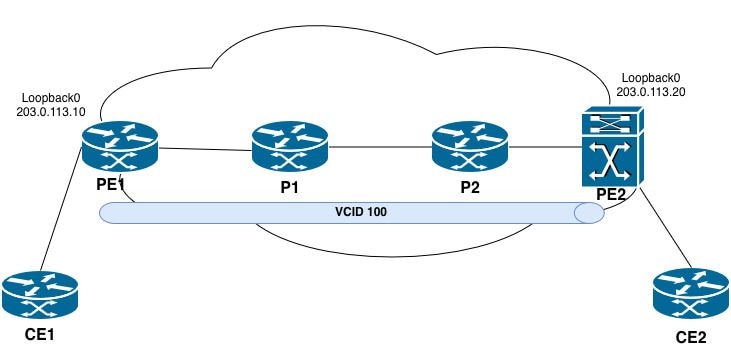 Topologia VPLS
VPLS Cross-Connect non è operativo
Procedura di risoluzione dei problemi
La connessione incrociata VPLS è in stato inattivo dopo l'interruzione imprevista della sessione.
PE2#show xconnect all
Legend: XC ST=Xconnect State S1=Segment1 State S2=Segment2 State
UP=Up DN=Down AD=Admin Down IA=Inactive
SB=Standby HS=Hot Standby RV=Recovering NH=No Hardware

XC ST  Segment 1                         S1 Segment 2                         S2
------+---------------------------------+--+---------------------------------+--
DN pri vfi 100                           UP mpls 203.0.113.10:100             DN
UP pri ac Vl100:100(Eth VLAN)            UP vfi 100                           UP
UP pri bd 100                            UP vfi 100                           UP
Passaggio 1. Confermare lo stato esatto di VC/VPLS.
PE2#show mpls l2transport vc 100 detail
Local interface: VFI 100 vfi up
   Interworking type is Ethernet
   Destination address: 203.0.113.10, VC ID: 100, VC status: down
     Last error: Local access circuit is not ready for label advertise << The local device is unable to advertise labels because the access circuit (AC) is not in a ready state.
     Output interface: none, imposed label stack {} << no MPLS labels are being imposed because no path exists.
     Preferred path: not configured << No explicit traffic engineering path is configured for this pseudowire.
     Default path: no route << No route to the remote PE (203.0.113.10) exists in the routing table.
     No adjacency
Create time: 10:50:35, last status change time: 00:17:39
  Last label FSM state change time: 00:17:33
Signaling protocol: LDP, peer x.x.x.x:0 up
  Targeted Hello: 203.0.113.20(LDP Id) -> 203.0.113.10, LDP is DOWN, no binding
  Graceful restart: not configured and not enabled
  Non stop routing: not configured and not enabled
  Status TLV support (local/remote) : enabled/None (no remote binding
    LDP route watch : enabled
    Label/status state machine : local ready, LruRnd
    Last local dataplane status rcvd: No fault
    Last BFD dataplane status rcvd: Not sent
    Last BFD peer monitor status rcvd: No fault
    Last local AC circuit status rcvd: No fault
    Last local AC circuit status sent: DOWN(hard-down) << The local device is advertising the access circuit as hard-down to the remote PE.
    Last local PW i/f circ status rcvd: No fault
    Last local LDP TLV status sent: No fault
    Last remote LDP TLV status rcvd: None (no remote binding) << No status has been received from the remote PE.
    Last remote LDP ADJ status rcvd: None (no remote binding) << No adjacency status received from the remote peer.
  MPLS VC labels: local 16, remote unassigned
  Group ID: local n/a, remote unknown
  MTU: local 1500, remote unknown
  Remote interface description:
Sequencing: receive disabled, send disabled
Control Word: On (configured: autosense)
SSO Descriptor: 203.0.113.10/100, local label: 16
Dataplane:
  SSM segment/switch IDs: 0/8194 (used), PWID: 1
VC statistics:
  transit packet totals: receive 0, send 0
  transit byte totals: receive 0, send 0
  transit packet drops: receive 0, seq error 0, send 0
Transizione della connessione incrociata VPLS (ID VC 100) a uno stato non attivo. La causa principale viene attribuita alle condizioni descritte:
1. Nessuna route verso il PE remoto - Il router non dispone di una route verso 203.0.113.10 nella tabella di routing (percorso predefinito: nessun percorso). Senza una route valida, non è possibile stabilire alcun LSP (Label-Switched Path) MPLS.
2. Sessione LDP di destinazione inattiva: la sessione LDP di destinazione compresa tra 203.0.113.20 e 203.0.113.10 non è stabilita. In questo modo si impedisce lo scambio di etichette di pseudofili tra i router PE.
3. Nessuna associazione di etichette remote - Poiché la sessione LDP di destinazione è inattiva, non è stata assegnata alcuna etichetta remota per VC 100. Lo pseudonimo non può inoltrare il traffico senza etichette locali e remote.
4. Nessuna adiacenza - Senza un percorso valido e una sessione LDP, non esiste alcuna adiacenza MPLS verso il sistema PE remoto.
Passaggio 2. Controllare il circuito di collegamento locale.
Sul computer in cui il VC è inattivo:
PE2#show interfaces vlan 100 | include up|errors
Vlan100 is up, line protocol is up , Autostate Disabled
Keepalive not supported
0 input errors, 0 CRC, 0 frame, 0 overrun, 0 ignored
0 output errors, 1 interface resets

PE2#show running-config interface vlan 100
Building configuration...

Current configuration : 72 bytes
!
interface Vlan100
no ip address
no autostate
xconnect vfi 100
end
Passaggio 3. Verificare la configurazione VFI.
PE2#show running-config | section l2 vfi
l2 vfi 100 manual
vpn id 100
neighbor 203.0.113.10 pw-class VPLS_100

PE2#show l2vpn vfi
Legend: RT=Route-target, S=Split-horizon, Y=Yes, N=No

VFI name: 100, state: up, type: multipoint, signaling: LDP
  VPN ID: 100
  Bridge-Domain 100 attachment circuits:
    Vlan100
  Pseudo-port interface: pseudowire100001
  Interface Peer Address VC ID S
  pseudowire100002 203.0.113.10 100 Y
Osservazioni principali
1. La VFI è operativa: l'istanza VFI locale è attiva e pronta per inoltrare il traffico.
2. Il circuito di collegamento è collegato - la Vlan100 è associata correttamente a Bridge-Domain 100 e alla VFI.
3. È stato configurato uno pseudowire - Uno pseudowire (pseudowire100002) è definito verso il PE remoto in 203.0.113.10 con ID VC 100.
4. Split-horizon abilitato - Si tratta del comportamento previsto in un ambiente multipoint VPLS per impedire loop di layer 2.
Passaggio 4. Verificare la raggiungibilità del loopback PE:
PE2#ping 203.0.113.10
Type escape sequence to abort.
Sending 5, 100-byte ICMP Echos to 203.0.113.10, timeout is 2 seconds:
!!!!!
Success rate is 100 percent (5/5), round-trip min/avg/max = 1/1/1 ms

PE2#show ip route 203.0.113.10
Routing entry for 203.0.113.10/32
Known via "ospf 1", distance 110, metric 2, type intra area
Last update from 192.0.2.9 on TwentyFiveGigE1/0/3, 00:01:30 ago
Routing Descriptor Blocks:
* 192.0.2.9, from 198.51.100.2, 00:01:30 ago, via TwentyFiveGigE1/0/3
Route metric is 2, traffic share count is 1

PE2#ping mpls ipv4 203.0.113.10/32 source 203.0.113.20
Sending 5, 72-byte MPLS Echos to 203.0.113.10/32,
timeout is 2 seconds, send interval is 0 msec:

Codes: '!' - success, 'Q' - request not sent, '.' - timeout,
'L' - labeled output interface, 'B' - unlabeled output interface,
'D' - DS Map mismatch, 'F' - no FEC mapping, 'f' - FEC mismatch,
'M' - malformed request, 'm' - unsupported tlvs, 'N' - no label entry,
'P' - no rx intf label prot, 'p' - premature termination of LSP,
'R' - transit router, 'I' - unknown upstream index,
'l' - Label switched with FEC change, 'd' - see DDMAP for return code,
'X' - unknown return code, 'x' - return code 0

Type escape sequence to abort.
!!!!!
Success rate is 100 percent (5/5), round-trip min/avg/max = 1/1/2 ms
Total Time Elapsed 8 ms
Ping standard e ping LSP MPLS: Distinzioni dei tasti
Il ping standard ha esito positivo anche quando l'LSP MPLS è interrotto per i motivi seguenti:
· Il pacchetto ICMP può essere indirizzato IP (non commutato con etichetta) se la destinazione è raggiungibile direttamente tramite IP.
· I router di transito possono inoltrare il pacchetto ICMP utilizzando la ricerca IP se non viene imposta alcuna etichetta.
Al contrario, il comando ping mpls ipv4 convalida il piano dati MPLS effettivo forzando il pacchetto a passare attraverso il percorso a commutazione di etichetta. Ciò garantisce che:
· Le etichette sono correttamente assegnate e distribuite.
· Le voci LFIB sono coerenti su ciascun hop.
· Il percorso end-to-end dell'LSP è funzionale.
Passaggio 5. Verificare MPLS e LDP nel core:
PE2#show mpls ldp neighbor
    Peer LDP Ident: 203.0.113.10:0; Local LDP Ident 203.0.113.20:0
        TCP connection: 203.0.113.10.646 - 203.0.113.20.39001
        State: Oper; Msgs sent/rcvd: 16/15; Downstream
        Up time: 00:02:15
        LDP discovery sources:
          TwentyFiveGigE1/0/3, Src IP addr: 192.0.2.9
          Targeted Hello 203.0.113.20 -> 203.0.113.10, active, passive
        Addresses bound to peer LDP Ident:
          203.0.113.10 192.0.2.6 192.0.2.9
Questo comando presenta le informazioni sulla sessione LDP adiacente tra il router locale (PE2) e il peer remoto. Ciascun campo nell'output viene descritto in dettaglio.
- Identificazione peer:
Identificatore LDP peer |203.0.113.10:0 | ID del router LDP del peer remoto. Il valore :0 indica lo spazio etichette predefinito a livello di piattaforma. Si tratta in genere dell'indirizzo di loopback del router remoto.
ID LDP locale |203.0.113.20:0 | ID del router LDP del router locale (PE2). Si tratta in genere dell'indirizzo di loopback di PE2.
- Informazioni sulla sessione TCP:
connessione TCP | 203.0.113.10.646 - 203.0.113.20.39001 | Sessione TCP utilizzata per la comunicazione LDP. Il peer remoto (203.0.113.10) utilizza la porta LDP 646 nota e il router locale (203.0.113.20) utilizza la porta effimera 39001. LDP utilizza il protocollo TCP per una distribuzione affidabile delle etichette.
- Stato sessione:
State Oper | | La sessione LDP è in uno stato operativo, il che significa che la sessione è completamente stabilita e funzionale.
Messaggi inviati/ricevuti |16/15 | Numero di messaggi LDP inviati (16) e ricevuti (15) dall'istituzione della sessione. inclusi i messaggi keepalive, le mappature delle etichette e altri messaggi LDP.
A valle |- | Indica la modalità di distribuzione delle etichette. Per Non sollecitato downstream si intende che il peer distribuisce le etichette a PE2 senza che PE2 le richieda esplicitamente. Questa è la modalità predefinita per LDP.
Tempo di attività |00:02:15 | La sessione è stata operativa per 2 minuti e 15 secondi. - Origini di individuazione LDP:
TwentyFiveGigE1/0/3 | Src Indirizzo IP: 192.0.2.9 | Il peer riceve una notifica di individuazione base (a livello di collegamento) dall'interfaccia TwentyFiveGigE1/0/3 con indirizzo IP di origine 192.0.2.9. Ciò indica che i due router sono collegati direttamente a questa interfaccia.
Hello mirato | 203.0.113.20 → 203.0.113.10, attiva, passiva | Esiste una porta hello di rilevamento mirato (esteso) tra il router locale (203.0.113.20) e il peer remoto (203.0.113.10). - Indirizzi associati all'ID LDP peer:
Indirizzi associati al peer | 203.0.113.10, 192.0.2.6, 192.0.2.9 | Elenco di indirizzi IP annunciati dal peer remoto tramite messaggi di indirizzi LDP. Queste rappresentano le interfacce sul router remoto.
Passaggio 5.1 Verifica del percorso MPLS Label-Switched al peer VPLS remoto
PE2#show mpls forwarding-table 203.0.113.10
Local        Outgoing         Prefix               Bytes Label     Outgoing          Next Hop
Label        Label            or Tunnel Id         Switched        interface
25           Pop Label        203.0.113.10/32      0                Twe1/0/3         192.0.2.9

PE2#show mpls ldp bindings 203.0.113.10 32
  lib entry: 203.0.113.10/32, rev 69
        local binding: label: 25
        remote binding: lsr: 203.0.113.10:0, label: imp-null
PE2 riceve imp-null direttamente da PE1, ignorando il percorso di etichetta previsto tramite P2 e P1. Ciò indica una sessione LDP mancante o un problema di configurazione MPLS tra PE2 e P2.
Passaggio 5.2 Convalidare le informazioni dell'hop successivo eseguendo i comandi forniti:
- show mpls ldp neighbor
- show mpls forwarding-table
P2#show mpls forwarding-table 203.0.113.10
Local        Outgoing          Prefix Bytes          Label           Outgoing       Next Hop
Label        Label             or Tunnel Id          Switched        interface
None         No Label          203.0.113.10/32       0
Osservazioni principali
- Etichetta locale: Nessuna | P2 non ha allocato un'etichetta locale per questo prefisso.
- Etichetta in uscita: Nessuna etichetta | Non viene eseguita alcuna operazione etichetta.
- Nessuna interfaccia in uscita o hop successivo | Il prefisso viene considerato di proprietà locale e non viene eseguito alcun inoltro verso PE1.
P2#show mpls ldp neighbor
    Peer LDP Ident: 203.0.113.20:0; Local LDP Ident 198.51.100.2:0
        TCP connection: 203.0.113.20.17326 - 198.51.100.2.646
        State: Oper; Msgs sent/rcvd: 30/29; Downstream
        Up time: 00:13:57
        LDP discovery sources:
           GigabitEthernet0/0/1, Src IP addr: 192.0.2.10
        Addresses bound to peer LDP Ident:
          203.0.113.20 192.0.2.10
Peer LDP Ident: 198.51.100.1:0; Local LDP Ident 198.51.100.2:0
    TCP connection: 198.51.100.1.646 - 198.51.100.2.12799
    State: Oper; Msgs sent/rcvd: 30/28; Downstream
    Up time: 00:13:56
    LDP discovery sources:
      GigabitEthernet0/0/0, Src IP addr: 192.0.2.5
    Addresses bound to peer LDP Ident:
      192.0.2.2 192.0.2.5 198.51.100.1

P2#show ip ospf neighbor

Neighbor ID       Pri   State           Dead Time    Address           Interface
198.51.100.3        0   FULL/ -         00:00:34     192.0.2.10        GigabitEthernet0/0/1
198.51.100.1        0   FULL/ -         00:00:34     192.0.2.5         GigabitEthernet0/0/0
Osservazioni principali
- P2 non ha un'adiacenza LDP diretta con PE1 (203.0.113.10). Ciò è previsto, in quanto P1 risiede tra P2 e PE1 nella topologia. P2 è responsabile del traffico di cambio etichetta verso P1, che quindi lo inoltra a PE1.
- L'ID LDP di P2 è 198.51.100.2:0 | P2 utilizza 198.51.100.2 come ID del router LDP, non 203.0.113.10. Tuttavia, 203.0.113.10 è ancora configurato su Loopback10 e causa un conflitto di routing.
Passaggio 6. Verificare la route all'indirizzo di loopback PE remoto:
P2#show ip route 203.0.113.10
Routing entry for 203.0.113.10/32
  Known via "connected", distance 0, metric 0 (connected, via interface)
  Routing Descriptor Blocks:
  * directly connected, via Loopback10
      Route metric is 0, traffic share count is 1
Conclusioni
- Indirizzo IP duplicato: l'indirizzo IP 203.0.113.10 è configurato su P2 (Loopback10) e PE1 (Loopback0), creando un conflitto nel dominio MPLS.
- Conflitto di routing - P2 installa 203.0.113.10/32 come percorso connesso (distanza amministrativa 0), che ha la precedenza su qualsiasi percorso con apprendimento IGP creato da PE1.
- Errore LSP - P2 considera il prefisso di proprietà locale e pertanto non alloca né annuncia un'etichetta di trasporto per 203.0.113.10/32 a PE2.
- Impatto VPLS: l'assenza di un'etichetta di trasporto valida da P2 impedisce a PE2 di stabilire un LSP in PE1. Di conseguenza, non è possibile formare il percorso di trasporto dello pseudofilo VPLS.
Connessione incrociata VPLS stabilita ma nessun traffico di dati attraversa lo pseudofilo
Verifica operativa VPLS per Catalyst serie 9000
Procedura di risoluzione dei problemi
Passaggio 1. Confermare che lo pseudonimo è in uno stato operativo.
Assicurarsi che i parametri siano corretti:
- Stato VFI attivo
- Viene elencata l'interfaccia pseudowire
- Vengono visualizzati l'indirizzo del peer e l'ID VC corretti
PE2#show mpls l2transport vc

Local intf    Local circuit              Dest address    VC ID      Status
------------- -------------------------- --------------- ---------- ----------
VFI 100        vfi                       203.0.113.10    100        UP
PE2#show mpls l2transport vc 100 detail
Local interface: VFI 100 vfi up
  Interworking type is Ethernet
  Destination address: 203.0.113.10, VC ID: 100, VC status: up
    Output interface: Twe1/0/3, imposed label stack {17 16}
    Preferred path: not configured
    Default path: active
    Next hop: 192.0.2.9
Create time: 1d11h, last status change time: 00:30:50
  Last label FSM state change time: 00:30:26
Signaling protocol: LDP, peer 203.0.113.10:0 up
  Targeted Hello: 203.0.113.20(LDP Id) -> 203.0.113.10, LDP is UP
  Graceful restart: not configured and not enabled
  Non stop routing: not configured and not enabled
  Status TLV support (local/remote) : enabled/supported
    LDP route watch : enabled
    Label/status state machine : established, LruRru
    Last local dataplane status rcvd: No fault
    Last BFD dataplane status rcvd: Not sent
    Last BFD peer monitor status rcvd: No fault
    Last local AC circuit status rcvd: No fault
    Last local AC circuit status sent: No fault
    Last local PW i/f circ status rcvd: No fault
    Last local LDP TLV status sent: No fault
    Last remote LDP TLV status rcvd: No fault
    Last remote LDP ADJ status rcvd: No fault
  MPLS VC labels: local 16, remote 16
  Group ID: local n/a, remote 0
  MTU: local 1500, remote 1500
  Remote interface description:
  MAC Withdraw: sent:1, received:0
Sequencing: receive disabled, send disabled
Control Word: On (configured: autosense)
SSO Descriptor: 203.0.113.10/100, local label: 16
Dataplane:
  SSM segment/switch IDs: 16395/8194 (used), PWID: 1
VC statistics:
transit packet totals: receive 0, send 0
transit byte totals: receive 0, send 0
transit packet drops: receive 0, seq error 0, send 0
- stato VFI | su | Il VFI funziona sul dispositivo locale.
- Indirizzo di destinazione |203.0.113.10 | ID del router PE remoto (indirizzo di loopback PE1).
- ID VC | 100 | L'identificatore del circuito virtuale per questo pseudofilo. Deve corrispondere su entrambi i router PE.
- Stato VC | su | Lo pseudowire è operativo. La segnalazione locale e remota non indica errori.
- Imposto stack di etichette {17/16} | Lo stack MPLS con due etichette viene imposto ai pacchetti che entrano nello pseudofilo. L'etichetta 17 è l'etichetta di trasporto (esterna) utilizzata per raggiungere il PE remoto attraverso il core MPLS. L'etichetta 16 è l'etichetta VC (interna) utilizzata per identificare lo pseudofilo nel PE remoto.
- Hello mirato | 203.0.113.20 → 203.0.113.10, LDP è ATTIVO | La sessione LDP di destinazione tra PE2 (locale) e PE1 (remota) è stabilita e operativa.
- Etichetta locale | 16 | L'etichetta VC assegnata da PE2 per questo pseudofilo. Il file PE remoto (PE1) utilizza questa etichetta per l'invio del traffico a PE2. Etichetta remota | 16 | L'etichetta VC pubblicizzata da PE1 per questo pseudofilo. PE2 impone questa etichetta (etichetta interna) durante l'invio del traffico a PE1.
- Ritiro MAC inviato | 1 | PE2 ha inviato 1 messaggio MAC di ritiro al PE remoto. Viene utilizzato per scaricare le tabelle degli indirizzi MAC dopo una modifica della topologia.
- Ritiro MAC ricevuto | 0 | Nessun messaggio MAC ritirato ricevuto dal PE remoto.
- Statistiche VC | non è stato inoltrato alcun traffico in nessuna direzione (inviare: 0, ricezione: 0).
Passaggio 2. Verificare lo stato del circuito di collegamento (interfaccia trunk).
Verificare che l'interfaccia trunk sia operativa e associata alla VLAN corretta.
Verifica:
- L'interfaccia è nello stato attivo/attivo
- La VLAN associata al dominio del bridge VPLS è consentita e attiva sul trunk
- La VLAN non viene eliminata o bloccata da STP
PE2#show interfaces twentyFiveGigE 1/0/2 status
Port       Name        Status        Vlan          Duplex       Speed  Type
Twe1/0/2               connected     trunk           full         10G  SFP-10GBase-SR
PE2#show interfaces trunk
Port         Mode        Encapsulation   Status       Native vlan
Twe1/0/2     on          802.1q          trunking     1

Port         Vlans allowed on trunk
Twe1/0/2     100

Port         Vlans allowed and active in management domain
Twe1/0/2     100

Port         Vlans in spanning tree forwarding state and not pruned
Twe1/0/2     100
Passaggio 3. Verificare l'associazione della vlan al dominio bridge.
Su Catalyst 9000 con una configurazione trunk (senza EVC), la vlan deve essere mappata al dominio bridge.
Conferma:
- La VLAN è associata al dominio bridge tramite il file VFI o la configurazione del membro.
- La configurazione bridge-domain fa riferimento alla VFI corretta.
PE2#show running-config interface vlan100
Building configuration...

Current configuration : 72 bytes
!
interface Vlan100
no ip address
xconnect vfi 100
Passaggio 4. Verificare l'apprendimento dell'indirizzo MAC.
Confermare che gli indirizzi MAC del circuito di collegamento locale e dello pseudofilo remoto siano stati appresi.
Verifica:
- L'indirizzo MAC CE1 locale viene appreso sull'interfaccia trunk.
- L'indirizzo MAC CE2 remoto viene appreso sull'interfaccia pseudowire.
Se non si imparano indirizzi MAC sullo pseudowire:
- Traffico non ricevuto dal PE remoto.
- Il file PE remoto presenta un problema di configurazione che impedisce al traffico di accedere allo pseudofilo.
- Il dominio bridge non è associato correttamente all'interfaccia pseudowire.
Se non si imparano indirizzi MAC sul trunk locale:
- Il dispositivo CE non trasmette il traffico sulla VLAN prevista.
- La VLAN è in stato bloccato o inattivo sull'interfaccia trunk.
PE2#show mac address-table vlan 100
          Mac Address Table
-------------------------------------------

Vlan Mac Address Type     Ports
---- ----------- -------- -----
100 cc7f.76b7.525f STATIC Vl100
100 e462.c4bb.17f1 DYNAMIC Twe1/0/2  >> CE2 Mac address learned over Twe1/0/2 interface.
Passaggio 5. Verificare lo stato del protocollo Spanning Tree Protocol (STP).
Il protocollo STP può bloccare la VLAN sull'interfaccia trunk, impedendo al traffico di entrare nel dominio bridge.
Verifica:
· La porta trunk è in stato di inoltro per la VLAN associata al dominio bridge VPLS
· La porta non si trova nello stato di blocco, ascolto o apprendimento
Se STP blocca la porta:
· Regolazione della priorità STP o del costo delle porte
· Considerare la configurazione della porta trunk come porta edge STP (se appropriata per la topologia)
PE2#show spanning-tree vlan 100

VLAN0100
  Spanning tree enabled protocol rstp
  Root ID    Priority 32868
           Address cc7f.76b7.51c0
           This bridge is the root
           Hello Time 2 sec Max Age 20 sec Forward Delay 15 sec

Bridge ID  Priority  32868 (priority 32768 sys-id-ext 100)
           Address   cc7f.76b7.51c0
           Hello Time 2 sec Max Age 20 sec Forward Delay 15 sec
           Aging Time 300 sec

Interface           Role Sts Cost      Prio.Nbr Type
------------------- ---- --- --------- -------- --------------------------------
Twe1/0/2            Desg FWD 2000      128.2    P2p
Passaggio 6. Verificare lo stack di etichette MPLS e il percorso di inoltro.
Confermare che vengano applicate le etichette corrette e che il percorso di inoltro sia valido.
Verifica:
- È presente un'etichetta in uscita valida (non Nessuna etichetta o Nessuna)
- L'interfaccia in uscita e l'hop successivo sono corretti
Percorso LSP da PE2 a P2:
PE2#show mpls forwarding-table 203.0.113.10 32
Local     Outgoing     Prefix            Bytes Label     Outgoing      Next Hop
Label     Label        or Tunnel Id      Switched        interface
22        17           203.0.113.10/32   810             Twe1/0/3      192.0.2.9 << For the transport path to the remote PE1 loopback, the imposed outgoing label is 17. The router at 192.0.2.9 assigned this value as its local label binding for the destination prefix.
Da P2 a P1 Percorso LSP:
P2#show mpls forwarding-table 203.0.113.10 32
Local     Outgoing    Prefix            Bytes Label     Outgoing       Next Hop
Label     Label       or Tunnel Id      Switched        interface
17        16          203.0.113.10/32   79290           Gi0/0/0        192.0.2.5 << Local label as 17 and the imposed outgoing label is 16. The router at 192.0.2.5 assigned this value as its local label binding for the destination prefix.
Da P1 a PE1 Percorso LSP:
P1#show mpls forwarding-table 203.0.113.10 32
Local     Outgoing    Prefix            Bytes Label     Outgoing       Next Hop
Label     Label       or Tunnel Id      Switched        interface
16        Pop Label   203.0.113.10/32   76184           Gi0/0/0        192.0.2.1 << Pop Label is performed before forwarding the packet to the next hop. This confirms that the next hop (PE1) advertised implicit null to P1.
Da P1 a PE1 Percorso LSP:
PE1#show mpls forwarding-table 203.0.113.10 32
Local      Outgoing   Prefix           Bytes Label         Outgoing       Next Hop
Label      Label      or Tunnel Id     Switched            interface
None       No Label   203.0.113.10/32  0
Conferma percorso etichetta:
In base a questo output e agli output precedenti di PE2 e P2, il percorso completo con cambio di etichetta da PE2 a PE1 è il seguente:
[PE2] Packet leaves with label stack: | 17 | (transport label)
        ↓
[P2]  Receives label 17, swaps to 16: | 16 | (transport label)
        ↓
[P1]  Receives label 16, pops label:  | IP | (pure IP packet)
        ↓
[PE1] Receives pure IP packet - local delivery
Quando il traffico VPLS attraversa questo LSP, il pacchetto ha uno stack di due etichette (trasporto: etichetta VC)
[PE2] Packet leaves with label stack: | 17 | 16 | (transport + VC label)
       ↓
[P2] Receives label 17, swaps to 16:  | 16 | 16 | (transport + VC label)
       ↓
[P1] Receives label 16, pops label:   | 16 | (VC label only)
       ↓
[PE1] Receives VC label 16 - pseudowire disposition into bridge domain
Conclusioni
L'LSP di trasporto MPLS da PE2 a PE1 è completamente operativo e correttamente programmato su tutti i router del percorso. La segnalazione dello pseudofilo VPLS è completa, con lo scambio di etichette sia locali che remote e nessun guasto segnalato.
Tuttavia, non viene inoltrato alcun traffico utente attraverso lo pseudowire, nonostante il control plane sia stato completamente stabilito. Ciò conferma che il problema risiede all'esterno della segnalazione del core e dello pseudofilo MPLS, in particolare a livello di circuito di collegamento su uno o entrambi i router PE
Verifica operativa VPLS per router
Procedura di risoluzione dei problemi
Passaggio 1. Confermare lo stato esatto di VC/VPLS.
Assicurarsi che i parametri siano corretti:
PE1#show mpls l2transport vc

Local intf    Local circuit              Dest address     VC ID     Status
------------- -------------------------- --------------- ---------- ----------
VFI 100        vfi                       203.0.113.20    100         UP
PE1#show mpls l2transport vc 100 detail
Local interface: VFI 100 vfi up
  Interworking type is Ethernet
  Destination address: 203.0.113.20, VC ID: 100, VC status: up
    Output interface: Te0/0/4, imposed label stack {19 16}
    Preferred path: not configured
    Default path: active
    Next hop: 192.0.2.2
  Create time: 1d09h, last status change time: 08:38:02
    Last label FSM state change time: 08:38:25
  Signaling protocol: LDP, peer 203.0.113.20:0 up
    Targeted Hello: 203.0.113.10(LDP Id) -> 203.0.113.20, LDP is UP
    Graceful restart: not configured and not enabled
    Non stop routing: not configured and not enabled
    Status TLV support (local/remote) : enabled/supported
      LDP route watch : enabled
      Label/status state machine : established, LruRru
      Last local dataplane status rcvd: No fault
      Last BFD dataplane status rcvd: Not sent
      Last BFD peer monitor status rcvd: No fault
      Last local AC circuit status rcvd: No fault
      Last local AC circuit status sent: No fault
      Last local PW i/f circ status rcvd: No fault
      Last local LDP TLV status sent: No fault
      Last remote LDP TLV status rcvd: No fault
      Last remote LDP ADJ status rcvd: No fault
    MPLS VC labels: local 16, remote 16
    Group ID: local n/a, remote 0
    MTU: local 1500, remote 1500
    Remote interface description:
    MAC Withdraw: sent:0, received:1
  Sequencing: receive disabled, send disabled
  Control Word: On (configured: autosense)
  SSO Descriptor: 203.0.113.20/100, local label: 20
  Dataplane:
    SSM segment/switch IDs: 8199/4097 (used), PWID: 1
  VC statistics:
    transit packet totals: receive 336, send 0
    transit byte totals:   receive 27552, send 0
    transit packet drops: receive 0, seq error 0, send 0
- stato VFI | su | Il VFI è operativo su PE1.
- Indirizzo di destinazione |203.0.113.20 | ID del router PE remoto (indirizzo di loopback PE2).
- ID VC | 100 | L'identificatore del circuito virtuale per questo pseudofilo. Questo valore corrisponde su entrambi i router PE.
- Stato VC | su | Lo pseudowire è operativo. La segnalazione locale e remota non indica errori.
- Interfaccia locale | VFI 100 | L'istanza di inoltro virtuale locale associata a questo pseudonowire.
- Stack di etichette imposto | {19/16} | Lo stack MPLS con due etichette viene imposto ai pacchetti che entrano nello pseudofilo. L'etichetta 19 è l'etichetta di trasporto (esterna) utilizzata per raggiungere PE2 nel core MPLS. L'etichetta 16 è l'etichetta VC (interna) utilizzata per identificare lo pseudofilo in PE2.
- Hello mirato | 203.0.113.10 → 203.0.113.20, LDP è ATTIVO | La sessione LDP di destinazione da PE1 (locale) a PE2 (remota) è stabilita e operativa.
- Etichetta locale | 16 | L'etichetta VC allocata da PE1 per questo pseudoproprietario. PE2 utilizza questa etichetta come etichetta interna per l'invio del traffico a PE1.
- Ritiro MAC inviato | 0 | PE1 non ha inviato alcun messaggio MAC di ritiro a PE2.
- Ritiro MAC ricevuto | 1 | PE1 ha ricevuto 1 messaggio MAC di ritiro da PE2. Ciò indica che PE2 ha subito una modifica della topologia e ha richiesto a PE1 di scaricare la tabella degli indirizzi MAC per questa VFI.
- Statistiche VC | Pacchetti in transito ricevuti | 336 | Sono stati ricevuti 336 pacchetti da PE2 su questo pseudofilo.
Byte in transito ricevuti | 27.552 | 27.552 byte ricevuti da PE2.
Pacchetti in transito inviati | 0 | Nessun pacchetto inviato da PE1 allo pseudofilo verso PE2.
Byte in transito inviati | 0 | Nessun byte inviato a PE2.
Passaggio 2. Verificare la configurazione e l'appartenenza di Bridge-Domain.
Verificare che il dominio bridge disponga dei membri corretti (interfaccia dell'istanza del servizio e pseudoproprietario).
PE1#show running-config interface TenGigabitEthernet0/0/5
Building configuration...

Current configuration : 174 bytes
!
interface TenGigabitEthernet0/0/5
no ip address
service instance 100 ethernet
encapsulation dot1q 100
rewrite ingress tag pop 1 symmetric
bridge-domain 100
!
end

PE1#show interfaces tenGigabitEthernet 0/0/5 | include up|errors
TenGigabitEthernet0/0/5 is up, line protocol is up
  Keepalive not supported
  Full Duplex, 10000Mbps, link type is force-up, media type is H10GB-CU1M
     0 input errors, 0 CRC, 0 frame, 0 overrun, 0 ignored
     0 output errors, 0 collisions, 1 interface resets
Passaggio 3. Verificare l'apprendimento dell'indirizzo MAC.
Confermare che gli indirizzi MAC del circuito di collegamento locale e dello pseudofilo remoto siano stati appresi.
PE1#show bridge-domain
Bridge-domain 100 (2 ports in all)
State: UP                 Mac learning: Enabled
Aging-Timer: 300 second(s)
Unknown Unicast Flooding Suppression: Disabled
Maximum address limit: 65536
    TenGigabitEthernet0/0/5 service instance 100
    vfi 100 neighbor 203.0.113.20 100
   AED MAC address Policy Tag Age Pseudoport
-----------------------------------------------------------------------------
Il bridge-domain stesso è attivo, ma l'assenza di indirizzi MAC appresi è il dettaglio chiave. Ciò in genere non indica ancora un traffico appreso o un problema di mappatura/inoltro del servizio da qualche parte tra l'interfaccia locale, il dominio bridge e la VFI remota.
Passaggio 4. Verificare la configurazione VFI:
PE1#show running-config | section vfi
l2 vfi 100 manual
 vpn id 100
 bridge-domain 100
neighbor 203.0.113.20 encapsulation mpls
Passaggio 5. Verificare il percorso del trasporto MPLS.
Eseguire una convalida rapida inviando un traceroute MPLS all'indirizzo di loopback remoto.
PE1#traceroute mpls ipv4 203.0.113.20 255.255.255.255 source 203.0.113.10
Tracing MPLS Label Switched Path to 203.0.113.20/32, timeout is 2 seconds

Codes: '!' - success, 'Q' - request not sent, '.' - timeout,
'L' - labeled output interface, 'B' - unlabeled output interface,
'D' - DS Map mismatch, 'F' - no FEC mapping, 'f' - FEC mismatch,
'M' - malformed request, 'm' - unsupported tlvs, 'N' - no label entry,
'P' - no rx intf label prot, 'p' - premature termination of LSP,
'R' - transit router, 'I' - unknown upstream index,
'l' - Label switched with FEC change, 'd' - see DDMAP for return code,
'X' - unknown return code, 'x' - return code 0

Type escape sequence to abort.
0 192.0.2.1 MRU 1500 [Labels: 17 Exp: 0]
L 1 192.0.2.2 MRU 1500 [Labels: 16 Exp: 0] 96 ms
L 2 192.0.2.6 MRU 1500 [Labels: implicit-null Exp: 0] 12 ms
! 3 192.0.2.10 2 ms
L'output del comando traceroute MPLS conferma che il percorso LSP (Label Switched Path) è stato creato tra il router PE di origine (203.0.113.10) e il router PE di destinazione (203.0.113.20).
La traccia mostra l'imposizione di etichette in ingresso, le operazioni di scambio di etichette tra router LSR (Label Switch Router) di transito e PHP (Penultimate Hop Popping) prima di raggiungere il PE di uscita.
In particolare:
- L'hop 0 indica che l'etichetta 17 viene imposta sul traffico destinato al FEC di destinazione.
- L'hop 1 mostra un'operazione di label swap da 17 a 16, a conferma dell'inoltro MPLS attraverso il core.
- L'hop 2 annuncia implicit-null, indicando che il protocollo PHP viene eseguito dal penultimo router.
- L'hop 3 raggiunge correttamente la destinazione, indicata dal simbolo "!" codice restituito.
Il traceroute non segnala alcuna anomalia di inoltro MPLS, come associazioni di etichette mancanti, mancata corrispondenza FEC, terminazione LSP prematura o operazioni di etichetta non supportate.
PE1
Push 17
  ↓
P1
Swap 17 → 16
  ↓
P2
Pop label
  ↓
PE2 receives pure IP packet
Passaggio 6. Convalidare il piano dati Pseudowire.
PE1#ping mpls pseudowire 203.0.113.20 100 source 203.0.113.10
Sending 5, 72-byte MPLS Echos to 203.0.113.20,
timeout is 2 seconds, send interval is 0 msec:

Codes: '!' - success, 'Q' - request not sent, '.' - timeout,
'L' - labeled output interface, 'B' - unlabeled output interface,
'D' - DS Map mismatch, 'F' - no FEC mapping, 'f' - FEC mismatch,
'M' - malformed request, 'm' - unsupported tlvs, 'N' - no label entry,
'P' - no rx intf label prot, 'p' - premature termination of LSP,
'R' - transit router, 'I' - unknown upstream index,
'l' - Label switched with FEC change, 'd' - see DDMAP for return code,
'X' - unknown return code, 'x' - return code 0

Type escape sequence to abort.
!!!!!
Success rate is 100 percent (5/5), round-trip min/avg/max = 1/1/1 ms
Total Time Elapsed 6 ms
PE2#ping mpls pseudowire 203.0.113.10 100 source 203.0.113.20
Sending 5, 72-byte MPLS Echos to 203.0.113.10,
timeout is 2 seconds, send interval is 0 msec:

Codes: '!' - success, 'Q' - request not sent, '.' - timeout,
'L' - labeled output interface, 'B' - unlabeled output interface,
'D' - DS Map mismatch, 'F' - no FEC mapping, 'f' - FEC mismatch,
'M' - malformed request, 'm' - unsupported tlvs, 'N' - no label entry,
'P' - no rx intf label prot, 'p' - premature termination of LSP,
'R' - transit router, 'I' - unknown upstream index,
'l' - Label switched with FEC change, 'd' - see DDMAP for return code,
'X' - unknown return code, 'x' - return code 0

Type escape sequence to abort.
!!!!!
Success rate is 100 percent (5/5), round-trip min/avg/max = 1/1/2 ms
Total Time Elapsed 9 ms
Il piano dati della periferica di trasmissione MPLS è stato convalidato dal test della periferica di trasmissione MPLS. Poiché il ping tra pseudofili ha esito positivo e il dominio-ponte apprende un MAC remoto tramite VPLS, il problema è più probabile sul circuito di collegamento locale o sul percorso di inoltro VLAN quando l'indirizzo MAC locale previsto non viene appreso.
Conclusioni
Il ping pseudowire MPLS riuscito conferma che i binding LSP trasporto MPLS e etichetta pseudowire sono operativi tra i router PE locale e remoto. Il risultato indica che l'inoltro MPLS, la distribuzione di etichette e la segnalazione dello pseudofilo funzionano correttamente e che il PE remoto è in grado di elaborare i pacchetti pseudofili OAM per il VC specificato.
In base a questo risultato, le infrastrutture MPLS core e pseudowire risultano operative. Se i problemi di traffico persistono, un'ulteriore indagine può concentrarsi sui circuiti di collegamento, sul comportamento di inoltro VPLS, sull'apprendimento degli indirizzi MAC, sulla coerenza MTU e sulla connettività con interfaccia CE piuttosto che sul percorso di trasporto MPLS sottostante.
Per ulteriori informazioni su questi argomenti, vedere:
- Configurazione Multiprotocol Label Switching
- Configurazione delle VPN di livello 2 MPLS
- Configurazione di VPLS tra Cat9500 e ISR4K
- Nota tecnica su VPLS con segnalazione BGP
Cronologia delle revisioni
| Revisione | Data di pubblicazione | Commenti |
|---|---|---|
1.0 |
07-Jul-2026
|
Versione iniziale |

 Feedback