Configurazione della riflessione del servizio multicast su Nexus 3000

Opzioni per il download
Linguaggio senza pregiudizi
La documentazione per questo prodotto è stata redatta cercando di utilizzare un linguaggio senza pregiudizi. Ai fini di questa documentazione, per linguaggio senza di pregiudizi si intende un linguaggio che non implica discriminazioni basate su età, disabilità, genere, identità razziale, identità etnica, orientamento sessuale, status socioeconomico e intersezionalità. Le eventuali eccezioni possono dipendere dal linguaggio codificato nelle interfacce utente del software del prodotto, dal linguaggio utilizzato nella documentazione RFP o dal linguaggio utilizzato in prodotti di terze parti a cui si fa riferimento. Scopri di più sul modo in cui Cisco utilizza il linguaggio inclusivo.
Informazioni su questa traduzione
Cisco ha tradotto questo documento utilizzando una combinazione di tecnologie automatiche e umane per offrire ai nostri utenti in tutto il mondo contenuti di supporto nella propria lingua. Si noti che anche la migliore traduzione automatica non sarà mai accurata come quella fornita da un traduttore professionista. Cisco Systems, Inc. non si assume alcuna responsabilità per l’accuratezza di queste traduzioni e consiglia di consultare sempre il documento originale in inglese (disponibile al link fornito).
Sommario
Introduzione
In questo documento viene descritto come configurare e verificare la funzione Service Reflection sugli switch Cisco Nexus serie 3000 (modalità regolare).
Prerequisiti
Requisiti
Suggerimenti generali per la conoscenza dei seguenti argomenti:
- PIM (Protocol Independent Multicast)
- OSPF (Open Shortest Path First)
- NAT (Network Address Translation)
- Protocollo IGMP (Internet Group Management Protocol)
Componenti usati
Le informazioni fornite in questo documento si basano sulle seguenti versioni software e hardware:
| N. software |
N9K-C93180YC-FX |
NXOS: versione 9.3(5) |
| N. software |
N3K-C3548P-XL |
NXOS: versione 7.0(3)I7(9) |
| N. software |
N3K-C3172TQ-10GT |
NXOS: versione 7.0(3)I7(9) |
Le informazioni discusse in questo documento fanno riferimento a dispositivi usati in uno specifico ambiente di emulazione. Su tutti i dispositivi menzionati nel documento la configurazione è stata ripristinata ai valori predefiniti. Se la rete è operativa, valutare attentamente eventuali conseguenze derivanti dall'uso dei comandi.
Premesse
Piattaforme Cisco Nexus 3k supportate
La funzione multicast service reflection è supportata solo sulle piattaforme Cisco Nexus 3548-X dalla versione 7.0(3)I7(2).
Riflessione sui metodi di servizio supportati
Multicast NAT in modalità regolare
In modalità normale, i pacchetti in entrata come interfacce S1, G1 vengono convertiti in interfacce S2, G2 e l'indirizzo MAC (Media Access Control) di destinazione del pacchetto in uscita viene convertito come indirizzo MAC multicast dell'interfaccia G2 (ad esempio, il gruppo tradotto).
Fast-pass e Fast-pass con NAT multicast senza riscrittura
In modalità fast-pass, le interfacce S1, G1 vengono convertite in interfacce S2, G2 e l'indirizzo MAC di destinazione del pacchetto in uscita ha l'indirizzo MAC multicast che corrisponde all'interfaccia G1 (ad esempio, l'indirizzo MAC del gruppo pre-tradotto).
Configurazione
Topologia
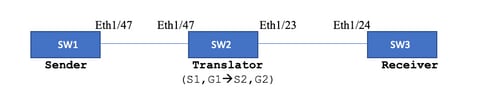
Gruppo nativo: 239.194.169.1 (G1)
Gruppo tradotto: 233.193.40.196 (G2)
Fonte originale: 10.11.11.1 (S1)
Fonte tradotta: 172.16.0.1. (S2)
Configurazione
Configurazione switch 1 (mittente)
SW1# show run int eth1/47

interface Ethernet1/47
no switchport
ip address 10.11.11.1/24
ip ospf network point-to-point
ip router ospf 1 area 0.0.0.0
ip pim sparse-mode


SW1# show run ospf
feature ospf
router ospf 1
router-id 192.168.1.1
interface Ethernet1/47
ip ospf network point-to-point
ip router ospf 1 area 0.0.0.0

SW1# show run pim
feature pim
ip pim rp-address 10.10.10.10 group-list 239.194.169.1/32
ip pim ssm range 232.0.0.0/8
interface Ethernet1/47
ip pim sparse-mode
Configurazione switch 2 (convertitore)
SW2# show run int eth 1/23,eth1/47
interface Ethernet1/23
no switchport
ip address 10.0.0.1/24
ip ospf network point-to-point
ip router ospf 1 area 0.0.0.0
ip pim sparse-mode
no shutdown

interface Ethernet1/47
  no switchport
  ip address 10.11.11.2/24
  ip ospf network point-to-point
  ip router ospf 1 area 0.0.0.0
  ip pim sparse-mode
  no shutdown


SW2# show run int lo0,lo411
interface loopback0
ip address 10.10.10.10/32
ip router ospf 1 area 0.0.0.0
ip pim sparse-mode

interface loopback411
ip address 172.16.0.1/32
ip router ospf 1 area 0.0.0.0
ip pim sparse-mode
ip igmp join-group 239.194.169.1


SW2# show run ospf
feature ospf
router ospf 1
router-id 192.168.1.2

interface loopback0
ip router ospf 1 area 0.0.0.0

interface loopback411
ip router ospf 1 area 0.0.0.0

interface Ethernet1/23
ip ospf network point-to-point
ip router ospf 1 area 0.0.0.0

interface Ethernet1/47
ip ospf network point-to-point
ip router ospf 1 area 0.0.0.0

SW2# show run pim
feature pim

ip pim rp-address 10.10.10.10 group-list 239.194.169.1/32
ip pim rp-address 172.16.0.1 group-list 233.193.40.196/32
ip pim ssm range 232.0.0.0/8

interface loopback0
ip pim sparse-mode

interface loopback411
ip pim sparse-mode

interface Ethernet1/23
ip pim sparse-mode

interface Ethernet1/47
ip pim sparse-mode

ip service-reflect mode regular
ip service-reflect destination 239.194.169.1 to 233.193.40.196 mask-len 32 source 172.16.0.1
hardware profile multicast service-reflect port 7
Configurazione switch 3 (ricevitore)
SW3# show run int eth 1/24
interface Ethernet1/24
ip address 10.0.0.2/24
ip ospf network point-to-point
ip router ospf 1 area 0.0.0.0
ip pim sparse-mode
ip igmp join-group 233.193.40.196
no shutdown


SW3# show run ospf
feature ospf
router ospf 1
router-id 192.168.1.3

interface Ethernet1/24
ip ospf network point-to-point
ip router ospf 1 area 0.0.0.0


SW3# show run pim

feature pim
ip pim rp-address 172.16.0.1 group-list 233.193.40.196/32
ip pim ssm range 232.0.0.0/8

interface Ethernet1/24
ip pim sparse-mode
Verifica
Fare riferimento a questa sezione per verificare che la configurazione funzioni correttamente.
Verifica funzionalità di Service Reflection
Verifica switch 1
SW1# show ip mroute
IP Multicast Routing Table for VRF "default"

(*, 232.0.0.0/8), uptime: 3w6d, pim ip
  Incoming interface: Null, RPF nbr: 0.0.0.0
  Outgoing interface list: (count: 0)

(10.11.11.1/32, 239.194.169.1/32), uptime: 00:06:57, pim ip
  Incoming interface: Ethernet1/47, RPF nbr: 10.11.11.1
  Outgoing interface list: (count: 1)
  Ethernet1/47, uptime: 00:06:57, pim, (RPF)
Verifica switch 2
SW2# show ip mroute
IP Multicast Routing Table for VRF "default"

(*, 232.0.0.0/8), uptime: 00:04:39, pim ip
  Incoming interface: Null, RPF nbr: 0.0.0.0
  Outgoing interface list: (count: 0)

(*, 233.193.40.196/32), uptime: 00:04:11, pim ip
  Incoming interface: loopback411, RPF nbr: 172.16.0.1  <-- Translation (ingress) Loopback interface
  Outgoing interface list: (count: 1)
  Ethernet1/23, uptime: 00:03:59, pim    <-- Egress interface for S2,G2


(172.16.0.1/32, 233.193.40.196/32), uptime: 00:00:15, ip mrib pim
  Incoming interface: loopback411, RPF nbr: 172.16.0.1
  Outgoing interface list: (count: 1)
  Ethernet1/23, uptime: 00:00:15, pim

(*, 239.194.169.1/32), uptime: 00:04:34, static pim ip  <-- (The NAT router would pull the traffic by using a (*,G) join on loopback )
  Incoming interface: loopback0, RPF nbr: 10.10.10.10
  Outgoing interface list: (count: 1)
 loopback411, uptime: 00:04:34, static    <-- Translation (egress) Loopback interface

(10.11.11.1/32, 239.194.169.1/32), uptime: 00:00:17, ip mrib pim
  Incoming interface: Ethernet1/47, RPF nbr: 10.11.11.1, internal     <-- Ingress interface for S1,G1
  Outgoing interface list: (count: 1)
  loopback411, uptime: 00:00:17, mrib


SW2# show ip mroute sr   <-- (Only SR nat routes)
IP Multicast Routing Table for VRF "default"

(*, 239.194.169.1/32), uptime: 00:09:29, static pim ip
    NAT Mode: Ingress
    NAT Route Type: Pre
    Incoming interface: loopback0, RPF nbr: 10.10.10.10
    Translation list: (count: 1)
    SR: (172.16.0.1, 233.193.40.196)

(10.11.11.1/32, 239.194.169.1/32), uptime: 00:05:12, ip mrib pim
    NAT Mode: Ingress
    NAT Route Type: Pre
    Incoming interface: Ethernet1/47, RPF nbr: 10.11.11.1, internal
    Translation list: (count: 1)
    SR: (172.16.0.1, 233.193.40.196)
Verifica switch 3
SW3# show ip mroute
IP Multicast Routing Table for VRF "default"
(*, 232.0.0.0/8), uptime: 02:45:09, pim ip
Incoming interface: Null, RPF nbr: 0.0.0.0
Outgoing interface list: (count: 0)

(*, 233.193.40.196/32), uptime: 01:47:02, ip pim igmp
Incoming interface: Ethernet1/24, RPF nbr: 10.0.0.1
Outgoing interface list: (count: 1)
Ethernet1/24, uptime: 01:43:27, igmp, (RPF)

(172.16.0.1/32, 233.193.40.196/32), uptime: 00:02:59, ip mrib pim
Incoming interface: Ethernet1/24, RPF nbr: 10.0.0.1
Outgoing interface list: (count: 1)
Ethernet1/24, uptime: 00:02:59, mrib, (RPF)
Risoluzione dei problemi
Le informazioni contenute in questa sezione permettono di risolvere i problemi relativi alla configurazione.
Se S2 e G2 non vengono creati o l'utente deve affrontare problemi di traduzione casuali, è possibile controllare i seguenti punti:
1. Una volta ricevuto il traffico (pre-tradotto), le voci post-tradotte vengono create in base al pkt puntato in mcastfwd.
2. Se il comando pkt non viene visualizzato in mcastfwd, è possibile controllare se il traffico richiesto si trova sull'interfaccia in entrata tramite ACL.
3 Se vengono visualizzati più contatori nell'ACL, verificare che lo stesso traffico raggiunga la CPU tramite l'analizzatore.
4 Può anche controllare la traduzione nella cronologia degli eventi MRIB:
SW2# show system  internal  mfwd ip mroute  --> Packets Punted in Mcast Forwarding.
MCASTFWD Multicast Routing Table for VRF "default"
(0.0.0.0/0, 232.0.0.0/8)
  Software switched packets: 0, bytes: 0
  RPF fail packets: 0, bytes: 0
(0.0.0.0/0, 233.193.40.196/32)
  Software switched packets: 1, bytes: 84
  RPF fail packets: 0, bytes: 0
(172.16.0.1/32, 233.193.40.196/32), data-alive
  Software switched packets: 1, bytes: 84
  RPF fail packets: 8, bytes: 672
(0.0.0.0/0, 239.194.169.1/32)
  Software switched packets: 1, bytes: 84
RPF fail packets: 0, bytes: 0
(10.11.11.1/32, 239.194.169.1/32), data-alive
Software switched packets: 10, bytes: 840
RPF fail packets: 0, bytes: 0
SW2# show ip access-lists test
IP access list test
        statistics per-entry
        10 permit ip any 239.194.169.1/32 [match=105] <-- Intrested traffic hitting ingress interface
        20 permit ip any any [match=11]

interface Ethernet1/47
  no switchport
  ip access-group test in  <-- ACL applied on ingress interface
  ip address 10.11.11.2/24
  ip ospf network point-to-point
  ip router ospf 1 area 0.0.0.0
  ip pim sparse-mode
  no shutdown
SW2# ethanalyzer loca int inband display-filter "ip.addr == 239.194.169.1" limit-captured-frames 0  --> Confirm (S1,G1) seen on CPU
Capturing on inband
wireshark-cisco-mtc-dissector: ethertype=0xde09, devicetype=0x0
2022-09-18 04:21:37.840227 10.11.11.1 -> 239.194.169.1 ICMP Echo (ping) request
2022-09-18 04:21:37.841275 10.11.11.1 -> 239.194.169.1 ICMP Echo (ping) request
2022-09-18 04:21:37.860153 10.11.11.1 -> 239.194.169.1 ICMP Echo (ping) request
2022-09-18 04:21:37.861199 10.11.11.1 -> 239.194.169.1 ICMP Echo (ping) request
2022-09-18 04:21:37.880072 10.11.11.1 -> 239.194.169.1 ICMP Echo (ping) request
2022-09-18 04:21:37.881113 10.11.11.1 -> 239.194.169.1 ICMP Echo (ping) request


SW2# ethanalyzer local  interface  inband capture-filter  "host 172.16.0.1" limit-captured-frames 0 --> Confirm (S2,G2) seen on CPU
Capturing on inband
wireshark-cisco-mtc-dissector: ethertype=0xde09, devicetype=0x0
2022-09-18 03:12:51.423484 172.16.0.1 -> 233.193.40.196 ICMP Echo (ping) request
2022-09-18 03:12:51.423978 10.0.0.2 -> 172.16.0.1 ICMP Echo (ping) reply
2022-09-18 03:12:53.425754 172.16.0.1 -> 233.193.40.196 ICMP Echo (ping) request
2022-09-18 03:12:53.425761 10.0.0.2 -> 172.16.0.1 ICMP Echo (ping) reply
2022-09-18 03:12:55.426719 172.16.0.1 -> 233.193.40.196 ICMP Echo (ping) request
2022-09-18 03:12:55.426726 10.0.0.2 -> 172.16.0.1 ICMP Echo (ping) reply
2022-09-18 03:12:57.428669 172.16.0.1 -> 233.193.40.196 ICMP Echo (ping) request
2022-09-18 03:12:57.429175 10.0.0.2 -> 172.16.0.1 ICMP Echo (ping) reply
2022-09-18 03:12:59.429890 172.16.0.1 -> 233.193.40.196 ICMP Echo (ping) request
2022-09-18 03:12:59.430386 10.0.0.2 -> 172.16.0.1 ICMP Echo (ping) reply
10 packets captured
SW2# show ip pim event-history  mrib --> Event history to confirm that the translation is being done
2022 Sep 18 04:28:39.970688: E_DEBUG    pim [19433]:  Sending ack: xid: 0xeeee00d2
2022 Sep 18 04:28:39.970255: E_DEBUG    pim [19433]:  MRIB Join notify for (10.11.11.1/32, 239.194.169.1/32)
2022 Sep 18 04:28:39.968875: E_DEBUG    pim [19433]:  MRIB sr route type notif for (10.11.11.1/32, 239.194.169.1/32) : 1
2022 Sep 18 04:28:39.968859: E_DEBUG    pim [19433]:  pim_process_mrib_rpf_notify: MRIB RPF notify for (10.11.11.1/32, 239.194.169.1/32), old RPF info: 10.11.11.1 (Ethernet1/47), new RPF info: 10.11.11.1 (Ethernet1/47). LISP source RLOC address
: 0.0.0.0, route-type 1
2022 Sep 18 04:28:39.968307: E_DEBUG    pim [19433]:  Copied the flags from MRIB for route (10.11.11.1/32, 239.194.169.1/32), (before/after): att F/F, sta F/F, z-oifs T/F, ext F/F, fabric F/F, fabric_src: F/F mofrr F/F
2022 Sep 18 04:28:39.968301: E_DEBUG    pim [19433]:  MRIB Join notify for (10.11.11.1/32, 239.194.169.1/32)
2022 Sep 18 04:28:39.968294: E_DEBUG    pim [19433]: Received a notify message from MRIB xid: 0xeeee00cf for 1 mroutes
2022 Sep 18 04:28:35.904652: E_DEBUG    pim [19433]:  Sending ack: xid: 0xeeee00cc
2022 Sep 18 04:28:35.904625: E_DEBUG    pim [19433]:  pim_process_mrib_rpf_notify: MRIB RPF notify for (172.16.0.1/32, 233.193.40.196/32), old RPF info: 172.16.0.1 (loopback411), new RPF info: 172.16.0.1 (loopback411). LISP sourc
e RLOC address: 0.0.0.0, route-type 0
2022 Sep 18 04:28:35.904484: E_DEBUG    pim [19433]:  pim_process_mrib_rpf_notify: After copying the values for route (0.0.0.0/32, 233.193.40.196/32) we got RPF info: 172.16.0.1 (loopback411). LISP source RLOC address: 0.0.0.0, route-t
ype 0
2022 Sep 18 04:28:35.904476: E_DEBUG    pim [19433]:  pim_process_mrib_rpf_notify: MRIB RPF notify for (0.0.0.0/32, 233.193.40.196/32), old RPF info: 0.0.0.0 ((null)), new RPF info: 172.16.0.1 (loopback411). LISP source RLOC address: 0
.0.0.0, route-type 0
2022 Sep 18 04:28:35.904400: E_DEBUG    pim [19433]:  MRIB Join notify for (172.16.0.1/32, 233.193.40.196/32)
2022 Sep 18 04:28:35.904343: E_DEBUG    pim [19433]:  MRIB Join notify for (0.0.0.0/32, 233.193.40.196/32)
2022 Sep 18 04:27:49.862827: E_DEBUG    pim [19433]:  pim_process_mrib_rpf_notify: After copying the values for route (*, 239.194.169.1/32) we got RPF info: 10.10.10.10 (loopback0). LISP source RLOC address: 0.0.0.0, route-type 0
2022 Sep 18 04:27:49.862812: E_DEBUG    pim [19433]:  pim_process_mrib_rpf_notify: MRIB RPF notify for (*, 239.194.169.1/32), old RPF info: 0.0.0.0 ((null)), new RPF info: 10.10.10.10 (loopback0). LISP source RLOC address: 0.0.0.0, route-
type 0
2022 Sep 18 04:27:49.862798: E_DEBUG    pim [19433]:  MRIB Join notify for (*, 239.194.169.1/32)
2022 Sep 18 04:27:49.862795: E_DEBUG    pim [19433]:  MRIB Join notify for (172.16.0.1/32, 233.193.40.196/32)
2022 Sep 18 04:27:49.862789: E_DEBUG    pim [19433]:  MRIB Join notify for (0.0.0.0/32, 233.193.40.196/32)
2022 Sep 18 04:27:49.861870: E_DEBUG    pim [19433]:  Creating PIM route for (*, 239.194.169.1/32)
2022 Sep 18 04:27:49.861868: E_DEBUG    pim [19433]:  MRIB Join notify for (*, 239.194.169.1/32)
Riepilogo
- In modalità Normale, il traffico raggiunge la voce S, G originale al primo passaggio e circola nuovamente a causa dell'OIFL (Outgoing Interface List) che ha solo la porta di loopback. Nel secondo passaggio, deriva l'indirizzo MAC di destinazione per la riscrittura.
- Nel terzo passaggio, la ricerca della route multicast viene eseguita sui pacchetti S, G convertiti e il pacchetto viene inoltrato alle porte IFL del gruppo tradotto corrispondenti.
- È stato aggiunto un join statico al loopback per forzare la ricezione del traffico sulla casella NAT.
- Quando si riceve il primo pacchetto per (s1, g1), lo switch esegue il programma (s1,g1) con il nuovo flag SR (s1, g —> s2 ,g2).
- Lo switch userebbe questi metadati per fare il recircle del pacchetto e punt il pacchetto per g2. Una volta che il pacchetto (S2, G2) è terminato per sup, la funzionalità FHR (primo hop router) viene attivata sulla scatola NAT per s2,g2.
- Una volta ricevuto il traffico, vale a dire le voci pre-tradotte e post-tradotte verrebbero create in base al pkt punted in mcastfwd.
- Se il pacchetto non viene reindirizzato al gruppo mcastfwd corrispondente, è possibile usare la procedura di risoluzione dei problemi descritta sopra per verificare se il traffico interessato ha raggiunto lo switch
Informazioni correlate
.
Cronologia delle revisioni
| Revisione | Data di pubblicazione | Commenti |
|---|---|---|
2.0 |
26-Jul-2023
|
Aggiornato e ripubblicato. |
1.0 |
21-Sep-2022
|
Versione iniziale |
Contributo dei tecnici Cisco
- Deepak KeshwaniCisco TAC Engineer
 Feedback