PDF(390.3 KB) View with Adobe Reader on a variety of devices
Updated:February 21, 2013
Document ID:1476773832246438
Bias-Free Language
The documentation set for this product strives to use bias-free language. For the purposes of this documentation set, bias-free is defined as language that does not imply discrimination based on age, disability, gender, racial identity, ethnic identity, sexual orientation, socioeconomic status, and intersectionality. Exceptions may be present in the documentation due to language that is hardcoded in the user interfaces of the product software, language used based on RFP documentation, or language that is used by a referenced third-party product. Learn more about how Cisco is using Inclusive Language.
Overview
The Cisco
® Catalyst
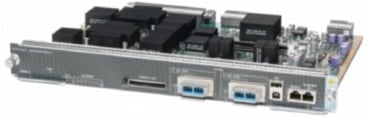
® 4500 Supervisor Engine 6-E with CenterFlex technology is an intelligent, high-performance, next-generation extension to the Cisco Catalyst 4500 Series optimized for customers deploying business-critical applications (Figure 1). Cisco developed application-specific integrated circuits (ASICs) specific to the Supervisor Engine 6-E that enable CenterFlex technology and deliver industry-leading centralized performance and configuration flexibility. CenterFlex technology enables granular optimization of real-time voice, video, and data communications to help ensure workforce productivity and profitability and customer success for organizations of all sizes.
• Flexibility to operate at 6 or 24 Gbps per line-card slot
• Ability to mix and match 6-Gbps classic and 24-Gbps E-Series line cards, with no performance degradation
• Twin gigabit converter modules that enable flexibility for up to 4 Gigabit Ethernet (Small Form-Factor Pluggable [SFP]) uplinks in the X2 optic slots
• Dynamic hardware forwarding table allocations for ease of IPv4-to-IPv6 migration
• Advanced QoS support with up to 8 queues per port, dynamic queue sizing, and hierarchical policing to provide flexibility and control
• Enhanced security with Unicast Reverse Path Forwarding (URPF) for added protection against network spoofing attacks
• File allocation table (FAT)-based file system for easier network administration
The Cisco Catalyst 4500 Supervisor Engine 6-E is compatible with classic Cisco Catalyst 4500 line cards, chassis, and power supplies, providing full investment protection. The Supervisor Engine 6-E delivers 24 Gbps per slot of switching capacity when deployed with the E-Series line cards in a Cisco Catalyst 4500 E-Series chassis. You can mix and match classic line cards and E-Series line cards within a Cisco Catalyst 4500 E-Series chassis with no performance degradation. When you deploy the Cisco Catalyst Supervisor Engine 6-E with classic line cards, all of the new features except the 24-Gbps per-slot switching capacity are inherited.
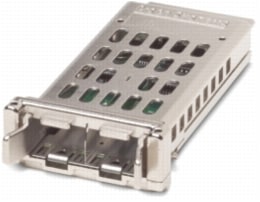
The Cisco Catalyst Supervisor Engine 6-E also provides flexibility and an easy migration path to 10 Gigabit Ethernet uplinks with dual-purpose X2 slots that can accommodate wire-speed 10 Gigabit Ethernet optics or Cisco Twin Gigabit Converter modules (Figure 2), enabling Gigabit Ethernet SFP optics.
The Cisco Twin Gigabit Converter Module, which ships standard with the Supervisor Engine 6-E (unless you order 10 Gigabit Ethernet optics on the configuration tool), converts a single 10 Gigabit Ethernet X2 interface into two Gigabit Ethernet port slots that can be populated with appropriate SFP optics, providing a total of 4 Gigabit Ethernet uplinks if used in both X2 interface slots. With the flexibility offered by the Cisco Twin Gigabit Converter Module, you can initially use the gigabit uplinks and then, as your business demands change, you can simply remove the Cisco Twin Gigabit Converter Module and insert 10 Gigabit Ethernet X2 optics to provide full line-rate 10 Gigabit Ethernet uplinks without having to upgrade. The ability to support both Gigabit Ethernet uplinks and 10 Gigabit Ethernet uplinks on a single supervisor engine further demonstrates the flexibility and the investment protection of the Cisco Catalyst 4500 Series.
Figure 2. Cisco Twin Gigabit Converter Module: Converting 10 Gigabit Ethernet X2 Interface Into Two Gigabit Ethernet SFP Interfaces
The increased capabilities and investment protection provided by the Supervisor Engine 6-E and CenterFlex technology facilitates not only scalability for today's network requirements but also investment protection by providing significant hardware resources for future growth.
Predictable Performance and Scalability
The Supervisor Engine 6-E provides a fourfold increase in per-slot switching capacity from previous-generation Cisco Catalyst 4500 supervisor engines: from 6 to 24 Gbps per slot. Table 1 highlights the performance and scalability enhancements of the Cisco Catalyst 4500 Supervisor Engine 6-E.
Table 1. Cisco Catalyst 4500 Supervisor Engine 6-E Performance and Scalability Features
Feature and Description
Supervisor Engine 6-E
Centralized switching capacity
320 Gbps
Per-slot switching capacity
24 Gbps
Throughput
250 Mpps for IPv4
125 Mpps for IPv6
250 Mpps for L2 Bridging
IPv4 Routing entries
256,000
IPv6 Routing entries
128,000
Multicast routes
32,000
CPU
1.3 GHz
CPU queues
64
Synchronous Dynamic RAM (SDRAM)
512 MB upgradable to 1 GB
Nonvolatile RAM (NVRAM)
No through Boot flash (64 MB)
Security and QoS hardware entries
128,000
Cisco Network Admission Control (NAC) and Dynamic Host Configuration Protocol (DHCP) Snooping entries
12,000
MAC addresses
55,000
Active VLANs
4096
Spanning Tree Protocol instances
10,000
Switched virtual interfaces (SVIs)
4096
Switched Port Analyzer (SPAN)
Maximum of 8 sessions: ingress and or egress
The Supervisor Engine 6-E is also optimized for multimedia applications with its advanced multicast support offered by features such as Protocol Independent Multicast (PIM) and Source-Specific Multicast (SSM), giving your network additional scalability to support multimedia applications.
Chassis and Line-Card Support
Already-installed Cisco Catalyst 4500 chassis with classic line cards can take advantage of the new features and functions of the Supervisor Engine 6-E on all ports with a simple supervisor engine upgrade. However, to take advantage of the increased switching capacity of 24 Gbps per slot, the Cisco Catalyst 4500 E-Series chassis and E-Series line cards are required. You can mix and match Cisco Catalyst 4500 E-Series line cards and classic line cards in an E-Series chassis with no performance degradation to either line card type. Table 2 shows the supervisor engine and line-card slot-assignment options in the Cisco Catalyst 4500 E-Series chassis.
The Cisco Catalyst 4500 Series was designed for nonstop communications with uninterrupted hardware switching. In addition to redundant power supplies, fans, and clock modules, the Cisco Catalyst 4510R-E, 4510R+E, 4507R+E, and 4507R-E chassis models support 1 + 1 supervisor engine redundancy, using the Supervisor Engine 6-E. The primary supervisor engine is active and is responsible for normal system operation. The other supervisor engine serves as a secondary standby, monitoring the operation of the primary supervisor engine.
Alerts are generated to the network monitoring software if either of the redundant supervisors fails. Hot-swapping of supervisor engines is supported without disrupting system operation. You can configure software to force switchover of supervisor engines, or you can use the Simple Network Management Protocol (SNMP) to perform switchover. The resiliency features of the Cisco Catalyst 4500 prevent network outages that could result in lost business and revenue.
Nonstop Forwarding with Stateful Switchover (NSF/SSO) offers continuous packet forwarding during supervisor engine switchover. Information is fully synchronized between supervisor engines to allow the standby supervisor engine to immediately take over in subsecond time if the primary fails. In-Service Software Upgrade (ISSU) allows you to upgrade or downgrade complete Cisco IOS
® Software images with minimal to no network disruption when using a redundant Cisco Catalyst 4500 E-Series system with dual supervisor engines. Facilitating rapid, undisruptive software upgrade for new line cards, new power supplies, new features, or bug fixes, ISSU offers continuous packet forwarding during the supervisor engine switchover running different Cisco IOS Software releases.
NSF/SSO and ISSU dramatically improve the network reliability and availability in a Layer 2 or Layer 3 environment. NSF/SSO and ISSU are essential for business-critical applications such as voice over IP (VoIP). These features help ensure that VoIP calls are not dropped.
Table 4 shows the high-availability and uplink options for the Supervisor Engine 6-E.
Table 4. Supervisor Engine 6-E High Availability and Uplink Options
Feature and Description
Supervisor Engine 6-E
Redundant-capable
• Yes
• Cisco Catalyst 4507R, 4507R-E, and 4507R+E models
• Cisco Catalyst 4510R, 4510R-E, and 4510R+E models
Active supervisor engine uplinks in redundant mode
• Two 10 Gigabit Ethernet (wire-speed)
or
• Four 10 Gigabit Ethernet (2:1 oversubscribed)
or
• Four Gigabit Ethernet (Cisco Twin Gig Converter Module)
Active supervisor engine uplinks (nonredundant mode)
• Two 10 Gigabit Ethernet
or
• Four Gigabit Ethernet (Cisco Twin Gig Converter Module)
Uplink optic types
SFP (Gigabit Ethernet) with Cisco Twin Gig Converter Module or X2 optics (10 Gigabit Ethernet ports)
SSO/NSF and ISSU
Yes
Please refer to the "Features at a Glance" section of this data sheet for a complete listing of supported features.
IPv6 Support
IPv6 is important for the future of IP networking and is critical for the expansion of IP address space in the future. IPv6 capability is required by many companies and is being mandated by governments worldwide. This protocol has been supported on the Cisco Catalyst 4500 Supervisor Engine II-Plus to V-10GE engines since Cisco IOS Software Release 12.2(20)EW with software forwarding. The Cisco Catalyst 4500 Supervisor Engine 6-E supports IPv6 Unicast and Multicast in hardware for full line-rate forwarding performance of up to 125 Mpps. The Supervisor Engine 6-E also dynamically allocates hardware table space between IPv4 and IPv6 routes to maximize table-space usage for optimal IPv4-to-IPv6 migration. The Supervisor Engine 6-E supports Multicast Listener Discovery (MLD) Snooping for IPv6, enhancing performance and reducing network traffic by allowing a switch to dynamically add and remove hosts from a multicast group.
Table 5 highlights the IPv6 capabilities of the Supervisor Engine 6-E.
Table 5. Summary of Supervisor Engine 6-E IPv6 Capabilities
Feature and Description
Supervisor Engine 6-E
IPv6 support
Unicast and Multicast forwarding done in hardware
IPv6 performance
125 Mpps
IPv6 Routing entries
128,000
Dynamic Hardware Route Table allocations
Yes
MLD Snooping for IPv6
Yes, in hardware
URPFv6: Strict mode
Yes, in hardware
Please refer to the "Features at a Glance" section of this data sheet for a complete listing of supported features.
Intelligent Network Services with QoS and Sophisticated Traffic Management
The Cisco Catalyst 4500 Supervisor Engine 6-E provides enhanced QoS features to help ensure that network traffic is classified, prioritized, and scheduled optimally to efficiently deploy a unified communications network that comprises bandwidth-hungry multimedia, time-sensitive (voice), and mission-critical applications. This type of network allows the administrator to differentiate between traffic flows and enforce policies. QoS capabilities include sharing, shaping, and strict-priority configurations for optimal scheduling of egress traffic as well as Dynamic Buffer Limiting (DBL), a flow-based congestion-avoidance feature. The Supervisor Engine 6-E extends the capabilities of previous-generation supervisor engines by providing flexible queuing with up to 8 transmit queues per port with dynamic queue sizing for greater flexibility in classifying and prioritizing traffic. Classification has also been enhanced by providing configurable classification mapping tables applied on a per-port basis, providing greater flexibility in marking traffic. Policing has also been enhanced to include 2-Rate, 3-Color Policing for more granular control and enforcement of traffic policies. Table 6 summarizes the enhanced QoS features of the Supervisor Engine 6-E.
Table 6. Summary of Supervisor Engine 6-E Enhanced QoS Features
Feature and Description
Supervisor Engine 6-E
QoS hardware entries
64,000
Policers
16,000 with flexible assignment for input/output
Hierarchical policies
Yes: 2-Rate, 3-Color
Number of Tx queues
Flex queues up to 8
Maximum Tx queue size
Dynamic 16 to 8184 packets per queue, depending on the number and type of line card and the number of queues configured on the port (refer to documentation for more details)
Dynamic queue sizes
Yes
Configurable classification mapping tables
Yes
Match IP on MAC Header
Yes
Modular QoS-compliant
Yes
DBL: Congestion-avoidance feature
Yes
QoS sharing
Supported on all ports
Shaping
Yes, per Tx queue
Broadcast suppression
Supported in hardware for all ports
Multicast suppression
Supported in hardware for all ports
Please refer to the "Features at a Glance" section of this data sheet for a complete listing of supported features.
Comprehensive Security with Cisco TrustSec
The Cisco Catalyst 4500E Supervisor Engine 6-E is a validated component of the Cisco TrustSec
® 2.1 architecture. This allows the Cisco Catalyst 4500E Supervisor Engine 6-E to be transparently integrated into campus switching environments for a comprehensive security solution based on Cisco TrustSec. The Cisco Catalyst Supervisor Engine 6-E is a foundational element of the Cisco TrustSec architecture with support for the following functionalities:
• Device sensor: The device sensor on the Cisco Catalyst 4500E Supervisor Engine 6-E enables the ability to recognize the devices connected to the switch. This feature also interoperates with the Cisco Identity Services Engine, providing for a centralized view of all devices' access to the network in a scalable manner. When combined with AutoSmartPorts (ASP), it also provides the ability to dynamically apply policies on the switch based on the device type. For more information, visit http://www.cisco.com/en/US/docs/ios-xml/ios/sec_usr_aaa/configuration/15-1sg/sec-dev-sensor.html.
• Identity-based networking: The Cisco Catalyst 4500E Supervisor Engine 6-E has the most rich and robust set of IEEE 802.1X based identity features to provide the right level of authenticated access to users. It also simplifies identity deployments with features such as Flexible Authentication, WebAuth, and MAC Authentication Bypass (MAB), as well as open mode for undisrupted operations while providing visibility of network access. The identity features also provide integrated support for IP telephony. It also provides for flexible authorization policies with VLAN assignment and dynamic ACLs.
Simplified and Scalable Network Virtualization with Easy Virtual Network (EVN)
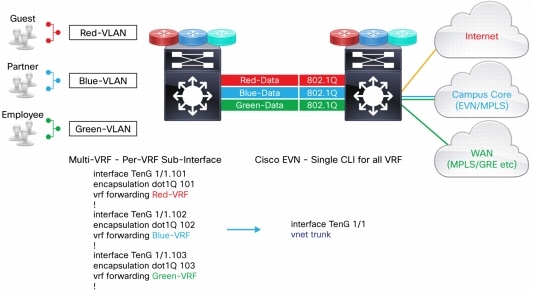
Enterprise networks use single foundational infrastructure to build multiple logical overlay networks for diversified closed usergroups, regulatory, secure IT applications, etc. On campuses the traditional Multi-VRF solution is widely adopted and deployed to solve such network segmentation challenges. The Cisco Catalyst 4500E Series platform simplifies virtual network operation and maximizes scalability with the Cisco campus end-to-end Easy Virtual Network (EVN) technology.
Figure 3. Simplified Campus Network Virtualization with Cisco EVN
Cisco EVN is a successor solution that offers numerous advantages over traditional Multi-VRF technology:
• Simplified: To simplify campus virtual-network solutions, the Cisco EVN is designed with following three major components:
– Virtual network (VNET) trunk: The Cisco EVN solution reduces 98 to 99 percent of configuration complexities.
– Route replication: A simplified unicast and multicast route-leaking capability enables shared network and application services to virtual-network users. It replaces traditional Border Gateway Protocol (BGP)-based route-leaking mechanics.
– Routing context: Simplified and optimized virtual-network operation and troubleshooting are supported on a per-VRF basis.
• Scalable: Cisco EVN enables flexibility to scale up to 32 virtual network solutions - operationally 4x virtual-network scalability capacity over Multi-VRF technology.
• Interoperable: Cisco EVN provides network topology isolation based on an RFC-defined control plane; for example, Enhanced IGRP (EIGRP), Open Shortest Path First (OSPF), Multicast etc. The data-plane security and protection are maintained through industry-standard IEEE 802.1Q. In addition, the Cisco EVN-supported system interoperates with peer Cisco EVN, Multi-VRF, and MPLS systems.
Comprehensive Centralized Management
The Cisco Catalyst Supervisor Engine 6-E features a single console port and a single IP address to manage all system features. Remote in-band management is available with SNMP, Telnet client, BOOTP, and Trivial File Transfer Protocol (TFTP). Support for local or remote out-of-band management is delivered through a terminal or modem attached to the console interface. USB drive support will be provided in a future software release. The Cisco Smartports macro for Cisco Catalyst switches is also supported, simplifying the configuration of the critical features for Ethernet networks.
The Cisco Catalyst 4500 Supervisor Engine 6-E is also FAT file system-capable, allowing images to be copied, saved, etc. with Windows-based machines with a Compact Flash. This capability will be available in a future software release.
Table 7. Key Supervisor Engine 6-E Management Features
Feature and Description
Supervisor Engine 6-E
USB drive support
Yes, future software release
Compact Flash support
Yes, 64- and 128-MB options
FAT file system support
Yes
SPAN
Up to 8 sessions: ingress and egress
Please refer to the "Features at a Glance" section of this data sheet for a complete listing of supported features.
The Cisco Catalyst 4500 Supervisor Engine 6-E also delivers a comprehensive set of management tools to provide the required visibility and control in the network. Managed with CiscoWorks solutions, Cisco Catalyst switches can be configured and managed to deliver end-to-end device, VLAN, traffic, and policy management. The CiscoWorks LAN Management Solution (LMS) bundle offers tools such as CiscoWorks Resource Manager Essentials and CiscoView. These Web-based management tools offer several services, including automated inventory collection, software deployment, easy tracking of network changes, views into device availability, and quick isolation of error conditions.
Lower Total Cost of Ownership and Ease of Use with Smart Install Director
Smart Install Director simplifies management of images and configurations for enterprise switches in campus and branch networks. The Cisco Catalyst 4500E, now acting as Smart Install Director, provides a single management point for images and configuration of directly or indirectly connected Cisco Catalyst 2960, 3560, 3750, and 3850 Series Switches. It provides for:
• Plug and play in switch deployment
• Zero-touch replacement of switches with the same configuration and image as the switch it is replacing
• Single point of image and configuration management, in which configuration and image management are centralized
• On-demand image and configuration updates across all downstream switches from a single touchpoint
Smart Install Director reduces the customer's TCO and operational expense, while providing ease of use to the user.
The Cisco Catalyst 4500 Supervisor Engine 6-E extends the rich set of industry-leading, integrated security features (Table 8) to proactively lock down a critical network infrastructure by supporting URPF in hardware. URPF helps prevents traffic spoofing by identifying traffic coming in on an unexpected port. The Cisco Catalyst 4500 Supervisor Engine 6-E also reduces network security risks with a rich set of Cisco NAC capabilities and 802.1X-based user authentication, authorization, and accounting (AAA). The security policy enforcement is uncompromised with the wire-rate, dedicated access control lists (ACLs) to fend off ever-increasing virus and security attacks. The Cisco Catalyst 4500 Supervisor Engine 6-E offers powerful, easy-to-use tools to effectively prevent untraceable man-in-the-middle attacks, control-plane resource exhaustion, IP spoofing, and flooding attacks, without any change to the end-user or host configurations. Secure remote access, file transfers, and network management are accomplished with the Secure Shell (SSH Versions 1 and 2) Protocol, Secure Copy Protocol (SCP), and SNMPv3, respectively.
Table 8. Supervisor Engine 6-E Security Features
Feature and Description
Supervisor Engine 6-E
Security hardware entries
64,000
Cisco NAC and DHCP Snooping entries
12,000
URPF
Yes, supported in hardware
802.1X
Yes
802.1X extensions
Yes
IP Source Guard, Dynamic ARP Inspection (DAI), and DHCP Snooping
Yes
Cisco NAC
Yes
Please refer to the "Features at a Glance" section of this data sheet for a complete listing of supported features.
• Per-VLAN Spanning Tree Plus (PVST+) and Per-VLAN Rapid Spanning Tree (PVRST)
• Spanning Tree PortFast and PortFast Guard
• Spanning Tree UplinkFast and BackboneFast
• 802.1s
• 802.1w
• 802.3ad
• 802.3af (Power over Ethernet [PoE])
• Spanning Tree Root Guard
• Cisco Discovery Protocol
• Internet Group Management Protocol (IGMP) Snooping v1, v2, and v3
• IPv6 MLD Snooping v1 and v2
• Cisco EtherChannel technology, Cisco Fast EtherChannel technology, and Cisco Gigabit EtherChannel technology across line cards
• Port Aggregation Protocol (PAgP)
• Link Aggregation Control Protocol (LACP)
• IGMP Querier
• IGMP Fast Leave
• VMPS client
• Unidirectional Link Detection (UDLD) and aggressive UDLD
• Voice VLAN and VLAN ID (VVID)
• Jumbo Frames (up to 9216 bytes)
• Baby Giants (up to 1600 bytes)
• Traffic Storm Control (formally known as Broadcast/Multicast Suppression)
• Forced 10/100 Autonegotiation
• Bridge Protocol Data Unit (BPDU) Guard
• Link Layer Discovery Protocol (LLDP)
Layer 3 Features
• Hardware-based IP Cisco Express Forwarding routing at 250 Mpps
• IP routing protocols: Enhanced Interior Gateway Routing Protocol (EIGRP), Open Shortest Path First (OSPF), Routing Information Protocol (RIP), and RIPv2
• Static Routing
• Inter-VLAN Routing
• Border Gateway Protocol Version 4 (BGPv4) and Multicast Border Gateway Protocol (MBGP): Q1CY'08 Release
• No performance penalty with advanced Layer 3 and Layer 4 services enabled
• Software-based learning at a sustained rate of 10,000 hosts per second
• Support for 55,000 unicast MAC addresses
• Support for 16,000 multicast MAC addresses
• Support for 256,000 entries in routing table (shared between unicast and multicast)
• Scalability to 4,096 virtual ports (VLAN port instances)
• Bandwidth aggregation up to 16 Gbps through Cisco Gigabit EtherChannel technology
• Bandwidth aggregation up to 160 Gbps for 10 Gigabit Ethernet through 10 Gigabit Ethernet Cisco EtherChannel technology
• Hardware-based multicast management
• Hardware-based ACLs
Comprehensive Management
• Single console port and single IP address to manage all system features
• Software configuration management, including local and remote storage
• Optional Compact Flash memory card to store software images for backup and easy software upgrades
• USB drive support: Future software release
• FAT file system support
• Manageable through CiscoWorks Windows network-management software on a per-port and per-switch basis, providing a common management interface for Cisco routers, switches, and hubs
• CLI-based management console to provide detailed out-of-band management
• Remote Monitoring (RMON) software agent to support four RMON groups (history, statistics, alarms, and events) for enhanced traffic management, monitoring, and analysis
• Analysis support, including ingress port, egress port, and VLAN SPAN
• Layer 2 Traceroute
• Remote SPAN (RSPAN): Q1 CY'08 Release
• Cisco Smartports macros
• SPAN ACL filtering
• DHCP Client Autoconfiguration
• Enhanced SNMP MIB support
• Network Timing Protocol (NTP)
Advanced Security
• TACACS+ and RADIUS, which enable centralized control of the switch and restrict unauthorized users from altering the configuration
• Standard and extended ACLs on all ports
• 802. 1x user authentication (with port security)
• 802.1x with VLAN assignment, voice VLAN: Q1CY`08 Release
• Router ACLs (RACLs) on all ports (no performance penalty)
• VLAN ACLs (VACLs)
• Port ACLs (PACLs)
• Private VLANs (PVLANs) on access and trunk ports
• DHCP Snooping and Option 82 insertion
• Port Security
• Sticky Port Security on Voice VLAN
• SSHv1 and v2
• Unicast Port Flood Blocking
• DAI
• IP Source Guard
• VLAN Management Policy Server (VMPS) client
• Cisco NAC Layer 2 802.1X
• Cisco NAC LAN Port IP
• 802.1X Inaccessible Authentication Bypass
• Voice VLAN Sticky Port Security
• SCP
• URPF Strict Mode (in hardware)
Technical Specifications
Management
• CiscoWorks LMS; includes CiscoWorks Resource Manager Essentials
• CiscoView
• SNMP v1, v2, and v3
• RMON I and II
• RFC 1213-MIB (MIB II)
• UDP-MIB
• TCP-MIB
• CISCO-FLASH-MIB
• CISCO-IMAGE-MIB
• RFC 2233 (IF-MIB)
• CISCO-CONFIG-MAN-MIB
• CISCO-MEMORY-POOL
• CISCO-CDP-MIB
• RMON-MIB lite (RFC 1757)
• RMON2-MIB lite (RFC 2021)
• HC-RMON-MIB
• SMON-MIB
• ENTITY-MIB (V1-RFC 2037) (V2- RFC 2737)
• CISCO-PROCESS-MIB
• CISCO-CONFIG-COPY-MIB
• CISCO-ENTITY-EXT-MIB
• CISCO-ENTITY-ASSET-MIB
• CISCO-ENTITY-FRU-CONTROL-MIB
• CISCO-ENTITY-SENSOR-MIB
• CISCO-ENVMON-MIB
• BRIDGE-MIB (RFC 1493)
• CISCO-PAGP-MIB
• CISCO-PRIVATE-VLAN-MIB
• CISCO-STP-EXTENSIONS-MIB
• CISCO-VLAN-MEMBERSHIP-MIB
• CISCO-VLAN-IFTABLE-RELATIONSHIP-MIB
• IGMP-MIB
• PIM-MIB
• OSPF-MIB
• CISCO-ENTITY-VENDORTYPE-OID-MIB
• CISCO-SYSLOG-MIB
• CISCO-BULK-FILE-MIB
• CISCO-CLASS-BASED-QOS-MIB
• CISCO-FTP-CLIENT-MIB
• CISCO-HSRP-MIB
• CISCO-IGMP-FILTER-MIB
• CISCO-IPMROUTE-MIB
• CISCO-PORT-SECURITY-MIB
• CISCO-RMON-CONFIG-MIB
• CISCO-VTP-MIB
• ETHERLIKE-MIB
• EXPRESSION-MIB
• CISCO-PORT-STORM-CONTROL-MIB
Industry Standards
• Ethernet: IEEE 802.3 and 10BASE-T
• Fast Ethernet: IEEE 802.3u, 100BASE-TX, and 100BASE-FX
• Gigabit Ethernet: IEEE 802.3z and 802.3ab
• 10 Gigabit Ethernet: IEEE 802.3ae
• IEEE 802.3af Power over Ethernet (PoE)
• IEEE 802. 1D Spanning Tree Protocol
• IEEE 802.1w Rapid Reconfiguration of Spanning Tree
• IEEE 802. 1s Multiple VLAN Instances of Spanning Tree
• IEEE 802.3 ad LACP
• IEEE 802. 1p CoS Prioritization
• IEEE 802.1Q VLAN
• IEEE 802. 1X User Authentication
• 1000BASE-X (GBIC)
• 1000BASE-X (SFP)
• 1000BASE-SX
• 1000BASE-LX/LH
• 1000BASE-ZX
• RMON I and II standards
Supported Cisco Catalyst 4500 E-Series Line Cards and Modules
• System status: Green (operational); red (faulty)
• Switch usage load: 1- to 100-percent aggregate switching usage
• Console: RJ-45 female
• Reset (switch recessed protected)
• Uplinks: Link and active
• Image management port: 10/100/1000 BASE-TX (RJ-45 female) data terminal equipment (DTE); green (good); orange (disabled); off (not connected)
Software Requirements
The Cisco Catalyst 4500 Series Supervisor Engine 6-E is supported only in Cisco IOS Software and is not supported in the Cisco Catalyst Operating System Software. The minimum software version is as follows:
• Supervisor Engine 6-E, Cisco IOS Software Release 12.2(40)SG or later
Environmental Conditions
• Operating temperature: 32 to 104ºF (0 to 40ºC)
• Storage temperature: -40 to 167ºF (-40 to 75ºC)
• Relative humidity: 10 to 90 percent, noncondensing
• Operating altitude: -60 to 2000m
Power and MTBF Information
Active supervisor power = 260W
Standby supervisor power = 185W
This result is not indicative of the actual power draw during operation. It is the absolute maximum value recommended for facility power and cooling capacity planning. Typical power draw is about 20 percent lower than the maximum value shown.
Cisco Technical Support Services (Tables 11 and 12) help to ensure that your products from Cisco operate efficiently, remain highly available, and benefit from current system software to assist you in effectively managing your network service while controlling operational costs.
Cisco Technical Support Services provide significant benefits that go beyond what is offered under the Cisco warranty policy. Services available under a Cisco SMARTnet
® service contract that are not covered under a warranty include the following:
• Latest software updates
• Rapid replacement of hardware in next-day, 4-hour, or 2-hour dispatch options
• Ongoing technical support through the Cisco Technical Assistance Center (TAC)
Table 11. Components of Cisco Technical Support Services
Service Feature Overview
Benefit or Advantage
Software support
Software support offers maintenance and minor and major updates for licensed feature sets. Downloading new maintenance releases, patches, or updates of Cisco IOS Software helps to enhance and extend the useful life of Cisco devices. Through major software updates, it is possible to extend the life of equipment and maximize application technology investments by:
• Adding new functions that, in many cases, require no additional hardware investment
• Increasing the performance of current functions
• Enhancing network or application availability, reliability, and stability
Cisco TAC support
With more than 1000 highly trained customer support engineers, 390 CCIE® experts, and access to 13,000 R&D engineers, Cisco TAC complements your in-house staff with a high level of knowledge in data, voice, and video communications networking technology. Its sophisticated call-routing system quickly routes calls to the correct technology personnel. The Cisco TAC is available 24 hours a day, 365 days a year.
Cisco.com
This award-winning Website provides 24-hour access to an extensive collection of online product and technology information, interactive network management and troubleshooting tools, and knowledge-transfer resources that can help customers reduce costs by increasing staff self-sufficiency and productivity.
Advance Replacement of hardware
Advance Replacement and onsite field engineer options supply fast access to replacement hardware and field resources for installing hardware, minimizing the risk of potential network downtime.
Table 12. Cisco Technical Support Services: Competitive Differentiators
Service Feature Overview
Benefit or Advantage
Worldwide Virtual Lab
This extensive lab of Cisco equipment and Cisco IOS Software versions provides an invaluable engineering resource and knowledge base for training, product information, and recreation and testing of selected network problems to help decrease time to resolution.
Cisco TAC Training
• Boot camps
• Tech calls
• Tech forums
Cisco is committed to providing customers the latest in technology support. These TAC training programs assist customers in case avoidance and provide knowledge transfer of Cisco networking expertise.
Cisco Live
A powerful suite of Internet-enabled tools with firewall-friendly features, these secure, encrypted Java applets can turn a simple phone call into an interactive collaboration session, allowing a customer and Cisco TAC support engineer to work together more effectively.
Global Logistics
This feature delivers award-winning, worldwide hardware-replacement support with 650 depots, covering 120 countries, at a $2.3 billion investment in inventory, taking advantage of 10,000 onsite field engineers.
Cisco IOS Software
Cisco IOS Software employs 100 discrete technologies with more than 2000 features. Each year 400 new features are added. Cisco IOS Software is installed in more than 10 million devices and is running on more than 10,000 networks worldwide. It operates on the world's largest IPv6 and VoIP networks and in all major service provider networks worldwide.
For More Information
To learn more about how you can take advantage of Cisco Technical Support Services, talk to your Cisco representative or visit:
 Feedback