Cisco Unified SIP Proxy Version 10 Data Sheet
Available Languages
Bias-Free Language
The documentation set for this product strives to use bias-free language. For the purposes of this documentation set, bias-free is defined as language that does not imply discrimination based on age, disability, gender, racial identity, ethnic identity, sexual orientation, socioeconomic status, and intersectionality. Exceptions may be present in the documentation due to language that is hardcoded in the user interfaces of the product software, language used based on RFP documentation, or language that is used by a referenced third-party product. Learn more about how Cisco is using Inclusive Language.
Cisco® Unified SIP Proxy (CUSP) is a high-performance, highly scalable SIP proxy server that may be deployed in a virtualized environment to help enterprises aggregate their Session Initiation Protocol (SIP) elements into a centralized architecture in order to simplify and improve the flexibility of their network.
CUSP simplifies call routing within multielement SIP networks, using call routing rules to improve control and flexibility of the overall network. For example, an enterprise network may include Cisco Unified Communications Manager for call control, Cisco Unified Border Element for session control, and Cisco Unified Customer Voice Portal for interactive voice response as well as other Cisco and third-party SIP-based elements. CUSP interconnects these different elements so that SIP network design and troubleshooting, when needed, are greatly simplified. Because CUSP acts as a “stateless” routing intermediary between these elements, it greatly reduces the call routing combinations to help identify problems faster and speed troubleshooting. As such, each SIP-based element need only route its call activities to CUSP to help ensure proper call routing to any other SIP-based element in its network. By forwarding call routing requests between call-control elements, CUSP provides the means for routing sessions within enterprise and service provider networks.
By simplifying SIP-based call routing, Cisco Unified SIP Proxy enables a broad range of unified communications applications and services, as described in the following paragraphs:
Cisco Unified Border Element Scalability and Load Balancing
Cisco Unified Border Element (CUBE) is Cisco’s enterprise session border controller providing session control, security, interworking, and demarcation in SIP trunking deployments. Cisco Unified SIP Proxy provides a central route point for management of multiple CUBEs, helping simplify and scale large SIP trunking deployments. You can establish logical separations and use a single Cisco Unified SIP Proxy for ingress or egress traffic or both. You can apply load balancing and rule-based routing with SIP message normalization where needed (Figure 1).
If a CUBE is unavailable, CUSP can intelligently reroute to an alternate CUBE. When the original CUBE returns to service, CUSP resumes the original call routing. This design enables demand driven growth of service provider interconnects and reduces the risk associated with a single point of failure.
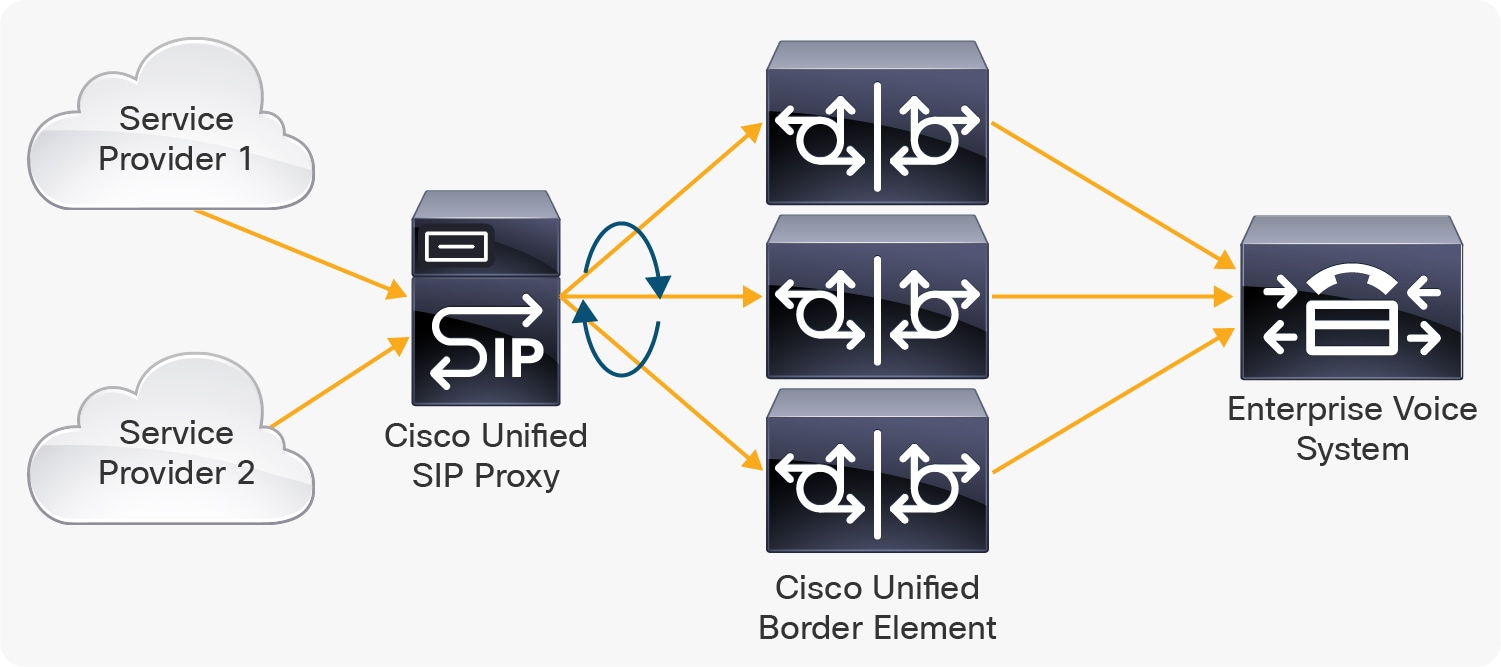
Cisco Unified Border Element Scalability and Load Balancing in a SIP Trunking Deployment
SIP Trunk for Contact Center
Whether for inbound or outbound traffic, CUSP enables routing and management across service provider trunks. Routing is also provided across multiple Cisco Unified Customer Voice Portals (CVPs) and Virtualized Voice Browsers (VVB). If a destination is unavailable, Cisco Unified SIP Proxy can intelligently reroute to an alternate resource until the original becomes available again. You can apply load balancing and rule-based routing with SIP message normalization where needed (Figure 2).
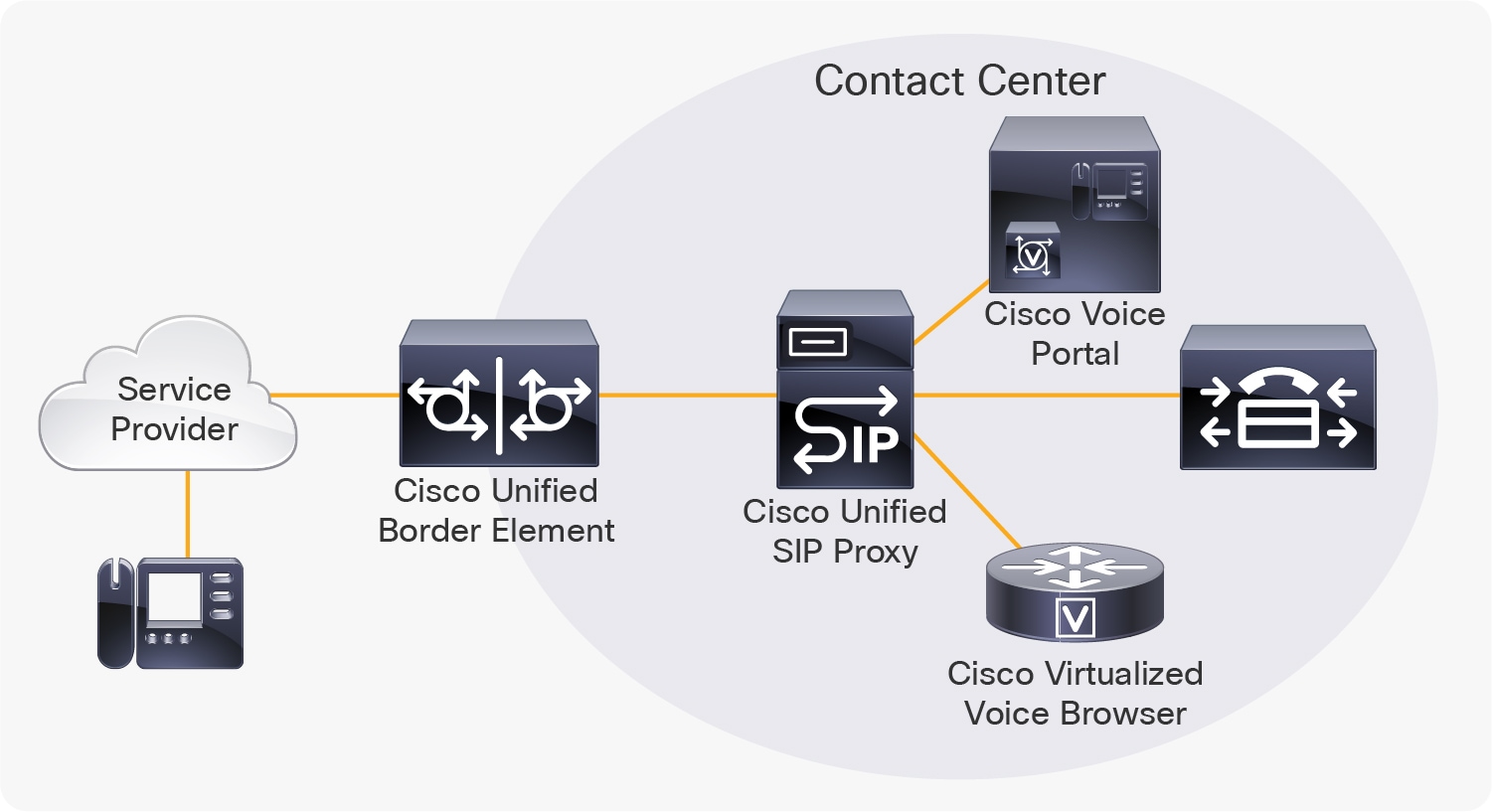
SIP Trunk for Contact Center
Cisco Unified Communications Manager and Cisco Unified Communications Manager Express SIP Aggregation
CUSP can also simplify the network for an enterprise deploying a distributed call-control network using Cisco Unified Communications Manager at large sites and Cisco Unified Communications Manager Express at the branch offices, Management of SIP dial peers across midsize and large Cisco Unified Communications Manager and Cisco Unified Communications Manager Express networks presents a challenge. Rather than building a full mesh, each system can be pointed to Cisco Unified SIP Proxy, which provides a central route point. This process also simplifies the addition and removal of new call-processing agents. If a call-processing agent is unavailable, alternate routing and recovery can be provided. You can apply load balancing and rule-based routing with SIP message normalization where needed (Figure 3).
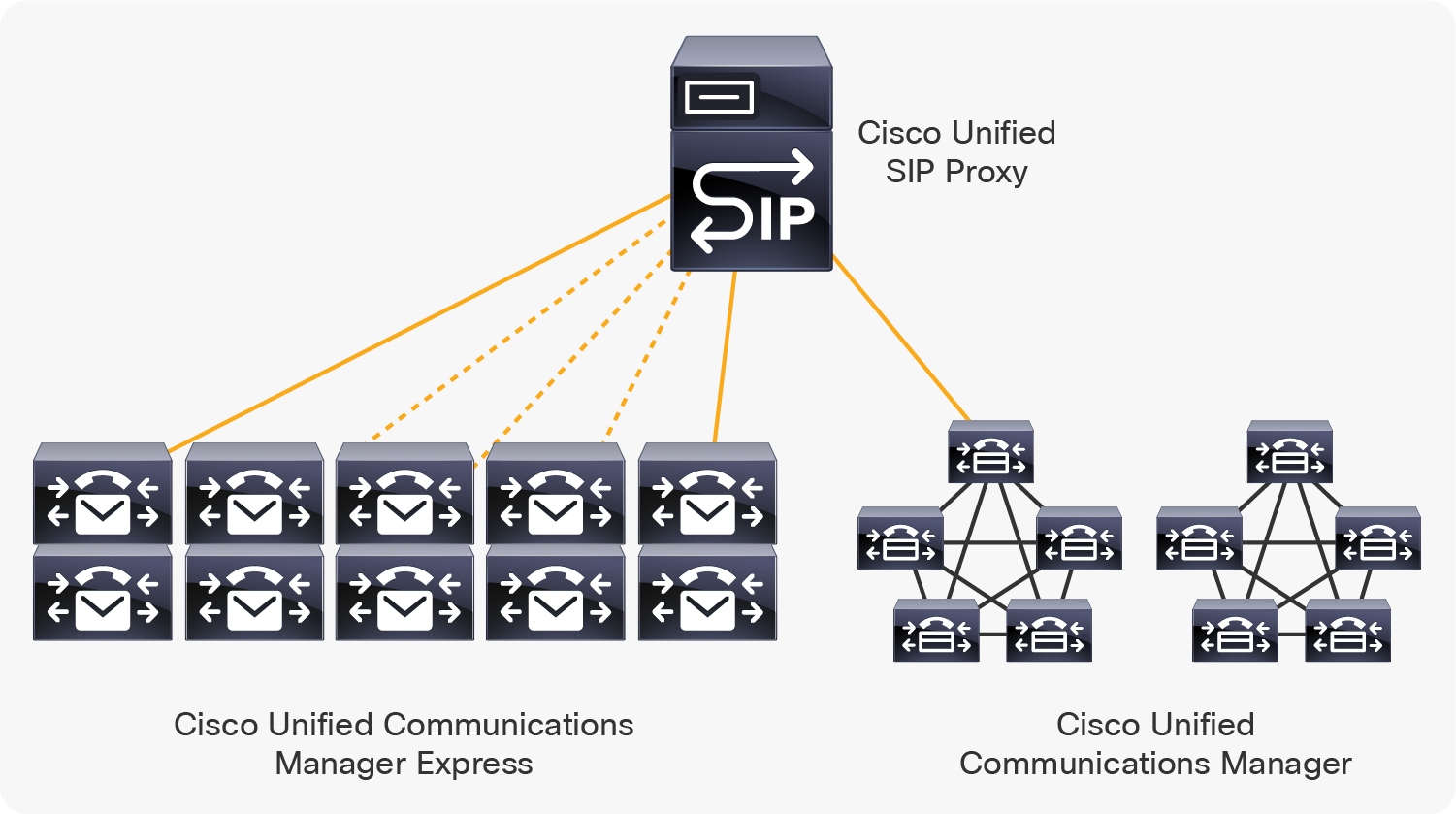
Cisco Unified Communications Manager and Cisco Unified Communications Manager Express SIP Aggregation
Service Provider SIP Interconnect Services
For interconnection among service providers, CUSP enables normalization of dial strings and SIP signaling variants. CUSP also provides routing and load balancing among SIP elements, including CUBEs (Figure 4).
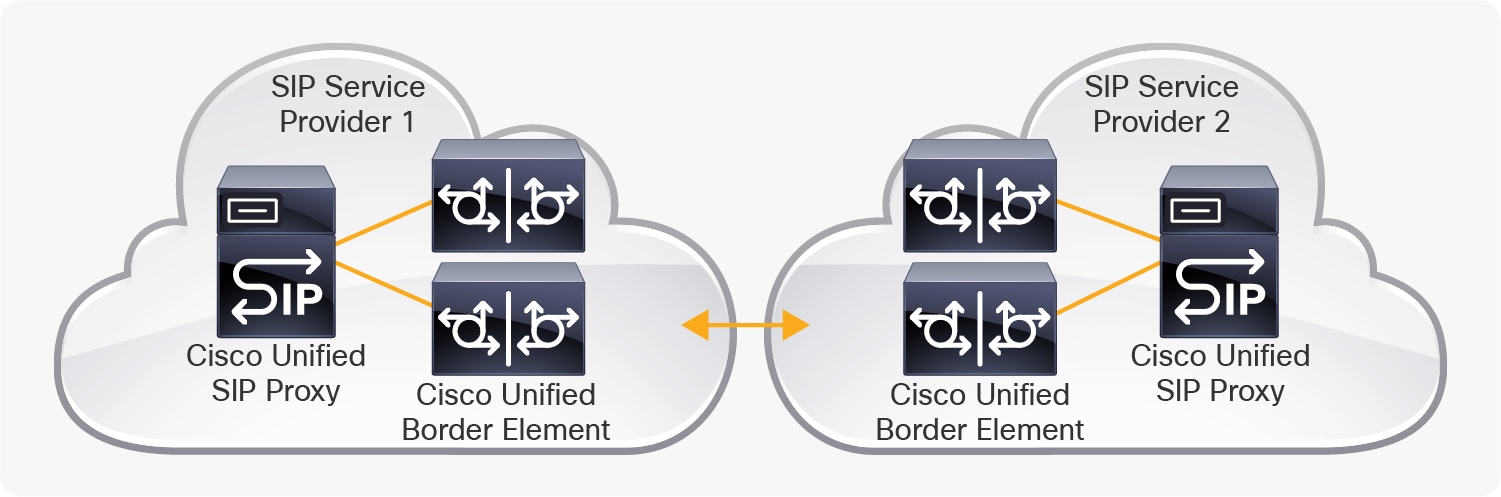
Service Provider SIP Interconnect
Cisco unified SIP Proxy call processing architecture
The Cisco Unified SIP Proxy is a call and dialog stateless SIP proxy. This means that after CUSP determines the correct SIP-based routing, it withdraws from the signaling interaction and allows the SIP-based elements to perform midcall signaling directly with one another. In a network with multiple SIP-based elements, this stateless proxy function greatly simplifies the various SIP protocol interactions between these elements. Furthermore, CUSP does not perform any media-handling functions. Instead, session media flows bypass CUSP and go directly to the SIP-based endpoints, which CUSP has interacted with in the session signaling process. CUSP can also modify SIP headers (normalization). Routing and normalization are determined based on administrator-configured policies. Policies are selected based on triggers, administrator-configured conditions that are matched based on information in the SIP message.
As SIP messages are presented to CUSP, a determination is made as to whether any pre-normalization policies need to be applied. Following pre-normalization, new triggers are used to determine application of routing policies. A further series of triggers provide for further header modification; for example, post-normalization policies after the routing decision has been made. In cases where a policy is not asserted, the proxy provides for pass-through of the SIP message (Figure 5).
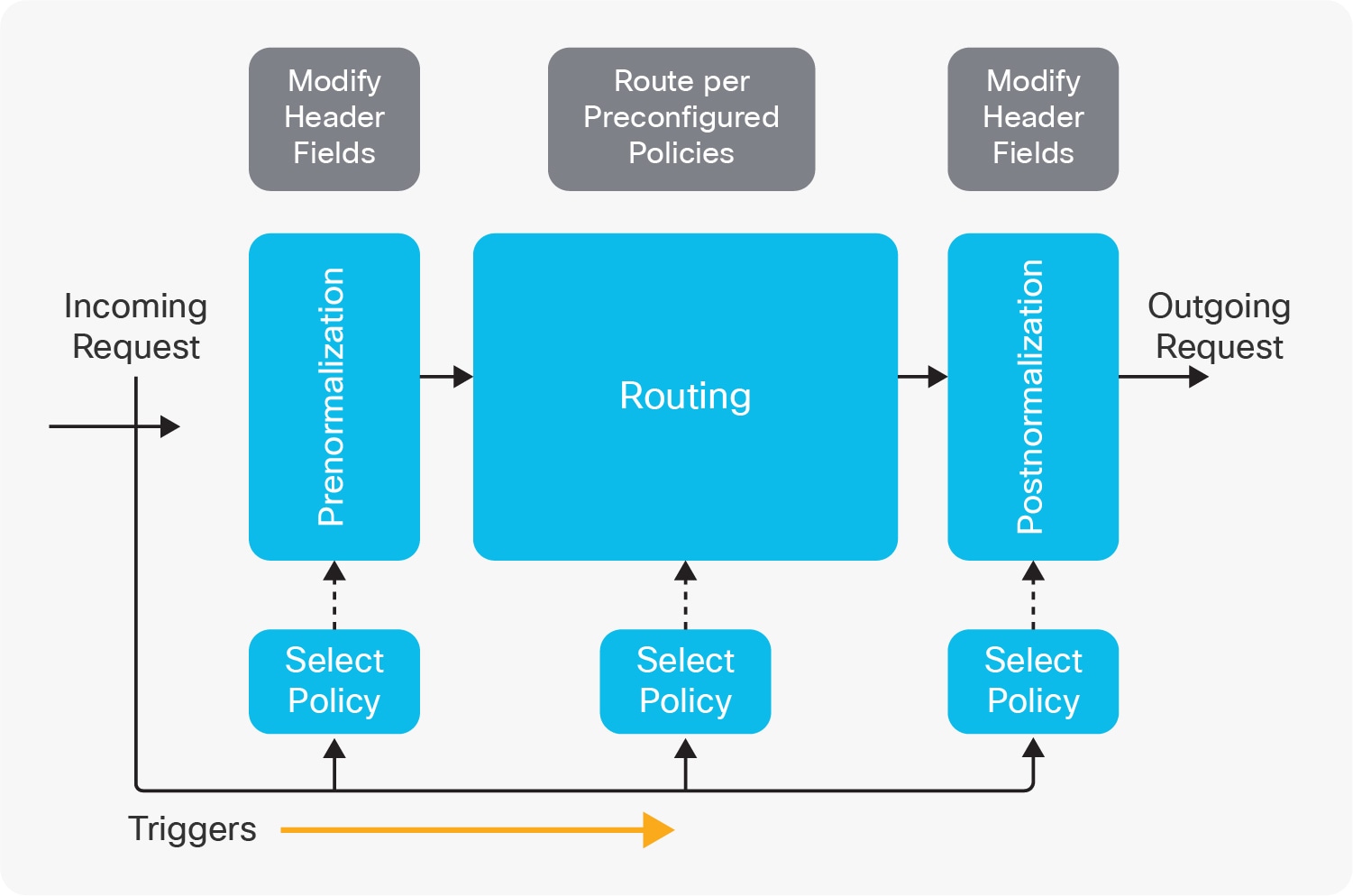
Cisco Unified SIP Proxy Call-Processing Model
You can apply distinct rules to groups of requests to create independent “virtualized proxies” within a single Cisco Unified SIP Proxy. The rules are highly flexible and scalable to form routing or normalization policies.
● Proxy for SIP unified communications signaling
● Signaling support: voice, video, fax, physical terminal line (TTY), modem, caller ID, caller name, updates, transfer, forward, hold, conference, status, Message Waiting Indicator (MWI), Dual-Tone Multifrequency (DTMF) relay, and SIP for Instant Messaging and Presence Leveraging Extensions (SIMPLE) (presence)
● Address resolution (DNS: Type A and SRV and Type NAPTR)
◦ Domain name resolution based on RFC 3263, Locating SIP Servers
● TCP, User Datagram Protocol (UDP), and Transport Layer Security (TLS)
● Standard (Record Route ON) mode: This mode keeps a record of the SIP sessions it connects. This record can be very valuable in the SIP-based network to determine if the call-routing policies (dial plan) defined within CUSP are working as intended
● Lite (Record Route OFF) mode: This mode allows Cisco Unified SIP Proxy to run at a higher SIP request rate than the standard mode call rate by disabling record-route functions. This mode is typically used after the SIP-based network call routing using CUSP has been thoroughly tested. For more details about lite mode, refer to the Performance section
● CUSP version 10 is deployed as a virtual machine on a Cisco Unified Computing System™ (Cisco UCS®) server running VMware ESXi
Routing
● Routing based on policy
● Configurable multistep routing policies with route-table lookup
◦ Configurable match rules (for example, longest prefix, exact match, and fixed-length match)
◦ Configurable keys selected from the SIP request: Remote address, local address, request for uniform Resource Identifier (URI), P-Asserted-Identity (caller ID), diversion, remote-party ID, To, and From; within these headers Cisco Unified SIP Proxy can select the user, host, port, domain, phone number, URI, carrier codes, and location routing numbers
◦ Configurable key modifiers (for example, case insensitivity, ignore plus, ignore display characters, etc.)
◦ Numerous routing decisions: Forward to a single route, forward to a route group, reject, and chain to another route policy
● Table-based routing for mapping of requests to destinations
◦ Support for large number of routes in a table (10,000+)
◦ Routes populated through Command-Line Interface (CLI) or upload of a route file
● Example routing scenarios:
◦ URI-based routing (number and name)
◦ Call block between specified sources and destinations, including policy-based transit routing (policy may require certain calls to either avoid or take certain routes)
◦ Class of restriction
◦ Translation of on-net to off-net dial plans (including public switched telephone network [PSTN] and IP-IP); simplifies network management, eliminating the need to configure translations in each call agent
● Percentage and weight-based routing
◦ Load balancing among downstream elements based on preset weight
◦ Priority values assignable for routing of selected calls; also enables configuration for least-cost routing
● Time policy routing
◦ Time(s) in a day, day(s) in a week, day(s) in a month, and month(s) in a year
● Ability to form downstream elements into a single logical group for load balancing and failover
● SIP element health management and monitoring
◦ Rerouting around unavailable SIP elements
◦ Ping for service availability and restoration of routing when unavailable SIP element is restored
● Rerouting based on redirect responses (routing policy and post-normalization applies to the new destination specified in the contact header of the redirect response, and provides for sequential forking)
● Transport protocol conversion: TCP, UDP, TLS (for example, an incoming call received over UDP can be forwarded to a destination over TLS)
● Configurable record routing (on/off)
● Global unique caller ID pass-through
Normalization
● Normalization of SIP headers based on configurable policy
◦ Ability to add, remove, or update headers and header parameters
◦ Ability to update URI components such as user, domain, and host and ability to add, remove, and update URI parameters
◦ Digit manipulation
◦ Address manipulation
◦ TEL URI <=> SIP URI conversion
◦ Domain conversions
◦ Regular-expression processing
● Construction of multistep normalization policies
● Pre- and post-normalization
◦ Pre-normalization prior to proxy application of routing rules (for example, applied to message coming into the proxy)
◦ Post-normalization after proxy application of routing rules (for example, applied to message going out from the proxy)
Rules-Based Selection of Routing and Normalization Policies
● Rich set of configurable rules
◦ SIP message type (for example, request and response)
◦ SIP method: INVITE, UPDATE, REFER, PRACK, BYE, SUBSCRIBE, NOTIFY, unsolicited NOTIFY, MESSAGE, PUBLISH, REGISTER, INFO, OPTIONS, and any custom or future SIP extensions
◦ Request-URI: User, host, phone number, etc.
◦ Local and remote IP, port, and protocol of the received SIP message
◦ Network name of the incoming and outgoing request (a network is a set of SIP listening points)
◦ Transport protocol
◦ Regular expression match on any SIP header
◦ Time policy check
◦ SIP response code
◦ Mid-dialog message check
● Call Admission Control
◦ Call counting based
Security and Privacy
● TLS (bidirectional)
● Through-header stripping (for topology hiding)
● User privacy (RFC 3325 P-Asserted ID: Removes P-Asserted ID when receiving a message from an element not configured as trusted, and removes P-Asserted ID and Privacy header when forwarding a message to an element not configured as trusted)
Network Design
● Multiple IP addresses (up to eight) to provide for flexible configuration and network topology design; you can group IP addresses to form networks and apply rules on these networks
● Multiple SIP listening points; each listening point can have a configurable port
● “Virtualized proxies” with multiple independent routing and normalization processing in a single server
● Redundancy through clustered network design for high availability
◦ Clusters addressed as fully qualified domain names (FQDNs). DNS resolution through service (SRV) record
● Very high scalability with clustering of multiple Cisco Unified SIP Proxies
◦ Hierarchical and peer requests among clustered Cisco Unified SIP Proxies, either as server-based on virtualized platforms
Management
● Flexible management through GUI and CLI
● Configuration backup and restore
● Graceful shutdown and restore, allowing for completion of transactions in process
● RADIUS accounting for SIP events
● SIP message logging for call monitoring
● Trace logging for troubleshooting
● SFTP access to CUSP for easy download of trace logs, SIP message logs, configuration files, and route files, and upload of configuration files and route files
● SIP message metrics logging (peg counting); for example, count of incoming and outgoing messages over a period of time and logging to a file
● Detailed call statistics with call attempt, success, and failure rates per element
● SNMPv2 traps and events, as follows:
◦ CUSP application status (trap)
◦ License limit call drop exception
◦ Calls per second (1-second and 1-minute average, 1-minute max)
◦ Last counter reset (date/time)
◦ Server Groups table (name, status, total calls, failed calls) (since last counter reset) (trap on these)
◦ Server Group Elements table (hostname/IP, status, total calls, failed calls) (since last counter reset) (trap on these)
◦ Calls routed (1-second and 1-minute average, 1-minute max)
◦ Calls dropped (1-second and 1-minute average, 1-minute max)
◦ Total calls (since last counter reset)
◦ Total failed calls (since last counter reset)
● Database store for debugs and logs
◦ Selectively log messages using regular expressions
◦ Search through stored log messages
◦ Store up to 1 million log messages (from version 10.2.2 onwards)
Supported Standards as a SIP Proxy
● IETF RFC 2246: TLS Protocol Version 1.0
● IETF RFC 2327: SDP - Session Description Protocol
● IETF RFC 2617: HTTP Authentication: Basic and Digest Access Authentication
● IETF RFC 2782: A DNS RR for specifying the location of services (DNS SRV)
● IETF RFC 2806: URLs for Telephone Calls
● IETF RFC 2976: The SIP INFO Method
● IETF RFC 3204: MIME Media Types for ISUP and QSIG Objects
● IETF RFC 3261: SIP - Session Initiation Protocol
● IETF RFC 3262: Reliability of Provisional Responses in SIP
● IETF RFC 3263: Locating SIP Servers
● IETF RFC 3264: An Offer/Answer Model with the Session Description Protocol (SDP)
● IETF RFC 3265: SIP-Specific Event Notification
● IETF RFC 3311: The SIP UPDATE Method
● IETF RFC 3325: Private Extensions to the SIP for Asserted Identity within Trusted Networks
● IETF RFC 3326: The Reason Header Field for SIP
● IETF RFC 3515: The SIP Refer Method
● IETF RFC 3665: SIP Basic Call Flow Examples
● IETF RFC 3666: SIP Public Switched Telephone Network (PSTN) Call Flows
● IETF RFC 3725: Best Current Practices for Third-Party Call Control (3PCC) in SIP
● IETF RFC 3842: A Message Summary and Message Waiting Indication Event Package for SIP
● IETF RFC 3856: A Presence Event Package for SIP
● IETF RFC 3891: The SIP "Replaces" Header
● IETF RFC 3892: SIP Referred-By Mechanism
● IETF RFC 4480: RPID - Rich Presence Extensions to the Presence Information Data Format (PIDF)
● IEFT RFC 5246: TLS Protocol Version 1.2
● SIP for Instant Messaging and Presence Leveraging Extensions (SIMPLE)
Cisco Unified SIP Proxy Version 10 may be used in either standard or lite mode.
Standard mode (also referred to as Record Route ON) supports the performance described by the SIP calls-per-second (CPS) licenses installed. The CUSP10-5CPS Smart License authorizes five SIP CPS. This mode is particularly recommended for contact center deployments, as it provides a complete history of SIP requests.
Lite mode (also referred to as Record Route OFF) enables CUSP to run at a higher call rate when the Record Route feature is disabled. In this mode, 2.5 times the number of configured licenses is authorized. For example, a system configured to use five CUSP10-5CPS licenses would be authorized to process up to 62 SIP CPS (rounded down).
CUSP licensing should be properly matched to the platform performance in terms of SIP calls per second.
Cisco Unified SIP Proxy Version 10 may be run on any Cisco UCS E, C, or B series server running VMware ESXi version 5.1 and newer virtualization software. When installed, Cisco Unified SIP Proxy uses 6 GB vRAM and 80 GB disk space. Virtual CPU requirements are determined based on the performance of the host server CPUs and the required call processing rate. Table 1 summarizes the vCPU requirements for different scenarios. Find out more information on Cisco UCS products.
Table 1. Cisco Unified SIP Proxy Version 10 Virtualized CPU Requirements (call routing only)
| Maximum CPS |
Host CPU less than 2.99 GHz |
2.99 GHz host CPU and above |
| 40 |
1 |
1 |
| 60 |
2 |
1 |
| 100 |
2 |
2 |
| 200 |
4 |
4 |
| 400 |
6 |
4 |
Note: Maximum performance will be reduced when features such as DNS lookup, SIP logging, or RADIUS logging are enabled.
Cisco Unified SIP Proxy Version 10 uses Cisco Smart Licensing, which provides the following benefits:
● Licenses are delivered directly to a common customer Smart Account, ready for us
● Common view of licensed devices and entitlement usage
● Cisco Unified SIP Proxy Licenses are freely portable between CUSP systems, regardless of host platform
● Licenses are additive. You don’t need to purchase confusing license upgrades to increase capacity. Simply order the appropriate number of licenses to cover your total business requirement. If more capacity is required later, simply add more licenses to your Smart Account.
Read more information about Cisco Smart Licensing.
Each Cisco Unified SIP Proxy version 10 license provides the entitlement to process 5 Calls Per Second (CPS) for either version 9 or 10 systems. Systems request a quantity of these licenses from a common Smart Account pool, based on configuration.
When ordering, use the Smart License-enabled product codes in Table 2 to ensure that entitlements are delivered directly to the customer Smart Account. All license options require at least one year of Software Support Service (SWSS) coverage.
Table 2. Cisco Unified SIP Proxy Version 10 Software Licensing Product IDs
| Part Number |
Description |
| L-CUSP |
Cisco Unified SIP Proxy (CUSP) Smart Licenses – top-level product ID |
| CUSP10-5CPS |
Cisco Unified SIP Proxy 10.x: 5 calls/sec (Smart License) |
Customers with Cisco Unified SIP Proxy Version 9 licenses covered by an active Software Support Service (SWSS) contract may order upgrades to Version 10 using the My Cisco Entitlements.
Cisco Software Support Service for Unified Communications
With three service levels to choose from (Basic, Enhanced, and Premium), SWSS for Unified Communications is designed to enable faster business outcomes, keep your company up to date with the latest technology, and give you peace of mind when it matters.
A minimum 12-month Basic Software Support Service is required for CUSP purchases, which helps reduce network disruptions and maximizes application availability by providing access to the following benefits:
● Foundational technical support – Enjoy full-time telephone, remote, and maintenance support services 24 hours a day, 7 days a week, from our award-winning Cisco Technical Assistance Center (TAC). Specialized engineers analyze complex application software and network issues to assist you with incident remediation.
● Software updates - Get software application maintenance, as well as minor and major updates to help keep your system operating efficiently and up to date.
● Online access to tools and resources help you quickly resolve technical issues, submit requests, track case resolution, and adopt new features.
Enhanced and Premium SWSS provide everything in the Basic tier, plus the support you need to increase uptime and achieve a faster return on your software investment.
To learn more about Basic, Enhanced, and Premium Software Support for Unified Communications, read about our Software Support Services.
Flexible Payment Solutions to Help You Achieve Your Objectives
Cisco Capital® financing makes it easier to get the right technology to achieve your objectives, enable business transformation, and help you stay competitive. We can help you reduce the total cost of ownership, conserve capital, and accelerate growth. In more than 100 countries, our flexible payment solutions can help you acquire hardware, software, services, and complementary third-party equipment in easy, predictable payments. Learn more.
For more information about Cisco Unified SIP Proxy, visit the CUSP website contact your local Cisco account representative.
| New or Revised Topic |
Described In |
Date |
| Replaced FTP to SFTP |
Page 9 in Features section under Management subhead |
23-Aug-2022 |
| Added (from version 10.2.2 onwards) |
Page 10 in Features section under Management subhead |
23-Aug-2022 |
| Replaced 4 GB to 6 GB |
Hardware Requirements section |
23-Aug-2022 |
| Replaced Product Upgrade Tool (PUT) to My Cisco Entitlements. (use hyperlink https://mce.cisco.com) |
Ordering section |
23-Aug-2022 |