Feedback Feedback
|

Table Of Contents
Cisco SIP Proxy Server Integration Guide for Cisco Unity Connection 1.1
Task List to Create the Integration
Task List to Make Changes to an Integration
Task List to Delete an Existing Integration
Integrations with Multiple Phone Systems
Planning How the Voice Messaging Ports Will Be Used by Cisco Unity Connection
Preparing for Programming the Phone System
Programming the Cisco SIP Proxy Server Phone System
Configure the SIP Gateway Servicing Cisco Unity Connection for the SIP Integration
Creating a New Integration with the Cisco SIP Proxy Server Phone System
(Multiple Integrations Only) Adding New User Templates
Changing the Settings for an Existing Integration
Deleting an Existing Phone System Integration
Appendix: Compatibility of Phone System Components
Appendix: Using Alternate Extensions and MWIsSetting Up Alternate Extensions
Appendix: Documentation and Technical AssistanceCisco Product Security Overview
Reporting Security Problems in Cisco Products
Obtaining Technical Assistance
Cisco Technical Support & Documentation Website
Definitions of Service Request Severity
Obtaining Additional Publications and Information
Cisco SIP Proxy Server Integration Guide for Cisco Unity Connection 1.1
Published November 22, 2005
This document provides instructions for integrating the Cisco SIP Proxy Server phone system with Cisco Unity Connection.
Integration Tasks
Before doing the following tasks to integrate Cisco Unity Connection with the Cisco SIP Proxy Server phone system, confirm that the Cisco Unity Connection server is ready for the integration by completing the applicable tasks in the Cisco Unity Connection Installation Guide.
The following task lists describe the process for creating, changing, and deleting integrations.
Task List to Create the Integration
Use the following task list to set up a new integration with the Cisco SIP Proxy Server phone system. If you are installing a new Cisco Unity Connection server by using the Cisco Unity Connection Installation Guide, you may have already completed some of the following tasks.
1.
Review the system and equipment requirements to confirm that all phone system and Cisco Unity Connection server requirements have been met. See the "Requirements" section.
2.
3.
4.
5.
6.
7.
Task List to Make Changes to an Integration
Use the following task list to make changes to an integration after it has been created.
1.
2.
Task List to Delete an Existing Integration
Use the following task list to remove an existing integration.
1.
2.
Requirements
The Cisco SIP Proxy Server integration supports configurations of the following components:
Phone System
•
•
The SIP phones must use the REFER method for call transfers.
•
For details on compatibility of the phone system components with the integration, see the "Appendix: Compatibility of Phone System Components" section.
Cisco Unity Connection Server
•
•
Network Configuration
•
Integration Description
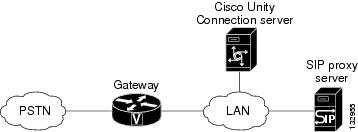
The Cisco SIP Proxy Server integration uses the SIP proxy server to set up communications between the voice messaging ports on the Cisco Unity Connection server and the applicable end point (for example, a SIP-enabled phone). The communications occur through:
•
•
Figure 1 shows the connections.
Figure 1 Connections Between the Cisco SIP Proxy Server Phone System and Cisco Unity Connection
Call Information
The proxy server sends the following information in the SIP message with the calls forwarded:
•
•
•
Cisco Unity Connection uses this information to answer the call appropriately. For example, a call forwarded to Cisco Unity Connection is answered with the personal greeting of the user. If the phone system routes the call to Cisco Unity Connection without this information, Cisco Unity Connection answers with the opening greeting.
Integration Features
The Cisco SIP Proxy Server integration with Cisco Unity Connection provides the following features.
Integrations with Multiple Phone Systems
Cisco Unity Connection can be integrated with multiple phone systems at one time. For the most recent information on and instructions for integrating Cisco Unity Connection with multiple phone systems, refer to the Multiple Phone System Integration Guide at http://www.cisco.com/en/US/products/ps6509/products_installation_and_configuration_guides_list.html.
Planning How the Voice Messaging Ports Will Be Used by Cisco Unity Connection
Before programming the phone system, you need to plan how the voice messaging ports will be used by Cisco Unity Connection.
Unlike other integrations, the hunt group mechanism for a Cisco SIP Proxy Server phone system integration is implemented on the Cisco Unity Connection server. Within a port group, each incoming call hunts for an available voice messaging port among all the ports in a round-robin (or circular) fashion. If a voice messaging port in the cluster is set not to answer calls or is not enabled, a call reaching that port may receive a busy signal.
Table 1 describes the voice messaging port settings in Cisco Unity Connection that can be set on Telephony Integrations > Port of Cisco Unity Connection Administration.
The Number of Voice Messaging Ports to Install
The number of voice messaging ports to install depends on numerous factors, including:
•
•
•
•
•
•
•
It is best to install only the number of voice messaging ports that are needed so that system resources are not allocated to unused ports.
The Number of Voice Messaging Ports That Will Answer Calls
The calls that the voice messaging ports answer can be incoming calls from unidentified callers or from users. Assign all of the voice messaging ports to answer calls.
You can set voice messaging ports to both answer calls and to dial out (for example, to set MWIs).
The Number of Voice Messaging Ports That Will Dial Out
Ports that will dial out can do one or more of the following:
•
•
•
Preparing for Programming the Phone System
Record your decisions about the voice messaging ports to guide you in programming the phone system.
Programming the Cisco SIP Proxy Server Phone System
If you use programming options other than those supplied in the following procedure, the performance of the integration may be affected. Do the following procedure.
To Program the Cisco SIP Proxy Server Phone System
Step 1
Step 2
Step 3
Note
Configure the SIP Gateway Servicing Cisco Unity Connection for the SIP Integration
To configure the SIP gateway for the SIP integration with Cisco Unity Connection, do the following three procedures.
To Configure Application Session on the Sip Gateway
Step 1
application sessionStep 2
Step 3
To Disable the SIP Media Inactivity Timer
Step 1
Router(config)# gatewayStep 2
Router(config-gateway)# no timer receive-rtcpStep 3
Router(config-gateway)# exitTo Enable DTMF Relay for SIP Calls by Using Named Telephony Events
Step 1
Router(config)# dial-peer voice <dial peer number> voipStep 2
Router(config-dial-peer)# session protocol sipv2Step 3
Router(config-dial-peer)# dtmf-relay rtp-nteStep 4
Router(config-dial-peer)# rtp payload-type nte <NTE packet payload type>
Creating a New Integration with the Cisco SIP Proxy Server Phone System
After ensuring that the Cisco SIP Proxy Server phone system and Cisco Unity Connection are ready for the integration, do the following procedures to set up the integration and to enter the port settings.
To Create an Integration
Step 1
Step 2
Step 3
Step 4
Step 5
Step 6
Step 7
Step 8
Step 9
Step 10
Step 11
Step 12
Note
Step 13
Step 14
a.
b.
Note
c.
Step 15
Step 16
Note
Step 17
Step 18
Step 19
Step 20
Step 21
Step 22
Step 23
Step 24
Step 25
Step 26
Step 27
If the test is not successful, the Task Execution Results displays one or more messages with troubleshooting steps. After correcting the problems, test the connection again.
Step 28
Step 29
Testing the Integration
To test whether Cisco Unity Connection and the phone system are integrated correctly, do the following procedures in the order listed.
If any of the steps indicate a failure, refer to the following documentation as applicable:
•
•
To Set Up the Test Configuration
Step 1
Step 2
Caution
Step 3
Step 4
Step 5
Step 6
Step 7
Step 8
Step 9
Step 10
Step 11
Step 12
Step 13
Step 14
Step 15
Step 16
Step 17
Step 18
Step 19
Do not close the Cisco Unity Connection Administration window because you will use it again in a later procedure.
Step 20
Step 21
Step 22
To Test an External Call with Release Transfer
Step 1
Step 2
Step 3
Step 4
Step 5
Step 6
Step 7
Step 8
Step 9
Step 10
To Test Listening to Messages
Step 1
Step 2
Step 3
Step 4
Step 5
Step 6
Step 7
Step 8
To Set Up Supervised Transfer on Cisco Unity Connection
Step 1
Step 2
Step 3
Step 4
Do not close the Cisco Unity Connection Administration window because you will use it again in a later procedure.
To Test Supervised Transfer
Step 1
Step 2
Step 3
Step 4
Step 5
Step 6
Step 7
Step 8
Step 9
To Delete the Test User
Step 1
Step 2
Step 3
(Multiple Integrations Only) Adding New User Templates
When you create the first phone system integration, this phone system is automatically selected in the default user template. The users that you add after creating this phone system integration will be assigned to this phone system by default.
However, for each additional phone system integration that you create, you must add the applicable new user templates that will assign users to the new phone system. You must add the new templates before you add new users who will be assigned to the new phone system.
For details on adding new user templates, refer to the "Adding, Changing, or Deleting an Account Template" chapter in the Cisco Unity Connection User Moves, Adds, and Changes Guide at http://www.cisco.com/en/US/products/ps6509/prod_maintenance_guides_list.html.
For details on selecting a user template when adding a new user, refer to the applicable chapter for adding user accounts in the Cisco Unity Connection User Moves, Adds, and Changes Guide at http://www.cisco.com/en/US/products/ps6509/prod_maintenance_guides_list.html.
Changing the Settings for an Existing Integration
After the integration is set up, if you want to change any of its settings (for example, to add or remove voice messaging ports for an integration), do the following procedure.
To Change the Settings for an Integration
Step 1
Step 2
Step 3
•
•
•
Step 4
Step 5
Caution
Step 6
Step 7
Step 8
Step 9
If the test is not successful, the Task Execution Results displays one or more messages with troubleshooting steps. After correcting the problems, test the connection again.
Step 10
Step 11
Deleting an Existing Phone System Integration
If you want to delete an existing phone system integration (for example, you have replaced the phone system with which Cisco Unity Connection originally integrated), confirm that the following items are deleted or associated to another phone system:
•
To see a list of users associated with the phone system, in Cisco Unity Connection Administration, expand Telephony Integrations > Phone System; click the name of the phone system; on the Phone System Basics page, on the Edit menu, click Phone System Associations.
•
•
•
If users, user templates, call handlers, MWI devices, or notification devices are associated with this phone system, Cisco Unity Connection cannot delete the phone system.
When you attempt to delete a phone system that still has these items associated with it, a status warning will appear with a link to the Delete Phone System Wizard. This wizard will guide you to associate all items from the phone system that you want to delete to another phone system.
All users, user templates, call handlers, MWI devices and notification devices that are associated with a phone system must be reassigned before the phone system can be deleted.
Note
It is not necessary to delete the port groups or ports that belong to a phone system before deleting the phone system integration. The member port groups and ports will be automatically deleted with the phone system.
Note
Do the following procedure.
To Delete an Existing Phone System Integration
Step 1
Step 2
Step 3
Step 4
Step 5
Step 6
Step 7
Step 8
Appendix: Compatibility of Phone System Components
Testing has shown compatibility of the following phone system components with Cisco Unity Connection in a SIP integration.
Other compatibility issues are:
•
•
•
Appendix: Using Alternate Extensions and MWIs
Alternate Extensions
On the New Phone Number page for a user, you can assign up to nine alternate extensions for the user. (The primary extension is the one that you assign to each user when the user is added to Cisco Unity Connection.)
Reasons to Use Alternate Extensions
There are several reasons that you may want to specify alternate extensions for users. For example, if you have more than one Cisco Unity Connection server that accesses a single, corporate-wide directory, you may want to use alternate extensions to simplify addressing messages to users at the different locations. With alternate extensions, the number that a user enters when addressing a message to someone at another location can be the same number that the user dials when calling. You may also want to use alternate extensions to:
•
•
•
How Alternate Extensions Work
Before you set up alternate extensions, review the following list for information on how alternate extensions work:
•
•
•
•
Setting Up Alternate Extensions
Do the applicable procedure to add, modify, or delete alternate extensions:
•
•
•
To Add Administrator-Defined Alternate Extensions
Step 1
Step 2
Step 3
Step 4
Step 5
Step 6
Step 7
To Modify Alternate Extensions
Step 1
Step 2
Step 3
Step 4
Step 5
Step 6
To Delete Alternate Extensions
Step 1
Step 2
Step 3
Step 4
Step 5
Alternate MWIs
You can set up Cisco Unity Connection to activate alternate MWIs when you want a new message for a user to activate the MWIs at up to 10 extensions. For example, a message left at extension 1001 can activate the MWIs on extensions 1001 and 1002.
Cisco Unity Connection uses MWIs to alert the user to new voice messages. MWIs are not used to indicate new e-mail, fax, or return receipt messages.
Setting Up Alternate MWIs
Cisco Unity Connection can activate alternate MWIs. Note that depending on the phones and phone systems, some additional phone system programming may be necessary. Refer to the installation guide for the phone system.
Do the applicable procedure to add, modify, or delete alternate MWIs:
•
To Add Alternate MWIs for Extensions
Step 1
Step 2
Step 3
Step 4
Step 5
Step 6
Step 7
To Modify Alternate MWIs
Step 1
Step 2
Step 3
Step 4
Step 5
Step 6
Step 7
To Delete Alternate MWIs
Step 1
Step 2
Step 3
Step 4
Step 5
Appendix: Documentation and Technical Assistance
Conventions
The Cisco SIP Proxy Server Integration Guide for Cisco Unity Connection 1.1 uses the following conventions.
The Cisco SIP Proxy Server Integration Guide for Cisco Unity Connection 1.1 also uses the following conventions:
Note
Caution
For descriptions and URLs of Cisco Unity Connection documentation on Cisco.com, see the About Cisco Unity Connection Documentation. The document is shipped with Cisco Unity Connection and is available at http://www.cisco.com/en/US/products/ps6509/products_documentation_roadmaps_list.html.
Obtaining Documentation
Cisco documentation and additional literature are available on Cisco.com. Cisco also provides several ways to obtain technical assistance and other technical resources. These sections explain how to obtain technical information from Cisco Systems.
Cisco.com
You can access the most current Cisco documentation at this URL:
http://www.cisco.com/techsupport
You can access the Cisco website at this URL:
You can access international Cisco websites at this URL:
http://www.cisco.com/public/countries_languages.shtml
Product Documentation DVD
Cisco documentation and additional literature are available in the Product Documentation DVD package, which may have shipped with your product. The Product Documentation DVD is updated regularly and may be more current than printed documentation.
The Product Documentation DVD is a comprehensive library of technical product documentation on portable media. The DVD enables you to access multiple versions of hardware and software installation, configuration, and command guides for Cisco products and to view technical documentation in HTML. With the DVD, you have access to the same documentation that is found on the Cisco website without being connected to the Internet. Certain products also have .pdf versions of the documentation available.
The Product Documentation DVD is available as a single unit or as a subscription. Registered Cisco.com users (Cisco direct customers) can order a Product Documentation DVD (product number DOC-DOCDVD=) from Cisco Marketplace at this URL:
http://www.cisco.com/go/marketplace/
Ordering Documentation
Beginning June 30, 2005, registered Cisco.com users may order Cisco documentation at the Product Documentation Store in the Cisco Marketplace at this URL:
http://www.cisco.com/go/marketplace/
Nonregistered Cisco.com users can order technical documentation from 8:00 a.m. to 5:00 p.m. (0800 to 1700) PDT by calling 1 866 463-3487 in the United States and Canada, or elsewhere by calling 011 408 519-5055. You can also order documentation by e-mail at tech-doc-store-mkpl@external.cisco.com or by fax at 1 408 519-5001 in the United States and Canada, or elsewhere at 011 408 519-5001.
Documentation Feedback
You can rate and provide feedback about Cisco technical documents by completing the online feedback form that appears with the technical documents on Cisco.com.
You can send comments about Cisco documentation to bug-doc@cisco.com.
You can submit comments by using the response card (if present) behind the front cover of your document or by writing to the following address:
Cisco Systems
Attn: Customer Document Ordering
170 West Tasman Drive
San Jose, CA 95134-9883We appreciate your comments.
Cisco Product Security Overview
Cisco provides a free online Security Vulnerability Policy portal at this URL:
http://www.cisco.com/en/US/products/products_security_vulnerability_policy.html
From this site, you can perform these tasks:
•
•
•
A current list of security advisories and notices for Cisco products is available at this URL:
If you prefer to see advisories and notices as they are updated in real time, you can access a Product Security Incident Response Team Really Simple Syndication (PSIRT RSS) feed from this URL:
http://www.cisco.com/en/US/products/products_psirt_rss_feed.html
Reporting Security Problems in Cisco Products
Cisco is committed to delivering secure products. We test our products internally before we release them, and we strive to correct all vulnerabilities quickly. If you think that you might have identified a vulnerability in a Cisco product, contact PSIRT:
•
An emergency is either a condition in which a system is under active attack or a condition for which a severe and urgent security vulnerability should be reported. All other conditions are considered nonemergencies.
•
In an emergency, you can also reach PSIRT by telephone:
•
•
Tip
Never use a revoked or an expired encryption key. The correct public key to use in your correspondence with PSIRT is the one linked in the Contact Summary section of the Security Vulnerability Policy page at this URL:
http://www.cisco.com/en/US/products/products_security_vulnerability_policy.html
The link on this page has the current PGP key ID in use.
Obtaining Technical Assistance
Cisco Technical Support provides 24-hour-a-day award-winning technical assistance. The Cisco Technical Support & Documentation website on Cisco.com features extensive online support resources. In addition, if you have a valid Cisco service contract, Cisco Technical Assistance Center (TAC) engineers provide telephone support. If you do not have a valid Cisco service contract, contact your reseller.
Cisco Technical Support & Documentation Website
The Cisco Technical Support & Documentation website provides online documents and tools for troubleshooting and resolving technical issues with Cisco products and technologies. The website is available 24 hours a day, at this URL:
http://www.cisco.com/techsupport
Access to all tools on the Cisco Technical Support & Documentation website requires a Cisco.com user ID and password. If you have a valid service contract but do not have a user ID or password, you can register at this URL:
http://tools.cisco.com/RPF/register/register.do
Note
Submitting a Service Request
Using the online TAC Service Request Tool is the fastest way to open S3 and S4 service requests. (S3 and S4 service requests are those in which your network is minimally impaired or for which you require product information.) After you describe your situation, the TAC Service Request Tool provides recommended solutions. If your issue is not resolved using the recommended resources, your service request is assigned to a Cisco engineer. The TAC Service Request Tool is located at this URL:
http://www.cisco.com/techsupport/servicerequest
For S1 or S2 service requests or if you do not have Internet access, contact the Cisco TAC by telephone. (S1 or S2 service requests are those in which your production network is down or severely degraded.) Cisco engineers are assigned immediately to S1 and S2 service requests to help keep your business operations running smoothly.
To open a service request by telephone, use one of the following numbers:
Asia-Pacific: +61 2 8446 7411 (Australia: 1 800 805 227)
EMEA: +32 2 704 55 55
USA: 1 800 553-2447For a complete list of Cisco TAC contacts, go to this URL:
http://www.cisco.com/techsupport/contacts
Definitions of Service Request Severity
To ensure that all service requests are reported in a standard format, Cisco has established severity definitions.
Severity 1 (S1)—Your network is "down," or there is a critical impact to your business operations. You and Cisco will commit all necessary resources around the clock to resolve the situation.
Severity 2 (S2)—Operation of an existing network is severely degraded, or significant aspects of your business operation are negatively affected by inadequate performance of Cisco products. You and Cisco will commit full-time resources during normal business hours to resolve the situation.
Severity 3 (S3)—Operational performance of your network is impaired, but most business operations remain functional. You and Cisco will commit resources during normal business hours to restore service to satisfactory levels.
Severity 4 (S4)—You require information or assistance with Cisco product capabilities, installation, or configuration. There is little or no effect on your business operations.
Obtaining Additional Publications and Information
Information about Cisco products, technologies, and network solutions is available from various online and printed sources.
•
http://www.cisco.com/go/marketplace/
•
•
•
http://www.cisco.com/go/iqmagazine
or view the digital edition at this URL:
http://ciscoiq.texterity.com/ciscoiq/sample/
•
•
http://www.cisco.com/en/US/products/index.html
•
http://www.cisco.com/discuss/networking
•
http://www.cisco.com/en/US/learning/index.html
© 2005 Cisco Systems, Inc. All rights reserved.