Feedback Feedback
|

Table Of Contents
1.1.32 Version Software Release Notes Cisco WAN MGX 8850, 8230, and 8250 Software
Features Introduced in Release 1.1.32
Support for Multiple RPM Card Types
Support for RPM-PR Module with MGX-PXM1
Features Introduced in Release 1.1.31
ForeSight and Standard ABR Coexistence Guidelines
Independent Service Rate on FRSM-HS1/B
Standard ABR on FRSM-8 and FRSM8-C Modules
VISM 2.0.0 on MGX 8230/8250/8850
Features Introduced in Release 1.1.25
Features Introduced in Release 1.1.24
Continued Support for the MGX 8850
Features Introduced in Release 1.1.23
Release 1.1.32 MGX 8850, MGX 8230, and MGX 8250 Hardware
MGX 8220 Hardware Not Supported on Release 1.1.32 of the MGX 8850
MGX 8220 Hardware That Has Been Superseded on the MGX 8850 by MGX 8850-Specific Hardware
MGX 8220 Hardware Not Supported on the MGX 8850
Features Not Supported in This Release
Major Network Management Features
ForeSight and Standard ABR Coexistence Guidelines
CLI Modification and Changes in this Release
Problems Fixed in Release 1.1.32
Problems Fixed in Release 1.1.31
Problems Fixed in Release 1.1.25
Problems Fixed in Release 1.1.24
Problems Fixed in Release 1.1.23
MGX 8230/8250/8850 Software Interoperability with Other Products
MGX 8850 Firmware Compatibility
RPM IOS Compatibility (MGX 8850)
MGX 8250 Firmware Compatibility
RPM IOS Compatibility (MGX 8250)
MGX 8230 Firmware Compatibility
RPM IOS Compatibility (MGX 8230)
Special Installation and Upgrade Requirements
Single PXM Installation Procedure
Installation Procedure for Redundant PXMs
Service Module Firmware Download Procedure
Manual Configuration of Chassis Identification
Chassis Identification During a Firmware Upgrade
Service Module Installation/Upgrade and Flash Download Requirements.
Known Anomalies for Platform Software and Service Module Firmware
Known Anomalies for RPM release 12.1(1)T
Known Anomalies for RPM Release 12.0(5)T1
RPM Configuration Examples for MPLS-based Virtual Private Networks
One PE - Two CE Configuration - OSPF & IBPG Between PEs & EBGP between PE-CE
One PE - Two CE Configuration - OSPF & IBPG Between PEs & RIP between PE-CE
One PE - Two CE Configuration - OSPF & IBPG Between PEs & STATIC ROUTES between PE-CE
Route Processor Module (RPM) Addendum
About the Cisco IOS 12.1(5.3)T_XT Release
Special Upgrade Requirements for RPM
General Upgrade/Downgrade Guidelines
Upgrade a RPM/B Module to RPM-PR
Install an RPM-PR Module in a Fresh Slot
Operate an RPM/B or RPM-PR in an MGX 8230 Chassis
RPM-PR Back Ethernet Card Support
RPM/B Ethernet Back Card Support
Problems Fixed with IOS 12.1(5.3)T_XT
Known Anomalies from Previous Releases
Obtaining Technical Assistance
Contacting TAC by Using the Cisco TAC Website
1.1.32 Version Software Release Notes Cisco WAN MGX 8850, 8230, and 8250 Software
About These Release Notes
Cisco documentation and additional literature are available in a CD-ROM package, which ships with your product. The Documentation CD-ROM, a member of the Cisco Connection Family, is updated monthly. Therefore, it might be more current than printed documentation. To order additional copies of the Documentation CD-ROM, contact your local sales representative or call customer service. The CD-ROM package is available as a single package or as an annual subscription. You can also access Cisco documentation on the World Wide Web at http://www.cisco.com, http://www-china.cisco.com, or http://www-europe.cisco.com.
If you are reading Cisco product documentation on the World Wide Web, you can submit comments electronically. Click Feedback in the toolbar, select Documentation, and click Enter the feedback form. After you complete the form, click Submit to send it to Cisco. We appreciate your comments.
About the 1.1.32 Release
This is a maintenance release including all features supported up to release 1.1.25.
Features Introduced in Release 1.1.32
Stratum 3 Clocking Support
Support for Stratum 3 Clocking, including the PXM-UI-S3 back card, is GA with Release 1.1.32 (this feature was supported in field trials only with Release 1.1.31). Refer to Stratum-3 Clocking, for additional information and descriptions.
Feature Descriptions
Note
Please refer to the "Route Processor Module (RPM) Addendum" section for additional information and special instructions on the installation of RPM modules with Release 1.1.32.
Support for Multiple RPM Card Types
When multiple RPM card types are present in the network, the PXM1 will recognize and display the correct RPM card type. The current RPM card types are RPM/B and RPM-PR. The MGX 1.1.32 Release contains PXM code base changes that recognize the multiple RPM card types.
Support for RPM-PR Module with MGX-PXM1
The RPM-PR provides the following features:
•
•
•
•
The higher-performance RPM requires Software Release 1.1.32, IOS version 12.1(5.3)T_XT and a minimum CWM version of 10.4.
Support for RPM/B in MGX 8230
Installation of the RPM/B in the MGX 8230 requires Release 1.1.32 and IOS version 12.1(5.3)T_XT.
Note
Features Introduced in Release 1.1.31
The following Features are available for the MGX 8850, MGX 8250, and MGX 8230 with Release 1.1.31 and IOS 12.1(3)T:
Feature Descriptions
For descriptions of the features introduced in Release 1.1.31, see the following sections:
•
•
•
•
CoS Map for FRSM-8
This feature implements the ATM Class of Service (CoS) on the FRSM-8 Module. This feature maps the connection with ATM Class of Service parameters to the appropriate queue in the ingress side of the FRSM-8 and PXM.
Previous versions do not support any CoS type of connections; only ForeSight and non-ForeSight type connections are supported. By mapping the CoS parameters, the connections can then be scheduled in the appropriate queue on the PXM.
The following service types are added to the existing service types: UBR, VBR, VBR-RT, VBR-nRT, and STD-ABR. The current limit on connection count is to be retained as far as possible. This feature is supported by CWM 10.3 (which is not targeted for General Availability).
DS3 Loopback on PXM-T3
This feature enables the active PXM to initiate the DS3 loopback code (program the T3 framers to generate the sequence of 16 bit FEAC codes, or Far End Alarm and Control codes). The main functions are:
•
•
The active PXM will initiate this code, which will also run on the standby PXM. This feature has CLI support and is supported by CWM 10.3 (which is not targeted for General Availability).
ForeSight and Standard ABR Coexistence Guidelines
With Release 1.1.31, both ABR TM4.0 and ForeSight congestion control are supported on the FRSM and AUSM modules. This document contains the following:
•
•
•
Independent Service Rate on FRSM-HS1/B
This feature provides the capability to configure a connection service rate in the ingress direction. Users can also specify EIR if connection is "0" of CIR. This feature is already implemented in FRSM-8 and FRSM-VHS.
This functionality is the same as that provided in FRSM-8 and FRSM-VHS. This feature is not supported by CWM 10.3 (which is not targeted for General Availability).
Online Diagnostics for PXM
This feature provides hardware tests to check the health of the SRM and PXM modules (both active and standby). This test is non-intrusive and operates with minimum overhead while the shelf is running. Connections, states and tasks are not affected.
The Online Diagnostics are optional tests operated through CLI and SNMP interfaces. The test is invoked from the active PXM. If a standby PXM exists and is in standby state, it also will be tested. When the test is executed, each component is checked and the results are presented on the screen. The results of the diagnostics are written to a log file so they can be viewed and analyzed offline.
Initially, intelligence is not provided, but built-in intelligence may be considered as a future enhancement. The hardware and software components selected for running the diagnostics will be selected from field experience. The targets are hard disk and memory components. Although the intent is to check the health of the hardware, a switchover should not occur except under severe circumstances.
SRM in MGX 8230
This feature provides SRM support in the MGX 8230. Only the newest version of the SRM, MGX-SRM-3T3/C, is supported in the 8230 chassis. This feature is not supported by CWM 10.3 (which is not targeted for General Availability), but is planned for a future release.
Standard ABR on AUSM
This feature involves implementing the standards-based TM 4.0 ABR congestion control loop. The current AUSM-8 card only supports ForeSight, which is pre-standards-based. Standard ABR is required on AUSM cards in order for them to interoperate with third-party devices that support standard ABR and AXSM cards.
Support for standard ABR calls for implementing the RM cells to perform the flow control. All three modes are considered: EFCI, ER, and RR. Only modes that can be supported on the existing hardware are implemented. In addition, all appropriate behaviors are implemented. These behaviors include Source, Destination, and Switch. Connections with the standard ABR parameter are mapped to the appropriate queue. This feature includes new CLI and MIB support. Also expected for the CWM support is the appropriate formula. Due to current hardware limitation, VS/VD is not considered. This feature is supported by CWM 10.3 (which is not targeted for General Availability).
Standard ABR on FRSM-8 and FRSM8-C Modules
The feature implements TM 4.0 ABR service on the FRSM card. The current FRSM supports ForeSight, a pre-standard version of congestion control. This feature provides standards-compliant ABR congestion mechanism in addition to ForeSight. The module will generate RM cells to dynamically increase or decrease bandwidth rate. This includes all applicable modes of behavior: Source, Destination, and Switch. Only relevant modes need be considered. Connections with the standard ABR parameter will be mapped to the appropriate queues and will co-exist with ForeSight connection types.
This feature is implemented via appropriate MIBS and CLI. This feature is supported by CWM 10.3 (which is not targeted for General Availability). ABR license (similar to ForeSight license) is created and is a billable feature. One common license is available for either ForeSight or standard ABR on FRSM. Standard ABR fulfils the standards-compliance part of TM 4.0.
Stratum-3 Clocking
Standard clocking in the MGX is supported with a built-in Stratum-4 clock source. For network applications that require a higher clock accuracy, the PXM-UI back card used with the Stratum-4 can be replaced with an optional PXM-UI-S3 back card that carries a Stratum-3 clock. This clock reference conforms to AT&T T1.5 and ITU G.824 specifications. A provision is also made for a Service Provider to connect an external clock source, if necessary.
Both holdover and fail-over modes are supported by the PXM-UI-S3. That is, if all clock sources fail, the Stratum-3 clock will hold the last best-known clocking frequency.
The default clock is the internal Stratum-4. Pertinent CLI and MIB support are provided for Stratum-3 configuration. The PXM-UI-S3 back card is also recognized by the Cisco WAN Manager.
Hardware Changes
A new PXM-UI-S3 back card replaces existing PXM-UI-B cards.
The new PXM-UI-S3 supports both T1 and E1 interfaces through an RJ-45/48 connector.
CLI
A new CLI cnfclklevel permits the user to set the STRATUM level desired.
Default Settings
The default clock source is set to be the Internal Oscillator. Subsequently, an External/Inband/SM clock can be configured to be the primary/secondary clock driving the node.
Limitations
There are two physical ports on the PXM-UI-S3 back card for providing External clock. However, only "Ext Clk 1" is currently supported. There are 2 physical LAN ports on the PXM-UI-S3 back card. However, only "LAN port 1" is currently supported.
Warning
* cnfclklevel 3
* cnfextclk (with T1/E1 option)
VBR-rt on AUSM
This feature involves implementing the standard Class of Service on the AUSM-8 Module. VBR-rT CoS is required for video and real time voice applications. In terms of conformance definition it is same as VBR-nRT, which is already supported. The connection parameters will be bounded by Peak Cell rate (PCR), Sustainable Cell Rate (SCR) and Maximum Burst Size (MBS). Cell Delay Variation Tolerance (CDVT) will be parameter to characterize the PCR.
This new CoS requires scheduling the appropriate queue in both the ingress and egress direction. It has lower priority than CBR but higher than VBR-nRT.
Appropriate CLI commands to configure the parameters are implemented. This feature is supported by CWM 10.3 (which is not targeted for General Availability).
VISM 1.5.5 on MGX 8250/8850
VISM 1.5.5 is supported on MGX 8250/8850. For VISM on MGX 8230, please use VISM 2.0.0 listed below. CWM 10.3 (which is not targeted for General Availability) supports VISM 1.5.5. VISM is not targeted for General Availability.
VoIP using RTP (RFC 1889)
VISMR1.5 supports standards-based VoIP using RTP (RFC1889) and RTCP protocols. This allows VISM to interwork with other VoIP Gateways.
VoAAL2 (With sub-cell multiplexing) PVC
The VISM supports standards-compliant AAL2 adaptation for the transport of voice over an ATM infrastructure. AAL2 trunking mode is supported.
Codec Support
G.711 PCM (A-law, Mu-law), G.726, G.729a/b
8 T1/E1 Interfaces
The VISM supports 8 T1 or 8 E1 interfaces when G.711 PCM coding is used. For higher complexity coders such as G.726-32K and G.729a-8K, the density drops to 6 T1 or 5 E1 interfaces (max 145 channels).
1:N redundancy using SRM.
T3 Interfaces (via SRM Bulk Distribution)
T3 interfaces are supported using the SRM's bulk distribution capability. In this case, the T3 interfaces are physically terminated at the SRM module. The SRM module breaks out the individual T1s and distributes the T1s via the TDM backplane bus to the individual VISM cards for processing.
Echo Cancellation
The VISM provides on-board echo cancellation on a per-connection basis. Up to 128 msec user-configurable near-end delay can be canceled. The echo cancellation is compliant with ITU G.165 and G.168 specifications.
Voice Activity Detection (VAD)
VISM uses VAD to distinguish between silence and voice on an active connection. VAD reduces the bandwidth requirements of a voice connection by not generating traffic during periods of silence in an active voice connection. At the far-end, comfort noise is generated.
Fax/Modem Detection for ECAN and VAD Control
The VISM continually monitors and detects fax and modem carrier tones. When carrier tone from a fax or modem is detected, the connection is upgraded to full PCM to ensure transparent connectivity. Fax and modem tone detection ensures compatibility with all voice-grade data connections.
CAS Tunneling via AAL2 (For AAL2 Trunking Mode)
The VISM in AAL2 mode facilitates transport of CAS signaling information. CAS signaling information is carried transparently across the AAL2 connection using type 3 packets. In this mode, VISM does not interpret any of the signaling information.
PRI Tunneling via AAL5 (For AAL2 Trunking Mode)
VISM supports transport of D-ch signaling information over an AAL5 VC. The signaling channel is transparently carried over the AAL5 VC and delivered to the far-end. In this mode, VISM does not interpret any of the signaling messages.
Voice CAC
VISM can be configured to administer Connection Admission Control (CAC) so that the bandwidth distribution between voice and data can be controlled in AAL2 mode.
Type 3 Packet for DTMF
The VISM in AAL2 mode facilitates transport of DTMF signaling information. DTMF information is carried transparently across the AAL2 connection using type 3 packets.
Dual (Redundant) PVCs for Bearer/Control
The VISM provides the capability to configure two PVCs for bearer/signaling traffic terminating on two external routers (dual-homing). VISM continually monitors the status of the active PVC by using OAM loopback cells. Upon detection of failure, the traffic is automatically switched over to the backup PVC.
64 K Clear Channel Transport
The VISM supports 64 Kbps clear channel support. In this mode, all codecs are disabled and the data is transparently transported through the VISM.
DTMF Relay for G.729
In VoIP mode, DTMF signaling information is transported across the connection using RTP NSE (Named Signaling Event) packets
MGCP 0.1 for VoIP with Softswitch Control
VISM supports Media Gateway Control Protocol (MGCP) Version 0.1. This open protocol allows any Softswitch to interwork with the VISM module.
Resource Coordination via SRCP
Simple Resource Control Protocol (SRCP) provides a hearbeat mechanism between the VISM and the Softswitch. In addition, SRCP also provides the Softswitch with gateway auditing capabilities.
Full COT Functions
VISM provides the capability to initiate continuity test as well as provide loopbacks to facilitate continuity tests when originated from the far-end.
Courtesy Down
This feature provides a mechanism for graceful upgrades. By enabling this feature, no new calls are allowed on the VISM while not disrupting the existing calls. Eventually, when there are no more active calls, the card is ready for a upgrade and/or service interruption.
VISM 2.0.0 on MGX 8230/8250/8850
VISM 2.0.0 supports all of the VISM 1.5.5 features listed above. VISM 2.0.0 is supported on MGX 8230/8250/8850. CWM 10.3 (which is not targeted for General Availability) supports VISM 2.0.0. VISM is not targeted for General Availability.
PRI Backhaul to the Softswitch Using RUDP
The PRI backhaul capability provides PRI termination on the VISM with the Softswitch providing call control. ISDN Layer 2 is terminated on the VISM and the layer 3 messages are transported to the Softswitch using RUDP.
Latency Reduction (<60 ms round-trip)
Significant improvements have been made to bring the round-trip delay to less than 60 ms.
Codecs Preference
VISM provides the capability to have the codecs negotiated between the two end-points of the call. The VISM can be configured, for a given end-point, to have a prioritized list of codecs. Codec negotiation could be directly between the end-points or could be controlled by a Softswitch
31 DS0 for E1 with 240 Channels Only
While all 31 DS0s on a E1 port can be used, there is a limitation of 240 channels per card.
Features Introduced in Release 1.1.25
None.
Features Introduced in Release 1.1.24
While no new features are incorporated into Software Release 1.1.24, this software release does provide support to two new wide area switches, the MGX 8230 and the MGX 8250, as well as continued support for the MGX 8850 switch.
MGX 8230
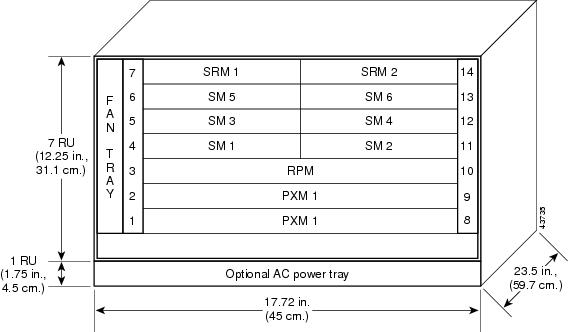
The MGX 8230 functions as a feeder to the IGX, BPX, or MGX 8850 switches, or can be used for bringing in service. It has a seven slot (double-height) chassis, and the slots are oriented in the following manner:
•
•
•
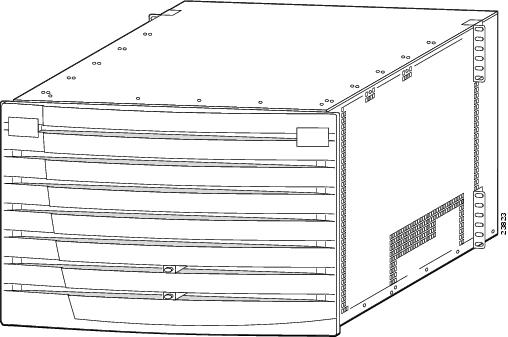
Figure 1 shows the MGX 8230 with its door attached. Note that there are light pipes in the door that display the status of the processor models (PXMs). Figure 2 is a conceptual drawing of an MGX 8230 showing the dimensions and the slot numbering. The slot numbering is as it appears from the front of the MGX 8230; slots 8 and 9 refer to back card slots only.
Note that the following features are not supported in this release, but are planned for future releases:
•
•
•
•
Figure 1 MGX 8230 with Door Attached
Figure 2 MGX 8230 Dimensions
Note
Main Features
Release 1.0 of MGX 8230 includes:
•
–
–
–
–
–
•
•
–
–
–
–
–
–
–
•
•
•
•
The MGX 8230 backplane supports a minimum of 1.2 Gbps of non-blocking switching and has a high-end limit of 21 Gbps with the PXM1. Individual line rates can range from DS0 through OC-3.
The MGX 8230 can also support a wide range of services over narrowband and mid-band user interfaces. It maps all the service traffic to and from ATM circuits based on standardized interworking methods.
The MGX 8230 supports up to 64 channelized or non-channelized T1 and E1 interfaces on a single IP + TM multiservice gateway. These interfaces support:
•
•
•
•
•
Frame-based services on T3 and E3 high-speed lines are also supported.
The MGX 8230 also supports Inverse Multiplexing for ATM (IMA) to provide ATM connectivity below T3 or E3 rates via the AUSM-8T1/E1 (AUSM/B).
The modular, software-based system architecture enables it to support new features through downloadable software upgrades or new hardware modules.
The Service Resource Module-3T3 (MGX-SRM-3T3/B), when supported in a future release, will be able to support up to 64 T1 interfaces over its three T2 lines and provide 1:N redundancy for the T1 and E1 cards. This feature is described in the MGX 8230 switch documentation, but is currently not supported by the hardware.
Standards-Based Conversion to ATM
The MGX 8230 converts all user-information into 53-byte ATM cells by using the appropriate ATM Adaptation Layer (AAL) for transport over the ATM backbone network. The individual service modules segment and reassemble (SAR) cells to eliminate system bottlenecks. The following list shows the applicable AAL for each service:
•
•
•
•
Refer to the Cisco MGX 8230 Installation and Configuration Guide for further installation and physical descriptions for the MGX 8230 switch.
MGX 8230 Cards
MGX 8230 Processor Switch Module (PXM1)
The MGX 8230 Processor Switch Module (PXM1) performs shelf control and shared-memory switching functions. It also serves as a data processing and ATM interface card. The PXM1 processor module for the MGX 8230 is identical to the PXM1 for the MGX 8250.
Primarily, the MGX 8230 PXM1 controls the switch and provides 1.2 Gbps of non-blocking, shared memory ATM switching and ATM trunking up to OC-12 speed. In addition, the PXM features:
•
•
•
The PXM1 and its two types of back cards make up the required control card set. The following are model numbers of cards supported by the MGX 8230 for this release:
The following are model numbers of cards supported by the MGX 8230 for this release:
•
•
•
•
•
•
•
•
•
PXM1 User Interface Back Card
The PXM1 User Interface card (PXM-UI) provides the MGX 8230 with the several user- interface ports. It mates with an PXM1 through the backplane and is installed in a back card slot (slot 8 or 9). As seen from the back of the MGX 8230, the PXM-UI will plug into the slot that is on the right side of its corresponding PXM1. The user-interface ports provide the following functions:
•
•
•
The PXM UI has the following physical connectors and interfaces:
•
•
•
•
•
•
MGX 8230 OC-3 Uplink Back Card
The MGX 8230 Uplink back card, which mates with a corresponding PXM1 through the backplane, provides the feeder trunk to the MGX switch. This uplink back card can provide either a multi-mode or single-mode fiber OC-3 interface:
•
•
•
FRSM Cards
The primary function of the FRSM is to convert between the Frame Relay-formatted data and ATM/AAL5 cell-formatted data. It converts the header format and translates the address for Frame Relay port/DLCIs, ATM-Frame UNI (FUNI) port/frame address, or frame forwarding port, and the ATM virtual connection identifiers (VPI/VCIs).
The MGX 8230 supports the following FRSM models:
•
The FRSM-8T1 card provides interfaces for up to eight T1 lines, each of which can support one
56 Kbps or one Nx64 Kbps FR-UNI, FR-NNI port, ATM-FUNI, or a frame forwarding port.
Note that this unchannelized card cannot be configured to support sub-T rates.•
The FRSM-8T1-C card provides interfaces for up to eight T1 lines, each of which can support up to twenty-four 56 Kbps or Nx64 Kbps FR-UNI, FR-NNI, ATM-FUNI, or frame forwarding ports.•
The FRSM-8E1 card provides interfaces for up to eight E1 lines, each of which can support one
56 Kbps or one Nx64 Kbps FR-UNI, FR-NNI, ATM-FUNI, or frame forwarding port.•
The FRSM-8E1-C card provides interfaces for up to eight E1 channelized Frame Relay lines, each of which can support multiple (up to thirty-one) 56 Kbps or Nx64 Kbps FR-UNI, FR-NNI, ATM-FUNI, or frame forwarding ports.•
The FRSM-2E3/T3 card provides interfaces for up to two T3 or E3 Frame Relay lines, each of which can support either two T3 lines (each at 44.736 Mbps) or two E3 lines (each at 34.368 Mbps) FR-UNI, FR-NNI, ATM-FUNI, or frame forwarding ports.•
The FRSM-2CT3 card supports interfaces for up to two T3 channelized Fame Relay lines, each of which supports 56 Kbps, 64 Kbps, Nx56 Kbps, Nx64 Kbps, T1 ports for a total of 256 ports that can be freely distributed across the two T3 lines.•
The FRSM-HS2 provides unchannelized Frame Relay service for up to 1000 user-connections over two HSSI lines on the SCSI2-2HSSI back card. The maximum rate for the card is 104 Mbps. Each port can operate in either DTE or DCE mode with incremental rates of N x T1 or N x E1 up to
52 Mbps.OC-12 Uplink Back Card
For Automatic Protection Switching (APS) requires the "B" model—an SMFLR-1-622/B.
SMFIR-1-622 Back Card
For Automatic Protection Switching (APS) requires the "B" model—an SMFIR-1-622/B.
BNC-2T3 Back Card
BNC-2E3 Back Card
Two versions of the BNC-2E3 card are available. The BNC-2E3A applies to Australia only, and the BNC-2E3 applies to all other sites that require E3 lines on the PXM uplink card.
ATM Universal Service Module
AUSM/B Front Card
AUSM/B Back Cards
The MGX-AUSM/B-8T1 and MGX-AUSM/B-8E1 use the generic 8-port T1 or E1 line modules that operate with the 8-port service modules. The standard T1 version of the back card has eight RJ-48 connectors. The standard versions of the E1 back card have either eight RJ-48 connectors or eight pairs of SMB connectors. The following back cards are compatible with the AUSM/B:
•
•
•
Circuit Emulation Service Module 8T1E1
CESM Models
The MGX 8230 supports the following CESM models:
•
The CESM-8T1 card provides interfaces for up to eight T1 lines, each of which is a 1.544 Mbps structured or unstructured synchronous data stream.•
The CESM-8E1 card provides interfaces for up to eight E1 lines, each of which is a 2.048 Mbps structured or unstructured synchronous data stream.•
The CESM-8T1E1 card set consists of the CESM-8T1E1 front card and one of the following back cards:
•
•
•
Redundancy Architecture
Since the MGX 8230 chassis is a smaller form factor MGX 8850, most of the redundancy features available in MGX 8850 are available in MGX 8230 chassis. The following is a list of available redundancy features on the MGX 8230 chassis.
•
•
•
•
•
•
•
MGX 8230 Management
To give you access for control purposes, the MGX 8230 switch supports high- and low-level user interfaces. You can use the Cisco WAN Manager application (formerly StrataView Plus) for connection management, the CiscoView application for hardware configuration, and a command line interface for low-level control of hardware functionality and connection control. An assortment of ports and protocols supports these user-interfaces. For communicating with the MGX 8230 switch, the control port (SLIP protocol only), the LAN (Ethernet) port, and the in-band ATM connection (feeder application only) all support access by the command line interface (CLI) via Telnet, TFTP, and SNMP protocols.
The downloadable firmware on each card determines the functionality, and you can upgrade functionality by downloading new firmware through a TFTP application on a workstation or a PC.
The current status and configuration parameters of the MGX 8230 modules reside in a Management Information Base (MIB). The firmware on each card updates the MIB as changes in status and configuration occur.
MGX 8250
The Cisco MGX 8250 wide-area edge switch supports:
•
•
•
•
•
It does not support PNNI, despite the fact that some CLI commands may show options for PNNI.
This chapter contains a brief outline of the features of the Cisco MGX 8250 switch. An illustration of the AC-powered version of the switch appears in Figure 3.
Figure 3 MGX 8250 Switch
The Applications of the MGX 8250 Switch
The MGX 8250 switch operates in two operational applications:
•
•
For a description of how to configure the switches for a particular application, see the MGX 8250 Switch Installation and Configuration Guide.
The switch is also capable of supporting Cisco Multiprotocol Label Switching (MPLS).
Universal Edge Architecture
The MGX 8250 switch can support a wide range of services over narrowband and mid-band user interfaces. It maps all the service traffic to and from ATM by using standardized interworking methods.
The supported interfaces for user-traffic are:
•
•
•
•
The optional Service Resource Module-3T3 (MGX-SRM-3T3/B) can support up to 80 T1 interfaces over its three T3 lines and provide 1:N redundancy for the T1 and E1 cards.
The modular, software-based system architecture enables the switch to support new features through downloadable software upgrades or new hardware modules.
The MGX 8250 backplane supports a minimum of 1.2 Gbps of non-blocking switching. Individual line rates range from DS0 through OC-12.
Standards-Based Conversion to ATM
The MGX 8250 switch converts all user information into 53-byte ATM cells by using the appropriate ATM Adaptation Layer (AAL) for transport over the ATM backbone network. The individual service modules segment and reassemble (SAR) cells to eliminate system bottlenecks. The following list shows the applicable AAL for each service:
•
•
•
•
MGX 8250 Cards
The MGX 8250 switch supports core cards and service modules. The Processor Switching Module (PXM) and optional Service Resource Module (SRM) are core cards. In addition to the PXM being a core card, it is also part of a a card set. A card set consists of a front card, a back card, and a daughter card. Service modules are not combined in this manner and are never part of a card set. Instead, service modules provide the interface to the transport technologies of the CPE—Frame Relay, ATM, and so on. The MGX 8250 enclosure contains up to 24 service modules (I/O cards) and 4 optional Service Redundancy Modules (SRMs) provide redundancy. A card set consists of a front card with its attached daughter card and a back card (or line module). The front card contains the processing intelligence and, on the daughter card, the firmware that distinguishes the interface (OC-3, T3, E3, and so on). The back card is a simple card that provides the electrical interface for one or more lines of a particular type. The MGX 8250 front and back cards are the:
•
This front card controls the switch and supports external interfaces for user-access and trunking or UNI ports. The back cards consist of a user interface card (PXM-UI) and a broadband network module (see subsequent list items).•
The PXM1-UI is the user interface card that has various types of ports to let you access and control the switch.•
The SMFIR-1-622 is a broadband network module for the PXM and provides a SONET OC12/STM4 ATM interface at 622 Mbps.•
The MMF-4-155 is a broadband network module for the PXM and provides four SONET OC3/STM1 ATM interfaces at 155 Mbps.•
The MGX-BNC-2T3 is a broadband network module for the PXM and provides two T3 ATM interfaces.•
The MGX-BNC-2E3 is a broadband network module for the PXM and provides two E3 ATM interfaces. A version for Australia, New Zealand, and elsewhere is available (MGX-BNC-2E3A).•
The MGX-FRSM-2E3/T3 provides interfaces for up to two T3 or E3 Frame Relay lines, each of which can support either two T3 lines (each at 44.736 Mbps) or two E3 lines (each at 34.368Mbps) FR-UNI, ATM-FUNI, or frame forwarding port.•
The MGX-FRSM-2CT3 supports interfaces for up to two T3 channelized Frame Relay lines, each of which supports 56 Kbps, 64 Kbps, Nx56 Kbps, Nx64 Kbps, T1 ports for a total of 256 ports that can be freely distributed across the two T3 lines.•
The MGX-HS2/B supports interfaces for 2 unchannelized HSSI lines, each of which supports approximately 51 Mbps. With both lines operating, maximum throughput is 70 Mbps.•
The AX-FRSM-8T1 provides interfaces for up to eight T1 lines, each of which can support one
56 Kbps or one Nx64 Kbps FR-UNI, ATM-FUNI, or a frame forwarding port. Note that this unchannelized card cannot be configured to support sub-T rates.•
The AX-FRSM-8T1c provides interfaces for up to eight T1 lines, each of which can support up to 24 56 Kbps or N x 64 Kbps FR-UNI, ATM-FUNI, or frame forwarding port.•
The AX-FRSM-8E1 provides interfaces for up to eight E1 lines, each of which can support one
56 Kbps or one N x 64 Kbps FR-UNI, ATM-FUNI, or frame forwarding port.•
The AX-FRSM-8E1c provides interfaces for up to 8 E1 channelized Frame Relay lines Each line can support N x 64-Kbps or (up to 31) 56-Kbps FR-UNI, ATM-FUNI, or frame forwarding ports.•
The MGX-AUSM/B-8T1 provides interfaces for up to eight T1 lines. You can group N x T1 lines to form a single, logical interface (IMA).•
The MGX-AUSM/B-8E1 provides interfaces for up to eight E1 lines. You can group N x E1 lines to form a single, logical interface (IMA).•
The AX-CESM-8T1 provides interfaces for up to eight T1 lines, each of which is a 1.544 Mbps structured or unstructured synchronous data stream.•
The AX-CESM-8E1 provides interfaces for up to eight E1 lines, each of which is a 2.048 Mbps structured or unstructured synchronous data stream.•
The RPM is a Cisco 7200 series router redesigned as a double-height card. Each RPM uses two single-height back cards. The back-card types are single-port Fast Ethernet, four-port Ethernet, and single-port (FDDI).•
The optional MGX-SRM-3T3/B provides bit error rate testing (BERT), 1:N redundancy for T1 and E1 service modules, and a demultiplexing function for T1 service called bulk mode.•
A multipersonality back card that supports either X.21 or V.35 interface.MGX 8250 Management
To give you access for control purposes, the MGX 8250 switch supports high- and low-level user interfaces. You can use the Cisco WAN Manager application (formerly StrataView Plus) for connection management, the CiscoView application for hardware configuration, and a command line interface for low-level control of hardware functionality and connection control. An assortment of ports and protocols supports these user-interfaces. For communicating with the MGX 8250 switch, the control port (SLIP protocol only), the LAN (Ethernet) port, and the in-band ATM connection (feeder application only) all support access by the command line interface (CLI) via Telnet, TFTP, and SNMP protocols.
The downloadable firmware on each card determines the functionality, and you can upgrade functionality by downloading new firmware through a TFTP application on a workstation or a PC.
The current status and configuration parameters of the MGX 8250 modules reside in a Management Information Base (MIB). The firmware on each card updates the MIB as changes in status and configuration occur.
Continued Support for the MGX 8850
The Cisco MGX 8850 wide area edge switch supports:
•
•
•
•
•
It does not support PNNI, despite the fact that some CLI commands may show options for PNNI.
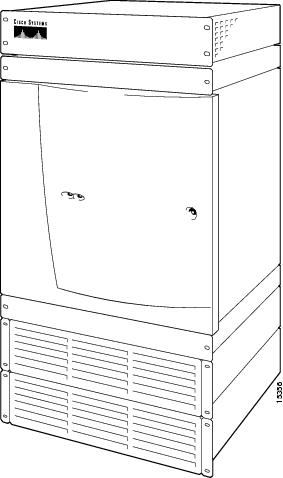
An illustration of the AC-powered version of the switch appears in Figure 4.
Figure 4 MGX 8850 Switch
The Applications of the MGX 8850 Switch
The MGX 8850 switch operates in two operational applications:
•
•
For a description of how to configure the switches for a particular application, see the MGX 8250 Switch Installation and Configuration Guide.
The switch is also capable of supporting Cisco Multiprotocol Label Switching (MPLS).
Universal Edge Architecture
The MGX 8850 switch can support a wide range of services over narrowband and mid-band user interfaces. It maps all the service traffic to and from ATM by using standardized interworking methods. When the MGX 8850 switch operates as a feeder, it uses a single port to communicate the aggregated traffic over an ATM interface with an MGX 8850 or BPX 8600 series switch.
The supported interfaces for user-traffic are:
•
•
•
•
The optional Service Resource Module-3T3 (MGX-SRM-3T3/B) can support up to 80 T1 interfaces over its 3 T3 lines and provide 1:N redundancy for the T1 and E1 cards.
The modular, software-based system architecture enables the switch to support new features through downloadable software upgrades or new hardware modules.
The MGX 8850 backplane supports a minimum of 1.2 Gbps of non-blocking switching up to
45 Gbps. Individual line rates range from DS0 through OC-12.Standards-Based Conversion to ATM
The MGX 8850 switch converts all user-information into 53-byte ATM cells by using the appropriate ATM Adaptation Layer (AAL) for transport over the ATM backbone network. The individual service modules segment and reassemble (SAR) cells to eliminate system bottlenecks. The following list shows the applicable AAL for each service:
•
•
•
•
MGX 8850 Cards
The MGX 8850 switch supports two types of card sets: the core cards (or core modules) and service modules. The Processor Switching Module (PXM) and optional Service Resource Module (SRM) are core cards. The service modules provide the interface to the transport technologies of the CPE—Frame Relay, ATM, and so on. The MGX 8850 enclosure contains up to 24 service modules (I/O cards) and 4 optional Service Redundancy Modules (SRMs) provide redundancy. A card set consists of a front card with its attached daughter card and a back card (or line module). The front card contains the processing intelligence and, on the daughter card, the firmware that distinguishes the interface (OC-3, T3, E3, and so on). The back card is a simple card that provides the electrical interface for one or more lines of a particular type. The MGX 8850 front and back cards are the:
•
This front card controls the switch and supports external interfaces for user-access and trunking or UNI ports. The back cards consist of a user interface card (PXM-UI) and a broadband network module (see subsequent list items).•
The PXM1-UI is the user interface card that has various types of ports to let you access and control the switch.•
The SMFIR-1-622 is a broadband network module for the PXM and provides a SONET OC12/STM4 ATM interface at 622 Mbps.•
The MMF-4-155 is a broadband network module for the PXM and provides four SONET OC3/STM1 ATM interfaces at 155 Mbps.•
The MGX-BNC-2T3 is a broadband network module for the PXM and provides two T3 ATM interfaces.•
The MGX-BNC-2E3 is a broadband network module for the PXM and provides two E3 ATM interfaces. A version for Australia, New Zealand, and elsewhere is available (MGX-BNC-2E3A).•
The MGX-FRSM-2E3/T3 provides interfaces for up to two T3 or E3 Frame Relay lines, each of which can support either two T3 lines (each at 44.736 Mbps) or two E3 lines (each at 34.368Mbps) FR-UNI, ATM-FUNI, or frame forwarding port.•
The MGX-FRSM-2CT3 supports interfaces for up to two T3 channelized Frame Relay lines, each of which supports 56 Kbps, 64 Kbps, Nx56 Kbps, Nx64 Kbps, T1 ports for a total of 256 ports that can be freely distributed across the two T3 lines.•
The MGX-HS2/B supports interfaces for two unchannelized HSSI lines, each of which supports approximately 51 Mbps. With both lines operating, maximum throughput is 70 Mbps.•
The AX-FRSM-8T1 provides interfaces for up to eight T1 lines, each of which can support one
56 Kbps or one Nx64 Kbps FR-UNI, ATM-FUNI, or a frame forwarding port.•
The AX-FRSM-8T1c provides interfaces for up to eight T1 lines, each of which can support up to 24 56 Kbps or N x 64 Kbps FR-UNI, ATM-FUNI, or frame forwarding port.•
The AX-FRSM-8E1 provides interfaces for up to eight E1 lines, each of which can support one
56 Kbps or one N x 64 Kbps FR-UNI, ATM-FUNI, or frame forwarding port.•
The AX-FRSM-8E1c provides interfaces for up to eight E1 channelized Frame Relay lines Each line can support N x 64-Kbps or (up to 31) 56-Kbps FR-UNI, ATM-FUNI, or frame forwarding ports.•
The MGX-AUSM/B-8T1 provides interfaces for up to eight T1 lines. You can group N x T1 lines to form a single, logical interface (IMA).•
The MGX-AUSM/B-8E1 provides interfaces for up to eight E1 lines. You can group N x E1 lines to form a single, logical interface (IMA).•
The AX-CESM-8T1 provides interfaces for up to eight T1 lines, each of which is a 1.544 Mbps structured or unstructured synchronous data stream.•
The AX-CESM-8E1 provides interfaces for up to eight E1 lines, each of which is a 2.048 Mbps structured or unstructured synchronous data stream.•
The RPM is a Cisco 7200 series router redesigned as a double-height card. Each RPM uses two single-height back cards. The back-card types are: single port Fast Ethernet, four port Ethernet, and single-port (FDDI).•
The optional MGX-SRM-3T3/B provides bit error rate testing (BERT), 1:N redundancy for T1 and E1 service modules, and a demultiplexing function for T1 service called bulk mode.•
A multi-personality back card that supports either X.21 or V.35 interface.MGX 8850 Management
To give you access for control purposes, the MGX 8850 switch supports high- and low-level user interfaces. You can use the Cisco WAN Manager application (formerly StrataView Plus) for connection management, the CiscoView application for hardware configuration, and a command line interface for low-level control of hardware functionality and connection control. An assortment of ports and protocols supports these user-interfaces. For communicating with the MGX 8850 switch, the control port (SLIP protocol only), the LAN (Ethernet) port, and the in-band ATM connection (feeder application only) all support access by the command line interface (CLI) via Telnet, TFTP, and SNMP protocols.
The downloadable firmware on each card determines the functionality, and you can upgrade functionality by downloading new firmware through a TFTP application on a workstation or a PC.
The current status and configuration parameters of the MGX 8850 modules reside in a Management Information Base (MIB). The firmware on each card updates the MIB as changes in status and configuration occur.
Features Introduced in Release 1.1.23
MGX 8850 Release 1.1.23 is a maintenance release of Release 1.1.22. In addition, it introduces the following new features:
•
•
•
•
•
Release 1.1.32 MGX 8850, MGX 8230, and MGX 8250 Hardware
MGX 8850 is a 45 Gbps backplane with 1.2 Gbps switching fabric for Release 1.1.32. The same backplane is used with different switching fabric cards (1.2, 45 Gbps) to achieve scalability. MGX 8850 Release 1.1.21 hardware components and their revisions that are supported are as follows:
Support for embedded Cisco IOS router (Router Processor Module - [RPM])
•
–
–
–
MGX 8220 Hardware Not Supported on Release 1.1.32 of the MGX 8850
The following cards are not supported in Release 1.1.32:
•
•
•
•
•
MGX 8220 Hardware That Has Been Superseded on the MGX 8850 by MGX 8850-Specific Hardware
•
The MGX-SRM-3T3-C front card replaces the original AX-SRM-3T3-A front card and the MGX-BNC-3T3 back card replaces the original AX-BNC-3T3 back card. This change allows the use of slots 9, 10, 25, and 26 for 1:N redundancy and BERT in the MGX 8850 chassis. Both the AX-SRM-3T3-A/AX-BNC-3T3 card set and the MGX-SRM-3T3-C/MGX-BNC-3T3 card set are supported on the MGX 8220.
New card should have enabled use of bulk distribution in slots 9 and 10. 1:N redundancy should have been supported in those slots with the model A card.
•
Superseded by the MGX-SCSCI2-2HSSI/B, which works with the MGX-FRSM-HS2 front card. A V.35 interface is supported on the MGX-FRSM-HS1/B in this release.
•
Superseded by MGX-AUSM-8T1/B and MGX-AUSM-8E1/B.
•
Superseded by MGX-AUSM-8T1/B and MGX-AUSM-8E1/B.
MGX 8220 Hardware Not Supported on the MGX 8850
•
•
•
•
Software Platform Features
MGX 8850 provides high-speed native ATM interfaces, which can be configured as ATM UNI ports or trunks.
Support for 1:N and 1:1 Service Module Redundancy, as indicated in the following table:
Support for Bulk Distribution using SRM-3T3-C card.
Service module and PXM upgrades.
Features Not Supported in This Release
•
•
•
•
•
•
•
•
•
•
•
•
•
•
•
Note
Major Network Management Features
•
•
•
•
•
•
•
For more details refer to the CWM Release 9.2.07 release notes part number 78-6659-07.
Connection Limits
•
•
•
•
SNMP MIB
The SNMP MGX 8850 MIB is being provided with the delivery of Release 1.1.32 of the MGX 8850 software on CCO. The MIB is in standard ASN.1 format and is located in the same directory within CCO. These files may be compiled with most standards-based MIB compilers. For changes in this MIB from Release 1.1.25, please refer to the MIB release notes on CCO. The following files are required:
•
•
•
•
•
•
•
•
•
•
•
•
•
•
•
•
Notes & Cautions
In Release 1.1.32, the default UPC connection parameters on the PXM have changed. The default PCR is 50 cps, and the default for policing is "enabled." These settings are insufficient for running RPM ISIS protocol over the connection, and with such settings, the ISIS protocol will fail. The PCR value needs to be increased, depending upon the number of interfaces configured for ISIS on the RPM. CLI modification and changes in this release.
Depending upon your connection type, you can use the following CLIs to modify the PCR parameter.
•
•
•
•
ForeSight and Standard ABR Coexistence Guidelines
ForeSight is similar to the rate-based ABR control system in TM 4.0 in that they both use Rate up and Rate down messages sent to the source of the connection to control the rate a connection runs at, based on congestion within the switches along that connections path. Both systems use Resource Management (RM) cells to pass these messages. There are differences between the two systems that need to be considered.
RM Cell Generation
ForeSight is a destination-driven congestion notification mechanism. The destination switch is responsible for generating the RM cells, which defaults to every 100 ms. This means that any rate modifications at the source end happen approximately every 100 ms, and the time delay between the actual congestion at the destination and the source getting to know about it could be 100 ms.
In standard ABR a source generates FRM cells every (nRM) cell intervals, where n is configurable. These are used to pass congestion information along to the destination switch, which then uses this information to generate BRM (Backward RM cells) back to the source A further consideration is that the actual user data flow will be lower for an equivalent rate due to the additional RM cells. Therefore, the more traffic being generated on a connection at any one time, the faster the feedback will be to the source.
There is also a TRM parameter which states that if no RM cells have been generated after this time has passed then one will automatically be sent. Depending upon the speed it is running at, an ABR connection may therefore react faster or slower to congestion than the equivalent ForeSight connection. (for example, if an ABR connection runs at 100 cells per second, and nRM is 32, then approximately three RM cells will be generated per second, or once every 300 msecs. If it runs at 1000 cps then an RM cell would be generated approximately every 30 msecs. In both cases, the equivalent ForeSight connection would generate an RM cell every 100 msec.)
Reaction to Feedback Messages - Rate Up
In ForeSight, in response to a Rate Up cell from the destination, the source increases its rate by a percentage of the MIR for that connection. If we call this percentage the rate increase percentage (RIP), then RIP is configurable at the card level (the default is 10 percent). In the case where MIR is low, the ForeSight rate increase will be slow as it has to increase as a percentage of MIR (rather than CIR).
On a standard ABR connection, in the event of available bandwidth (no congestion) the source increases its rate by a factor of (RIF*PCR). This means the rate increase step sizes are much bigger than for ForeSight for larger values of RIF (RIF has a range of 1/2, 1/4,....,1/32768). If RIF is not configured properly then standard ABR will ramp up its rate much faster and to a higher value. This is aided by the fact that the step sizes are bigger and the step frequency is higher in comparison with ForeSight.
Reaction to feedback messages - Rate Down
In ForeSight on receiving a Rate Down cell from the remote end, the source reduces its current rate (actual cell rate) by 13 percent. The rate decrease percentage (RDP). RDP is configurable at the card level.
In standard ABR, rate decrease is by an amount (RDF*ACR). Currently, the default value of RDF is 1/16 (6.25 percent). This means when this connection co-exists with ForeSight connections, in the event of congestion ForeSight connection reduces its rate by 13 percent whereas standard ABR connection reduces its rate by only 6.25 percent. Therefore, in the case of co-existence, if we need to approximate the same behavior across the two connection types, then RDF should be changed to 1/8, so that both connections ramp down by the same amount (13 percen).
Fast-Down
In ForeSight if the destination egress port drops any data due to congestion then the destination sends a Fast Rate Down cell. Also, if a frame cannot be reassembled at the egress due to a lost cell somewhere in the network, a Fast-down will be generated. On reception of Fast Rate Down the source reduces its current rate by 50 percent (this is again a card-level configurable parameter).
Standard ABR does not distinguish between drops and the ECN/EFCI threshold being exceeded. This means that, in case of drops in the egress port queue, a standard ABR connection rate reduces by only (RDF*ACR) but the ForeSight connection rate reduces by (ACR*0.5). Therefore, in the case of co-existence, if we need to approximate the same behavior across the two connection types then Fast Down could be effectively disabled by configuring the reaction to be 13 percent rate down instead of 50 percent.
Guidelines
The two systems will work together within the network, but as the above description suggests, if the differences between the two systems are not taken into consideration, then a ForeSight connection and an ABR connection with the same configuration parameters will not behave the same way within the network.
ABR and ForeSight provide a mechanism for distributing excess bandwidth between connections over and above the minimum rate, therefore if these guidelines are not taken into consideration then the allocation of this excess bandwidth may be biased toward connections running one of these algorithms over connections running the other.
If this is a requirement, the following guidelines may be useful, assuming ForeSight is set to defaults except for Fast Rate Down which is set for 13 percent.
1.
100 milliseconds, to match that of ForeSight. This calculation is based on the expected average, or sustained, cell rate of the connection. However, if the (potential) fast-down messages from ForeSight are left to equate to 50 percent rate down, then an estimate of how often this may occur needs to be made and factored into the equation. If the connection receives Fast-down messages, then this would make the ForeSight connection react faster than the equivalent ABR connection to congestion. To compensate for this, Nrm needs to be set at a value of less than 100 msecs, a suggested value to aim for is between 60-70 msecs (this would be approximate as n is configurable in steps of 2**n). This would mean that, in the event of congestion, the ABR connection would start to react faster.2.
3.
The following worked examples may help explain this further
Assume a network is currently running ForeSight with default parameters, and supports the following four connection type, where CIR = MIR, PIR = port speed, and QIR = PIR:
T1 Port Speed 64K CIR
Example:
CIR = MIR = 64K
PIR = QIR = port speed = 1544
Fastdown = 13%(The calculation used to convert between frame based parameters (CIR, PIR, and so on.) and their equivalent cell-based parameters is FR_param *3/800. This allows for cell overheads, and so on. based on frame sizes of 100 octets.)
CIR = MIR = (64000*3/800) = 240 cps
PIR = QIR = (1544 *3/800) = 5790 cpsForeSight ABR
Rate-up equals (240*.1) = 24 cps RIF equals x where (1590/x) = 24 cps
X needs to be approx 200
RIF equals 256 (nearest factor of 2)RDF equals 13% RDF = 1/8
Nrm equals 100 msecs Nrm equals 32RM cells will be generated somewhere between 6 (5790 cps approx equal to 32 cells per 6 msecs) and 133 msecs (240 cps approx equal to 32 cells every 133 msecs) depending on ACR.
CLI Modification and Changes in this Release
dspfail <slotno>
shows all failed connections per slot basis
dspfabit <slotno>
shows all A-bit failed connections per slot basis
dsplmiloop
shows if LMI loop is present
chkslotcon <slotno>
checks database consistency per slot basis
chkportcon <slotno> <portno>
checks database consistency per slot basis
Chkcon <slot.port.vpi.vci>
checks database consistency per connection basis
dspbecnt
displays bit error count
CLI modification and changes in previous releases:
•
–
–
–
–
–
–
–
–
–
–
–
–
–
Syntax:
cnfifip "Interface IPaddr [NetMask [BroadcastAddr]]"
or cnfifip "Interface Flag"
Interface -- 26/28/37 (26:Ethernet 28:SLIP 37:ATM)
or Ethernet/SLIP/ATM
IP_Addr -- <n>.<n>.<n>.<n> (<n>: integer 0..255)
Net_Mask -- <n>.<n>.<n>.<n> (<n>: integer 0..255)
BroadcastAddr -- <n>.<n>.<n>.<n>
(<n>: integer 0..255)
Flag -- a string "UP" or "DOWN"
Example:
> cnfifip atm 192.9.200.1 255.255.255.128
This configures the ATM interface and brings it UP.
> cnfifip atm up
This will bring up the ATM interface with current information in the database.
> cnfifip atm down
This will bring down the ATM interface and preserve the information in the database.
–
Syntax:
delifip Interface
Interface -- 26/28/37 (26:Ethernet 28:SLIP 37:ATM) or Ethernet/SLIP/ATM
Example:
> delifip 37
This will bring down the ATM interface and delete the information in the database.
–
Example:
> dspifipInterface Flag IP Address Subnetmask Broadcast Addr--------------- ---- --------------- --------------- ---------------Ethernet/lnPci0 UP 172.29.37.77 255.255.255.0 172.29.37.255SLIP/sl0 DOWN 172.29.36.253 255.255.255.252 (N/A)ATM/atm0 UP 192.9.200.1 255.255.255.128 0.0.0.0
This command shows the current condition of all three interfaces. The data shown for the SLIP interface will apply when it is turned UP with, for example, cnfifip slip on.
–
Syntax:
cnfenetgw IPAddr
Example:
> cnfenetgw 172.29.37.1This command will set the default gateway and add the appropriate routes necessary to it.
–
Example:
> dspenetgwEnet Gateway: 172.29.37.1–
Several lines are essential for the network to function:
- boot device : lnPci
(The only Ethernet interface)
- inet on ethernet (e) : 172.29.37.40:ffffff00
(IP address and subnetmask)
- gateway inet (g) : 172.29.37.1
(Default Ethernet gateway)
The PXM will try to correct bad entries when it boots up. This information will be copied to the standby card and if different than the shelf IP address it will up the interface on the standby with the bootChange IP address. The shellconn version of this command only updates the local bootline values and is not copied to the other card.
–
Used to bring up the Ethernet interface when CLI prompt is not there or in backup boot if it's not enabled.
The following commands are related to FRSM-2CT3 line-level loopbacks.
•
This loopback can be configured in FRSM-2CT3 using the following commands:
addds3rmtloop <lineno>
xcnfln -ds3 <lineno> -e 3 -lpb 2
•
This loopback can be configured in FRSM-2CT3 using the following commands:
addds3loop <lineno>
xcnfln -ds3 <lineno> -e 3 -lpb 3
DS3 Loopback status will be displayed with following commands:
dspds3ln <lineno>
dspalm -ds3 <lineno>
dspalms -ds3
FEAC codes monitoring and Inband loopbacks for DS3 are not supported in FRSM-2CT3
•
This loopback can be configured in FRSM-2CT3 using the following commands:
cnfbert (from PXM)
addrmtloop <lineno>
xcnfln -ds1 <lineno> -e 3 -lpb 2
•
This loopback can be configured in FRSM-2CT3 using the following commands:
cnfbert (from PXM)
addlnloop <lineno>
xcnfln -ds1 <lineno> -e 3 -lpb 3
DS1 Loopback status will be displayed with following commands:
dspln <lineno>
dspalm -ds1 <lineno>
dspalms -ds1
•
xcnfln -ds1 <lineno> -e 3 -detect 2
•
•
•
–
–
–
Node Related
A maximum of one BERT test can be performed per shelf at any point in time. BERT can be activated only through the CLI.
Do not execute the restoreallcnf command in the middle of the installation process. If you follow the steps below, the dsplns command will display a line as disabled, but you cannot run an addln command. Do not execute the restoreallcnf command until the install and newrev commands have completed
The correct order for the restore procedure is:
Step 1
Step 2
Step 3
Step 4
Note
Addln should be issued before issuing addapsln.
The following line and alarm-related commands have been modified to allow slots 8, 16, and 32 as valid arguments if PXM at slot 8 is active:
•
•
•
•
•
•
•
•
•
•
•
•
•
•
•
Full SRM redundancy requires redundant SRMs. There must be SRMs in BOTH slot 15 and 16 to ensure service module redundancy for the upper shelf and SRMs in BOTH slot 31 and 32 to ensure service module redundancy for the lower shelf. Lack of the second SRM in either shelf may result in mismatch conditions.
For service module redundancy support, if the active service module is physically removed from the slot then a switchcc would cause the now active service module to be inaccessible. The workaround is to make sure that both the active and standby cards are physically present in their slots. If the active card does need to be removed, then at shellconn type: pmmStartScmPolling(slotnumber) after the switchcc.
If you are moving service modules from an existing MGX 8220 platform to the MGX 8850, the MGX 8220 service modules (AX-FRSM-8T1/E1, and AX-CESM-8T1/E1) need to have the boot flash upgraded to MGX 8220 Release 5.0.00 common boot code (1.0.01 version) before they can be plugged in to the MGX 8850 chassis. All MGX 8220 service module versions that use Release 4.0.xx of boot code and earlier are not supported in the MGX 8850.
If loading of the correct common boot code image is required then it will have to be performed on an MGX 8220 chassis, and cannot be performed on an MGX 8850 chassis. Please refer to the procedure below, which is also outlined in the Cisco MGX 8850 Installation and Configuration publication on the documentation CD.
Step 1
Step 2
Step 3
tftp <ip address of the MGX 8220 shelf >binput <boot filename> AXIS_SM_1_<slot#>.BOOTInsure that TFTP downloaded the appropriate boot code by verifying the flash checksums.
Step 1
cc <slot #>'Step 2
chkflash'If not, repeat the process until they are the same. If they are the same, then you can safely remove the card. At this point the service module can be used in the MGX 8850 shelf.
Caution
Whenever an MGX 8850 is added as a feeder to a BPX 8600, SWSW automatically programs a channel with a VPI.VCI of 3.8 for use as the IP Relay channel. IP Relay is used to send IP data between nodes via the network handler, allowing every node in the domain to be directly addressable via IP addressing and CWM workstations to communicate with every node (especially feeders) using TELNET, SNMP and CWM protocols. If the user tries to add a channel with a VPI.VCI of 3.8, the BPX 8600 does not prevent the user channel from being added, but the MGX 8850 rejects it. To delete the added channel on the BPX 8600, and to get IP relay working you need to reset the BXM card.
In addition to clearing the entire configuration, clrallcnf clears the network IP addresses. IP addresses and netmasks stay the same (dspifip). However, it's recommended by engineering to reconfigure them using the cnfifip command. Network IP is gone (dspnwip), and must be reconfigured using the cnfifip command. Refer to the entry on cnfifip in the Cisco MGX 8850 Command Reference publication on the documentation CD for syntax.
•
A minimum of two and up to four IP addresses are needed to be configured for MGX 8850 (one or more of the following: Ethernet, ATM, SLIP) and the boot IP address. The user should use bootChange to set up IP gateway when the PXM card is just installed. The IP default gateway should be on the same subnet as the PXM board. Use the bootChange command to set correct IP address, netmask, and default gateway.
Do not install a Y-cable on the UIA CP port for PXMs. If you do, both serial ports will be enabled and you will not be able to communicate with the shelf through the console ports. If after switchcc the standby PXM loses the down-level port, it is most likely due to a downlevel Beta version of UIA back card that was shipped during field-trial only. Upgrading the UIA back card to the latest version should fix this problem.
To configure the external clock source, use the interface label 7.35. Do not use 0.33 or 7.33.
There are also routeShow/routeAdd/routeDelete commands for modifying routing tables.
You must reboot your PXM after each modification with "bootChange" for it to take effect. Also make sure the subnet mask is 255.255.0.2
. bootChange- Only enter the ethernet IP address, netmask and default gateway.- Type "." to erase incorrect entries.tigers.1.7.PXM.a > bootChange'.' = clear field; '-' = go to previous field; ^D = quitboot device :lnPciprocessor number :0host name :C <-- Please put "C".file name :inet on ethernet (e) :172.29.37.40:ffff00 <-- Ethernet IP Addr/Netmaskinet on backplane (b):host inet (h) :gateway inet (g) :172.29.37.1 <-- Default Gatewayuser (u) :ftp password (pw) (blank = use rsh):flags (f) :0x0target name (tn) :startup script (s) :other (o) :- Type in reboot, after this the command "" will work:tigers.1.7.PXM.a > 171.71.54.53 1171.71.54.53 is aliveConfiguration save-and-restore is supported only through the CLI (CWM does not support configuration save-and-restore). Service module upgrades error handling is not provided. If the user skips any of the steps during upgrade or if a power failure happens in the middle of the upgrade, results will be unpredictable. See the Special Installation and Upgrade requirements section for service module upgrades. To recover from procedural errors contact your TAC support personnel.
The MGX 8850 supports 15 simultaneous Telnet sessions and 10 TFTP sessions.
You must use the following Y-cables for FRSM-HS2 and FRSM-CT3 redundancy as specified in the Product Orderability Matrix (Straight Cable: 72-0710-01, Crossover Cable: 72-1265-01, Straight Y-cable: FRSM-HS2: CAB-SCSI2-Y, FRSM-CT3: CAB-T3E3-Y). Other cables are not supported.
Y-cable redundancy for FRSM-HS2, FRSM-2CT3, FRSM-2T3, FRSM-2E3 is supported only for adjacent slots.
Statistics are not supported for the RPM.
There is no need to issue the syncdisk and shutdisk commands before removing the PXMs. The system quiesces the disk by detecting the removal of the PXM board and flushes the write buffers to the disk and puts the PXM in sleep mode. This disables any further hard disk access since it locks the actuator. When the card is reinserted the PXM automatically comes out of sleep mode.
Syntax of addlink command has changed as follows:
New Syntax:
Syntax: addlink <T3LineNum> <T1Slot> <NumberOfT1s> <TargetSlotNum>
<TargetSlotLineNum>
<T3LineNum> where = Slot.Line
Slot = 15,31
Line = 1 - 3
<T1Slot> where T1Slot = 1 - 28
<NumberOfT1s> where NumberOfT1s = 1-8
<TargetSlotNum> where TargetSlotNum = 1-6|11-14|17-22|27-30
<TargetSlotLineNum> where TargetSlotLineNum = 1-8
PAR command cnfnwip has been disabled in this release, please use cnfifip instead.
If you lose power, or remove the online PXM you lose the broadcast address. Use the "cnfifip" command to configure the broadcast address. To redefine your ATM address and IP address that are in the same subnet, you have to change the ATM address to a temporary address not in the same subnet, then add back your IP address with the original Broadcast address, then go back and correct your ATM address.
Cooling and Power limitations: Customer should be aware of the need for extra power supplies and fans beyond certain limitations. A single fan tray will support all configurations that draw between 1200 and 1400 watts. For power requirements, the MGX 8850 requires a minimum of one power supply per line cord to support the power requirement for five cards.
This is based on an estimated worst-case power requirement of 190W plus margin per card slot.
Connection Management Related
The name of the node cannot be changed if there are PVCs. The node name must be changed from the default value before adding connections, since it cannot be changed later. Use the cnfname command to change the node name.
Only one feeder trunk can be configured. No BNI trunk to MGX 8850 as a feeder is supported.
The slave end of a connection must be added first.
The slave end cannot be deleted and re-added back by itself. If you delete the slave end, the entire connection must be completely torn down and re-added back. If the slave end of the connection is deleted and re-added back by itself, then unpredictable results will happen.
For user connections, VCI 3 and VCI 4 on every VPI are reserved for VPC OAMs.
The actual number of feeder connections you can provision on the PXM is always two less than you have configured. The dsprscprtns command shows max connections as 32767, but you can only use 32767 - 2 = 32765. One connection is used for LMI and another one for IP relay.
There is no error handling detection while provisioning through the CLI. Invalid endpoints and unsupported connection types (such as connections between FRSM-CESM ports or connections between structured and unstructured connections) are permitted using the CLI. The user should not configure these connections.
The sum of CIR of all channels of a port can be greater than port speed as long as CAC is disabled. However, it is not acceptable for one channel's CIR to be greater then port speed even if CAC is disabled. Two channels added up can exceed port speed. This means you cannot oversubscribe a port if only one channel is configured.
When trying to add a port on DS0 slot 32 of a CESM-8E1 line using an SNMP set or the CiscoView Equipment Manager, the SNMP agent in CESM will time out, without adding the port. The SNMP libraries treat the 32 bit DS0 slotmap (cesPortDs0ConfigBitMap) as an integer. The value for the last DS0 is treated as the sign value. This causes a corruption in the packet coming to the agent. As the agent does not receive a complete SNMP packet, it does not respond and times out. Use the command line interface to add a port on DS0 slot 32 of a CESM-8E1 line.
The cnfport command does not allow VPI ranges to be reduced. The cnfport command only allows the VPI range to expand. The correct sequence is to delete all connections on the partitions, delete the partitions, delete the port, and add the port with new VPI range.
On an FRSM-2CT3, one can add 128 ports on a group of 14 T1 lines as indicated below.
•
•
•
•
So, to add 256 ports on one T3: add 128 ports on the first 14 T1 lines and the remaining 128 on the next 14 T1 lines.
Note that (A) and (D) are connected to first FREEDM and (B) and (C) are connected to the second FREEDM. Each FREEDM supports only 128 ports. If 128 ports are added on one T3 as in (A), then there cannot be any more ports as in (D). The 129th port should be on lines 15 to 42 (as in B or C).
If the user adds a connection between an RPM and a PXM and then deletes the connection, the RPM shows no connection but the PXM still has the connection. The MGX was designed and implemented in such a way that only the connections that have the master end show up on PXM (by dspcons command). Consider these three connections:
•
•
•
When using the dspcons command, c2 and c3 will be displayed, not c1. The connection will not show up once the master end (PXM) is deleted. Recommendation: When adding a connection, if one end of the connection is PXM, always configure the PXM side to be the slave. Thus when deleting the RPM side, which is the master, the connection will not show up on the PXM. However, keep in mind that the slave end (PXM) still exists. This also provides a side benefit. When a connection exists with only the slave side, no bandwidth is occupied. The bandwidth is reserved only if the master end exists (with or without the slave).
The MGX-FRSM-HS1/B is capable of supporting a total throughput (card-level) of 16 Mbps. However, it is possible to configure four lines each supporting up to 8 Mbps, thus oversubscribing the card. This has been raised in bug #CSCdm71476 and a restriction/warning will be added in a future release.
Addlnloop on an FRSM-HS1/B line works only when there is a (valid) cable plugged in to the back card on that line. This is a hardware limitation on the back card and has been mentioned in the Release Notes in bug# CSCdm44993.
RPM Related
With MGX Release 1.1.32, two Route Processor Modules (RPMs) are supported; the RPM/B and the RPM-PR.
The RPM/B is a NPE-150 based router card capable of sustaining 150,000 pps. The RPM-PR is an NPE-400 based router capable of sustaining over 350,000 pps. The RPM-PR will only operate with IOS 12.1(5.3)T_XT or later. For the following section "RPM" will refer to both the RPM/B and the RPM-PR, (unless specifically called out) even though some software versions and limitations are not applicable to the RPM-PR because it doesn't support IOS versions before 12.1(5.3)T_XT.
With RPM/B versions earlier than 12.O.7T1, some limitations in Inter-Process Communication when the RPM/B is at high loads can cause the PXM to declare that the RPM/B has Failed . To avoid this with RPM/B, software releases earlier than 12.0.7T1, throughput is limited to 62,000 pps, and it is recommended that MPLS configurations are limited to 100 interfaces. With RPM software releases from 12.0.7T1, those limitations are removed. In a separate limitation, the number of directly connected OSPF networks supported by an RPM is currently limited to 27. This means that any or all of the subinterfaces supported by the RPM can run OSPF, but the number of distinct OSPF networks supported is limited to 27. (A work around is available and is discussed below.) The limit of 27 arises because of the overheads of supporting separate link-state databases for separate networks.
In an application where the RPM is a Provider Edge Router in an MPLS Virtual Private Network service, a much better solution in any case is to use a distance-vector routing protocol between the customer routers and the RPM. A distance-vector routing protocol provides exactly the information required for this application: reachability information, and not link-state information. The distance-vector routing protocols supported by the RPM are BGP, RIP v1 and RIP v2, as well as static routing. With RPM software releases from 12.0.7T1, distance-vector routing protocols can be used with as many different networks as subinterfaces.
Note that if the RPM is acting as a Provider Edge Router in an MPLS Virtual Private Network service, and even if OSPF is running in a customer network, it is not necessary to run OSPF between the customer router and the RPM. If the customer edge devices run Cisco IOS, they can redistribute OSPF routing information into RIP using the IOS commands, redistribute RIP in the OSPF configuration, and redistribute OSPF in the RIP configuration. Similar configurations are possible for BGP. (For more information on readvertisement, see the "Configuring IP Routing Protocol-Independent Features" chapter in the Cisco IOS Release 12.0 Network Protocols Configuration Guide, Part 1). Redistribution is not unique to Cisco CPE, and other vendors' equipment also supports redistribution.
Recommendations for Booting:
The current implementation provides the following options:
•
•
•
Recommendations for saving RPM configuration:
The current implementation provides the following options:
•
•
•
•
It is recommended to save the configuration on flash and on the PXM Disk, as well as on the network server. This ensures that the configuration can be restored, even in the case of multiple failures.
For example, if an RPM card has problems, you can copy the configuration from either the PXM disk or from the network to new RPM card. In case of multiple hardware failures (both RPM and PXM cards have problems) you can copy the configuration from the network server.
Replacing the existing RPM with a new card or a card with old configuration in flash
The existing configuration (of the old card) can be restored on the newly inserted card by following the instructions given below:
Step 1
Step 2
Step 3
Step 4
Step 5
Please note that in RPM context the "config save/restore" feature of the PXM restores only the PXM part of the RPM configuration/connections. The RPM part of the configuration should also be saved from RPM CLI through copy command. For example, copy run c: <config-filename> for saving to PXM Disk for future restoration.
RPM Connection Resynchronization
The RPM Connection Resync process is supported in the 12.04T and higher releases. This feature checks for consistency between the RPM and PXM connection databases.
Limitations
restoreallcnf
Do not execute the restoreallcnf command in the middle of the installation process. If you do, the dsplns command will display a line as disabled, but you cannot run an addln command. Do not execute the restoreallcnf command until the install and newrev commands have completed.
The correct order for the restore procedure is:
Step 1
Step 2
Step 3
Step 4
Note
Please also note the following:
•
•
•
•
clrsmcnf
As a speedy way to wipe out all configuration on an SM, you can use clrsmcnf. This command works in the following scenarios:
•
•
•
To be able to use an SM of a different type from the current one in a slot you can also use clrsmcnf for example, if there is a FRSM8T1/E1 in the slot with some configuration and the customer wants to use this slot for an AUSM8T1/E1 card.
The clrsmcnf cannot delete a port or channel due to corruption or error locally on the SM. It is able to delete the port/channel from within the PXM, but it cannot delete a port or channel due to corruption/error on the PXM itself. You can save an SM configuration and restore it back to the same slot on the same node. If the SM configuration is corrupted on disk, but the run-time image is okay and the file contented is corrupted, this is supported.
The following are NOT supported on the MGX 8850:
•
•
•
If you have more than 500 connections on a service module, before issuing clrsmcnf you need to change the session timeout default value.
Use CLI command timeout 0 (no timeout)
clrsmcnf
After it is done, use the CLI command timeout 600 (to set the timeout value back to the default).
Note
Core Dump Mask
There are no system performance implication unless you take a core dump, currently the default error mask to take core dump is attached,. You can change the mask or take it manually.
Set the core dump mask to its default value. If you enable core dumps with power on reset and shell reset core dumps enabled you will end up with a PXM that continuously dumps the core and resets. The only way out is to use a download boot that does not have the core dump feature.
Default setting 0x262eeOFF 0001 Power ON ResetON 0002 DRAM Parity ErrorON 0004 WatchDog Timeout ResetON 0008 Resource OverflowOFF 0010 Clear All ConfigurationON 0020 Missing TaskON 0040 Reset because of PXM Low VoltageON 0080 Reset By Event Log TaskOFF 0100 Reset from ShellON 0200 UnknownOFF 0400 Reset from PXMOFF 0800 Reset SystemOFF 1000 Switch Core CardON 2000 Secondary Cache ErrorON 4000 Software Error ResetOFF 8000 S/W reset due to upgradeOFF 10000 Restore All ConfigurationON 20000 Device Driver ErrorNODENAME.1.8.PXM.a > core hot-dumpDo you want to proceed (Yes/No)? yDum PXM Core Image[0]:.......................................................................................... ......................................Done.NODENAME.1.7.PXM.s > core save 2 core.zipCreating core.zip.................................Core dump basics.There are two steps to save a core dump.1. The system will store a raw core dump image on the disk (this image ison a portion of the disk that is not used for the filesystem).2. After the raw core dump image is saved on the disk, use the cli command"core" to zip the image and save it in a file on the disk.Use the "core mask" command to display and to set the mask which determineswhich conditions will cause an autmatic core dump.NODENAME.1.7.PXM.s > core maskAutomatic Core Dum is enabled..The Current Core slot is 0The Current Core mask is 0x4004OFF 0001 Power ON ResetOFF 0002 DRAM Parity ErrorON 0004 WatchDog Timeout ResetOFF 0008 Resource OverflowOFF 0010 Clear All ConfigurationOFF 0020 Missing TaskOFF 0040 Reset because of PXM Low VoltageOFF 0080 Reset By Event Log TaskOFF 0100 Reset from ShellOFF 0200 UnknownOFF 0400 Reset from PXMOFF 0800 Reset SystemOFF 1000 Switch Core CardOFF 2000 Secondary Cache ErrorON 4000 Software Error ResetOFF 8000 S/W reset due to upgradeOFF 10000 Restore All ConfigurationOFF 20000 Device Driver ErrorNODENAME.1.7.PXM.s > core mask 0x2e2eeAutomatic Core Dum is enabled..The Current Core slot is 0The Current Core mask is 0x2e2eeOFF 0001 Power ON ResetON 0002 DRAM Parity ErrorON 0004 WatchDog Timeout ResetON 0008 Resource OverflowOFF 0010 Clear All ConfigurationON 0020 Missing TaskON 0040 Reset because of PXM Low VoltageON 0080 Reset By Event Log TaskOFF 0100 Reset from ShellON 0200 UnknownOFF 0400 Reset from PXMOFF 0800 Reset SystemOFF 1000 Switch Core CardON 2000 Secondary Cache ErrorON 4000 Software Error ResetON 8000 S/W reset due to upgradeOFF 10000 Restore All ConfigurationON 20000 Device Driver ErrorNODENAME.1.7.PXM.s >Use the "core mask default" command to set the mask back to the default.NODENAME.1.7.PXM.s > core mask defaultAutomatic Core Dum is enabled..The Current Core slot is 0The Current Core mask is 0x262eeOFF 0001 Power ON ResetON 0002 DRAM Parity ErrorON 0004 WatchDog Timeout ResetON 0008 Resource OverflowOFF 0010 Clear All ConfigurationON 0020 Missing TaskON 0040 Reset because of PXM Low VoltageON 0080 Reset By Event Log TaskOFF 0100 Reset from ShellON 0200 UnknownOFF 0400 Reset from PXMOFF 0800 Reset SystemOFF 1000 Switch Core CardON 2000 Secondary Cache ErrorON 4000 Software Error ResetOFF 8000 S/W reset due to upgradeOFF 10000 Restore All ConfigurationON 20000 Device Driver ErrorNODENAME.1.7.PXM.s >Use the "core enable" command to enable autmatic core dumps.NODENAME.1.7.PXM.s > core enableAutomatic Core Dum is enabled..NODENAME.1.7.PXM.s >Use the "core disable" command to disable automatic core dumps.NODENAME.1.7.PXM.s > core disableAutomatic Core Dum is disabled..NODENAME.1.7.PXM.s >Use the "core hot-dump" to dump the raw image to the disk.NODENAME.1.7.PXM.s > core hot-dumpDo you want to proceed (Yes/No)? yDum PXM Core Image[0]:.......................................................................................... ......................................Done.NODENAME.1.7.PXM.s >Use the "core" command to list the current list of raw core dumps save onthe disk.NODENAME.1.7.PXM.s > coreSaved Core Images:Slot Reset Reason Dump Time-------------------------------------------------------------0 Unknown WED DEC 29 09:38:30 19991 WatchDog Timeout Reset FRI DEC 10 08:51:52 19992 WatchDog Timeout Reset TUE DEC 14 08:01:39 19993 WatchDog Timeout Reset TUE DEC 14 12:38:01 19994 Reset from Shell TUE DEC 14 14:45:30 19995 WatchDog Timeout Reset WED DEC 22 08:20:26 1999Automatic Core Dum is enabled.The Current Core slot is 0NODENAME.1.7.PXM.s >Use the "core save" command to save the specified raw image to thespecified zip file.NODENAME.1.7.PXM.s > core save 0 cccCreating ccc.................................NODENAME.1.7.PXM.s >To upload the zip file, you must use FTP (TFTP has a limit of 16 MBytesfor file size).Enter shellconn:NODENAME.1.7.PXM.s > shellConn->Set the and enable the user name:-> setLoginsetLoginUser Name=========ciscovalue = 0 = 0x0->The user name is "cisco" and the password is "ciscoinc".Now you can FTP the image. Be sure to use binary mode.After the image has been uploaded, disable the user name:-> clrLoginclrLoginUser Name=========value = 0 = 0x0->
Problems Fixed in Release 1.1.32
Problems Fixed in Release 1.1.31
Problems Fixed in Release 1.1.25
Problems Fixed in Release 1.1.24
Problems Fixed in Release 1.1.23
Compatibility Notes
MGX 8230/8250/8850 Software Interoperability with Other Products
Firmware File Names and Sizes
The following table displays the file names and file sizes for the Release 1.1.32 Firmware and IOS files. These files correspond to the compatibility charts on the following pages:
MGX 8850 Firmware Compatibility
System Release 1.1.32
RPM IOS Compatibility (MGX 8850)
RPM IOS version requirements (with Release 1.1.32):
MGX-RPM-128M/B
RPM
12.1(5.3)T_XT
12.1(5.3)T_XT
MGX-RPM-PR
RPM-PR
12.1(5.3)T_XT
12.1(5.3)T_XT
Each RPM card requires the following two files (with Release 1.1.32):
Boot File
rpm-boot-mz.121-5.3.T_XT
2448740
Firmware File
rpm-js-mz.121-5.3.T_XT
7895412
MGX 8250 Firmware Compatibility
System Release 1.1.32
RPM IOS Compatibility (MGX 8250)
RPM IOS version requirements (with Release 1.1.32):
MGX-RPM-128M/B
RPM
12.1(5.3)T_XT
12.1(5.3)T_XT
MGX-RPM-PR
RPM-PR
12.1(5.3)T_XT
12.1(5.3)T_XT
Each RPM card requires the following two files (with Release 1.1.32):
Boot File
rpm-boot-mz.121-5.3.T_XT
2448740
Firmware File
rpm-js-mz.121-5.3.T_XT
7895412
MGX 8230 Firmware Compatibility
System Release 1.1.32
RPM IOS Compatibility (MGX 8230)
RPM IOS version requirements (with Release 1.1.32):
MGX-RPM-128M/B
RPM
12.1(5.3)T_XT
12.1(5.3)T_XT
MGX-RPM-PR
RPM-PR
12.1(5.3)T_XT
12.1(5.3)T_XT
Each RPM card requires the following two files (with Release 1.1.32):
Boot File
rpm-boot-mz.121-5.3.T_XT
2448740
Firmware File
rpm-js-mz.121-5.3.T_XT
7895412
Compatibility Matrix
This multiservice gateway comparison matrix is designed to identify capabilities supported in the MGX 8220, 8230, 8250, and 8850 platforms.
Special Installation and Upgrade Requirements
Existing customers should use the upgrade procedure on page 111 to upgrade from 1.1.22/1.1.23/1.1.25 to 1.1.32. For new customers the image will be pre-installed as 1.1.32 and should use the PXM installation procedure to upgrade to future maintenance releases.
A graceful upgrade from any release previous to 1.1.32 is supported. However, a graceful downgrade or aborts during the upgrade is not supported.This also implies that if you have to abort after newrev command (and the commit command), you have to do an ungraceful downgrade.
Below is the procedure for ungraceful downgrade:
Step 1
Saveallcnf
Step 2
Step 3
Step 4
a.
b.
Step 5
Step 6
Step 7
Step 8
Note
Single PXM Installation Procedure
Step 1
saveallcnfStep 2
node-prompt> ll "C:/CNF"size date time name-------- ------ ------ --------512 APR-08-1999 08:16:18 . <DIR>512 APR-08-1999 08:16:18 .. <DIR>512 APR-09-1999 05:26:42 TMP <DIR>45433 APR-09-1999 05:28:42 NODENAME_0409990528.zip45433 APR-09-1999 05:28:42 NODENAME.zipIn the file system :total space : 819200 K bytesfree space : 787787 K bytesStep 3
unix-prompt> tftp shelf.ip.addresstftp> bintftp> get CNF/NODENAME_0409990528.zipReceived 45433 bytes in 0.4 secondsStep 4
tftp <node_name or IP address>binput <image> @PXM.BTquitStep 5
tftp <node_name or IP address>binput ComMat.datquitStep 6
copy ComMat.dat /FW/ComMat.datStep 7
Step 8
Installation Procedure for Redundant PXMs
This section applies to upgrades from 1.1.23, 1.1.24, or 1.1.25.
Caution
During the graceful upgrade procedure, if after the newrev command the non-active card enters the "MISMATCH" state, do the normal commit command. You will get a warning message:
other card not found,
do you still want to complete the commit operation
Answer yes and then reset the non-active card.
If you get the MISMATCH during the upgrade process, after you finish, you will also get the MISMATCH. To correct the mismatch, you must check your back cards; they must be identical.
Note
To set the PXM address, use the bootChange command:
node-prompt> bootChange'.' = clear field; '-' = go to previous field; ^D = quitboot device : lnPciprocessor number : 0host name :file name :inet on ethernet (e) : 172.29.37.220:ffff00inet on backplane (b):host inet (h) :gateway inet (g) : 172.29.37.1user (u) :ftp password (pw) (blank = use rsh):flags (f) : 0x0target name (tn) :startup script (s) :other (o) :Set the "inet on ethernet (e) :" field with the first part of the entry (before the :) as the IP address, and the second part as the subnet mask.
Set the "gateway inet (g) :" with the gateway address.
This must be done on both PXMs. This can also be done in backup boot from the VxWorks prompt "->".
To set the shelf IP address:
node-prompt> cnfifip 26 shelf.ip.address subnet.mask broadcast.address•
•
•
Step 1
saveallcnfStep 2
node-prompt> ll "C:/CNF"size date time name-------- ------ ------ --------512 APR-08-1999 08:16:18 . <DIR>512 APR-08-1999 08:16:18 .. <DIR>512 APR-09-1999 05:26:42 TMP <DIR>45433 APR-09-1999 05:28:42 NODENAME_0409990528.zip45433 APR-09-1999 05:28:42 NODENAME.zipIn the file system :total space : 819200 K bytesfree space : 787787 K bytesStep 3
unix-prompt> tftp shelf.ip.addresstftp> bintftp> get CNF/NODENAME_0409990528.zipReceived 45433 bytes in 0.4 secondsStep 4
Step 5
unix-prompt> tftp pxm.ip.addresstftp> bintftp> put pxm_1.1.23.fw @PXM.FWput <image> @PXM.BTSent 1982672 bytes in 18.3 secondsMake sure that the transfer is successful by looking at the message displayed on the PXM console after the transfer:
Program length = 1982672Calculated checksum = 0xd9779bc6 stored checksum = 0xd9779bc6Fw checksum passedStep 6
tftp <node_name or IP address>bincd fwput ComMat.datcopy ComMat.dat to FW directory on the PXM.quitStep 7
copy ComMat.dat /FW/ComMat.dateStep 8
Step 9
The Active card will be reset and go to hold state.
After the newrev the firmware should now show the new revision on dspcd.
Step 10
Service Module Firmware Download Procedure
Step 1
tftp <node_name or IP address>binput <backup boot> @SM_1_0.BTquittftp <node_name or IP address>put <FW file> @SM_1_0.FWquitYou cannot do two puts in the same TFTP session.
Step 2
Step 3
Step 4
Note
Note
Manual Configuration of Chassis Identification
MGX as a Standalone Node
If any MGX box is to be used as a standalone node for testing, the intended model number from the PXM firmware configuration should be matched MANUALLY by running the "runConfigurator" utility.
Example: ipfrnj40 was running 1.1.24 as a 8850 node:
If the node's model number is set to 8250 by default after a 1.1.32 firmware upgrade, but the ipfrnj40 is still configured as a 8850 standalone node on the CWM side, then CWM will reject the node on discovery, and the node will remain undiscovered.
Solution: On every standalone node, manually verify that the runConfigurator settings match the switch.
Chassis Identification During a Firmware Upgrade
On the CWM side, the emd.conf must be modified to a one second wait time so it can help clean up the emc process's internal cache and CWM database (regarding any slot that has sent the functional removal trap). This ensures that CWM will sync up whatever is current with the switch after the upgrade.
Before a firmware upgrade is begun, complete the following steps:
Step 1
"Hold for 300 secs before deleting the card after a func module trap is received".
to
"Hold for 1 secs before deleting the card after a func module trap is received".
Note
Step 2
Step 3
Step 4
Service Module Installation/Upgrade and Flash Download Requirements.
Caution
If you are moving service modules from an existing MGX 8220 platform to the MGX 8850, the MGX 8220 service modules (AX-FRSM-8T1/E1, and AX-CESM-8T1/E1) need to have the boot flash upgraded to MGX 8220 Release 5.0.00 common boot code (1.0.01 version) before they can be plugged in the MGX 8850 chassis. All MGX 8220 service module versions that use Release 4.0.xx of boot code and earlier are not supported in the MGX 8850.
SPARE DEPOT: Customers receiving a replacement service module via the TAC (through the RMA process) will have the common boot code image that works for MGX 8220 Release 4.x, 5,x, and MGX 8850 installed on legacy service modules. (Spare service modules received directly from manufacturing through the normal ordering process will have the correct boot code image already loaded.)
If loading of the correct common boot code image is required then it will have to be performed on an MGX 8220 chassis, and cannot be performed on an MGX 8850 chassis. Please refer to the procedure below, which is also outlined in the Cisco MGX 8850 Installation and Configuration Guide on the documentation CD.
Use ftp to port the Axis 5 common boot image for the service module to a workstation.
Plug in the card into the MGX 8220 shelf.
Download the proper MGX 8220 shelf Release 5.0 boot image using the following commands from the workstation:
tftp <ip address of the MGX 8220 shelf >binput <boot filename> AXIS_SM_1_<slot#>.BOOTNow you must insure that TFTP downloaded the appropriate boot code by verifying the flash checksums.
Login to the shelf.
cc <slot #>'chkflash'Verify that the two checksums are the same.
If NOT, repeat the process until they are the same. If they are the same, then you can safely remove the card. At this point the service module can be used in the MGX 8850 shelf.
Service Module Upgrades
The following steps need to be followed for service module upgrades. Service module firmware images cannot be downloaded as specific versions in MGX 8850 Release 1.1.32 because only one image can be present on the disk at one instance. Hence the user cannot revert back during the installation process.
Step 1
unix-prompt> tftp shelf.ip.addresstftp> bintptp>put frsm_8t1e1_10.0.01.fw @SM_1_0.FWSent 1982672 bytes in 18.3 secondsMake sure that the transfer is successful by looking at the message displayed on the PXM console after the transfer:
Program length = 1982672Calculated checksum = 0xd9779bc6 stored checksum = 0xd9779bc6Fw checksum passedRepeat for each service module type and for each slot-independent firmware.
For a slot-specific image (in this example the service module is tied to slot 1),
tftp <ip address of the MGX 8850 shelf >binput frsm_<version>.fw @SM_1_1.fwfor a slot-dependent image,
Note
•
•
Step 2
Step 3
install sm <slot> <version>where <slot> is the service module that is being upgraded
and <version> is the service module image on the disk.
Note
newrev sm <slot> <version>where <slot> is the service module that is being upgraded
and <version> is the service module image on the disk.
commit sm <slot> <version>where <slot> is the service module that is being upgraded
and <version> is the service module image on the disk.
Note
Known Anomalies for Platform Software and Service Module Firmware
The following is the list of known anomalies in the MGX 8850, Release 1.1.32 delivery. Included with each is a brief discussion of the problem. A more in-depth discussion is available in the Release Note enclosure of the problem record in Bug Navigator.
CSCdk54268
Symptom:
When sending cells with VPI=0, VCI=0, and CLP=1 on a UNI port, dspportcnt reports the cells as being discarded due to VpiVciErr and the cell rate also gets updated. However, CLP=0 cells are discarded gracefully and no port stats reported.
Conditions:
The local port is an ATM port. The other end is configured as IMA port.
Workaround:
Configure the other end of the port as an ATM port.
CSCdk71643
Symptom/Condition:
This is suppose to be an added feature that gives robust end-to-end connectivity with full recovery in cases of error. But unfortunately, with the current design it will take some extra effort and time to provide this. It will be part of future enhancement and may be available in the next release. Just a little note about why, any traps sent to PAR are directed by LCN number, which is not available without a complete end-to-end connection, which currently limits the generation of traps for incomplete connections (after a stipulated timeout period).
For now, due to absence of these traps a little more responsibility goes to the end user who is creating end-to-end connections. It is important that if and when a connection is added or removed, both Master and Slave end of the connection should be added or removed respectively. Only one side of a connection should not be removed to create a new connection with the other side. Hence creating and deleting connections under any circumstance is complete only with the creation and deletion of both end of the connections. Failure to do this can result in unneeded dangling connections.
CSCdk86638
Symptom:
When using CWM to add connections, if the connection addition request times out, subsequent addition of the same connection may fail as well, complaining that the connection already exists (even though it timed out).
Description:
This is caused by two factors:
1.
2.
Workaround:
Do not use the same VPI/VCI/DLCI used by the timed out connections. This can be fixed by CWM to perform a retrieval to check if the connection is actually provisioned or not on the switch, after connection addition times out.
CSCdm05358
Symptom:
When modifying a particular protected memory address on CESM8p, which causes CESM HW watchdog reset, PXM got reset or lost SAR functionality.
Description:
When this happens, CESM sent a huge amount of traffic onto the management connection that is supposed to be used for intercard communication activities such as polling. This traffic causes the SAR to spend all its resources on doing the cleaning/flushing in ISR (interrupt service). This address should never be modified using the shellConn "modify" command. It was used unknowingly in debug/test process.
Workaround:
Don't try to modify this protected address in shellConn (m 0xb300060) (0xb300060 is ATMizer CPU address for SAR on CESM8P). As a general guideline, shellConn commands like "modify memory" should not be used by the customer.
CSCdm10722
Symptom/Condition:
The install, newrev and commit commands for service module upgrade (there is no concept of downgrade here, as there exits only one valid, service module image on the disk at a time), do not follow the same state machine as PXM commands in the current release.
Hence, it is mandatory that for service modules these commands are given in the documented order, which is:
1.
2.
3.
Warning
Workaround:
Assuming that these commands were given out of order, now we have two different images running on primary/secondary combination.
f1—Old image version
f2—Newly downloaded image
1.
2.
3.
CSCdm11410
Symptom:
When listing a directory, some file names contain either illegal characters or a timestamp for the name instead of a standard DOS file name. These file entries will fail to be removed when passed to the remove command.
Conditions:
No specific known conditions are responsible for this problem.
Workaround:
Tools are available to clean condition up on the disk. Contact Cisco engineering.
CSCdm22510
Symptom:
Connection traps are not sent out when receiving A-bit update from CPE.
Conditions:
The end result of this is that CWM will not be notified about the channel status change (failure or normal), neither will PXM/PAR.
The remote end is notified via in band OAM.
This applies to all service modules.
Workaround:
None.
For more information on this bug, refer to CSCdm22510.
CSCdm31437
Conditions:
SV+ needs a trap when a line is added or deleted.
Symptoms:
In a Feeder case, SV+ is informed of a line addition through Inband communication. However, in case of stand-alone configuration SV+ needs a trap to determine addition or deletion of lines.
Workaround:
There is currently no workaround for this.
CSCdm33351
Symptom/Condition: For VISM.
When an endpoint is added to a line that is already in an alarm condition, an Endpoint Added Trap message and an Endpoint is Active message are sent to the manager from VISM. However, the Endpoint Failed Indication Trap message is not sent.
Workaround:
None.
CSCdm33605
Symptom/Condition: For VISM.
When a switchover to a redundant VISM card takes place due to a reset/failure of the active VISM card, the display on CWM is not correct.
Workaround:
None.
CSCdm33638
Symptom/Condition: For VISM.
When a switchover to a redundant VISM card takes place due to a reset/failure of the active VISM card, the switchover takes place but the display of active lines is not consistent between the shelf and CiscoView.
Workaround:
None.
CSCdm42849
Symptom:
An execution of the dlmi command to display LMI messages results in a system reboot.
Conditions:
Enable lmitrace using lmitrace command in order to start capturing LMI messages. The dlmi results in system reboot.
Workaround:
The dlmi is a debug command that should not be used when large number of connection are present in the system. This problem is seen only with large number of connections.
CSCdm43053
Symptom:
Connection addition fails.
Conditions:
200 connections are already provisioned in the FRSM-HS1.
Workaround:
None.
Further Problem Description:
FRSM-HS1 card supports only a maximum of 200 connections. Memory limitations in HS1 SRAM and DRAM place an upper limit on the number of connection data structures that can be stored in memory.
CSCdm48639
Symptom:
Better error checking needs to be provided for SM boot and firmware download. It's possible to download the boot image as firmware and vice versa.
Workaround:
The boot images must be downloaded with the .BOOT extension and the firmware with the .FW extension.
CSCdm53758
Symptom:
Channel alarms do not get propagated to the middle segment if NNI signaling is enabled.
Conditions:
This happens when the channel level traps are disabled. This will be fixed once a bulk trap mechanism is implemented to indicate channel alarms.
Workaround:
None.
CSCdm56094
Symptom
The far-end device cannot be put into a loopback using the "Far End Inband Loopback" or the "Far End ESF Loopback" options under the "DEVICE TO LOOP" menu in the cnfbert command. If these options are chosen as part of a BERT pattern test, then the test will not be configured as it will fail to sync the pattern.
Condition
The inband and ESF loopbacks are activated/de-activated by transmitting the loopback codes for the minimum number of seconds specified by the ANSI T1.403 specification. However, due to variations in the way time is measured by the AUSM and the far-end devices, some devices do not detect the code for the desired number of seconds and hence they do not activate/deactivate the loopback.
Workaround
This problem may not be seen on all (far-end) devices. If it is seen, then there is no workaround other than trying to repeat the test configuration till it is successful.
CSCdm85931
Symptom:
There are display errors for FRSM-HS1 card for dspchancnt 17.
Condition:
Unknown. This happens very rarely.
Workaround:
None.
CSCdm91930
The LED status in CWM are different for lines in same status in Active card and hot standby.
CSCdm92345
Symptom/Condition:
The VHS SM have either DAX or FEEDER connections on the logical port, which is simulated with some kind of signaling. Simulated line in logical (diagnostic) loopback the CWM shows connections Failed but after deleting the diagnostic loopback from line connections does not come back in OK state event although traffic runs well through the connections. CLI shows the correct status of the connections but CWM does not show the correct status of the connections once connections go to the Fail state.
Workaround:
None.
CSCdp00912
Symptom:
Core redundancy should be allowed in mismatch state
Workaround:
None.
CSCdp11859
Symptom:
The ABCD bits that are produced on the egress of a CCS-to-CAS connection seem to have a random/unpredictable pattern. As this also applies to the MFA signal, attached devices might go OOMF.
Workaround:
There is currently no workaround for this.
CSCdp32043
Symptom:
SV+ node sync always failed because of timeout, due to TFTP very low. This condition was caused by manually issuing multiple switchccs on the active PXM during config uploads from a SM to CWM. This condition happens when at least three such uploads to a SM is terminated by the swithchccs. Hitting this window is extremely rare as config uploads start and finish with in a very short duration.
Workaround:
The recovery from this condition is to reboot the SM.
The chances of happening this in the field is very remote.
Engineering has a solution for this problem, which would be thoroughly tested before it is released.
CSCdp34543
Symptom:
Install backup boot fails when it tries to program the flash on the standby card.This problem is with the database manager and the file transfer code. If an active PXM gets reset while the database manager is copying files to the standby, the new active card database manager will be left in a state where it cannot mirror files to the standby.
Workaround:
Before trying the install command, use the shellconn dbmFileShow command on the active. If it shows any file in the state of being copied, you will have the problem. Do a switchcc to clear the problem.
CSCdp35772
Not enough information to find the cause. This should not affect the normal running of the system as the background memory check checks for memory corruption and leaks.
CSCdp36477
Symptom:
The switchcc on 8850 causes a Sig_F APS line switch on BPX.
Conditions:
This happens rarely on our shelves.
Workaround:
None.
CSCdp39894
The software error is logged as a result of an attempt to refer to a transaction that is already complete. Such an attempt is due to a retry resulting from a timeout. Since the transaction is already complete, the error is logged only for information and has no serious implication in this case.
CSCdp39900
The software error is logged when trying to allocate a msg buffer to send VSI commit for a connection. Buffer allocation problem was fixed by bug CSCdp29728. Retest the problem with the fix for bug CSCdp29278. If the problem doesn't exist, we can close the bug.
CSCdp42349
Symptom:
A PXM1-155 alarm is issued.
Conditions:
This problem occurs under the following scenario:
Port3 Rx <----> Port4 Tx
Port3 Tx <----> Port4 RxWhen Port3 Rx is removed, and the command dsplog is issued, the log does not indicate the correct alarm status. Note that when the dspcds command is issued, the shelf integrated alarm field is clear.
CSCdp44837
Symptom:
When deleting a large number of connections using a script, it was found that for some connections, the resources were not properly freed.
Workaround:
Do switchcc.
CSCdp46927
Symptoms:
VISM card in alarm after addcid.
Conditions:
This problem occurs when the addcon command is issued on a line in alarm.
Workaround:
Reset the VISM card.
CSCdp48790
This problem has not been reproducible. It was primarily a display issue observed on a one-time occurrence.
CSCdp50045
Symptom:
During boot time, VC-create failed message will be displayed.
Conditions:
This message appears when there is VC configuration in the configuration file.
Workaround:
There is no impact on the functionality.
CSCdp50317
Problem:
Information displayed using the dsphotstandby command is not consistent.
Symptoms:
When one of the cards in a 1:1 hot standby pair is pulled, the dsphotstandby command displays "Slot XX: SM not in Hot Standby state." If you never inserted an SM with hot standby following the last shelf reset, it displays a slightly different message. "Slot XX :SM linked by 1:1 Redundancy. HSB not supported."
Workaround:
None required. If there is no SM in the slot, both the messages indicated that there is no hot standby in this slot.
CSCdp51707
Symptom:
Removing a Service Module, then inserting an RPM in the same slot causes the RPM to go to Active State instead of Mismatch.
Workaround:
Issuing the command resetcd will sometimes correct this problem. However, it's better to issue a clrsmcnf command for the RPM slot.
CSCdp52549
This software error has been a one-time occurrence when deleting a connection. The cause of the software error is a retry attempt to delete a connection that is already in the process of deletion. The error is just a warning and has no side-effect on the connection that is deleted.
CSCdp52776
Symptom:
New CLI command to delportrscprtn for the AUSM and the FRSM.
Conditions
New command to delete the port resource partition to be implemented on AUSM and FRSM.
Workaround:
None.
CSCdp53342
Information on this anomaly is unavailable at this time.
CSCdp53347
Symptom/Condition
If two different HS1 SM have too many master and slave connections, delete about 15 slaves first.
Workaround:
None.
CSCdp59851
Customer is currently BLOCKED and two channels have deleted automatically. Per the log messages, PAR failed, followed by PVC deletion.
CSCdp60443
Symptom:
A data outage occurs on the FRSM-2CT3, up to 15 seconds in length.
Conditions:
This problem is observed during a switchover induced by removing the back card of the standby card.
Workaround:
User has to do either a Softswitch or issue the resetcd command and remove the back card of the standby card.
CSCdp63530
Symptom:
FRSM-2T3 fails after upgrading causing switchover to secondary.
Condition:
If two FRSM-2T3 cards are set for 1:1 redundancy and a graceful upgrades occurs on PXM, then the Primary FRSM card goes into a fail state and switchover occurs. This always happens in the above scenario.
Workaround:
None.
CSCdp63922
Connections could not be added successfully from a SM, with a particular port/DLCI combo that did not seem to be used.
CSCdp63924
SYSTEM ERROR 20102 (PV_DB_RMV_ERR) is reported when we try to refer a completed transaction. This is duplicate of the bug CSCdp39894
CSCdp65639
This is needed in cases of abnormalities such as excessive error logging, which are more prevalent when the product is in development in engineering environment. Conditions such as these are not expected to occur in released software. Existence of any such problem that can lead to time-out scenario described in the bug report would be the one to be addressed as the root cause. There are no known outstanding issues of such nature at this time in released software.
CSCdp65652
The ImaGroupRxImaId is not updating properly on the AUSM when the TxImaGroupId parameter is manually changed via the Kentrox CPE.
CSCdp71408
No information is available about this anomaly at this time.
CSCdp75846
Problem description:
In the AAL1 cells generated by CESM for a Structured T1 CAS connection, the AAL1 pointer may not be pointing to the first 125 us frame of the multiframe.
Symptom:
Analog modem calls that are transported over the Structured T1 CAS CESM connections may experience more bit corruptions than on a normal TDM link. This may even exceed the tolerable Signal-to-Noise Ratio (SNR) for some modems and might result in modem calls getting dropped.
Workaround.
Use unstructured CESM connections if analog modems drop calls due to excessive bit corruption.
CSCdp77451
Symptom:
Inserting standby PXM can cause the Telnet to be lost on the active PXM.
Workaround:
1.
2.
3.
a.
b.
c.
d.
Ethernet connectivity via Telnet and TFTP to the active card should be restored.
CSCdp81287
The clrsmcnf says unsupported SM for CESM-8E1.
CSCdp84145
Symptom:
When adding a connection from CWM using local and remote nodename, which is different from the one configured on the node (because CWM is not synced), the addcon request erroneously passes and the connection gets added. This is because some service modules are not doing the checking for the Local Nodename. It just passes the Local Nodename without checking whether it is valid or not. When the addcon request comes to PAR, we check whether the local and remote NSAP match or not, in case they match we allow the addcon to go through. PAR assumes the Local nodename to be correctly passed from Platform.
The error is not seen when we try to add a connection from CLI with incorrect remote nodename. In case of CLI, we don't have to specify the Local Nodename, it is extracted from the database by the respective Service Module. This problem is only seen when we use CWM (to reproduce the problem one can use SNMP set as well).
We need make sure that Service Modules are doing the validity check for Local Nodename before sending the Hard Disk Update to Platform.
CSCdp84773
It has been found that the Resource Partitioning of an AUSM card on the PXM is registered as zero instead of a value of three. This process takes place automatically with the AUSM card, and on the VISM it is done with a command of addrscprtn.
CSCdp86479
Symptom:
PVCs shown as UP on RPM even when they are deleted remotely.
Conditions:
PXM ver: 1.1.0 RPM ver: 12.1(0.7)PI PVCs are added between two RPMs through a ls1010 (ATM Switch).
Workaround:
None.
CSCdp89717
Symptom:
In some cases, when RPM fails, it is not declared as failed on PXM, and any attempt to cc to this FAILED card fails, even though it is showing ACTIVE on PXM. So this is not a cc problem, but the card state should be changed from ACTIVE to FAILED.
Workaround:
Check the console of RPM and if it has failed, reset the card either from console (using reload command) or from PXM (using resetcd <slotno> command).
CSCdp92736
Symptom:
The line, port, channel counters are reset to zero, and start counting from 0 after a switchcc.
Conditions:
This is always the case, even in the case of an SM switchover.
Workaround:
CWM maintains a copy of the counters, in 15-minute bucket intervals, after the switchcc, the previous values can be retained from CWM DB.
CSCdp93004
Symptom:
When a connection fails, the A-bit status displayed on the connection manager for the particular connection always stays as "ok". The PXM does not send the A-bit information to the connection manager, so the A-bit information does not reach the connection manager and the channel status is not reflected in the CWM. It is displayed as "ok" even if the channel is in failed state.
CSCdp94060
Receiving user connection modification traps 25015 for no reason.
CSCdp96632
Symptom:
The table rpm_port parameter will have -1 value, even if the port is in the active state.
Workaround:
Table rpm_port parameter will have -1 value even the port is in active state. The rpm_port parameter table has the wrong value because the status given by RPM does not match with the values expected by MIB definitions. As a result, the retrieved values show wrong status.
CSCdp99496
Symptom:
When the help command (?) is issued in the following manner:
FRSM-VHS2T3?
The return display shows that dspportstats is a command. However, no such command exists.
Condition:
Happens always on an FRSM-VHS2T3.
Workaround:
Do not use the CLI dspportstats for FRSM-VHS2T3 and FRSM-VHSHS2 cards.
CSCdr00016
Symptom/Condition:
This problem was encountered sometimes when deleting more than 500 connections using a single delchans command.
Workaround:
It is recommended not group such a large number of connections in each delchans command. Restricting to 50 or 100 connections per delchans would help work around this problem.
CSCdr01410
Symptom:
PXM resets if holding down the return key while cc'ed to a service module.
Workaround:
Don't hold the Return key.
CSCdr01426
Symptom:
Error logs overwritten and no core dump. Information is not retained on reset.
Condition:
One time occurrence.
CSCdr02667
Symptom:
When IMA ports are configured on AUSM via SRM (BULK distribution), execution of switchcc causes IMA port failure.
Workaround
None.
CSCdr04154
Customer has come upon a failed PXM in their shelf and would like to have EFA done on it to determine the root cause of the failure.
CSCdr05471
Softswitch caused FRSM-CT3 cards to go to failed state, and ed map in the PXM had the same slot number for both the entries.
CSCdr06052
Symptom:
The dspcd in PXM would show the FAB number as 800-XXX, which is actually the PCB number.
Workaround:
The dspnovram command would help in reading the FAB Number.
CSCdr10332
Symptom:
Upon switchcc, AUSM in bulk mode receives wrong VPI-VCI cells. The setup includes AUSM-to-AUSM DAX connections. An ATM tester is connected to one AUSM and traffic is pumped through it. The other AUSM is configured in bulk mode. Traffic is being pumped on four ports of the card. When a switchcc is done, some ports of AUSM get cells with wrong VPI-VCI. Some recover and some not.this was observed more frequently when a back card was inserted in the AUSM slot configured in bulk mode. This was also observed when the back card was not present.
CSCdr11454
PVC alarm status was not reported correctly after a Softswitch was executed on FRSM-2CT3.
CSCdr14672
Standby FRSM shows not available under redundancy and hot standby table. Happened once. User was performing a lot of operations such as Softswitch, switchcc, delapsln, addapsln, switchapsln, dspred and dsphotstandby command outputs however, show one slot to be empty and second one available as hotstandby respectively. It is not possible to Softswitch from one to the other since one is not available as a standby.
CSCdr15892
The addlnloop on the PXM causes SONET line alarms, which sometimes do not clear when the loop is removed.
CSCdr16499
Symptom:
RPM sends Trap 50600 after resetcd.
Conditions:
PXM ver: 1.1.22Ll RPM ver: 12.0.
Workaround:
None.
CSCdr16720
Problem Description:
Softswitch caused the standby FRSM-VHS to Failed state. (Though Softswitch succeeded according to the CLI it really didn't occur.)
Setup:
FRSM-2T3 cards in Slots 1 and 2 and configured for 1:1 redundancy with Y-cable and connected to ADC-Kentrok DSU. Traffic was pumped from Tekelec tester to the cards. FRSM-2T3 in Slot 1 was in Active and FRSM-2T3 in Slot 2 was in Standby.
Steps involved:
With the traffic present, configured cnflnsubrate on FRSM-2T3 on the Active card (Slot 1). The configuration went fine. Then did a Softswitch. The Softswitch CLI got executed and the dspcds CLI executed immediately after the Softswitch, showed the Slot 1 as still active and Slot 2 as standby, but the redundancy column was giving the message covering Slot 1.
The next dspcds showed the card in Slot 2 as Failed. (It was supposed to have come to Active and the card in Slot 1 should have gone to Standby.) The card in Slot 1 never got reset and the traffic continuity was perfect.
CSCdr17959
Symptom:
AUSM card hangs if 2 to 3 ILMI requests are sent on a port. It reboots if 5 ILMI requests are sent.
Workaround:
Disable ILMI.
CSCdr19456
Symptom:
Sending five ILMI requests to an AUSM card makes the directly connected AUSM card reboot, setting up an HP test set to a directly connected AUSM card. This created a connection to another AUSM card with a loopback plug on that port. After sending only two ILMI requests, the directly connected AUSM card locks up.
After sending five ILMI requests the directly connected AUSM, the card reboots.
Workaround:
None.
CSCdr20239
Symptom:
When the command tstcon is issued, it clears the alarm status of connection when connection is failed due to remote A-bit failure.
Conditions:
This problem occurs on with a feeder connection. This problem is not consistent.
Workaround:
None. Resetting the card may produce the correct alarm status.
CSCdr21393
Symptom:
The AUSM-AUSM loopback connections go into alarm.
Conditions:
This happens when CCS connections are added between VISM and AUSM.
Workaround:
None.
Further Problem Description:
This problem occurs when there are CCS connections added between VISM and AUSM. Only the loopback connections are going into alarm.
CSCdr22375
Symptom/Condition:
The added between SMs fails to report a feature mismatch but dspsmcnf shows identical feature bitmaps for the two SMs. Happens only when a graceful PXM upgrade is done to 1.1.23, and no SM upgrade/reset is done after the PXM upgrade and an addred is attempted.
The IMA feature has been made standard instead of optional in 1.1.23 PXM firmware. Hence an SM that booted while the PXM ran pre-1.1.23 firmware will maintain its old feature bitmap. But an SM that booted while the PXM ran 1.1.23 firmware (or greater) will show a new feature bitmap. Addred will thus fail between two such SMs.
Workaround:
After the PXM upgrade, reset all the SMs for which addred needs to be done, and then do addred.
CSCdr23964
Symptom:
The 50012 trap is sent twice.
Conditions:
This occurs when the DC power supply is on.
Workaround:
None.
Further Problem Description:
The moduleTrapAlarmSeverity is "0" in the first one and "major(2)" in the second one.
CSCdr25038
Symptom:
There are times when we are not able to send the cc frame to the RPM card and as such not able to do a cc.
Conditions:
If SCM is busy talking to RPM then the cc frame gets lost and is not able to go to the card.
Workaround:
The cc is successful the second time.
CSCdr25083
Symptom:
Mod Conn fails with error "Wrong OID or problem with Varbind" for FRSM-VHS endpoint connections. Both DAX/NONDAX.
Condition:
Unknown. This happens with some versions of switch only.
Workaround:
Upgrading the switch version from 1.1.22 to 1.1.23 will solve the problem.
CSCdr25163
Details on this anomaly are not available at this time.
CSCdr26529
Symptom:
Able to restoresmcnf on a different slot.
Workaround:
Be sure to enter the correct slot number (the slot number is part of filename). The filename is formed as:
<nodename>_<sm slotnumber>_<cardtype>_<mib version>_<timestamp>.CSCdr28177
Symptoms:
During a switchcc, VISM lines go into yellow alarm for a very short interval.
Workaround:
None.
CSCdr36469
Symptom:
CLI commands are required to display the NOVRAM contents of all the MGX 8850 cards.
Workaround:
•
•
•
CSCdr41616
Unable to Telnet to the active FRSM card even when there only one cc session initiated to that SM. This problem has been reproduced using two different scenarios that are noted in this case.
CSCdr43216
The stand-by PXM and all service modules go into a failed stated after 64-byte packet transmitted from RPM.
CSCdr44024
The MGX and BPX defaults are consistent. The solution is to explicitly configure the framing. AXSM needs to be changed.
CSCdr44337
Symptom:
The aveallcnf creates 2 identical files.
Workaround:
The saveallcnf creates one file with timestamp and the same is copied to <nodeName>.zip file. Saveallcnf is not restricted to run only once.
CSCdr44487
Symptom:
System error is printed onscreen.
Conditions:
Unknown.
Workaround:
Unknown.
CSCdr49478
Symptom:
This is a one-time occurrence. After a sequence combination of adding and deleting SM redundancy and clrsmcnf, and connection deletion/addition, tstcon is not passing on certain connections.
Conditions:
Occurs when there is 1:1 redundancy configured between VHS cards.
Workaround:
Use CWM or CLI to delete connections on both slots when SM is configured with redundancy. Then use the command clrsmcnf to clear the port/line configuration.
CSCdr53807
Symptom:
The LED on a card is green even though the card failed.
Conditions:
It occasionally happens that a card fails, but the LED does not change color, and remains green.
Workaround:
None.
CSCdr57422
Symptom:
Channel Active or Channel Added trap was not received by CWM.
Workaround:
None.
CSCdr58123
Symptom:
The card gets reset.
Conditions:
This problem occurs when a continuous getnext operation on the atmfVccEntry MIB group is done via the ILMI protocol from the CPE side.
Workaround:
None.
Further Problem Description:
This problem is a duplicate of CSCdr61335.
CSCdr58189
Symptom:
Alarm status is inconsistent for standby PXM card.
Condition:
When there is an alarm on the active PXM, the standby PXM state is also displayed as a minor alarm while issuing the command dspcds.
Workaround:
None. It is working as implemented.
CSCdr60198
Symptom:
The Arbiter PLD on the existing 4E back cards is not compatible with the PCI rev2.1 Port Adapter bridges that are used on the RPM400. However it does work with the older PCIrev2.0 bridges used on the RPM and RPM/B. The new PLD solves the arbitration problem at the expense of some performance.
Workaround:
Use the new RPM 4E/B with the new Arbiter PLD for RPM-PR. This card is backward compatible with RPM/B.
CSCdr61309
Symptom:
MGX log fills up when the Frame Relay port is in alarm.
This generates the following error message:
05/27/1999-19:31:38 8 tlmi 4062 MSG Number error : Port: 98
CSCdr61335
Symptom:
The card gets reset.
Conditions:
This problem occurs when a continuous getnext operation on the atmfVccEntry MIB group is done via the ILMI protocol from the CPE side.
Workaround:
None.
Further Problem Description:
This problem is a duplicate of CSCdr58123.
CSCdr61360
Symptom:
When the AUSM card is receiving AIS from the network side as well the A-bit alarm from PXM, it passes the received AID toward the port side as well as generates its own AIS, thus sending duplicate AIS on the port side.
Workaround:
None.
Further Problem Description:
The duplication of AIS has to be stopped as part of the fix.
CSCdr61544
No information is available about this anomaly at this time.
CSCdr62285
Symptom:
When running BERT tests on CESM lines or ports, the PXM might report a general error.
Condition:
This problem is caused whenever PXM sends a BERT message to CESM with a
Qid = 0. BERT m with Qid = 0 are reserved for intercard purposes in CESM; hence, CESM will not reply to those messages. This causes the PXM to time out.Workaround:
None. User has to reinitiate BERT on the port or line.
CSCdr62322
Symptom:
Some of the BERT test patterns, for example, QRSS, fail to synchronize with the new CESM-8T1 card.
Workaround:
None.
CSCdr62361
Symptom:
Able to configure line parameters on an FRSM when BERT port tests are running.
Conditions:
The problem occurs in the following scenarios:
Scenario 1: When the line parameters configured and the line parameters given for configuration are the same, the Framer will not be reprogrammed. There is no ERROR returned in this case (irrespective of whether BERT is enabled or not). From the BERT point of view, it doesn't mean that line parameters got modified just because ERROR is not flagged.
Scenario 2: When Framer needs to be reprogrammed, for example, when the configured and given line parameters are different, and if BERT is enabled, an ERROR is flagged.
Workaround:
None.
CSCdr62370
Symptom:
BERT pattern tests on the SRM-3T3-C are intermittently not synchronized with the FRSM-8E1 module.
Workaround:
CSCdr66666
Symptom:
Some of the lines in IMA group become unavailable.
Conditions:
After a switchcc on the PXM, the AUSM-8T1 card starts displaying Minor Alarm. Some of the lines configured as a part of the IMA group became unavailable. The respective AUSM-8T1 card is in bulk mode.
Workaround:
None.
Further Problem Description:
Note that this problem is a duplicate of CSCdr58168.
CSCdr68155
Symptom:
Sometimes the disk update messages for the simulated delete connection/delete port done when the clrsmcnf command is issued occurs after the database is removed (as a result of clrsmcnf). These update messages are harmless, and do not create any problems.
Workaround:
None.
CSCdr71479
Symptom:
Lines on AUSM/B in slot 9 of MGX 8850 are failed upon switchover to redundant AUSM/B.
Conditions:
When using 1:N redundant configuration with AUSM/B in slot 9 of MGX 8850, all lines are placed into alarm upon switchover to the redundant card. The line status is correctly returned upon a switchover back to the AUSM/B in slot 9. This was observed in 1.1.21 and 1.1.23.
Workaround:
Only known workaround is to not use slot 9 for an AUSM/B card.
CSCdr71982
Symptom:
CESM addred displays incorrect error message when the card is in Reserved State.
Workaround:
None.
CSCdr73483
Information on this anomaly is unavailable at this time.
CSCdr82396
Symptom:
The srvovrd option is not functioning in cnfchansrvrate command.
Conditions:
Adding connection on a line, modifying the channel service rate (srvrate) with service override (srvovrd option) disable, the channel service rate is getting updated. But it shouldn't happen.
This condition exists:
1.
2.
Workaround:
None.
CSCdr90512
Symptom:
Not able to collect statistics from the MGX 8850 Release 1 shelf.
Conditions:
All different types of statistics for ports, channels, and lines are enabled.
Workaround:
Reduce the number of statistics collected.
CSCdr90658
Even though xaddcon/xcnfcon displays 38328 cps as the maximum value if calculated correctly, it should have been 38312 cps, do not configure it to a maximum of 38328 cps.
CSCdr90871
Symptom:
Customer is requesting additional information be provided in the log file when a PVC is deleted. Customer indicates it would make it easier for isolating problems. Currently only the channel number is provided in the log.
Conditions:
Deleting a channel
Workaround:
None
CSCdr90987
Symptom:
The cnfclklevel command succeeds for level 3 even if the old PXM UI back card is used.
Conditions:
The problem happens under all conditions.
Workaround:
None.
Further Description:
This is cosmetic in nature. The command actually failed but it did not display the error message to the user. Fix needs to be added to the code to print this error message.
CSCdr91331
Symptom:
Configurations, like bulk mode SRM configurations, seen in unused slots of the shelf.
Conditions:
This could happen when configurations like bulk mode SRM configurations exist on a standby PXM which when moved to another standby PXM slot in a new shelf, could cause the original configurations to be retained. These configurations could then become active after a switchcc is performed and the standby PXM becomes active.
CSCdr91665
Symptom:
The displayShelfBanner on Standby PXM does not display the right banner.
Conditions:
Irrelevant.
CSCdr92373
Symptom:
PUBLIC community string should be "READ-ONLY", on MGX "PUBLIC" can be used to write by SNMP.
Conditions:
SNMP set to any READ/WRITE MIB object with community string set to "PUBLIC" will go through. This should return an error.
Workaround:
Do not consider SNMPv1 as secure, additional (firewall security) should be provided. There is no workaround except that currently there is no READ-ONLY community string. CWM takes care of this problem.
Further Problem Description:
The snmpAgent should be fixed to support "READ-ONLY" community string of PUBLIC. Will be fixed in future releases.
CSCdr93342
Details on this anomaly are not available at this time.
CSCdr93376
Details on this anomaly are not available at this time.
CSCdr93664
Symptom:
Unused slots on 8250 show up as "reserved" even after a clrallcnf.
Conditions:
This could happen after the active PXM is transferred from an 8230 shelf to an 8250 shelf.
Workaround:
None.
CSCdr96138
Symptom:
Tried to configure the transmit FEAC code to be dsx3SendPayloadCode on DS1s, which should be rejected since DS3 application on PXM is unchannelized. The dsplog shows that the transmit code is invalid but CLI accepts and configures it.
r8250-1.1.7.PXM.a > cnfln -ds3 7.1 -tfeac 3
r8250-1.1.7.PXM.a >
Conditions:
It happens under all conditions.
Workaround:
None.
Further Description:
Check needs to be added in the firmware to see if the card is PXM then do not allow the dsx3SendPayoadCode on DS1s. This option is applicable only for channelized DS3s (SRM 3T3).
CSCdr98578
Symptom:
1.
2.
Condition:
Executing command dspalms.
Workaround:
None.
CSCds03072
The soft reset path on the RPM400 rommon is not re-initializing the TLB correctly that causes RPM400 card not coming up. The new rommon placed a work around on soft reset to look like a POR, which can make sure the card will come up properly.
CSCds04372
Initial Burst Size behavior (IBS) is not functioning correctly for the ABR connections.
CSCds05040
Symptom:
The major alarm LED on the active and the standby PXM on MGX 8850 are on, while the CLI commands do not show any indication of alarm.
Conditions:
If the SRM back card in the redundant core card set is removed and reinserted, the alarms on the shelf will be clear, but the MAJ alarm LED alone will be left turned on.
Workaround:
Perform switchcc to clear the LED.
CSCds05580
Symptom:
On doing a dspcon on a PXM connection, the remote end LCN is displayed as 0.
Conditions:
This has been observed once by the submitter of this bug.
Workaround:
None.
CSCds05593
Symptom:
1.
2.
Condition:
Setup local loopback on SRM and any SM.
Workaround:
None.
CSCds05978
Symptom:
On trying to use option "*" for VCI in the cnfilmi command as specified in the CLI help, the command returns an error.
Conditions:
Will happen on attempting to configure ILMI with VCI="*" on AUSM-8T1/E1 cards.
Workaround:
Do not use the option "*" for VCI in the cnfilmi command.
CSCds07944
Symptom:
The clralmcnt -ds3 does not clear the counters.
Workaround:
Use clralms -ds3
CSCds08528
Symptom:
The ports do not go into signaling failure even after the two ports have a signaling mismatch.
Condition:
This happens when the two ports have been put into a signaling mismatch.
Workaround:
No workaround.
Further Problem Description:
Problem still under investigation.
CSCds09036
Symptom:
The version displays StrataCom instead of displaying Cisco.
Condition:
When you execute the CLI "version."
Workaround:
None.
CSCds09448
At present CWM is setting %util values(lper_util, rper_util) to -1. CWM will get these values from * TFTP config UpLoad File * SNMP UpLoad file. CWM will parse these values and update Database. For FSRM(4T, 4E, 8T, 8E.), AUSM, VISM, CESM cards we are not getting lper_util & rper_util values in TFTP upload and SNMP upload fields. But these values are there on CLI. It is required to have these %util values in TFTP & SNMP config Upload files for all cards, so that CWM can parse these values and populate in database.
CSCds10270
Symptom:
When a OC-12 feeder trunk is configured as 1+1 unidirectional mode, the PXM-622 OC-12 line on slot 7.1 of peartx40 MGX node did not have the option in specifying whether the "working" or "protection" line would be applied upon an external request such as "Manual Switch" and "Forced Switch". This will prevent the capability to allow a user to change a request from "MS: W->P" to "FS: W->P" directly.
Conditions:
With APS configured and trying to do switchapsln.
Workaround:
None
CSCds10279
Symptom:
Request for user-friendly APS status information.
Conditions:
If APS is configured in the system, more information may be required for debugging.
Workaround:
Use the dspapsln and the dumpaps commands. For decoding K1 and K2 information, use standards document.
CSCds10286
Symptom:
The PXM displays the incorrect error message when trying to switch APS line using switchapsln CLI. The error message seen is "Manual Switching is blocked by SF or SD on PROT line," which is incorrect when the switch is being attempted from Protection line to working line.
Conditions:
An OC-12/OC-3 trunk/line is configured as 1+1 unidirectional mode on the PXM. When the working line is in LOS and a MS APS switching request is made, the PXM incorrectly shows the request is blocked by SF or SD on protection line.
Workaround:
None. This is an erroneous message and can be ignored.
CSCds10287
Symptom:
An APS protection switch has occurred because of line alarm. When the status of dsptrks and dspalms are checked, they indicate that the lines are clear.
Conditions:
An OC-12/OC-3 feeder trunk/line is configured as 1+1 unidirectional mode on the PXM. When the working line is in LOS, both dspalm and dsptrks fail to display a correct alarm status. Instead, they display "Clear" on the line in failure.
Workaround:
The dspapsln and dumpaps commands can be used to obtain the APS and line status. The dsptrks will show clear because data traffic is not impacted.
CSCds10377
Symptom:
When one of the OC-12/OC-3 lines are in alarm, the CLI dspapsln shows the line status as "ALM" instead of specifically indicating LOS/LOF.
Conditions:
When a OC-12/OC-3 line/trunk configured for APS goes into alarm because of LOS or LOF.
Workaround:
Use the dspalm CLI command to obtain the correct alarm status.
CSCds10765
Symptom:
Software error 20304 was observed during resetsys/switchcc.
Conditions:
Software error 20304 is logged during resync, when database inconsistency is detected. This is a rare occurrence, not been reproduced.
Workaround:
None.
CSCds11679
No known workaround. To be fixed in later releases.
CSCds12647
From Cisco WAN Manager, v9.2.07, Connection Manager, customer tries to create a new NRTVBR3 connection on MGX 8850. There are three passwords: login, password, and RPM enable password.
Customer has verified that:
login = PXM login password password = PXM password
RPM enable password = RPM enable password.
In order to connect to this device using Connection Manager, customer must configure on the MGX the RPM vty password and enable password as the same. This is NOT ACCEPTABLE due to a possible security breach. If a customer knows the vty login, then they will also know the enable password to the RPM.
CSCds13629
Symptom:
Issue clrallcnf on PXM, RPM400 failed to erase the connection setup in NVRAM.
Conditions:
The clrallcnf wasn't able to clear all the connections. NVRAM, as seen on RPM400, was because clrallcnf command was aborted midway by "corrupted" NVRAM. Two criteria to determine NVRAM is bad: bad NVMAGIC number or checksum error. This is due to the ROMMON being compiled on cosmos branch instead of del_t branch.
Fix/Workaround:
Placed a workaround in the new rommon to re-initialize RPM400 properly. When cosmos branch is successfully merged to del_t via del_t_pi4 in the future, all the problem will be fixed.
CSCds14812
Symptom:
During a switchcc, the AUSM Secondary active card LEDS show LOS for a while.
Condition:
During a switchcc.
Workaround:
No workaround.
Further Problem Description:
Problem under investigation.
CSCds15610
Symptom:
PXM takes long time (10+ mins) to reprogram the connections after power recycle.
Conditions:
Many connections have been added before the power recycle.
Workaround:
None.
CSCds15835
Symptom:
When a user configures a CESM-T3 or E3 line in a local loopback, the dspalm display does not indicate that the loopback is configured on the line.
Condition:
The dspalm does not reflect the loopback status in all conditions.
Workaround:
There is no workaround to this display problem. Configuring local loopback using addlnloop will program the line for loopback, similarly, dellnloop will bring the line out of the local loopback state.
CSCds16990
Symptom:
When issuing clrsmcnf, an "auto:upLoadBram, Read file failure" can be seen on screen.
Condition:
Unknown.
Workaround:
Unknown.
CSCds17001
Symptom:
Log file cannot be found for a particular slot.
Conditions:
Use dsplog command with invalid option.
Workaround:
Give valid option. Use dsplog ? for all valid options.
Further problem description:
When receiving a command with invalid option, system should return error for unknown option.
CSCds18374
Symptom:
Reset of an FRSM-HS2 card corrupted the PXM card type matrix and it started displaying improper card types.
Conditions:
It's highly likely that some other operations done before this one would have already triggered the problem. So the submitter needs to analyze that and see if the problem can be reproduced.
Workaround:
Based on the snapshot attached in the Description note, the following steps should be followed:
Ungraceful: Perform a resetsys on the node. This will cause all the cards in the node to get reset. It'll take approx. 5 minutes for the whole node to come up depending upon the load.
Graceful:
a.
b.
c.
CSCds18459
Symptom:
The help string shows an incorrect value for the line rate.
Conditions:
Always.
Workaround:
None.
CSCds18513
Symptom:
Error message while configuring the line rate gave a misleading reason for failure.
Conditions:
Whenever the line rate is attempted to be configured greater than 8.192 Mbps.
Workaround:
No workaround as of now.
CSCds18524
Symptom:
Addcon help for CIR shows a range greater than the possible line rate.
Conditions:
Happens every time help is required for CIR of addcon.
Workaround:
No workaround as of yet.
CSCds18760
Symptom:
Local Connection ID returns wrong VPI on the slave side of addcon.
Conditions:
Every time a connection is added.
Workaround:
None.
CSCds19141
Symptom:
The card goes into mismatched after the CLI cnfbctype.
Conditions:
Happens every time cnfbctype is used.
Workaround:
Use clrsmcnf after cnfbctype.
CSCds19155
Symptom:
The tstcon passes for a deleted side of connection.
Condition:
Add both slave and master end of connection. Delete the slave end. Run tstcon from the master end.
Workaround:
None. SAR does not verify the connection existence before replying for the tstcon.
CSCds19333
Symptom:
The port loopbacks trap are not generated when the loopback is initiated using BERT.
Condition:
When the ports are configured in loopback using BERT.
Workaround:
No workaround.
CSCds19363
Details on this anomaly is not available at this time.
CSCds19477
Details on this anomaly is not available at this time.
CSCds19934
Symptom:
Port is generating a large number of async updates when the connection is made up/down.
Conditions:
The async updates begins flooding the port when connections are made up/down.
Workaround:
None.
CSCds20497
Symptom:
An alarm is not raised by the slave end when the corresponding master end is deleted.
Conditions:
This happens when the master connection of a DAX connection is deleted.
Workaround:
None.
CSCds25261
Symptom:
SNMP trap to indicate ILMI failure on AUSM card causes HP OpenView to crash.
Conditions:
When ILMI is disabled or fails, (after being enabled), an SNMP trap #50915 is sent to CWM. This trap causes HP OpenView to crash with the following message:
"xnmevents lost contact with pmd.
No new events will be received.
Lost connection with pmd/ovEvent process (application disconnected)"Workaround:
None.
CSCds25992
The command cnfplpp configures a line even when the line has not been added/enabled.
CSCds28525
Symptom:
The alarm status for the connection shown at CESM and PXM do not match. The CLIs tstcon and tstdelay fails for these connections.
Conditions:
One of the identifed conditions is that this problem appears for a low partial-fill value.
Workaround:
Assigning the partial-fill value of 47 sometimes solves the problem.
CSCds38687
Symptom:
FRSM-8T1/E1 takes Invalid (lesser) no. of parameters in the addcon CLI and does not display any error message. This CLI does not require the user to specify the ServType Field in the addcon command. As a result, dspcons or dspcon output shows the ServType field as blank.
Conditions:
This happens when you do not specify the ServType Field in the addcon CLI.
Workaround:
None.
CSCds47676
Symptom:
When the clock level is configured to be STRATUM-3, the PXM trunk card does not receive the STRATUM-3 clock signal. The trunk card still gets the STRATUM-4 clock.
Conditions:
When the clock level is set as STRATUM-3, the Stratum-3 clock signal does not output to the PXM trunk card. The PXM trunk card still gets the Stratum-4 clock. However, the service modules do receive the Stratum-3 clock.
Workaround:
No workaround currently.
CSCds47699
Symptom:
The cnfupcvbr setting incorrect default ingress %util when parm=0.
Condition:
When executing the cnfupcvbr with util% = 0.
Workaround:
None.
CSCds47719
Symptom:
The xdspconstdabr and xdspcon displayed the contents of the first channel, when the channel number was given without the "-chn" prefix. This will cause confusion to the user.
Workaround:
1.
2.
Workaround:
Problem under investigation.
CSCds48610
Symptom:
Neither the VBR connections are getting higher bandwidth even when it has higher Maxbwinc values than CBR and ABR VCC's.
Conditions:
This happens when there are different connections (different service types) and the VBR connection's have a higher value of Maxbwinc than the CBR and ABR VCCs.
Workaround:
Problem under investigation.
CSCds48615
Symptom:
The VBR connections are not getting a higher bandwidth even though their CLP-high and CLP-Low values are changed to Q-Max. The cell rate remains the same. Changing these values has no effect on the connections cell rate. The problem has been reported for Algorithm 5.
Conditions:
When the CLP-low and CLP-high values are changed (increased) to Q-Max, 1000.
Workaround:
Problem under investigation.
CSCds51198
Symptom:
RPM-PR crashes in boot mode when in dir c:
Conditions:
This only occurs when RPM-PR is in boot mode. The crash also occurred on an RPM-B in boot mode.
Workaround:
This problem was resolved in IOS IPC code where the crash occurred. The crash occurred when IPC messages got dropped and got out of sequence. The fix prevents this from happening.
CSCds52875
Symptom:
The Ingress/Egress traffic was stopped after the card was reset or upgraded for ports configured for Algorithm 4.The Maxbwinc value is not retained after the reset /upgrade and hence the traffic gets stopped. The value of Maxbwinc is reset to 0 after this action and hence traffic is stopped.
Conditions:
This happens when the card is reset/upgraded.
Workaround:
Problem under investigation.
CSCds52894
Symptom:
1.
2.
Workaround:
Problem under investigation.
CSCds53841
Symptom:
There are six type options available to set the CoS. No ConnServiceType option for rtVBR.
Workaround:
Problem under investigation.
CSCds56829
Symptom:
After switchcc the Standby PXM back card still displays on.
Conditions:
This problem sometimes occurs with E3 back card when switchcc is done.
Workaround:
None.
CSCds59688
Symptom:
CESM/T3 & CESM/E3 failed to upgrade to 10.0.20 version. Both cards stayed in Standby mode. The port and connection disappeared on CESM, but the PXM7 still retained some connection information.
Workaround:
Problem under investigation.
CSCds60827
Symptom:
The FRSM 2CT3 VCCs were configured with CBR and CIR=4240. Since the FRT tester was pum higher data rate, the committed rate was changed to 50000 bps. All corresponding VCCs segments were changed accordingly. The tstcon failed after the change. Other VCCs without change passed tstcon.
Workaround:
Problem under investigation.
CSCds63641
Symptom:
FRSM/T1 in an MGX1 Feeder node, added 470 CBR VCCs on port 1 with script. Tried to add another 500 rtVBR VCCs on port 2, it failed after VCC (35,790). Tried to add with CLI command manually also got rejected. The fail reason was "ConnExceed". The dsptotals showed total VCCs were 761.
Workaround:
Problem under investigation.
CSCds64800
Symptom:
The FRSM/2T3 card was in Active, with 200 VCCs. Then it switched to Standby mode without any cause. The depcd showed it had "Watchdog Timeout Reset". CLI resetcd could not clear it from Standby mode.
Workaround:
Problem under investigation.
CSCds65754
Symptom:
Both PXM modules stuck in boot mode.
Condition:
Unknown.
Workaround:
Clearing the DB directory on slot 7 finally brought slot 7 up. The cause of the problem seemed to be that slot 7 was running 1.1.23 firmware together with the 1.1.31 database.
CSCds78615
Symptom:
Redundant PXM goes into failed state when restoring SM configuration.
Workaround:
None.
Additional Description:
This bug is a duplicate of CSCds69585.
CSCds81277
Symptom:
Adding a slave connection on FRSM-HS1/B returns a wrong Local Connection ID.
Conditions:
When the addcon command is run-on on FRSM-HS1/B Release 1.1.32
Workaround:
Modify the VPI returned by addcon command from 1 to 0.
CSCds81743
Symptoms:
A system error 21205 is sometimes seen after invoking a switchcc.
Conditions:
This sometimes occurs during a switchcc.
Workaround:
None.
CSCds82088
Symptom:
The clrsmcnf gives wrong error message when the card is not present.
Workaround:
Avoid giving empty slot number while executing clrsmcnf.
CSCds82667
Symptom:
Ports are Alarms Free when line and channels are on Alarms.
Conditions:
Unknown.
Workaround:
delchans the ports and lines, then add them.
CSCds82670
Symptom:
delchans causes Telnet session to freeze.
Conditions:
Add about 50 connections (master/slave) on FRSM-HS1/B, then run delchans to delete more than 50 connections.
Workaround:
None.
CSCds83090
Symptom:
The clrsmcnf times out when deleting a non-existent port on FRSM-8E1.
Conditions:
The clrsmcnf on FRSM-8E1 on MGX 8850 Release 1.1.3Ae.
Workaround:
Unknown
CSCds83131
Symptom:
The clrsmcnf fails after a Service Module is replaced with an RPM.
Condition:
This problem occurs when the Service Module configuration is not cleared before the RPM is inserted.
Workaround:
1.
2.
3.
Note
CSCds83554
Symptom:
When doing a graceful upgrade, a system error is sometimes seen.
Conditions:
During an upgrade to 1.1.32.
Workaround:
None.
CSCds83584
Symptom:
The savesmcnf/restoresmcnf are not blocked for RPM cards even though the commands are not supported.
Conditions:
When trying to perform savesmcnf/restoresmcnf for RPM cards.
Workaround:
None.
CSCds84695
Symptom:
Display for slot 14 disappears in MGX 8230.
Conditions:
When an RPM is inserted in slot 6 of an MGX 8230.
Workaround:
The SRM is fully functional and all commands on SRM can be executed. To check the state of SRM card, use CLI dspcd.
Further Problem Description:
When an RPM is inserted in slot 6 it occupies slot numbers 6 and 13. Using a dspcds does not show the details for slot 14 (SRM slot).
CSCds85934
Symptom:
Restoring the SMs configuration takes a long time (8 to 20 mins) using CLI restoresmcnf <slot #>.
Conditions:
Lab Conditions:
•
•
•
•
Workaround:
None.
Further Problem Description:
This happens because the current configuration of the slot has to be cleared, then each connection must be committed with PAR on a single-connection basis.
CSCds86720
Symptoms:
One end of Frame Forwarding connection is permanently on Alarm.
Conditions:
Add a frame forwarding connection using a DLCI other than 1000.
Workaround:
Delete the connection, then add it using DLCI = 1000.
CSCds86780
Symptom:
The dspcd, dspln, dsplns, dspport, dspports, dspcon, dspcons commands never prompt after adding multiple 3 segment connections.
Conditions:
Add multiple 3 segment connections on MGX-8850 using script.
Workaround:
None
CSCds87189
Symptom:
The RcvLOS count toggles between 0 and 252.
Conditions:
When executing addds1loop/delds1loop.
Workaround:
None.
Further Problem Description:
None.
CSCds89200
Symptom:
SYSTEM ERROR 20301 logged after deleting a frame forwarding port.
Conditions:
After using the delport command on a frame forwarding port on FRSM-HS1/B,
Workaround:
None
Further Problem Description:
Under Investigation.
CSCds89508
Symptom:
Able to configure the port N393 timer values less than N392.
Conditions:
Configure the port N393 timer values less than N392.
Workaround:
None.
CSCds89838
Symptom:
The delchans command causes SYSTEM ERROR 20404.
Conditions:
Delete 50 three-segments connections on FRSM-HS1/B using delchans command
Workaround:
None.
CSCds90056
Symptoms:
DAX connections on FRSM-HS1/B are free of alarms after removing one of the two cards used to establish those connections.
Conditions:
Remove one FRSM-HS1/B and check the connections status on the remaining side.
Workaround:
None.
CSCds91080
Symptoms:
The addport command with wrong port type causes Data Bus Error.
Condition:
The addport on FRSM-HS1/B using wrong port type (value other than 1, 2 or 3).
Workaround:
Use only valid port type values (1, 2 or 3).
CSCds92204
Symptom:
System Error 20617 caused by delchans command.
Conditions:
Delete multiple connections using delchans command on FRSM-HS2.
Workaround:
None.
CSCdt00596
Symptom:
The dspcons command display is not aligned on FRSM-HS2
Conditions:
Add a few connections on FRSM-HS2, then run the dspcons command.
Workaround:
None.
CSCdt00613
Symptoms:
The dlecon or delchans commands when deleting connections cause System Error 20300.
Conditions:
Run the delcon or delchans commands to delete a few connections.
Workaround:
None.
CSCdt03252
Symptom:
The tstcon and tstdelay fail for the CESM-T3 to CESM-T3 three-segment connection.
Condition:
A three-segment connection is configured for the CESM-T3 card.
Workaround:
None.
CSCdt03580
Symptom:
Ungraceful upgrades of AUSM-8E1 sometimes fail when the configuration for the SM is lost. This problem occurred once.
Conditions:
During an upgrade from 1.1.25 to 1.1.32.
Workaround:
Save all configurations before starting the upgrade. If there is a loss of configuration during the upgrade, restore the original configuration.
CSCdt05474
Symptoms:
A bit alarm on a three-segment connection is not propagated from PXM to FRSM-2T3
Conditions:
Add three-segments connection with wrong remote DLCI on BPX.
Workaround:
Use the correct DLCI on BPX.
CSCdt05984
Symptom:
The xcnfchan command does not display the setup options correctly.
Conditions:
The xcnfchan command on FRSM2-T3/E3
Workaround:
None.
CSCdt07206
Symptom:
On a PXM to PXM feeder connection, when doing a dspchancnt on the ATM port side of the connection, "Discard Cells to Port" shows that cells have been discarded.
Conditions:
This happens on a PXM to PXM feeder connection when the feeder trunk is oversubscribed and hence drops cells in the egress direction. This drop count incorrectly shows up on the dspchancnt of the ATM port end of the feeder connection. This bug applies to all PXM versions up to the version where this bug has been fixed.
Work Around:
None.
.
CSCdm22510
The NNI part of the connection is working correctly. A=0 is being sent from the tester to the local port of the FRSM and the remote port of the FRSM is sending A=0 to the remote port of the tester. However, Test Suite 16 of Bellcore's Frame Relay Protocol Conformance Certification Test Suites states "Since the active/inactive indication is independent of direction, the IUT(FRSM) Local port (DLCI 16) should transmit STATUS messages with ACTIVE status to the local test equipment." In other words port 1(Local port) of the FRSM should also transmit A=1 back to port 1(Local port) of the tester. This is stated in Frame Relay Forum Document No. FRF 2.1 Frame Relay Network-to-Network Interface Implementation Agreement. This was verified by Bellcore Engineers.
The last sentence of the expected results statement: "Since the active/inactive indication is independent of direction, the IUT Local port (DLCI 16) should transmit STATUS messages with ACTIVE status to the local test equipment." is correct as stated. This statement actually reflects a requirement from FRF 2.1 Section 4.2:
"PVC status information from full status reports and optionally from single PVC asynchronous status reports shall be propagated toward the user-to-network interface (UNI) of the multi-network PVC. The PVC status information element active bit state signaled at the NNI is independent of the PVC status information element active bit state signaled in the other direction at the same NNI."
Bidirectional status signaling requires that a user-side process and a network-side process execute concurrently. Nowhere in the requirements, Annex A, Annex D, FRF 2.1 does it state that these processes share information. They are totally independent. PVC status is signaled to the local user based on the service affecting conditions or PVC status signaled from the remote user side.
Polling Requirements of Network-to-network Interfaces
Two sets of sequence numbers and local in-channel signaling parameters are administered for the network-to-network interface as shown below; see the table for parameter ranges and default values.
•
•
The table below summarizes the acceptable values when using bidirectional procedures at the NNI. The default values should be used as the actual system parameter values. Parameter values other than the default values are a subscription time option. Procedures for starting and stop T391 and T392 are described in Q.933 Annex A.
Both networks are required to initiate status enquiry messages based on T391. A full status report is requested each N391 (default 6) polling cycles. Both networks shall have the same values for T391, T392, N392, and N393 for both user side procedures and network side procedures; N391 is not required to have the same value in both networks.
PVC status information from full status reports and optionally from single PVC asynchronous status reports shall be propagated towards the user-to-network interface (UNI) of the multi-network PVC. The PVC status information element active bit state signaled at the NNI is independent of the PVC status information element active bit state signaled in the other direction at the same NNI.
Note
Known Anomalies for RPM release 12.1(1)T
1.
The user will still be able to add the connections. The only side effect is that there will be a syslog entry (and a message on the console, if not under Telnet) every five minutes.
2.
Known Anomalies for RPM Release 12.0(5)T1
These RPM anomalies are tied to its function with the MGX 8850. For generic IOS issues, refer to the 12.0.5T1 release notes.
•
•
•
Note
•
•
•
This problem will not occur when either enough time is given to the protocols to converge or the newly added connections are just added without enabling these protocols, and later these protocols are enabled on them.
To avoid this condition, you may limit the tag PVP connections to 75 or fewer. Above this, the TDP updates may create a CPUHOG condition (with CPU utilization very high). This in turn will break the IPC channel between PXM and RPM, and PXM will declare the RPM as Failed.
•
•
If not, the saved config needs to be copied to running config by "copy" command.
•
•
%error opening c: filename (bad file number)
message then delete:
(rm <filename>)
the existing file and then copy the new file.
•
If the PVC leg of the connections is added using the pvc command, then the "VCD" is chosen automatically for those PVCs. If the RPM is reloaded, then these VCD values might change. If they do change, then those connections will appear in the mismatched state.
This condition does not affect traffic. The problem can be avoided by using the atm pvc command which requires the user to specify the VCD value explicitly in the command. The "show switch connections nextvcd" command can be used to determine a VCD value that can be used with the atm pvc command.
In the event that the pvc commands were used and the connections go into the mismatched state, they can be cleaned up by re-adding the affected connections or if all the connections are affected and all of them are in the mismatched state, they can all be re-added using the "copy startup-config running-config" command.
This problem is fixed in the 120-5.T1 release.
RPM Configuration Examples for MPLS-based Virtual Private Networks
The following are MPLS VPN examples with MGX/RPM. These examples will be included in the online version of the Cisco RPM Installation and Configuration publication.
One PE - Two CE Configuration
The following is a one PE and two CE VPN configuration.
Note
e10/1/2+---------+e0/1 +---------+ PVC +----------+ e14/1/2| CE1 |--------------| PE1 |--------------| PE2 |------+| sys-2-1 | +-------| |sw1.1 sw1.1| | |+---------+ | +---------+ +----------+ || e0/3 | e10/1/3 || | || e0/2 | |+---------+ | +----------+ e0/1 || CE3 |------+ | CE2 |------+| sys-2-2 |e0/1 PE1 ==> RPM-18-110 | sys-2-4 |+---------+ PE2 ==> RPM-18-114 +----------+One PE - Two CE Configuration - OSPF & IBPG Between PEs & EBGP between PE-CE
CE1 Configuration:
sys-2-1#sho runBuilding configuration...Current configuration:!version 12.0service timestamps debug uptimeservice timestamps log uptimeno service password-encryption!hostname sys-2-1!boot system tftp mpls/12.0/c3620-js-mz.120-5.0.2.T2 3.3.0.1logging buffered 4096 debuggingno logging console!!!!!ip subnet-zerono ip domain-lookupip host ios-lab-fw 3.3.0.1!ip cefcns event-service server!!!process-max-time 200!interface Loopback0ip address 12.12.12.12 255.255.255.255no ip directed-broadcast!interface Ethernet0/0ip address 3.3.30.1 255.255.0.0no ip directed-broadcastshutdown!interface Ethernet0/1ip address 50.0.0.1 255.0.0.0no ip directed-broadcast!interface Ethernet0/2no ip addressno ip directed-broadcastshutdown!interface Ethernet0/3ip address 52.0.0.1 255.0.0.0no ip directed-broadcast!interface Serial1/0no ip addressno ip directed-broadcastshutdownno fair-queue!interface Serial1/1no ip addressno ip directed-broadcastshutdown!interface Serial1/2no ip addressno ip directed-broadcastshutdown!interface Serial1/3no ip addressno ip directed-broadcastshutdown!router ospf 100redistribute bgp 101passive-interface Ethernet0/1network 12.0.0.0 0.255.255.255 area 100network 52.0.0.0 0.255.255.255 area 100!router bgp 101no synchronizationnetwork 12.0.0.0network 13.0.0.0network 50.0.0.0network 51.0.0.0network 52.0.0.0neighbor 50.0.0.2 remote-as 100!ip default-gateway 3.3.0.1no ip classlessno ip http server!!!line con 0exec-timeout 0 0transport input noneline aux 0line vty 0 4password lablogin!!endsys-2-1#sys-2-1#CE2 Configuration
sys-2-4#sho runBuilding configuration...Current configuration:!version 12.0service timestamps debug uptimeservice timestamps log uptimeno service password-encryption!hostname sys-2-4!boot system tftp mpls/12.0/c3640-js-mz.120-5.0.2.T2 3.3.0.1logging buffered 4096 debuggingno logging console!!!!!ip subnet-zerono ip domain-lookupip host ios-lab-fw 3.3.0.1!ip cefcns event-service server!!!process-max-time 200!interface Loopback0ip address 14.14.14.14 255.255.255.255no ip directed-broadcast!interface Ethernet0/0ip address 3.3.30.4 255.255.0.0no ip directed-broadcastshutdown!interface Ethernet0/1ip address 53.0.0.2 255.0.0.0no ip directed-broadcast!interface Ethernet0/2no ip addressno ip directed-broadcastshutdown!interface Ethernet0/3no ip addressno ip directed-broadcastshutdown!router ospf 100redistribute bgp 102passive-interface Ethernet0/1network 14.0.0.0 0.255.255.255 area 100!router bgp 102no synchronizationnetwork 14.0.0.0network 53.0.0.0neighbor 53.0.0.1 remote-as 100!ip default-gateway 3.3.0.1no ip classlessno ip http server!!!line con 0exec-timeout 0 0transport input noneline aux 0line vty 0 4password lablogin!!endsys-2-4#sys-2-4#CE3 Configuration:
sys-2-2#sho runBuilding configuration...Current configuration:!version 12.0service timestamps debug uptimeservice timestamps log uptimeno service password-encryption!hostname sys-2-2!boot system tftp mpls/12.0/c3640-js-mz.120-5.0.2.T2 3.3.0.1logging buffered 4096 debuggingno logging console!!!!!ip subnet-zerono ip domain-lookupip host ios-lab-fw 3.3.0.1!ip cefcns event-service server!!!process-max-time 200!interface Loopback0ip address 13.13.13.13 255.255.255.255no ip directed-broadcast!interface Ethernet0/0ip address 3.3.30.2 255.255.0.0no ip directed-broadcastshutdown!interface Ethernet0/1ip address 51.0.0.2 255.0.0.0no ip directed-broadcast!interface Ethernet0/2ip address 52.0.0.2 255.0.0.0no ip directed-broadcast!interface Ethernet0/3no ip addressno ip directed-broadcastshutdown!interface Serial1/0no ip addressno ip directed-broadcastshutdownno fair-queue!interface Serial1/1no ip addressno ip directed-broadcastshutdown!interface Serial1/2no ip addressno ip directed-broadcastshutdown!interface Serial1/3no ip addressno ip directed-broadcastshutdown!router ospf 100redistribute bgp 101passive-interface Ethernet0/1network 13.0.0.0 0.255.255.255 area 100network 52.0.0.0 0.255.255.255 area 100!router bgp 101no synchronizationnetwork 12.0.0.0network 13.0.0.0network 50.0.0.0network 51.0.0.0network 52.0.0.0neighbor 51.0.0.1 remote-as 100!ip default-gateway 3.3.0.1no ip classlessno ip http server!!!line con 0exec-timeout 0 0transport input noneline aux 0line vty 0 4password lablogin!!endsys-2-2#sys-2-2#PE1 Configuration:
rpm-18-110#sho runBuilding configuration...Current configuration:!version 12.0no service padservice timestamps debug uptimeservice timestamps log uptimeno service password-encryption!hostname rpm-18-110!boot system tftp mpls/12.0/rpm-js-mz.120-5.T.bin 3.3.0.1no logging console!!!!!clock timezone EST -5clock summer-time EDT recurringip subnet-zerono ip domain-lookupip host ios-lab-fw 3.3.0.1!!ip vrf vpn1rd 100:1route-target export 100:1route-target import 100:1ip cefcns event-service server!!process-max-time 200!interface Loopback0ip address 11.11.11.11 255.255.255.255no ip directed-broadcast!interface Loopback1no ip addressno ip directed-broadcast!interface Ethernet1/1ip address 3.3.18.110 255.255.0.0no ip directed-broadcastno ip mroute-cacheno keepalive!interface Ethernet1/2ip vrf forwarding vpn1ip address 50.0.0.2 255.0.0.0no ip directed-broadcastno ip mroute-cacheno keepalivetag-switching ip!interface Ethernet1/3bandwidth 100ip vrf forwarding vpn1ip address 51.0.0.1 255.0.0.0no ip directed-broadcastno ip mroute-cachetag-switching ipno fair-queue!interface Ethernet1/4no ip addressno ip directed-broadcastno ip mroute-cacheno keepalive!interface FastEthernet2/1no ip addressno ip directed-broadcastno ip mroute-cache!interface Switch1no ip addressno ip directed-broadcastno atm ilmi-keepalive!interface Switch1.1 tag-switchingip unnumbered Loopback0no ip directed-broadcastatm pvc 50 50 0 aal5snaptag-switching atm vp-tunnel 50tag-switching ip!interface Switch1.2 tag-switchingip unnumbered Loopback0no ip directed-broadcastatm pvc 30 30 0 aal5snaptag-switching atm vp-tunnel 30tag-switching ip!interface Switch1.3 tag-switchingip unnumbered Loopback0no ip directed-broadcastatm pvc 60 60 0 aal5snaptag-switching atm vp-tunnel 60tag-switching ip!router ospf 100passive-interface Ethernet1/2passive-interface Ethernet1/3network 11.0.0.0 0.255.255.255 area 100!router bgp 100no synchronizationno bgp default ipv4-unicastneighbor 10.10.10.10 remote-as 100neighbor 10.10.10.10 update-source Loopback0!address-family ipv4 vrf vpn1neighbor 50.0.0.1 remote-as 101neighbor 50.0.0.1 activateneighbor 51.0.0.2 remote-as 101neighbor 51.0.0.2 activateno auto-summaryno synchronizationexit-address-family!address-family vpnv4neighbor 10.10.10.10 activateneighbor 10.10.10.10 send-community extendedexit-address-family!ip default-gateway 3.3.0.1no ip classlessno ip http server!dialer-list 1 protocol ip permitdialer-list 1 protocol ipx permit!x25 host shorun!line con 0exec-timeout 0 0transport input noneline aux 0line vty 0 4password lablogin!exception core-file mpls/mgx/dumps/rpm-18-110.corerpmrscprtn PAR 100 100 0 255 0 3840 4047addcon vpc switch 1.2 30 rslot 0 3 30 master localaddcon vpc switch 1.1 50 rslot 14 1 50addcon vpc switch 1.3 60 rslot 0 4 60 master localendrpm-18-110#rpm-18-110#rpm-18-110#PE2 Configuration:
rpm-18-114#sho runBuilding configuration...Current configuration:!version 12.0no service padservice timestamps debug uptimeservice timestamps log uptimeno service password-encryption!hostname rpm-18-114!boot system tftp mpls/12.0/rpm-js-mz.120-5.T.bin 3.3.0.1no logging console!!!!!clock timezone EST -5clock summer-time EDT recurringip subnet-zerono ip domain-lookupip host ios-lab-fw 3.3.0.1!!ip vrf vpn1rd 100:1route-target export 100:1route-target import 100:1ip cefcns event-service server!!process-max-time 200!interface Loopback0ip address 10.10.10.10 255.255.255.255no ip directed-broadcast!interface Loopback1no ip addressno ip directed-broadcast!interface Ethernet1/1ip address 3.3.18.114 255.255.0.0no ip directed-broadcastno ip mroute-cacheno keepalive!interface Ethernet1/2bandwidth 100ip vrf forwarding vpn1ip address 53.0.0.1 255.0.0.0no ip directed-broadcastno ip mroute-cachetag-switching ipno fair-queue!interface Ethernet1/3no ip addressno ip directed-broadcastno ip mroute-cache!interface Ethernet1/4bandwidth 100no ip addressno ip directed-broadcastno ip mroute-cacheno fair-queue!interface Switch1no ip addressno ip directed-broadcastno atm ilmi-keepalive!interface Switch1.1 tag-switchingip unnumbered Loopback0no ip directed-broadcastatm pvc 50 50 0 aal5snaptag-switching atm vp-tunnel 50tag-switching ip!interface Switch1.2 tag-switchingip unnumbered Loopback0no ip directed-broadcastatm pvc 40 40 0 aal5snaptag-switching atm vp-tunnel 40tag-switching ip!interface Switch1.3 tag-switchingip unnumbered Loopback0no ip directed-broadcastatm pvc 20 20 0 aal5snaptag-switching atm vp-tunnel 20tag-switching ip!router ospf 100passive-interface Ethernet1/2network 10.0.0.0 0.255.255.255 area 100!router bgp 100no synchronizationno bgp default ipv4-unicastneighbor 11.11.11.11 remote-as 100neighbor 11.11.11.11 update-source Loopback0!address-family ipv4 vrf vpn1neighbor 53.0.0.2 remote-as 102neighbor 53.0.0.2 activateno auto-summaryno synchronizationexit-address-family!address-family vpnv4neighbor 11.11.11.11 activateneighbor 11.11.11.11 send-community extendedexit-address-family!ip default-gateway 3.3.0.1no ip classlessno ip http server!dialer-list 1 protocol ip permitdialer-list 1 protocol ipx permit!!line con 0exec-timeout 0 0transport input noneline aux 0line vty 0 4password lablogin!exception core-file mpls/mgx/dumps/rpm-18-114.corerpmrscprtn PAR 100 100 0 255 0 3840 4047addcon vpc switch 1.3 20 rslot 0 2 20 master localaddcon vpc switch 1.2 40 rslot 0 1 40addcon vpc switch 1.1 50 rslot 10 1 50 master localendrpm-18-114#One PE - Two CE Configuration - OSPF & IBPG Between PEs & RIP between PE-CE
CE1 Configuration
sys-2-1#sho runBuilding configuration...Current configuration:!version 12.0service timestamps debug uptimeservice timestamps log uptimeno service password-encryption!hostname sys-2-1!boot system tftp mpls/12.0/c3620-js-mz.120-5.0.2.T2 3.3.0.1logging buffered 4096 debuggingno logging console!!!!!ip subnet-zerono ip domain-lookupip host ios-lab-fw 3.3.0.1!ip cefcns event-service server!!!process-max-time 200!interface Loopback0ip address 12.12.12.12 255.255.255.255no ip directed-broadcast!interface Ethernet0/0ip address 3.3.30.1 255.255.0.0no ip directed-broadcastshutdown!interface Ethernet0/1ip address 50.0.0.1 255.0.0.0no ip directed-broadcast!interface Ethernet0/2no ip addressno ip directed-broadcastshutdown!interface Ethernet0/3ip address 52.0.0.1 255.0.0.0no ip directed-broadcast!interface Serial1/0no ip addressno ip directed-broadcastshutdownno fair-queue!interface Serial1/1no ip addressno ip directed-broadcastshutdown!interface Serial1/2no ip addressno ip directed-broadcastshutdown!interface Serial1/3no ip addressno ip directed-broadcastshutdown!router ripversion 2network 12.0.0.0network 50.0.0.0network 52.0.0.0no auto-summary!ip default-gateway 3.3.0.1no ip classlessno ip http server!!!line con 0exec-timeout 0 0transport input noneline aux 0line vty 0 4password lablogin!!endsys-2-1#sys-2-1#CE2 Configuration
sys-2-4#sho runBuilding configuration...Current configuration:!version 12.0service timestamps debug uptimeservice timestamps log uptimeno service password-encryption!hostname sys-2-4!boot system tftp mpls/12.0/c3640-js-mz.120-5.0.2.T2 3.3.0.1logging buffered 4096 debuggingno logging console!!!!!ip subnet-zerono ip domain-lookupip host ios-lab-fw 3.3.0.1!ip cefcns event-service server!!!process-max-time 200!interface Loopback0ip address 14.14.14.14 255.255.255.255no ip directed-broadcast!interface Ethernet0/0ip address 3.3.30.4 255.255.0.0no ip directed-broadcastshutdown!interface Ethernet0/1ip address 53.0.0.2 255.0.0.0no ip directed-broadcast!interface Ethernet0/2no ip addressno ip directed-broadcastshutdown!interface Ethernet0/3no ip addressno ip directed-broadcastshutdown!router ripversion 2network 14.0.0.0network 53.0.0.0no auto-summary!ip default-gateway 3.3.0.1no ip classlessno ip http server!!!line con 0exec-timeout 0 0transport input noneline aux 0line vty 0 4password lablogin!!endsys-2-4#sys-2-4#sys-2-4#CE3 Configuration
sys-2-2#sho runBuilding configuration...Current configuration:!version 12.0service timestamps debug uptimeservice timestamps log uptimeno service password-encryption!hostname sys-2-2!boot system tftp mpls/12.0/c3640-js-mz.120-5.0.2.T2 3.3.0.1logging buffered 4096 debuggingno logging console!!!!!ip subnet-zerono ip domain-lookupip host ios-lab-fw 3.3.0.1!ip cefcns event-service server!!!process-max-time 200!interface Loopback0ip address 13.13.13.13 255.255.255.255no ip directed-broadcast!interface Ethernet0/0ip address 3.3.30.2 255.255.0.0no ip directed-broadcastshutdown!interface Ethernet0/1ip address 51.0.0.2 255.0.0.0no ip directed-broadcast!interface Ethernet0/2ip address 52.0.0.2 255.0.0.0no ip directed-broadcast!interface Ethernet0/3no ip addressno ip directed-broadcastshutdown!interface Serial1/0no ip addressno ip directed-broadcastshutdownno fair-queue!interface Serial1/1no ip addressno ip directed-broadcastshutdown!interface Serial1/2no ip addressno ip directed-broadcastshutdown!interface Serial1/3no ip addressno ip directed-broadcastshutdown!router ripversion 2network 13.0.0.0network 51.0.0.0network 52.0.0.0no auto-summary!ip default-gateway 3.3.0.1no ip classlessno ip http server!!x25 host shorun!line con 0exec-timeout 0 0transport input noneline aux 0line vty 0 4password lablogin!!endsys-2-2#sys-2-2#PE1 Configuration
rpm-18-110#sho runBuilding configuration...Current configuration:!version 12.0no service padservice timestamps debug uptimeservice timestamps log uptimeno service password-encryption!hostname rpm-18-110!boot system tftp mpls/12.0/rpm-js-mz.120-5.T.bin 3.3.0.1no logging console!!!!!clock timezone EST -5clock summer-time EDT recurringip subnet-zerono ip domain-lookupip host ios-lab-fw 3.3.0.1!!ip vrf vpn1rd 100:1route-target export 100:1route-target import 100:1ip cefcns event-service server!!process-max-time 200!interface Loopback0ip address 11.11.11.11 255.255.255.255no ip directed-broadcast!interface Loopback1no ip addressno ip directed-broadcast!interface Ethernet1/1ip address 3.3.18.110 255.255.0.0no ip directed-broadcastno ip mroute-cacheno keepalive!interface Ethernet1/2ip vrf forwarding vpn1ip address 50.0.0.2 255.0.0.0no ip directed-broadcastno ip mroute-cacheno keepalivetag-switching ip!interface Ethernet1/3bandwidth 100ip vrf forwarding vpn1ip address 51.0.0.1 255.0.0.0no ip directed-broadcastno ip mroute-cachetag-switching ipno fair-queue!interface Ethernet1/4no ip addressno ip directed-broadcastno ip mroute-cacheno keepalive!interface FastEthernet2/1no ip addressno ip directed-broadcastno ip mroute-cache!interface Switch1no ip addressno ip directed-broadcastno atm ilmi-keepalive!interface Switch1.1 tag-switchingip unnumbered Loopback0no ip directed-broadcastatm pvc 50 50 0 aal5snaptag-switching atm vp-tunnel 50tag-switching ip!interface Switch1.2 tag-switchingip unnumbered Loopback0no ip directed-broadcastatm pvc 30 30 0 aal5snaptag-switching atm vp-tunnel 30tag-switching ip!interface Switch1.3 tag-switchingip unnumbered Loopback0no ip directed-broadcastatm pvc 60 60 0 aal5snaptag-switching atm vp-tunnel 60tag-switching ip!router ospf 100passive-interface Ethernet1/2passive-interface Ethernet1/3network 11.0.0.0 0.255.255.255 area 100network 50.0.0.0 0.255.255.255 area 100network 51.0.0.0 0.255.255.255 area 100!router ripversion 2!address-family ipv4 vrf vpn1version 2redistribute bgp 100 metric 2network 50.0.0.0network 51.0.0.0no auto-summaryexit-address-family!router bgp 100no synchronizationno bgp default ipv4-unicastneighbor 10.10.10.10 remote-as 100neighbor 10.10.10.10 update-source Loopback0!address-family ipv4 vrf vpn1redistribute ripno auto-summaryno synchronizationexit-address-family!address-family vpnv4neighbor 10.10.10.10 activateneighbor 10.10.10.10 send-community extendedexit-address-family!ip default-gateway 3.3.0.1no ip classlessno ip http server!dialer-list 1 protocol ip permitdialer-list 1 protocol ipx permit!!line con 0exec-timeout 0 0transport input noneline aux 0line vty 0 4password lablogin!exception core-file mpls/mgx/dumps/rpm-18-110.corerpmrscprtn PAR 100 100 0 255 0 3840 4047addcon vpc switch 1.2 30 rslot 0 3 30 master localaddcon vpc switch 1.1 50 rslot 14 1 50addcon vpc switch 1.3 60 rslot 0 4 60 master localendrpm-18-110#rpm-18-110#PE2 Configuration
rpm-18-114#sho runBuilding configuration...Current configuration:!version 12.0no service padservice timestamps debug uptimeservice timestamps log uptimeno service password-encryption!hostname rpm-18-114!boot system tftp mpls/12.0/rpm-js-mz.120-5.T.bin 3.3.0.1no logging console!!!!!clock timezone EST -5clock summer-time EDT recurringip subnet-zerono ip domain-lookupip host ios-lab-fw 3.3.0.1!!ip vrf vpn1rd 100:1route-target export 100:1route-target import 100:1ip cefcns event-service server!!process-max-time 200!interface Loopback0ip address 10.10.10.10 255.255.255.255no ip directed-broadcast!interface Loopback1no ip addressno ip directed-broadcast!interface Ethernet1/1ip address 3.3.18.114 255.255.0.0no ip directed-broadcastno ip mroute-cacheno keepalive!interface Ethernet1/2bandwidth 100ip vrf forwarding vpn1ip address 53.0.0.1 255.0.0.0no ip directed-broadcastno ip mroute-cachetag-switching ipno fair-queue!interface Ethernet1/3no ip addressno ip directed-broadcastno ip mroute-cache!interface Ethernet1/4bandwidth 100no ip addressno ip directed-broadcastno ip mroute-cacheno fair-queue!interface Switch1no ip addressno ip directed-broadcastno atm ilmi-keepalive!interface Switch1.1 tag-switchingip unnumbered Loopback0no ip directed-broadcastatm pvc 50 50 0 aal5snaptag-switching atm vp-tunnel 50tag-switching ip!interface Switch1.2 tag-switchingip unnumbered Loopback0no ip directed-broadcastatm pvc 40 40 0 aal5snaptag-switching atm vp-tunnel 40tag-switching ip!interface Switch1.3 tag-switchingip unnumbered Loopback0no ip directed-broadcastatm pvc 20 20 0 aal5snaptag-switching atm vp-tunnel 20tag-switching ip!router ospf 100passive-interface Ethernet1/2network 10.0.0.0 0.255.255.255 area 100network 53.0.0.0 0.255.255.255 area 100!router ripversion 2!address-family ipv4 vrf vpn1version 2redistribute bgp 100 metric 2network 53.0.0.0no auto-summaryexit-address-family!router bgp 100no synchronizationno bgp default ipv4-unicastneighbor 11.11.11.11 remote-as 100neighbor 11.11.11.11 update-source Loopback0!address-family ipv4 vrf vpn1redistribute ripno auto-summaryno synchronizationexit-address-family!address-family vpnv4neighbor 11.11.11.11 activateneighbor 11.11.11.11 send-community extendedexit-address-family!ip default-gateway 3.3.0.1no ip classlessno ip http server!dialer-list 1 protocol ip permitdialer-list 1 protocol ipx permit!!line con 0exec-timeout 0 0transport input noneline aux 0line vty 0 4password lablogin!exception core-file mpls/mgx/dumps/rpm-18-114.corerpmrscprtn PAR 100 100 0 255 0 3840 4047addcon vpc switch 1.3 20 rslot 0 2 20 master localaddcon vpc switch 1.2 40 rslot 0 1 40addcon vpc switch 1.1 50 rslot 10 1 50 master localendrpm-18-114#rpm-18-114#rpm-18-114#One PE - Two CE Configuration - OSPF & IBPG Between PEs & STATIC ROUTES between PE-CE
CE1 Configuration
sys-2-1#sho runBuilding configuration...Current configuration:!version 12.0service timestamps debug uptimeservice timestamps log uptimeno service password-encryption!hostname sys-2-1!boot system tftp mpls/12.0/c3620-js-mz.120-5.0.2.T2 3.3.0.1logging buffered 4096 debuggingno logging console!!!!!ip subnet-zerono ip domain-lookupip host ios-lab-fw 3.3.0.1!ip cefcns event-service server!!!process-max-time 200!interface Loopback0ip address 12.12.12.12 255.255.255.255no ip directed-broadcast!interface Ethernet0/0ip address 3.3.30.1 255.255.0.0no ip directed-broadcastshutdown!interface Ethernet0/1ip address 50.0.0.1 255.0.0.0no ip directed-broadcast!interface Ethernet0/2no ip addressno ip directed-broadcastshutdown!interface Ethernet0/3ip address 52.0.0.1 255.0.0.0no ip directed-broadcast!interface Serial1/0no ip addressno ip directed-broadcastshutdownno fair-queue!interface Serial1/1no ip addressno ip directed-broadcastshutdown!interface Serial1/2no ip addressno ip directed-broadcastshutdown!interface Serial1/3no ip addressno ip directed-broadcastshutdown!router ospf 100passive-interface Ethernet0/1network 12.0.0.0 0.255.255.255 area 100network 50.0.0.0 0.255.255.255 area 100network 52.0.0.0 0.255.255.255 area 100!ip default-gateway 3.3.0.1no ip classlessip route 0.0.0.0 0.0.0.0 Ethernet0/1 50.0.0.2no ip http server!!!line con 0exec-timeout 0 0transport input noneline aux 0line vty 0 4password lablogin!!endsys-2-1#sys-2-1#CE2 Configuration
sys-2-4#sho runBuilding configuration...Current configuration:!version 12.0service timestamps debug uptimeservice timestamps log uptimeno service password-encryption!hostname sys-2-4!boot system tftp mpls/12.0/c3640-js-mz.120-5.0.2.T2 3.3.0.1logging buffered 4096 debuggingno logging console!!!!!ip subnet-zerono ip domain-lookupip host ios-lab-fw 3.3.0.1!ip cefcns event-service server!!!process-max-time 200!interface Loopback0ip address 14.14.14.14 255.255.255.255no ip directed-broadcast!interface Ethernet0/0ip address 3.3.30.4 255.255.0.0no ip directed-broadcastshutdown!interface Ethernet0/1ip address 53.0.0.2 255.0.0.0no ip directed-broadcast!interface Ethernet0/2no ip addressno ip directed-broadcastshutdown!interface Ethernet0/3no ip addressno ip directed-broadcastshutdown!router ospf 100passive-interface Ethernet0/1network 14.0.0.0 0.255.255.255 area 100network 53.0.0.0 0.255.255.255 area 100!ip default-gateway 3.3.0.1no ip classlessip route 0.0.0.0 0.0.0.0 Ethernet0/1 53.0.0.1no ip http server!!!line con 0exec-timeout 0 0transport input noneline aux 0line vty 0 4password lablogin!!endsys-2-4#CE3 Configuration
sys-2-2#sho runBuilding configuration...Current configuration:!version 12.0service timestamps debug uptimeservice timestamps log uptimeno service password-encryption!hostname sys-2-2!boot system tftp mpls/12.0/c3640-js-mz.120-5.0.2.T2 3.3.0.1logging buffered 4096 debuggingno logging console!!!!!ip subnet-zerono ip domain-lookupip host ios-lab-fw 3.3.0.1!ip cefcns event-service server!!!process-max-time 200!interface Loopback0ip address 13.13.13.13 255.255.255.255no ip directed-broadcast!interface Ethernet0/0ip address 3.3.30.2 255.255.0.0no ip directed-broadcastshutdown!interface Ethernet0/1ip address 51.0.0.2 255.0.0.0no ip directed-broadcast!interface Ethernet0/2ip address 52.0.0.2 255.0.0.0no ip directed-broadcast!interface Ethernet0/3no ip addressno ip directed-broadcastshutdown!interface Serial1/0no ip addressno ip directed-broadcastshutdownno fair-queue!interface Serial1/1no ip addressno ip directed-broadcastshutdown!interface Serial1/2no ip addressno ip directed-broadcastshutdown!interface Serial1/3no ip addressno ip directed-broadcastshutdown!router ospf 100passive-interface Ethernet0/1network 13.0.0.0 0.255.255.255 area 100network 51.0.0.0 0.255.255.255 area 100network 52.0.0.0 0.255.255.255 area 100!ip default-gateway 3.3.0.1no ip classlessip route 0.0.0.0 0.0.0.0 Ethernet0/1 51.0.0.1no ip http server!!!line con 0exec-timeout 0 0transport input noneline aux 0line vty 0 4password lablogin!!endsys-2-2#sys-2-2#sys-2-2#PE1 Configuration
rpm-18-110#sho runBuilding configuration...Current configuration:!version 12.0no service padservice timestamps debug uptimeservice timestamps log uptimeno service password-encryption!hostname rpm-18-110!boot system tftp mpls/12.0/rpm-js-mz.120-5.T.bin 3.3.0.1no logging console!!!!!clock timezone EST -5clock summer-time EDT recurringip subnet-zerono ip domain-lookupip host ios-lab-fw 3.3.0.1!!ip vrf vpn1rd 100:1route-target export 100:1route-target import 100:1ip cefcns event-service server!!process-max-time 200!interface Loopback0ip address 11.11.11.11 255.255.255.255no ip directed-broadcast!interface Loopback1no ip addressno ip directed-broadcast!interface Ethernet1/1ip address 3.3.18.110 255.255.0.0no ip directed-broadcastno ip mroute-cacheno keepalive!interface Ethernet1/2ip vrf forwarding vpn1ip address 50.0.0.2 255.0.0.0no ip directed-broadcastno ip mroute-cacheno keepalivetag-switching ip!interface Ethernet1/3bandwidth 100ip vrf forwarding vpn1ip address 51.0.0.1 255.0.0.0no ip directed-broadcastno ip mroute-cacheshutdowntag-switching ipno fair-queue!interface Ethernet1/4no ip addressno ip directed-broadcastno ip mroute-cacheno keepalive!interface FastEthernet2/1no ip addressno ip directed-broadcastno ip mroute-cache!interface Switch1no ip addressno ip directed-broadcastno atm ilmi-keepalive!interface Switch1.1 tag-switchingip unnumbered Loopback0no ip directed-broadcastatm pvc 50 50 0 aal5snaptag-switching atm vp-tunnel 50tag-switching ip!interface Switch1.2 tag-switchingip unnumbered Loopback0no ip directed-broadcastatm pvc 30 30 0 aal5snaptag-switching atm vp-tunnel 30tag-switching ip!interface Switch1.3 tag-switchingip unnumbered Loopback0no ip directed-broadcastatm pvc 60 60 0 aal5snaptag-switching atm vp-tunnel 60tag-switching ip!router ospf 100passive-interface Ethernet1/2passive-interface Ethernet1/3network 11.0.0.0 0.255.255.255 area 100network 50.0.0.0 0.255.255.255 area 100network 51.0.0.0 0.255.255.255 area 100!router bgp 100no synchronizationno bgp default ipv4-unicastneighbor 10.10.10.10 remote-as 100neighbor 10.10.10.10 update-source Loopback0!address-family ipv4 vrf vpn1redistribute connectedredistribute staticno auto-summaryno synchronizationexit-address-family!address-family vpnv4neighbor 10.10.10.10 activateneighbor 10.10.10.10 send-community extendedexit-address-family!ip default-gateway 3.3.0.1no ip classlessip route vrf vpn1 12.0.0.0 255.0.0.0 Ethernet1/2 50.0.0.1ip route vrf vpn1 13.0.0.0 255.0.0.0 Ethernet1/3 51.0.0.2ip route vrf vpn1 50.0.0.0 255.0.0.0 Ethernet1/2 50.0.0.1ip route vrf vpn1 51.0.0.0 255.0.0.0 Ethernet1/3 51.0.0.2ip route vrf vpn1 52.0.0.0 255.0.0.0 Ethernet1/2 50.0.0.1ip route vrf vpn1 52.0.0.0 255.0.0.0 Ethernet1/3 51.0.0.2no ip http server!dialer-list 1 protocol ip permitdialer-list 1 protocol ipx permit!!line con 0exec-timeout 0 0transport input noneline aux 0line vty 0 4password lablogin!exception core-file mpls/mgx/dumps/rpm-18-110.corerpmrscprtn PAR 100 100 0 255 0 3840 4047addcon vpc switch 1.2 30 rslot 0 3 30 master localaddcon vpc switch 1.1 50 rslot 14 1 50addcon vpc switch 1.3 60 rslot 0 4 60 master localendrpm-18-110#rpm-18-110#rpm-18-110#PE2 Configuration
rpm-18-114#sho runBuilding configuration...Current configuration:!version 12.0no service padservice timestamps debug uptimeservice timestamps log uptimeno service password-encryption!hostname rpm-18-114!boot system tftp mpls/12.0/rpm-js-mz.120-5.T.bin 3.3.0.1no logging console!!!!!clock timezone EST -5clock summer-time EDT recurringip subnet-zerono ip domain-lookupip host ios-lab-fw 3.3.0.1!!ip vrf vpn1rd 100:1route-target export 100:1route-target import 100:1ip cefcns event-service server!!process-max-time 200!interface Loopback0ip address 10.10.10.10 255.255.255.255no ip directed-broadcast!interface Loopback1no ip addressno ip directed-broadcast!interface Ethernet1/1ip address 3.3.18.114 255.255.0.0no ip directed-broadcastno ip mroute-cacheno keepalive!interface Ethernet1/2bandwidth 100ip vrf forwarding vpn1ip address 53.0.0.1 255.0.0.0no ip directed-broadcastno ip mroute-cachetag-switching ipno fair-queue!interface Ethernet1/3no ip addressno ip directed-broadcastno ip mroute-cache!interface Ethernet1/4bandwidth 100no ip addressno ip directed-broadcastno ip mroute-cacheno fair-queue!interface Switch1no ip addressno ip directed-broadcastno atm ilmi-keepalive!interface Switch1.1 tag-switchingip unnumbered Loopback0no ip directed-broadcastatm pvc 50 50 0 aal5snaptag-switching atm vp-tunnel 50tag-switching ip!interface Switch1.2 tag-switchingip unnumbered Loopback0no ip directed-broadcastatm pvc 40 40 0 aal5snaptag-switching atm vp-tunnel 40tag-switching ip!interface Switch1.3 tag-switchingip unnumbered Loopback0no ip directed-broadcastatm pvc 20 20 0 aal5snaptag-switching atm vp-tunnel 20tag-switching ip!router ospf 100passive-interface Ethernet1/2network 10.0.0.0 0.255.255.255 area 100network 53.0.0.0 0.255.255.255 area 100!router bgp 100no synchronizationno bgp default ipv4-unicastneighbor 11.11.11.11 remote-as 100neighbor 11.11.11.11 update-source Loopback0!address-family ipv4 vrf vpn1redistribute connectedredistribute staticno auto-summaryno synchronizationexit-address-family!address-family vpnv4neighbor 11.11.11.11 activateneighbor 11.11.11.11 send-community extendedexit-address-family!ip default-gateway 3.3.0.1no ip classlessip route vrf vpn1 14.0.0.0 255.0.0.0 Ethernet1/2 53.0.0.2ip route vrf vpn1 53.0.0.0 255.0.0.0 Ethernet1/2 53.0.0.2no ip http server!dialer-list 1 protocol ip permitdialer-list 1 protocol ipx permit!!line con 0exec-timeout 0 0transport input noneline aux 0line vty 0 4password lablogin!exception core-file mpls/mgx/dumps/rpm-18-114.corerpmrscprtn PAR 100 100 0 255 0 3840 4047addcon vpc switch 1.3 20 rslot 0 2 20 master localaddcon vpc switch 1.2 40 rslot 0 1 40addcon vpc switch 1.1 50 rslot 10 1 50 master localendrpm-18-114#Route Processor Module (RPM) Addendum
This section describes the installation requirements and guidelines for RPM modules installed with Release 1.1.32. These features are available only with Cisco IOS 12.1(5.3)T_XT
About the Cisco IOS 12.1(5.3)T_XT Release
The Cisco IOS 12.1(5.3)T_XT with MGX Release 1.1.32 provides support for:
•
(Note: RPM-PR is FCS with Release 1.1.32. GA is targeted for Release 1.1.34.)•
•
IOS 12.1(5.3)T_XT offers no other new software features for the RPM.
RPM Compatibility Matrix
Special Upgrade Requirements for RPM
This section describes procedures for graceful firmware/hardware upgrades and downgrades in nodes.
General Upgrade/Downgrade Guidelines
•
•
•
Warning
The following upgrade instructions are included in this section:
•
•
•
Upgrade the RPM Firmware
Step 1
•
Step 2
Step 3
Step 4
a.
b.
c.
d.
Note
Step 5
Step 6
Step 7
Upgrade a RPM/B Module to RPM-PR
RPM-PR requires IOS Release 12.1(5.3)T or higher.
Caution
Step 1
Step 2
Step 3
a.
b.
c.
Step 4
•
•
Install an RPM-PR Module in a Fresh Slot
This section contains instructions to insert an RPM-PR card in a fresh slot. RPM-PR requires IOS Release 12.1(5.3)T_XT or higher.
Step 1
Step 2
Step 3
Step 4
Operate an RPM/B or RPM-PR in an MGX 8230 Chassis
Step 1
Step 2
Note
http://www.cisco.com/public/sw-center/
The filename is: rpm-js-mz.121-5.3.T_XT
A laptop or workstation with an IP stack will be required to access this FTP location.Step 3
Step 4
New CLI Commands for RPM
The new CLI commands for the Route Processor Module are:
•
•
•
Note
ATM ping command for the RPM
This command provides a single point of reference from which troubleshooting can be performed along with the round-trip transit time information. The command syntax is:
atm <switch interface> <vpi> <vci> {seg-loopback | end-loopback} [<repeat>] [<timeout>]
For example, issuing the command "atm sw1.200 0 300 end-loopback" would five, 53 byte OAM echoes to the connection end-point over VPI 0, VCI 300 and provide a reliability and round-trip time measurement. The command can be extended so that the default repeat and timeout values can be modified. The command can be issued even when the OAM management is configured to run periodic background test on the same vc. The user can abort the command by the escape sequence before the command finishes.
debug rpm ecc
This new CLI command displays the number of ECC errors since the system was booted.
debug rpm ecc [number]
This new CLI command allows an administrator to determine the number of ECC errors (since the system was booted) that will result in a switch over.
Notes and Cautions (RPM)
RPM-PR Back Ethernet Card Support
For Ethernet connectivity with the RPM-PR, the model "/B" four-port Ethernet back card is required (order number: MGX-RJ45-4E/B).
RPM/B Ethernet Back Card Support
The model "/B" four-port Ethernet back card can be used with the RPM/B module only in combination with IOS 12.1(5.3)T_XT or higher. The model "/B" back card will not work on the RPM/B with earlier versions of the IOS.
The order number is order number: MGX-RJ45-4E/B.
Older back cards can be used with any version of the IOS.
model "/B" back card
12.1(5.3)T_XT or later
earlier back card models
any IOS
Limitations
CWM does not distinguish between the Ethernet back card versions installed with the RPM/B or RPM-PR. There is no functionality difference. The ability for CWM to distinguish between the Ethernet back card revisions is planned, but there is no targeted release at this time.
Known Anomalies (RPM)
The following is a list of known anomalies relating to the use of IOS 12.1(5.3)T_XT with MGX 1.1.32 and CWM 10.4.
Problems Fixed with IOS 12.1(5.3)T_XT
Please refer to the IOS 12.1 Release Notes at:
http://www.cisco.com/univercd/cc/td/doc/product/software/ios121/121relnt/index.htm
Known Anomalies from Previous Releases
Please refer to the IOS Release Notes for previous releases.
Obtaining Documentation
The following sections provide sources for obtaining documentation from Cisco Systems.
World Wide Web
You can access the most current Cisco documentation on the World Wide Web at the following sites:
•
•
•
Documentation CD-ROM
Cisco documentation and additional literature are available in a CD-ROM package, which ships with your product. The Documentation CD-ROM is updated monthly and may be more current than printed documentation. The CD-ROM package is available as a single unit or as an annual subscription.
Ordering Documentation
Cisco documentation is available in the following ways:
•
http://www.cisco.com/cgi-bin/order/order_root.pl
•
http://www.cisco.com/go/subscription
•
Documentation Feedback
If you are reading Cisco product documentation on the World Wide Web, you can submit technical comments electronically. Click Feedback in the toolbar and select Documentation. After you complete the form, click Submit to send it to Cisco.
You can e-mail your comments to bug-doc@cisco.com.
To submit your comments by mail, use the response card behind the front cover of your document, or write to the following address:
Attn Document Resource Connection
Cisco Systems, Inc.
170 West Tasman Drive
San Jose, CA 95134-9883We appreciate your comments.
Obtaining Technical Assistance
Cisco provides Cisco.com as a starting point for all technical assistance. Customers and partners can obtain documentation, troubleshooting tips, and sample configurations from online tools. For Cisco.com registered users, additional troubleshooting tools are available from the TAC website.
Cisco.com
Cisco.com is the foundation of a suite of interactive, networked services that provides immediate, open access to Cisco information and resources at anytime, from anywhere in the world. This highly integrated Internet application is a powerful, easy-to-use tool for doing business with Cisco.
Cisco.com provides a broad range of features and services to help customers and partners streamline business processes and improve productivity. Through Cisco.com, you can find information about Cisco and our networking solutions, services, and programs. In addition, you can resolve technical issues with online technical support, download and test software packages, and order Cisco learning materials and merchandise. Valuable online skill assessment, training, and certification programs are also available.
Customers and partners can self-register on Cisco.com to obtain additional personalized information and services. Registered users can order products, check on the status of an order, access technical support, and view benefits specific to their relationships with Cisco.
To access Cisco.com, go to the following website:
http://www.cisco.com
Technical Assistance Center
The Cisco TAC website is available to all customers who need technical assistance with a Cisco product or technology that is under warranty or covered by a maintenance contract.
Contacting TAC by Using the Cisco TAC Website
If you have a priority level 3 (P3) or priority level 4 (P4) problem, contact TAC by going to the TAC website:
http://www.cisco.com/tac
P3 and P4 level problems are defined as follows:
•
•
In each of the above cases, use the Cisco TAC website to quickly find answers to your questions.
To register for Cisco.com, go to the following website:
http://www.cisco.com/register/
If you cannot resolve your technical issue by using the TAC online resources, Cisco.com registered users can open a case online by using the TAC Case Open tool at the following website:
http://www.cisco.com/tac/caseopen
Contacting TAC by Telephone
If you have a priority level 1(P1) or priority level 2 (P2) problem, contact TAC by telephone and immediately open a case. To obtain a directory of toll-free numbers for your country, go to the following website:
http://www.cisco.com/warp/public/687/Directory/DirTAC.shtml
P1 and P2 level problems are defined as follows:
•
•