


 Feedback
Inter Sub Domain Mobility
Introduction
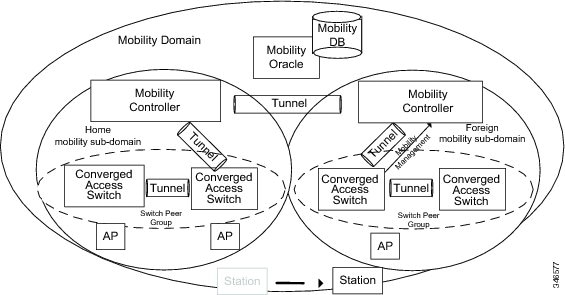
This section focuses specifically on mobility events that occur across mobility sub-domains. An inter sub-domain mobility event occurs when a user moves from his home sub-domain to a foreign sub-domain. When the station initially roams to the foreign sub-domain, the foreign Mobility Controller signals the mobility event through the Mobility Oracle. This causes the station's traffic to be tunneled between the MCs in both sub-domains.
Point of Presence at Anchor Switch
When a station moves across sub-domains, the home and foreign MCs ensure that all of the station's traffic is tunneled.
Tunneling across sub-domains when the client roams from Anchor Switch to Foreign Switch
The following events happen when a station roams across sub-domains with the anchor switch in the home sub-domain as its point of presence:
- A station joins the network by associating to the AP on switch A and is provided with an IP address from a subnet available on it.Its traffic is natively bridged at the switch and no tunneling is required. switch A is both the point of presence and point of attachment for the station.
- When the station roams to switch B where the same subnet is not available, the information is provided in the handoff process.
- When the handoff is complete, the mobile announce message is sent from switch B to the MC in foreign sub-domain.
- The MC belonging to the foreign sub-domain will then tunnel the mobile announce message to the MO. This cause the stations traffic to be tunneled between the MCs in both the sub-domains.
- The MO will tunnel the mobile announce message to the MC in the home sub-domain.
- The MC in the home sub-domain will then tunnel the traffic to the anchor switch.
Tunneling across sub-domains with the Anchor Switch in the home sub-domain is the point of presence
The following events happen when a station roams across sub-domains with the anchor switch in the home sub-domain as its point of presence:
- A station joins the network by associating to the AP on switch A and is provided with an IP address from a subnet available on it.Its traffic is natively bridged at the switch and no tunneling is required. switch A is both the point of presence and point of attachment for the station.
- When the station roams to switch B where the same subnet is not available, the information is provided in the handoff process.
- When the handoff is complete, the anchor switch (Switch A) sends the handoff complete message to Switch B.
- The MC in the foreign sub-domain then forwards the handoff complete message to the MC in the home sub-domain.
- The MC belonging to the foreign sub-domain will then tunnel the traffic to the MO and finally reached the MC in the home sub-domain.
- The MC in the home sub-domain will then tunnel the traffic to the anchor switch.
- The anchor switch continues to be the point of presence for the station.
- The Switch B will contain the point of attachment.