



 Feedback
Contents
Header Compression
Header compression is a mechanism that compresses the header in a packet before the packet is transmitted. For Cisco IOS XE Software, Cisco provides RTP header compression (used for RTP packets).
This module contains a high-level overview of header compression. Before configuring header compression, you should understand the information in this module.
Finding Feature Information
Your software release may not support all the features documented in this module. For the latest feature information and caveats, see the release notes for your platform and software release. To find information about the features documented in this module, and to see a list of the releases in which each feature is supported, see the Feature Information Table at the end of this document.
Use Cisco Feature Navigator to find information about platform support and Cisco software image support. To access Cisco Feature Navigator, go to www.cisco.com/go/cfn. An account on Cisco.com is not required.
Information About Header Compression
Header Compression Defined
Header compression is a mechanism that compresses the header in a data packet before the packet is transmitted. Header compression reduces network overhead and speeds up the transmission of packets. Header compression also reduces the amount of bandwidth consumed when the packets are transmitted.
RTP Functionality and Header Compression
Real-Time Transport Protocol (RTP) provides end-to-end network transport functions for applications that support audio, video, or simulation data over unicast or multicast services.
RTP provides support for real-time conferencing of groups of any size within the Internet. This support includes source identification support for gateways such as audio and video bridges, and support for multicast-to-unicast translators. RTP provides QoS feedback from receivers to the multicast group and support for the synchronization of different media streams.
RTP includes a data portion and a header portion. The data portion of RTP is a thin protocol that provides support for the real-time properties of applications, such as continuous media, including timing reconstruction, loss detection, and content identification. The header portion of RTP is considerably larger than the data portion. The header portion consists of the IP segment, the User Datagram Protocol (UDP) segment, and the RTP segment. Given the size of the IP/UDP/RTP segment combinations, it is inefficient to send the IP/UDP/RTP header without compressing it.
To avoid the unnecessary consumption of available bandwidth, RTP header compression is used on a link-by-link basis.
How RTP Header Compression Works
RTP header compression compresses the RTP header (that is, the combined IP, UDP, and RTP segments) in an RTP packet. The figure below illustrates this process and shows how RTP header compression treats incoming packets.
In this example, packets arrive at an interface and the packets are classified. After the packets are classified, they are queued for transmission according to the configured queuing mechanism.
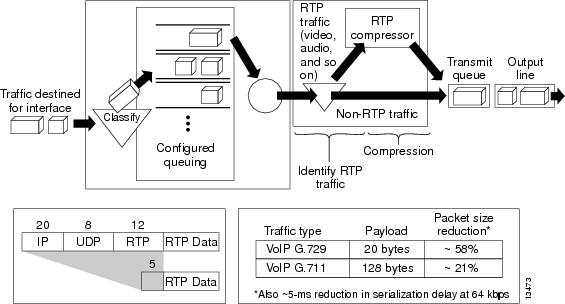
For most audio applications, the RTP packet typically has a 20- to 128-byte payload.
RTP header compression identifies the RTP traffic and then compresses the IP header portion of the RTP packet. The IP header portion consists of an IP segment, a UDP segment, and an RTP segment. In the figure above, the minimal 20 bytes of the IP segment, combined with the 8 bytes of the UDP segment, and the 12 bytes of the RTP segment, create a 40-byte IP/UDP/RTP header. In the figure above, the RTP header portion is compressed from 40 bytes to approximately 5 bytes.
 Note | RTP header compression is supported on serial interfaces using Frame Relay, HDLC, or PPP encapsulation. It is also supported over ISDN interfaces. |
Why Use RTP Header Compression
RTP header compression accrues major gains in terms of packet compression because although several fields in the header change in every packet, the difference from packet to packet is often constant, and therefore the second-order difference is zero. The decompressor can reconstruct the original header without any loss of information.
RTP header compression also reduces overhead for multimedia RTP traffic. The reduction in overhead for multimedia RTP traffic results in a corresponding reduction in delay; RTP header compression is especially beneficial when the RTP payload size is small, for example, for compressed audio payloads of 20 to 50 bytes.
Use RTP header compression on any WAN interface where you are concerned about bandwidth and where there is a high portion of RTP traffic. RTP header compression can be used for media-on-demand and interactive services such as Internet telephony. RTP header compression provides support for real-time conferencing of groups of any size within the Internet. This support includes source identification support for gateways such as audio and video bridges, and support for multicast-to-unicast translators. RTP header compression can benefit both telephony voice and multicast backbone (MBONE) applications running over slow links.
Additional References
Related Documents
|
Related Topic |
Document Title |
|---|---|
|
Cisco IOS commands |
|
|
QoS commands: complete command syntax, command modes, command history, defaults, usage guidelines, and examples |
Cisco IOS Quality of Service Solutions Command Reference |
|
MQC |
"Applying QoS Features Using the MQC" module |
|
RTP header compression |
"Configuring RTP Header Compression" module |
MIBs
Technical Assistance
|
Description |
Link |
|---|---|
|
The Cisco Support and Documentation website provides online resources to download documentation, software, and tools. Use these resources to install and configure the software and to troubleshoot and resolve technical issues with Cisco products and technologies. Access to most tools on the Cisco Support and Documentation website requires a Cisco.com user ID and password. |
Glossary
compression --The running of a data set through an algorithm that reduces the space required to store the data set or the bandwidth required to transmit the data set.
decompression --The act of reconstructing a compressed header.
HDLC --High-Level Data Link Control. A bit-oriented synchronous data link layer protocol developed by International Organization for Standardization (ISO). Derived from Synchronous Data Link Control (SDLC), HDLC specifies a data encapsulation method on synchronous serial links using frame characters and checksums.
header --A chain of subheaders.
incorrect decompression --The circumstance in which a compressed and then decompressed header is different from the uncompressed header. This variance is usually due to a mismatched context between the compressor and decompressor or bit errors during transmission of the compressed header.
ISDN --Integrated Services Digital Network. A communication protocol offered by telephone companies that permits telephone networks to carry data, voice, and other source traffic.
MQC --Modular Quality of Service Command-Line Interface. The MQC allows you to create traffic classes and policy maps and then attach the policy maps to interfaces. The policy maps apply QoS features to your network.
PPP --Point-to-Point Protocol. A protocol that provides router-to-router and host-to-network connections over synchronous and asynchronous circuits.
regular header --A normal, uncompressed header. A regular header does not carry a context identifier (CID) or generation association.
RTP --Real-Time Transport Protocol. A protocol that is designed to provide end-to-end network transport functions for applications that transmit real-time data, such as audio, video, or simulation data, over unicast or multicast network services. RTP provides such services as payload type identification, sequence numbering, timestamping, and delivery monitoring to real-time applications.
subheader --An IPv6 base header, an IPv6 extension header, an IPv4 header, a UDP header, an RTP header, or a TCP header.
UDP --User Datagram Protocol. A connectionless transport layer protocol in the TCP/IP protocol stack. UDP is a simple protocol that exchanges datagrams without acknowledgments or guaranteed delivery, requiring that error processing and retransmission be handled by other protocols. UDP is defined in RFC 768.
Cisco and the Cisco Logo are trademarks of Cisco Systems, Inc. and/or its affiliates in the U.S. and other countries. A listing of Cisco's trademarks can be found at www.cisco.com/go/trademarks. Third party trademarks mentioned are the property of their respective owners. The use of the word partner does not imply a partnership relationship between Cisco and any other company. (1005R)
Any Internet Protocol (IP) addresses and phone numbers used in this document are not intended to be actual addresses and phone numbers. Any examples, command display output, network topology diagrams, and other figures included in the document are shown for illustrative purposes only. Any use of actual IP addresses or phone numbers in illustrative content is unintentional and coincidental.