Visão geral do Any-Source Multicast (ASM) no ambiente de malha do campus do SDA

Opções de download
Linguagem imparcial
O conjunto de documentação deste produto faz o possível para usar uma linguagem imparcial. Para os fins deste conjunto de documentação, a imparcialidade é definida como uma linguagem que não implica em discriminação baseada em idade, deficiência, gênero, identidade racial, identidade étnica, orientação sexual, status socioeconômico e interseccionalidade. Pode haver exceções na documentação devido à linguagem codificada nas interfaces de usuário do software do produto, linguagem usada com base na documentação de RFP ou linguagem usada por um produto de terceiros referenciado. Saiba mais sobre como a Cisco está usando a linguagem inclusiva.
Sobre esta tradução
A Cisco traduziu este documento com a ajuda de tecnologias de tradução automática e humana para oferecer conteúdo de suporte aos seus usuários no seu próprio idioma, independentemente da localização. Observe que mesmo a melhor tradução automática não será tão precisa quanto as realizadas por um tradutor profissional. A Cisco Systems, Inc. não se responsabiliza pela precisão destas traduções e recomenda que o documento original em inglês (link fornecido) seja sempre consultado.
Contents
Introdução
Este documento descreve a Visão Geral do Multicast Any-Source (ASM) com Ponto de Reunião Único (RP) no Ambiente de Acesso Definido por Software (SD-Access).
Pré-requisitos
Requisitos
Recomenda-se que você tenha conhecimento do Locator ID Separation Protocol (LISP) e multicast.
Componentes Utilizados
Este documento não se restringe a versões de software e hardware específicas.
As informações apresentadas neste documento foram criadas a partir de dispositivos em um ambiente de laboratório específico. Se sua rede estiver ativa, certifique-se de que você compreende o impacto potencial de qualquer comando.GUI
Dispositivos usados para este artigo
Controlador Digital Network Architecture (DNAC) - Versão 1.2.1
Borda e Borda - Switch Cat3k Cisco
Fusão - Roteador Cisco com suporte para vazamento de Inter-VRF (Virtual Route Forwarding)
Configurar
Diagrama de Rede
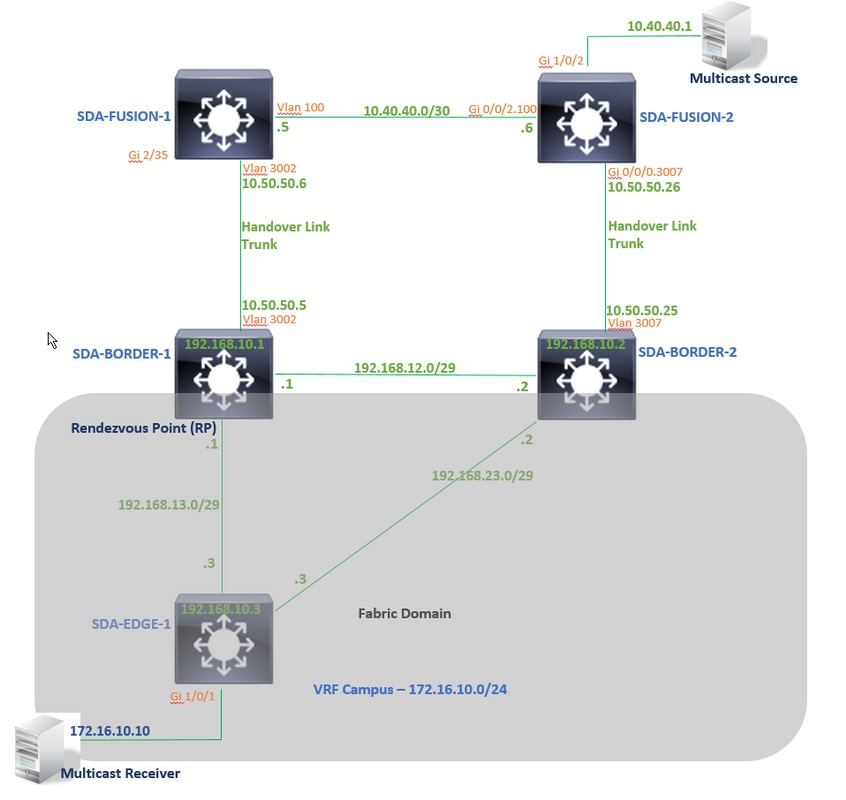
A topologia usada para este artigo consiste em dois roteadores de borda, ambos configurados como fronteiras externas, e dois roteadores de fusão com uma conexão para cada roteador de borda respectivo. Border-1 é configurado como RP, a origem de multicast é conectada ao Fusion-2 e o receptor de multicast é conectado ao Edge-1.
Configurações
Este artigo não aborda as etapas para configurar a estrutura no ambiente de Acesso Definido por Software (SDA) e começa com uma explicação das etapas para configurar o Multicast no domínio de estrutura para uma VLAN específica.
Etapa1: Configurar multicast em dispositivos de estrutura de DNAC
Na interface gráfica do usuário (GUI) do DNAC, em Provisionar -> Fluxo de trabalho da estrutura. O multicast é configurado pela opção "Enable Rendezvous point " no dispositivo SDA-BORDER-1.
Em seguida, escolha um pool de Internet Protocol (IP) a ser usado para a configuração de multicast em um VPN específico. "Campus" neste exemplo.

Etapa 2: Verificar a configuração aplicada nos dispositivos
Esta seção aborda a verificação da configuração Multicast em dispositivos de estrutura.
SDA-BORDER-1
interface Loopback4099                            <<<<<<<<<<<< Loopback Interface is created and assigned an IP from Pool selected
 vrf forwarding Campus
 ip address 192.168.50.1 255.255.255.255
 ip pim sparse-mode                               <<<<<<<<<<< PIM is enabled on Interface
end


interface LISP0.4099                              <<<<<<<<<<< PIM is enabled on LISP interface
 ip pim sparse-mode
end

SDA-Border1#sh run | in pim|multicast

ip multicast-routing                             <<<<<<<<<<< Multicast Routing is enabled for Global
ip multicast-routing vrf Campus                  <<<<<<<<<<< Multicast Routing is enabled for Campus VN

ip pim ssm default                               <<<<<<<<<< PIM SSM mode is enabled for Global for default address range
ip pim vrf Campus rp-address 192.168.50.1        <<<<<<<<<< BORDER-1 Loopback4099 is configued as RP
ip pim vrf Campus register-source Loopback4099
ip pim vrf Campus ssm default                    <<<<<<<<<< PIM SSM mode is enabled for vrf Campus for default address range

SDA-Border1#sh run | s address-family ipv4 vrf Campus
 address-family ipv4 vrf Campus
.....
 network 192.168.50.1 mask 255.255.255.255       <<<<<<<<<<< RP Address is injected into BGP Table
 aggregate-address 192.168.50.0 255.255.255.0 summary-only <<<<<<<<<<< Aggregate for Multicast Pool is advertised
.....
SDA-BORDER-2
interface Loopback4099
 vrf forwarding Campus
 ip address 192.168.50.3 255.255.255.255
 ip pim sparse-mode
end

interface LISP0.4099
 ip pim sparse-mode
end


SDA-Border2#sh run | in pim|multicast

ip multicast-routing
ip multicast-routing vrf Campus

ip pim ssm default
ip pim vrf Campus rp-address 192.168.50.1       <<<<<<<<<< BORDER-1 Loopback4099 is configued as RP
ip pim vrf Campus register-source Loopback4099
ip pim vrf Campus ssm default


SDA-Border2#sh run | s address-family ipv4 vrf Campus
 address-family ipv4 vrf Campus
.....
 network 192.168.50.1 mask 255.255.255.255
 aggregate-address 192.168.50.0 255.255.255.0 summary-only
.....
SDA-EDGE-1
interface Vlan1021
 description Configured from apic-em
 mac-address 0000.0c9f.f45c
 vrf forwarding Campus
 ip address 172.16.10.1 255.255.255.0
 ip helper-address 10.10.10.100
 no ip redirects
 ip local-proxy-arp
 ip pim sparse-mode                            <<<<<<<<<<< PIM is enabled on all SVI-s under Campus VN
 ip route-cache same-interface
 ip igmp version 3
 no lisp mobility liveness test
 lisp mobility 172_16_10_0-Campus
end


interface Loopback4099
 vrf forwarding Campus
 ip address 192.168.50.2 255.255.255.255
 ip pim sparse-mode
end


interface LISP0.4099
 ip pim sparse-mode
end


SDA-Edge1#sh run | in pim|multicast

ip multicast-routing
ip multicast-routing vrf Campus

ip pim ssm default
ip pim vrf Campus rp-address 192.168.50.1       <<<<<<<<<< BORDER-1 Loopback4099 is configued as RP
ip pim vrf Campus register-source Loopback4099
ip pim vrf Campus ssm default
Etapa 3: Configurar manualmente o PIM através do link de transferência
A origem de multicast é conectada fora da estrutura ao Fusion-2 neste exemplo. Para que o fluxo do Multicast ocorra, verifique se há um caminho PIM de RP para Origem e de Receptor para Origem (os caminhos podem ser diferentes!).
Correspondência PIM entre SDA-BORDER-1 e SDA-FUSION-1
SDA-BORDER-1
------------------------------------------------
interface Vlan3002                             <<<<<<<< Enable PIM on Handover link in Campus VN
 description vrf interface to External router
 vrf forwarding Campus
 ip address 10.50.50.5 255.255.255.252
 no ip redirects
 ip pim sparse-mode
 ip route-cache same-interface
end


SDA-FUSION-1
------------------------------------------------
ip multicast-routing
ip multicast-routing vrf Campus               <<<<<<<<< Enable Multicast Routing in vrf Campus

ip pim vrf Campus rp-address 192.168.50.1     <<<<<<<<< Configure BORDER-1 Loopback4099 as RP

interface Vlan3002                            <<<<<<<<< Enable PIM on Fusion Interface towards Border
vrf forwarding Campus
ip address 10.50.50.6 255.255.255.252
ip pim sparse-mode
end
Correspondência PIM entre SDA-BORDER-2 e SDA-FUSION-2
SDA-BORDER-2
------------------------------------------------
interface Vlan3007
 description vrf interface to External router
 vrf forwarding Campus
 ip address 10.50.50.25 255.255.255.252
 no ip redirects
 ip pim sparse-mode
 ip route-cache same-interface
end


SDA-FUSION-2
------------------------------------------------
ip multicast-routing distributed
ip multicast-routing vrf Campus distributed

ip pim vrf Campus rp-address 192.168.50.1

interface GigabitEthernet0/0/0.3007
 encapsulation dot1Q 3007
 vrf forwarding Campus
 ip address 10.50.50.26 255.255.255.252
 ip pim sparse-mode
 no cdp enable
end
Correspondência PIM entre SDA-FUSION-1 e SDA-FUSION-2
SDA-FUSION-1
------------------------------------------------
interface Vlan100
 description Muticast_Campus
 vrf forwarding Campus
 ip address 10.40.40.5 255.255.255.252
 ip pim sparse-mode
end


SDA-FUSION-2
------------------------------------------------
interface GigabitEthernet0/0/2.100
 encapsulation dot1Q 100
 vrf forwarding Campus
 ip address 10.40.40.6 255.255.255.252
 ip pim sparse-mode
end
Habilitar PIM na interface que se conecta à Origem
SDA-FUSION-2
-------------------------------------------------

interface GigabitEthernet1/0/2
 vrf forwarding Campus
 ip address 10.40.40.2 255.255.255.252
 ip pim sparse-mode
 load-interval 30
 negotiation auto
end
Processo do plano de controle
Em algum momento, o receptor multicast envia um protocolo de gerenciamento de grupos na Internet (IGMP) Join to Last Hop Router(LHR) para receber o fluxo de um grupo específico, e a fonte multicast (servidor) começa a enviar o fluxo multicast para o roteador de primeiro salto (FHR). Em nosso caso, FHR é SDA-FUSION-2 e LHR é SDA-EDGE-1 e o Processo de Plano de Controle é explicado no cenário em que o Receptor solicita um fluxo primeiro e a Origem inicia o streaming para esse grupo depois.
Junção de IGMP no LHR
O receptor multicast envia um relatório IGMP (união) ao LHR para o grupo 239.1.1.1. O receptor está conectado à Gi1/0/1 (SVI 1021) em SDA-EDGE-1.
SDA-Edge1#debug ip igmp vrf Campus 239.1.1.1
IGMP debugging is on

*Aug 14 23:53:06.445: IGMP(4): Received v2 Report on Vlan1021 from 172.16.10.10 for 239.1.1.1
*Aug 14 23:53:06.445: IGMP(4): Received Group record for group 239.1.1.1, mode 2 from 172.16.10.10 for 0 sources
*Aug 14 23:53:06.445: IGMP(4): MRT Add/Update Vlan1021 for (*,239.1.1.1) by 0

*Aug 14 23:54:07.445: IGMP(4): Received v2 Report on Vlan1021 from 172.16.10.10 for 239.1.1.1   <<<<<<< one minute apart

SDA-Edge1#show ip igmp vrf Campus group
IGMP Connected Group Membership
Group Address    Interface                Uptime    Expires   Last Reporter
239.1.1.1        Vlan1021                 00:49:10  00:02:45  172.16.10.10    <<<<<<< Receiver is present
SDA-Edge1#
O novo serviço de observação de rota multicast determina as informações de Encaminhamento de caminho reverso (RPF) em direção ao RP (para árvore compartilhada) e em direção à origem (para SPT (Shortest Path Tree)). Para endereços alcançáveis por LISP, o vizinho do próximo salto é representado pelo endereço RLOC (localizador de roteamento) remoto do site upstream.
SDA-Edge1#show ip pim vrf Campus rp mapping 239.1.1.1
PIM Group-to-RP Mappings

Group(s): 224.0.0.0/4, Static
    RP: 192.168.50.1 (?)                          <<<<<<<<<<< RP is 192.168.50.1
SDA-Edge1#
SDA-Edge1#


SDA-Edge1#show lisp eid-table vrf Campus ipv4 map 192.168.50.1/32       <<<<<<<<< check Reachability towards the RP address
LISP IPv4 Mapping Cache for EID-table vrf Campus (IID 4099), 4 entries

192.168.50.1/32, uptime: 2w5d, expires: 23:10:58, via map-reply, complete
  Sources: map-reply
  State: complete, last modified: 2w5d, map-source: 192.168.10.1
  Active, Packets out: 171704(3435172 bytes) (~ 00:00:43 ago)
  Locator       Uptime    State      Pri/Wgt     Encap-IID
  192.168.10.1  2w5d      up          10/10        -                 <<<<<<<<<<< RLOC is 192.168.10.1
    Last up-down state change:         2w5d, state change count: 1
    Last route reachability change:    2w5d, state change count: 1
    Last priority / weight change:     never/never
    RLOC-probing loc-status algorithm:
      Last RLOC-probe sent:            00:49:02 (rtt 3ms)


SDA-Edge1#show ip cef vrf Campus 192.168.50.1/32
192.168.50.1/32
  nexthop 192.168.10.1 LISP0.4099                                   <<<<<<<<<<< RP is reachable via LISP interface


SDA-Edge1#show ip mroute vrf Campus 239.1.1.1
IP Multicast Routing Table

(*, 239.1.1.1), 00:50:06/00:02:57, RP 192.168.50.1, flags: SJC     <<<<<<<<<<< (*,G) entry is created
  Incoming interface: LISP0.4099, RPF nbr 192.168.10.1             <<<<<<<<<<< Incoming interface is set as LISP interface
  Outgoing interface list:
    Vlan1021, Forward/Sparse, 00:50:06/00:02:57                    <<<<<<<<<<< Outgoing Interface is set towards Receiver
Em seguida, o LHR envia um PIM (*,G) Join para o RP (em intervalos de um minuto) - se o LHR for DR para esse segmento.
SDA-Edge1#debug ip pim vrf Campus 239.1.1.1
PIM debugging is on

*Aug 15 00:03:44.592: PIM(4): Building Periodic (*,G) Join / (S,G,RP-bit) Prune message for 239.1.1.1
*Aug 15 00:03:44.593: PIM(4): Insert (*,239.1.1.1) join in nbr 192.168.10.1's queue
*Aug 15 00:03:44.593: PIM(4): Building Join/Prune packet for nbr 192.168.10.1
*Aug 15 00:03:44.594: PIM(4):  Adding v2 (192.168.50.1/32, 239.1.1.1), WC-bit, RPT-bit, S-bit Join
*Aug 15 00:03:44.594: PIM(4): Adding LISP Unicast transport attribute in join/prune to 192.168.10.1 (LISP0.4099)
*Aug 15 00:03:44.594: PIM(4): Send v2 join/prune to 192.168.10.1 (LISP0.4099)         <<<<<<< PIM (*,G) Join is sent towards the RP

*Aug 15 00:04:42.892: PIM(4): Building Periodic (*,G) Join / (S,G,RP-bit) Prune message for 239.1.1.1
*Aug 15 00:04:42.892: PIM(4): Insert (*,239.1.1.1) join in nbr 192.168.10.1's queue
*Aug 15 00:04:42.892: PIM(4): Building Join/Prune packet for nbr 192.168.10.1
*Aug 15 00:04:42.892: PIM(4):  Adding v2 (192.168.50.1/32, 239.1.1.1), WC-bit, RPT-bit, S-bit Join
*Aug 15 00:04:42.892: PIM(4): Adding LISP Unicast transport attribute in join/prune to 192.168.10.1 (LISP0.4099)
*Aug 15 00:04:42.892: PIM(4): Send v2 join/prune to 192.168.10.1 (LISP0.4099)
SDA-Edge1#
Criação de vizinhos
Quando as informações de RPF são obtidas apontando para a interface LISP, o PIM precisa criar explicitamente uma estrutura vizinha para o RLOC correspondente. Isso é necessário porque o Roteador de túnel upstream (xTR) não envia mensagens de saudação. O novo bloco vizinho expira quando nenhuma mensagem de junção/remoção foi enviada ao vizinho após 2 vezes o tempo de intervalo padrão entre junção/remoção.
Em nosso caso, o SDA-EDGE-1 cria um vizinho PIM usando o endereço RLOC de upstream/RPF.
SDA-Edge1#show ip pim vrf Campus neighbor
PIM Neighbor Table

Neighbor          Interface                Uptime/Expires    Ver   DR
Address                                                            Prio/Mode
192.168.10.1      LISP0.4099               1w5d/00:01:27     v2    0 /             <<<<<<< RLOC address used for the neighbor


SDA-Edge1#debug ip pim vrf Campus timers    <— chatty!
PIM-TIMERS debugging is on

*Aug 15 00:08:37.992: PIM(4): Building Periodic (*,G) Join / (S,G,RP-bit) Prune message for 239.1.1.1
*Aug 15 00:08:37.993: PIM(4) Twheel Start: Neighbor Timer for Nbr: 192.168.10.1. idb LISP0.4099. delay: 120000 ms. jitter 0.

...
Junção PIM recebida no RP
A junção PIM é recebida no RP(SDA-BORDER-1) de LHR(SDA-EDGE-1) na Interface LISP
SDA-Border1#debug ip pim vrf Campus 239.1.1.1
PIM debugging is on

*Aug 18 01:47:14.812: PIM(4): J/P Transport Attribute, Transport Type: Unicast
*Aug 18 01:47:14.813: PIM(4): Join-list: (*, 239.1.1.1), RPT-bit set, WC-bit set, S-bit set
*Aug 18 01:47:14.813: PIM(4): Check RP 192.168.50.1 into the (*, 239.1.1.1) entry
*Aug 18 01:47:14.813: PIM(4): Adding register decap tunnel (Tunnel1) as accepting interface of (*, 239.1.1.1).
*Aug 18 01:47:14.813: PIM(4): Add LISP0.4099/192.168.10.3 to (*, 239.1.1.1), Forward state, by PIM *G Join        <<<<<< (*,G) join received from RLOC of LHR over LISP Interface

*Aug 18 01:48:14.267: PIM(4): J/P Transport Attribute, Transport Type: Unicast
*Aug 18 01:48:14.267: PIM(4): Join-list: (*, 239.1.1.1), RPT-bit set, WC-bit set, S-bit set
*Aug 18 01:48:14.267: PIM(4): Update LISP0.4099/192.168.10.3 to (*, 239.1.1.1), Forward state, by PIM *G Join


SDA-Border1#show ip mroute vrf Campus 239.1.1.1
IP Multicast Routing Table

(*, 239.1.1.1), 00:01:38/00:02:51, RP 192.168.50.1, flags: S
  Incoming interface: Null, RPF nbr 0.0.0.0                               <<<<<<<<<<<< RP is myself hence RPF Neighbor is Null
  Outgoing interface list:
    LISP0.4099, 192.168.10.3, Forward/Sparse, 00:01:38/00:02:51           <<<<<<<<<<<< Outgoing Interface is set towards LHR RLOC
O RP(Border1) não envia nenhuma junção pela interface LISP, portanto nenhum Vizinho PIM é criado no RP pela interface LISP.
Em nosso caso, o único vizinho PIM é em direção ao Fusion-1 em uma interface não LISP e formado como resultado dos pacotes Hello PIM periódicos recebidos.
SDA-Border1#debug ip pim vrf Campus hello
PIM-HELLO debugging is on
SDA-Border1#
*Aug 24 00:02:19.944: PIM(4): Received v2 hello on Vlan3002 from 10.50.50.6
*Aug 24 00:02:19.944: PIM(4): Neighbor (10.50.50.6) Hello GENID = 1315387214
SDA-Border1#
*Aug 24 00:02:49.396: PIM(4): Received v2 hello on Vlan3002 from 10.50.50.6
*Aug 24 00:02:49.397: PIM(4): Neighbor (10.50.50.6) Hello GENID = 1315387214

SDA-Border1#show ip pim vrf Campus neigh
PIM Neighbor Table

Neighbor          Interface                Uptime/Expires    Ver   DR
Address                                                            Prio/Mode
10.50.50.6        Vlan3002                 2w0d/00:01:31     v2    1 / DR S P G
Vizinho PIM em Roteadores Fusion
Vizinhos PIM em Roteadores Fusion estão em interfaces não LISP e, portanto, também são criados com base nos Hello-s PIM recebidos periodicamente.
SDA-FUSION-1

SDA-Fusion1#show ip pim vrf Campus neighbor
PIM Neighbor Table

Neighbor          Interface                Uptime/Expires    Ver   DR
Address                                                            Prio/Mode
10.40.40.6        Vlan100                  5d00h/00:01:41    v2    1 / S P G
10.50.50.5        Vlan3002                 2w4d/00:01:44     v2    1 / S P G


SDA-FUSION-2

SDA-Fusion2#show ip pim vrf Campus neighbor
PIM Neighbor Table

Neighbor          Interface                Uptime/Expires    Ver   DR
Address                                                            Prio/Mode
10.50.50.25       Gi0/0/0.3007             2w5d/00:01:36     v2    1 / S P G
10.40.40.5        GigabitEthernet0/0/2.100 5d00h/00:01:23    v2    100/ DR S P G
PIM Register no RP do FHR
Quando a origem começa a enviar tráfego para o grupo, o FHR (SDA-FUSION-2) registra o (S,G) com o RP assim que recebe o primeiro pacote multicast da origem - e se o FHR for o DR nesse segmento.
SDA-Fusion2#show ip pim vrf Campus rp mapping 239.1.1.1
PIM Group-to-RP Mappings

Group(s): 224.0.0.0/4, Static
    RP: 192.168.50.1 (?)                              <<<<<<<< RP for the Group

SDA-Fusion2#show ip cef vrf Campus 192.168.50.1
192.168.50.1/32
  nexthop 10.40.40.5 GigabitEthernet0/0/2.100         <<<<<<<< Next-hop Interface towards RP


SDA-Fusion2#debug ip mrouting vrf Campus
IP multicast routing debugging is on
SDA-Fusion2#debug ip pim vrf Campus
PIM debugging is on

*Aug 22 21:59:42.601: PIM(2): Check RP 192.168.50.1 into the (*, 239.1.1.1) entry
*Aug 22 21:59:42.601: MRT(2): (*,239.1.1.1), RPF change from  /0.0.0.0 to GigabitEthernet0/0/2.100/10.40.40.5         <<<<<<<< RPF Interface is determined
*Aug 22 21:59:42.601: PIM(2): Building Triggered (*,G) Join / (S,G,RP-bit) Prune message for 239.1.1.1
*Aug 22 21:59:42.601: MRT(2): Create (*,239.1.1.1), RPF (GigabitEthernet0/0/2.100, 10.40.40.5, 1/0)
*Aug 22 21:59:42.602: MRT(2): (10.40.40.1,239.1.1.1), RPF install from  /0.0.0.0 to GigabitEthernet1/0/2/0.0.0.0
*Aug 22 21:59:42.602: PIM(2): Adding register encap tunnel (Tunnel0) as forwarding interface of (10.40.40.1, 239.1.1.1). <<<<< Register Tunnel is created
*Aug 22 21:59:42.602: MRT(2): Set the F-flag for (*, 239.1.1.1)
*Aug 22 21:59:42.602: MRT(2): Set the F-flag for (10.40.40.1, 239.1.1.1)                                              <<<<<<< Register(F) flag is set
*Aug 22 21:59:42.602: MRT(2): Create (10.40.40.1,239.1.1.1), RPF (GigabitEthernet1/0/2, 0.0.0.0, 0/0)                 <<<<<<< (S,G) is created
*Aug 22 21:59:42.602: MRT(2): Set the T-flag for (10.40.40.1, 239.1.1.1)                                              <<<<<<< SPT (T) flag is set
*Aug 22 21:59:42.629: PIM(2): Received v2 Join/Prune on GigabitEthernet0/0/2.100 from 10.40.40.5, to us
*Aug 22 21:59:42.629: PIM(2): Join-list: (10.40.40.1/32, 239.1.1.1), S-bit set                                        <<<<<<< (S,G) join is received
*Aug 22 21:59:42.629: MRT(2): WAVL Insert interface: GigabitEthernet0/0/2.100 in (10.40.40.1,239.1.1.1) Successful

*Aug 22 21:59:42.630: MRT(2): set min mtu for (10.40.40.1, 239.1.1.1) 18010->1500
*Aug 22 21:59:42.630: MRT(2): Add GigabitEthernet0/0/2.100/239.1.1.1 to the olist of (10.40.40.1, 239.1.1.1), Forward state - MAC built
*Aug 22 21:59:42.630: PIM(2): Add GigabitEthernet0/0/2.100/10.40.40.5 to (10.40.40.1, 239.1.1.1), Forward state, by PIM SG Join
*Aug 22 21:59:42.630: MRT(2): Add GigabitEthernet0/0/2.100/239.1.1.1 to the olist of (10.40.40.1, 239.1.1.1), Forward state - MAC built
*Aug 22 21:59:42.630: MRT(2): Set the PIM interest flag for (10.40.40.1, 239.1.1.1)

SDA-Fusion2#show ip mroute vrf Campus 239.1.1.1
IP Multicast Routing Table

(*, 239.1.1.1), 00:01:17/stopped, RP 192.168.50.1, flags: SPF
  Incoming interface: GigabitEthernet0/0/2.100, RPF nbr 10.40.40.5
  Outgoing interface list: Null

(10.40.40.1, 239.1.1.1), 00:01:17/00:02:14, flags: FT
  Incoming interface: GigabitEthernet1/0/2, RPF nbr 0.0.0.0       <<<<<<<< RPF neighbor is 0.0.0.0 as the Source is directly connected
  Outgoing interface list:
    Gi0/0/0.3007, Forward/Sparse, 00:01:17/00:03:10

SDA-Fusion2#

SDA-Fusion2#show interface tunnel 0         <<<<<<<< Register Tunnel is created between FHR and RP
Tunnel0 is up, line protocol is up
 Hardware is Tunnel
 Description: Pim Register Tunnel (Encap) for RP 192.168.50.1 on VRF Campus
 Interface is unnumbered. Using address of GigabitEthernet0/0/2.100 (10.40.40.6)
 MTU 9972 bytes, BW 100 Kbit/sec, DLY 50000 usec,
 reliability 255/255, txload 1/255, rxload 1/255
 Encapsulation TUNNEL, loopback not set
 Keepalive not set
 Tunnel linestate evaluation up
 Tunnel source 10.40.40.6 (GigabitEthernet0/0/2.100), destination 192.168.50.1
RP (BORDER-1) recebe o Registro do FHR, que aciona uma Junção (S,G) a ser enviada para o FHR, e também uma Parada de Registro para o FHR - uma vez que o fluxo é recebido nativamente no RP.
SDA-Border1#debug ip mrouting vrf Campus 239.1.1.1
IP multicast routing debugging is on

*Aug 18 02:29:05.186: PIM(4): Received v2 Register on Vlan3002 from 10.40.40.6                                           <<<<<<< PIM Register is received from FHR
*Aug 18 02:29:05.186:      for 10.40.40.1, group 239.1.1.1
*Aug 18 02:29:05.187: PIM(4): Adding register decap tunnel (Tunnel1) as accepting interface of (10.40.40.1, 239.1.1.1).  <<<<<<< Register tunnel is created
*Aug 18 02:29:05.187: MRT(4): (10.40.40.1,239.1.1.1), RPF install from  /0.0.0.0 to Vlan3002/10.50.50.6
*Aug 18 02:29:05.188: MRT(4): Create (10.40.40.1,239.1.1.1), RPF (Vlan3002, 10.50.50.6, 20/0)                            <<<<<<< (S,G) is created and RPF is resolved
*Aug 18 02:29:05.188: MRT(4): WAVL Insert LISP interface: LISP0.4099 in (10.40.40.1,239.1.1.1) Next-hop: 192.168.10.3 Outer-source: 0.0.0.0 Successful
*Aug 18 02:29:05.188: MRT(4): set min mtu for (10.40.40.1, 239.1.1.1) 18010->17892
*Aug 18 02:29:05.189: MRT(4): Add LISP0.4099/192.168.10.3 to the olist of (10.40.40.1, 239.1.1.1), Forward state - MAC not built   <<<<<< LISP OIF is inherited from (*,G)
*Aug 18 02:29:05.189: PIM(4): Insert (10.40.40.1,239.1.1.1) join in nbr 10.50.50.6's queue
*Aug 18 02:29:05.189: PIM(4): Building Join/Prune packet for nbr 10.50.50.6
*Aug 18 02:29:05.189: PIM(4):  Adding v2 (10.40.40.1/32, 239.1.1.1), S-bit Join
*Aug 18 02:29:05.189: PIM(4): Send v2 join/prune to 10.50.50.6 (Vlan3002)                                                <<<<<<< (S,G) join is sent towards the Source
*Aug 18 02:29:05.272: PIM(4): J/P Transport Attribute, Transport Type: Unicast
*Aug 18 02:29:05.272: PIM(4): Join-list: (*, 239.1.1.1), RPT-bit set, WC-bit set, S-bit set
*Aug 18 02:29:05.272: PIM(4): Update LISP0.4099/192.168.10.3 to (*, 239.1.1.1), Forward state, by PIM *G Join
*Aug 18 02:29:05.272: MRT(4): Update LISP0.4099/192.168.10.3 in the olist of (*, 239.1.1.1), Forward state - MAC not built
*Aug 18 02:29:05.272: PIM(4): Prune-list: (10.40.40.1/32, 239.1.1.1) RPT-bit set
*Aug 18 02:29:05.273: PIM(4): Prune LISP0.4099/192.168.10.3 from (10.40.40.1/32, 239.1.1.1)                              <<<<<<< (S,G) Prune is received from Edge1
*Aug 18 02:29:05.273: MRT(4): Delete LISP0.4099/192.168.10.3 from the olist of (10.40.40.1, 239.1.1.1)
*Aug 18 02:29:05.273: PIM(4): Insert (10.40.40.1,239.1.1.1) prune in nbr 10.50.50.6's queue - deleted

*Aug 18 02:29:05.273: PIM(4): Building Join/Prune packet for nbr 10.50.50.6
*Aug 18 02:29:05.273: PIM(4):  Adding v2 (10.40.40.1/32, 239.1.1.1), S-bit Prune
*Aug 18 02:29:05.273: PIM(4): Send v2 join/prune to 10.50.50.6 (Vlan3002)
*Aug 18 02:29:05.439: PIM(4): J/P Transport Attribute, Transport Type: Unicast

*Aug 18 02:29:07.193: PIM(4): Received v2 Register on Vlan3002 from 10.40.40.6
*Aug 18 02:29:07.193:      for 10.40.40.1, group 239.1.1.1
*Aug 18 02:29:07.194: PIM(4): Send v2 Register-Stop to 10.40.40.6 for 10.40.40.1, group 239.1.1.1                        <<<<<<< Register-Stop is sent towards FHR


SDA-Border1#show ip mroute vrf Campus 239.1.1.1
IP Multicast Routing Table

(*, 239.1.1.1), 00:51:28/00:02:44, RP 192.168.50.1, flags: S
  Incoming interface: Null, RPF nbr 0.0.0.0
  Outgoing interface list:
    LISP0.4099, 192.168.10.3, Forward/Sparse, 00:51:28/00:02:44

(10.40.40.1, 239.1.1.1), 00:09:37/00:01:24, flags: P                     <<<<<<<<<<<< (S,G) is created but Pruned flag is set
  Incoming interface: Vlan3002, RPF nbr 10.50.50.6                       <<<<<<<<<<<< Incoming interface and RPF neighbor
  Outgoing interface list: Null


SDA-Border1#show ip rpf vrf Campus 10.40.40.1
RPF information for ? (10.40.40.1)
  RPF interface: Vlan3002                                                <<<<<<<<<< RPF interface towards the Source
  RPF neighbor: ? (10.50.50.6)                                           <<<<<<<<<< RPF neighbor - must be a PIM neighbor
  RPF route/mask: 10.40.40.0/30
 RPF type: unicast (bgp 65005)                                          <<<<<<<<<< RPF information coming from unicast RIB/BGP
  Doing distance-preferred lookups across tables
  RPF topology: ipv4 multicast base, originated from ipv4 unicast base
SDA-Border1#
SDA-Border1#show ip route vrf Campus 10.40.40.1

Routing Table: Campus
Routing entry for 10.40.40.0/30
  Known via "bgp 65005", distance 20, metric 0
  Tag 65004, type external
  Last update from 10.50.50.6 2w6d ago
  Routing Descriptor Blocks:
  * 10.50.50.6, from 10.50.50.6, 2w6d ago
      Route metric is 0, traffic share count is 1
      AS Hops 1
      Route tag 65004
      MPLS label: none
      MPLS Flags: NSF
SDA-Border1#
O SPT está sendo removido pela borda 1 - vamos até o LHR para ver por quê.
(S,G) Criação em LHR
Após receber os dados multicast encaminhados pelo RP, a entrada (S,G) é criada no LHR.
Em seguida, o LHR mudará para o SPT Shortest Path Tree (Árvore de caminho mais curto)) enviando um Join (S,G) em direção à Origem. Isso é enviado na interface RPF em direção à origem.
SDA-Edge1#
*Aug 18 02:19:53.759: MRT(4): Create (10.40.40.1,239.1.1.1), RPF (unknown, 0.0.0.0, 0/0)                    <<<<<<<<< (S,G) is created on LHR
*Aug 18 02:19:53.759: MRT(4): WAVL Insert interface: Vlan1021 in (10.40.40.1,239.1.1.1) Successful
*Aug 18 02:19:53.759: MRT(4): set min mtu for (10.40.40.1, 239.1.1.1) 18010->1500
*Aug 18 02:19:53.759: MRT(4): Add Vlan1021/239.1.1.1 to the olist of (10.40.40.1, 239.1.1.1), Forward state - MAC not built    <<<<<<< OIL is inherited from (*,G)
*Aug 18 02:19:53.759: MRT(4): Set the J-flag for (10.40.40.1, 239.1.1.1)                                    <<<<<<<< SPT Join Flag is set
*Aug 18 02:19:53.762: MRT(4): (10.40.40.1,239.1.1.1), RPF change from  /0.0.0.0 to LISP0.4099/192.168.10.2  <<<<<<<< RPF interface is resolved
*Aug 18 02:19:53.762: MRT(4): Set the T-flag for (10.40.40.1, 239.1.1.1)
*Aug 18 02:19:53.763: PIM(4): Insert (10.40.40.1,239.1.1.1) join in nbr 192.168.10.2's queue
*Aug 18 02:19:53.763: PIM(4): Building Join/Prune packet for nbr 192.168.10.2
*Aug 18 02:19:53.763: PIM(4):  Adding v2 (10.40.40.1/32, 239.1.1.1), S-bit Join
*Aug 18 02:19:53.763: PIM(4): Adding LISP Unicast transport attribute in join/prune to 192.168.10.2 (LISP0.4099)
*Aug 18 02:19:53.763: PIM(4): Send v2 join/prune to 192.168.10.2 (LISP0.4099)                               <<<<<<<< (S,G) Join towards the Source is sent
*Aug 18 02:19:53.826: PIM(4): Building Periodic (*,G) Join / (S,G,RP-bit) Prune message for 239.1.1.1
*Aug 18 02:19:53.826: PIM(4): Insert (*,239.1.1.1) join in nbr 192.168.10.1's queue
*Aug 18 02:19:53.826: PIM(4): Insert (10.40.40.1,239.1.1.1) sgr prune in nbr 192.168.10.1's queue
*Aug 18 02:19:53.826: PIM(4): Building Join/Prune packet for nbr 192.168.10.1
*Aug 18 02:19:53.826: PIM(4):  Adding v2 (192.168.50.1/32, 239.1.1.1), WC-bit, RPT-bit, S-bit Join
*Aug 18 02:19:53.827: PIM(4):  Adding v2 (10.40.40.1/32, 239.1.1.1), RPT-bit, S-bit Prune
*Aug 18 02:19:53.827: PIM(4): Adding LISP Unicast transport attribute in join/prune to 192.168.10.1 (LISP0.4099)
*Aug 18 02:19:53.827: PIM(4): Send v2 join/prune to 192.168.10.1 (LISP0.4099)                               <<<<<<<<< (S,G) Prune towards the RP is sent
*Aug 18 02:20:08.323: MRT(4): Update (*,239.1.1.1), RPF (LISP0.4099, 192.168.10.1, 1/1)
*Aug 18 02:20:08.323: MRT(4): Update Vlan1021/239.1.1.1 in the olist of (*, 239.1.1.1), Forward state - MAC not built
*Aug 18 02:20:08.323: MRT(4): Update Vlan1021/239.1.1.1 in the olist of (10.40.40.1, 239.1.1.1), Forward state - MAC not built


SDA-Edge1#show ip mroute vrf Campus 239.1.1.1
IP Multicast Routing Table

(*, 239.1.1.1), 00:43:35/stopped, RP 192.168.50.1, flags: SJC
  Incoming interface: LISP0.4099, RPF nbr 192.168.10.1
  Outgoing interface list:
    Vlan1021, Forward/Sparse, 00:43:35/00:02:29

(10.40.40.1, 239.1.1.1), 00:01:45/00:01:14, flags: JT                       <<<<<<<<<<<< (S,G) is created
  Incoming interface: LISP0.4099, RPF nbr 192.168.10.2                      <<<<<<<<<<<< Border-2 is the RPF neighbor towards the Source
  Outgoing interface list:
    Vlan1021, Forward/Sparse, 00:01:47/00:02:27


SDA-Edge1#show lisp eid-table vrf Campus ipv4 map 10.40.40.1                  <<<<<<<< LISP lookup for the Source
LISP IPv4 Mapping Cache for EID-table vrf Campus (IID 4099), 5 entries

0.0.0.0/1, uptime: 2w1d, expires: 18:05:53, via map-reply, forward-native
  Sources: map-reply
  State: forward-native, last modified: 2w1d, map-source: 192.168.10.1
  Active, Packets out: 106458(41136237 bytes) (~ 00:00:38 ago)
  Encapsulating to proxy ETR                                                <<<<<<<<< No specific entry is known, forwarding to Proxy ETR


SDA-Edge1#show ip cef vrf Campus 10.40.40.1 detail
0.0.0.0/1, epoch 0, flags [subtree context, check lisp eligibility], per-destination sharing
  SC owned,sourced: LISP remote EID - locator status bits 0x00000000
  LISP remote EID: 106468 packets 41140303 bytes fwd action encap
  LISP source path list
    nexthop 192.168.10.1 LISP0.4099                                         <<<<<<<<<< Load balancing towards 2 Proxy ETR-s
    nexthop 192.168.10.2 LISP0.4099
  2 IPL sources [no flags]
  nexthop 192.168.10.1 LISP0.4099
  nexthop 192.168.10.2 LISP0.4099


SDA-Edge1#show ip cef vrf Campus exact-route 192.168.50.2 10.40.40.1          <<<<<<<<< CEF hashing points towards Border-2
192.168.50.2 -> 10.40.40.1 =>IP adj out of GigabitEthernet1/0/11, addr 192.168.23.2

SDA-Edge1#show ip rpf vrf Campus 10.40.40.1
RPF information for ? (10.40.40.1)
  RPF interface: LISP0.4099
  RPF neighbor: ? (192.168.10.2)                                              <<<<<<<<<< Hence SPT Join is sent towards Border-2
  RPF route/mask: 0.0.0.0/1
  RPF type: unicast ()
  Doing distance-preferred lookups across tables
  RPF topology: ipv4 multicast base
SDA-Edge1#
Como a Junção (S,G) é enviada em direção à Borda 2 pela Interface LISP, um novo vizinho PIM é criado na Borda 1
SDA-Edge1#show ip pim vrf Campus neighbor
PIM Neighbor Table

Neighbor          Interface                Uptime/Expires    Ver   DR
Address                                                            Prio/Mode
192.168.10.2      LISP0.4099               00:07:32/00:01:22 v2    0 /         <<<<<<<< Neighbor towards Border-2 is created
192.168.10.1      LISP0.4099               2w1d/00:01:58     v2    0 /
Como Border-2 está no Caminho de Dados para o fluxo multicast, ele precisa executar RLOC Tracking Explícito para rastrear o RLOC de XTR-s Downstream para Replicação Unicast dos pacotes.
SDA-Border2#show ip mroute vrf Campus 239.1.1.1
IP Multicast Routing Table

(*, 239.1.1.1), 00:23:00/stopped, RP 192.168.50.1, flags: SP
  Incoming interface: LISP0.4099, RPF nbr 192.168.10.1
  Outgoing interface list: Null

(10.40.40.1, 239.1.1.1), 00:12:35/00:02:52, flags: T                 <<<<<<< SPT flag is set
  Incoming interface: Vlan3007, RPF nbr 10.50.50.26                  <<<<<<< RPF neighbor is based on RPF towards the Source - must be a PIM neighbor
  Outgoing interface list:
    LISP0.4099, 192.168.10.3, Forward/Sparse, 00:12:35/00:02:45      <<<<<<< OIL created from (S,G) join received from LHR and containing LHR's RLOC info which has to be tracked

SDA-Border2#show ip mfib vrf Campus 239.1.1.1 10.40.40.1
Entry Flags:    C - Directly Connected, S - Signal, IA - Inherit A flag,
                ET - Data Rate Exceeds Threshold, K - Keepalive
                DDE - Data Driven Event, HW - Hardware Installed
                ME - MoFRR ECMP entry, MNE - MoFRR Non-ECMP entry, MP - MFIB
                MoFRR Primary, RP - MRIB MoFRR Primary, P - MoFRR Primary
                MS  - MoFRR  Entry in Sync, MC - MoFRR entry in MoFRR Client.
I/O Item Flags: IC - Internal Copy, NP - Not platform switched,
                NS - Negate Signalling, SP - Signal Present,
                A - Accept, F - Forward, RA - MRIB Accept, RF - MRIB Forward,
                MA - MFIB Accept, A2 - Accept backup,
                RA2 - MRIB Accept backup, MA2 - MFIB Accept backup

Forwarding Counts: Pkt Count/Pkts per second/Avg Pkt Size/Kbits per second
Other counts:      Total/RPF failed/Other drops
I/O Item Counts:   FS Pkt Count/PS Pkt Count
VRF Campus
 (10.40.40.1,239.1.1.1) Flags: HW
   SW Forwarding: 0/0/0/0, Other: 0/0/0
   HW Forwarding:   176/0/122/0, Other: 0/0/0                       <<<<<<< Multicast stream is forwarded in h/w
   Vlan3007 Flags: A
   LISP0.4099, 192.168.10.3 Flags: F NS
     Pkts: 0/0

SDA-Border2#sh ip mfib vrf Campus 239.1.1.1 10.40.40.1 count
Forwarding Counts: Pkt Count/Pkts per second/Avg Pkt Size/Kilobits per second
Other counts:      Total/RPF failed/Other drops(OIF-null, rate-limit etc)
VRF Campus
 6 routes, 2 (*,G)s, 3 (*,G/m)s
Group: 239.1.1.1
  Source: 10.40.40.1,
   SW Forwarding: 0/0/0/0, Other: 0/0/0
   HW Forwarding:   182/0/122/0, Other: 0/0/0                      <<<<<<<< Counter is incrementing
  Totals - Source count: 1, Packet count: 182

Groups: 1, 1.00 average sources per group
SDA-Border2#
Colaborado por engenheiros da Cisco
- Rahul GuptaEngenheiro do TAC
- Adriana VascanEngenheiro do TAC
 Feedback
Contate a Cisco
- Abrir um caso de suporte

- (É necessário um Contrato de Serviço da Cisco)