Describes how transit routing enables connectivity between multiple Layer 3 domains, mainframes, service nodes, multipod topologies, and GOLF configurations in ACI fabric environments. Provides context for integrating external and internal network resources.
Transit routing is a network function that allows Layer 3 domains, mainframes, service nodes, and multipod topologies to interconnect through the ACI fabric for external and internal traffic.
-
Enables peering between external pods, mainframes, service nodes, and WAN routers with the ACI fabric.
-
Supports redistribution of host routes and VIP addresses for external connectivity.
-
Facilitates multipod and GOLF configurations using OSPF or BGP peering for managed resource pods and border leaf L3Outs.
Transit Routing Scenarios and Connectivity Details
Multiple Layer 3 domains such as external pods, mainframes, service nodes, or WAN routers can peer with the ACI fabric to provide transit functionality between them.
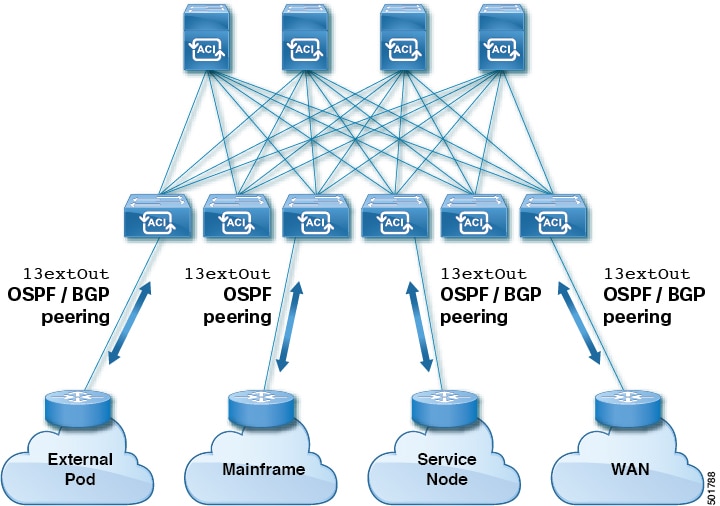
Mainframes can function as IP servers running standard IP routing protocols that accommodate requirements from Logical Partitions (LPARs) and Virtual IP Addressing (VIPA).
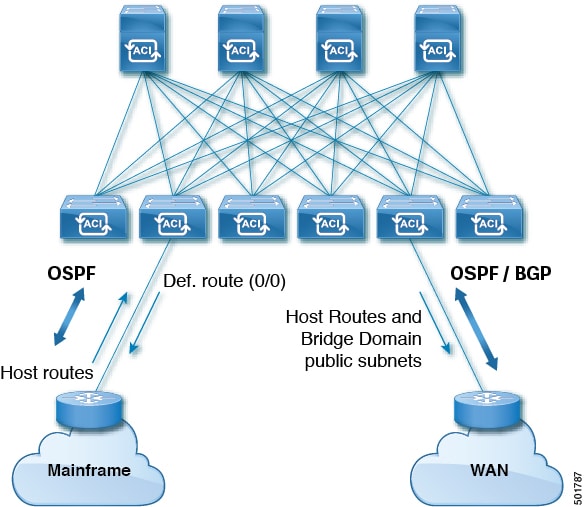
In this topology, mainframes require the ACI fabric to be a transit domain for external connectivity through a WAN router and for east-west traffic within the fabric. They push host routes to the fabric to be redistributed within the fabric and out to external interfaces.
Service nodes can peer with the ACI fabric to advertise a Virtual IP (VIP) route that is redistributed to an external WAN interface.
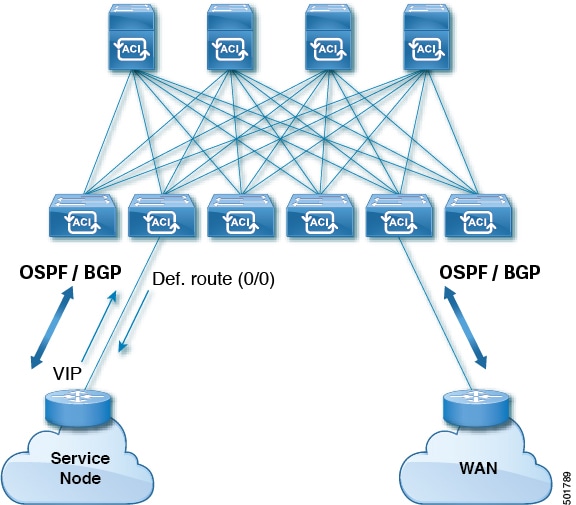
The VIP is the external facing IP address for a particular site or service. A VIP is tied to one or more servers or nodes behind a service node.
In a multipod topology, the fabric acts as a transit for external connectivity and interconnection between multiple pods. Cloud providers can deploy managed resource pods inside a customer datacenter. The demarcation point can be an L3Out with OSPF or BGP peering with the fabric.

In such scenarios, the policies are administered at the demarcation points and ACI policies need not be imposed.
Layer 4 to Layer 7 route peering is a special use case of the fabric as a transit where the fabric serves as a transit OSPF or BGP domain for multiple pods. You configure route peering to enable OSPF or BGP peering on the Layer 4 to Layer 7 service device so that it can exchange routes with the leaf node to which it is connected. A common use case for route peering is Route Health Injection where the SLB VIP is advertised over OSPF or iBGP to clients outside the fabric. See L4-L7 Route Peering with Transit Fabric - Configuration Walkthrough for a configuration walk-through of this scenario.
In APIC , release 2.0 and later, the Cisco ACI supports transit routing with GOLF L3Outs (with BGP and OSPF). For example, the following diagram shows traffic transiting the fabric with GOLF L3Outs and a border leaf L3Out.
