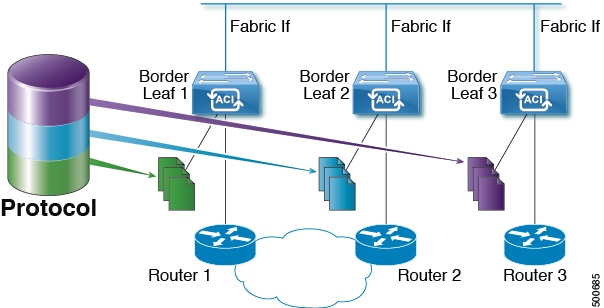
Describes how multiple border leaf switches coordinate to prevent duplicate multicast traffic and balance load across the fabric through designated forwarder selection.
Multiple border leaf switches as designated forwarder is a multicast routing mechanism that
-
selects only one border leaf switch as the designated forwarder when multiple border leaf switches exist in the fabric
-
prevents multiple copies of multicast traffic from entering the fabric from external IPv4/IPv6 networks, and
-
balances load across multiple border leaf switches by striping ownership for groups.
Group striping and load balancing
The designated forwarder selection uses group striping across available border leaf switches as a function of the group address and the VRF virtual network ID (VNID). A border leaf that is responsible for a group sends PIM/PIM6 joins to the external network to attract traffic into the fabric on behalf of receivers in the fabric.
Each border leaf in the fabric maintains a view of all other active border leaf switches in the fabric within that VRF, enabling consistent group striping across all switches. Each border leaf monitors PIM/PIM6 neighbor relations on the fabric interface to derive the list of active border leaf switches.
When a border leaf switch is removed or discovered, the groups are re-striped across the remaining active border leaf switches. The striping method is similar to the method used for hashing the GIPos to external links in multi-pod deployment, ensuring that the group-to-border leaf mapping is sticky and results in fewer changes during topology changes.