Cisco APIC Layer 3 Networking Configuration Guide, Release 6.2(x)

PDF

Cisco APIC Layer 3 Networking Configuration Guide, Release 6.2(x)

Configure multi-pod provisioning

Want to summarize with AI?

Log in

Configure the IPN (Inter-Pod Network) with the required settings to enable multi-pod provisioning in ACI environments.


Configure the IPN to support multi-pod deployments by ensuring proper network connectivity, routing protocols, and multicast functionality across all pods.

The IPN is not managed by the APIC and must be preconfigured manually before multi-pod provisioning can be implemented. This configuration ensures proper inter-pod communication and control plane functionality.

Procedure

  1. Configure the interfaces connected to the spines of all pods.

    Use Layer 3 sub-interfaces tagging traffic with VLAN-4 and increase the MTU at least 50 bytes above the maximum MTU required for inter-site control plane and data plane traffic.

    If remote leaf switches are included in any pods, see Remote Leaf Switches and the Cisco ACI Remote Leaf Architecture White Paper.

  2. If the IPN underlay protocol will be OSPF, enable OSPF on sub-interfaces with the correct area ID.

    Beginning with Cisco APIC Release 5.2(3), the IPN underlay protocol can be either OSPF or BGP (eBGP only).

  3. Enable DHCP Relay on IPN interfaces connected to all spines.

  4. Enable PIM.

  5. Add bridge domain GIPO range as PIM Bidirectional (bidir) group range (default is 225.0.0.0/15).

    A group in bidir mode has only shared tree forwarding capabilities.

  6. Add 239.255.255.240/28 as PIM bidir group range.

  7. Enable PIM and IGMP on the interfaces connected to all spines.

The IPN is configured with the necessary settings to support multi-pod provisioning, including proper interface configuration, routing protocols, DHCP relay, and multicast functionality.
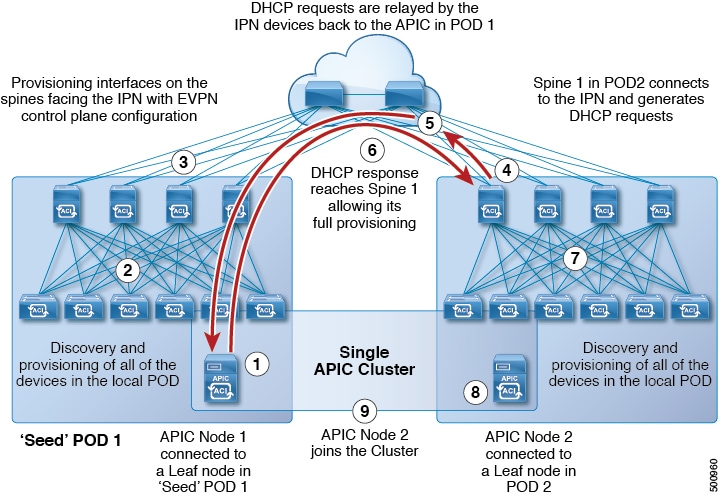
Figure 1. Multi-Pod provisioning
Note
When deploying PIM bidir, at any given time it is only possible to have a single active RP (Rendezvous Point) for a given multicast group range. RP redundancy is hence achieved by leveraging a Phantom RP configuration. Because multicast source information is no longer available in Bidir, the Anycast or MSDP mechanism used to provide redundancy in sparse-mode is not an option for bidir.