Prevents physical or virtual endpoint devices within the same EPG or microsegmented EPG from communicating with each other. This feature provides security by isolating endpoints to prevent unauthorized access or the spread of viruses.
Intra-EPG isolation is a configuration option that restricts communication between endpoints residing in the same EPG.
-
Enforces total isolation of endpoint devices within an EPG.
-
Supports VMware VDS and Microsoft Hyper-V Virtual Switch environments.
-
Utilizes primary and secondary VLAN encapsulation to manage traffic flow between the fabric and the virtual switch.
Operational Details and Configuration
A Cisco Application Centric Infrastructure ( ACI ) VMM domain creates an isolated PVLAN port group for each EPG with isolation enabled. The fabric administrator or the system dynamically specifies primary encapsulation during EPG-to-VMM domain association.
Primary encapsulation deployment methods:
-
Segregate primary and secondary VLAN defined ports on different switches.
-
Use a different encapsulation for static ports that use only port encapsulation to create a second EPG VLAN without primary encapsulation.
Traffic flow encapsulation rules:
-
Fabric to virtual switch: Uses VLAN-pri.
-
Virtual switch to fabric: Uses VLAN-sec.
When intra-EPG isolation is not enforced, the VLAN-pri value is ignored even if specified. Additionally, a VMware DVS domain with EDM UCSM integration may fail if configured on an EPG attached to a domain using UCSM Mini 6324, which does not support private VLANs.
BPDUs are not forwarded through EPGs with intra-EPG isolation enabled, which may prevent the detection of Layer 2 loops in external networks. Ensure a single logical link exists between the Cisco ACI and the external network to avoid this issue.
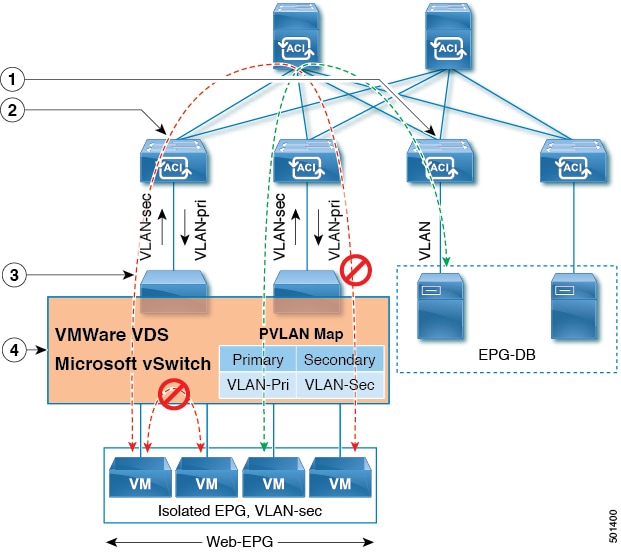
Visual representation of the isolation process:
-
EPG-DB sends VLAN traffic to the Cisco ACI leaf switch, which encapsulates traffic with a primary VLAN tag and forwards it to the Web-EPG endpoint.
-
The virtual switch sends traffic to the Cisco ACI leaf switch using VLAN-sec; the leaf switch drops all intra-EPG traffic due to enforced isolation.
-
The virtual switch VLAN-sec uplink is in isolated trunk mode, and the Cisco ACI leaf switch uses VLAN-pri for downlink traffic.
-
The PVLAN map is configured in the virtual switch and Cisco ACI leaf switches; the virtual switch denies local intra-WEB EPG VM traffic, sending it to the Cisco ACI leaf switch using VLAN-Sec.
- Configuring Intra-EPG Isolation for VMware VDS or Microsoft Hyper-V Virtual Switch using the GUI
Configures intra-EPG isolation for VMware VDS or Microsoft Hyper-V virtual switches within the Cisco APIC GUI. This process enables enforced isolation for application EPGs to enhance network security. - Configure intra-EPG isolation for vmware VDS or microsoft Hyper-V virtual switch using the NX-OS style CLI
Configure intra-EPG isolation for VMware VDS or Microsoft Hyper-V virtual switches using the NX-OS style CLI to prevent communication between endpoints within the same EPG.