Distributes network traffic across several alternative paths using weighted segment lists. This feature improves traffic engineering granularity and resource utilization by allowing precise control over how traffic is split without requiring multiple parallel policies.
Multiple segment list (MSL) is a feature of SR policy that
-
allows a single SR policy to contain multiple distinct segment lists, each with configurable weights,
enables granular and efficient distribution of network traffic over several alternative paths, and
improves flexibility and control for traffic engineering strategies.
Operational benefits
Operational benefits of using multiple segment lists include:
-
Greater precision: Assign weights to individual segment lists for fine-grained traffic distribution beyond fixed equal splits.
-
Simplified management: Reduce operational complexity by eliminating the need to deploy multiple parallel policies.
-
Adaptive traffic control: Easily adjust traffic distribution by updating segment list weights, without the need to add or remove policies.
-
Improved network stability: Lower the risk of disrupting existing ECMP flows and enables smoother adaptation to traffic shifts.
Requirements and limitations
-
MSL policies are automatically generated and deployed by Local Congestion Mitigation (LCM) only for GRPC_MSL compliant devices in automated mode.
-
You cannot create or edit MSL policies directly using the Crosswork Network Controller UI or API. Once deployed by LCM, you can only view these policies and their corresponding segments.
-
Supported for XR devices with the required gRPC and BGP-LS configurations.
-
Device must be tagged "grpc_msl" or "GRPC_MSL" for deployment.
-
In Automated mode, PCE-initiated policies are not supported. In manual mode, if the tag is missing, LCM deploys a PCE-initiated policy.
For detailed instructions on how to enable gRPC-MSL support, refer to the "Prepare devices for gRPC policy management" section in the Cisco Crosswork Network Controller 7.2.x Network Bandwidth Management guide.
Traditional SR policies vs. SR policies with multiple segment list
Traditionally, to divert traffic and mitigate congestion, multiple parallel SR policies (up to a maximum of eight) were deployed. Traffic was split equally among these policies, which meant the smallest possible diversion was determined by the number of policies in use. This approach limited the granularity of traffic distribution and required deploying a large number of policies to achieve finer control over traffic splitting.
With MSL, a single SR policy can define several segment lists mapped to unique paths, each with an assigned weight. The weight determines how much traffic is allocated to each path, enabling precise traffic splitting and optimal utilization of network resources.
For example, consider a scenario where interface A→B has a utilization of 50%, a congestion threshold of 40%, and all network links are 100 Mbps with the same IGP metric.
-
Traditional approach: Five parallel SR policies (each carrying 10 Mbps) are created to split the traffic: four policies would keep 40 Mbps on the shortest path, and one policy would reroute 10 Mbps via a detour path.
MSL approach: LCM deploys only a single policy with two weighted segment lists: one for the shortest path (A→B) and another for the detour path. The segment weights are set so that 40 Mbps remains on the main path and 10 Mbps is diverted to the detour. If traffic patterns shift over time, the solution can be easily adjusted by modifying the segment list weights, without creating or removing additional policies.
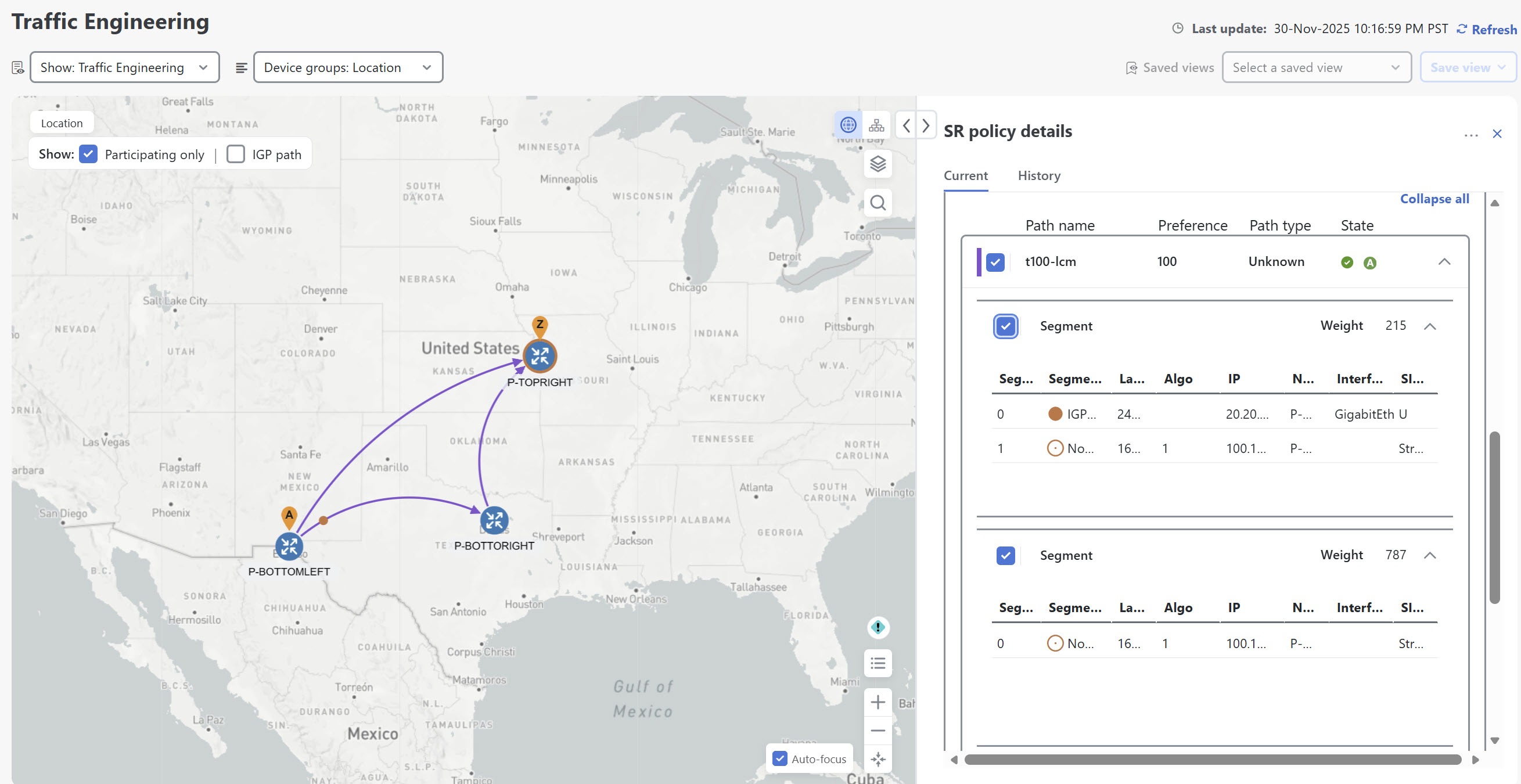
The screenshot illustrates how multiple segment lists appear within a single SR policy. You can see the individual segment lists, their associated weights, and other key details, providing clear visibility into how traffic is distributed across different paths.