Cisco Nexus 2000 and Nexus 5500 Switches Data Sheet
Available Languages
Latest Additions to the Cisco Nexus 5000 Series Switches
Cisco Nexus 5000 Series Switches Product Overview
Today’s data centers are increasingly filled with dense rack-mount and blade servers that host powerful multicore processors. The rapid increase in in-rack computing density and the increasing use of virtualization software combine to accelerate the demand for 10 Gigabit Ethernet and consolidated I/O: applications for which the Cisco Nexus® 5000 Series Switches are an excellent match. With low latency and choice of front-to-back or back-to-front cooling, copper or fiber access ports, and rear-facing data ports, the Cisco Nexus 5000 Series is designed for a broad range of physical, virtual, storage access, and high-performance computing environments, thus giving customers the flexibility to meet and scale their data center requirements in a gradual manner and at a pace that aligns with their business objectives.
The switch series, using cut-through architecture, supports line-rate 10 Gigabit Ethernet on all ports while maintaining consistently low latency independent of packet size and services enabled. It supports a set of network technologies known collectively as Data Center Bridging (DCB) that increases the reliability, efficiency, and scalability of Ethernet networks. These features allow the switches to support multiple traffic classes over a lossless Ethernet fabric, thus enabling consolidation of LAN, SAN, and cluster environments. Its ability to connect Fibre Channel over Ethernet (FCoE) to native Fibre Channel protects existing storage system investments while dramatically simplifying in-rack cabling.
In addition to supporting standard 10 Gigabit Ethernet network interface cards (NICs) on servers, the Cisco Nexus 5000 Series integrates with multifunction adapters called converged network adapters (CNAs) that combine the functions of Ethernet NICs and Fibre Channel host bus adapters (HBAs), making the transition to a single, unified network fabric transparent and consistent with existing practices, management software, and OS drivers. The switch series is compatible with integrated transceivers and Twinax cabling solutions that deliver cost-effective connectivity for 10 Gigabit Ethernet to servers at the rack level, eliminating the need for expensive optical transceivers. The Cisco Nexus 5000 Series portfolio also provides the flexibility to connect directly to servers using 10GBASE-T connections or fiber with Enhanced Small Form-Factor Pluggable (SFP+) transceivers.
The Cisco Nexus 5000 Series is designed for data center environments with cut-through technology that enables consistent low-latency Ethernet solutions, with front-to-back or back-to-front cooling, and with data ports in the rear, bringing switching into close proximity with servers and making cable runs short and simple. The switch series is highly serviceable, with redundant, hot-pluggable power supplies and fan modules. It uses data center-class Cisco® NX-OS Software for high reliability and ease of management.
Cisco Nexus 5500 Platform Overview
In a constantly changing business environment, companies are calling upon their IT departments to help them reduce costs, improve productivity, and introduce new ways to interact with their customer base.
The Cisco Nexus 5500 platform extends the industry-leading versatility of the Cisco Nexus 5000 Series purpose-built 10 Gigabit Ethernet data center-class switches and provides innovative advances toward higher density, lower latency, and multilayer services. The Cisco Nexus 5500 platform is well suited for enterprise-class data center server access-layer deployments across a diverse set of physical, virtual, storage-access, and high‑performance computing (HPC) data center environments.
Cisco Nexus 5548P Switch
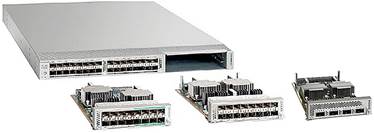
The Cisco Nexus 5548P Switch (Figure 1) is the first of the Cisco Nexus 5500 platform switches. It is a one-rack-unit (1RU) 10 Gigabit Ethernet and FCoE switch offering up to 960-Gbps throughput and up to 48 ports. The switch has 32 1/10-Gbps fixed SFP+ Ethernet and FCoE ports and one expansion slot.
Cisco Nexus 5548UP Switch
The Cisco Nexus 5548UP (Figure 2) is a 1RU 10 Gigabit Ethernet, Fibre Channel, and FCoE switch offering up to 960 Gbps of throughput and up to 48 ports. The switch has 32 unified ports and one expansion slot.

Cisco Nexus 5596UP Switch
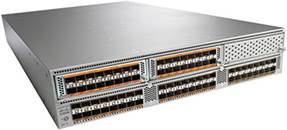
The Cisco Nexus 5596UP Switch (Figure 3) is a 2RU 10 Gigabit Ethernet, Fibre Channel, and FCoE switch offering up to 1920 Gbps of throughput and up to 96 ports. The switch has 48 unified ports and three expansion slots.
Cisco Nexus 5596T Switch
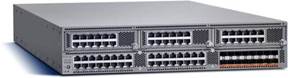
The Cisco Nexus 5596T Switch (Figure 4) is a 2RU form factor, with 32 fixed ports of 10G BASE-T and 16 fixed ports of SFP+. The switch also supports up to three expansion slots. The switch supports 10 Gigabit Ethernet (fiber and copper), Fibre Channel, and FCoE, offering up to 1920 Gbps of throughput and up to 96 ports. The switch supports unified ports on all SFP+ ports. The 10G BASE-T ports support FCoE up to 30m distance with Category 6a and Category 7 cables.
Expansion Module Options for the Cisco Nexus 5548P, 5548UP, 5596UP, and 5596T Switches
The Cisco Nexus 5500 platform is equipped with expansion modules that can be used to increase the number of 10 Gigabit Ethernet, 40 Gigabit Ethernet and FCoE ports or to connect to Fibre Channel SANs with 8/4/2/1-Gbps Fibre Channel switch ports, or both.
The Cisco Nexus 5548P and 5548UP supports two expansion module, and the Cisco Nexus 5596UP and 5596T support four expansion modules from the following offerings (Figure 5):
● Ethernet module that provides sixteen 1/10 Gigabit Ethernet and FCoE ports using the SFP+ interface.
● Fibre Channel plus Ethernet module that provides eight 1/10 Gigabit Ethernet and FCoE ports using the SFP+ interface, and eight ports of 8/4/2/1-Gbps native Fibre Channel connectivity using the SFP+/SFP interface.
● Unified port module that provides up to sixteen 1/10 Gigabit Ethernet and FCoE ports using the SFP+ interface or up to sixteen ports of 8/4/2/1-Gbps native Fibre Channel connectivity using the SFP+ and SFP interfaces; the use of 1/10 Gigabit Ethernet or 8/4/2/1-Gbps Fibre Channel on a port is mutually exclusive but can be selected for any of the 16 physical ports per module.
● Four port QSFP Ethernet module that provides 4 40 Gigabit Ethernet ports using QSFP interface. Each QSFP 40GE port can only work in 4x10G mode and supports DCB and FCoE.

The Cisco Nexus 5596T also supports another expansion module:
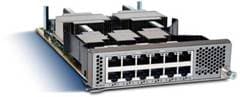
● Ethernet module (Figure 6) that provides twelve 10G BASE-T ports; The 10G BASE-T ports support FCoE up to 30m distance with Category 6a and Category 7 cables.
Layer 3 Daughter Card and Expansion Module Options for Cisco Nexus 5548P, 5548UP, 5596UP, and 5596T Switches
● In addition to these expansion modules, the Cisco Nexus 5548P and 5548UP support a Layer 3 daughter card that can be ordered with the system or as a spare (field upgradable). This daughter card provides up to 160 Gbps of Layer 3 forwarding capability (240 million packets per second [mpps]) that can be shared by all 48 ports in the chassis. As shown in Figure 7, the Layer 3 daughter card does not take up one of the expansion slots on the rear of the chassis, but instead is installed by replacing the Layer 2 I/O module (N55‑DL2) that is located on the front of the chassis.

● In addition to these expansion modules, the Cisco Nexus 5596UP and 5596T support a Layer 3 module that provides up to 160 Gbps of Layer 3 forwarding capability (240 mpps) that can be shared by all the I/O ports in the chassis (Figure 8).
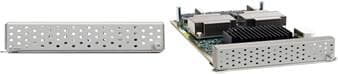
● Version 2 of Layer 3 daughter cards and expansion modules have enhanced capabilities that increase the host table size from 8000 to 16,000 entries, or multicast routes from 4000 to 8000 starting from software release Cisco NX-OS Software Release 5.2(1)N1(1b) and later.
● Requires free of charge a base LAN license (N55-BAS1k9=) to be installed. This is included in the hardware purchase; however the license would need to be manually installed.
Cisco Nexus 2000 Series Fabric Extenders
The Cisco Nexus 2000 Series Fabric Extenders comprise a category of data center products that provide a universal server-access platform that scales across a multitude of 1 Gigabit Ethernet, 10 Gigabit Ethernet, unified fabric, rack, and blade server environments. The Cisco Nexus 2000 Series Fabric Extenders are designed to simplify data center architecture and operations by meeting the business and application needs of a data center.
Working in conjunction with Cisco Nexus switches, the Cisco Nexus 2000 Series Fabric Extenders offer a cost effective and efficient way to support today’s Gigabit Ethernet environments while allowing easy migration to 10 Gigabit Ethernet, virtual machine-aware Cisco unified fabric technologies.
The Cisco Nexus 2000 Series design is aligned with the design of servers. It offers front-to-back or back-to-front cooling, compatibility with data center hot-aisle and cold-aisle designs, placement of all switch ports at the rear of the unit in close proximity to server ports, and accessibility of all user-serviceable components from the front panel. The Cisco Nexus 2000 Series is built for nonstop operation, with redundant hot-swappable power supplies and a hot-swappable fan tray with redundant fans. Its compact 1RU form factor takes up relatively little space, making it easy to incorporate into rack designs (Figure 9).
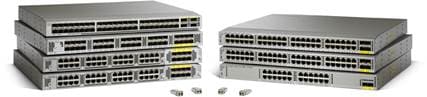
The Cisco Nexus 2000 Series provides two types of ports: ports for end-host attachment (host interfaces) and uplink ports (fabric interfaces). Fabric Interfaces are differentiated with a yellow color for connectivity to the upstream parent Cisco Nexus switch.
Table 1 lists the Cisco Nexus 2000 Series Fabric Extenders. Fabric extenders can be mixed and matched to a parent switch to provide connectivity options.
Table 1. Cisco Nexus 2000 Series Specifications
| Description |
Specification |
Minimum Software Cisco NX-OS Release |
| Cisco Nexus 2224TP |
24 100/1000BASE-T host interfaces and 2 10 Gigabit Ethernet fabric interfaces (SFP+) |
4.2(1)N2(1) |
| Cisco Nexus 2248TP |
48 100/1000BASE-T host interfaces and 4 10 Gigabit Ethernet fabric interfaces (SFP+) |
4.2(1)N2(1) |
| Cisco Nexus 2248TP-E |
48 100/1000BASE-T host interfaces and 4 10 Gigabit Ethernet fabric interfaces (SFP+) [32MB Shared Buffer] |
5.1(3)N1(1) |
| Cisco Nexus 2232PP |
32 1/10 Gigabit Ethernet and FCoE host interfaces (SFP+) and 8 10 Gigabit Ethernet and FCoE fabric interfaces (SFP+) |
4.2(1)N2(1) |
| Cisco Nexus 2248PQ |
48 1/10 Gigabit Ethernet and FCoE host interfaces (SFP+) and four QSFP+ Gigabit Ethernet and FCoE fabric interfaces (QSFP+) |
6.0(2)N1(1) |
| Cisco Nexus 2232TM |
32 1/10 G BASE-T host interfaces and 8 10 Gigabit Ethernet (SFP+) Uplink Module |
5.0(3)N2(1) |
| Cisco Nexus 2232TM-E |
32 1/10 G BASE-T host interfaces and 8 10 Gigabit Ethernet (SFP+) Uplink Module (Lower power consumption and improved BER) |
5.2(1)N1(1) |
| Cisco Nexus B22HP |
16x 1/10 G BASE-KR internal host interfaces and 8 10 Gigabit Ethernet fabric interfaces (SFP+) Network Interfaces |
5.0(3)N2(1) |
| Cisco Nexus B22F |
16x 10 G BASE-KR internal host interfaces and 8 10 Gigabit Ethernet fabric interfaces (SFP+) Network Interfaces |
5.2(1)N1(1) |
| Cisco Nexus B22DELL |
16x 10 G BASE-KR internal host interfaces and 8 10 Gigabit Ethernet fabric interfaces (SFP+) Network Interfaces |
6.0(2)N1(1) |
The Cisco Nexus 2224TP, 2248TP, and 2248TP-E provide port density options for highly scalable 100-Mbps and Gigabit Ethernet connectivity. The Cisco Nexus 2232PP provides ease of migration from Gigabit Ethernet to 10 Gigabit Ethernet while supporting highly scalable 10 Gigabit environments.
The Cisco Nexus 2248TP-E Fabric Extender is a general-purpose 1 Gigabit Ethernet fabric extender with enhancements that target workloads such as large-volume databases, distributed storage, and video editing. Just like the Cisco Nexus 2248TP, the Cisco Nexus 2248TP-E also supports 48 100/1000BASE-T host facing ports and four 10 Gigabit Ethernet fabric interfaces.
The Cisco Nexus 2232TM-E Fabric Extender supports scalable 1/10GBASE-T environments, ease of migration from 1GBASE-T to 10GBASE-T, and effective reuse of existing structured cabling. It comes with an uplink module that supports eight 10 Gigabit Ethernet fabric interfaces. It is a superset of the Cisco Nexus 2232TM with the latest generation of 10GBASE-T PHY, enabling lower power and improved bit error rate (BER). The Cisco Nexus 2232TM-E supports DCB and LAN and SAN consolidation.
The Cisco Nexus 2232PP 1/10GE Fabric Extender is the ideal platform for migration from Gigabit Ethernet to 10 Gigabit Ethernet and unified fabric environments. It supports FCoE and a set of network technologies known collectively as Data Center Bridging (DCB) that increase the reliability, efficiency, and scalability of Ethernet networks. These features allow the switches to support multiple traffic classes over a lossless Ethernet fabric, thus enabling consolidation of LAN, SAN, and cluster environments.
The Cisco Nexus 2248PQ 10 Gigabit Ethernet Fabric Extender is the newest member of the Cisco Nexus Fabric Extender Family. It supports high- density 10 Gigabit Ethernet environments and has 48 forty-eight 1/10 Gigabit Ethernet SFP+ host ports and 4 QSFP+ fabric ports (16 x 10 GE fabric ports). QSFP+ connectivity simplifies cabling while lowering power and solution cost. The Cisco Nexus 2248PQ 10GE Fabric Extender supports FCoE and a set of network technologies known collectively as Data Center Bridging (DCB) that increase the reliability, efficiency, and scalability of Ethernet networks. These features allow support for multiple traffic classes over a lossless Ethernet fabric, thus enabling consolidation of LAN, storage area network (SAN), and cluster environments.
The Cisco Nexus B22HP Fabric Extender (Figure 10) for HP Blade System is the first 10 Gigabit Ethernet and FCoE fabric extender in a third-party blade chassis format. It is targeted at customers who already own HP blade servers and makes it easier for them to integrate with the Cisco Nexus data center fabric.

The Cisco Nexus B22F (Figure 10) Fabric Extender for Fujitsu BladeSystem is the 10 Gigabit Ethernet and FCoE fabric extender in a third-party blade chassis format. It is targeted at customers who already own Fujitsu blade servers and makes it easier for them to integrate with the Cisco Nexus data center fabric.
The Cisco Nexus B22DELL (Figure 10) Fabric Extender for Dell Blade System is the 10 Gigabit Ethernet and FCoE fabric extender in a third-party blade chassis format. It is targeted at customers who already own Dell blade servers and makes it easier for them to integrate with the Cisco Nexus data center fabric.
Cisco Nexus 2000 Series Fabric Extenders connect to a parent Cisco Nexus switch through their fabric links using CX1 copper cable, short-reach or long-reach optics, and the cost-effective Cisco Fabric Extender Transceivers. Cisco Fabric Extender Transceivers are optical transceivers that provide a highly cost-effective solution for connecting the fabric extender to its parent switch.
Cisco Nexus 2000 Series and Cisco Nexus 5000 Series Deployment Scenarios
The fabric extenders can be used in the following deployment scenarios:
● Rack servers with 100 Megabit Ethernet, Gigabit Ethernet, or 10 Gigabit Ethernet network interface cards (NICs); the fabric extender can be physically located at the top of the rack and the Cisco Nexus 5000 Series switch can reside in the middle or at the end of the row, or the fabric extender and the Cisco Nexus 5000 Series switch can both reside at the end or middle of the row.
● Mixed Gigabit Ethernet and 10 Gigabit Ethernet environments in which rack servers are running at either speeds in the same rack or in adjacent racks.
● 10 Gigabit Ethernet and FCoE deployments, using servers with converged network adapters (CNAs) for unified fabric environments with the Cisco Nexus 2232PP.
● 1/10 Gigabit Ethernet BASE-T server connectivity with ease of migration from 1 to 10GBASE-T and effective reuse of structured cabling.
● Server racks with integrated lights-out (iLO) management, with 100 Megabit Ethernet or Gigabit Ethernet management and iLO interfaces.
● Gigabit Ethernet and 10 Gigabit Ethernet blade servers with pass-through blades.
● Low-latency, high-performance computing environments.
● Virtualized access.
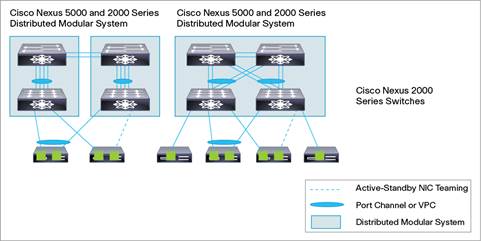
● Cisco Nexus 2000 Series Fabric Extenders can single or dual-connect (using Enhanced vPC) to two upstream Cisco Nexus 5500 platform switches (Figure 11).
● Servers or end host can connect to single or dual Cisco Nexus 2000 Series Fabric Extenders using NIC teaming (Figure 11) when the parent Cisco Nexus 5500 platform has Enhanced vPC enabled.
Efficient Transceiver and Cabling Options
The Cisco Nexus 5500 platform supports a wide variety of 1 and 10 Gigabit Ethernet connectivity options using Cisco 10GBASE SFP+ modules.
In addition, the Cisco Nexus 5500 platform supports 1 Gigabit Ethernet connectivity options using 1GBASE SFP modules, 8/4/2 -Gbps Fibre Channel SFP+ and 4/2/1-Gbps Fibre Channel SFP interfaces are supported with expansion module options.
Table 2 lists the supported transceiver options.
Table 2. Cisco Nexus 5500 Platform Transceiver Support Matrix
| Cisco SFP |
Description |
| FET-10G |
10-Gbps SFP+ module for Cisco Nexus 2000 Series to Cisco Nexus 5000 Series connectivity |
| Cisco SFP-10G-SR |
10GBASE-SR SFP+ module (multimode fiber [MMF]) |
| Cisco SFP-10G-LR |
10GBASE-LR SFP+ module (single-mode fiber [SMF]) |
| Cisco SFP-10G-ER |
10GBASE-ER-SFP+ module (single-mode fiber[SMF]) |
| Cisco SFP-H10GB-CU1M |
10GBASE-CU SFP+ cable 1m (Twinax cable) |
| Cisco SFP-H10GB-CU3M |
10GBASE-CU SFP+ cable 3m (Twinax cable) |
| Cisco SFP-H10GB-CU5M |
10GBASE-CU SFP+ cable 5m (Twinax cable) |
| Cisco SFP-H10GB-ACU7M |
10GBASE-CU SFP+ cable 7m (active Twinax cable) |
| Cisco SFP-H10GB-ACU10M |
10GBASE-CU SFP+ cable 10m (active Twinax cable) |
| Cisco GLC-T |
1000BASE-T SFP |
| GLC-ZX-SM |
1000BASE-ZX SFP transceiver module for SMF, 1550-nm wavelength, dual LC/PC connector |
| Cisco GLC-SX-MM |
Gigabit Ethernet SFP, LC connector SX transceiver (MMF) |
| Cisco GLC-SX-MMD |
Gigabit Ethernet SFP, LC connector SX transceiver (MMF), extended temperature range and digital optical monitoring (DOM) |
| Cisco GLC-LH-SM |
Gigabit Ethernet SFP, LC connector LX/LH transceiver (SMF) |
| Cisco GLC-LH-SMD |
Gigabit Ethernet SFP, LC connector LX/LH transceiver (SMF), extended temperature range and digital optical monitoring (DOM) |
| Cisco SFP-GE-T |
1000BASE-T SFP, extended temperature range |
| Cisco SFP-GE-S |
Gigabit Ethernet SFP, LC connector SX transceiver (MMF), extended temperature range and digital optical monitoring (DOM) |
| Cisco SFP-GE-L |
Gigabit Ethernet SFP, LC connector LX/LH transceiver (SMF), extended temperature range and DOM |
| Cisco DS-SFP-FC4G-SW |
4-Gbps Fibre Channel SW SFP, LC (for Fibre Channel expansion module ports) |
| Cisco DS-SFP-FC4G-LW |
4-Gbps Fibre Channel LW SFP, LC (for Fibre Channel expansion module ports) |
| Cisco DS-SFP-FC8G-SW |
8-Gbps Fibre Channel SW SFP+, LC (for Fibre Channel expansion module ports) |
| Cisco DS-SFP-FC8G-LW |
8-Gbps Fibre Channel LW SFP+, LC (for Fibre Channel expansion module ports) |
The high bandwidth of 10 Gigabit Ethernet poses challenges to transmissions that are met by the transceiver and cabling options supported by the Cisco Nexus 5500 platform.
The platform supports an innovative Twinax copper cabling solution that connects to standard SFP+ connectors for in-rack use, and optical cabling for longer cable runs (Table 3).
● For in-rack or adjacent-rack cabling, the Cisco Nexus 5500 platform supports SFP+ direct-attach 10 Gigabit Ethernet copper, an innovative solution that integrates transceivers with Twinax cables into an energy-efficient, low-cost, and low-latency solution. SFP+ direct-attach 10 Gigabit Twinax copper cables use only 0.1 watt (W) of power per transceiver and introduce only approximately 0.25 microsecond of latency per link.
● For longer cable runs, the Cisco Nexus 5500 platform supports multimode, short-reach optical SFP+ transceivers. These optical transceivers use approximately 1W per transceiver and have a latency of less than 0.1 microsecond.
Table 3. The Cisco Nexus 5500 Platform Supports SFP+ Direct-Attach 10 Gigabit Copper for In-Rack Cabling, and Optical Solutions for Longer Connections (Ethernet Only)
| Connector (Media) |
Cable |
Distance |
Power (Each Side) |
Transceiver Latency (Link) |
Standard |
| SFP+ CU copper |
Twinax |
5m |
Approximately 0.1W |
Approximately 0 microsecond |
SFF 8431 |
| SFP+ ACU copper |
Active Twinax |
7m 10m |
Approximately 0.5W |
Approximately 0.1 microsecond |
SFF 8461 |
| SFP+ SR MMF and SR |
MMF (OM2) MMF (OM3) |
82m 300m |
1W |
Approximately 0.1 microsecond |
IEEE 802.3ae |
| SFP+ LR |
SMF |
10Km |
1W |
Approximately 0.1 microsecond |
IEEE 802.3ae |
| SFP+ ER |
SMF |
40Km |
1.5W |
Approximately 0.1 microsecond |
IEEE 802.3ae |
Features and Benefits
The comprehensive feature sets of the Cisco Nexus 5500 platform make it well suited for top-of-rack, middle-of-row, or end-of-row data center access-layer applications. The platform switches protect investments in data center racks with standards-based 10 Gigabit Ethernet and FCoE features and virtual machine awareness features that allow IT departments to consolidate networks based on their own requirements and timing. The combination of higher port density, lossless Ethernet, wire-speed performance, and very low latency makes the switch platform well suited for meeting the growing demand for 10 Gigabit Ethernet that can support a common Ethernet-based fabric in enterprise and service provider data centers, protecting enterprises’ investments. The switch platform provides sufficient port density to support single and multiple racks fully populated with blade and rack-mount servers.
● Built for today’s data centers, the switches are designed just like the servers they support. Ports and power connections are at the rear, close to server ports, helping keep cable lengths as short and efficient as possible, delivering benefits traditionally offered on blade servers to rack servers as well. Hot-swappable power and fan modules can be accessed from the front panel, where status lights offer an at-a-glance view of switch operation. Front-to-back or back-to-front cooling is consistent with server designs, supporting efficient data center hot- and cold-aisle designs. Serviceability is enhanced with all customer-replaceable units accessible from the front panel. The use of SFP+ ports offers increased flexibility, enabling use of a range of interconnect solutions, including copper Twinax cable for short runs and fiber for long runs.
● DCB enables Ethernet fabrics to support lossless transmission to increase network scalability, support I/O consolidation, ease management of multiple traffic flows, and optimize performance. Although SAN consolidation requires only the lossless fabric provided by the Ethernet Pause mechanism, the Cisco Nexus 5500 platform provides additional features that create an even more easily managed, high-performance, unified network fabric. DCB features are summarized in Table 4 and supported by the Cisco Nexus 5500 platform.
Table 4. DCB Features and Benefits
| Feature |
Business Benefit |
| Priority Flow Control (PFC) |
● Simplifies management of multiple traffic flows over a single network link
● Creates lossless behavior for Ethernet by allowing class-of-service (CoS)-based flow control
|
| Enhanced Transmission Selection (ETS) |
Enables consistent management of quality of service (QoS) at the network level by providing consistent scheduling of different traffic types (IP, storage, etc.) |
| Data Center Bridging Exchange (DCBX) Protocol |
Simplifies network deployment and reduces configuration errors by providing auto negotiation of DCB features between the NIC and the switch and between switches |
● FCoE is a standards-based upper-layer protocol that maps the Fibre Channel Protocol (FCP) and services onto Layer 2 Ethernet. It is a straightforward encapsulation of Fibre Channel within Ethernet that preserves existing Fibre Channel network management models and tools, helping protect investments in software and staff training.
● Cisco unified fabric consolidates all data center I/O onto Layer 2 Ethernet. Unified fabric reduces capital and operating costs by reducing the number of server adapters, cables, and upstream switches needed. All I/O (LAN, SAN, and cluster) typically is consolidated onto two Ethernet links. DCB and FCoE enable the incorporation of Fibre Channel frames into a unified fabric, facilitating wire-once strategies in which all servers become capable of SAN connection. A standard and uniform approach to I/O enhances server and storage consolidation strategies. The Cisco Nexus 5500 platform also connects to existing native Fibre Channel networks, protecting current investments in storage networks. Additionally, the Cisco Nexus 5500 platform attaches to directly connected FCoE and Fibre Channel storage devices and supports multi-tiered unified network fabric connect directly over FCoE.
● Unified ports allow any capable port to take on the character of 1 and 10 Gigabit Ethernet, SAN and LAN shared on 10 Gigabit Ethernet, or 8/4/2/1-Gbps Fibre Channel. Unified ports give the user flexibility in choosing SAN and LAN port options consistent with the virtualized data center and offer a migration path to FCoE for those users not yet ready to make the move from native Fibre Channel.
● Energy efficiency achieved through the use of the Cisco Nexus 5500 platform helps data centers operate within their space, power, and cooling parameters while reducing their carbon footprints. Every network link at the rack level requires adapters, switches, and transceivers, all of which consume power. I/O consolidation reduces energy consumption by eliminating the need for separate Fibre Channel adapters, cables, and switches.
In many cases, server cluster networks also can be consolidated onto 10 Gigabit Ethernet networks, especially given the low latency of the Cisco Nexus 5500 platform. The switch hardware is also designed for energy efficiency. Variable-speed fans consume only the amount of power necessary to cool the chassis at that specific point in time. The switch power supplies are sized to support worst-case scenarios, in which inefficient SFP+ transceivers increase power draw; however, when low-power cabling solutions are deployed, the switch platform’s power supplies maintain 90 percent efficiency at only 25 percent utilization, making efficient use of power in best-case scenarios.
● Consistent management for Cisco products is provided through the consistency of both the Cisco NX-OS Software and Cisco MDS 9000 Software management models and tools. The switch platform’s network features can be managed using the Cisco command-line interface (CLI), and the Fibre Channel and FCoE features can be managed through the Cisco Fabric Manager suite. Cisco Data Center Network Manager (DCNM) also supports the Cisco Nexus 5500 platform. The capability to manage Ethernet and FCoE features independently with existing Cisco tools preserves existing management models, best practices, and investments in staff training.
In addition, Simple Network Management Protocol (SNMP) MIBs, XML, and the Cisco CLI are made available to customers for switch management through third-party and custom‑developed tools. The switch platform uses Cisco NX-OS for superior operating efficiency, pervasive security, and continuous operation even through software upgrades.
● Software manageability and serviceability features include Smart Call Home and automated parameter exchange (through DCBX). Security is enhanced through role-based access control (RBAC); support for authentication, authorization, and accounting (AAA), remote TACACS+, and RADIUS servers; and Secure Shell (SSH) access.
Applications
The Cisco Nexus 5500 platform supports a number of application scenarios, making the switches a versatile data center option:
● As access-layer switches, they can be used purely as 1 and 10 Gigabit Ethernet switches, consolidating 10 Gigabit Ethernet connections into a smaller number of server connections trunked to the aggregation layer.
● In conjunction with the Cisco Nexus 2248TP GE Ethernet Fabric Extender, the Cisco Nexus 5500 platform can be used as a high-density 1 Gigabit Ethernet switching system, consolidating more than 900 Gigabit Ethernet connections in a single management plane.
● In conjunction with the Cisco Nexus 2232PP 10GE Fabric Extender, the Cisco Nexus 5500 platform can be used as a high-density 10 Gigabit Ethernet switching system, consolidating more than 600 10 Gigabit Ethernet connections in a single management plane.
● As a rack-level I/O consolidation platform, the switches carry Ethernet traffic from servers to the aggregation layer, and carry Fibre Channel traffic to existing Fibre Channel SANs.
● As a crucial element in data center I/O consolidation, the switches enable I/O consolidation at the access layer and provide interoperability between the Cisco Nexus 5500 platform and other standards-based products.
The capability of the Cisco Nexus 5500 platform to function in all these capacities helps protect investment in the data center with a deployment model in which additional features can be enabled as they are needed.
Gigabit Ethernet and 10 Gigabit Ethernet Access-Layer Switch
The Cisco Nexus 5500 platform is designed with the density, performance, front-to-back or back-to-front cooling, and rear data-port configuration that make it well suited for aggregating a large number of 10 Gigabit Ethernet links either from servers or from other access-layer switches. The switch port density allows each switch to support a single rack or neighboring racks using the SFP+ direct-attach 10 Gigabit copper cabling option. The Cisco Nexus 5500 platform can also be purchased with only the Ethernet capabilities enabled, allowing IT departments to deploy them in parallel with existing Fibre Channel SANs.
Figure 12 shows an active-active pair of Cisco Nexus 5500 platform switches cross-connected to redundant Ethernet NICs in servers. Instead of using multiple 1 Gigabit Ethernet connections to servers for LAN, virtual machine mobility applications, and Small Computer System Interface over IP (iSCSI) SAN support, customers can combine their traffic over a consolidated, lossless, low-latency 10 Gigabit Ethernet fabric.
The Cisco Nexus 5500 platform can be deployed as a top-of-tack, access-layer switch in parallel with existing Fibre Channel SANs.
Unified Access Architecture
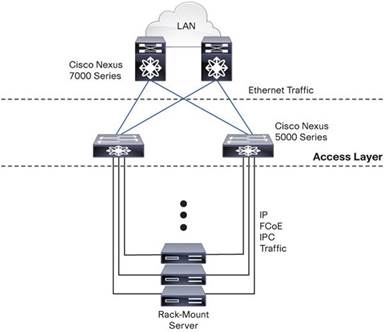
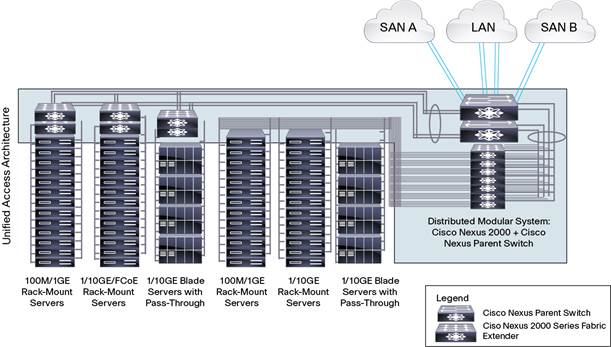
One deployment scenario involves equipping each data center rack with two Cisco Nexus 2248 GE Fabric Extenders or with two Cisco Nexus 2232 10GE Fabric Extenders, connected to two upstream Cisco Nexus 5500 platform switches (Figure 13). Up to 48 servers can connect to each 1 Gigabit Ethernet fabric extender, and up to 32 servers can connect to each 10 Gigabit Ethernet fabric extender. Assuming that these servers are dual-homed, a pair of Cisco Nexus 5500 platform switches can connect up to 1152 1 Gigabit Ethernet servers (24 Cisco Nexus 2248 fabric extenders) or up to 768 10 Gigabit Ethernet servers (24 Cisco Nexus 2232 fabric extenders).
Unified Fabric with FCoE: I/O Consolidation
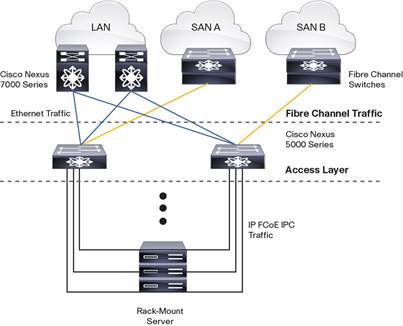
The Cisco Nexus 5500 platform consolidates multiple networks - LAN, SAN, and server cluster - on a single unified fabric, saving the capital and operating expenses associated with deployment of multiple parallel networks, switching infrastructure, and cabling. The Cisco Nexus 5500 platform is compatible with third-party I/O CNAs that present separate Ethernet NICs and Fibre Channel HBAs to the server operating system. This approach allows existing drivers and Fibre Channel management software to work transparently with FCoE. Upstream, expansion modules support direct connections from the Cisco Nexus 5500 platform to existing native Fibre Channel SANs using dedicated native Fibre Channel ports (Figure 14). Cisco Nexus 5500 platform can also be connected to upstream FCoE-capable switches through industry-standard VE-port Inter-Switch Links (ISLs).
Investment Protection with FCoE Unified Fabric
The Cisco Nexus 5500 platform supports consolidated I/O using FCoE on downlinks to servers. FCoE is Fibre Channel and, as such, has familiar methods of configuration, operation, and management. On the uplinks to the network, customers can choose among FCoE direct attachment to storage systems, native Fibre Channel direct attachment to storage systems, FCoE connection to FCoE-capable switches, and native Fibre Channel connection to existing SANs. Fibre Channel and FCoE can exist simultaneously in the Fibre Channel network, allowing customers to continue to use their existing administration and management tools. Cisco Fabric Manager SAN management software manages Fibre Channel and FCoE flows over both FCoE- and Fibre Channel-capable ports.
Product Architecture
The Cisco Nexus 5500 platform is built around two custom components: a unified crossbar fabric and a unified port controller application-specific integrated circuit (ASIC). Each Cisco Nexus 5500 platform switch contains a single unified crossbar fabric ASIC and multiple unified port controllers to support fixed ports and expansion modules within the switch.
The unified port controller provides an interface between the unified crossbar fabric ASIC and the network media adapter and makes forwarding decisions for Ethernet, Fibre Channel, and FCoE frames. The ASIC supports the overall cut-through design of the switch by transmitting packets to the unified crossbar fabric before the entire payload has been received. The unified crossbar fabric ASIC is a single-stage, nonblocking crossbar fabric capable of meshing all ports at wire speed. The unified crossbar fabric offers superior performance by implementing QoS‑aware scheduling for unicast and multicast traffic. Moreover, the tight integration of the unified crossbar fabric with the unified port controllers helps ensure low-latency, lossless fabric for ingress interfaces requesting access to egress interfaces.
Cisco NX-OS Software Overview
Cisco NX-OS is a data centerclass operating system built with modularity, resiliency, and serviceability at its foundation. Based on the industry-proven Cisco MDS 9000 SAN-OS Software, Cisco NX-OS helps ensure continuous availability and sets the standard for mission-critical data center environments. The self-healing and highly modular design of Cisco NX-OS makes zero-impact operations a reality and enables exceptional operational flexibility.
Focused on the requirements of the data center, Cisco NX-OS provides a robust and comprehensive feature set that fulfills the Ethernet and storage networking requirements of present and future data centers. With an XML interface and a CLI like that of Cisco IOS® Software, Cisco NX-OS provides state-of-the-art implementations of relevant networking standards as well as a variety of true data centerclass Cisco innovations.
Cisco NX-OS Software Features and Benefits
● Software compatibility: Cisco NX-OS Software Release 5.0 interoperates with Cisco products running any variant of the Cisco IOS Software operating system. Cisco NX-OS 5.0 also interoperates with any networking OS that conforms to the networking standards listed as supported in this data sheet.
● Common software throughout the data center: Cisco NX-OS simplifies the data center operating environment and provides a unified OS designed to run all areas of the data center network, including the LAN, SAN, and Layer 4 to 7 network services.
● Modular software design: Cisco NX-OS is designed to support distributed multithreaded processing on symmetric multiprocessors (SMPs), multicore CPUs, and distributed line-card processors. Computationally intensive tasks, such as hardware table programming, can be offloaded to dedicated processors distributed across the line cards. Cisco NX-OS modular processes are instantiated on demand, each in a separate protected memory space. Thus, processes are started and system resources allocated only when a feature is enabled. The modular processes are governed by a real-time preemptive scheduler that helps ensure the timely processing of critical functions.
● Quick development of enhancements and problem fixes: The modularity of Cisco NX-OS allows new features, enhancements, and problem fixes to be integrated into the software quickly. Thus, modular fixes can be developed, tested, and delivered in a short time span.
● Troubleshooting and diagnostics: Cisco NX-OS is built with unique serviceability functions to enable network operators to take early action based on network trends and events, enhancing network planning and improving network operations center (NOC) and vendor response times. Smart Call Home and Cisco Generic Online Diagnostics (GOLD) are some of the features that enhance the serviceability of Cisco NX‑OS.
◦ Smart Call Home: The Smart Call Home feature continuously monitors hardware and software components to provide email-based notification of critical system events. A versatile range of message formats is available for optimal compatibility with pager services, standard email, and XML-based automated parsing applications. This feature offers alert grouping capabilities and customizable destination profiles. It can be used, for example, to directly page a network support engineer, send an email message to a NOC, and employ Cisco Auto-Notify services to directly generate a case with the Cisco Technical Assistance Center (TAC). This feature is a step toward autonomous system operation, enabling networking devices to inform IT when a problem occurs and helping ensure that the problem is acted on quickly, reducing time to resolution and increasing system uptime.
◦ Cisco GOLD: Cisco GOLD is a suite of diagnostic facilities to verify that hardware and internal data paths are operating as designed. Boot-time diagnostics, continuous monitoring, and on-demand and scheduled tests are part of the Cisco GOLD feature set. This industry-leading diagnostics subsystem allows rapid fault isolation and continuous system monitoring, critical in today’s continuously operating environments.
● Programmatic XML interface: Based on the NETCONF industry standard, the Cisco NX-OS XML interface provides a consistent API for devices, enabling rapid development and creation of tools to enhance the network.
● SNMP: Cisco NX-OS complies with SNMPv1, v2, and v3. An extensive collection of MIBs is supported.
● RBAC: With RBAC, Cisco NX-OS enables administrators to limit access to switch operations by assigning roles to users. Administrators can customize access and restrict it to the users who require it.
● Enhanced virtual port channel: The virtual port channel (vPC) feature allows one end of a port channel to be split across a pair of Cisco Nexus 5000 Series Switches. vPC provides Layer 2 multipathing through the elimination of Spanning Tree Protocol blocked ports in dual-homed connections. vPC enables fully used bisectional bandwidth and simplified Layer 2 logical topologies without the need to change the existing management and deployment models. vPC feature is further enhanced so that edge devices can connect to Nexus 2000 platform using vPC as well as Nexus 2000 platform can connect to Nexus 5000 platforms using vPC at same time.
● Cisco FabricPath: Cisco FabricPath is a set of multipath Ethernet technologies that combine the reliability and scalability benefits of Layer 3 routing with the flexibility of Layer 2 networks, enabling IT to build massively scalable data centers. Cisco FabricPath offers a topology-based Layer 2 routing mechanism that provides an equal-cost multipath (ECMP) forwarding model. Cisco FabricPath implements an enhancement that solves the MAC address table scalability problem characteristic of switched Layer 2 networks. Furthermore, Cisco FabricPath supports vPC+, a technology similar to vPC that allows redundant interconnection of the existing Ethernet infrastructure to Cisco FabricPath without using Spanning Tree Protocol. Benefits introduced by the Cisco FabricPath technology include:
◦ Operational simplicity: Cisco FabricPath embeds an autodiscovery mechanism that does not require any additional platform configuration. By offering Layer 2 connectivity, the “VLAN anywhere” characteristic simplifies provisioning and offers workload flexibility across the network.
◦ High resiliency and performance: Because Cisco FabricPath is a Layer 2 routed protocol; it offers stability, scalability, and optimized resiliency along with network failure containment.
◦ Massively scalable fabric: By building a forwarding model on 16-way ECMP routing, Cisco FabricPath helps prevent bandwidth bottlenecks and allows organizations to add capacity dynamically, without network disruption.
◦ FabricPath Multi-Topology support for two distinct topologies that provide VLAN localization and reuse in the network.
● Cisco TrustSec® security: As part of the Cisco TrustSec security suite, Nexus 5000 series will be able to participate in CTS authentication to ACS server and download ACS policy. Security group access control lists (SGACLs), a new paradigm in network access control, are based on security group tags instead of IP addresses, enabling implementation of policies that are more concise and easier to manage because of their topology independence.
Cisco NX-OX Software Packaging for Cisco Nexus 5000 Series
The software packaging for the Cisco Nexus 5000 Series offers flexibility and a comprehensive feature set while being consistent with Cisco Nexus access switches. The default system software has a comprehensive Layer 2 feature set with comprehensive security and management features. To enable Layer 3 IP unicast and multicast routing functions, additional licenses need to be installed.
Table 5 lists the software packaging and licensing available.
Table 5. Software Packaging and Licensing
| License |
Chassis Based or Port Based |
Part Number |
Supported Features and Platforms |
| Cisco Nexus 5548 FCoE NPV License |
Chassis |
N5548-FNPV-SSK9 |
FCoE NPV features supported on Cisco Nexus 5548 |
| Cisco Nexus 5596 FCoE NPV License |
Chassis |
N5596-FNPV-SSK9 |
FCoE NPV features supported on Cisco Nexus 5596 |
| Cisco Nexus 5500 Storage Protocols Services License, 8 Ports |
Port |
N55-8P-SSK9 |
Fibre Channel and FCoE and FCoE NPV features supported on any 8 ports of Cisco Nexus 5548 and 5596 |
| Cisco Nexus 5500 Storage Protocols Services License, 48 Ports |
Port |
N55-48P-SSK9 |
Fibre Channel and FCoE and FCoE NPV features supported on any 48 ports of Cisco Nexus 5548 and 5596 |
| Cisco Nexus 5500 Layer 3 Base Software License |
Chassis |
N55-BAS1K9 |
Static routing, RIPv2, OSPFv2, EIGRP stub, HSRP, VRRP, IGMPv2 and v3, PIMv2 (sparse mode), routed ACL; OSPF scalability is limited to 256 dynamically learned routes, |
| Cisco Nexus 5500 Layer 3 Enterprise Software License |
Chassis |
N55-LAN1K9 |
Full EIGRP, OSPF with scalability up to 8000 routes, BGP; maximum routes supported by Layer 3 hardware: 8000 entries; uRPF |
| Cisco Nexus 5500 VM-FEX Software License |
Chassis |
N55-VMFEXK9 |
Cisco Data Center VM-FEX supported on Cisco Nexus 5548 and Cisco Nexus 5596 |
| Cisco Nexus 5548 Enhanced Layer 2 Software License |
Chassis |
N5548-EL2-SSK9 |
Cisco FabricPath supported on Cisco Nexus 5548 |
| Cisco Nexus 5596 Enhanced Layer 2 Software License |
Chassis |
N5596-EL2-SSK9 |
Cisco FabricPath supported on Cisco Nexus 5596 |
| Cisco DCNM SAN Software License |
Chassis |
DCNM-SAN-N5K-K9 |
Cisco DCNM for SAN Advanced Edition for Nexus 5000 Series |
| Cisco DCNM LAN Software License |
Chassis |
DCNM-L-NXACCK9 |
Cisco DCNM for LAN Advanced Edition for Cisco Nexus 3000 and 5000 Series |
Cisco ONE Software
Licenses can be purchased individually for each feature as shown in Table 5 or through Cisco ONE™ Software for Data Center Networking which is available for the Cisco Nexus 5500 platform.
Cisco ONE Software provides a new way for customers to purchase, consume, and use our infrastructure software. It offers a simplified consumption model focused on common customer scenarios for the data center, WAN, and LAN.
Cisco ONE Software and services provide customers with four main benefits:
● Software suites that address typical customer use scenarios at an attractive price
● Investment protection of software purchases through software services-enabled license portability
● Access to ongoing innovation and new technology with Cisco Software Support Service (SWSS)
● Flexible licensing models to smoothly distribute the customer's software spending over time
For ordering information for Cisco ONE Software for the Cisco Nexus 5500 platform switches, please click here.
Cisco Data Center Network Manager
The Cisco Nexus 5000 is supported in Cisco DCNM. Cisco DCNM is designed for hardware platforms enabled for Cisco NX-OS, which are the Cisco Nexus Family of products. Cisco DCNM is a Cisco management solution that increases overall data center infrastructure uptime and reliability, hence improving business continuity. Focused on the management requirements of the data center network, Cisco DCNM provides a robust framework and comprehensive feature set that meets the routing, switching, and storage administration needs of present and future data centers. In particular, Cisco DCNM automates the provisioning process, proactively monitors the LAN by detecting performance degradation, secures the network, and streamlines the diagnosis of dysfunctional network elements.
Specifications
Table 6 lists the specifications for the Cisco Nexus 5500 platform.
Table 6. Product Specifications
| Performance |
|
● Cisco Nexus 5548P and 5548UP: Layer 2 hardware forwarding at 960 Gbps or 714.24 mpps; Layer 3 performance of up to 160 Gbps or 240 mpps
● Cisco Nexus 5596UP and 5596T: Layer 2 hardware forwarding at 1920 Gbps or 1428 mpps; Layer 3 performance of up to 160 Gbps or 240 mpps
● MAC address table entries: 32,000
● Low-latency cut-through design that provides predictable, consistent traffic latency regardless of packet size, traffic pattern, or enabled features on 10 Gigabit Ethernet interfaces
● Line-rate traffic throughput on all ports
|
| Interfaces |
|
● Cisco Nexus 5548P: 32 fixed 1 and 10 Gigabit Ethernet and FCoE ports; additional interfaces through one expansion module
● Cisco Nexus 5548UP: 32 fixed ports configurable as 1 and 10 Gigabit Ethernet and FCoE or 8/4/2/1-Gbps native Fibre Channel; additional interfaces through one expansion module
● Cisco Nexus 5596UP: 48 fixed ports configurable as 1 and 10 Gigabit Ethernet and FCoE or 8/4/2/1-Gbps native Fibre Channel; additional interfaces through up to three expansion modules
● Cisco Nexus 5596T: 32 fixed ports of 1 and 10G BASE-T and 16 SFP+ fixed ports configurable as 1 and 10 Gigabit Ethernet and FCoE or 8/4/2/1-Gbps native Fibre Channel; additional interfaces through up to three expansion modules
● Expansion modules
● 16-port 1 and 10 Gigabit Ethernet and FCoE module
● 8-port 8/4/2/1-Gbps Fibre Channel plus 8-port 1 and 10 Gigabit Ethernet and FCoE module
● Unified port module consisting of 16 ports configurable as 8/4/2/1-Gbps Fibre Channel or 1 and 10 Gigabit Ethernet and FCoE
● 4-port QSFP expansion module
●
12-port 10G BASE-T module (Cisco Nexus 5596T only)
● Layer 3 module (Cisco Nexus 5596UP and 5596T only; one per system)
● Layer 3 daughter card (Cisco Nexus 5548P and 5548UP only; one per system)
● Extension through the Cisco Nexus 2000 Series
|
| Layer 2 Features |
|
● Layer 2 switch ports and VLAN trunks
● IEEE 802.1Q VLAN encapsulation
● Support for up to 4096 VLANs
● Rapid Per-VLAN Spanning Tree Plus (PVRST+) (IEEE 802.1w compatible)
● Multiple Spanning Tree Protocol (MSTP) (IEEE 802.1s): 64 instances
● Spanning Tree PortFast
● Spanning Tree root guard
● Spanning Tree Bridge Assurance
● Cisco EtherChannel technology (up to 16 ports per EtherChannel)
● Cisco vPC technology
● Enhanced vPC enable vPC between Cisco Nexus 5000 and 2000 Series as well as between Cisco Nexus 3000 Series and end host
● vPC configuration synchronization
● Link Aggregation Control Protocol (LACP): IEEE 802.3ad
● Advanced port channel hashing based on Layer 2, 3, and 4 information
● Jumbo frames on all ports (up to 9216 bytes)
● Pause frames (IEEE 802.3x)
● Storm control (unicast, multicast, and broadcast)
● Private VLANs
● Private VLAN over trunks (isolated and promiscuous)
● Private VLANs over vPC and EtherChannels
● VLAN Remapping
● Cisco FabricPath
● EvPC and vPC+ with FabricPath
● Cisco Adapter FEX
● Cisco Data Center VM FEX
● Support for up to 24 fabric extenders on each Cisco Nexus 5500 platform
|
| Layer 3 Features |
|
● Layer 3 interfaces: Routed ports on Cisco Nexus 5500 platform interfaces, switch virtual interface (SVI), port channels, subinterfaces, and port channel subinterfaces for a total of 4096 entries
● Support for up to 8000 prefixes and up to 16000 IPv4 and 8000 IPv6 host entries
● Support for up to 8000 multicast routes
● Support for up to 8000 IGMP groups
● Support for 1000 VRF entries
● Support for up to 4096 VLANs
● 16-way equal-cost multipathing (ECMP)
● 1664 ingress and 2048 egress access control list (ACL) entries
● Routing protocols: Static, Routing Information Protocol Version2 (RIPv2), Enhanced Interior Gateway Routing Protocol (EIGRP), Open Shortest Path First Version 2 (OSPFv2), and Border Gateway Protocol (BGP)
● IPv6 Routing Protocols: Static, Open Shortest Path First Version 3 (OPFv3), Border Gateway Protocol (BGPv6), Enhanced Interior Gateway Routing Protocol (EIGRPv6)
● IPv6 VRF Lite
● Hot-Standby Router Protocol (HSRP) and Virtual Router Redundancy Protocol (VRRP)
● ACL: Routed ACL with Layer 3 and 4 options to match ingress and egress ACL
● Multicast: Protocol Independent Multicast Version 2 (PIMv2) sparse mode, Source Specific Multicast (SSM), Multicast Source Discovery Protocol (MSDP), Internet Group Management Protocol Versions 2, and 3 (IGMP v2, and v3), and Multicast VLAN Registration (MVR)
● Virtual Route Forwarding (VRF): VRF-lite (IP VPN); VRF-aware unicast; and BGP-, OSPF-, RIP-, and VRF-aware multicast
● Unicast Reverse Path Forwarding (uRFP) with ACL; strict and loose modes
● Jumbo frame support (up to 9216 bytes)
● Support for up to 16 fabric extender on each Nexus 5500 with L3 modules
● RFC 896
|
| QoS |
|
● Layer 2 IEEE 802.1p (CoS)
● 8 hardware queues per port
● Per-port QoS configuration
● CoS trust
● Port-based CoS assignment
● Modular QoS CLI (MQC) compliance - IPv4 and IPv6
● ACL-based QoS classification (Layers 2, 3, and 4)
● MQC CoS marking
● Per-port virtual output queuing
● CoS-based egress queuing
● Egress strict-priority queuing
● Egress port-based scheduling: Weighted Round-Robin (WRR)
● Control Plan Policing (CoPP) - IPv4 and IPv6
|
| Security |
|
● Ingress ACLs (standard and extended) on Ethernet and virtual Ethernet ports
● Standard and extended Layer 2 ACLs: MAC addresses, protocol type, etc.
● Standard and extended Layer 3 to 4 ACLs: IPv4 and IPv6, Internet Control Message Protocol (ICMP and ICMPv6), TCP, User Datagram Protocol (UDP), etc.
● VLAN-based ACLs (VACLs)
● Port-based ACLs (PACLs)
● Named ACLs
● Optimized ACL distribution
● ACLs on virtual terminals (VTYs)
● ACL logging on management interface
● Dynamic Host Configuration Protocol (DHCP) snooping with Option 82
● Dynamic Address Resolution Protocol (ARP) Inspection
● IP source guard
● DHCP relay
● Cisco CTS (Authentication and Policy download from ACS)
● Ethernet Port Security
● IPv6 RACL
● IPv6 PACL
● IPv6 VACL
|
| High-Availability Features |
|
● In-Service Software Upgrade (ISSU) for Layer 2
● Hot-swappable field-replaceable power supplies, fan modules, and expansion modules
● 1:1 power redundancy
● N:1 fan module redundancy
|
| Management |
|
● Switch management using 10/100/1000-Mbps management or console ports
● CLI-based console to provide detailed out-of-band management
● In-band switch management
● Locator and beacon LEDs on Cisco Nexus 2000 Series
● Port-based locator and beacon LEDs
● Configuration synchronization
● Module preprovisioning
● Configuration rollback
● Secure Shell Version 2 (SSHv2)
● Telnet
● AAA
● AAA with RBAC
● RADIUS
● TACACS+
● Syslog (8 servers)
● Embedded packet analyzer
● SNMPv1, v2, and v3 (IPv4 & IPv6)
● Enhanced SNMP MIB support
● XML (NETCONF) support
● Remote monitoring (RMON)
● Advanced Encryption Standard (AES) for management traffic
● Unified username and passwords across CLI and SNMP
● Microsoft Challenge Handshake Authentication Protocol (MS-CHAP)
● Digital certificates for management between switch and RADIUS server
● Cisco Discovery Protocol Versions 1 and 2
● RBAC
● Switched Port Analyzer (SPAN) on physical, port channel, VLAN, and Fibre Channel interfaces
● Encapsulated Remote SPAN (ERSPAN)
● Ingress and egress packet counters per interface
● Network Time Protocol (NTP)
● Cisco GOLD
● Comprehensive bootup diagnostic tests
● Call Home
● Smart Call Home
● Cisco Fabric Manager
● Cisco DCNM
● CiscoWorks LAN Management Solution (LMS)
|
| Data Center Bridging |
|
● CEE- and IEEE-compliant PFC (per-priority Pause frame support)
● PFC link distance support: 3000m
● CEE-compliant DCBX Protocol
● CEE- and IEEE-compliant Enhanced Transmission Selection
|
| Fibre Channel and FCoE Features (Requires Storage Services License) |
|
●
T11
standards-compliant FCoE (FC-BB-5)
● T11 FCoE Initialization Protocol (FIP) (FC-BB-5)
● Any 10 Gigabit Ethernet port configurable as FCoE
● SAN administration separate from LAN administration
● FCP
● Fibre Channel forwarding (FCF)
● Fibre Channel standard port types: E, F, and NP
● Fibre Channel enhanced port types: VE, TE, and VF
● F-port trunking
● F-port channeling
● Direct attachment of FCoE and Fibre Channel targets
● Up to 240 buffer credits per native Fibre Channel port
● Up to 32 VSANs per switch
● Fibre Channel (SAN) port channel
● Native Interop Mode 1
● Native Interop Mode 2
● Native Interop Mode 3
● Native Interop Mode 4
● VSAN trunking
● Fabric Device Management Interface (FDMI)
● Fibre Channel ID (FCID) persistence
● Distributed device alias services
● In-order delivery
● Port tracking
● Cisco N-Port Virtualization (NPV) technology
● N-port identifier virtualization (NPIV)
● Fabric services: Name server, registered state change notification (RSCN), login services, and name-server zoning
● Per-VSAN fabric services
● Cisco Fabric Services
● Diffie-Hellman Challenge Handshake Authentication Protocol (DH-CHAP) and Fibre Channel Security Protocol (FC-SP)
● Distributed device alias services
● Host-to-switch and switch-to-switch FC-SP authentication
● Fabric Shortest Path First (FSPF)
● Fabric binding for Fibre Channel
● Standard zoning
● Port security
● Domain and port
● Enhanced zoning
● SAN port channels
● Cisco Fabric Analyzer
● Fibre Channel traceroute
● Fibre Channel ping
● Fibre Channel debugging
● Cisco Fabric Manager support
● Storage Management Initiative Specification (SMI-S)
● Boot from SAN over VPC/EVPC
|
| SNMP MIBs |
| Generic MIBs |
|
● SNMPv2-SMI
● CISCO-SMI
● SNMPv2-TM
● SNMPv2-TC
● IANA-ADDRESS-FAMILY-NUMBERS-MIB
● IANAifType-MIB
● IANAiprouteprotocol-MIB
● HCNUM-TC
● CISCO-TC
● SNMPv2-MIB
● SNMP-COMMUNITY-MIB
● SNMP-FRAMEWORK-MIB
● SNMP-NOTIFICATION-MIB
● SNMP-TARGET-MIB
● SNMP-USER-BASED-SM-MIB
● SNMP-VIEW-BASED-ACM-MIB
● CISCO-SNMP-VACM-EXT-MIB
|
| Layer 3 MIBs |
|
● UDP-MIB
● TCP-MIB
● OSPF-MIB
● BGP4-MIB
● CISCO-HSRP-MIB
|
| Fibre Channel MIBs |
|
● CISCO-ST-TC
● CISCO-FC-FE-MIB
● CISCO-FCSP-MIB
● CISCO-PORT-TRACK-MIB
● CISCO-PSM-MIB
● CISCO-FC-SPAN-MIB
● CISCO-PORT-CHANNEL-MIB
● CISCO-RSCN-MIB
● CISCO-NS-MIB
● CISCO-FCS-MIB
● CISCO-DM-MIB
● FIBRE-CHANNEL-FE-MIB
● CISCO-FC-ROUTE-MIB
● CISCO-FSPF-MIB
● CISCO-ZS-MIB
● CISCO-ZS-EXT-MIB
● CISCO-VSAN-MIB
● CISCO-CFS-MIB
● CISCO-FCPING-MIB
● CISCO-FCTRACEROUTE-MIB
● CISCO-FDMI-MIB
● CISCO-FC-DEVICE-ALIAS-MIB
● CISCO-WWNMGR-MIB
● FCMGMT-MIB
● CISCO-VEDM-MIB
● CISCO-FCOE-MIB
|
| Ethernet MIBs |
|
● CISCO-VLAN-MEMBERSHIP-MIB
● CISCO-Virtual-Interface-MIB
|
| Configuration MIBs |
|
● ENTITY-MIB
● IF-MIB
● CISCO-ENTITY-EXT-MIB
● CISCO-ENTITY-FRU-CONTROL-MIB
● CISCO-ENTITY-SENSOR-MIB
● CISCO-FLASH-MIB
● CISCO-SYSTEM-MIB
● CISCO-SYSTEM-EXT-MIB
● CISCO-IP-IF-MIB
● CISCO-IF-EXTENSION-MIB
● CISCO-SERVER-INTERFACE-MIB
● CISCO-NTP-MIB
● CISCO-IMAGE-MIB
● CISCO-IMAGE-CHECK-MIB
● CISCO-IMAGE-UPGRADE-MIB
● CISCO-CONFIG-COPY-MIB
● CISCO-ENTITY-VENDORTYPE-OID-MIB
● CISCO-BRIDGE-MIB
|
| Monitoring MIBs |
|
● DIFFSERV-DSCP-TC
● NOTIFICATION-LOG-MIB
● DIFFSERV-MIB
● CISCO-CALLHOME-MIB
● CISCO-SYSLOG-EXT-MIB
● CISCO-PROCESS-MIB
● RMON-MIB
● CISCO-RMON-CONFIG-MIB
● CISCO-HC-ALARM-MIB
|
| Security MIBs |
|
● CISCO-AAA-SERVER-MIB
● CISCO-AAA-SERVER-EXT-MIB
● CISCO-COMMON-ROLES-MIB
● CISCO-COMMON-MGMT-MIB
● CISCO-RADIUS-MIB
● CISCO-SECURE-SHELL-MIB
● TCP/IP MIBs
● INET-ADDRESS-MIB
● TCP-MIB
● CISCO-TCP-MIB
● UDP-MIB
● IP-MIB
● CISCO-IP-PROTOCOL-FILTER-MIB
● CISCO-DNS-CLIENT-MIB
● CISCO-PORTSECURITY- MIB
|
| Miscellaneous MIBs |
|
● START-MIB
● CISCO-LICENSE-MGR-MIB
● CISCO-FEATURE-CONTROL-MIB
● CISCO-CDP-MIB
● CISCO-RF-MIB
● CISCO-ETHERNET-FABRIC-EXTENDER-MIB
● CISCO-BRIDGE-MIB
|
| Standards |
| Industry Standards |
|
● IEEE 802.1D: Spanning Tree Protocol
● IEEE 802.1p: CoS prioritization
● IEEE 802.1Q: VLAN tagging
● IEEE 802.1Qaz: Enhanced transmission selection
● IEEE 802.1Qbb: Per-priority Pause
● IEEE 802.1s: Multiple VLAN instances of Spanning Tree Protocol
● IEEE 802.1w: Rapid reconfiguration of Spanning Tree Protocol
● IEEE 802.3: Ethernet
● IEEE 802.3ad: LACP with fast timers
● IEEE 802.3ae: 10 Gigabit Ethernet
● SFF 8431 SFP+ CX1 support
● RMON
● IEEE 1588-2008: Precision Time Protocol (Boundary Clock)
|
| Fibre Channel Standards |
|
●
FC-
PH, Revision 4.3 (ANSI/INCITS 230-1994)
● FC-PH, Amendment 1 (ANSI/INCITS 230-1994/AM1 1996)
● FC-PH, Amendment 2 (ANSI/INCITS 230-1994/AM2-1999)
●
FC-PH-2, Revision 7.4 (ANSI/INCITS 297-1997)
●
FC-PH-3, Revision 9.4 (ANSI/INCITS 303-1998)
●
FC-PI, Revision 13 (ANSI/INCITS 352-2002)
●
FC-PI-2, Revision 10 (ANSI/INCITS 404-2006)
● FC-PI-4, Revision 7.0
●
FC-FS, Revision 1.9 (ANSI/INCITS 373-2003)
● FC-FS-2, Revision 0.91
● FC-LS, Revision 1.2
●
FC-SW-2, Revision 5.3 (ANSI/INCITS 355-2001)
●
FC-SW-3, Revision 6.6 (ANSI/INCITS 384-2004)
●
FC-GS-3, Revision 7.01 (ANSI/INCITS 348-2001)
●
FC-GS-4, Revision 7.91 (ANSI/INCITS 387-2004)
● FC-BB-5, Revision 2.0 for FCoE
● FCP, Revision 12 (ANSI/INCITS 269-1996)
● FCP-2, Revision 8 (ANSI/INCITS 350-2003)
● FCP-3, Revision 4 (ANSI/INCITS 416-2006)
● FC-MI, Revision 1.92 (INCITS TR-30-2002, except for FL-ports and Class 2)
● FC-MI-2, Revision 2.6 (INCITS TR-39-2005, except for FL-ports and Class 2)
● FC-SP, Revision 1.6
● FC-DA, Revision 3.1 (INCITS TR-36-2004, except for FL-ports, SB-ports and Class 2)
● Class of Service: Class 3, Class F
● Fibre Channel standard port types: E and F
● Fibre Channel enhanced port types: SD and TE
|
| Physical Specifications |
| SFP+ Optics |
| Cisco Nexus 5500 platform supports 10 Gigabit Ethernet SFP+ copper Twinax cables for short distances and SFP+ optics (10GBASE-SR, 10GBASE-LR, 10GBASE-ER, GLC-ZX-SM and Cisco Nexus 2000 Series Fabric Extender Transceiver [FET-10G]) for longer distances. SFP+ has several advantages compared to other 10 Gigabit Ethernet connectivity options:
● Small 10 Gigabit Ethernet form factor
● Optical interoperability with XENPAK, X2, and XFP interface types
● Low power consumption
● Hot-swappable device
● Cisco Nexus 5500 platform products support 8-Gbps Fibre Channel-compatible SFP+ for native Fibre Channel connectivity options; 8-Gbps Fibre Channel-compatible short-reach and 10-km long-reach SFP transceiver modules operate at 8/4/2 Gbps and are supported in the 8‑Gbps-capable native Fibre Channel ports on expansion modules and unified ports
|
SFP Optics
The Cisco Nexus 5500 platform supports Gigabit Ethernet SFP for Gigabit Ethernet connectivity options, available in both standard and extended temperature ranges with Digital Optical Monitoring (DOM) support. The following SFP transceiver modules are supported by hardware in all ports of the Cisco Nexus 5500 platform:
● Cisco 1000BASE-T SFP
● Cisco 1000BASE-SX SFP
● Cisco 1000BASE-LX/LR SFP
● Cisco 8/4/2/1-Gbps Fibre Channel SFP
Power Supply
Table 7 lists the power supply properties of the Cisco Nexus 5500 platform.
Table 7. Power Supply Properties
| AC Power Supply Properties |
Cisco Nexus 5548P and 5548UP |
Cisco Nexus 5596UP |
Cisco Nexus 5596T |
| Typical operating power |
390W |
660W |
900W |
| Maximum power (Layer 2) |
600W (without Layer 3 daughter card) |
882W (without Layer 3 expansion module) |
1050W (with 3x 10G BASE-T (Cu) expansion module) |
| Maximum power (Layer 3) |
730W (with Layer 3 daughter card) |
972W (with Layer 3 expansion module) |
1050W (with 3x 10G BASE-T (Cu) expansion module) |
| Input voltage |
100 to 240 VAC |
100 to 240 VAC |
100 to 240 VAC |
| Frequency |
50 to 60 Hz |
50 to 60 Hz |
50 to 60 Hz |
| Efficiency |
95 to 98% (50 to 100% load) |
95 to 98% (50 to 100% load) |
95 to 98% (50 to 100% load) |
| RoHS compliance |
Yes |
Yes |
Yes |
| Hot swappable |
Yes |
Yes |
Yes |
| Typical heat dissipation |
1331 BTU/hr |
2252 BTU/hr |
3071 BTU/hr |
| Front-to-back air flow power supply |
Yes |
Yes |
Yes |
| Back-to-front air flow power supply |
Yes (only on Cisco Nexus 5548UP; need fan tray as well) |
Yes |
Yes |
| DC Power Supply Properties |
Cisco Nexus 5548P and 5548UP |
Cisco Nexus 5596UP |
Cisco Nexus 5596T |
| Typical operating power |
390W |
680W |
900W |
| Maximum power (Layer 2) |
680W (without Layer 3 daughter card) |
882W (without Layer 3 expansion module) |
1050W (with 3x 10G BASE-T (Cu) expansion module) |
| Maximum power (Layer 3) |
730W (with Layer 3 daughter card) |
1079W (with Layer 3 expansion module) |
1079W (with 3x 10G BASE-T (Cu) expansion module) |
| Input voltage |
-40 to -72 VDC |
-40 to -72 VDC |
-40 to -72 VDC |
| Frequency |
N/A |
N/A |
N/A |
| Efficiency |
88% |
88% |
88% |
| RoHS compliance |
Yes |
Yes |
Yes |
| Hot swappable |
Yes |
Yes |
Yes |
| Typical heat dissipation |
1331 BTU/hr |
2320 BTU/hr |
3071 BTU/hr |
| Front-to-back air flow power supply |
Yes |
Yes |
Yes |
| Back-to-front air flow power supply |
No |
No |
No |
Environment
Table 8 lists the environment properties of the Cisco Nexus 5500 platform.
Table 8. Environment Properties
| Property |
Cisco Nexus 5548P and 5548UP |
Cisco Nexus 5596UP and 5596T |
| Physical (height x width x depth) |
1.72 x 17.3 x 29.5 in. (4.4 x 43.9 x 74.9 cm) |
3.47 x 17.3 x 29.5 in. (8.8 x 43.9 x 74.9 cm) |
| Operating temperature |
32 to 104°F (0 to 40°C) |
32 to 104°F (0 to 40°C) |
| Nonoperating (storage) temperature |
-40 to 158°F (-40 to 70°C) |
-40 to 158°F (-40 to 70°C) |
| Humidity |
5 to 95% (noncondensing) |
5 to 95% (noncondensing) |
| Altitude |
0 to 10,000 ft (0 to 3000m) |
0 to 10,000 ft (0 to 3000m) |
Weight
Table 9 lists the weight of the Cisco Nexus 5500 platform switches.
Table 9. Weight
| Component |
Weight |
| Cisco Nexus 5548P or 5548UP with two 750W power supplies, 1 expansion module, and 2 fan modules |
35 lb (15.88 kg) |
| Cisco Nexus 5596UP or 5596T with two 1100W power supplies, 3 unified port expansion modules, and 4 fan modules |
47.5 lb (21.55 kg) |
Software Requirements
The Cisco Nexus 5500 platform is supported by Cisco NX-OS Software Release 5.0 and later. The Cisco Nexus 5548UP, 5596UP, unified port expansion module, and Layer 3 modules are supported by Cisco NX-OS Software Release 5.0(3)N1.1 and later. The Cisco Nexus 5596T and N55-M12T (12 x 10G BASE-T Module) is supported by Cisco NX-OS Software Release 5.2(1)N1(1b) and later. FCoE support on 10G Base-T ports is supported by Cisco NX-OS Software Release 6.0(2)N1(1) and later. N55-M4Q is supported by Cisco NX-OS Software Release 6.0(2)N1(2) and later. Cisco NX-OS interoperates with any networking OS, including Cisco IOS Software, that conforms to the networking standards mentioned in this data sheet.
For the latest software release information and recommendations, please see the product bulletin at http://www.cisco.com/go/nexus5000.
Regulatory Standards Compliance
Table 10 summarizes regulatory standards compliance for the Cisco Nexus 5500 platform.
Table 10. Regulatory Standards Compliance: Safety, Security and EMC
| Specification |
Description |
| Regulatory compliance |
Products should comply with CE Markings according to directives 2004/108/EC and 2006/95/EC |
| Safety |
● UL 60950-1 Second Edition
● CAN/CSA-C22.2 No. 60950-1 Second Edition
● EN 60950-1 Second Edition
● IEC 60950-1 Second Edition
● AS/NZS 60950-1
● GB4943
|
| EMC: Emissions |
● 47CFR Part 15 (CFR 47) Class A
● AS/NZS CISPR22 Class A
● CISPR22 Class A
● EN55022 Class A
● ICES003 Class A
● VCCI Class A
● EN61000-3-2
● EN61000-3-3
● KN22 Class A
● CNS13438 Class A
|
| EMC: Immunity |
● EN55024
● CISPR24
● EN300386
● KN 61000-4 series
|
| Security |
|
| RoHS |
The product is RoHS 6 compliant with exceptions for leaded ball grid array (BGA) balls and lead press-fit connectors |
Ordering Information
Table 11 presents ordering information for the Cisco Nexus 5500 platform. Note that the Cisco Nexus 2000 Series Fabric Extenders can be ordered either separately or along with the Cisco Nexus 5500 platform.
Table 11. Ordering Information
| Part Number |
Description |
| Chassis |
|
| N5K-C5548P-FA |
Chassis includes 32 fixed ports, Front-to-Back Airflow, 2 750W AC Power Supplies, Fan Trays, 1 Expansion Slot |
| N5K-C5548UP-FA |
Chassis includes 32 fixed unified ports, Front-to-Back Airflow, 2 750W AC Power Supplies, Fan Trays, 1 Expansion Slot |
| N5K-C5596UP-FA |
Chassis includes 48 fixed unified ports, Front-to-Back Airflow, 2 1100W AC Power Supplies, Fan Trays, 3 Expansion Slots |
| N5K-C5596T-FA |
Chassis includes 32 10G BASE-T fixed ports and 16 1/10G SFP+ fixed ports, Back-to-Front Airflow, 2 1100W AC Power Supplies, Fan Trays, 3 Expansion Slots |
| Fan Modules |
|
| N5548P-FAN(=) |
Cisco Nexus 5548P/5548UP Fan Module, Front-to-Back Airflow, Spare |
| N5548P-FAN-B(=) |
Cisco Nexus 5548UP Fan Module, Back-to-Front Airflow, Spare |
| N5596UP-FAN(=) |
Cisco Nexus 5596UP/5596T Fan Module, Front-to-Back Airflow, Spare |
| N5596UP-FAN-B(=) |
Cisco Nexus 5596UP/5596T Fan Module, Back-to-Front Airflow, Spare |
| Power Supplies |
|
| N55-PAC-750W(=) |
Cisco Nexus 5548P/5548UP PSU Front-to-Back Airflow module spare, A/C, 100-240V, 750W |
| N55-PAC-750W-B(=) |
Cisco Nexus 5548UP PSU Back-to-Front Airflow module spare, A/C, 100-240V, 750W |
| N55-PDC-750W(=) |
Cisco Nexus 5548P/5548UP PSU Front-to-Back Airflow module spare, D/C, -40 to -72VDC, 750W |
| N55-PDC-1100W(=) |
Cisco Nexus 5596UP/5596T PSU Front-to-Back Airflow module spare, D/C, - 40 to -72VDC, 1100W |
| N55-PAC-1100W(=) |
Cisco Nexus 5596UP PSU Front-to-Back Airflow module spare, A/C, 100-240V, 1100W |
| N55-PAC-1100W-B(=) |
Cisco Nexus 5596UP/5596T PSU Back-to-Front Airflow module spare, A/C, 100-240V, 1100W |
| NXA-PAC-1100W(=) |
Cisco Nexus 5596T Platinum PSU Front-to-Back Airflow module spare, A/C, 100-240V, 1100W |
| NXA-PAC-1100W-B(=) |
Cisco Nexus 5596T Platinum PSU Back-to-Front Airflow module spare, A/C, 100-240V, 1100W |
| Miscellaneous |
|
| N55-M-BLNK(=) |
Cisco Nexus 5500 Blank module cover |
| Software |
|
| N5KUK9-602N1.2(=) |
Cisco Nexus 5000 Base OS Software Release 6.0(2)N1(2) |
| N5KUK9-521N1.1B(=) |
Cisco Nexus 5000 Base OS Software Release 5.2(1)N1(1b) |
| N5KUK9-521N1.1A(=) |
Cisco Nexus 5000 Base OS Software Release 5.2(1)N1(1a) |
| N5KUK9-521N1.1(=) |
Cisco Nexus 5000 Base OS Software Release 5.2(1)N1(1) |
| N5KUK9-513N2.1C(=) |
Cisco Nexus 5000 Base OS Software Release 5.1(3)N2(1c) |
| N5KUK9-513N2.1(=) |
Cisco Nexus 5000 Base OS Software Release 5.1(3)N2(1) |
| N5KUK9-513N1.1A(=) |
Cisco Nexus 5000 Base OS Software Release 5.1(3)N1(1a) |
| N5KUK9-513N1.1(=) |
Cisco Nexus 5000 Base OS Software Release 5.1(3)N1(1) |
| N5KUK9-503N2.1(=) |
Cisco Nexus 5000 Base OS Software Release 5.0(3)N2(1) |
| N5KUK9-503N1.1B(=) |
Cisco Nexus 5000 Base OS Software Release 5.0(3)N1(1b) |
| N5KUK9-503N1.1(=) |
Cisco Nexus 5000 Base OS Software Release 5.0(3)N1(1) |
| N5KUK9-502N1.1(=) |
Cisco Nexus 5000 Base OS Software Release 5.0(2)N1(1) |
| N55-8P-SSK9(=) |
Cisco Nexus 5500 8-Port Storage Protocol Services License |
| N5000FMS1K9(=) |
Cisco Nexus 5000 Series Fabric Manager Server License |
| N55-LAN1K9(=) |
Cisco Nexus 5500 Layer 3 Enterprise Software License |
| N55-BAS1K9(=) |
Cisco Nexus 5500 Layer 3 Base Software License |
| Expansion Modules and Daughter Card |
|
| N55-M16P(=) |
16-port 1/10GE Ethernet/FCoE module (Requires SFP+ for 8Gbps or SFP for 4Gbps operation) |
| N55-M12T(=) |
12-port 10G BASE-T Ethernet Module (Only supported on 5596T chassis) |
| N55-M8P8FP(=) |
8-port FC (8/4/2/1G) + 8-port Eth/FCoE Module |
| N55-M16UP(=) |
16-port Unified Port Expansion Module |
| N55-M4Q(=) |
4-port QSFP expansion module |
| N55-D160L3(=) |
Nexus 5548 Layer 3 Daughter Card |
| N55-D160L3-V2(=) |
Nexus 5548 Layer 3 Daughter Card, version 2 |
| N55-M160L3(=) |
Nexus 5596 Layer 3 Expansion Module |
| N55-M160L3-V2(=) |
Nexus 5596 Layer 3 Expansion Module, version 2 |
| Cables and Optics |
|
| SFP-10G-SR(=) |
10GBASE-SR SFP+ Module |
| SFP-10G-LR(=) |
10GBASE-LR SFP+ Module |
| SFP-10G-ER(=) |
10GBASE-ER-SFP+ Module |
| SFP-H10GB-CU1M(=) |
10GBASE-CU SFP+ Cable 1 Meter |
| SFP-H10GB-CU3M(=) |
10GBASE-CU SFP+ Cable 3 Meter |
| SFP-H10GB-CU5M(=) |
10GBASE-CU SFP+ Cable 5 Meter |
| SFP-H10GB-ACU7M(=) |
Active Twinax cable assembly, 7m |
| SFP-H10GB-ACU10M(=) |
Active Twinax cable assembly, 10m |
| GLC-T(=) |
1000BASE-T SFP |
| GLC-ZX-SM(=) |
1000BASE-ZX SFP transceiver module for SMF, 1550-nm wavelength, dual LC/PC connector |
| GLC-SX-MM(=) |
GE SFP, LC connector SX transceiver |
| GLC-SX-MMD(=) |
GE SFP, LC connector SX transceiver with Digital Optical Monitoring (DOM) and Extended Temperature Range |
| GLC-LH-SM(=) |
GE SFP, LC connector LX/LH transceiver |
| GLC-LH-SMD(=) |
GE SFP, LC connector LX/LH transceiver with Digital Optical Monitoring (DOM) and Extended Temperature Range |
| SFP-GE-T(=) |
1000BASE-T SFP, Extended Temperature Range |
| SFP-GE-S(=) |
GE SFP, LC connector SX transceiver, with Digital Optical Monitoring (DOM) and Extended Temperature Range |
| SFP-GE-L(=) |
GE SFP, LC connector LX/LH transceiver, with Digital Optical Monitoring (DOM) and Extended Temperature Range |
| DS-SFP-FC4G-SW(=) |
4Gbps Fibre Channel-SW SFP, LC |
| DS-SFP-FC4G-LW(=) |
4Gbps Fibre Channel-LW SFP, LC |
| DS-SFP-FC8G-SW(=) |
8Gbps Fibre Channel-SW SFP+, LC |
| DS-SFP-FC8G-LW(=) |
8Gbps Fibre Channel-LW SFP+, LC |
| DS-CWDM4G1470(=) |
1470 nm CWDM 1/2/4-Gbps Fibre Channel SFP (Color: Grey) |
| DS-CWDM4G1490(=) |
1490 nm CWDM 1/2/4-Gbps Fibre Channel SFP (Color: Violet) |
| DS-CWDM4G1510(=) |
1510 nm CWDM 1/2/4-Gbps Fibre Channel SFP (Color: Blue) |
| DS-CWDM4G1530(=) |
1530 nm CWDM 1/2/4-Gbps Fibre Channel SFP (Color: Green) |
| DS-CWDM4G1550(=) |
1550 nm CWDM 1/2/4-Gbps Fibre Channel SFP (Color: Yellow) |
| DS-CWDM4G1570(=) |
1570 nm CWDM 1/2/4-Gbps Fibre Channel SFP (Color: Orange) |
| DS-CWDM4G1590(=) |
1590 nm CWDM 1/2/4-Gbps Fibre Channel SFP (Color: Red) |
| DS-CWDM4G1610(=) |
1610 nm CWDM 1/2/4-Gbps Fibre Channel SFP (Color: Brown) |
| QSFP-40G-SR4(=) |
40GBASE-SR4 QSFP module, (multimode fiber [MMF] at 100m) |
| QSFP-40G-CSR4 |
40GBASE Extended CSR4 QSFP module, (MMF at 300m) |
| QSFP-4x10G-AC7M |
Cisco 40GBASE-CR4 QSFP+ to 4 10GBASE-CU SFP+ direct-attach breakout cable, 7m, active |
| QSFP-4x10G-AC10M |
Cisco 40GBASE-CR4 QSFP+ to 4 10GBASE-CU SFP+ direct-attach breakout cable, 10m, active |
| QSFP-H40G-CU1M |
Cisco 40GBASE-CR4 QSFP+ direct-attach copper cable, 1m, passive |
| QSFP-H40G-CU3M |
Cisco 40GBASE-CR4 QSFP+ direct-attach copper cable, 3m, passive |
| QSFP-H40G-CU5M |
Cisco 40GBASE-CR4 QSFP+ direct-attach copper cable, 5m, passive |
| QSFP-H40G-ACU7M |
Cisco 40GBASE-CR4 QSFP+ direct-attach copper cable, 7m, active |
| QSFP-H40G-ACU10M |
Cisco 40GBASE-CR4 QSFP+ direct-attach copper cable, 10m, active |
| Power Cords |
|
| CAB-250V-10A-AR |
AC Power Cord - 250V, 10A - Argentina (2.5 meter) |
| CAB-9K10A-AU |
Power Cord, 250VAC 10A 3112 Plug, Australia (2.5 meter) |
| CAB-250V-10A-BR |
AC Power Cord - 250V, 10A – Brazil (2.1 meter) |
| CAB-250V-10A-CN |
AC Power Cord - 250V, 10A - PRC (2.5 meter) |
| CAB-9K10A-EU |
Power Cord, 250VAC 10A CEE 7/7 Plug, EU (2.5 meter) |
| CAB-IND-10A |
10A Power cable for India (2.5 meter) |
| CAB-250V-10A-IS |
AC Power Cord - 250V, 10A - Israel (2.5 meter) |
| CAB-9K10A-IT |
Power Cord, 250VAC 10A CEI 23-16/VII Plug, Italy (2.5 meter) |
| CAB-250V-10A-ID |
AC Power Cord - 250V, 10A, South Africa (2.5 meter) |
| CAB-9K10A-SW |
Power Cord, 250VAC 10A MP232 Plug, SWITZ (2.5 meter) |
| CAB-9K10A-UK |
Power Cord, 250VAC 10A BS1363 Plug (13 A fuse), UK (2.5 meter) |
| CAB-9K12A-NA |
Power Cord, 125VAC 13A NEMA 5-15 Plug, North America (2.5 meter) |
| CAB-AC-L620-C13= |
North America, NEMA L6-20-C13 (2.0 meter) |
| CAB-N5K6A-NA |
Power Cord, 200/240V 6A North America (2.5 meter) |
| CAB-C13-CBN |
Cabinet Jumper Power Cord, 250 VAC 10A, C14-C13 Connectors (0.7 meter) |
| CAB-C13-C14-2M |
Power Cord Jumper, C13-C14 Connectors, 2 Meter Length (2 meter) |
| CAB-C13-C14-AC |
Power cord, C13 to C14 (recessed receptacle), 10A (3 meter) |
| Accessory Kit |
|
| N5548-ACC-KIT= |
Accessory Kit for Nexus 5548 Chassis |
| N5596-ACC-KIT= |
Accessory Kit for Nexus 5596 Chassis |
Warranty
The Cisco Nexus 5500 platform has a 1-year limited hardware warranty. The warranty includes hardware replacement with a 10-day turnaround from receipt of a return materials authorization (RMA).
Service and Support
Cisco offers a wide range of services to help accelerate your success in deploying and optimizing the Cisco Nexus 5500 platform in your data center. The innovative Cisco Services are delivered through a unique combination of people, processes, tools, and partners and are focused on helping you increase operation efficiency and improve your data center network. Cisco Advanced Services uses an architecture-led approach to help you align your data center infrastructure with your business goals and achieve long-term value.
Cisco Smart Net Total Care™ Service helps you resolve mission-critical problems with direct access at any time to Cisco network experts and award-winning resources. With this service, you can take advantage of the Smart Call Home service capability, which offers proactive diagnostics and real-time alerts on your Cisco Nexus 5500 platform. Spanning the entire network lifecycle, Cisco Services offerings help increase investment protection, optimize network operations, support migration operations, and strengthen your IT expertise.
Cisco Capital Financing to Help You Achieve Your Objectives
Cisco Capital® financing can help you acquire the technology you need to achieve your objectives and stay competitive. We can help you reduce capital expenditures (CapEx), accelerate your growth, and optimize your investment dollars and ROI. Cisco Capital financing gives you flexibility in acquiring hardware, software, services, and complementary third-party equipment. And there’s just one predictable payment. Cisco Capital financing is available in more than 100 countries. Learn more.
For More Information
● Cisco Nexus 5000 Series Switches: http://www.cisco.com/go/nexus5000
● Cisco Nexus 2000 Series Fabric Extenders: http://www.cisco.com/go/nexus2000
● Cisco NX-OS Software: http://www.cisco.com/go/nxos

 Feedback