General Deployment Version: Cisco Catalyst OS Software 7.6(12)
OVERVIEW
This product bulletin announces the General Deployment code status for Cisco® Catalyst® Operating System (Catalyst OS) 7 train while detailing the hardware and software support provided in the release. A discussion of the Catalyst OS software release strategy and release trains for the Cisco Catalyst 4000 and Catalyst 6500 series switches is also included for reference.
Cisco Catalyst OS software train number 7 has been in the development phase since January 2002 and was completed in April 2003. In addition to meeting stringent internal metrics, Cisco Systems® recently solicited feedback to a survey from Cisco Catalyst 4000 and Catalyst 6500 customers to gauge customer perception of the quality of the code in Catalyst OS 7 train. More than 1000 customers responded to the survey with very positive responses and comments. Given the maturity of the software in wide and successful deployments in the Cisco Catalyst 4000 and Catalyst 6500 customer base, the positive responses to the survey, and the meeting of internal metrics, Cisco has elevated the 7.6(12) and later releases to General Deployment status. Some important components of the hardware and software features supported, portions of which were delivered in previous switch software versions of 7.x, are outlined in the following section. With the general deployment announcement of the Cisco Catalyst 7 train, Cisco recommends that all customers using the 6.x releases from Catalyst OS 6 train to upgrade with the latest release in the Catalyst OS 7 train, for example, 7.6(12)GD or later. An announcement for end of sale, end of engineering, and end of life for the Cisco Catalyst 4000, 5000, and 6500 Series Catalyst OS version 6.x software will follow in the near future.
Key Features Supported in 7 Train
Following are some of the primary hardware and software features that are supported in the Cisco Catalyst OS 7 train. Pointers for further detail are given in later sections.
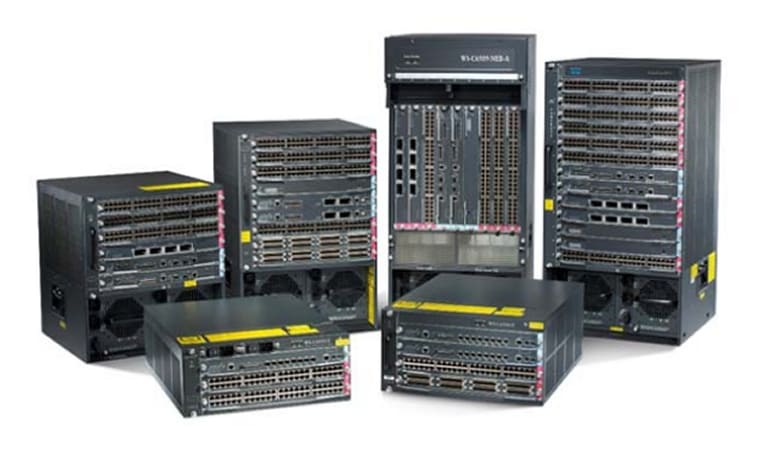
Cisco Catalyst 6500 Series Hardware Overview
• Support for Cisco Catalyst 3-slot chassis
• Support for Catalyst 6500 Firewall Services Module, Catalyst 6500 SSL Services Module, Catalyst 6500 Intrusion Detection System Module 2, and Cisco Content Switching Module
• Support for 48-port 10/100/1000-Mbps classic and Ethernet fabric-enabled interface modules with inline power
Cisco Catalyst 4000 Series Hardware Overview
Cisco Catalyst 4000 Series extends control from the backbone network to the network edge with intelligent network services, including advanced quality of service (QoS), scalable performance, comprehensive security, and simple manageability. The modular architecture, media flexibility, and expandability of the Cisco Catalyst 4000 Series facilitate a longer deployment life in converged networks, which reduces the overall cost of ownership by minimizing recurring operational expenses and improves return on investment (ROI).
Cisco Catalyst 6500 and Catalyst 4000 Series Software Overview
• Support for EEE 802.1w specification, (Rapid Spanning Tree Protocol), which provides for sub-second reconvergence of the Spanning Tree Protocol after failure of one of the uplinks in a bridged environment.
• Support for IEEE 802.1s specification (Multiple Spanning Tree), which allows a user to build multiple spanning trees over VLAN trunks.
• Support for 802.1x extensions like IEEE 802.1x with guest VLAN, IEEE 802.1x operation with voice VLAN Identification (VVID), IEEE 802.1x with Port Security, and IEEE 802.1x with VLAN assignment.
HARDWARE SUPPORT
Table 1 and 2 list the hardware that is supported in 7 train, in addition to the hardware support in prior releases. Details are given in the release notes.
Table 1. Cisco Catalyst 6500 Series Hardware Supported in 7 Train
Part Number
Description
WS-X6501-10GEX4
1-port 10GBASE-EX4 Metro 10-Gigabit Ethernet, fabric-enabled QoS port architecture (Rx/Tx): 1p1q8t/1p2q1t
WS-X6502-10GE
1-port 10GBASE-E Serial 10-Gigabit Ethernet, fabric-enabled QoS port architecture (Rx/Tx): 1p1q8t/1p2q1t
WS-X6148-GE-TX
WS-X6148V-GE-TX
48-port 10/100/1000BASE-TX switching module (WS-X6148V-GE-TX provides inline power to IP telephones) QoS port architecture (Rx/Tx): 1q2t/1p2q2t
WS-X6548-GE-TX
WS-X6548V-GE-TX
48-port 10/100/1000BASE-TX switching module, fabric-enabled (WS-X6548V-GE-TX provides inline power to IP telephones) QoS port architecture (Rx/Tx): 1q2t/1p2q2t
400W AC power supply for Catalyst 4000 Series chassis
WS-X4008-DC=
400W DC power supply for Catalyst 4000 Series chassis
PWR-C45-1000AC=
1000W AC power supply for Catalyst 4500 Series chassis (data only)
PWR-C45-1300ACV=
1300W AC power supply with inline power for Catalyst 4500 Series chassis
PWR-C45-2800ACV=
2800W AC power supply with inline power for Catalyst 4500 Series chassis
PWR-C45-1400DC-P=
1400W DC power supply with integrated power entry module (PEM) for Catalyst 4500 Series chassis
SOFTWARE SUPPORT
The Cisco Catalyst OS 7 train supports the following features for Cisco Catalyst 4000 and Catalyst 6500 series (Table 3), in addition to the software features supported in previous releases. (Note: products are listed in parenthesis.) Some of the features listed as supported on "4000 only" may be supported on the Catalyst 6500 Series in an earlier Catalyst OS release. For more details on features, please refer to the release notes.
Table 3. Features Supported by Cisco Catalyst OS 7 Train
The numbering scheme for Release X.Y(n)zzz is as follows:
• X Denotes a train, for example, the "7 train"
• X.Y Denotes a feature set, for example, "Release 7.1"
• (n) Denotes the maintenance or bug-fix level, for example, "7.1(1)"
• zzz Denotes a special release, for example, "7.1(1)XXX"
SOFTWARE TRAIN LIFE CYCLE
Each Cisco Catalyst 4000 and Catalyst 6500 series software release is a member of a release train. Each release train consists of two phases: the Early Deployment release phase and the General Deployment release phase. Early Deployment releases are the early-life stages of the train, where new capability is added concurrent with bug fixes being applied.
The General Deployment releases are considered the later-life stages where only bug fixes are applied. There are three classifications within the General Deployment release phase. These include Pre-General Deployment, General Deployment, and General Deployment-Mature Maintenance. After the train has transitioned to maintenance mode, it enters Pre-General Deployment and no new capability is added. After all requirements are met for the train, the train transitions to General Deployment status, and eventually to General Deployment-Mature Maintenance when the train is near its end of life.
CISCO CATALYST 4000 AND CATALYST 6500 SERIES SOFTWARE RELEASE TRAIN TYPES AND DEFINITIONS
Early Deployment Release
• Deliver new capability to market quickly
• Generally delivered every three to six months
• Typically there are several Early Deployment releases in each train before it goes to Pre-General Deployment, and then General Deployment status
• When a train is in the Early Deployment stage of its life cycle, delivery of bug fixes often requires moving to the next Early Deployment release, which includes new capability
Pre-General Deployment Release
• The software train is now at the mature "Feature Freeze" stage in its life cycle
• Typically there are several maintenance releases in this stage
A train is designated as "Pre-General Deployment" when no new capability is being added and only bug fixes are applied (for example, this becomes a maintenance train)
General Deployment Release
• Goal is stability
• General Deployment maintenance releases are generally delivered every six to ten weeks
• Must meet rigid criteria including defect arrival-rate thresholds and a customer feedback survey in order to achieve General Deployment status. To achieve General Deployment status, a software release train must meet the following criteria:
1. Minimal deployment timeframe of three months in the field.
2. Installed and running on at least 1000 systems in the field (determined by number of systems shipped from Cisco manufacturing plus the number of downloads from Cisco.com).
3. Arrival rate for customer-found severity-1 bugs must be less than 10 per month.
4. Successfully pass a detailed Customer Satisfaction Survey with responses from at least 100 customers. To pass there must be agreement that there are no quality problem areas. Any problems must be addressed by engineering.
General Deployment-Mature Maintenance
A train is designated as "General Deployment-Mature Maintenance" when it is close to end of life. Only severity-1 bugs are fixed in this stage
MILESTONE DATES
• End of Sale-The date at which product is removed from the price list and is no longer orderable through the normal, nonexception, order-fulfillment process
• End of Engineering-The date after which scheduled maintenance releases are not produced and the software is removed from Cisco.com
• End of Life-The date after which the software release is no longer supported by Cisco customer support
RELEASE TRAIN STATUS-TRANSITION TIMEFRAMES
From the start of a train there are multiple Early Deployment releases before Feature Freeze, at which point the train becomes pre-General Deployment.
• On average it takes 12 months before a train reaches Pre-General Deployment status
• From Pre-General Deployment it takes six months on average to achieve General Deployment status
• General Deployment to General Deployment-Mature Maintenance will generally occur in 8 to 12 months
• General Deployment-Mature Maintenance to end of engineering is no less than three months and generally not longer than six months
• The Cisco customer support group continues to provide support for a release train until it reaches its end of life, which is generally six months after end of engineering
CISCO CATALYST 4000, CATALYST 5000, AND CATALYST 6500 SERIES SOFTWARE-MAINTENANCE GUIDELINES
To better ensure the stability of the release train as it ages, less change is allowed in the source-code base. The level of change that is allowed depends on the severity of the problem and its effect on the release's stability. Table 4 identifies the minimal severity level required at different milestones in the release train's life.
Table 4. Bug Fixes for Each Release Type
Release Status
Committed Fixes
General Deployment-Mature Maintenance
S1
General Deployment
S1-S2
Pre-General Deployment
S1-S3
Early Deployment
S1-S4
Development Mainline
S1-S5
Table 5. Bug Security Level Definitions
Level
Definitions
S1
Catastrophic
S2
Severe
S3
Moderate
S4
Minor
S5
Cosmetic/Enhancement Request
QUESTIONS, COMMENTS AND FEEDBACK
Please forward any questions, comments, or feedback regarding this product bulletin to: