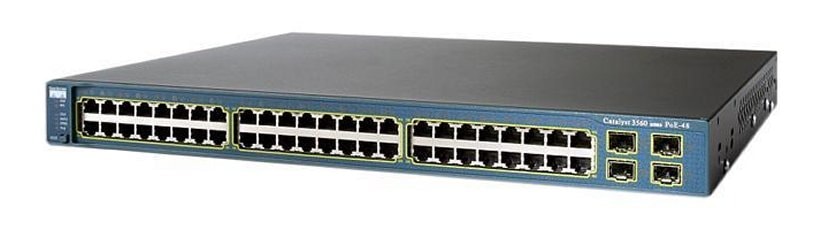
Catalyst 3560 Switch Command Reference, Rel. 12.1(19)EA1
Cisco IOS Commands - rmon collection through test cable-diagnostics tdr

Table Of Contents

rmon collection stats

sdm prefer

service password-recovery

service-policy

set

setup

setup express

show access-lists

show auto qos

show boot

show cable-diagnostics tdr

show class-map

show cluster

show cluster candidates

show cluster members

show controllers cpu-interface

show controllers ethernet-controller

show controllers power inline

show controllers tcam

show dot1x

show dtp

show env

show errdisable detect

show errdisable flap-values

show errdisable recovery

show etherchannel

show interfaces

show interfaces counters

show ip dhcp snooping

show ip dhcp snooping binding

show ip igmp profile

show ip igmp snooping

show ip igmp snooping mrouter

show ip igmp snooping multicast

show lacp

show mac access-group

show mac address-table

show mac address-table address

show mac address-table aging-time

show mac address-table count

show mac address-table dynamic

show mac address-table interface

show mac address-table multicast

show mac address-table notification

show mac address-table static

show mac address-table vlan

show mls qos

show mls qos aggregate-policer

show mls qos input-queue

show mls qos interface

show mls qos maps

show mls qos queue-set

show monitor

show mvr

show mvr interface

show mvr members

show pagp

show parser macro

show policy-map

show port-security

show power inline

show sdm prefer

show setup express

show spanning-tree

show storm-control

show system mtu

show udld

show version

show vlan

show vlan access-map

show vlan filter

show vmps

show vtp

shutdown

shutdown vlan

snmp-server enable traps

snmp-server host

snmp trap mac-notification

spanning-tree backbonefast

spanning-tree bpdufilter

spanning-tree bpduguard

spanning-tree cost

spanning-tree extend system-id

spanning-tree guard

spanning-tree link-type

spanning-tree loopguard default

spanning-tree mode

spanning-tree mst configuration

spanning-tree mst cost

spanning-tree mst forward-time

spanning-tree mst hello-time

spanning-tree mst max-age

spanning-tree mst max-hops

spanning-tree mst port-priority

spanning-tree mst priority

spanning-tree mst root

spanning-tree port-priority

spanning-tree portfast (global configuration)

spanning-tree portfast (interface configuration)

spanning-tree uplinkfast

spanning-tree vlan

speed

srr-queue bandwidth limit

srr-queue bandwidth shape

srr-queue bandwidth share

storm-control

switchport

switchport access

switchport block

switchport host

switchport mode

switchport nonegotiate

switchport port-security

switchport port-security aging

switchport priority extend

switchport protected

switchport trunk

switchport voice vlan

system mtu


2]

rmon collection stats

Use the rmon collection stats interface configuration command to collect Ethernet group statistics, which include usage statistics about broadcast and multicast packets, and error statistics about cyclic redundancy check (CRC) alignment errors and collisions. Use the no form of this command to return to the default setting.

rmon collection stats index [owner name]

no rmon collection stats index [owner name]

Syntax Description

index

Remote Network Monitoring (RMON) collection control index. The range is 1 to 65535.

owner name

(Optional) Owner of the RMON collection.


Defaults

The RMON statistics collection is disabled.

Command Modes

Interface configuration

Command History

Release
Modification

12.1(19)EA1

This command was first introduced.


Usage Guidelines

The RMON statistics collection command is based on hardware counters.

Examples

This example shows how to collect RMON statistics for the owner root:

Switch(config)# interface gigabitethernet0/1
Switch(config-if)# rmon collection stats 2 owner root

You can verify your setting by entering the show rmon statistics privileged EXEC command.

Related Commands

Command
Description

show rmon statistics

Displays RMON statistics.

For syntax information, select Cisco IOS Configuration Fundamentals Command Reference for Release 12.1 > Cisco IOS System Management Commands > RMON Commands.


sdm prefer

Use the sdm prefer global configuration command on the switch to configure the template used in Switch Database Management (SDM) resource allocation. Use the no form of this command to return to the default template.

sdm prefer {default | routing | vlan}

no sdm prefer

Syntax Description

default

Give balance to all functions.

routing

Provide maximum system usage for unicast routing. Typically used for a router or aggregator in the middle of a network.

vlan

Provide maximum system usage for VLANs. Maximizes system resources for use as a Layer 2 switch with no routing.


Defaults

The default template provides a balance to all features.

Command Modes

Global configuration

Command History

Release
Modification

12.1(19)EA1

This command was first introduced.


Usage Guidelines

You can use a template to allocate system resources to best support the features being used in your application. Use a template to provide maximum system usage for unicast routing or for VLAN configuration. You must reload the switch for the configuration to take effect. If you enter the show sdm prefer command before you enter the reload privileged EXEC command, the show sdm prefer command shows the template currently in use and the template that will become active after a reload.

Use the no sdm prefer command to set the switch to the default desktop template.

The default template balances the use of system resources.

Use the sdm prefer vlan global configuration command only on switches intended for Layer 2 switching with no routing. When you use the VLAN template, no system resources are reserved for routing entries, and any routing is done through software. This overloads the CPU and severely degrades routing performance.

Do not use the routing template if you do not have routing enabled on your switch. Entering the sdm prefer routing global configuration command prevents other features from using the memory allocated to unicast routing in the routing template.

Table 2-15 lists the approximate number of each resource supported in each of the three templates for a switch. The first eight rows in the tables (unicast MAC addresses through security ACEs) represent approximate hardware boundaries set when a template is selected. If a section of a hardware resource is full, all processing overflow is sent to the CPU, seriously impacting switch performance. The last row is a guideline used to calculate hardware resource consumption related to the number of Layer 3 VLANs configured.

Table 2-15 Approximate Number of Feature Resources Allowed by Each Template

Resource
Default
Routing
VLAN

Unicast MAC addresses

6 K

3 K

12 K

IGMP groups and multicast routes

1 K

1 K

1 K

Unicast routes

8 K

11 K

0

Directly connected hosts

6 K

3 K

0

Indirect routes

2 K

8 K

0

Policy-based routing ACEs

0

512 K

0

QoS classification ACEs

512 K

512 K

512 K

Security ACEs

1 K

1 K

1 K

Layer 2 VLANs

1 K

1 K

1 K


Examples

This example shows how to configure the routing template on a switch:

Switch(config)# sdm prefer routing
Switch(config)# exit
Switch# reload

This example shows how to change a switch template to the default template.

Switch(config)# no sdm prefer
Switch(config)# exit
Switch# reload

You can verify your settings by entering the show sdm prefer privileged EXEC command.

Related Commands

Command
Description

show sdm prefer

Displays the current SDM template in use or displays the templates that can be used, with approximate resource allocation per feature.


service password-recovery

Use the service password-recovery global configuration command to enable the password-recovery mechanism (the default). This mechanism allows an end user with physical access to the switch to hold down the Mode button and interrupt the boot process while the switch is powering up and to assign a new password. Use the no form of this command to disable part of the password-recovery functionality. When the password-recovery mechanism is disabled, interrupting the boot process is allowed only if the user agrees to set the system back to the default configuration.

service password-recovery

no service password-recovery

Syntax Description

This command has no arguments or keywords.

Defaults

The password-recovery mechanism is enabled.

Command Modes

Global configuration

Command History

Release
Modification

12.1(19)EA1

This command was first introduced.


Usage Guidelines

As a system administrator, you can use the no service password-recovery command to disable some of the functionality of the password recovery feature by allowing an end user to reset a password only by agreeing to return to the default configuration.

The password-recovery mechanism has been triggered, but
is currently disabled.  Access to the boot loader prompt
through the password-recovery mechanism is disallowed at
this point.  However, if you agree to let the system be
reset back to the default system configuration, access
to the boot loader prompt can still be allowed.

Would you like to reset the system back to the default configuration (y/n)?

If the user chooses not to reset the system back to the default configuration, the normal boot process continues, as if the Mode button had not been pressed. If you choose to reset the system back to the default configuration, the configuration file in Flash memory is deleted, and the VLAN database file, flash:vlan.dat (if present), is deleted.


Note If you use the no service password-recovery command to control end user access to passwords, we recommend that you save a copy of the config file in a location away from the switch in case the end user uses the password recovery procedure and sets the system back to default values. Do not keep a backup copy of the config file on the switch.

If the switch is operating in VTP transparent mode, we recommend that you also save a copy of the vlan.dat file in a location away from the switch.


You can verify if password recovery is enabled or disabled by entering the show version privileged EXEC command.

Examples

This example shows how to disable password recovery on a switch so that a user can only reset a password by agreeing to return to the default configuration.

Switch(config)# no service-password recovery
Switch(config)# exit

Related Commands

Command
Description

show version

Displays version information for the hardware and firmware.


service-policy

Use the service-policy interface configuration command to apply a policy map defined by the policy-map command to the input of a port. Use the no form of this command to remove the policy map and port association.

service-policy input policy-map-name

no service-policy input policy-map-name

Syntax Description

input policy-map-name

Apply the specified policy-map to the input of a port.


Note Though visible in the command-line help strings, the history keyword is not supported, and you should ignore the statistics that it gathers. The output keyword is also not supported.


Defaults

No policy maps are attached to the port.

Command Modes

Interface configuration

Command History

Release
Modification

12.1(19)EA1

This command was first introduced.


Usage Guidelines

Only one policy map per ingress port is supported.

Classification using a port trust state (for example, mls qos trust [cos | dscp | ip-precedence] and a policy map (for example, service-policy input policy-map-name) are mutually exclusive. The last one configured overwrites the previous configuration.

Examples

This example shows how to apply plcmap1 to an ingress port:

Switch(config)# interface gigabitethernet0/1
Switch(config-if)# service-policy input plcmap1

This example shows how to detach plcmap2 from a port:

Switch(config)# interface gigabitethernet0/2
Switch(config-if)# no service-policy input plcmap2

You can verify your settings by entering the show running-config privileged EXEC command.

Related Commands

Command
Description

policy-map

Creates or modifies a policy map that can be attached to multiple ports to specify a service policy.

show policy-map

Displays quality of service (QoS) policy maps.


set

Use the set policy-map class configuration command to classify IP traffic by setting a Differentiated Services Code Point (DSCP) or an IP-precedence value in the packet. Use the no form of this command to remove traffic classification.

set {ip dscp new-dscp | ip precedence new-precedence}

no set {ip dscp new-dscp | ip precedence new-precedence}

Syntax Description

ip dscp new-dscp

New DSCP value assigned to the classified traffic. The range is 0 to 63. You also can enter a mnemonic name for a commonly used value.

ip precedence new-precedence

New IP-precedence value assigned to the classified traffic. The range is 0 to 7. You also can enter a mnemonic name for a commonly used value.


Note Though visible in the command-line help strings, the mpls keyword is not supported.


Defaults

No traffic classification is defined.

Command Modes

Policy-map class configuration

Command History

Release
Modification

12.1(19)EA1

This command was first introduced.


Usage Guidelines

The set command is mutually exclusive with the trust policy-map class configuration command within the same policy map.

For the set ip dscp new-dscp or the set ip precedence new-precedence command, you can enter a mnemonic name for a commonly used value. For example, you can enter the set ip dscp af11 command, which is the as same entering the set ip dscp 10 command. You can enter the set ip precedence critical command, which is the same as entering the set ip precedence 5 command. For a list of supported mnemonics, enter the set ip dscp ? or the set ip precedence ? command to see the command-line help strings.

To return to policy-map configuration mode, use the exit command. To return to privileged EXEC mode, use the end command.

Examples

This example shows how to assign DSCP 10 to all FTP traffic without any policers:

Switch(config)# policy-map policy_ftp
Switch(config-pmap)# class ftp_class
Switch(config-pmap-c)# set ip dscp 10
Switch(config-pmap)# exit

You can verify your settings by entering the show policy-map privileged EXEC command.

Related Commands

Command
Description

class

Defines a traffic classification match criteria (through the police, set, and trust policy-map class configuration commands) for the specified class-map name.

police

Defines a policer for classified traffic.

policy-map

Creates or modifies a policy map that can be attached to multiple ports to specify a service policy.

show policy-map

Displays quality of service (QoS) policy maps.

trust

Defines a trust state for traffic classified through the class policy-map configuration command or the class-map global configuration command.


setup

Use the setup privileged EXEC command to configure the switch with its initial configuration.

setup

Syntax Description

This command has no arguments or keywords.

Command Modes

Privileged EXEC

Command History

Release
Modification

12.1(19)EA1

This command was first introduced.


Usage Guidelines

When you use the setup command, make sure that you have this information:

IP address and network mask

Password strategy for your environment

Whether the switch will be used as the cluster command switch and the cluster name

When you enter the setup command, an interactive dialog, called the System Configuration Dialog, appears. It guides you through the configuration process and prompts you for information. The values shown in brackets next to each prompt are the default values last set by using either the setup command facility or the configure privileged EXEC command.

Help text is provided for each prompt. To access help text, press the question mark (?) key at a prompt.

To return to the privileged EXEC prompt without making changes and without running through the entire System Configuration Dialog, press Ctrl-C.

When you complete your changes, the setup program shows you the configuration command script that was created during the setup session. You can save the configuration in NVRAM or return to the setup program or the command-line prompt without saving it.

Examples

This is an example of output from the setup command:

Switch# setup

--- System Configuration Dialog ---

Continue with configuration dialog? [yes/no]: yes

At any point you may enter a question mark '?' for help.
Use ctrl-c to abort configuration dialog at any prompt.
Default settings are in square brackets '[]'.

Basic management setup configures only enough connectivity
for management of the system, extended setup will ask you
to configure each interface on the system.

Would you like to enter basic management setup? [yes/no]: yes
Configuring global parameters:

Enter host name [Switch]:host-name

  The enable secret is a password used to protect access to
  privileged EXEC and configuration modes. This password, after
  entered, becomes encrypted in the configuration.
  Enter enable secret: enable-secret-password

  The enable password is used when you do not specify an
  enable secret password, with some older software versions, and
  some boot images.
  Enter enable password: enable-password

  The virtual terminal password is used to protect
  access to the router over a network interface.
  Enter virtual terminal password: terminal-password

  Configure SNMP Network Management? [no]: yes
  Community string [public]: 

Current interface summary
Any interface listed with OK? value "NO" does not have a valid configuration

Interface                  IP-Address      OK? Method Status                Protocol
Vlan1                      172.20.135.202  YES NVRAM  up                    up

GigabitEthernet0/1         unassigned      YES unset  up                    up

GigabitEthernet0/2         unassigned      YES unset  up                    down

<output truncated>

Port-channel1              unassigned      YES unset  up                    down

Enter interface name used to connect to the
management network from the above interface summary: vlan1

Configuring interface vlan1:
Configure IP on this interface? [yes]: yes 
IP address for this interface: ip_address
Subnet mask for this interface [255.0.0.0]: subnet_mask

Would you like to enable as a cluster command switch? [yes/no]: yes

Enter cluster name: cluster-name

The following configuration command script was created:

hostname host-name
enable secret 5 $1$LiBw$0Xc1wyT.PXPkuhFwqyhVi0
enable password enable-password
line vty 0 15
password terminal-password
snmp-server community public
!
no ip routing
!
interface GigabitEthernet0/1
no ip address
!
interface GigabitEthernet0/2
no ip address
! 

cluster enable cluster-name
!
end
Use this configuration? [yes/no]: yes
!
[0] Go to the IOS command prompt without saving this config.

[1] Return back to the setup without saving this config.

[2] Save this configuration to nvram and exit.

Enter your selection [2]:

Related Commands

Command
Description

show running-config

Displays the running configuration on the switch. For syntax information, select Cisco IOS Configuration Fundamentals Command Reference for Release 12.1 > Cisco IOS File Management Commands > Configuration File Commands.

show version

Displays version information for the hardware and firmware.


setup express

Use the setup express global configuration command to enable Express Setup mode. Use the no form of this command to disable Express Setup mode.

setup express

no setup express

Syntax Description

This command has no arguments or keywords.

Defaults

Express Setup is enabled.

Command Modes

Global configuration

Command History

Release
Modification

12.1(19)EA1

This command was first introduced.


Usage Guidelines

When Express Setup is enabled on a new (unconfigured) switch, you can press the Mode button for 2 seconds to activate Express Setup. You can access the switch through an Ethernet port by using the IP address 10.0.0.1 and then can configure the switch with the web-based Express Setup program or the command-line interface (CLI)-based setup program.

When you press the Mode button for 2 seconds on a configured switch, switch, the LEDs above the Mode button start blinking. If you press the Mode button for a total of 10 seconds, the switch configuration is deleted, and the switch reboots. The switch can then be configured like a new switch, either through the web-based Express Setup program or the CLI-based setup program.


Note As soon as you make any change to the switch configuration (including entering no at the beginning of the CLI-based setup program), configuring the switch by using Express Setup is no longer available. You can only run Express Setup again by pressing the Mode button for 10 seconds. This deletes the switch configuration and reboots the switch.


If Express Setup is active on the switch, entering the write memory or copy running-configuration startup-configuration privileged EXEC commands deactivates Express Setup. The IP address 10.0.0.1 is no longer valid on the switch, and your connection using this IP address ends.

The primary purpose of the no setup express command is to prevent someone from deleting the switch configuration by pressing the Mode button for 10 seconds.

Examples

This example shows how to enable Express Setup mode:

Switch(config)# setup express

You can verify that Express Setup mode is enabled by pressing the Mode button:

On an unconfigured switch, the LEDs above the Mode button turn solid green after 3 seconds.

On a configured switch, the mode LEDs begin blinking after 2 seconds and turn solid green after 10 seconds.


Caution If you hold the Mode button down for a total of 10 seconds, the configuration is deleted, and the switch reboots.

This example shows how to disable Express Setup mode:

Switch(config)# no setup express

You can verify that Express Setup mode is disabled by pressing the Mode button. The mode LEDs do not turn solid green or begin blinking green if Express Setup mode is not enabled on the switch.

Related Commands

Command
Description

clear setup express

Exits Express Setup mode.

show setup express

Displays if Express Setup mode is active.


show access-lists

Use the show access-lists privileged EXEC command to display access control lists (ACLs) configured on the switch.

show access-lists [name | number | hardware counters | ipc] [ | {begin | exclude | include} expression]

Syntax Description

name

(Optional) Name of the ACL.

number

(Optional) ACL number. The range is 1 to 2699.

hardware counters

(Optional) Display global hardware ACL statistics for switched and routed packets.

ipc

(Optional) Display Interprocess Communication (IPC) protocol access-list configuration download information.

| begin

(Optional) Display begins with the line that matches the expression.

| exclude

(Optional) Display excludes lines that match the expression.

| include

(Optional) Display includes lines that match the specified expression.

expression

Expression in the output to use as a reference point.


Note Though visible in the command-line help strings, the rate-limit keywords are not supported.


Command Modes

Privileged EXEC

Command History

Release
Modification

12.1(19)EA1

This command was first introduced.


Usage Guidelines

The switch supports only IP standard and extended access lists. Therefore, the allowed numbers are only 1 to 199 and 1300 to 2699.

Expressions are case sensitive. For example, if you enter | exclude output, the lines that contain output are not displayed, but the lines that contain Output are displayed.

Examples

This is an example of output from the show access-lists command:

Switch# show access-lists
Standard IP access list 1
    permit 1.1.1.1
    permit 2.2.2.2
    permit any
    permit 0.255.255.255, wildcard bits 12.0.0.0
Standard IP access list videowizard_1-1-1-1
    permit 1.1.1.1
Standard IP access list videowizard_10-10-10-10
    permit 10.10.10.10
Extended IP access list 121
    permit ahp host 10.10.10.10 host 20.20.10.10 precedence routine
Extended IP access list CMP-NAT-ACL
    Dynamic Cluster-HSRP deny   ip any any
      deny ip any host 19.19.11.11
      deny ip any host 10.11.12.13
    Dynamic Cluster-NAT permit ip any any
      permit ip host 10.99.100.128 any
      permit ip host 10.46.22.128 any
      permit ip host 10.45.101.64 any
      permit ip host 10.45.20.64 any
      permit ip host 10.213.43.128 any
      permit ip host 10.91.28.64 any
      permit ip host 10.99.75.128 any
      permit ip host 10.38.49.0 any 

This is an example of output from the show access-lists hardware counters command:

Switch# show access-lists hardware counters
L2 ACL INPUT Statistics
     Drop:                All frame count: 855
     Drop:                All bytes count: 94143
     Drop And Log:        All frame count: 0
     Drop And Log:        All bytes count: 0
     Bridge Only:         All frame count: 0
     Bridge Only:         All bytes count: 0
     Bridge Only And Log: All frame count: 0
     Bridge Only And Log: All bytes count: 0
     Forwarding To CPU:   All frame count: 0
     Forwarding To CPU:   All bytes count: 0
     Forwarded:           All frame count: 2121
     Forwarded:           All bytes count: 180762
     Forwarded And Log:   All frame count: 0
     Forwarded And Log:   All bytes count: 0

 L3 ACL INPUT Statistics
     Drop:                All frame count: 0
     Drop:                All bytes count: 0
     Drop And Log:        All frame count: 0
     Drop And Log:        All bytes count: 0
     Bridge Only:         All frame count: 0
     Bridge Only:         All bytes count: 0
     Bridge Only And Log: All frame count: 0
     Bridge Only And Log: All bytes count: 0
     Forwarding To CPU:   All frame count: 0
     Forwarding To CPU:   All bytes count: 0
     Forwarded:           All frame count: 13586
     Forwarded:           All bytes count: 1236182
     Forwarded And Log:   All frame count: 0
     Forwarded And Log:   All bytes count: 0

 L2 ACL OUTPUT Statistics
     Drop:                All frame count: 0
     Drop:                All bytes count: 0
     Drop And Log:        All frame count: 0
     Drop And Log:        All bytes count: 0
     Bridge Only:         All frame count: 0
     Bridge Only:         All bytes count: 0
     Bridge Only And Log: All frame count: 0
     Bridge Only And Log: All bytes count: 0
     Forwarding To CPU:   All frame count: 0
     Forwarding To CPU:   All bytes count: 0
     Forwarded:           All frame count: 232983
     Forwarded:           All bytes count: 16825661
     Forwarded And Log:   All frame count: 0
     Forwarded And Log:   All bytes count: 0

 L3 ACL OUTPUT Statistics
     Drop:                All frame count: 0
     Drop:                All bytes count: 0
     Drop And Log:        All frame count: 0
     Drop And Log:        All bytes count: 0
     Bridge Only:         All frame count: 0
     Bridge Only:         All bytes count: 0
     Bridge Only And Log: All frame count: 0
     Bridge Only And Log: All bytes count: 0
     Forwarding To CPU:   All frame count: 0
     Forwarding To CPU:   All bytes count: 0
     Forwarded:           All frame count: 514434
     Forwarded:           All bytes count: 39048748
     Forwarded And Log:   All frame count: 0
     Forwarded And Log:   All bytes count: 0

Related Commands

Command
Description

access-list

Configures a standard or extended numbered access list on the switch. For syntax information, select Cisco IOS IP and IP Routing Command Reference for IOS Release 12.1 > IP Addressing and Services > IP Services Commands.

ip access list

Configures a named IP access list on the switch. For syntax information, select Cisco IOS IP and IP Routing Command Reference for IOS Release 12.1 > IP Addressing and Services > IP Services Commands.

mac access-list extended

Configures a named or numbered MAC access list on the switch.


show auto qos

Use the show auto qos user EXEC command to display the initial configuration that is generated by the automatic quality of service (auto-QoS) feature.

show auto qos [interface [interface-id]] [ | {begin | exclude | include} expression]

Syntax Description

interface [interface-id]

(Optional) Display auto-QoS information for the specified port or for all ports. Valid interfaces include physical ports.

| begin

(Optional) Display begins with the line that matches the expression.

| exclude

(Optional) Display excludes lines that match the expression.

| include

(Optional) Display includes lines that match the specified expression.

expression

Expression in the output to use as a reference point.


Command Modes

User EXEC

Command History

Release
Modification

12.1(19)EA1

This command was first introduced.


Usage Guidelines

The show auto qos [interface [interface-id]] command displays the initial auto-QoS configuration; it does not display any user changes to the configuration that might be in effect. Use the show running-config privileged EXEC command to display the auto-QoS configuration and the user modifications.

To display information about the QoS configuration that might be affected by auto-QoS, use one of these commands:

show mls qos

show mls qos maps cos-dscp

show mls qos interface [interface-id] [buffers | queueing]

show mls qos maps [cos-dscp | cos-input-q | cos-output-q | dscp-cos | dscp-input-q | dscp-output-q]

show mls qos input-queue

show running-config

Expressions are case sensitive. For example, if you enter | exclude output, the lines that contain output are not displayed, but the lines that contain Output are displayed.

Examples

This is an example of output from the show auto qos command when auto-QoS is enabled:

Switch# show auto qos 
Initial configuration applied by AutoQoS:
mls qos map cos-dscp 0 8 16 26 32 46 48 56
mls qos
no mls qos srr-queue input cos-map
no mls qos srr-queue output cos-map
mls qos srr-queue input cos-map queue 1 threshold 3 0
mls qos srr-queue input cos-map queue 1 threshold 2 1
mls qos srr-queue input cos-map queue 2 threshold 1 2
mls qos srr-queue input cos-map queue 2 threshold 2 4 6 7
mls qos srr-queue input cos-map queue 2 threshold 3 3 5
mls qos srr-queue output cos-map queue 1 threshold 3 5
mls qos srr-queue output cos-map queue 2 threshold 3 3 6 7
mls qos srr-queue output cos-map queue 3 threshold 3 2 4
mls qos srr-queue output cos-map queue 4 threshold 2 1
mls qos srr-queue output cos-map queue 4 threshold 3 0
no mls qos srr-queue input dscp-map
no mls qos srr-queue output dscp-map
mls qos srr-queue input dscp-map queue 1 threshold 2 9 10 11 12 13 14 15
mls qos srr-queue input dscp-map queue 1 threshold 3 0 1 2 3 4 5 6 7
mls qos srr-queue input dscp-map queue 1 threshold 3 32
mls qos srr-queue input dscp-map queue 2 threshold 1 16 17 18 19 20 21 22 23
mls qos srr-queue input dscp-map queue 2 threshold 2 26 33 34 35 36 37 38 39
mls qos srr-queue input dscp-map queue 2 threshold 2 48 49 50 51 52 53 54 55
mls qos srr-queue input dscp-map queue 2 threshold 2 56 57 58 59 60 61 62 63
mls qos srr-queue input dscp-map queue 2 threshold 3 24 25 27 28 29 30 31 40
mls qos srr-queue input dscp-map queue 2 threshold 3 41 42 43 44 45 46 47
mls qos srr-queue output dscp-map queue 1 threshold 3 40 41 42 43 44 45 46 47
mls qos srr-queue output dscp-map queue 2 threshold 3 24 25 26 27 28 29 30 31 
mls qos srr-queue output dscp-map queue 2 threshold 3 48 49 50 51 52 53 54 55 
mls qos srr-queue output dscp-map queue 2 threshold 3 56 57 58 59 60 61 62 63
mls qos srr-queue output dscp-map queue 3 threshold 3 16 17 18 19 20 21 22 23
mls qos srr-queue output dscp-map queue 3 threshold 3 32 33 34 35 36 37 38 39
mls qos srr-queue output dscp-map queue 4 threshold 1 8
mls qos srr-queue output dscp-map queue 4 threshold 2 9 10 11 12 13 14 15
mls qos srr-queue output dscp-map queue 4 threshold 3 0 1 2 3 4 5 6 7
no mls qos srr-queue input priority-queue 1
no mls qos srr-queue input priority-queue 2
mls qos srr-queue input bandwidth 90 10
no mls qos srr-queue input buffers
mls qos queue-set output 1 buffers 20 20 20 40
!
interface GigabitEthernet0/2
 mls qos trust device cisco-phone
 mls qos trust cos
 no queue-set 1
 srr-queue bandwidth shape 10 0 0 0
 srr-queue bandwidth share 10 10 60 20

This is an example of output from the show auto qos interface command after the auto qos voip cisco-phone interface configuration command is entered:

Switch# show auto qos interface
Initial configuration applied by AutoQoS:
!
interface GigabitEthernet0/2
 mls qos trust device cisco-phone
 mls qos trust cos
 no queue-set 1
 srr-queue bandwidth shape 10 0 0 0
 srr-queue bandwidth share 10 10 60 20

This is an example of output from the show auto qos interface interface-id command after the auto qos voip cisco-phone interface configuration command is entered:

Switch# show auto qos interface gigabitethernet0/2
 mls qos trust device cisco-phone
 mls qos trust cos
 no queue-set 1
 srr-queue bandwidth shape 10 0 0 0
 srr-queue bandwidth share 10 10 60 20

Related Commands

Command
Description

auto qos voip

Automatically configures QoS for VoIP within a QoS domain.

debug autoqos

Enables debugging of the auto-QoS feature.


show boot

Use the show boot privileged EXEC command to display the settings of the boot environment variables.

show boot [ | {begin | exclude | include} expression]

Syntax Description

| begin

(Optional) Display begins with the line that matches the expression.

| exclude

(Optional) Display excludes lines that match the expression.

| include

(Optional) Display includes lines that match the specified expression.

expression

Expression in the output to use as a reference point.


Command Modes

Privileged EXEC

Command History

Release
Modification

12.1(19)EA1

This command was first introduced.


Usage Guidelines

Expressions are case sensitive. For example, if you enter | exclude output, the lines that contain output are not displayed, but the lines that contain Output are displayed.

Examples

This is an example of output from the show boot command. Table 2-16 describes each field in the display.

Switch# show boot
BOOT path-list:      flash:c3560-i5-mz.121-19.EA1/c3560-i5-mz.121-19.EA1.bin
Config file:         flash:config.text
Private Config file: private-config
Enable Break:        no
Manual Boot:         yes
HELPER path-list:
NVRAM/Config file
      buffer size:   32768 

Table 2-16 show boot Field Descriptions

Field
Description

BOOT path-list

Displays a semicolon separated list of executable files to try to load and execute when automatically booting.

If the BOOT environment variable is not set, the system attempts to load and execute the first executable image it can find by using a recursive, depth-first search through the Flash file system. In a depth-first search of a directory, each encountered subdirectory is completely searched before continuing the search in the original directory.

If the BOOT variable is set but the specified images cannot be loaded, the system attempts to boot the first bootable file that it can find in the Flash file system.

Config file

Displays the filename that Cisco IOS uses to read and write a nonvolatile copy of the system configuration.

Private Config file

Displays the filename that Cisco IOS uses to read and write a nonvolatile copy of the system configuration.

Enable Break

Displays whether a break during booting is enabled or disabled. If it is set to yes, on, or 1, you can interrupt the automatic boot process by pressing the Break key on the console after the Flash file system is initialized.

Manual Boot

Displays whether the switch automatically or manually boots. If it is set to no or 0, the boot loader attempts to automatically boot the system. If it is set to anything else, you must manually boot the switch from the boot loader mode.

Helper path-list

Displays a semicolon separated list of loadable files to dynamically load during the boot loader initialization. Helper files extend or patch the functionality of the boot loader.

NVRAM/Config file buffer size

Displays the buffer size that Cisco IOS uses to hold a copy of the configuration file in memory. The configuration file cannot be larger than the buffer size allocation.


Related Commands

Command
Description

boot config-file

Specifies the filename that Cisco IOS uses to read and write a nonvolatile copy of the system configuration.

boot enable-break

Enables interrupting the automatic boot process.

boot manual

Enables manually booting the switch during the next boot cycle.

boot private-config-file

Specifies the filename that Cisco IOS uses to read and write a nonvolatile copy of the private configuration.

boot system

Specifies the Cisco IOS image to load during the next boot cycle.


show cable-diagnostics tdr

Use the show cable-diagnostics tdr privileged EXEC command to display the Time Domain Reflector (TDR) results.

show cable-diagnostics tdr interface interface-id [ | {begin | exclude | include} expression]

Syntax Description

interface-id

Specify the interface on which TDR was run.

| begin

(Optional) Display begins with the line that matches the expression.

| exclude

(Optional) Display excludes lines that match the expression.

| include

(Optional) Display includes lines that match the specified expression.

expression

Expression in the output to use as a reference point.


Command Modes

Privileged EXEC

Command History

Release
Modification

12.1(19)EA1

This command was introduced.


Usage Guidelines

TDR is supported only on copper Ethernet 10/100/1000 ports. It is not supported on 10/100 ports or small form-factor pluggable (SFP)-module ports. For more information about TDR, refer to the software configuration guide for this release

Expressions are case sensitive. For example, if you enter | exclude output, the lines that contain output are not displayed, but the lines that contain Output are displayed.

Examples

This is an example of output from the show cable-diagnostics tdr interface interface-id command:

Switch# show cable-diagnostics tdr interface gigabitethernet0/2
TDR test last run on: March 01 20:15:40
Interface Speed Local pair Pair length        Remote pair Pair status
--------- ----- ---------- ------------------ ----------- --------------------
Gi0/2     auto  Pair A     0    +/- 2  meters N/A         Open
                Pair B     0    +/- 2  meters N/A         Open
                Pair C     0    +/- 2  meters N/A         Open
                Pair D     0    +/- 2  meters N/A         Open

Table 2-17 lists the descriptions of the fields in the show cable-diagnostics tdr command output.

Table 2-17 Fields Descriptions for the show cable-diagnostics tdr Command Output 

Field
Description

Interface

Interface on which TDR was run.

Speed

Current speed of connection.

Local pair

Name of the pair of wires that TDR is testing on the local interface.

Pair length

Location on the cable where the problem is, with respect to your switch. TDR can only determine the location in one of these cases:

The cable is properly connected, the link is up, and the interface speed is 1000 Mbps.

The cable is open.

The cable has a short.

Remote pair

Name of the pair of wires to which the local pair is connected. TDR can determine the remote pair only when the cable is connected properly and the link is up.

Pair status

The status of the pair of wires on which TDR is running:

Normal—The pair of wires is properly connected.

Not completed—The test is running and is not completed.

Not supported—The interface does not support TDR.

Open—The pair of wires is open.

Shorted—The pair of wires is shorted.


For more examples of output from the show cable-diagnostics tdr interface interface-id command, refer to the software configuration guide for this release.

Related Commands

Command
Description

text cable-diagnostics tdr

Enables and runs TDR on an interface.


show class-map

Use the show class-map user EXEC command to display quality of service (QoS) class maps, which define the match criteria to classify traffic.

show class-map [class-map-name] [ | {begin | exclude | include} expression]

Syntax Description

class-map-name

(Optional) Display the contents of the specified class map.

| begin

(Optional) Display begins with the line that matches the expression.

| exclude

(Optional) Display excludes lines that match the expression.

| include

(Optional) Display includes lines that match the specified expression.

expression

Expression in the output to use as a reference point.


Command Modes

User EXEC

Command History

Release
Modification

12.1(19)EA1

This command was first introduced.


Usage Guidelines

Expressions are case sensitive. For example, if you enter | exclude output, the lines that contain output are not displayed, but the lines that contain Output are displayed.

Examples

This is an example of output from the show class-map command:

Switch> show class-map 
Class Map match-all videowizard_10-10-10-10 (id 2)
   Match access-group name videowizard_10-10-10-10

 Class Map match-any class-default (id 0)
   Match any
 Class Map match-all dscp5 (id 3)
   Match ip dscp 5

Related Commands

Command
Description

class-map

Creates a class map to be used for matching packets to the class whose name you specify.

match (class-map configuration)

Defines the match criteria to classify traffic.


show cluster

Use the show cluster user EXEC command to display the cluster status and a summary of the cluster to which the switch belongs. This command can be entered on the cluster command switch and cluster member switches.

show cluster [ | {begin | exclude | include} expression]

Syntax Description

| begin

(Optional) Display begins with the line that matches the expression.

| exclude

(Optional) Display excludes lines that match the expression.

| include

(Optional) Display includes lines that match the specified expression.

expression

Expression in the output to use as a reference point.


Command Modes

User EXEC

Command History

Release
Modification

12.1(19)EA1

This command was first introduced.


Usage Guidelines

If you enter this command on a switch that is not a cluster member, the error message Not a management cluster member appears.

On a cluster member switch, this command displays the identity of the cluster command switch, the switch member number, and the state of its connectivity with the cluster command switch.

On a cluster command switch, this command displays the cluster name and the total number of members. It also shows the cluster status and time since the status changed. If redundancy is enabled, it displays the primary and secondary command-switch information.

Expressions are case sensitive. For example, if you enter | exclude output, the lines that contain output are not displayed, but the lines that contain Output are displayed.

Examples

This is an example of output when the show cluster command is entered on the active cluster command switch:

Switch> show cluster
Command switch for cluster "Ajang"
        Total number of members:        7
        Status:                         1 members are unreachable
        Time since last status change:  0 days, 0 hours, 2 minutes
        Redundancy:                     Enabled
                Standby command switch: Member 1
                Standby Group:          Ajang_standby
                Standby Group Number:   110
        Heartbeat interval:             8
        Heartbeat hold-time:            80
        Extended discovery hop count:   3 

This is an example of output when the show cluster command is entered on a cluster member switch:

Switch1> show cluster
Member switch for cluster "hapuna"
        Member number:                  3
        Management IP address:          192.192.192.192
        Command switch mac address:     0000.0c07.ac14
        Heartbeat interval:             8
        Heartbeat hold-time:            80 

This is an example of output when the show cluster command is entered on a cluster member switch that is configured as the standby cluster command switch:

Switch> show cluster
Member switch for cluster "hapuna"
        Member number:                  3 (Standby command switch)
        Management IP address:          192.192.192.192
        Command switch mac address:     0000.0c07.ac14
        Heartbeat interval:             8
        Heartbeat hold-time:            80 

This is an example of output when the show cluster command is entered on the cluster command switch that has lost connectivity with member 1:

Switch> show cluster
Command switch for cluster "Ajang"
        Total number of members:        7
        Status:                         1 members are unreachable
        Time since last status change:  0 days, 0 hours, 5 minutes
        Redundancy:                     Disabled
        Heartbeat interval:             8
        Heartbeat hold-time:            80
        Extended discovery hop count:   3 

This is an example of output when the show cluster command is entered on a cluster member switch that has lost connectivity with the cluster command switch:

Switch> show cluster
Member switch for cluster "hapuna"
        Member number:                  <UNKNOWN>
        Management IP address:          192.192.192.192
        Command switch mac address:     0000.0c07.ac14
        Heartbeat interval:             8
        Heartbeat hold-time:            80 

Related Commands

Command
Description

cluster enable

Enables a command-capable switch as the cluster command switch, assigns a cluster name, and optionally assigns a member number to it.

show cluster candidates

Displays a list of candidate switches.

show cluster members

Displays information about the cluster members.


show cluster candidates

Use the show cluster candidates privileged EXEC command to display a list of candidate switches.

show cluster candidates [detail | mac-address H.H.H.] [ | {begin | exclude | include} expression]

Syntax Description

detail

(Optional) Display detailed information for all candidates.

mac-address H.H.H.

(Optional) MAC address of the cluster candidate.

| begin

(Optional) Display begins with the line that matches the expression.

| exclude

(Optional) Display excludes lines that match the expression.

| include

(Optional) Display includes lines that match the specified expression.

expression

Expression in the output to use as a reference point.


Command Modes

User EXEC

Command History

Release
Modification

12.1(19)EA1

This command was first introduced.


Usage Guidelines

This command is available only on the cluster command switch.

If the switch is not a cluster command switch, the command displays an empty line at the prompt.

The SN in the display means switch member number. If E appears in the SN column, it means that the switch is discovered through extended discovery. If E does not appear in the SN column, it means that the switch member number is the upstream neighbor of the candidate switch. The hop count is the number of devices the candidate is from the cluster command switch.

Expressions are case sensitive. For example, if you enter | exclude output, the lines that contain output are not displayed, but the lines that contain Output are displayed.

Examples

This is an example of output from the show cluster candidates command:

Switch> show cluster candidates
                                                             |---Upstream---|
MAC Address    Name         Device Type      PortIf  FEC Hops SN PortIf  FEC
00d0.7961.c4c0 StLouis-2    WS-C3560-12T     Gi0/1      2   1  Fa0/11 
00d0.bbf5.e900 ldf-dist-128 WS-C3524-XL      Fa0/7        1   0  Fa0/24      
00e0.1e7e.be80 1900_Switch  1900             3        0   1   0  Fa0/11      
00e0.1e9f.7a00 Surfers-24   WS-C2924-XL      Fa0/5        1   0  Fa0/3       
00e0.1e9f.8c00 Surfers-12-2 WS-C2912-XL      Fa0/4        1   0  Fa0/7       
00e0.1e9f.8c40 Surfers-12-1 WS-C2912-XL      Fa0/1        1   0  Fa0/9       

This is an example of output from the show cluster candidates command that uses the MAC address of a cluster member switch directly connected to the cluster command switch:

Switch> show cluster candidates mac-address 00d0.7961.c4c0
Device 'Tahiti-12' with mac address number 00d0.7961.c4c0
        Device type:            cisco WS-C3560-12T
        Upstream MAC address:   00d0.796d.2f00 (Cluster Member 0)
        Local port:             Gi0/1   FEC number:
        Upstream port:          GI0/11  FEC Number:
Hops from cluster edge: 1
        Hops from command device: 1

This is an example of output from the show cluster candidates command that uses the MAC address of a cluster member switch three hops from the cluster edge:

Switch> show cluster candidates mac-address 0010.7bb6.1cc0
Device 'Ventura' with mac address number 0010.7bb6.1cc0
        Device type:            cisco WS-C2912MF-XL
        Upstream MAC address:   0010.7bb6.1cd4
        Local port:             Fa2/1   FEC number: 
        Upstream port:          Fa0/24  FEC Number: 
        Hops from cluster edge: 3
        Hops from command device: -

This is an example of output from the show cluster candidates detail command:

Switch> show cluster candidates detail
Device 'Tahiti-12' with mac address number 00d0.7961.c4c0
        Device type:            cisco WS-C3512-XL
        Upstream MAC address:   00d0.796d.2f00 (Cluster Member 1)
        Local port:             Fa0/3   FEC number: 
        Upstream port:          Fa0/13  FEC Number: 
        Hops from cluster edge: 1
        Hops from command device: 2
Device '1900_Switch' with mac address number 00e0.1e7e.be80
        Device type:            cisco 1900
        Upstream MAC address:   00d0.796d.2f00 (Cluster Member 2)
        Local port:             3       FEC number: 0
        Upstream port:          Fa0/11  FEC Number: 
        Hops from cluster edge: 1
        Hops from command device: 2
Device 'Surfers-24' with mac address number 00e0.1e9f.7a00
        Device type:            cisco WS-C2924-XL
        Upstream MAC address:   00d0.796d.2f00 (Cluster Member 3)
        Local port:             Fa0/5   FEC number: 
        Upstream port:          Fa0/3   FEC Number: 
        Hops from cluster edge: 1
        Hops from command device: 2

Related Commands

Command
Description

show cluster

Displays the cluster status and a summary of the cluster to which the switch belongs.

show cluster members

Displays information about the cluster members.


show cluster members

Use the show cluster members privileged EXEC command to display information about the cluster members.

show cluster members [n | detail] [ | {begin | exclude | include} expression]

Syntax Description

n

(Optional) Number that identifies a cluster member. The range is 0 to 15.

detail

(Optional) Display detailed information for all cluster members.

| begin

(Optional) Display begins with the line that matches the expression.

| exclude

(Optional) Display excludes lines that match the expression.

| include

(Optional) Display includes lines that match the specified expression.

expression

Expression in the output to use as a reference point.


Command Modes

Privileged EXEC

Command History

Release
Modification

12.1(19)EA1

This command was first introduced.


Usage Guidelines

This command is available only on the cluster command switch.

If the cluster has no members, this command displays an empty line at the prompt.

Expressions are case sensitive. For example, if you enter | exclude output, the lines that contain output are not displayed, but the lines that contain Output are displayed.

Examples

This is an example of output from the show cluster members command. The SN in the display means switch number.

Switch# show cluster members
                                                |---Upstream---|
SN MAC Address    Name         PortIf FEC Hops   SN PortIf  FEC  State
0  0002.4b29.2e00 StLouis1                 0                    Up   (Cmdr)
1  0030.946c.d740 tal-switch-1 Fa0/13      1     0  Gi0/1       Up
2  0002.b922.7180 nms-2820     10      0   2     1  Fa0/18      Up
3  0002.4b29.4400 SanJuan2     Gi0/1       2     1  Fa0/11      Up
4  0002.4b28.c480 GenieTest    Gi0/2       2     1  Fa0/9       Up


This is an example of output from the show cluster members for cluster member 3:

Switch# show cluster members 3
Device 'SanJuan2' with member number 3
        Device type:            cisco WS-C3560-12T
        MAC address:            0002.4b29.4400
        Upstream MAC address:   0030.946c.d740 (Cluster member 1)
        Local port:             Gi0/1   FEC number:
        Upstream port:          GI0/11  FEC Number:
        Hops from command device: 2    

This is an example of output from the show cluster members detail command:

Switch# show cluster members detail
Device 'StLouis1' with member number 0 (Command Switch)
        Device type:            cisco WS-C3560-12T
        MAC address:            0002.4b29.2e00
        Upstream MAC address:
        Local port:                     FEC number:
        Upstream port:                  FEC Number:
        Hops from command device: 0                 
Device 'tal-switch-14' with member number 1
        Device type:            cisco WS-C3548-XL
        MAC address:            0030.946c.d740
        Upstream MAC address:   0002.4b29.2e00 (Cluster member 0)
        Local port:             Fa0/13  FEC number:
        Upstream port:          Gi0/1   FEC Number:
        Hops from command device: 1                   
Device 'nms-2820' with member number 2
        Device type:            cisco 2820
        MAC address:            0002.b922.7180
        Upstream MAC address:   0030.946c.d740 (Cluster member 1)
        Local port:             10      FEC number: 0
        Upstream port:          Fa0/18  FEC Number:
        Hops from command device: 2                        
Device 'SanJuan2' with member number 3
        Device type:            cisco WS-C3560-12T
        MAC address:            0002.4b29.4400
        Upstream MAC address:   0030.946c.d740 (Cluster member 1)
        Local port:             Gi0/1   FEC number:
        Upstream port:          Fa0/11  FEC Number:
        Hops from command device: 2
Device 'GenieTest' with member number 4
        Device type:            cisco SeaHorse
        MAC address:            0002.4b28.c480
        Upstream MAC address:   0030.946c.d740 (Cluster member 1)
        Local port:             Gi0/2   FEC number:
        Upstream port:          Fa0/9   FEC Number:
        Hops from command device: 2
Device 'Palpatine' with member number 5
        Device type:            cisco WS-C2924M-XL
        MAC address:            00b0.6404.f8c0
        Upstream MAC address:   0002.4b29.2e00 (Cluster member 0)
        Local port:             Gi2/1   FEC number:
        Upstream port:          Gi0/7   FEC Number:
        Hops from command device: 1                            

Related Commands

Command
Description

show cluster

Displays the cluster status and a summary of the cluster to which the switch belongs.

show cluster candidates

Displays a list of candidate switches.


show controllers cpu-interface

Use the show controllers cpu-interface privileged EXEC command to display the state of the CPU network interface ASIC and the send and receive statistics for packets reaching the CPU.

show controllers cpu-interface [ | {begin | exclude | include} expression]

Syntax Description

| begin

(Optional) Display begins with the line that matches the expression.

| exclude

(Optional) Display excludes lines that match the expression.

| include

(Optional) Display includes lines that match the specified expression.

expression

Expression in the output to use as a reference point.


Command Modes

Privileged EXEC

Command History

Release
Modification

12.1(19)EA1

This command was first introduced.


Usage Guidelines

This display provides information that might be useful for Cisco technical support representatives troubleshooting the switch.

Expressions are case sensitive. For example, if you enter | exclude output, the lines that contain output are not displayed, but the lines that contain Output are displayed.

Examples

This is a partial output example from the show controllers cpu-interface command:

Switch# show controllers cpu-interface
cpu-queue-frames  retrieved  dropped    invalid    hol-block
----------------- ---------- ---------- ---------- ----------
rpc               4523063    0          0          0
stp               1545035    0          0          0
ipc               1903047    0          0          0
routing protocol  96145      0          0          0
L2 protocol       79596      0          0          0
remote console    0          0          0          0
sw forwarding     5756       0          0          0
host              225646     0          0          0
broadcast         46472      0          0          0
cbt-to-spt        0          0          0          0
igmp snooping     68411      0          0          0
icmp              0          0          0          0
logging           0          0          0          0
rpf-fail          0          0          0          0
queue14           0          0          0          0
cpu heartbeat     1710501    0          0          0

Supervisor ASIC receive-queue parameters
----------------------------------------
 queue 0 maxrecevsize 5EE pakhead 1419A20 paktail 13EAED4
 queue 1 maxrecevsize 5EE pakhead 15828E0 paktail 157FBFC
 queue 2 maxrecevsize 5EE pakhead 1470D40 paktail 1470FE4
 queue 3 maxrecevsize 5EE pakhead 19CDDD0 paktail 19D02C8

<output truncated>

Supervisor ASIC Mic Registers
------------------------------
MicDirectPollInfo               80000800
MicIndicationsReceived          00000000
MicInterruptsReceived           00000000
MicPcsInfo                      0001001F
MicPlbMasterConfiguration       00000000
MicRxFifosAvailable             00000000
MicRxFifosReady                 0000BFFF
MicTimeOutPeriod:       FrameTOPeriod: 00000EA6 DirectTOPeriod: 00004000

<output truncated>

MicTransmitFifoInfo:
Fifo0:   StartPtrs:     038C2800        ReadPtr:        038C2C38
        WritePtrs:      038C2C38        Fifo_Flag:      8A800800
        Weights:        001E001E
Fifo1:  StartPtr:       03A9BC00        ReadPtr:        03A9BC60
        WritePtrs:      03A9BC60        Fifo_Flag:      89800400
        writeHeaderPtr: 03A9BC60
Fifo2:  StartPtr:       038C8800        ReadPtr:        038C88E0
        WritePtrs:      038C88E0        Fifo_Flag:      88800200
        writeHeaderPtr: 038C88E0
Fifo3:  StartPtr:       03C30400        ReadPtr:        03C30638
        WritePtrs:      03C30638        Fifo_Flag:      89800400
        writeHeaderPtr: 03C30638
Fifo4:  StartPtr:       03AD5000        ReadPtr:        03AD50A0
        WritePtrs:      03AD50A0        Fifo_Flag:      89800400
        writeHeaderPtr: 03AD50A0
Fifo5:  StartPtr:       03A7A600        ReadPtr:        03A7A600
        WritePtrs:      03A7A600        Fifo_Flag:      88800200
        writeHeaderPtr: 03A7A600
Fifo6:  StartPtr:       03BF8400        ReadPtr:        03BF87F0
        WritePtrs:      03BF87F0        Fifo_Flag:      89800400 

<output truncated>

Related Commands

Command
Description

show controllers ethernet-controller

Displays per-interface send and receive statistics read from the hardware or the interface internal registers.

show interfaces

Displays the administrative and operational status of all interfaces or a specified interface.


show controllers ethernet-controller

Use the show controllers ethernet-controller privileged EXEC command without keywords to display per-interface send and receive statistics read from the hardware. Use with the phy keyword to display the interface internal registers or the port-asic keyword to display information about the port ASIC.

show controllers ethernet-controller [interface-id] [phy [detail]] [port-asic {configuration | statistics}] [ | {begin | exclude | include} expression]

Syntax Description

interface-id

The physical interface (including type, module, and port number).

phy

(Optional) Display the status of the internal registers on the switch physical layer device (PHY) for the device or the interface. This display includes the operational state of the automatic medium-dependent interface crossover (Auto-MDIX) feature on an interface.

detail

(Optional) Display details about the PHY internal registers.

port-asic

(Optional) Display information about the port ASIC internal registers.

configuration

Display port ASIC internal register configuration.

statistics

Display port ASIC statistics, including the Rx/Sup Queue and miscellaneous statistics.

| begin

(Optional) Display begins with the line that matches the expression.

| exclude

(Optional) Display excludes lines that match the expression.

| include

(Optional) Display includes lines that match the specified expression.

expression

Expression in the output to use as a reference point.


Command Modes

Privileged EXEC (only supported with the interface-id keywords in user EXEC mode)

Command History

Release
Modification

12.1(19)EA1

This command was first introduced.


Usage Guidelines

This display without keywords provides traffic statistics, basically the RMON statistics for all interfaces or for the specified interface.

When you enter the phy or port-asic keywords, the displayed information is useful primarily for Cisco technical support representatives troubleshooting the switch.

Expressions are case sensitive. For example, if you enter | exclude output, the lines that contain output are not displayed, but the lines that contain Output are displayed.

Examples

This is an example of output from the show controllers ethernet-controller command for an interface. Table 2-18 describes the Transmit fields, and Table 2-19 describes the Receive fields.

Switch# show controllers ethernet-controller gigabitethernet0/1
Transmit GigabitEthernet0/1            Receive
         0 Bytes                             0 Bytes
         0 Unicast frames                    0 Unicast frames
         0 Multicast frames                  0 Multicast frames
         0 Broadcast frames                  0 Broadcast frames
         0 Too old frames                    0 Unicast bytes
         0 Deferred frames                   0 Multicast bytes
         0 MTU exceeded frames               0 Broadcast bytes
         0 1 collision frames                0 Alignment errors
         0 2 collision frames                0 FCS errors
         0 3 collision frames                0 Oversize frames
         0 4 collision frames                0 Undersize frames
         0 5 collision frames                0 Collision fragments
         0 6 collision frames
         0 7 collision frames                0 Minimum size frames
         0 8 collision frames                0 65 to 127 byte frames
         0 9 collision frames                0 128 to 255 byte frames
         0 10 collision frames               0 256 to 511 byte frames
         0 11 collision frames               0 512 to 1023 byte frames
         0 12 collision frames               0 1024 to 1518 byte frames
         0 13 collision frames               0 Overrun frames
         0 14 collision frames               0 Pause frames
         0 15 collision frames               0 Symbol error frames
         0 Excessive collisions
         0 Late collisions                   0 Invalid frames, too large
         0 VLAN discard frames               0 Valid frames, too large
         0 Excess defer frames               0 Invalid frames, too small
         0 64 byte frames                    0 Valid frames, too small
         0 127 byte frames
         0 255 byte frames                   0 Too old frames
         0 511 byte frames                   0 Valid oversize frames
         0 1023 byte frames                  0 System FCS error frames
         0 1518 byte frames                  0 RxPortFifoFull drop frame
         0 Too large frames
         0 Good (1 coll) frames

Table 2-18 Transmit Field Descriptions 

Field
Description

Bytes

The total number of bytes sent on an interface.

Unicast Frames

The total number of frames sent to unicast addresses.

Multicast frames

The total number of frames sent to multicast addresses.

Broadcast frames

The total number of frames sent to broadcast addresses.

Too old frames

The number of frames dropped on the egress port because the packet aged out.

Deferred frames

The number of frames that are not sent after the time exceeds 2*maximum-packet time.

MTU exceeded frames

The number of frames that are larger than the maximum allowed frame size.

1 collision frames

The number of frames that are successfully sent on an interface after one collision occurs.

2 collision frames

The number of frames that are successfully sent on an interface after two collisions occur.

3 collision frames

The number of frames that are successfully sent on an interface after three collisions occur.

4 collision frames

The number of frames that are successfully sent on an interface after four collisions occur.

5 collision frames

The number of frames that are successfully sent on an interface after five collisions occur.

6 collision frames

The number of frames that are successfully sent on an interface after six collisions occur.

7 collision frames

The number of frames that are successfully sent on an interface after seven collisions occur.

8 collision frames

The number of frames that are successfully sent on an interface after eight collisions occur.

9 collision frames

The number of frames that are successfully sent on an interface after nine collisions occur.

10 collision frames

The number of frames that are successfully sent on an interface after ten collisions occur.

11 collision frames

The number of frames that are successfully sent on an interface after 11 collisions occur.

12 collision frames

The number of frames that are successfully sent on an interface after 12 collisions occur.

13 collision frames

The number of frames that are successfully sent on an interface after 13 collisions occur.

14 collision frames

The number of frames that are successfully sent on an interface after 14 collisions occur.

15 collision frames

The number of frames that are successfully sent on an interface after 15 collisions occur.

Excessive collisions

The number of frames that could not be sent on an interface after 16 collisions occur.

Late collisions

After a frame is sent, the number of frames dropped because late collisions were detected while the frame was sent.

VLAN discard frames

The number of frames dropped on an interface because the CFI1 bit is set.

Excess defer frames

The number of frames that are not sent after the time exceeds the maximum-packet time.

64 byte frames

The total number of frames sent on an interface that are 64 bytes.

127 byte frames

The total number of frames sent on an interface that are from 65 to 127 bytes.

255 byte frames

The total number of frames sent on an interface that are from 128 to 255 bytes.

511 byte frames

The total number of frames sent on an interface that are from 256 to 511 bytes.

1023 byte frames

The total number of frames sent on an interface that are from 512 to 1023 bytes.

1518 byte frames

The total number of frames sent on an interface that are from 1024 to 1518 bytes.

Too large frames

The number of frames sent on an interface that are larger than the maximum allowed frame size.

Good (1 coll) frames

The number of frames that are successfully sent on an interface after one collision occurs. This value does not include the number of frames that are not successfully sent after one collision occurs.

1 CFI = canonical format indicator


Table 2-19 Receive Field Descriptions 

Field
Description

Bytes

The total amount of memory (in bytes) used by frames received on an interface, including the FCS1 value and the incorrectly formed frames. This value excludes the frame header bits.

Unicast frames

The total number of frames successfully received on the interface that are directed to unicast addresses.

Multicast frames

The total number of frames successfully received on the interface that are directed to multicast addresses.

Broadcast frames

The total number of frames successfully received on an interface that are directed to broadcast addresses.

Unicast bytes

The total amount of memory (in bytes) used by unicast frames received on an interface, including the FCS value and the incorrectly formed frames. This value excludes the frame header bits.

Multicast bytes

The total amount of memory (in bytes) used by multicast frames received on an interface, including the FCS value and the incorrectly formed frames. This value excludes the frame header bits.

Broadcast bytes

The total amount of memory (in bytes) used by broadcast frames received on an interface, including the FCS value and the incorrectly formed frames. This value excludes the frame header bits.

Alignment errors

The total number of frames received on an interface that have alignment errors.

FCS errors

The total number of frames received on an interface that have a valid length (in bytes) but do not have the correct FCS values.

Oversize frames

The number of frames received on an interface that are larger than the maximum allowed frame size.

Undersize frames

The number of frames received on an interface that are smaller than 64 bytes.

Collision fragments

The number of collision fragments received on an interface.

Minimum size frames

The total number of frames that are the minimum frame size.

65 to 127 byte frames

The total number of frames that are from 65 to 127 bytes.

128 to 255 byte frames

The total number of frames that are from 128 to 255 bytes.

256 to 511 byte frames

The total number of frames that are from 256 to 511 bytes.

512 to 1023 byte frames

The total number of frames that are from 512 to 1023 bytes.

1024 to 1518 byte frames

The total number of frames that are from 1024 to 1518 bytes.

Overrun frames

The total number of overrun frames received on an interface.

Pause frames

The number of pause frames received on an interface.

Symbol error frames

The number of frames received on an interface that have symbol errors.

Invalid frames, too large

The number of frames received that were larger than maximum allowed MTU2 size (including the FCS bits and excluding the frame header) and that have either an FCS error or an alignment error.

Valid frames, too large

The number of frames received on an interface that are larger than the maximum allowed frame size.

Invalid frames, too small

The number of frames received that are smaller than 64 bytes (including the FCS bits and excluding the frame header) and that have either an FCS error or an alignment error.

Valid frames, too small

The number of frames received on an interface that are smaller than 64 bytes (or 68 bytes for VLAN-tagged frames) and that have valid FCS values. The frame size includes the FCS bits but excludes the frame header bits.

Too old frames

The number of frames dropped on the ingress port because the packet aged out.

Valid oversize frames

The number of frames received on an interface that are larger than the maximum allowed frame size and have valid FCS values. The frame size includes the FCS value but does not include the VLAN tag.

System FCS error frames

The total number of frames received on an interface that have a valid length (in bytes) but that do not have the correct FCS values.

RxPortFifoFull drop frames

The total number of frames received on an interface that are dropped because the ingress queue is full.

1 FCS = frame check sequence

2 MTU = maximum transmission unit


This is an example of output from the show controllers ethernet-controller phy command for a specific interface. Note that the last line of the display is the setting for Auto-MDIX for the interface.

Switch# show controllers ethernet-controller gigabitethernet0/2 phy
Control Register                      :  0001 0001 0100 0000
 Control STATUS                        :  0111 1001 0100 1001
 Phy ID 1                              :  0000 0001 0100 0001
 Phy ID 2                              :  0000 1100 0010 0100
 Auto-Negotiation Advertisement        :  0000 0011 1110 0001
 Auto-Negotiation Link Partner         :  0000 0000 0000 0000
 Auto-Negotiation Expansion Reg        :  0000 0000 0000 0100
 Next Page Transmit Register           :  0010 0000 0000 0001
 Link Partner Next page Registe        :  0000 0000 0000 0000
 1000BASE-T Control Register           :  0000 1111 0000 0000
 1000BASE-T Status Register            :  0100 0000 0000 0000
 Extended Status Register              :  0011 0000 0000 0000
 PHY Specific Control Register         :  0000 0000 0111 1000
 PHY Specific Status Register          :  1000 0001 0100 0000
 Interrupt Enable                      :  0000 0000 0000 0000
 Interrupt Status                      :  0000 0000 0100 0000
 Extended PHY Specific Control         :  0000 1100 0110 1000
 Receive Error Counter                 :  0000 0000 0000 0000
 Reserved Register 1                   :  0000 0000 0000 0000
 Global Status                         :  0000 0000 0000 0000
 LED Control                           :  0100 0001 0000 0000
 Manual LED Override                   :  0000 1000 0010 1010
 Extended PHY Specific Control         :  0000 0000 0001 1010
 Disable Receiver 1                    :  0000 0000 0000 1011
 Disable Receiver 2                    :  1000 0000 0000 0100
 Extended PHY Specific Status          :  1000 0100 1000 0000
 Auto-MDIX                             :  On   [AdminState=1   Flags=0x00052248]

This is an example of output from the show controllers ethernet-controller port-asic configuration command:

Switch# show controllers ethernet-controller port-asic configuration
========================================================================
PortASIC 0 Registers
------------------------------------------------------------------------
DeviceType                         : 000101BC
Reset                              : 00000000
PmadMicConfig                      : 00000001
PmadMicDiag                        : 00000003
SupervisorReceiveFifoSramInfo      : 000007D0 000007D0 40000000
SupervisorTransmitFifoSramInfo     : 000001D0 000001D0 40000000
GlobalStatus                       : 00000800
IndicationStatus                   : 00000000
IndicationStatusMask               : FFFFFFFF
InterruptStatus                    : 00000000
InterruptStatusMask                : 01FFE800
SupervisorDiag                     : 00000000
SupervisorFrameSizeLimit           : 000007C8
SupervisorBroadcast                : 000A0F01
GeneralIO                          : 000003F9 00000000 00000004
StackPcsInfo                       : FFFF1000 860329BD 5555FFFF FFFFFFFF
                                     FF0FFF00 86020000 5555FFFF 00000000
StackRacInfo                       : 73001630 00000003 7F001644 00000003
                                     24140003 FD632B00 18E418E0 FFFFFFFF
StackControlStatus                 : 18E418E0
stackControlStatusMask             : FFFFFFFF
TransmitBufferFreeListInfo         : 00000854 00000800 00000FF8 00000000
                                     0000088A 0000085D 00000FF8 00000000
TransmitRingFifoInfo               : 00000016 00000016 40000000 00000000
                                     0000000C 0000000C 40000000 00000000
TransmitBufferInfo                 : 00012000 00000FFF 00000000 00000030
TransmitBufferCommonCount          : 00000F7A
TransmitBufferCommonCountPeak      : 0000001E
TransmitBufferCommonCommonEmpty    : 000000FF
NetworkActivity                    : 00000000 00000000 00000000 02400000
DroppedStatistics                  : 00000000
FrameLengthDeltaSelect             : 00000001
SneakPortFifoInfo                  : 00000000
MacInfo                            : 0EC0801C 00000001 0EC0801B 00000001
                                     00C0001D 00000001 00C0001E 00000001

<output truncated>

This is an example of output from the show controllers ethernet-controller port-asic statistics command:

Switch# show controllers ethernet-controller port-asic statistics
===========================================================================
 PortASIC 0 Statistics
---------------------------------------------------------------------------
         0 RxQ-0, wt-0 enqueue frames            0 RxQ-0, wt-0 drop frames
   4118966 RxQ-0, wt-1 enqueue frames            0 RxQ-0, wt-1 drop frames
         0 RxQ-0, wt-2 enqueue frames            0 RxQ-0, wt-2 drop frames

         0 RxQ-1, wt-0 enqueue frames            0 RxQ-1, wt-0 drop frames
       296 RxQ-1, wt-1 enqueue frames            0 RxQ-1, wt-1 drop frames
   2836036 RxQ-1, wt-2 enqueue frames            0 RxQ-1, wt-2 drop frames

         0 RxQ-2, wt-0 enqueue frames            0 RxQ-2, wt-0 drop frames
         0 RxQ-2, wt-1 enqueue frames            0 RxQ-2, wt-1 drop frames
    158377 RxQ-2, wt-2 enqueue frames            0 RxQ-2, wt-2 drop frames

         0 RxQ-3, wt-0 enqueue frames            0 RxQ-3, wt-0 drop frames
         0 RxQ-3, wt-1 enqueue frames            0 RxQ-3, wt-1 drop frames
         0 RxQ-3, wt-2 enqueue frames            0 RxQ-3, wt-2 drop frames


        15 TxBufferFull Drop Count               0 Rx Fcs Error Frames
         0 TxBufferFrameDesc BadCrc16            0 Rx Invalid Oversize Frames
         0 TxBuffer Bandwidth Drop Cou           0 Rx Invalid Too Large Frames
         0 TxQueue Bandwidth Drop Coun           0 Rx Invalid Too Large Frames
         0 TxQueue Missed Drop Statist           0 Rx Invalid Too Small Frames
        74 RxBuffer Drop DestIndex Cou           0 Rx Too Old Frames
         0 SneakQueue Drop Count                 0 Tx Too Old Frames
         0 Learning Queue Overflow Fra           0 System Fcs Error Frames
         0 Learning Cam Skip Count

        15 Sup Queue 0 Drop Frames               0 Sup Queue 8 Drop Frames
         0 Sup Queue 1 Drop Frames               0 Sup Queue 9 Drop Frames
         0 Sup Queue 2 Drop Frames               0 Sup Queue 10 Drop Frames
         0 Sup Queue 3 Drop Frames               0 Sup Queue 11 Drop Frames
         0 Sup Queue 4 Drop Frames               0 Sup Queue 12 Drop Frames
         0 Sup Queue 5 Drop Frames               0 Sup Queue 13 Drop Frames
         0 Sup Queue 6 Drop Frames               0 Sup Queue 14 Drop Frames
         0 Sup Queue 7 Drop Frames               0 Sup Queue 15 Drop Frames
===========================================================================
 PortASIC 1 Statistics
---------------------------------------------------------------------------
         0 RxQ-0, wt-0 enqueue frames            0 RxQ-0, wt-0 drop frames
        52 RxQ-0, wt-1 enqueue frames            0 RxQ-0, wt-1 drop frames
         0 RxQ-0, wt-2 enqueue frames            0 RxQ-0, wt-2 drop frames

<output truncated>

Related Commands

Command
Description

show boot

Displays the state of the CPU network ASIC and send and receive statistics for packets reaching the CPU.

show controllers tcam

Displays the state of registers for all ternary content addressable memory (TCAM) in the system and for TCAM interface ASICs that are CAM controllers.


show controllers power inline

Use the show controllers power inline privileged EXEC command to display the values in the registers of the specified Power over Ethernet (PoE) controller.

show controllers power inline [instance] [ | {begin | exclude | include} expression]

Syntax Description

instance

(Optional) Power controller instance, where each instance corresponds to four ports. For the Catalyst 3560-48PS switch, the range is from 0 to 11; for the Catalyst 3560-24PS switch, the range is from 0 to 5. If no instance is specified, all instances are displayed.

| begin

(Optional) Display begins with the line that matches the expression.

| exclude

(Optional) Display excludes lines that match the expression.

| include

(Optional) Display includes lines that match the specified expression.

expression

Expression in the output to use as a reference point.


Command Modes

User EXEC

Command History

Release
Modification

12.1(19)EA1

This command was first introduced.


Usage Guidelines

This display provides information that might be useful for Cisco technical support representatives troubleshooting the switch.

Expressions are case sensitive. For example, if you enter | exclude output, the lines that contain output are not displayed, but the lines that contain Output are displayed.

Examples

This is an example of output from the show controllers power inline command:

Switch# show controllers power inline
Controller Instance 0, Address 0x40
Interrupt           Reg 0x0  = 0x0
Intr Mask           Reg 0x1  = 0xF6
Power Event         Reg 0x2  = 0x0
Detect Event        Reg 0x4  = 0x0
Fault Event         Reg 0x6  = 0x0
T-Start Event       Reg 0x8  = 0x0
Supply Event        Reg 0xA  = 0x0
Port 1 Status       Reg 0xC  = 0x64
Port 2 Status       Reg 0xD  = 0x3
Port 3 Status       Reg 0xE  = 0x3
Port 4 Status       Reg 0xF  = 0x3
Power Status        Reg 0x10 = 0xFF
Pin Status          Reg 0x11 = 0x0
Operating Mode      Reg 0x12 = 0xAA
Disconnect Enable   Reg 0x13 = 0xF0
Detect/Class Enable Reg 0x14 = 0xFF
Reserved            Reg 0x15 = 0x0
Timing Config       Reg 0x16 = 0x0
Misc Config         Reg 0x17 = 0xA0
ID Revision         Reg 0x1A = 0x64

Controller Instance 1, Address 0x42
 --More-- 

Related Commands

Command
Description

logging event power-inline-status

Enables or disables logging of PoE events for all PoE ports.

power inline

Enables or disables power for the specified PoE port or for all PoE ports.

show power inline

Displays the power status for the specified PoE port or for all PoE ports.


show controllers tcam

Use the show controllers tcam privileged EXEC command to display the state of the registers for all the ternary content addressable memory (TCAM) in the system and for all TCAM interface ASICs that are CAM controllers.

show controllers tcam [asic [number]] [detail] [ | {begin | exclude | include} expression]

Syntax Description

asic

(Optional) Display port ASIC TCAM information.

number

(Optional) Display information for the specified port ASIC number. The range is from 0 to 15.

detail

(Optional) Display detailed TCAM register information.

| begin

(Optional) Display begins with the line that matches the expression.

| exclude

(Optional) Display excludes lines that match the expression.

| include

(Optional) Display includes lines that match the specified expression.

expression

Expression in the output to use as a reference point.


Command Modes

Privileged EXEC

Command History

Release
Modification

12.1(19)EA1

This command was first introduced.


Usage Guidelines

This display provides information that might be useful for Cisco technical support representatives troubleshooting the switch.

Expressions are case sensitive. For example, if you enter | exclude output, the lines that contain output are not displayed, but the lines that contain Output are displayed.

Examples

This is an example of output from the show controllers tcam command:

Switch# show controllers tcam
------------------------------------------------------------------------
TCAM-0 Registers
------------------------------------------------------------------------
  REV:    00B30103
  SIZE:   00080040
  ID:     00000000
  CCR:    00000000_F0000020

  RPID0:  00000000_00000000
  RPID1:  00000000_00000000
  RPID2:  00000000_00000000
  RPID3:  00000000_00000000

  HRR0:   00000000_E000CAFC
  HRR1:   00000000_00000000
  HRR2:   00000000_00000000
  HRR3:   00000000_00000000
  HRR4:   00000000_00000000
  HRR5:   00000000_00000000
  HRR6:   00000000_00000000
  HRR7:   00000000_00000000
<output truncated>

  GMR31:  FF_FFFFFFFF_FFFFFFFF
  GMR32:  FF_FFFFFFFF_FFFFFFFF
  GMR33:  FF_FFFFFFFF_FFFFFFFF

=============================================================================
 TCAM related PortASIC 1 registers
=============================================================================
LookupType:                   89A1C67D_24E35F00
LastCamIndex:                 0000FFE0
LocalNoMatch:                 000069E0
ForwardingRamBaseAddress:
                              00022A00 0002FE00 00040600 0002FE00 0000D400
                              00000000 003FBA00 00009000 00009000 00040600
                              00000000 00012800 00012900

Related Commands

Command
Description

show controllers cpu-interface

Displays the state of the CPU network ASIC and send and receive statistics for packets reaching the CPU.

show controllers ethernet-controller

Displays per-interface send and receive statistics read from the hardware or the interface internal registers.


show dot1x

Use the show dot1x privileged EXEC command to display 802.1X statistics, administrative status, and operational status for the switch or for the specified port.

show dot1x [all | interface interface-id | statistics interface interface-id] [ | {begin | exclude | include} expression]

Syntax Description

all

(Optional) Display the 802.1X status for all ports.

interface interface-id

(Optional) Display the 802.1X status for the specified port (including type, module, and port number).

statistics interface interface-id

(Optional) Display 802.1X statistics for the specified port (including type, module, and port number).

| begin

(Optional) Display begins with the line that matches the expression.

| exclude

(Optional) Display excludes lines that match the expression.

| include

(Optional) Display includes lines that match the specified expression.

expression

Expression in the output to use as a reference point.


Command Modes

Privileged EXEC

Command History

Release
Modification

12.1(19)EA1

This command was first introduced.


Usage Guidelines

If you do not specify a port, global parameters and a summary appear. If you specify a port, details for that port appear.

Expressions are case sensitive. For example, if you enter | exclude output, the lines that contain output are not displayed, but the lines that contain Output appear.

Examples

This is an example of output from the show dot1x and the show dot1x all privileged EXEC commands:

Switch# show dot1x 
Sysauthcontrol                    = Enabled 
Dot1x Protocol Version            = 1 
Dot1x Oper Controlled Directions  = Both 
Dot1x Admin Controlled Directions = Both 

Switch# show dot1x all
Dot1x Info for interface GigabitEthernet0/1 
----------------------------------------------------
Supplicant MAC 00d0.b71b.35de
   AuthSM State      = CONNECTING
   BendSM State      = IDLE
PortStatus        = UNAUTHORIZED
MaxReq            = 2 
HostMode          = Single 
Port Control      = Auto
QuietPeriod       = 60 Seconds 
Re-authentication = Disabled 
ReAuthPeriod      = 3600 Seconds
ServerTimeout     = 30 Seconds 
SuppTimeout       = 30 Seconds 
TxPeriod          = 30 Seconds 
Guest-Vlan        = 0 

Dot1x Info for interface GigabitEthernet0/2 
----------------------------------------------------
PortStatus        = UNAUTHORIZED
MaxReq            = 2 
HostMode          = Multi 
Port Control      = Auto
QuietPeriod       = 60 Seconds 
Re-authentication = Disabled 
ReAuthPeriod      = 3600 Seconds
ServerTimeout     = 30 Seconds 
SuppTimeout       = 30 Seconds 
TxPeriod          = 30 Seconds 
Guest-Vlan        = 0 

This is an example of output from the show dot1x interface interface-id privileged EXEC command:

Switch# show dot1x interface gigabitethernet0/1
Supplicant MAC 00d0.b71b.35de
   AuthSM State      = AUTHENTICATED
   BendSM State      = IDLE
PortStatus        = AUTHORIZED
MaxReq            = 2 
HostMode          = Single 
Port Control      = Auto
QuietPeriod       = 60 Seconds 
Re-authentication = Disabled 
ReAuthPeriod      = 3600 Seconds
ServerTimeout     = 30 Seconds 
SuppTimeout       = 30 Seconds 
TxPeriod          = 30 Seconds 
Guest-Vlan        = 0 

This is an example of output from the show dot1x statistics interface interface-id command. Table 2-20 describes the fields in the display.

Switch# show dot1x statistics interface gigabitethernet0/1
PortStatistics Parameters for Dot1x 
--------------------------------------------
TxReqId = 15    TxReq = 0       TxTotal = 15 
RxStart = 4     RxLogoff = 0    RxRespId = 1    RxResp = 1
RxInvalid = 0   RxLenErr = 0    RxTotal= 6
RxVersion = 1   LastRxSrcMac 00d0.b71b.35de 

Table 2-20 show dot1x statistics Field Descriptions 

Field
Description

TxReqId

Number of Extensible Authentication Protocol (EAP)-request/identity frames that have been sent.

TxReq

Number of EAP-request frames (other than request/identity frames) that have been sent.

TxTotal

Number of Extensible Authentication Protocol over LAN (EAPOL) frames of any type that have been sent.

RxStart

Number of valid EAPOL-start frames that have been received.

RxLogoff

Number of EAPOL-logoff frames that have been received.

RxRespId

Number of EAP-response/identity frames that have been received.

RxResp

Number of valid EAP-response frames (other than response/identity frames) that have been received.

RxInvalid

Number of EAPOL frames that have been received and have an unrecognized frame type.

RxLenError

Number of EAPOL frames that have been received in which the packet body length field is invalid.

RxTotal

Number of valid EAPOL frames of any type that have been received.

RxVersion

Number of received packets in the 802.1X version 1 format.

LastRxSrcMac

Source MAC address carried in the most recently received EAPOL frame.


Related Commands

Command
Description

dot1x default

Resets the configurable 802.1X parameters to their default values.


show dtp

Use the show dtp privileged EXEC command to display Dynamic Trunking Protocol (DTP) information for the switch or for a specified interface.

show dtp [interface interface-id] [ | {begin | exclude | include} expression]

Syntax Description

interface interface-id

(Optional) Display port security settings for the specified interface. Valid interfaces include physical ports (including type, module, and port number).

| begin

(Optional) Display begins with the line that matches the expression.

| exclude

(Optional) Display excludes lines that match the expression.

| include

(Optional) Display includes lines that match the specified expression.

expression

Expression in the output to use as a reference point.


Command Modes

User EXEC

Command History

Release
Modification

12.1(19)EA1

This command was first introduced.


Usage Guidelines

Expressions are case sensitive. For example, if you enter | exclude output, the lines that contain output are not displayed, but the lines that contain Output are displayed.

Examples

This is an example of output from the show dtp command:

Switch# show dtp
Global DTP information
        Sending DTP Hello packets every 30 seconds
        Dynamic Trunk timeout is 300 seconds
        21 interfaces using DTP

This is an example of output from the show dtp interface command:

Switch# show dtp interface gigabitethernet0/1
DTP information for GigabitEthernet0/1:
  TOS/TAS/TNS:                              ACCESS/AUTO/ACCESS
  TOT/TAT/TNT:                              NATIVE/NEGOTIATE/NATIVE
  Neighbor address 1:                       000943A7D081
  Neighbor address 2:                       000000000000
  Hello timer expiration (sec/state):       1/RUNNING
  Access timer expiration (sec/state):      never/STOPPED
  Negotiation timer expiration (sec/state): never/STOPPED
  Multidrop timer expiration (sec/state):   never/STOPPED
  FSM state:                                S2:ACCESS
  # times multi & trunk                     0
  Enabled:                                  yes
  In STP:                                   no

  Statistics
  ----------
  3160 packets received (3160 good)
  0 packets dropped
      0 nonegotiate, 0 bad version, 0 domain mismatches, 0 bad TLVs, 0 other
  6320 packets output (6320 good)
      3160 native, 3160 software encap isl, 0 isl hardware native
  0 output errors
  0 trunk timeouts
  1 link ups, last link up on Mon Mar 01 1993, 01:02:29
  0 link downs

Related Commands

Command
Description

show interfaces trunk

Displays interface trunking information.


show env

Use the show env user EXEC command to display fan, temperature, redundant power system (RPS) availability, and power information for the switch.

show env {all | fan | power | rps| temperature} [ | {begin | exclude | include} expression]

Syntax Description

all

Display both fan and temperature environmental status.

fan

Display the switch fan status.

power

Display the switch power status.

rps

Display whether an RPS 300 Redundant Power System is connected to the switch.

temperature

Display the switch temperature status.

| begin

(Optional) Display begins with the line that matches the expression.

| exclude

(Optional) Display excludes lines that match the expression.

| include

(Optional) Display includes lines that match the specified expression.

expression

Expression in the output to use as a reference point.


Command Modes

User EXEC

Command History

Release
Modification

12.1(19)EA1

This command was first introduced.


Usage Guidelines

Expressions are case sensitive. For example, if you enter | exclude output, the lines that contain output are not displayed, but the lines that contain Output are displayed.

Examples

This is an example of output from the show env all command entered:

Switch> show env all
FAN is OK
TEMPERATURE is OK
POWER is OK
RPS is AVAILABLE

This is an example of output from the show env fan command:

Switch> show env fan
FAN is OK

show errdisable detect

Use the show errdisable detect user EXEC command to display error-disable detection status.

show errdisable detect [ | {begin | exclude | include} expression]

Syntax Description

| begin

(Optional) Display begins with the line that matches the expression.

| exclude

(Optional) Display excludes lines that match the expression.

| include

(Optional) Display includes lines that match the specified expression.

expression

Expression in the output to use as a reference point.


Command Modes

User EXEC

Command History

Release
Modification

12.1(19)EA1

This command was first introduced.


Usage Guidelines

Expressions are case sensitive. For example, if you enter | exclude output, the lines that contain output are not displayed, but the lines that contain Output are displayed.

A displayed gbic-invalid error reason refers to an invalid small form-factor pluggable (SFP) module.

Examples

This is an example of output from the show errdisable detect command:

Switch> show errdisable detect
ErrDisable Reason    Detection status
-----------------    ----------------
udld                 Enabled
bpduguard            Enabled
security-violation   Enabled
channel-misconfig    Enabled
psecure-violation    Enabled
dhcp-rate-limit      Enabled
unicast-flood        Enabled
vmps                 Enabled
pagp-flap            Enabled
dtp-flap             Enabled
link-flap            Enabled
gbic-invalid         Enabled
loopback             Enabled

Note Though visible in the output, the dhcp-rate-limit and unicast-flood fields are not valid.


Related Commands

Command
Description

errdisable detect cause

Enables error-disable detection for a specific cause or all causes.

show errdisable flap-values

Displays error condition recognition information.

show errdisable recovery

Displays error-disable recovery timer information.

show interfaces status

Displays interface status or a list of interfaces in error-disabled state.


show errdisable flap-values

Use the show errdisable flap-values user EXEC command to display conditions that cause an error to be recognized for a cause.

show errdisable flap-values [ | {begin | exclude | include} expression]

Syntax Description

| begin

(Optional) Display begins with the line that matches the expression.

| exclude

(Optional) Display excludes lines that match the expression.

| include

(Optional) Display includes lines that match the specified expression.

expression

Expression in the output to use as a reference point.


Command Modes

User EXEC

Command History

Release
Modification

12.1(19)EA1

This command was first introduced.


Usage Guidelines

The Flaps column in the display shows how many changes to the state within the specified time interval will cause an error to be detected and a port to be disabled. For example, the display shows that an error will be assumed and the port shut down if three Dynamic Trunking Protocol (DTP)-state (port mode access/trunk) or Port Aggregation Protocol (PAgP) flap changes occur during a 30-second interval, or if 5 link-state (link up/down) changes occur during a 10-second interval.

ErrDisable Reason    Flaps    Time (sec)
-----------------    ------   ----------
pagp-flap              3       30
dtp-flap               3       30
link-flap              5       10

Expressions are case sensitive. For example, if you enter | exclude output, the lines that contain output are not displayed, but the lines that contain Output are displayed.

Examples

This is an example of output from the show errdisable flap-values command:

Switch> show errdisable flap-values
ErrDisable Reason    Flaps    Time (sec)
-----------------    ------   ----------
pagp-flap              3       30
dtp-flap               3       30
link-flap              5       10

Related Commands

Command
Description

errdisable detect cause

Enables error-disable detection for a specific cause or all causes.

show errdisable detect

Displays error-disable detection status.

show errdisable recovery

Displays error-disable recovery timer information.

show interfaces status

Displays interface status or a list of interfaces in error-disabled state.


show errdisable recovery

Use the show errdisable recovery user EXEC command to display the error-disable recovery timer information.

show errdisable recovery [ | {begin | exclude | include} expression]

Syntax Description

| begin

(Optional) Display begins with the line that matches the expression.

| exclude

(Optional) Display excludes lines that match the expression.

| include

(Optional) Display includes lines that match the specified expression.

expression

Expression in the output to use as a reference point.


Command Modes

User EXEC

Command History

Release
Modification

12.1(19)EA1

This command was first introduced.


Usage Guidelines

Expressions are case sensitive. For example, if you enter | exclude output, the lines that contain output are not displayed, but the lines that contain Output are displayed.

A gbic-invalid error-disable reason refers to an invalid small form-factor pluggable (SFP) interface.

Examples

This is an example of output from the show errdisable recovery command:

Switch> show errdisable recovery
ErrDisable Reason    Timer Status
-----------------    --------------
udld                 Disabled
bpduguard            Disabled
security-violatio    Disabled
channel-misconfig    Disabled
vmps                 Disabled
pagp-flap            Disabled
dtp-flap             Disabled
link-flap            Disabled
gbic-invalid         Disabled
psecure-violation    Disabled
gbic-invalid         Disabled
dhcp-rate-limit      Disabled
unicast-flood        Disabled
loopback             Disabled

Timer interval:300 seconds

Interfaces that will be enabled at the next timeout:

Interface    Errdisable reason    Time left(sec)
---------    -----------------    --------------
Gi0/2       link-flap             279 

Related Commands

Command
Description

errdisable recovery

Configures the recover mechanism variables.

show errdisable detect

Displays error disable detection status.

show errdisable flap-values

Displays error condition recognition information.

show interfaces status

Displays interface status or a list of interfaces in error-disabled state.


show etherchannel

Use the show etherchannel user EXEC command to display EtherChannel information for a channel.

show etherchannel [channel-group-number {detail | port | port-channel | protocol | summary}] {detail | load-balance | port | port-channel | protocol | summary} [ | {begin | exclude | include} expression]

Syntax Description

channel-group-number

(Optional) Number of the channel group. The range is 1 to 12.

detail

Display detailed EtherChannel information.

load-balance

Display the load-balance or frame-distribution scheme among ports in the port channel.

port

Display EtherChannel port information.

port-channel

Display port-channel information.

protocol

Display the protocol that is being used in the EtherChannel.

summary

Display a one-line summary per channel-group.

| begin

(Optional) Display begins with the line that matches the expression.

| exclude

(Optional) Display excludes lines that match the expression.

| include

(Optional) Display includes lines that match the specified expression.

expression

Expression in the output to use as a reference point.


Command Modes

User EXEC

Command History

Release
Modification

12.1(19)EA1

This command was first introduced.


Usage Guidelines

If you do not specify a channel-group, all channel groups are displayed.

In the output, the Passive port list field is displayed only for Layer 3 port channels. This field means that the physical port, which is still not up, is configured to be in the channel group (and indirectly is in the only port channel in the channel group).

Expressions are case sensitive. For example, if you enter | exclude output, the lines that contain output are not displayed, but the lines that contain Output are displayed.

Examples

This is an example of output from the show etherchannel 1 detail command:

Switch> show etherchannel 1 detail
Group state = L2
Ports: 2   Maxports = 16
Port-channels: 1 Max Port-channels = 16
Protocol:   LACP
                Ports in the group:
                -------------------
Port: Gi0/1
------------

Port state    = Up Mstr In-Bndl
Channel group = 1           Mode = Active      Gcchange = -
Port-channel  = Po1         GC   =   -         Pseudo port-channel = Po1
Port index    = 0           Load = 0x00        Protocol =   LACP

Flags:  S - Device is sending Slow LACPDUs   F - Device is sending fast LACPDU
        A - Device is in active mode.        P - Device is in passive mode.

Local information:
                            LACP port     Admin     Oper    Port     Port
Port      Flags   State     Priority      Key       Key     Number   State
Gi0/1     SA      bndl      32768         0x0       0x1     0x0      0x3D

Age of the port in the current state: 01d:20h:06m:04s
                Port-channels in the group:
                ----------------------

Port-channel: Po1    (Primary Aggregator)
------------

Age of the Port-channel   = 01d:20h:20m:26s
Logical slot/port   = 10/1          Number of ports = 2
HotStandBy port = null
Port state          = Port-channel Ag-Inuse
Protocol            =   LACP

Ports in the Port-channel:

Index   Load   Port     EC state        No of bits
------+------+------+------------------+-----------
  0     00     Gi0/1    Active          0
  0     00     Gi0/2    Active          0

Time since last port bundled:    01d:20h:20m:20s    Gi0/2

This is an example of output from the show etherchannel 1 summary command:

Switch> show etherchannel 1 summary
Flags:  D - down        P - in port-channel
        I - stand-alone s - suspended
        H - Hot-standby (LACP only)
        R - Layer3      S - Layer2
        u - unsuitable for bundling
        U - in use      f - failed to allocate aggregator
        d - default port

Number of channel-groups in use: 1
Number of aggregators:           1

Group  Port-channel  Protocol    Ports
------+-------------+-----------+----------------------------------------
1      Po1(SU)         LACP      Gi0/1(P)    Gi0/2(P) 

This is an example of output from the show etherchannel 1 port-channel command:

Switch> show etherchannel 1 port-channel 
                Port-channels in the group: 
                ----------------------
Port-channel: Po1    (Primary Aggregator)

------------

Age of the Port-channel   = 01d:20h:24m:50s
Logical slot/port   = 10/1          Number of ports = 2
HotStandBy port = null
Port state          = Port-channel Ag-Inuse
Protocol            =   LACP

Ports in the Port-channel:

Index   Load   Port     EC state        No of bits
------+------+------+------------------+-----------
  0     00     Gi0/1    Active          0
  0     00     Gi0/2    Active          0

Time since last port bundled:    01d:20h:24m:44s    Gi0/2

This is an example of output from show etherchannel protocol command:

Switch# show etherchannel protocol
                Channel-group listing:
                -----------------------
Group: 1
----------
Protocol:  LACP

Group: 2
----------
Protocol:  PAgP

Related Commands

Command
Description

channel-group

Assigns an Ethernet port to an EtherChannel group.

channel-protocol

Restricts the protocol used on a port to manage channeling.

interface port-channel

Accesses or creates the port channel.


show interfaces

Use the show interfaces privileged EXEC command to display the administrative and operational status of all interfaces or a specified interface.

show interfaces [interface-id | vlan vlan-id] [accounting | capabilities [module number] | counters | description | etherchannel | flowcontrol | pruning | stats | status [err-disabled] | switchport | trunk] [ | {begin | exclude | include} expression]

Syntax Description

interface-id

(Optional) Valid interfaces include physical ports (including type, module, and port number) and port channels. The valid port-channel range is 1 to 12.

vlan vlan-id

(Optional) VLAN identification. The range is 1 to 4094.

accounting

(Optional) Display accounting information on the interface, including active protocols and input and output packets and octets.

capabilities

(Optional) Display the capabilities of all interfaces or the specified interface, including the features and options that you can configure on the interface. Though visible in the command line help, this option is not available for VLAN IDs.

module number

(Optional) Display capabilities of all interfaces on the switch. Although the indicated range is from 1 to 9, entering only module 1 displays the switch capabilities. This option is not available if you enter a specific interface ID before the capabilities keyword.

counters

(Optional) See the show interfaces counters command.

description

(Optional) Display the administrative status and description set for an interface.

etherchannel

(Optional) Display interface EtherChannel information.

flowcontrol

(Optional) Display interface flowcontrol information

pruning

(Optional) Display interface trunk VTP pruning information.

stats

(Optional) Display the input and output packets by switching path for the interface.

status

(Optional) Display the status of the interface.

err-disabled

(Optional) Display interfaces in error-disabled state.

switchport

(Optional) Display the administrative and operational status of a switching (nonrouting) port, including port blocking and port protection settings.

trunk

Display interface trunk information. If you do not specify an interface, information for only active trunking ports is displayed.

| begin

(Optional) Display begins with the line that matches the expression.

| exclude

(Optional) Display excludes lines that match the expression.

| include

(Optional) Display includes lines that match the specified expression.

expression

Expression in the output to use as a reference point.


Note Though visible in the command-line help strings, the crb, fair-queue, irb, mac-accounting, precedence, private-vlan mapping, random-detect, rate-limit, and shape keywords are not supported.


Command Modes

Privileged EXEC

Command History

Release
Modification

12.1(19)EA1

This command was first introduced.


Usage Guidelines

The show interfaces capabilities command with different keywords has these results:

Entering show interface capabilities module 1 displays the capabilities of all interfaces on the switch. If you enter any other number, the output is blank.

Entering show interfaces interface-id capabilities displays the capabilities of the specified interface.

Entering show interfaces capabilities (with no module number or interface ID) displays the capabilities of all interfaces on the switch.

Expressions are case sensitive. For example, if you enter | exclude output, the lines that contain output are not displayed, but the lines that contain Output are displayed.

Examples

This is an example of output from the show interfaces command for Gigabit Ethernet interface 3:

Switch# show interfaces gigabitethernet0/2 
GigabitEthernet0/2 is down, line protocol is down
  Hardware is Gigabit Ethernet, address is 0009.43a7.d085 (bia 0009.43a7.d085)
  MTU 1500 bytes, BW 10000 Kbit, DLY 1000 usec,
     reliability 255/255, txload 1/255, rxload 1/255
  Encapsulation ARPA, loopback not set
  Keepalive set (10 sec)
  Auto-duplex, Auto-speed
  input flow-control is off, output flow-control is off
  ARP type: ARPA, ARP Timeout 04:00:00 Last input never, output never, output hang never
  Last clearing of "show interface" counters never
  Input queue: 0/75/0/0 (size/max/drops/flushes); Total output drops: 0
  Queueing strategy: fifo
  Output queue :0/40 (size/max)
  5 minute input rate 0 bits/sec, 0 packets/sec
  5 minute output rate 0 bits/sec, 0 packets/sec
     2 packets input, 1040 bytes, 0 no buffer
     Received 0 broadcasts, 0 runts, 0 giants, 0 throttles
     0 input errors, 0 CRC, 0 frame, 0 overrun, 0 ignored
     0 watchdog, 0 multicast, 0 pause input
     0 input packets with dribble condition detected
     4 packets output, 1040 bytes, 0 underruns
     0 output errors, 0 collisions, 3 interface resets
     0 babbles, 0 late collision, 0 deferred
     0 lost carrier, 0 no carrier, 0 PAUSE output
     0 output buffer failures, 0 output buffers swapped out

This is an example of output from the show interfaces accounting command.

Switch# show interfaces accounting
Vlan1
                Protocol    Pkts In   Chars In   Pkts Out  Chars Out
                      IP    1094395  131900022     559555   84077157
           Spanning Tree     283896   17033760         42       2520
                     ARP      63738    3825680        231      13860
Interface Vlan2 is disabled
Vlan7
                Protocol    Pkts In   Chars In   Pkts Out  Chars Out
No traffic sent or received on this interface.
Vlan31
                Protocol    Pkts In   Chars In   Pkts Out  Chars Out
No traffic sent or received on this interface.

GigabitEthernet0/1
                Protocol    Pkts In   Chars In   Pkts Out  Chars Out
No traffic sent or received on this interface.
GigabitEthernet0/2
                Protocol    Pkts In   Chars In   Pkts Out  Chars Out
No traffic sent or received on this interface.

<output truncated>

This is an example of output from the show interfaces capabilities command for an interface.

Switch# show interfaces gigabitethernet0/2 capabilities
GigabitEthernet0/2
  Model:                 WS-C3560-24PS
  Type:                  10/100/1000BaseTX
  Speed:                 10,100,1000,auto
  Duplex:                full,auto
  Trunk encap. type:     802.1Q,ISL
  Trunk mode:            on,off,desirable,nonegotiate
  Channel:               yes
  Broadcast suppression: percentage(0-100)
  Flowcontrol:           rx-(off,on,desired),tx-(none)
  Fast Start:            yes
  QoS scheduling:        rx-(not configurable on per port basis),tx-(4q2t)
  CoS rewrite:           yes
  ToS rewrite:           yes
  UDLD:                  yes
  Inline power:          no
  SPAN:                  source/destination
  PortSecure:            yes
  Dot1x:                 yes
  Dot1x:                 yes

This is an example of output from the show interfaces gigabitethernet0/2 description command when the interface has been described as Connects to Marketing by using the description interface configuration command.

Switch# show interfaces gigabitethernet0/2 description
Interface Status         Protocol Description
Gi0/2       up             down     Connects to Marketing

This is an example of output from the show interfaces etherchannel command when port channels are configured on the switch:

Switch# show interfaces etherchannel
----
Port-channel1:
Age of the Port-channel   = 03d:20h:17m:29s
Logical slot/port   = 10/1           Number of ports = 0
GC                  = 0x00000000      HotStandBy port = null
Port state          = Port-channel Ag-Not-Inuse

Port-channel2:
Age of the Port-channel   = 03d:20h:17m:29s
Logical slot/port   = 10/2           Number of ports = 0
GC                  = 0x00000000      HotStandBy port = null
Port state          = Port-channel Ag-Not-Inuse

Port-channel3:
Age of the Port-channel   = 03d:20h:17m:29s
Logical slot/port   = 10/3           Number of ports = 0
GC                  = 0x00000000      HotStandBy port = null
Port state          = Port-channel Ag-Not-Inuse

This is an example of output from the show interfaces gigabitethernet0/2 pruning command when pruning is enabled in the VTP domain:

Switch# show interfaces gigibitethernet0/2 pruning
Port    Vlans pruned for lack of request by neighbor
Gi0/2     3,4

Port    Vlans traffic requested of neighbor
Gi0/2     1-3

This is an example of output from the show interfaces stats command for a specified interface.

Switch# show interfaces vlan 1 stats
Switching path    Pkts In   Chars In   Pkts Out  Chars Out
        Processor    1165354  136205310     570800   91731594
      Route cache          0          0          0          0
            Total    1165354  136205310     570800   91731594

This is an example of partial output from the show interfaces status command. It displays the status of all interfaces.

Switch# show interfaces status
Port      Name               Status       Vlan       Duplex  Speed Type
Fa0/1                      notconnect   1            auto   auto 10/100BaseTX
Fa0/2                      notconnect   1            auto   auto 10/100BaseTX
Fa0/3                      notconnect   1            auto   auto 10/100BaseTX
Fa0/4   Test               notconnect   1            auto   auto 10/100BaseTX
Fa0/5                      notconnect   1            auto   auto 10/100BaseTX

<output truncated>

Gi0/1                      notconnect   1            auto   auto 10/100/1000BaseTX
Gi0/2                      notconnect   1            auto   auto 10/100/1000BaseTX
<output truncated>

This is an example of output from the show interfaces status err-disabled command. It displays the status of interfaces in the error-disabled state.

Switch# show interfaces status err-disabled 
Port      Name               Status       Reason
Gi0/2                        err-disabled dtp-flap

This is an example of output from the show interfaces switchport command for a single port. Table 2-21 describes the fields in the display.


Note Private VLANs are not supported in this release, so those fields are not applicable.


Switch# show interfaces gigabitethernet0/3 switchport
Name: Gi0/3
Switchport: Enabled
Administrative Mode: static access
Operational Mode: down
Administrative Trunking Encapsulation: negotiate
Negotiation of Trunking: Off
Access Mode VLAN: 1 (default)
Trunking Native Mode VLAN: 1 (default)
Voice VLAN: none
Administrative private-vlan host-association: none
Administrative private-vlan mapping: none
Administrative private-vlan trunk native VLAN: none
Administrative private-vlan trunk encapsulation: dot1
Administrative private-vlan trunk normal VLANs: none
Administrative private-vlan trunk private VLANs: none
Operational private-vlan: none
Trunking VLANs Enabled: ALL
Pruning VLANs Enabled: 2-1001
Capture Mode Disabled
Capture VLANs Allowed: ALL
Protected: false
Unknown unicast blocked: disabled
Unknown multicast blocked: disabled

Appliance trust: none

Table 2-21 show interfaces switchport Field Descriptions 

Field
Description

Name

Displays the port name.

Switchport

Displays the administrative and operational status of the port. In this display, the port is in switchport mode.

Administrative Mode

Operational Mode

Displays the administrative and operational modes.

Administrative Trunking Encapsulation

Operational Trunking Encapsulation

Negotiation of Trunking

Displays the administrative and operational encapsulation method and whether trunking negotiation is enabled.

Access Mode VLAN

Displays the VLAN ID to which the port is configured.

Trunking Native Mode VLAN

Trunking VLANs Enabled

Trunking VLANs Active

Lists the VLAN ID of the trunk that is in native mode. Lists the allowed VLANs on the trunk. Lists the active VLANs on the trunk.

Pruning VLANs Enabled

Lists the VLANs that are pruning-eligible.

Protected

Displays whether or not protected port is enabled (True) or disabled (False) on the interface.

Unknown unicast blocked

Unknown multicast blocked

Displays whether or not unknown multicast and unknown unicast traffic is blocked on the interface.

Voice VLAN

Displays the VLAN ID on which voice VLAN is enabled.

Appliance trust

Displays the CoS setting of the data packets of the IP phone.


This is an example of output from the show interfaces interface trunk command. It displays trunking information for the port.

Switch# show interfaces gigabitethernet0/1 trunk
Port          Mode         Encapsulation  Status        Native vlan
Gi0/1         auto         negotiate      trunking      1

Port          Vlans allowed on trunk
Gi0/1         1-4094

Port          Vlans allowed and active in management domain
Gi0/1         1-4

Port          Vlans in spanning tree forwarding state and not pruned
Gi0/1         1-4

Related Commands

Command
Description

switchport access

Configures a port as a static-access or dynamic-access port.

switchport block

Blocks unknown unicast or multicast traffic on an interface.

switchport mode

Configures the VLAN membership mode of a port.

switchport protected

Isolates unicast, multicast, and broadcast traffic at Layer 2 from other protected ports on the same switch.

switchport trunk pruning

Configures the VLAN pruning-eligible list for ports in trunking mode.


show interfaces counters

Use the show interfaces counters privileged EXEC command to display various counters for the switch or for a specific interface.

show interfaces [interface-id | vlan vlan-id] counters [broadcast | errors | multicast | trunk | unicast] [ | {begin | exclude | include} expression]

Syntax Description

interface-id

(Optional) ID of the physical interface, including type, module, and port number.

vlan vlan-id

(Optional) VLAN number of the management VLAN. The range is 1 to 4094.

broadcast

(Optional) Display discarded broadcast traffic.

errors

(Optional) Display error counters.

multicast

(Optional) Display discarded multicast traffic.

trunk

(Optional) Display trunk counters.

unicast

(Optional) Display discarded unicast traffic.

| begin

(Optional) Display begins with the line that matches the expression.

| exclude

(Optional) Display excludes lines that match the expression.

| include

(Optional) Display includes lines that match the specified expression.

expression

Expression in the output to use as a reference point.


s

Command Modes

Privileged EXEC

Command History

Release
Modification

12.1(19)EA1

This command was first introduced.


Usage Guidelines

If you do not enter any keywords, all counters for all interfaces are included.

Expressions are case sensitive. For example, if you enter | exclude output, the lines that contain output are not displayed, but the lines that contain Output are displayed.

Examples

This is an example of partial output from the show interfaces counters command. It displays all counters for the switch.

Switch# show interfaces counters
Port            InOctets   InUcastPkts   InMcastPkts   InBcastPkts
Fa0/1                0             0             0             0
Fa0/2                0             0             0             0
Fa0/3                0             0             0             0
Fa0/4                0             0             0             0
Fa0/5                0             0             0             0
<output truncated>

This is an example of partial output from the show interfaces counters broadcast command. It displays dropped broadcast traffic for all interfaces.

Switch# show interfaces counters broadcast
Port      BcastSuppDiscards
Fa0/1                   0
Fa0/2                   0
Fa0/3                   0
Fa0/4                   0
Fa0/5                   0
Fa0/6                   0
<output truncated>

This is an example of output from the show interfaces counters trunk command. It displays trunk counters for all interfaces.

Switch# show interfaces counters trunk
Port        TrunkFramesTx  TrunkFramesRx  WrongEncap
Fa0/1                   0              0           0
Fa0/2                   0              0           0
Fa0/3               80678           4155           0
Fa0/4               82320            126           0
Fa0/5                   0              0           0
<output truncated>

Related Commands

Command
Description

show interfaces

Displays additional interface characteristics.

show storm-control

Displays storm-control settings for an interface or all interfaces.

storm-control

Sets storm-control broadcast, multicast, and unicast suppression levels for an interface.


show ip dhcp snooping

Use the show ip dhcp snooping privileged EXEC command to display the Dynamic Host Configuration Protocol (DHCP) snooping configuration.

show ip dhcp snooping

Syntax Description

This command has no arguments or keywords.

Command Modes

Privileged EXEC

Command History

Release
Modification

12.1(19)EA1

This command was first introduced


Examples

This is an example of output from the show ip dhcp snooping command.

Switch# show ip dhcp snooping
Switch DHCP snooping is enabled
DHCP snooping is configured on following VLANs:
40-42
Insertion of option 82 is enabled
Interface                    Trusted     Rate limit (pps)
------------------------     -------     ----------------
GigabitEthernet0/1               yes         unlimited
GigabitEthernet0/2               yes         unlimited

Related Commands

Command
Description

show ip dhcp snooping binding

Displays the DHCP snooping binding information.


show ip dhcp snooping binding

Use the show ip dhcp snooping binding privileged EXEC command to display the Dynamic Host Configuration Protocol (DHCP) snooping binding table and configuration information for all interfaces on a switch.

show ip dhcp snooping binding [ip-address] [mac-address] [dynamic] [interface interface-id] [static] [vlan vlan-id]| {begin | exclude | include} expression]

Syntax Description

ip-address

(Optional) Specify the binding entry IP address.

mac-address

(Optional) Specify the binding entry MAC address.

dynamic

(Optional) Specify the dynamic binding entry.

interface interface-id

(Optional) Specify the binding input interface.

static

(Optional) Specify the static binding entry.

vlan vlan-id

(Optional) Specify the binding entry VLAN.

| begin

Display begins with the line that matches the expression.

| exclude

Display excludes lines that match the expression.

| include

Display includes lines that match the specified expression.

expression

Expression in the output to use as a reference point.


Command Modes

Privileged EXEC

Command History

Release
Modification

12.1(19)EA1

This command was first introduced


Examples

This example shows how to display the DHCP snooping binding entries for a switch.

Switch# show ip dhcp snooping binding
MacAddress          IpAddress        Lease(sec)  Type     VLAN  Interface
------------------  ---------------  ----------  -------  ----  --------------------
00:30:94:C2:EF:35   41.0.0.51        286         dynamic  41    GigabitEthernet0/1
00:D0:B7:1B:35:DE   41.0.0.52        237         dynamic  41    GigabitEthernet0/2

This example shows how to display the DHCP snooping binding entries for a specific IP address.

Switch# show ip dhcp snooping binding 41.0.0.51
MacAddress          IpAddress        Lease(sec)  Type     VLAN  Interface
------------------  ---------------  ----------  -------  ----  --------------------
00:30:94:C2:EF:35   41.0.0.51        285         dynamic  41    GigabitEthernet0/2

This example shows how to display the DHCP snooping binding entries for a specific MAC address.

Switch# show ip dhcp snooping binding 0030.94c2.ef35
MacAddress          IpAddress        Lease(sec)  Type     VLAN  Interface
------------------  ---------------  ----------  -------  ----  --------------------
00:30:94:C2:EF:35   41.0.0.51        279         dynamic  41    GigabitEthernet0/2

This example shows how to display the DHCP snooping dynamic binding entries on a switch.

Switch# show ip dhcp snooping binding dynamic
MacAddress          IpAddress        Lease(sec)  Type     VLAN  Interface
------------------  ---------------  ----------  -------  ----  --------------------
00:30:94:C2:EF:35   41.0.0.51        286         dynamic  41    GigabitEthernet0/1
00:D0:B7:1B:35:DE   41.0.0.52        296         dynamic  41    GigabitEthernet0/1
00:00:00:00:00:01   40.0.0.46        46          dynamic  40    GigabitEthernet0/2
00:00:00:00:00:03   42.0.0.33        46          dynamic  42    GigabitEthernet0/2

This example shows how to display the DHCP snooping binding entries on a port.

Switch# show ip dhcp snooping binding interface gi/0/2
MacAddress          IpAddress        Lease(sec)  Type     VLAN  Interface
------------------  ---------------  ----------  -------  ----  --------------------
00:30:94:C2:EF:35   41.0.0.51        290         dynamic  41    GigabitEthernet0/2
00:D0:B7:1B:35:DE   41.0.0.52        270         dynamic  41    GigabitEthernet0/2

This example shows how to display the DHCP snooping binding entries on VLAN 41.

Switch# show ip dhcp snooping binding vlan 41
MacAddress          IpAddress        Lease(sec)  Type     VLAN  Interface
------------------  ---------------  ----------  -------  ----  --------------------
00:30:94:C2:EF:35   41.0.0.51        274         dynamic  41    GigabitEthernet0/1
00:D0:B7:1B:35:DE   41.0.0.52        165         dynamic  41    GigabitEthernet0/1
00:00:00:00:00:02   41.0.0.53        65          dynamic  41    GigabitEthernet0/2

Related Commands

Command
Description

show ip dhcp snooping

Displays the DHCP snooping configuration.


show ip igmp profile

Use the show ip igmp profile privileged EXEC command to view all configured Internet Group Management Protocol (IGMP) profiles or a specified IGMP profile.

show ip igmp profile [profile number] [ | {begin | exclude | include} expression]

Syntax Description

profile number

(Optional) The IGMP profile number to be displayed. The range is 1 to 4294967295. If no profile number is entered, all IGMP profiles are displayed.

| begin

(Optional) Display begins with the line that matches the expression.

| exclude

(Optional) Display excludes lines that match the expression.

| include

(Optional) Display includes lines that match the specified expression.

expression

Expression in the output to use as a reference point.


Command Modes

Privileged EXEC

Command History

Release
Modification

12.1(19)EA1

This command was first introduced.


Usage Guidelines

Expressions are case sensitive. For example, if you enter | exclude output, the lines that contain output are not displayed, but the lines that contain Output are displayed.

Examples

These are examples of output from the show ip igmp profile privileged EXEC command, with and without specifying a profile number. If no profile number is entered, the display includes all profiles configured on the switch.

Switch# show ip igmp profile 40
IGMP Profile 40
    permit
    range 233.1.1.1 233.255.255.255

Switch# show ip igmp profile
IGMP Profile 3
    range 230.9.9.0 230.9.9.0
IGMP Profile 4
    permit
    range 229.9.9.0 229.255.255.255

Related Commands

Command
Description

ip igmp profile

Configures the specified IGMP profile number.


show ip igmp snooping

Use the show ip igmp snooping user EXEC command to display the Internet Group Management Protocol (IGMP) snooping configuration of the switch or the VLAN.

show ip igmp snooping [mrouter | multicast | querier] [vlan vlan-id] [ | {begin | exclude | include} expression]

Syntax Description

mrouter

(Optional) See the show ip igmp snooping mrouter command.

multicast

(Optional) See the show ip igmp snooping multicast command.

querier

(Optional) Display information about the IGMP version that an interface supports.

vlan vlan-id

(Optional) Specify a VLAN; the range is 1 to 4094 (only available in privileged EXEC mode).

| begin

(Optional) Display begins with the line that matches the expression.

| exclude

(Optional) Display excludes lines that match the expression.

| include

(Optional) Display includes lines that match the specified expression.

expression

Expression in the output to use as a reference point.


Command Modes

User EXEC

The vlan vlan-id keyword is available only in privileged EXEC mode.

Command History

Release
Modification

12.1(19)EA1

This command was first introduced.


Usage Guidelines

Use this command to display snooping configuration for the switch or for a specific VLAN.

Although visible in the output display, output lines related to TCN and source-only learning are not supported.

Use the show ip igmp snooping querier command to display the IGMP version and ports that are associated with a multicast IP address.

Expressions are case sensitive. For example, if you enter | exclude output, the lines that contain output are not displayed, but the lines that contain Output are displayed.

Examples

This is an example of output from the show ip igmp snooping vlan 1 command. It shows snooping characteristics for a specific VLAN.

Switch# show ip igmp snooping vlan 1
Global IGMP Snooping configuration:
-----------------------------------
IGMP snooping             :Enabled
IGMPv3 snooping (minimal) :Enabled
Report suppression        :Enabled
TCN solicit query         :Disabled
TCN flood query count     :2

Vlan 1:
--------
IGMP snooping                       :Enabled
Immediate leave                     :Disabled
Multicast router learning mode      :pim-dvmrp
Source only learning age timer      :10
CGMP interoperability mode          :IGMP_ONLY

Note Topology change notification (TCN) and source-only learning are not supported, and information displayed about these features is not valid.


This is an example of output from the show ip igmp snooping command. It displays snooping characteristics for all VLANs on the switch.

Switch> show ip igmp snooping 
Global IGMP Snooping configuration:
-----------------------------------
IGMP snooping             : Enabled
IGMPv3 snooping (minimal) : Enabled
Report suppression        : Enabled
TCN solicit query         : Disabled
TCN flood query count     : 2

Vlan 1:
--------
IGMP snooping                       :Enabled
Immediate leave                     :Disabled
Multicast router learning mode      :pim-dvmrp
Source only learning age timer      :10
CGMP interoperability mode          :IGMP_ONLY

Vlan 2:
--------
IGMP snooping                       :Enabled
Immediate leave                     :Disabled
Multicast router learning mode      :pim-dvmrp
Source only learning age timer      :10
CGMP interoperability mode          :IGMP_ONLY

<output truncated>

This is an example of output from the show ip igmp snooping querier command:

Switch> show ip igmp snooping querier
Vlan      IP Address     IGMP Version        Port
---------------------------------------------------
1         172.20.50.11   v3                  Gi0/1
2         172.20.40.20   v2                  Router

Related Commands

Command
Description

ip igmp snooping

Enables and configures IGMP snooping on the switch or on a VLAN.

show ip igmp snooping mrouter

Displays IGMP snooping multicast router ports for the switch or for the specified multicast VLAN.

show ip igmp snooping multicast

Displays IGMP snooping multicast information for the switch or for the specified parameter.


show ip igmp snooping mrouter

Use the show ip igmp snooping mrouter privileged EXEC command to display the Internet Group Management Protocol (IGMP) snooping dynamically learned and manually configured multicast router ports for the switch or for the specified multicast VLAN.

show ip igmp snooping mrouter [vlan vlan-id] [ | {begin | exclude | include} expression]

Syntax Description

vlan vlan-id

(Optional) Specify a VLAN; the range is 1 to 4094.

| begin

(Optional) Display begins with the line that matches the expression.

| exclude

(Optional) Display excludes lines that match the expression.

| include

(Optional) Display includes lines that match the specified expression.

expression

Expression in the output to use as a reference point.


Command Modes

Privileged EXEC

Command History

Release
Modification

12.1(19)EA1

This command was first introduced.


Usage Guidelines

Use this command to display multicast router ports on the switch or for a specific VLAN.

When multicast VLAN registration (MVR) is enabled, the show ip igmp snooping mrouter command displays MVR multicast router information and IGMP snooping information.

Expressions are case sensitive. For example, if you enter | exclude output, the lines that contain output do not appear, but the lines that contain Output appear.

Examples

This is an example of output from the show ip igmp snooping mrouter command. It shows how to display multicast router ports on the switch.

Switch# show ip igmp snooping mrouter
Vlan    ports
----    -----
   1    Gi0/1(dynamic)

Related Commands

Command
Description

ip igmp snooping

Enables and configures IGMP snooping on the switch or on a VLAN.

show ip igmp snooping

Displays the IGMP snooping configuration of the switch or the VLAN

show ip igmp snooping multicast

Displays IGMP snooping multicast information for the switch or for the specified parameter.


show ip igmp snooping multicast

Use the show ip igmp snooping multicast privileged EXEC command to display the Internet Group Management Protocol (IGMP) snooping multicast table for the switch or multicast information for the selected parameter. Use with the vlan keyword to display the multicast table for a specified multicast VLAN or information about the selected parameter for the VLAN.

show ip igmp snooping multicast [vlan vlan-id] [count | dynamic [count | group ip_address] | group ip_address | user [count | group ip_address]] [ | {begin | exclude | include} expression]

Syntax Description

vlan vlan-id

(Optional) Specify a VLAN; the range is 1 to 4094.

count

(Optional) Display the total number of entries for the specified command

options instead of the actual entries.

dynamic

(Optional) Display entries learned through IGMP snooping.

group ip_address

(Optional) Display characteristics of the multicast group with the specified group IP address.

user

(Optional) Display only the user-configured multicast entries.

| begin

(Optional) Display begins with the line that matches the expression.

| exclude

(Optional) Display excludes lines that match the expression.

| include

(Optional) Display includes lines that match the specified expression.

expression

Expression in the output to use as a reference point.


Command Modes

Privileged EXEC

Command History

Release
Modification

12.1(19)EA1

This command was first introduced.


Usage Guidelines

Use this command to display multicast information and the multicast table for specified parameters.

Expressions are case sensitive. For example, if you enter | exclude output, the lines that contain output do not appear, but the lines that contain Output appear.

Examples

This is an example of output from the show ip igmp snooping multicast command without any keywords. It displays the multicast table for the switch.

Switch# show ip igmp snooping multicast

Vlan    Group Address     Type       Ports
----    -------------     ----       -----
   1    224.1.2.30        IGMP        Gi0/1, Gi0/2
   1    224.1.2.1         IGMP        Gi0/1, Gi0/2
   1    224.4.4.4         USER        Gi0/1, Gi0/2

This is an example of output from the show ip igmp snooping multicast count command. It displays the total number of multicast groups on the switch.

Switch# show ip igmp snooping multicast count
Total number of multicast groups: 3

This is an example of output from the show ip igmp snooping multicast dynamic command. It shows only the entries learned through IGMP snooping.

Switch# show ip igmp snooping multicast dynamic

Vlan    Group Address     Type       Ports
----    -------------     ----       -----
   1    224.1.2.30        IGMP        Gi0/1, Gi0/2
   1    224.1.2.1         IGMP        Gi0/1, Gi0/2

This is an example of output from the show ip igmp snooping multicast group command. It shows the entries for the group with the specified IP address.

Switch# show ip igmp snooping multicast group 224.1.2.30
Vlan    Group Address     Type       Ports
----    -------------     ----       -----
   1    224.1.2.30        IGMP       Gi0/1, Gi0/2

This is an example of output from the show ip igmp snooping multicast vlan command. It displays all entries belonging to the specified VLAN.

Switch# show ip igmp snooping multicast vlan 1

Vlan    Group Address     Type       Ports
----    -------------     ----       -----
   1    224.1.2.30        IGMP       Gi0/1, Gi0/2
   1    224.1.2.1         IGMP       Gi0/1, Gi0/2

Related Commands

Command
Description

ip igmp snooping

Enables and configures IGMP snooping on the switch or on a VLAN.

show ip igmp snooping

Displays the IGMP snooping configuration of the switch or the VLAN

show ip igmp snooping mrouter

Displays IGMP snooping multicast router ports for the switch or for the specified multicast VLAN.


show lacp

Use the show lacp user EXEC command to display Link Aggregation Control Protocol (LACP) channel-group information.

show lacp [channel-group-number] {counters | internal | neighbor | sys-id} [ | {begin | exclude | include} expression]

Syntax Description

channel-group-number

(Optional) Number of the channel group. The range is 1 to 12.

counters

Display traffic information.

internal

Display internal information.

neighbor

Display neighbor information.

sys-id

Display the system identifier that is being used by LACP. The system identifier is made up of the LACP system priority and the switch MAC address.

| begin

(Optional) Display begins with the line that matches the expression.

| exclude

(Optional) Display excludes lines that match the expression.

| include

(Optional) Display includes lines that match the specified expression.

expression

Expression in the output to use as a reference point.


Command Modes

User EXEC

Command History

Release
Modification

12.1(19)EA1

This command was first introduced.


Usage Guidelines

You can enter any show lacp command to display the active channel-group information. To display specific channel information, enter the show lacp command with a channel-group number.

If you do not specify a channel group, information for all channel groups appears.

You can enter the channel-group-number option to specify a channel group for all keywords except sys-id.

Expressions are case sensitive. For example, if you enter | exclude output, the lines that contain output do not appear, but the lines that contain Output appear.

Examples

This is an example of output from the show lacp counters user EXEC command. Table 2-22 describes the fields in the display.

Switch> show lacp counters
               LACPDUs         Marker      Marker Response    LACPDUs
Port         Sent   Recv     Sent   Recv     Sent   Recv      Pkts Err
---------------------------------------------------------------------
Channel group:1
Gi0/1        19     10       0      0        0      0         0     
Gi0/2        14     6        0      0        0      0         0     

Table 2-22 show lacp counters Field Descriptions 

Field
Description

LACPDUs Sent and Recv

The number of LACP packets sent and received by a port.

Marker Sent and Recv

The number of LACP marker packets sent and received by a port.

Marker Response Sent and Recv

The number of LACP marker response packets sent and received by a port.

LACPDUs Pkts and Err

The number of unknown and illegal packets received by LACP for a port.


This is an example of output from the show lacp internal command:

Switch> show lacp 1 internal 
Flags:  S - Device is requesting Slow LACPDUs
        F - Device is requesting Fast LACPDUs
        A - Device is in Active mode       P - Device is in Passive mode 

Channel group 1
                              LACP port     Admin     Oper    Port     Port
Port        Flags   State     Priority      Key       Key     Number   State
Gi0/1       SA      bndl      32768         0x3       0x3     0x4      0x3D  
Gi0/2       SA      bndl      32768         0x3       0x3     0x5      0x3D  

Table 2-23 describes the fields in the display:

Table 2-23 show lacp internal Field Descriptions 

Field
Description

State

State of the specific port. These are the allowed values:

- —Port is in an unknown state.

bndl—Port is attached to an aggregator and bundled with other ports.

susp—Port is in a suspended state; it is not attached to any aggregator.

hot-sby—Port is in a hot-standby state.

indiv—Port is incapable of bundling with any other port.

indep—Port is in an independent state (not bundled but able to switch data traffic. In this case, LACP is not running on the partner port).

down—Port is down.

LACP Port Priority

Port priority setting. LACP uses the port priority to put ports s in standby mode when there is a hardware limitation that prevents all compatible ports from aggregating.

Admin Key

Administrative key assigned to this port. LACP automatically generates an administrative key value as a hexadecimal number. The administrative key defines the ability of a port to aggregate with other ports. A port's ability to aggregate with other ports is determined by the port physical characteristics (for example, data rate and duplex capability) and configuration restrictions that you establish.

Oper Key

Runtime operational key that is being used by this port. LACP automatically generates this value as a hexadecimal number.

Port Number

Port number.

Port State

State variables for the port, encoded as individual bits within a single octet with these meanings:

bit0: LACP_Activity

bit1: LACP_Timeout

bit2: Aggregation

bit3: Synchronization

bit4: Collecting

bit5: Distributing

bit6: Defaulted

bit7: Expired


This is an example of output from the show lacp neighbor command:

Switch> show lacp neighbor 
Flags:  S - Device is sending Slow LACPDUs F - Device is sending Fast LACPDUs
        A - Device is in Active mode       P - Device is in Passive mode     

Channel group 3 neighbors

Partner's information:

          Partner               Partner                     Partner
Port      System ID             Port Number     Age         Flags
Gi0/1     32768,0007.eb49.5e80  0xC              19s        SP

          LACP Partner         Partner         Partner
          Port Priority        Oper Key        Port State
          32768                0x3             0x3C

Partner's information:

          Partner               Partner                     Partner
Port      System ID             Port Number     Age         Flags
Gi0/2     32768,0007.eb49.5e80  0xD              15s        SP

          LACP Partner         Partner         Partner
          Port Priority        Oper Key        Port State
          32768                0x3             0x3C

This is an example of output from the show lacp sys-id command:

Switch> show lacp sys-id 
32765,0002.4b29.3a00

The system identification is made up of the system priority and the system MAC address. The first two bytes are the system priority, and the last six bytes are the globally administered individual MAC address associated to the system.

Related Commands

Command
Description

clear lacp

Clears the LACP channel-group information.

lacp port-priority

Configures the LACP port priority.

lacp system-priority

Configures the LACP system priority.


show mac access-group

Use the show mac access-group user EXEC command to display the MAC access control lists (ACLs) configured for an interface or a switch.

show mac access-group [interface interface-id] [ | {begin | exclude | include} expression]

Syntax Description

interface interface-id

(Optional) Display the MAC ACLs configured on a specific interface. Valid interfaces are physical ports and port channels; the port channel range is 1 to 64.

| begin

(Optional) Display begins with the line that matches the expression.

| exclude

(Optional) Display excludes lines that match the expression.

| include

(Optional) Display includes lines that match the specified expression.

expression

Expression in the output to use as a reference point.


Command Modes

User EXEC; the interface keyword is available only in privileged EXEC mode.

Command History

Release
Modification

12.1(19)EA1

This command was first introduced.


Usage Guidelines

Expressions are case sensitive. For example, if you enter | exclude output, the lines that contain output do not appear, but the lines that contain Output appear.

Examples

This is an example of output from the show mac-access group user EXEC command. In this display, Gigabit Ethernet interface 0/1 has the MAC access list macl_e1 applied; no MAC ACLs are applied to other interfaces.

Switch> show mac access-group 
Interface GigabitEthernet0/1:
   Inbound access-list is not set
Interface GigabitEthernet0/2:
   Inbound access-list is macl_e1
<output truncated>

This is an example of output from the show mac access-group interface gigabitethernet0/1 command:

Switch# show mac access-group interface GigabitEthernet0/1
Interface GigabitEthernet0/1:
   Inbound access-list is macl_e1

Related Commands

Command
Description

mac access-group

Applies a MAC access group to an interface.


show mac address-table

Use the show mac address-table user EXEC command to display a specific MAC address table static and dynamic entry or the MAC address table static and dynamic entries on a specific interface or VLAN.

show mac address-table [ | {begin | exclude | include} expression]


Note Beginning with Cisco IOS Release 12.1(19)EA1, the show mac address-table command replaces the show mac-address-table command (with the hyphen).


Syntax Description

| begin

(Optional) Display begins with the line that matches the expression.

| exclude

(Optional) Display excludes lines that match the expression.

| include

(Optional) Display includes lines that match the specified expression.

expression

Expression in the output to use as a reference point.


Command Modes

User EXEC

Command History

Release
Modification

12.1(19)EA1

This command was first introduced.


Usage Guidelines

Expressions are case sensitive. For example, if you enter | exclude output, the lines that contain output do not appear, but the lines that contain Output appear.

Examples

This is an example of output from the show mac address-table command:

Switch> show mac address-table
          Mac Address Table
------------------------------------------
Vlan    Mac Address       Type       Ports
----    -----------       ----       -----
 All    0000.0000.0001    STATIC     CPU
 All    0000.0000.0002    STATIC     CPU
 All    0000.0000.0003    STATIC     CPU
 All    0000.0000.0009    STATIC     CPU
 All    0000.0000.0012    STATIC     CPU
 All    0180.c200.000b    STATIC     CPU
 All    0180.c200.000c    STATIC     CPU
 All    0180.c200.000d    STATIC     CPU
 All    0180.c200.000e    STATIC     CPU
 All    0180.c200.000f    STATIC     CPU
 All    0180.c200.0010    STATIC     CPU
   1    0030.9441.6327    DYNAMIC    Gi0/4
Total Mac Addresses for this criterion: 12

Related Commands

Command
Description

clear mac address-table dynamic

Deletes from the MAC address table a specific dynamic address, all dynamic addresses on a particular interface, or all dynamic addresses on a particular VLAN.

show mac address-table aging-time

Displays the aging time in all VLANs or the specified VLAN.

show mac address-table count

Displays the number of addresses present in all VLANs or the specified VLAN.

show mac address-table dynamic

Displays dynamic MAC address table entries only.

show mac address-table interface

Displays the MAC address table information for the specified interface.

show mac address-table multicast

Displays the Layer 2 multicast entries for all VLANs or the specified VLAN.

show mac address-table notification

Displays the MAC address notification settings for all interfaces or the specified interface.

show mac address-table static

Displays static MAC address table entries only.

show mac address-table vlan

Displays the MAC address table information for the specified VLAN.


show mac address-table address

Use the show mac address-table address user EXEC command to display MAC address table information for the specified MAC address.

show mac address-table address mac-address [interface interface-id] [vlan vlan-id] [ | {begin | exclude | include} expression]


Note Beginning with Cisco IOS Release 12.1(19)EA1, the show mac address-table address command replaces the show mac-address-table address command (with the hyphen).


Syntax Description

mac-address

Specify the 48-bit MAC address; the valid format is H.H.H.

interface interface-id

(Optional) Display information for a specific interface. Valid interfaces include physical ports and port channels.

vlan vlan-id

(Optional) Display entries for the specific VLAN only. The range is 1 to 4094.

| begin

(Optional) Display begins with the line that matches the expression.

| exclude

(Optional) Display excludes lines that match the expression.

| include

(Optional) Display includes lines that match the specified expression.

expression

Expression in the output to use as a reference point.


Command Modes

User EXEC

Command History

Release
Modification

12.1(19)EA1

This command was first introduced.


Usage Guidelines

Expressions are case sensitive. For example, if you enter | exclude output, the lines that contain output do not appear, but the lines that contain Output appear.

Examples

This is an example of output from the show mac address-table address command:

Switch# show mac address-table address 0002.4b28.c482
          Mac Address Table
------------------------------------------

Vlan    Mac Address     Type    Ports
----    -----------     ----    -----
 All    0002.4b28.c482  STATIC  CPU
Total Mac Addresses for this criterion: 1 

Related Commands

Command
Description

show mac address-table aging-time

Displays the aging time in all VLANs or the specified VLAN.

show mac address-table count

Displays the number of addresses present in all VLANs or the specified VLAN.

show mac address-table dynamic

Displays dynamic MAC address table entries only.

show mac address-table interface

Displays the MAC address table information for the specified interface.

show mac address-table multicast

Displays the Layer 2 multicast entries for all VLANs or the specified VLAN.

show mac address-table notification

Displays the MAC address notification settings for all interfaces or the specified interface.

show mac address-table static

Displays static MAC address table entries only.

show mac address-table vlan

Displays the MAC address table information for the specified VLAN.


show mac address-table aging-time

Use the show mac address-table aging-time user EXEC command to display the aging time of a specific address table instance, all address table instances on a specified VLAN or, if a specific VLAN is not specified, on all VLANs.

show mac address-table aging-time [vlan vlan-id] [ | {begin | exclude | include} expression]


Note Beginning with Cisco IOS Release 12.1(19)EA1, the show mac address-table aging-time command replaces the show mac-address-table aging-time command (with the hyphen).


Syntax Description

vlan vlan-id

(Optional) Display aging time information for a specific VLAN. The range is 1 to 4094.

| begin

(Optional) Display begins with the line that matches the expression.

| exclude

(Optional) Display excludes lines that match the expression.

| include

(Optional) Display includes lines that match the specified expression.

expression

Expression in the output to use as a reference point.


Command Modes

User EXEC

Command History

Release
Modification

12.1(19)EA1

This command was first introduced.


Usage Guidelines

If no VLAN number is specified, the aging time for all VLANs appears.

Expressions are case sensitive. For example, if you enter | exclude output, the lines that contain output do not appear, but the lines that contain Output appear.

Examples

This is an example of output from the show mac address-table aging-time command:

Switch> show mac address-table aging-time
Vlan    Aging Time
----    ----------
   1     300 

This is an example of output from the show mac address-table aging-time vlan 10 command:

Switch> show mac address-table aging-time vlan 10
Vlan    Aging Time
----    ----------
  10     300 

Related Commands

Command
Description

mac address-table aging-time

Sets the length of time that a dynamic entry remains in the MAC address table after the entry is used or updated.

show mac address-table address

Displays MAC address table information for the specified MAC address.

show mac address-table count

Displays the number of addresses present in all VLANs or the specified VLAN.

show mac address-table dynamic

Displays dynamic MAC address table entries only.

show mac address-table interface

Displays the MAC address table information for the specified interface.

show mac address-table multicast

Displays the Layer 2 multicast entries for all VLANs or the specified VLAN.

show mac address-table notification

Displays the MAC address notification settings for all interfaces or the specified interface.

show mac address-table static

Displays static MAC address table entries only.

show mac address-table vlan

Displays the MAC address table information for the specified VLAN.


show mac address-table count

Use the show mac address-table count user EXEC command to display the number of addresses present in all VLANs or the specified VLAN.

show mac address-table count [vlan vlan-id] [ | {begin | exclude | include} expression]

Syntax Description

vlan vlan-id

(Optional) Display the number of addresses for a specific VLAN. The range is 1 to 4094.

| begin

(Optional) Display begins with the line that matches the expression.

| exclude

(Optional) Display excludes lines that match the expression.

| include

(Optional) Display includes lines that match the specified expression.

expression

Expression in the output to use as a reference point.


Command Modes

User EXEC

Command History

Release
Modification

12.1(19)EA1

This command was first introduced.


Usage Guidelines

If no VLAN number is specified, the address count for all VLANs appears.

Expressions are case sensitive. For example, if you enter | exclude output, the lines that contain output do not appear, but the lines that contain Output appear.

Examples

This is an example of output from the show mac address-table count command:

Switch# show mac address-table count
Mac Entries for Vlan   : 1
---------------------------
Dynamic Address Count  : 2
Static  Address Count  : 0
Total Mac Addresses    : 2 

Related Commands

Command
Description

show mac address-table address

Displays MAC address table information for the specified MAC address.

show mac address-table aging-time

Displays the aging time in all VLANs or the specified VLAN.

show mac address-table dynamic

Displays dynamic MAC address table entries only.

show mac address-table interface

Displays the MAC address table information for the specified interface.

show mac address-table multicast

Displays the Layer 2 multicast entries for all VLANs or the specified VLAN.

show mac address-table notification

Displays the MAC address notification settings for all interfaces or the specified interface.

show mac address-table static

Displays static MAC address table entries only.

show mac address-table vlan

Displays the MAC address table information for the specified VLAN.


show mac address-table dynamic

Use the show mac address-table dynamic user EXEC command to display only dynamic MAC address table entries.

show mac address-table dynamic [address mac-address] [interface interface-id] [vlan vlan-id]
[ | {begin | exclude | include} expression]

Syntax Description

address mac-address

(Optional) Specify a 48-bit MAC address; the valid format is H.H.H (available in privileged EXEC mode only).

interface interface-id

(Optional) Specify an interface to match; valid interfaces include physical ports and port channels.

vlan vlan-id

(Optional) Display entries for a specific VLAN; the range is 1 to 4094.

| begin

(Optional) Display begins with the line that matches the expression.

| exclude

(Optional) Display excludes lines that match the expression.

| include

(Optional) Display includes lines that match the specified expression.

expression

Expression in the output to use as a reference point.


Command Modes

User EXEC; address keyword available only in privileged EXEC mode.

Command History

Release
Modification

12.1(19)EA1

This command was first introduced.


Usage Guidelines

Expressions are case sensitive. For example, if you enter | exclude output, the lines that contain output do not appear, but the lines that contain Output appear.

Examples

This is an example of output from the show mac address-table dynamic command:

Switch> show mac address-table dynamic
          Mac Address Table
------------------------------------------

Vlan    Mac Address     Type    Ports
----    -----------     ----    -----
   1    0030.b635.7862  DYNAMIC Gi0/2
   1    00b0.6496.2741  DYNAMIC Gi0/2
Total Mac Addresses for this criterion: 2 

Related Commands

Command
Description

clear mac address-table dynamic

Deletes from the MAC address table a specific dynamic address, all dynamic addresses on a particular interface, or all dynamic addresses on a particular VLAN.

show mac address-table address

Displays MAC address table information for the specified MAC address.

show mac address-table aging-time

Displays the aging time in all VLANs or the specified VLAN.

show mac address-table count

Displays the number of addresses present in all VLANs or the specified VLAN.

show mac address-table interface

Displays the MAC address table information for the specified interface.

show mac address-table multicast

Displays the Layer 2 multicast entries for all VLANs or the specified VLAN.

show mac address-table static

Displays static MAC address table entries only.

show mac address-table vlan

Displays the MAC address table information for the specified VLAN.


show mac address-table interface

Use the show mac address-table interface