


 Feedback
Table Of Contents
Assign IP Addresses to Network Interfaces
Assign Multiple IP Addresses to Network Interfaces
Enable IP Processing on a Serial Interface
Configure IP Addressing Options
Map Host Names to IP Addresses
Map IP Addresses to Host Names
Configure HP Probe Proxy Name Requests
Configure the Next Hop Resolution Protocol
Cisco's Implementation of NHRP
Configure a Station's Static IP-to-NBMA Address Mapping
Statically Configure a Next Hop Server (Server Mode)
Suppress Forward and Reverse Record Options
Specify the NHRP Responder Address
Change the Time Period NBMA Addresses Are Advertised as Valid
Configure a GRE Tunnel for Multipoint Operation
Routing Assistance When IP Routing Is Disabled
Configure Broadcast Packet Handling
Enable Directed Broadcast-to-Physical Broadcast Translation
Forward UDP Broadcast Packets and Protocols
Establish an IP Broadcast Address
Disable ICMP Protocol Unreachable Messages
Disable ICMP Redirect Messages
Enable ICMP Mask Reply Messages
Create Standard and Extended Access Lists
Apply an Access List to an Interface or Terminal Line
Configure the Hot Standby Router Protocol
Configure Basic IP Security Options
Enable IPSO and Set the Security Classifications
Specify How IP Security Options Are Processed
Configure Extended IP Security Options
Configure Global Default Settings
Configure the DNSIX Audit Trail Facility
Enable the DNSIX Audit Trail Facility
Specify Hosts to Receive Audit Trail Messages
Specify Transmission Parameters
Configure Performance Parameters
Set the TCP Connection Attempt Time
Control Route Cache Invalidation
Monitor and Maintain the IP Network
Clear Caches, Tables, and Databases
Clear the Access List Counters
Specify the Format of Network Masks
Display System and Network Statistics
Serial Interfaces Configuration Example
Creating a Network from Separated Subnets Example
Establishing IP Domains Example
Configuring HP Hosts on a Network Segment Example
Customizing ICMP Services Example
Examples of Implicit Masks in Access Lists
Examples of Configuring Extended Access Lists
NHRP on a Multipoint Tunnel Example
Configuring IP
The Internet Protocol (IP) is a packet-based protocol used to exchange data over computer networks. IP handles addressing, fragmentation, reassembly, and protocol demultiplexing. It is the foundation on which all other IP protocols, collectively referred to as the IP Protocol suite, are built. IP is a network-layer protocol that contains addressing and control information that allows data packets to be routed.
The Transmission Control Protocol (TCP) is built upon the IP layer. TCP is a connection-oriented protocol that specifies the format of data and acknowledgments used in the transfer of data. TCP also specifies the procedures that the computers use to ensure that the data arrives correctly. TCP allows multiple applications on a system to communicate concurrently because it handles all demultiplexing of the incoming traffic among the application programs.
This chapter describes how to configure the IP protocol. For a complete description of the commands in this chapter, refer to the "IP Commands" chapter of the Access and Communication Servers Command Reference publication. For information on configuring the various IP routing protocols, refer to the "Configuring IP Routing Protocols" chapter of this manual.
Cisco's Implementation of IP
Cisco's implementation of IP provides most of the major services contained in the various protocol specifications. Cisco access servers also provide the TCP and User Datagram Protocol (UDP) services called Echo and Discard, which are described in RFCs 862 and 863, respectively.
Cisco supports both TCP and UDP at the transport layer, for maximum flexibility in services. Cisco also supports all standards for IP broadcasts.
IP Configuration Task List
A number of tasks are associated with configuring IP. A basic and required task for configuring IP is to assign IP addresses to network interfaces. Doing so enables the interfaces and allows communication with hosts on those interfaces using IP. Associated with this task are decisions about subnetting and masking the IP addresses.
To configure IP, complete the tasks in the following sections:
•
Assign IP Addresses to Network Interfaces
•
•
•
•
•
•
•
•
•
•
•
Remember that not all of the tasks in these sections are required. The tasks you need to perform will depend on your network and your needs.
At the end of this chapter, the examples in the "IP Configuration Examples" section illustrate how you might configure your network using IP.
Assign IP Addresses to Network Interfaces
IP addresses identify locations to which IP datagrams can be sent. See the Internetworking Technology Overview publication for detailed information on IP addresses.
Some IP addresses are reserved for special uses and cannot be used for host, subnet, or network addresses. lists ranges of IP addresses and shows which addresses are reserved and which are available for use.
Table 18-1
Reserved and Available IP Addresses
The official description of IP addresses is found in RFC 1166, "Internet Numbers."
To receive an assigned network number, contact your Internet service provider.
To assign an IP address and a network mask to a network interface on the access server, perform the following task in interface configuration mode:
A mask identifies the bits that denote the network number in an IP address. When you use the mask to subnet a network, the mask is then referred to as a subnet mask. Subnets are described in the Internetworking Technology Overview publication.
Note
The tasks required to enable additional, optional, IP addressing features are contained in the following sections:
•
•
Assign Multiple IP Addresses to Network Interfaces
The software supports multiple IP addresses per interface. You can specify an unlimited number of secondary addresses. Secondary IP addresses can be used in a variety of situations. The following are the most common applications:
•
•
•
Note
To assign multiple IP addresses to network interfaces, perform the following task in interface configuration mode:
Assign multiple IP addresses to network interfaces.
ip address ip-address mask secondary
Note
See the "IP Configuration Examples" section at the end of the chapter for an example of creating a network from separated subnets.
Enable Use of Subnet Zero
Subnetting with a subnet address of zero is illegal and strongly discouraged (as stated in RFC 791) because of the confusion that can arise between a network and a subnet that have the same addresses. For example, if network 172.16.0.0 is subnetted as 255.255.255.0, subnet zero would be written as 172.16.0.0—which is identical to the network address.
You can use the all zeros and all ones subnet (172.16.255.0), even though it is discouraged. Configuring interfaces for the all ones subnet is explicitly allowed. However, if you need the entire subnet space for your IP address, perform the following task in global configuration mode to enable subnet zero:
Enable the use of subnet zero for interface addresses and routing updates.
ip subnet-zero
Enable IP Processing on a Serial Interface
You might want to enable IP processing on a serial or tunnel interface without assigning an explicit IP address to the interface. Whenever the unnumbered interface generates a packet (for example, for a routing update), it uses the address of the interface you specified as the source address of the IP packet. It also uses the specified interface address in determining which routing processes are sending updates over the unnumbered interface. Restrictions are as follows:
•
•
•
•
Note
To enable IP processing on an unnumbered serial interface, perform the following task in interface configuration mode:
Enable IP processing on a serial or tunnel interface without assigning an explicit IP address to the interface.
ip unnumbered type number
The interface you specify must be the name of another interface in the router that has an IP address, not another unnumbered interface.
The interface you specify must also be enabled (listed as "up" in the show interfaces command display).
An example of how to configure serial interfaces can be found in the "IP Configuration Examples" section at the end of the chapter.
Configure IP Addressing Options
With our IP implementation, you can control interface-specific handling of IP addresses by facilitating address resolution, name services, and other functions. The following sections describe how to configure IP addressing options:
•
•
Establish Address Resolution
A device in the IP can have both a local address, which uniquely identifies the device on its local segment or LAN, and a network address, which identifies the network the device belongs to. The local address is more properly known as a data link address because it is contained in the data link layer (Layer 2 of the OSI model) part of the packet header and is read by data link devices (bridges and all device interfaces, for example). The more technically inclined will refer to local addresses as MAC addresses, because the Media Access Control (MAC) sublayer within the data link layer processes addresses for the layer.
To communicate with a device on Ethernet, for example, the access server first must determine the 48-bit MAC or local data link address of that device. The process of determining the local data link address from an IP address is called address resolution. The process of determining the IP address from a local data link address is called reverse address resolution. The access server uses three forms of address resolution: Address Resolution Protocol (ARP), proxy ARP, and Probe (which is similar to ARP). The access server also uses the Reverse Address Resolution Protocol (RARP). The ARP, proxy ARP, and RARP protocols are defined in RFCs 826, 1027, and 903, respectively. Probe is a protocol developed by the Hewlett-Packard Company for use on IEEE-802.3 networks.
The Address Resolution Protocol (ARP) is used to associate IP addresses with media or MAC addresses. Taking an IP address as input, ARP determines the associated media address. Once a media or MAC address is determined, the IP address/media address association is stored in an ARP cache for rapid retrieval. Then the IP datagram is encapsulated in a link-layer frame and sent over the network. Encapsulation of IP datagrams and ARP requests and replies on IEEE 802 networks other than Ethernet is specified by the Subnetwork Access Protocol (SNAP).
The Reverse Address Resolution Protocol (RARP) works the same way as ARP, except that the RARP Request packet requests an IP address instead of a local data link address. Use of RARP requires a RARP server on the same network segment as the access server interface. RARP often is used by diskless nodes that do not know their IP addresses when they boot. Our access servers attempt to use RARP if they do not know the IP address of an interface at startup. Also, the access servers are able to act as RARP servers by responding to RARP requests that they are able to answer. See the "Loading System Images and Configuration Files" chapter to learn how to configure an access server as a RARP server.
Perform the following tasks to set address resolution on the access server:
•
•
•
The procedures for performing these tasks are described in the following sections.
Define a Static ARP Cache
ARP and other address resolution protocols provide a dynamic mapping between IP addresses and media addresses. Because most hosts support dynamic address resolution, you generally do not need to specify static ARP cache entries. If you do need to define them, you can do so globally. Doing this task installs a permanent entry in the ARP cache. The access server uses this entry to translate 32-bit IP addresses into 48-bit hardware addresses.
Optionally, you can specify that the access server respond to ARP requests as if it were the owner of the specified IP address, and you also have the option of specifying an ARP entry timeout period when you define ARP entries.
The following two tables list the tasks to provide dynamic mapping between IP addresses and media address.
Perform either of the following tasks in global configuration mode:
Perform the following task in interface configuration mode:
To display the type of ARP being used on a particular interface and also display the ARP timeout value, use the show interfaces EXEC command. Use the show arp EXEC command to examine the contents of the ARP cache. Use the show ip arp EXEC command to show IP entries. To remove all nonstatic entries from the ARP cache, use the privileged EXEC command clear arp-cache.
Set ARP Encapsulations
By default, standard Ethernet-style ARP encapsulation (represented by the arpa keyword) is enabled on the IP interface. You can change this encapsulation method to SNAP or HP Probe, as required by your network, to control the interface-specific handling of IP address resolution into
48-bit Ethernet hardware addresses.When you set HP Probe encapsulation, the access server uses the Probe protocol whenever it attempts to resolve an IEEE-802.3 or Ethernet local data link address. The subset of Probe that performs address resolution is called Virtual Address Request and Reply. Using Probe, the access server can communicate transparently with Hewlett-Packard IEEE-802.3 hosts that use this type of data encapsulation. You must explicitly configure all interfaces for Probe that will use Probe.
To specify the ARP encapsulation type, perform the following task in interface configuration mode:
Specify one of three ARP encapsulation methods for a specified interface.
arp {arpa | probe | snap}
Disable Proxy ARP
The access server uses proxy ARP, as defined in RFC 1027, to help hosts with no knowledge of routing determine the media addresses of hosts on other networks or subnets. For example, if the access server receives an ARP request for a host that is not on the same network as the ARP request sender, and if the access server has the best route to that host, then the access server sends an ARP reply packet giving its own local data link address. The host that sent the ARP request then sends its packets to the access server, which forwards them to the intended host. Proxy ARP is enabled by default.
To disable proxy ARP, perform the following task in interface configuration mode, as necessary, for your network:
Map Host Names to IP Addresses
Each unique IP address can have a host name associated with it. The access server maintains a cache of host name-to-address mappings for use by the EXEC connect, telnet, ping and related Telnet support operations. This cache speeds the process of converting names to addresses.
IP defines a naming scheme that allows a device to be identified by its location in the IP. This is a hierarchical naming scheme that provides for domains. Domain names are pieced together with periods (.) as the delimiting characters. For example, Cisco Systems is a commercial organization that the IP identifies by a com domain name, so its domain name is cisco.com. A specific device in this domain, the File Transfer Protocol (FTP) system for example, is identified as ftp.cisco.com.
To keep track of domain names, IP has defined the concept of a name server whose job it is to hold a cache, or database, of names mapped to IP addresses. To map domain names to IP addresses, you must first identify the host names, then specify a name server, and enable the Domain Name System (DNS), the Internet's global naming scheme that uniquely identifies network devices. You do these by performing the following tasks:
•
The following sections describe these tasks.
Map IP Addresses to Host Names
The access server maintains a table of host names and their corresponding addresses, also called host name-to-address mapping. Higher-layer protocols such as Telnet use host names to identify network devices (hosts). The access server and other network devices must be able to associate host names with IP addresses to communicate with other IP devices. Host names and IP addresses can be associated with one another through static or dynamic means.
Manually assigning host names to addresses is useful when dynamic mapping is not available.
To assign host names to addresses, perform the following task in global configuration mode:
Statically associate host names with IP addresses.
ip host hostname [tcp-port-number] address1
[address2...address8]
Specify the Domain Name
You can specify a default domain name that the access server software will use to complete domain name requests. You can specify either a single domain name or a list of domain names. Any IP host name that does not contain a domain name will have the domain name you specify appended to it before being added to the host table.
To specify a domain name or names, perform either of the following tasks in global configuration mode:
See the "IP Configuration Examples" section at the end of this chapter for an example of establishing IP domains.
Specify a Name Server
To specify one or more hosts (up to six) that can function as a name server to supply name information for the Domain Name System (DNS), perform the following task in global configuration mode:
Specify one or more hosts that supply name information.
ip name-server server-address1
[[server-address2]...server-address6]
If your network devices require connectivity with devices in networks for which you do not control name assignment, you can assign device names that uniquely identify your devices within the entire internetwork. The Internet's global naming scheme, the DNS, accomplishes this task. This service is enabled by default.
Disable the DNS
To disable the DNS, perform the following task in global configuration mode:
See the "IP Configuration Examples" section at the end of this chapter for an example of enabling the DNS.
Configure HP Probe Proxy Name Requests
HP Probe Proxy support allows an access server to respond to HP Probe Proxy name requests. These requests are typically used at sites that have Hewlett-Packard (HP) equipment and are already using HP Probe. Tasks associated with HP Probe Proxy are shown in the following two tables.
To configure HP Probe Proxy, perform the following task in interface configuration mode:
Perform the following task in global configuration mode:
Enter the host name of an HP host (for which the access server is acting as a proxy) into the host table.
ip hp-host hostname ip-address
See the "IP Configuration Examples" section at the end of this chapter for an example of configuring HP hosts on a network segment.
Configure the Next Hop Resolution Protocol
Access servers and hosts can use Next Hop Resolution Protocol (NHRP) to discover the addresses of other access servers and hosts connected to a nonbroadcast, multiaccess (NBMA) network. In the past, partially meshed NBMA networks had to be configured with overlapping LIS (logically independent IP subnets). In such configurations, packets might have had to make several hops over the NBMA network before arriving at the exit access server (the access server nearest the destination network). In addition, such NBMA networks (whether partially or fully meshed) have typically required tedious static configurations. These static configurations provided the mapping between network layer addresses (such as IP) and NBMA addresses (such as E.164 addresses for SMDS).
NHRP provides an ARP-like solution that alleviates these NBMA network problems. With NHRP, systems attached to an NBMA network can dynamically learn the NBMA address of the other systems that are part of that network. These systems can then directly communicate without using an intermediate hop, which reduces traffic.
The NBMA network can be considered anonbroadcast network either because it technically does not support broadcasting (for example, an X.25 network) or because broadcasting is not feasible (for example, an SMDS broadcast group or an extended Ethernet that would be too large).
Cisco's Implementation of NHRP
Cisco's initial implementation of NHRP supports only IP Version 4. Currently, NHRP can run on ATM, Ethernet, SMDS, and multipoint tunnel networks. Although NHRP is available on Ethernet, it is not necessary to implement NHRP over Ethernet media because Ethernet is capable of broadcasting.
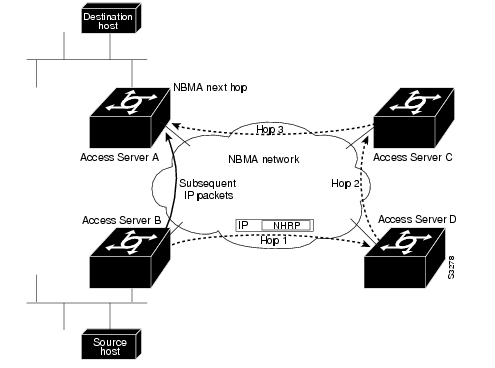
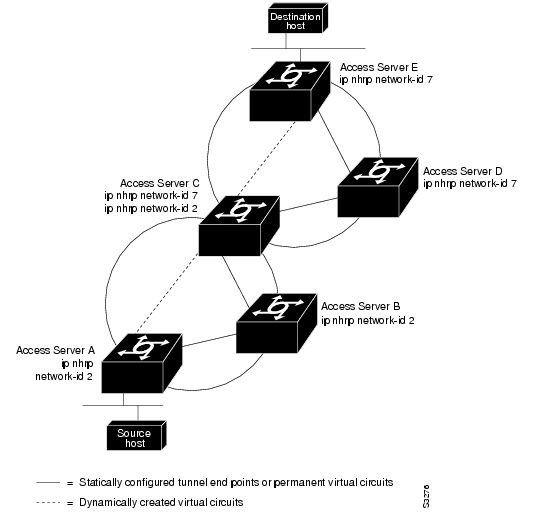
Figure 18-1 Next Hop Resolution Protocol (NHRP)
illustrates four access servers connected to an NBMA network. Within the network are ATM or SMDS switches necessary for the access servers to communicate with each other. Assume that the switches have virtual circuit connections represented by hops 1, 2, and 3 of the figure. When Access Server A attempts to forward an IP packet from the source host to the destination host, NHRP is triggered. On behalf of the source host, Access Server A sends an NHRP request packet encapsulated in an IP packet, which takes three hops across the network to reach Access Server D, connected to the destination host. After receiving a positive NHRP reply, Access Server D is determined to be the "NBMA next hop," and Access Server A sends subsequent IP packets for the destination to Access Server D in one hop.
With NHRP, once the NBMA next hop is determined, the source can either start sending IP packets to the destination (in a connectionless NBMA network such as SMDS) or first establish a connection to the destination with the desired bandwidth and quality of service (QOS) characteristics (in a connection-oriented NBMA network such as ATM).
Other address resolution methods can be in use while NHRP is deployed. Hosts that can use only the LIS model might require ARP servers and services over NBMA networks, and deployed hosts might not implement NHRP but might continue to support ARP variations. NHRP is designed to eliminate the suboptimal routing that results from the LIS model and can be deployed with existing ARP services without interfering with them.
NHRP uses a virtual private network, which is a virtual Layer 3 network that is built on top of an actual Layer 3 network. The topology you can use over the virtual private network can be largely independent of the underlying network, and the protocols you run over it can be completely independent of it.
Connected to the NBMA network are one or more Next Hop servers, which implement NHRP. All of our access servers are capable of implementing NHRP and thus can act as Next Hop servers. A host or access server that is not an NHRP speaker must be configured with the identity of the Next Hop server that serves it.
Each Next Hop server serves a set of destination hosts, which might or might not be directly connected to the NBMA network. Next Hop servers cooperatively resolve the NBMA next hop addresses within their NBMA network. In addition to NHRP, Next Hop servers typically support protocols used to disseminate routing information across (and beyond the boundaries of) the NBMA network\ and might support ARP service also.
A Next Hop server maintains a "next-hop resolution" cache, which is a table of IP-to-NBMA address mappings. The table is created from information gleaned from NHRP register packets, extracted from NHRP request or reply packets that traverse the Next Hop server as they are forwarded, or through other means such as ARP and preconfigured tables.
Modes of Operation
NHRP supports two modes of operation: server mode and fabric mode. The modes differ in the way the Next Hop server updates the destination address in the IP packet containing the NHRP Request.
Hosts attached directly to the NBMA network have no knowledge of whether NHRP is deployed in server or fabric mode and host configuration is the same in each case. Regardless of which mode is used, NHRP clients must be configured with the IP address and NBMA address of at least one Next Hop server. In practice, a host's default access server should also be its Next Hop server.
Fabric Mode
In fabric mode, it is expected that all access servers within the NBMA network are NHRP-capable. A Next Hop server that serves a destination must lie along the routed path to that destination. In practice, this means that all egress access servers must double as Next Hop servers serving the destinations beyond them, and that hosts on the NBMA network are served by access servers that double as Next Hop servers.
Server Mode
In server mode, there are few Next Hop servers in an NBMA network. This might occur in networks that have access servers that do not support NHRP or networks that have many directly attached hosts and relatively few access servers.
Server mode requires static configuration of Next Hop server identity in the client stations (hosts or access servers). The client station must be configured with the IP address of one or more Next Hop servers, and there must be a path to that Next Hop server (either directly, in which case the Next Hop server's NBMA address must be known, or indirectly, through an access server whose NBMA address is known). If there are multiple Next Hop servers, they must be configured with each others' addresses, the identities of the destinations they each serve, and a logical NBMA network identifier. (This static configuration requirement, which might also involve authentication, tends to limit the number of Next Hop servers.)
If the NBMA network offers a group addressing or multicast feature, the client station can be configured with a group address assigned to the group of Next Hop servers. The client might then submit NHRP requests to the group address, eliciting a response from one or more Next Hop servers, depending on the response strategy selected.
The servers can also be configured with the group or multicast address of their peers, and a Next Hop server might use this address to forward NHRP requests that its peers cannot satisfy. This might elicit a response (to the Next Hop server) from one or more Next Hop servers, depending on the response strategy. The Next Hop server would then forward the NHRP reply to the NHRP request originator. The purpose of using group addressing or a similar multicast mechanism in this scenario is to eliminate the need to preconfigure each Next Hop server in a logical NBMA network with both the individual identities of other Next Hop servers and the destinations they serve. It reduces the number of Next Hop servers that might be used to process an NHRP request (in those configurations where Next Hop servers either respond or forward via the multicast, only two Next Hop servers would be traversed) and allows the Next Hop server that serves the NHRP request originator to cache next hop information associated with the reply.
NHRP Configuration Task List
To configure NHRP, perform the tasks described in the following sections. The first task is required, the remainder are optional.
•
•
•
•
•
•
•
For NHRP configuration examples, see the section "NHRP Configuration Examples" later in this chapter.
Enable NHRP on an Interface
To enable NHRP for an interface on an access server, perform the following task in interface configuration mode. In general, all NHRP stations within a logical NBMA network must be configured with the same network identifier.
For an example of enabling NHRP, see the section "Enabling NHRP Example" at the end of this chapter.
Configure a Station's Static IP-to-NBMA Address Mapping
To participate in NHRP, a station connected to an NBMA network should be configured with the IP and NBMA addresses of its Next Hop server(s).
Alternatively, the station should be configured with a means of acquiring those addresses, that is, the group address that can be used to reach the Next Hop servers.
A third possibility is that the Next Hop servers can be physically located on the stations's default or peer access servers, so their IP addresses can be obtained from the station's IP forwarding table.
If the station is attached to several link layer networks (including logical NBMA networks), the station should also be configured to receive routing information from its Next Hop servers and peer access servers so that it can determine which IP networks are reachable through which link layer networks.
To configure static IP-to-NBMA address mapping on a station (host or access server), perform the following task in interface configuration mode:
Statically Configure a Next Hop Server (Server Mode)
A Next Hop server is configured with its own identity, a set of IP address prefixes that correspond to the IP addresses of the stations it serves, a logical NBMA network identifier, and in the case of server mode, the identities of other Next Hop servers in the same logical NBMA network. If a served station is attached to several link layer networks, the Next Hop server might also need to be configured to advertise routing information to such stations.
If a Next Hop server acts as an egress access server for stations connected to link layer networks other than the NBMA network, the Next Hop server must also be configured to exchange routing information between the NBMA network and these other link layer networks.
In all cases, routing information is exchanged using conventional intradomain or interdomain routing protocols.
To statically configure a Next Hop server, perform the following task in interface configuration mode:
Statically configure a Next Hop server.
ip nhrp nhs nhs-address [net-address [netmask]]
To configure multiple networks that the Next Hop server serves, repeat the ip nhrp nhs command with the same Next Hop server address, but different IP network addresses. To configure additional Next Hop servers, repeat the ip nhrp nhs command.
In the absence of static address configurations, a Next Hop server operates in fabric mode and must itself learn the NBMA addresses of the stations it serves dynamically through NHRP.
Configure NHRP Authentication
Configuring an authentication string ensures that only access servers configured with the same string can intercommunicate using NHRP. Therefore, if the authentication scheme is to be used, the same string must be configured in all access servers that are configured for NHRP on a fabric. To specify the authentication string for NHRP on an interface, perform the following task in interface configuration mode:
Control NHRP Initiation
You can specify an IP access list that is used to decide which IP packets can trigger the sending of NHRP requests. By default, all non-NHRP packets can trigger NHRP requests. To limit which IP packets trigger NHRP requests, you must define an access list and then apply it to the interface.
To define an access list, perform one of the following tasks in global configuration mode:
Then apply the IP access list to the interface by performing the following task in interface configuration mode:
Specify an IP access list that controls NHRP requests.
ip nhrp interest access-list-number
Suppress Forward and Reverse Record Options
To dynamically detect link-layer filtering in NBMA networks (for example, X.25 closed user group facility, or SMDS address screens) and to provide loop detection and diagnostic capabilities, NHRP incorporates a Route Record in requests and replies. The Route Record options contain the network (and link layer) addresses of all intermediate Next Hop servers between source and destination (in the forward direction) and between destination and source (in the reverse direction).
By default, forward record options and reverse record options are included in NHRP request and reply packets. To suppress the use of these options, perform the following task in interface configuration mode:
Specify the NHRP Responder Address
If an NHRP requestor wants to know which Next Hop server generates an NHRP reply packet, it can request that information by including the responder address option in its NHRP request packet. The Next Hop server that generates the NHRP reply packet then complies by inserting its own IP address in the NHRP reply. The Next Hop server uses the primary IP address of the specified interface.
To specify which interface the Next Hop server uses for the NHRP responder IP address, perform the following task in interface configuration mode.
Specify which interface the Next Hop server uses to determine the NHRP responder address.
ip nhrp responder interface-type interface-number
If an NHRP reply packet being forwarded by a Next Hop server contains that Next Hop server's own IP address, the Next Hop server generates an Error Indication of type "NHRP Loop Detected" and discards the reply.
Change the Time Period NBMA Addresses Are Advertised as Valid
You can change the length of time that NBMA addresses are advertised as valid in positive and negative NHRP responses. In this context, "advertised" means how long the access server tells other access servers to keep the addresses it is providing in NHRP responses. The default length of time for each response is 7200 seconds (2 hours). To change the length of time, perform the following task in interface configuration mode:
Specify the number of seconds that NBMA addresses are advertised as valid in positive or negative NHRP responses.
ip nhrp holdtime seconds-positive [seconds-negative]
Configure a GRE Tunnel for Multipoint Operation
You can enable a generic route encapsulation (GRE) tunnel to operate in multipoint fashion. A tunnel network of multipoint tunnel interfaces can be thought of as an NBMA network. To configure the tunnel, perform the following tasks in interface configuration mode:
Enable a GRE tunnel to be used in multipoint fashion.
tunnel mode gre multipoint
Configure a tunnel identification key.
tunnel key key-number
The tunnel key should correspond to the NHRP network identifier specified in the ip nhrp network-id command. For an example of NHRP configured on a multipoint tunnel, see the section "NHRP on a Multipoint Tunnel Example" later in this chapter.
Monitor and Maintain NHRP
To monitor the NHRP cache or traffic, perform either of the following tasks in EXEC mode:
The NHRP cache can contain static entries caused by statically configured addresses and dynamic entries caused by the access server learning addresses from NHRP packets. To clear static entries, use the no ip nhrp map command. To clear the NHRP cache of dynamic entries, perform the following task in EXEC mode:
Disable IP Routing
Every access server ships with IP routing automatically enabled. If you choose to set up the access server to bridge rather than route IP datagrams, you must disable IP routing. To disable IP routing, perform the following task in global configuration mode:
When IP routing is disabled, the access server will act as an IP end host for IP packets destined for or sourced by it, whether or not bridging is enabled for those IP packets not destined for the access server. To reenable IP routing, use the ip routing command.
Routing Assistance When IP Routing Is Disabled
The access server software provides three methods by which the access server can learn about routes to other networks when IP routing is disabled and the access server is acting as an IP host:
•
•
•
When IP routing is disabled, the default gateway feature and the router discovery client are enabled, and proxy ARP is disabled. When IP routing is enabled, the default gateway feature is disabled and you can configure proxy ARP and the router discovery servers.
Proxy ARP
The most common method of learning about other routes is by using proxy ARP. Proxy ARP, defined in RFC 1027, enables an Ethernet host with no knowledge of routing to communicate with hosts on other networks or subnets. Such a host assumes that all hosts are on the same local Ethernet and that it can use ARP to determine their hardware addresses.
Under proxy ARP, if an access server receives an ARP Request for a host that is not on the same network as the ARP Request sender, the access server evaluates whether it has the best route to that host. If the access server does have the best route, it sends an ARP Reply packet giving its own Ethernet hardware address. The host that sent the ARP Request then sends its packets to the access server, which forwards them to the intended host. The software treats all networks as if they are local and performs ARP requests for every IP address. This feature is enabled by default.
Proxy ARP works as long as other access servers support it. Many other access servers, especially host-based routing software, do not support it.
Default Gateway
Another method for locating routes is to define a default router (or gateway). The software sends all nonlocal packets to this access server functioning as a router, which either routes them appropriately or sends an Internet Control Message Protocol (ICMP) redirect message back to the access server, telling it of a better route. The ICMP redirect message indicates which local access server the host should use. The software caches the redirect messages and routes each packet thereafter as efficiently as possible. The limitations of this method are that there is no means of detecting when the default access server has crashed or is unavailable, and no method of picking another access server if one of these events should occur.
To set up a default gateway for a host, perform the following task in global configuration mode:
To display the address of the default gateway, use the show ip redirects EXEC command.
Router Discovery Mechanism
The access server software provides a third method, called router discovery, by which the access server can dynamically learn about routes to other networks using the Gateway Discovery Protocol (GDP) or the ICMP Router Discovery Protocol (IRDP) for detecting routers. The software is also capable of wire-tapping Routing Information Protocol (RIP) and Interior Gateway Routing Protocol (IGRP) routing updates and inferring the location of access servers from those updates. The server/client implementation of router discovery does not actually examine or store the full routing tables sent by access servers, it merely keeps track of which systems are sending such data.
This mechanism supports the following protocols:
•
•
•
•
You can configure these protocols in any combination. When possible, use GDP or IRDP because they allow each access server to specify both a priority and the time after which an access server should be assumed down if no further packets are received. Access servers discovered using IGRP are assigned an arbitrary priority of 60. Access servers discovered through RIP are assigned a priority of 50. For IGRP and RIP, the software attempts to measure the time between updates and will assume that the access server is down if no updates are received for 2.5 times that interval.
Each access server discovered becomes a candidate for the default access server. The list of candidates is scanned and a new highest priority access server is selected when any of the following events occur:
•
•
•
To configure the access server discovery feature using the GDP routing protocol, perform the following task in interface configuration mode:
To configure the access server discovery feature using the IRDP routing protocol, perform the following task in interface configuration mode:
To configure the access server discovery feature using the RIP routing protocol, perform the following task in interface configuration mode:
To configure the access server discovery feature using the IGRP routing protocol, perform the following task in interface configuration mode:
Enable IP Bridging
To transparently bridge IP on an interface, perform the following tasks beginning in global configuration mode:
Disable IP routing.
no ip routing
Specify an interface.
interface type number
Add the interface to a bridge group.
bridge-group group1
1 This command is documented in the "Transparent Bridging Commands" chapter of the Access and Communication Servers Command Reference publication.
You can route IP on some interfaces and transparently bridge it on other interfaces simultaneously. To enable concurrent routing and bridging for the router, perform the following task in global configuration mode:
Enable concurrent routing and bridging for the router.
bridge crb1
1 This command is documented in the "Transparent Bridging Commands" chapter of the Access and Communication Servers Command Reference publication.
Configure a Routing Process
At this point in the configuration process, you can configure one or more of the many routing protocols based on your individual network needs. Routing protocols provide topology information of an internetwork. Refer to the "Configuring IP Routing Protocols" chapter for the tasks involved in configuring IP routing protocols. If you want to continue to perform basic IP configuration tasks, continue reading the following sections.
Configure Broadcast Packet Handling
A broadcast is a data packet destined for all hosts on a particular physical network. Network hosts recognize broadcasts by special addresses. Broadcasts are heavily used by some protocols, including several important Internet protocols. Control of broadcast messages is an essential part of the IP network administrator's job.
Our access servers support two kinds of broadcasting: directed broadcasting and flooding. A directed broadcast is a packet sent to a specific network or series of networks, and a flooded broadcast packet is sent to every network. A directed broadcast address includes the network or subnet fields.
Several early IP implementations do not use the current broadcast address standard. Instead, they use the old standard, which calls for all zeros instead of all ones to indicate broadcast addresses. Many of these implementations do not recognize an all-ones broadcast address and fail to respond to the broadcast correctly. Others forward all-ones broadcasts, which causes a serious network overload known as a broadcast storm. Implementations that exhibit these problems include systems based on versions of BSD UNIX prior to Version 4.3.
Routers provide some protection from broadcast storms by limiting their extent to the local cable. Bridges (including intelligent bridges), because they are Layer 2 devices, forward broadcasts to all network segments, thus propagating all broadcast storms.
The best solution to the broadcast storm problem is to use a single broadcast address scheme on a network. Most modern IP implementations allow the network manager to set the address to be used as the broadcast address. Many implementations, including the one on our access server, can accept and interpret all possible forms of broadcast addresses.
For detailed discussions of broadcast issues in general, see RFC 919, "Broadcasting Internet Datagrams," and RFC 922, "Broadcasting IP Datagrams in the Presence of Subnets." The access server support for Internet broadcasts generally complies with RFC 919 and RFC 922; however, it does not support multisubnet broadcasts as defined in RFC 922.
The current broadcast address standard provides specific addressing schemes for forwarding broadcasts. Perform the tasks in the following sections to enable these schemes:
•
•
•
See the "IP Configuration Examples" section at the end of this chapter for broadcasting configuration examples.
Enable Directed Broadcast-to-Physical Broadcast Translation
To enable forwarding of directed broadcasts on an interface where the broadcast becomes a physical broadcast, perform one of the tasks that follow. By default, this feature is enabled only for those protocols configured using the ip forward-protocol global configuration command. You can specify an access list to control which broadcasts are forwarded. When an access list is specified, only those IP packets permitted by the access list are eligible to be translated from directed broadcasts to physical broadcasts.
Perform either of the following tasks in interface configuration mode as required for your network:
Forward UDP Broadcast Packets and Protocols
Network hosts occasionally use UDP broadcasts to determine address, configuration, and name information. If such a host is on a network segment that does not include a server, UDP broadcasts are normally not forwarded. You can remedy this situation by configuring the interface of your access server to forward certain classes of broadcasts to a helper address. You can have more than one helper address per interface.
You can specify a UDP destination port to control which UDP services are forwarded. You can specify multiple UDP protocols. You can also specify the Network Disk (ND) protocol, which is used by older diskless Sun workstations, and you can specify the network security protocol SDNS. By default, both UDP and ND forwarding are enabled if a helper address has been defined for an interface. The description for the ip forward-protocol command in the Router Products Command Reference publication lists the ports that are forwarded by default if you do not specify any UDP ports.
If you do not specify any UDP ports when you configure the forwarding of UDP broadcasts, you are configuring the access server to act as a BOOTP forwarding agent. BOOTP packets carry Dynamic Host Configuration Protocol (DHCP) information. (DHCP is defined in RFC 1531.) This means that the access server is now compatible with DHCP clients.
To enable forwarding and to specify the destination address, perform the following task in interface configuration mode:
Enable forwarding and specify the destination address for forwarding UDP broadcast packets, including BootP.
ip helper-address address
To specify which protocols will be forwarded, perform the following task in global configuration mode:
Specify which protocols will be forwarded over which ports.
ip forward-protocol {udp [port] | nd | sdns}
See the "IP Configuration Examples" section in this publication for an example of how to configure helper addresses.
Establish an IP Broadcast Address
The access server supports IP broadcasts on both local- and wide-area networks. There are several ways to indicate an IP broadcast address. Currently, the most popular way (the default) is an address consisting of all ones (255.255.255.255), although the access servers can be configured to generate any form of IP broadcast address. Our access servers also can receive and understand any form of IP broadcast.
To set the access server's IP broadcast address, perform the following task in interface configuration mode:
Establish a different broadcast address (other than 255.255.255.255).
ip broadcast-address [ip-address]
If the access server does not have nonvolatile memory, and you need to specify the broadcast address to use before the access server has been configured, you have to change the IP broadcast address by setting jumpers in the processor configuration register. Setting bit 10 causes the access server to use all zeros. Bit 10 interacts with bit 14, which controls the network and subnet portions of the broadcast address. Setting bit 14 causes the access server to include the network and subnet portions of its address in the broadcast address. shows the combined effect of setting bits 10 and 14.
Table 18-2 Configuration Register Settings for Broadcast Address Destination
Out
Out
<ones><ones>
Out
In
<zeros><zeros>
In
In
<net><zeros>
In
Out
<net><ones>
Some access server platforms allow the configuration register to be set through the software; see the "Loading System Images and Configuration Files" chapter for details. For other access server platforms, the configuration register can only be changed through hardware; see the appropriate hardware installation and maintenance manual for your system.
Configure IP Services
The IP suite offers a number of services that control and manage IP connections. Many of these services are provided by the Internet Control Message Protocol (ICMP). ICMP messages are sent by access servers to hosts or other access servers when a problem is discovered with the Internet header. For detailed information on ICMP, see RFC 792.
To configure IP services, complete the tasks in the following sections:
•
•
•
•
See the "IP Configuration Examples" section at the end of this chapter for examples of ICMP services.
Disable ICMP Protocol Unreachable Messages
If the access server receives a nonbroadcast packet destined for itself that uses an unknown protocol, it sends an ICMP Protocol Unreachable message back to the source. Similarly, if the access server receives a packet that it is unable to deliver to the ultimate destination because it knows of no route to the destination address, it sends an ICMP Host Unreachable message to the source. This feature is enabled by default.
You can disable this service by performing the following task in interface configuration mode:
Disable the sending of ICMP Protocol Unreachable and Host Unreachable messages.
no ip unreachables
Disable ICMP Redirect Messages
Routes sometimes can become less than optimal. For example, it is possible for the access server to be forced to resend a packet through the same interface on which it was received. If this happens, the access server sends an ICMP Redirect message to the packet's originator telling it that it is on a subnet directly connected to the access server, and that it must forward the packet to another system on the same subnet. It does so because the originating host presumably could have sent that packet to the next hop without involving the access server at all. The Redirect message instructs the sender to remove the access server from the route and substitute a specified device representing a more direct path. This feature is enabled by default.
You can disable the sending of ICMP Redirect messages by performing the following task in interface configuration mode:
Understand Path MTU Discovery
Our access servers support the IP Path MTU Discovery mechanism, as defined in RFC 1191. IP Path MTU Discovery allows a host to dynamically discover and cope with differences in the maximum allowable maximum transmission unit (MTU) size of the various links along the path. Sometimes an access server is unable to forward a datagram because it requires fragmentation (the packet is larger than the MTU you set for the interface with the ip mtu command), but the "Don't fragment" (DF) bit is set. The access server sends a message to the sending host, alerting it to the problem. The host must fragment packets for the destination so that they fit the smallest packet size of all the links along the path. This technique is shown in Figure 18-2.
Figure 18-2 IP Path MTU Discovery
IP Path MTU Discovery is useful when a link in a network goes down, forcing use of another, different MTU-sized link (and different access servers). Figure 18-2 shows an attempt to send IP packets over a network where the MTU in the first access server is set to 1500 bytes, but then reaches an access server where the MTU is set to 512 bytes. If the datagram's "Don't fragment" bit is set, the datagram is dropped because the 512-byte access server is unable to forward it. All packets larger than 512 bytes are dropped in this case. The second access server returns an ICMP Destination Unreachable message to the source of the datagram with its Code field indicating "Fragmentation needed and DF set." To support IP Path MTU Discovery, the access server would also include the MTU of the next-hop network link in the low-order bits of an unused header field.
IP Path MTU Discovery is also useful when a connection is first being established and the sender has no information at all about the intervening links. Use the largest MTU that the links will bear; the larger the MTU, the fewer packets the host needs to send.
Note
Because the CTR card does not support the switching of frames larger than 4472 bytes, some interoperability problems may occur if CTR cards are intermixed with other Token Ring cards on the same network. You can minimize this by setting lower (and the same) IP maximum packet sizes for all devices on the network with the ip mtu interface command.
Set the MTU Packet Size
All interfaces have a default MTU packet size. You can adjust the IP MTU size so that if an IP packet exceeds the MTU set for an access server's interface, the access server will fragment it.
Changing the MTU value (with the mtu interface configuration command) can affect the IP MTU value. If the current IP MTU value is the same as the MTU value, and you change the MTU value, the IP MTU value will be modified automatically to match the new MTU. However, the reverse is not true; changing the IP MTU value has no effect on the value for the mtu interface configuration command.
Also, all devices on a physical medium must have the same protocol MTU in order to operate.
To set the MTU packet size for a specified interface, perform the following task in interface configuration mode:
Enable ICMP Mask Reply Messages
Occasionally, network devices need to know the subnet mask for a particular subnetwork in the internetwork. To achieve this information, such devices can send ICMP Mask Request messages. These messages are responded to by ICMP Mask Reply messages from devices that have the requested information. The access server can respond to ICMP Mask Request messages if this function is enabled.
To enable the sending of ICMP Mask Reply messages, perform the following task in interface configuration mode:
Disable IP Source Routing
The access server examines IP header options on every packet. It supports the IP header options Strict Source Route, Loose Source Route, Record Route, and Time Stamp, which are defined in RFC 791. If the access server finds a packet with one of these options enabled, it performs the appropriate action. If it finds a packet with an invalid option, it sends an ICMP Parameter Problem message to the source of the packet and discards the packet.
IP provides an option called source routing, which allows the source IP host to specify a route through the IP network. You specify source routing as an option in the IP header. If source routing is specified, the access server forwards the packet according to the specified source route. You use this feature when you want to force a packet to take a certain route through the network. The default is to perform source routing.
You can disable IP source-route header options by performing the following task in global configuration mode:
Cause the access server to discard any IP datagram containing a source-route option.
no ip source-route
Filter IP Packets
Packet filtering helps control packet movement through the network. Such control can help limit network traffic and restrict network use by certain users or devices. To permit or deny packets from crossing specified access server interfaces, we provide access lists.
You can use access lists in several ways:
•
•
•
This section summarizes how to create access lists and how to apply them.
See the "IP Configuration Examples" section at the end of this chapter for examples of configuring access lists.
An access list is a sequential collection of permit and deny conditions that apply to IP addresses. The access server tests addresses against the conditions in an access list one by one. The first match determines whether the access server accepts or rejects the address. Because the access server stops testing conditions after the first match, the order of the conditions is critical. If no conditions match, the access server rejects the address.
The two steps involved in using access lists are as follows:
Step 1
Step 2
These steps are described in the next sections.
Create Standard and Extended Access Lists
CautionThis release introduces substantial changes to IP access lists. These extensions are backward compatible; migrating from existing releases to Release 10.3 or Release 11.0 Release will convert your access lists automatically. However, previous releases are not upwardly compatible with these changes. Thus, if you save an access list with Release 10.3 and 11.0 and then use older software, the resulting access list will not be interpreted correctly. This can cause you severe security problems. Save your old configuration file before booting Cisco IOS Release 10.3 or 11.0 images.
The software supports two styles of access lists for IP:
•
•
To create a standard access list, perform one of the following tasks in global configuration mode:
To create an extended access list, perform one of the following tasks in global configuration mode:
After an access list is created initially, any subsequent additions (possibly entered from the terminal) are placed at the end of the list. In other words, you cannot selectively add or remove access list command lines from a specific access list.
Note
Refer to the "IP Configuration Examples" section at the end of this chapter for examples of implicit masks.
Apply an Access List to an Interface or Terminal Line
After an access list is created, you can apply it to one or more interfaces. Access lists can be applied on either outbound or inbound interfaces. The next two tables show how this task is accomplished for both terminal lines and network interfaces.
Perform the following task in line configuration mode:
Restrict incoming and outgoing connections between a particular virtual terminal line (into a device) and the addresses in an access list.
access-class access-list-number {in | out}
Perform the following task in interface configuration mode:
For inbound access lists, after receiving a packet, the access server checks the source address of the packet against the access list. If the access list permits the address, the access server continues to process the packet. If the access list rejects the address, the access server discards the packet and returns an ICMP Host Unreachable message.
For outbound access lists, after receiving and routing a packet to a controlled interface, the access server checks the source address of the packet against the access list. If the access list permits the address, the access server transmits the packet. If the access list rejects the address, the access server discards the packet and returns an ICMP Host Unreachable message.
When you apply an access list (standard or extended) that has not yet been defined to an interface, the access server will act as if the access list has not been applied to the interface and will accept all packets. Remember this behavior if you use undefined access lists as a means of security in your network.
Note
Configure the Hot Standby Router Protocol
The Hot Standby Router Protocol provides high network availability because it routes IP traffic from hosts on Ethernet or Token Ring networks without relying on the availability of any single router.
This feature is useful for hosts that do not support a router discovery protocol such as IRDP and do not have the functionality to switch to a new router when their selected router reloads or loses power. Because existing TCP sessions can survive the failover, this protocol also provides a more transparent means of recovery for hosts that dynamically select a next hop for routing IP traffic.
When the Hot Standby Router Protocol is configured on a network segment, it provides a virtual MAC address and an IP address that is shared among routers in a group of routers that are running the Hot Standby Router Protocol. One of these routers is selected by the protocol to be the active router. The active router receives and routes packets destined for the group's MAC address. For n routers running the Hot Standby Router Protocol, there are n+1 IP and MAC addresses assigned.
The Hot Standby Router Protocol detects when the designated active router fails, at which point a selected standby router assumes control of the Hot Standby group's MAC and IP addresses. A new standby router is also selected at that time.
Routers that are running the Hot Standby Router Protocol send and receive multicast UDP-based hello packets to detect router failure and to designate active and standby routers.
When the Hot Standby Router Protocol is configured on an interface, ICMP Redirect messages are disabled by default for the interface.
You can configure multiple Hot Standby groups on an interface, thereby making fuller use of the redundant routers. To do so, specify a group number for each Hot Standby command you configure for the interface.
Note
Note
To enable the Hot Standby Router Protocol on an interface, perform the following task in interface configuration mode:
To configure other Hot Standby group attributes that affect how the local router participates in the Hot Standby Router Protocol, perform one or more of the following tasks in interface configuration mode:
Configure Basic IP Security Options
Our IP Security Option (IPSO) support addresses both the basic and extended security options as described in RFC 1108. Our implementation is only minimally compliant with RFC 1108, because our access server only accepts and generates a 4-byte IPSO. IPSO is generally used to comply with the U.S. Government's DoD security policy.
Our basic IPSO support provides the following features:
•
•
•
•
•
To configure basic IPSO, complete the tasks in the following sections:
•
•
Enable IPSO and Set the Security Classifications
To enable IPSO and set security classifications on an interface, perform either of the following tasks in interface configuration mode:
Use the no ip security command to reset an interface to its default state.
Specify How IP Security Options Are Processed
To specify how IP security options are processed, perform any of the following optional tasks in interface configuration mode:
In order to fully comply with IPSO, the default values for the minor keywords have become complex. Default value usages include the following:
•
•
•
provides a list of all default values.
Table 18-3 Default Security Keyword Values
None
None
None
On
Off
Dedicated
Unclassified
Genser
On
Off
Dedicated
Any
Any
Off
On
Multilevel
Any
Any
Off
On
The default value for any interface is "dedicated, unclassified Genser." Note that this implies implicit labeling. This might seem unusual, but it makes the system entirely transparent to packets without options. This is the setting generated when you specify the no ip security interface configuration command.
Configure Extended IP Security Options
Our extended IPSO support is compliant with the Department of Defense Intelligence Information System Network Security for Information Exchange (DNSIX) specification documents. Extended IPSO functionality can unconditionally accept or reject Internet traffic that contains extended security options by comparing those options to configured allowable values. This support allows DNSIX networks to use additional security information to achieve a higher level of security than that achievable with basic IPSO.
We also support a subset of the security features defined in the DNSIX Version 2.1 specification. Specifically, we support DNSIX definitions of the following:
•
•
There are two kinds of extended IPSO fields defined by the DNSIX 2.1 specification and supported by our implementation of extended IPSO—Network Level Extended Security Option (NLESO) and Auxiliary Extended Security Option (AESO) fields.
NLESO processing requires that security options be checked against configured allowable information, source, and compartment bit values and requires that the access server be capable of inserting extended security options in the IP header.
AESO is similar to NLESO, except that its contents are not checked and are assumed to be valid if its source is listed in the AESO table.
To configure extended IPSO, complete the tasks in the following sections:
•
DNSIX Version 2.1 causes slow-switching code.
Configure Global Default Settings
To configure global default settings for extended IPSO, including AESOs, perform the following task in global configuration mode:
Configure system-wide default settings.
ip security eso-info source compartment-size default-bit
Attach ESOs to an Interface
To specify the minimum and maximum sensitivity levels for an interface, perform the following tasks in interface configuration mode:
Attach AESOs to an Interface
To specify the extended IPSO sources that are to be treated as AESO sources, perform the following task in interface configuration mode:
Configure the DNSIX Audit Trail Facility
The Audit Trail Facility is a UDP-based protocol that generates an audit trail of IPSO security violations. This facility allows the system to report security failures on incoming and outgoing packets. The Audit Trail Facility sends DNSIX audit trail messages when a datagram is rejected because of IPSO security violations. This feature allows you to configure organization-specific security information.
The DNSIX audit trail facility consists of two protocols:
•
•
To configure the DNSIX auditing facility, complete the tasks in the following sections:
•
•
•
Enable the DNSIX Audit Trail Facility
To enable the DNSIX audit trail facility, perform the following task in global configuration mode:
Specify Hosts to Receive Audit Trail Messages
To define and change primary and secondary addresses of the host to receive audit messages, perform the following task in global configuration mode:
Specify Transmission Parameters
To specify transmission parameters, perform the following tasks in global configuration mode:
Configure IP Accounting
Our IP accounting support provides basic IP accounting functions. By enabling IP accounting, users can see the number of bytes and packets switched through the access server on a source and destination IP address basis. Only transit IP traffic is measured and only on an outbound basis; traffic generated by the access server or terminating in the access server is not included in the accounting statistics. To maintain accurate accounting totals, the access server software maintains two accounting databases: an active and a checkpointed database.
Our IP accounting support provides information to identify IP traffic that fails IP access lists. Identifying IP source addresses that violate IP access lists alerts you to possible attempts to breach security. The data also indicates that you should verify IP access list configurations. To make this feature available to users, you must enable IP accounting of access list violations using the ip accounting access-violations command. Users can then display the number of bytes and packets from a single source that attempted to breach security against the access list for the source destination pair. By default, IP accounting displays the number of packets that have passed access lists and were routed.
To enable IP accounting, perform one of the following tasks for each interface in interface configuration mode:
Enable basic IP accounting.
ip accounting
Enable IP accounting with the ability to identify IP traffic that fails IP access lists.
ip accounting access-violations
To configure other IP accounting functions, perform one or more of the following tasks in global configuration mode:
To display IP access violations for a specific IP accounting database, perform the following task in EXEC mode:
Display IP access-violation information.
show ip accounting [checkpoint] access-violations
To display IP access violations, you must give the access-violations keyword on the command. If you do not specify the keyword, the command defaults to displaying the number of packets that have passed access lists and were routed. The access violations output displays the number of the access list failed by the last packet for the source and destination pair. The number of packets reveals how aggressive the attack is upon a specific destination.
Use the EXEC command show ip accounting to display the active accounting database. To display the checkpointed database, use the show ip accounting checkpoint EXEC command. The clear ip accounting EXEC command clears the active database and creates the checkpointed database.
Configure Performance Parameters
To tune IP performance, complete the tasks in the following sections:
•
•
Compress TCP Packet Headers
You can compress the headers of your TCP/IP packets in order to reduce their size, thereby increasing performance. Header compression is particularly useful on networks with a large percentage of small packets, such as those supporting many Telnet connections. This feature only compresses the TCP header, so it has no effect on UDP packets or other protocol headers. The TCP header compression technique, described fully in RFC 1144, is supported on serial lines using HDLC or PPP encapsulation. You must enable compression on both ends of a serial connection.
You can optionally specify outgoing packets to be compressed only if TCP incoming packets on the same interface are compressed. If you do not specify this option, the access server will compress all traffic. The default is no compression.
You also can specify the total number of header compression connections that can exist on an interface. You should configure one connection for each TCP connection through the specified interface.
To enable compression, perform either of the following optional tasks in interface configuration mode:
Note
Set the TCP Connection Attempt Time
You can set the amount of time the access server will wait to attempt to establish a TCP connection. In previous versions of access server software, the system would wait a fixed 30 seconds when attempting to do so. This amount of time is not sufficient in networks that have dial-up asynchronous connections, such as a network consisting of dial-on-demand links that are implemented over modems. Your ability to make a Telnet connection over the link (from the access server) will be affected if the link must be brought up.
Because the connection attempt time is a host parameter, it does not pertain to traffic going through the access server, just to traffic originated at the access server.
To set the TCP connection attempt time, perform the following task in global configuration mode:
Set the amount of time the access server will wait to attempt to establish a TCP connection.
ip tcp synwait-time seconds
Enable Fast Switching
Fast switching involves the use of a high-speed switching cache for IP routing. With fast switching, destination IP addresses are stored in the high-speed cache so that some time-consuming table lookups need not be done. Our access servers generally offer better packet transfer performance when fast switching is enabled.
To enable or disable fast switching, perform the following tasks in interface configuration mode:
Enable fast-switching (use of a high-speed route cache for IP routing).
ip route-cache
Disable fast switching and enable load balancing on a per-packet basis.
no ip route-cache
Control Route Cache Invalidation
The high-speed route cache used by IP fast switching is invalidated when the IP routing table changes. By default, the invalidation of the cache is delayed slightly to avoid excessive CPU load while the routing table is changing.
To control route cache invalidation, perform the following tasks in global configuration mode as needed for your network:
Allow immediate invalidation of the cache.
no ip cache-invalidate-delay
Delay invalidation of the cache.
ip cache-invalidate-delay [minimum maximum quiet threshold]
Note
Configure IP over WANs
You can configure IP over X.25, SMDS, Frame Relay, and DDR networks. To do this, configure the address mappings, as described in the appropriate wide-area networking chapters.
Monitor and Maintain the IP Network
To monitor and maintain your network, perform the tasks in the following sections:
•
•
•
Clear Caches, Tables, and Databases
You can remove all contents of a particular cache, table, or database. Clearing a cache, table, or database can become necessary when the contents of the particular structure are suspected to be invalid.
The following table lists the tasks associated with clearing caches, tables, and databases. All are performed in EXEC mode.
Clear the Access List Counters
The system counts how many packets pass each line of an access list; the counters are displayed by the show access-lists command. You can clear the counters of an access list by performing the following task in EXEC mode.
Specify the Format of Network Masks
IP uses a 32-bit mask that indicates which address bits belong to the network and subnetwork fields and which bits belong to the host field. This is called a network mask. By default, show commands display an IP address and then its network mask in dotted decimal notation. For example, a subnet would be displayed as 172.16.11.55 255.255.255.0.
You might find it more convenient to display the network mask in hexadecimal format or bitcount format instead. The hexadecimal format is commonly used on UNIX systems. The preceding example would be displayed as 172.16.11.55 0XFFFFFF00.
The bitcount format for displaying network masks is to append a slash (/) and the total number of bits in the network mask to the address itself. The preceding example would be displayed as 172.16.11.55/24.
To specify the format in which network masks appear for the current session, perform the following task in EXEC mode:
Specify the format of network masks for the current session.
term ip netmask-format {bitcount | decimal | hexadecimal}
To configure the format in which network masks appear for an individual line, perform the following task in line configuration mode:
Configure the format of network masks for a line.
ip netmask-format {bitcount | decimal | hexadecimal}
Display System and Network Statistics
You can display specific access server statistics such as the contents of IP routing tables, caches, and databases. Information provided can be used to determine resource utilization and solve network problems. You also can display information about node reachability and discover the routing path that your access server's packets are taking through the network.
These tasks are summarized in the table that follows. See the "IP Commands" chapter in the Access and Communication Servers Command Reference for details about the commands listed in these tasks. Perform the following tasks in privileged EXEC mode:
IP Configuration Examples
The following sections provide IP configuration examples:
•
•
•
•
•
Serial Interfaces Configuration Example
In the following example, the second serial interface (serial 1) is given Ethernet 0's address. The serial interface is unnumbered.
interface ethernet 0ip address 145.22.4.67 255.255.255.0interface serial 1ip unnumbered ethernet 0Creating a Network from Separated Subnets Example
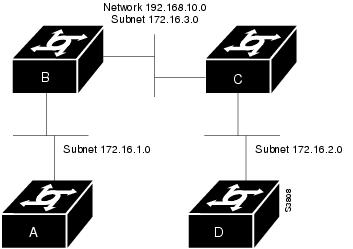
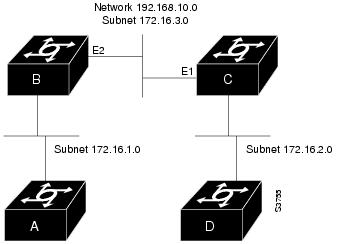
In the following example, subnets 1 and 2 of network 172.16.0.0 are separated by a backbone, as shown in Figure 18-3. The two networks are brought into the same logical network through the use of secondary addresses.
Figure 18-3
Creating a Network from Separated Subnets
The following examples show the configurations for access servers B and C.
Configuration for Access Server B
interface ethernet 2ip address 192.5.10.1 255.255.255.0ip address 172.16.3.1 255.255.255.0 secondaryConfiguration for Access Server C
interface ethernet 1ip address 192.5.10.2 255.255.255.0ip address 172.16.3.2 255.255.255.0 secondaryDynamic Lookup Example
A cache of host name-to-address mappings is used by connect, telnet, ping, trace, copy running-config tftp, copy running-config rcp, copy tftp running-config, and copy rcp running-config EXEC commands to speed the process of converting names to addresses. The commands used in this example specify the form of dynamic name lookup to be used. Static name lookup also can be configured.
The following example configures the host name-to-address mapping process for the access server. IP DNS-based translation is specified, the addresses of the name servers are specified, and the default domain name is given.
! IP Domain Name System (DNS)-based host name-to-address translation is enabledip domain-lookup! Specifies host 172.16.1.111 as the primary name server and host 172.16.1.2 ! as the secondary serverip name-server 172.16.1.111 172.16.1.2! Defines cisco.com as the default domain name the access server uses to complete ! unqualified host namesip domain-name cisco.comEstablishing IP Domains Example
The following example establishes a domain list with several alternate domain names:
ip domain-list csi.comip domain-list telecomprog.eduip domain-list merit.eduConfiguring HP Hosts on a Network Segment Example
The following example has a network segment with Hewlett-Packard devices on it. The commands listed customize the access server's first Ethernet port to respond to Probe name requests for bl4zip and to use Probe as well as ARP.
ip hp-host bl4zip 172.31.6.27interface ethernet 0arp probeip probe proxyHelper Addresses Example
In the following example, one access server is on network 192.168.1.0 and the other is on network 172.24.0.0, and you want to permit IP broadcasts from hosts on either network segment to reach both servers. Figure 18-4 illustrates how to configure the access server that connects network 172 to network 192.168.1.
Figure 18-4 IP Helper Addresses
The following example shows the configuration:
ip forward-protocol udp!interface ethernet 1ip helper-address 172.24.44.7interface ethernet 2ip helper-address 192.168.162.19Broadcasting Example
Our access servers support two types of broadcasting: directed broadcasting and flooding. A directed broadcast is a packet sent to a specific network or series of networks, and a flooded broadcast packet is sent to every network.
Figure 18-5 shows a flooded broadcast packet being sent to every network. The packet that is incoming from interface E0 is flooded to interfaces Async 1, Async 2 and S0 (Serial 0).
Figure 18-5 IP Flooded Broadcast
A directed broadcast address includes the network or subnet fields. For example, if the network address is 192.168.0.0, the address 192.168.255.255 indicates all hosts on network 192.168.0.0. This would be a directed broadcast. If network 192.168.0.0 has a subnet mask of 255.255.255.0 (the third octet is the subnet field), the address 192.168.5.255 specifies all hosts on subnet 5 of network 192.168.0.0—another directed broadcast.
Customizing ICMP Services Example
The example that follows changes some of the ICMP defaults for the first Ethernet interface 0. Disabling the sending of redirects could mean that you do not think your access servers on this segment will ever have to send a redirect. Disabling the Unreachables messages will have a secondary effect—it also will disable IP Path MTU Discovery, because path discovery works by having access servers send Unreachables messages. If you have a network segment with a small number of devices and an absolutely reliable traffic pattern—which could easily happen on a segment with a small number of little-used user devices—you would be disabling options that your access server would be unlikely to use anyway.
interface ethernet 0no ip unreachablesno ip redirectsAccess List Examples
In the following example, network 10.0.0.0 is a Class A network whose second octet specifies a subnet; that is, its subnet mask is 255.255.0.0. The third and fourth octets of a network 10.0.0.0 address specify a particular host. Using access list 2, the access server would accept one address on subnet 48 and reject all others on that subnet. The last line of the list shows that the access server accepts addresses on all other network 10.0.0.0 subnets.
access-list 2 permit 10.48.0.3access-list 2 deny 10.48.0.0 0.0.255.255access-list 2 permit 10.0.0.0 0.255.255.255interface ethernet 0ip access-group 2 inExamples of Implicit Masks in Access Lists
IP access lists contain implicit masks. For instance, if you omit the mask from an associated IP host address access list specification, 0.0.0.0 is assumed to be the mask. Consider the following sample configuration:
access-list 1 permit 0.0.0.0access-list 1 permit 172.16.0.0access-list 1 deny 0.0.0.0 255.255.255.255For this example, the following masks are implied in the first two lines:
access-list 1 permit 0.0.0.0 0.0.0.0access-list 1 permit 172.16.0.0 0.0.0.0The last line in the configuration (using the deny keyword) can be left off, because IP access lists implicitly deny all other access. This is equivalent to finishing the access list with the following command statement:
access-list 1 deny 0.0.0.0 255.255.255.255The following access list only allows access for those hosts on the three specified networks. It assumes that subnetting is not used; the masks apply to the host portions of the network addresses. Any hosts with a source address that does not match the access list statements will be rejected.
access-list 1 permit 172.26.34.0 0.0.0.255access-list 1 permit 192.168.0.0 0.0.255.255access-list 1 permit 10.0.0.0 0.255.255.255! (Note: all other access implicitly denied)To specify a large number of individual addresses more easily, you can omit the address mask that is all zeros from the access-list global configuration command. Thus, the following two configuration commands are identical in effect:
access-list 2 permit 10.48.0.3access-list 2 permit 10.48.0.3 0.0.0.0Examples of Configuring Extended Access Lists
In the following example, the first line permits any incoming TCP connections with destination ports greater than 1023. The second line permits incoming TCP connections to the SMTP port of host 192.168.1.2. The last line permits incoming ICMP messages for error feedback.
access-list 102 permit tcp 0.0.0.0 255.255.255.255 192.168.0.0 0.0.255.255 gt 1023access-list 102 permit tcp 0.0.0.0 255.255.255.255 192.168.1.2 0.0.0.0 eq 25access-list 102 permit icmp 0.0.0.0 255.255.255.255 192.168.0.0 255.255.255.255interface ethernet 0ip access-group 102 inFor another example of using an extended access list, suppose you have a network connected to the Internet, and you want any host on an Ethernet to be able to form TCP connections to any host on the Internet. However, you do not want IP hosts to be able to form TCP connections to hosts on the Ethernet except to the mail (SMTP) port of a dedicated mail host.
SMTP uses TCP port 25 on one end of the connection and a random port number on the other end. The same two port numbers are used throughout the life of the connection. Mail packets coming in from the Internet will have a destination port of 25. Outbound packets will have the port numbers reversed. The fact that the secure system behind the access server will always accept mail connections on port 25 makes it possible to separately control incoming and outgoing services.The access list can be configured on either the outbound or inbound interface.
In the following example, the Ethernet network is a Class B network with the address 192.168.0.0, and the mail host's address is 192.168.1.2. The keyword established is used only for the TCP protocol to indicate an established connection. A match occurs if the TCP datagram has the ACK or RST bits set, which indicate that the packet belongs to an existing connection.
access-list 102 permit tcp 0.0.0.0 255.255.255.255 192.168.0.0 0.0.255.255 establishedaccess-list 102 permit tcp 0.0.0.0 255.255.255.255 192.168.1.2 0.0.0.0 eq 25interface ethernet 0ip access-group 102 inIPSO Configuration Examples
In the following example, three Ethernet interfaces are presented. These interfaces are running at security levels of Confidential Genser, Secret Genser, and Confidential to Secret Genser, as shown in
Figure 18-6.Figure 18-6 IPSO Security Levels
The following commands set up interfaces for the configuration in Figure 18-6:
interface async 1ip security dedicated confidential genserinterface async 2ip security dedicated secret genserinterface ethernet 0ip security multilevel confidential genser to secret genserIt is possible for the setup to be much more complex.
In the following example, there are devices on Ethernet 0 that cannot generate a security option, and so must accept packets without a security option. These hosts do not understand security options; therefore, never place one on an interface. Furthermore, there are hosts on the other two networks that are using the extended security option to communicate information, so you must allow these to pass through the system. Finally, there also is a host (a Blacker Front End; see the "Configuring X.25 and LABP" chapter for more information about Blacker emergency mode) on Ethernet 2 that requires the security option to be the first option present, and this condition also must be specified. The new configuration follows.
interface ethernet 0ip security dedicated confidential genserip security implicit-labellingip security stripinterface async 1ip security dedicated secret genserip security extended-allowed!interface async 2ip security multilevel confidential genser to secret genserip security extended-allowedip security firstPing Command Example
You can specify the access server address to use as the source address for ping packets. In the following example, the address is 172.16.105.62:
Sandbox# pingProtocol [ip]:Target IP address: 172.16.1.111Repeat count [5]:Datagram size [100]:Timeout in seconds [2]:Extended commands [n]: yesSource address: 172.16.105.62Type of service [0]:Set DF bit in IP header? [no]:Data pattern [0xABCD]:Loose, Strict, Record, Timestamp, Verbose[none]:Sweep range of sizes [n]:Type escape sequence to abort.Sending 5, 100-byte ICMP Echos to 172.16.1.111, timeout is 2 seconds:!!!!!Success rate is 100 percent, round-trip min/avg/max = 4/4/4 msNHRP Configuration Examples
This section provides the following NHRP configuration examples:
•
Enabling NHRP Example
A logical NBMA network is considered to be the group of interfaces and hosts that participate in NHRP and have the same network identifier. illustrates two logical NBMA networks (shown as circles) configured over a single physical NBMA network. Access Server A can communicate with Access Server B and C because they share the same network identifier (2). Access Server C can also communicate with Access Server D and E, because they share network identifier 7. After address resolution is complete, Access Server A can send IP packets to Access Server C in one hop, and Access Server C can send them to Access Server E in one hop, as shown by the dotted lines.
Figure 18-7 Two Logical NBMA Networks over One Physical NBMA Network
The five access servers in might be configured like the example in . The source host is connected to Access Server A and the destination host is connected to Access Server E. The same switch serves all five access servers, making one physical NBMA network.
Figure 18-8 Physical Configuration of a Sample NBMA
Refer again to . Initially, before NHRP has resolved any NBMA addresses, IP packets from the source host to the destination host travel through all five access servers connected to the switch before reaching the destination. When Access Server A first forwards the IP packet toward the destination host, Access Server A also generates an NHRP request for the destination host's IP address. The request is forwarded to Access Server C, whereupon a reply is generated. Access Server C replies because it is the egress access server between the two logical NBMA networks.
Similarly, Access Server C generates an NHRP request of its own, which Access Server E replies to. In this example, subsequent IP traffic between the source and the destination still requires two hops to traverse the NBMA network, because the IP traffic must be forwarded between the two logical NBMA networks. Only one hop would be required if the NBMA network were not logically divided.
NHRP on a Multipoint Tunnel Example
With multipoint tunnels, a single tunnel interface may be connected to multiple neighboring access servers. Unlike point-to-point tunnels, a tunnel destination does not need to be configured. In fact, if configured, the tunnel destination must correspond to an IP multicast address. Broadcast or multicast packets sent over the tunnel interface can be then transmitted by sending the GRE packet to the multicast address configured as the tunnel destination.
Multipoint tunnels require that you configure a tunnel key. Otherwise, unexpected generic route encapsulation (GRE) traffic could easily be received by the tunnel interface. For simplicity, it is recommended that the tunnel key correspond to the NHRP network identifier.
In the following example, Access Servers A, B, C, and D all share a common Ethernet segment. Minimal connectivity over the multipoint tunnel network is configured, thus creating a network that can be treated as a partially meshed NBMA network. Due to the static NHRP map entries, Access Server A knows how to reach Access Server B, Access Server B knows how to reach Access Server C, Access Server C know how to reach Access Server D, and Access Server D knows how to reach Access Server A.
When Access Server A initially attempts to send an IP packet to Access Server D, the packet is forwarded through Access Server B and C. Through NHRP, the access servers quickly learn each other's NBMA addresses (in this case, IP addresses assigned to the underlying Ethernet network). The partially meshed tunnel network readily becomes fully meshed, at which point any of the access servers can directly communicate over the tunnel network without their IP traffic requiring an intermediate hop.
The significant portions of the configurations for Access Servers A, B, C, and D follow.
Access Server A
interface tunnel 0no ip redirectsip address 10.0.0.1 255.0.0.0ip nhrp map 10.0.0.2 10.10.0.2ip nhrp network-id 1ip nhrp nhs 10.10.0.2tunnel source ethernet 0tunnel mode gre multipointtunnel key 1interface ethernet 0ip address 10.0.0.1 255.0.0.0Access Server B
interface tunnel 0no ip redirectsip address 10.0.0.2 255.0.0.0ip nhrp map 10.0.0.3 10.0.0.3ip nhrp network-id 1ip nhrp nhs 10.0.0.3tunnel source ethernet 0tunnel mode gre multipointtunnel key 1interface ethernet 0ip address 10.0.0.2 255.0.0.0Access Server C
interface tunnel 0no ip redirectsip address 10.0.0.3 255.0.0.0ip nhrp map 10.0.0.4 10.0.0.4ip nhrp network-id 1ip nhrp nhs 10.0.0.4tunnel source ethernet 0tunnel mode gre multipointtunnel key 1interface ethernet 0ip address 10.0.0.3 255.0.0.0Access Server D
interface tunnel 0no ip redirectsip address 10.0.0.4 255.0.0.0ip nhrp map 10.0.0.1 10.0.0.1ip nhrp network-id 1ip nhrp nhs 10.0.0.1tunnel source ethernet 0tunnel mode gre multipointtunnel key 1interface ethernet 0ip address 10.0.0.4 255.0.0.0