



 Feedback
Contents
- RSVP Local Policy Support
- Finding Feature Information
- Feature Overview
- Benefits of RSVP Local Policy Support
- Supported Platforms
- Prerequisites
- Configuration Tasks
- Creating an RSVP Local Policy
- Specifying Command Line Interface Submodes
- Verifying RSVP Local Policy Configuration
- Monitoring and Maintaining RSVP Local Policy Support
- Configuration Examples
- Example RSVP Local Policy Support
- Additional References
- Glossary
RSVP Local Policy Support
Feature History
This document describes the Resource Reservation Protocol (RSVP) Local Policy Support feature in Cisco IOS Release 12.2(13)T. It identifies the supported platforms, provides configuration examples, and lists related Cisco IOS command line interface (CLI) commands.
This document includes the following sections:
Finding Feature Information
Your software release may not support all the features documented in this module. For the latest caveats and feature information, see Bug Search Tool and the release notes for your platform and software release. To find information about the features documented in this module, and to see a list of the releases in which each feature is supported, see the feature information table at the end of this module.
Use Cisco Feature Navigator to find information about platform support and Cisco software image support. To access Cisco Feature Navigator, go to www.cisco.com/go/cfn. An account on Cisco.com is not required.
Feature Overview
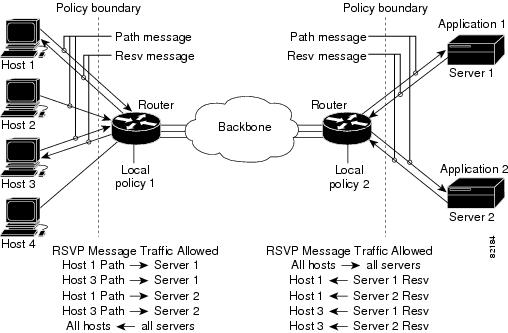
Network administrators need the ability to control the resources that RSVP reservations are allowed to use. For example, they may want to restrict RSVP reservations to certain subnets or from specific network servers.
The RSVP Local Policy Support feature allows network administrators to create default and access control list (ACL)-based policies. These policies, in turn, control how RSVP filters its signalling messages to allow or deny quality of service (QoS), as shown in the figure below, to networking applications based on the IP addresses of the requesting hosts.
Supported Platforms
For supported platforms in Cisco IOS Release 12.2(13)T, consult Cisco Feature Navigator.
Determining Platform Support Through Cisco Feature Navigator
Cisco IOS software is packaged in feature sets that are supported on specific platforms. To get updated information regarding platform support for this feature, access Cisco Feature Navigator. Cisco Feature Navigator dynamically updates the list of supported platforms as new platform support is added for the feature.
Cisco Feature Navigator is a web-based tool that enables you to determine which Cisco IOS software images support a specific set of features and which features are supported in a specific Cisco IOS image. You can search by feature or release. Under the release section, you can compare releases side by side to display both the features unique to each software release and the features in common.
To access Cisco Feature Navigator, you must have an account on Cisco.com. If you have forgotten or lost your account information, send a blank e-mail to cco-locksmith@cisco.com. An automatic check will verify that your e-mail address is registered with Cisco.com. If the check is successful, account details with a new random password will be e-mailed to you. Qualified users can establish an account on Cisco.com by following the directions found at this URL:
http://www.cisco.com/register http://www.cisco.com/register
Cisco Feature Navigator is updated regularly when major Cisco IOS software releases and technology releases occur. For the most current information, go to the Cisco Feature Navigator home page at the following URL:
Availability of Cisco IOS Software Images
Platform support for particular Cisco IOS software releases is dependent on the availability of the software images for those platforms. Software images for some platforms may be deferred, delayed, or changed without prior notice. For updated information about platform support and availability of software images for each Cisco IOS software release, refer to the online release notes or, if supported, Cisco Feature Navigator.
Prerequisites
RSVP must be configured on two or more routers or on one router and one host within the network before you can use the RSVP Local Policy Support feature.
Configuration Tasks
- Creating an RSVP Local Policy
- Specifying Command Line Interface Submodes
- Verifying RSVP Local Policy Configuration
Creating an RSVP Local Policy
To create an RSVP local policy, use the following command beginning in global configuration mode:
Specifying Command Line Interface Submodes
To specify CLI submodes, use the following command beginning in local policy mode:
|
Command |
Purpose |
|---|---|
Router(config-rsvp-policy-local)#
{accept
| forward
} {all
 | path
| path-error
| resv
 | resv-error
}
|
Defines the properties of the default or ACL-based local policy that you are creating. |
See the ip rsvp policy local command in the Cisco IOS Quality of Service Solutions Command Reference for more detailed information on submodes.
Verifying RSVP Local Policy Configuration
DETAILED STEPS
Monitoring and Maintaining RSVP Local Policy Support
To monitor and maintain the RSVP Local Policy Support feature, use the following commands in EXEC mode:
|
Command |
Purpose |
|---|---|
Router# show ip rsvp policy
|
Displays either the configured COPS servers or the local policies. |
Router# show ip rsvp policy local
|
Displays selected local policies that have been configured. |
Router# show ip rsvp reservation detail
|
Displays detailed RSVP-related receiver information currently in the database. |
Router# show ip rsvp sender detail
|
Displays detailed RSVP-related sender information currently in the database. |
Configuration Examples
Example RSVP Local Policy Support
In the following example, any RSVP nodes in the 192.168.101.0 subnet can initiate or respond to reservation requests, but all other nodes can respond only to reservation requests. This means that any 192.168.101.x node can send and receive Path, PathError, Resv, or ResvError messages. All other nodes can send only Resv or ResvError messages.
In the following example, ACL 104 is configured for a local policy:
Router# configure terminal
Router(config)# access-list 104 permit ip 192.168.101.0 0.0.0.255 any
Router(config)# ip rsvp policy local acl 104
Router(config-rsvp-policy-local)# forward
 all
Router(config-rsvp-policy-local)# end
In the following example, a default local policy is configured:
Router(config)# ip rsvp policy local default
Router(config-rsvp-policy-local)# forward resv
Router(config-rsvp-policy-local)# forward resverror
Router(config-rsvp-policy-local)# end
Additional References
Related Documents
|
Related Topic |
Document Title |
|---|---|
|
Cisco IOS commands |
|
|
QoS commands: complete command syntax, command modes, command history, defaults, usage guidelines, and examples |
Cisco IOS Quality of Service Solutions Command Reference |
|
Signalling Overview |
"Signalling Overview" module |
|
QoS configuration tasks related to RSVP |
"Configuring RSVP" module |
|
Conceptual information and configuration tasks for classifying network traffic. |
"Classifying Network Traffic" module |
|
Congestion Management |
"Congestion Management Overview" module |
|
Cisco United Communications Manager (CallManager) and related features |
"Overview of Cisco Unified Communications Manager and Cisco IOS Interoperability" module |
|
Regular expressions |
"Using the Cisco IOS Command-Line Interface" module |
MIBs
Technical Assistance
|
Description |
Link |
|---|---|
|
The Cisco Support and Documentation website provides online resources to download documentation, software, and tools. Use these resources to install and configure the software and to troubleshoot and resolve technical issues with Cisco products and technologies. Access to most tools on the Cisco Support and Documentation website requires a Cisco.com user ID and password. |
Glossary
access control list-- See ACL.
ACL-- access control list. An ACL consists of individual filtering rules grouped together in a single list. It is generally used to provide security filtering, though it may be used to provide a generic packet classification facility.
flow --A stream of data traveling between two endpoints across a network (for example, from one LAN station to another). Multiple flows can be transmitted on a single circuit.
latency --The delay between the time a device receives a packet and the time that packet is forwarded out the destination port.
packet --A logical grouping of information that includes a header containing control information and (usually) user data. Packets most often refer to network layer units of data.
policy --Any defined rule that determines the use of resources within the network. A policy can be based on a user, a device, a subnetwork, a network, or an application.
port scanning --The act of systematically checking a computer's ports to find an access point.
Resource Reservation Protocol --See RSVP.
RSVP --Resource Reservation Protocol. A protocol for reserving network resources to provide quality of service guarantees to application flows.
router --A network layer device that uses one or more metrics to determine the optimal path along which network traffic should be forwarded. Routers forward packets from one network to another based on network layer information.
tunnel --A secure communications path between two peers, such as routers.
Voice over IP --See VoIP.
VoIP --Voice over IP. The ability to carry normal telephony-style voice over an IP-based Internet maintaining telephone-like functionality, reliability, and voice quality.
Cisco and the Cisco logo are trademarks or registered trademarks of Cisco and/or its affiliates in the U.S. and other countries. To view a list of Cisco trademarks, go to this URL: www.cisco.com/go/trademarks. Third-party trademarks mentioned are the property of their respective owners. The use of the word partner does not imply a partnership relationship between Cisco and any other company. (1110R)
Any Internet Protocol (IP) addresses and phone numbers used in this document are not intended to be actual addresses and phone numbers. Any examples, command display output, network topology diagrams, and other figures included in the document are shown for illustrative purposes only. Any use of actual IP addresses or phone numbers in illustrative content is unintentional and coincidental.