- Configuring LAN Interfaces
- Fast EtherChannel
- Configuring Serial Interfaces
- Lossless Compression R1 ATM Cell Switching and External BITS Clocking Source
- Network Analysis Module (NM-NAM)
- Minimal Disruptive Restart of VIP Cards
- Rate Based Satellite Control Protocol
- Configuring Virtual Interfaces
- Implementing Tunnels
- Dynamic Layer 3 VPNs with Multipoint GRE Tunnels
- MPLS VPN over mGRE
- IP Tunnel MIBs
- IF-MIBs
- Managing Dial Shelves
- Router-Shelf Redundancy for the Cisco AS5800
- Route-Switch-Controller Handover Redundancy on the Cisco AS5850
- Route Processor Redundancy Plus (RPR+)
- Synchronous Ethernet (SyncE) ESMC and SSM
- IPv6 GRE Tunnels in CLNS Networks
- ISATAP Tunnel Support for IPv6
- IP over IPv6 Tunnels
- IPv6 Automatic 6to4 Tunnels
- IPv6 over IPv4 GRE Tunnels
- IPv6 Automatic IPv4-Compatible Tunnels
- Manually Configured IPv6 over IPv4 Tunnels
Contents
- IPv6 over IPv4 GRE Tunnels
- Finding Feature Information
- Information About IPv6 over IPv4 GRE Tunnels
- Overlay Tunnels for IPv6
- GRE IPv4 Tunnel Support for IPv6 Traffic
- How to Configure IPv6 over IPv4 GRE Tunnels
- Configuring GRE IPv6 Tunnels
- Configuration Examples for IPv6 over IPv4 GRE Tunnels
- Example: GRE Tunnel Running IS-IS and IPv6 Traffic
- Example: Tunnel Destination Address for IPv6 Tunnel
- Additional References
- Feature Information for IPv6 over IPv4 GRE Tunnels
IPv6 over IPv4 GRE Tunnels
GRE tunnels are links between two points, with a separate tunnel for each link. The tunnels are not tied to a specific passenger or transport protocol, but in this case carry IPv6 as the passenger protocol with the GRE as the carrier protocol and IPv4 or IPv6 as the transport protocol.
- Finding Feature Information
- Information About IPv6 over IPv4 GRE Tunnels
- How to Configure IPv6 over IPv4 GRE Tunnels
- Configuration Examples for IPv6 over IPv4 GRE Tunnels
- Additional References
- Feature Information for IPv6 over IPv4 GRE Tunnels
Finding Feature Information
Your software release may not support all the features documented in this module. For the latest caveats and feature information, see Bug Search Tool and the release notes for your platform and software release. To find information about the features documented in this module, and to see a list of the releases in which each feature is supported, see the feature information table at the end of this module.
Use Cisco Feature Navigator to find information about platform support and Cisco software image support. To access Cisco Feature Navigator, go to www.cisco.com/go/cfn. An account on Cisco.com is not required.
Information About IPv6 over IPv4 GRE Tunnels
Overlay Tunnels for IPv6
Overlay tunneling encapsulates IPv6 packets in IPv4 packets for delivery across an IPv4 infrastructure (a core network or the figure below). By using overlay tunnels, you can communicate with isolated IPv6 networks without upgrading the IPv4 infrastructure between them. Overlay tunnels can be configured between border devices or between a border device and a host; however, both tunnel endpoints must support both the IPv4 and IPv6 protocol stacks. IPv6 supports the following types of overlay tunneling mechanisms:
Manual
Generic routing encapsulation (GRE)
IPv4-compatible
6to4
Intrasite Automatic Tunnel Addressing Protocol (ISATAP)
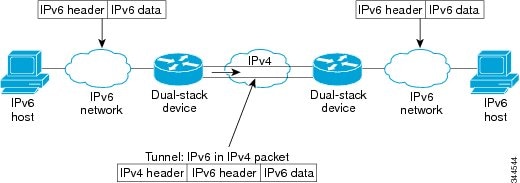
 Note | Overlay tunnels reduce the maximum transmission unit (MTU) of an interface by 20 octets (assuming that the basic IPv4 packet header does not contain optional fields). A network that uses overlay tunnels is difficult to troubleshoot. Therefore, overlay tunnels that connect isolated IPv6 networks should not be considered a final IPv6 network architecture. The use of overlay tunnels should be considered as a transition technique toward a network that supports both the IPv4 and IPv6 protocol stacks or just the IPv6 protocol stack. |
Use the table below to help you determine which type of tunnel that you want to configure to carry IPv6 packets over an IPv4 network.
|
Tunneling Type |
Suggested Usage |
Usage Notes |
|---|---|---|
|
Manual |
Simple point-to-point tunnels that can be used within a site or between sites. |
Can carry IPv6 packets only. |
|
GRE- and IPv4- compatible |
Simple point-to-point tunnels that can be used within a site or between sites. |
Can carry IPv6, Connectionless Network Service (CLNS), and many other types of packets. |
|
IPv4- compatible |
Point-to-multipoint tunnels. |
Uses the ::/96 prefix. We do not recommend using this tunnel type. |
|
6to4 |
Point-to-multipoint tunnels that can be used to connect isolated IPv6 sites. |
Sites use addresses from the 2002::/16 prefix. |
|
6RD |
IPv6 service is provided to customers over an IPv4 network by using encapsulation of IPv6 in IPv4. |
Prefixes can be from the SP’s own address block. |
|
ISATAP |
Point-to-multipoint tunnels that can be used to connect systems within a site. |
Sites can use any IPv6 unicast addresses. |
Individual tunnel types are discussed in detail in this document. We recommend that you review and understand the information about the specific tunnel type that you want to implement. When you are familiar with the type of tunnel you need, see the table below for a summary of the tunnel configuration parameters that you may find useful.
|
Tunneling Type |
Tunnel Configuration Parameter |
|||
|---|---|---|---|---|
|
Tunnel Mode |
Tunnel Source |
Tunnel Destination |
Interface Prefix or Address |
|
|
Manual |
ipv6ip |
An IPv4 address, or a reference to an interface on which IPv4 is configured. |
An IPv4 address. |
An IPv6 address. |
|
GRE/IPv4 |
gre ip |
An IPv4 address. |
An IPv6 address. |
|
|
IPv4- compatible |
ipv6ip auto-tunnel |
Not required. These are all point-to-multipoint tunneling types. The IPv4 destination address is calculated, on a per-packet basis, from the IPv6 destination. |
Not required. The interface address is generated as ::tunnel-source/96. |
|
|
6to4 |
ipv6ip 6to4 |
An IPv6 address. The prefix must embed the tunnel source IPv4 address. |
||
|
6RD |
ipv6ip 6rd |
An IPv6 address. |
||
|
ISATAP |
ipv6ip isatap |
An IPv6 prefix in modified eui-64 format. The IPv6 address is generated from the prefix and the tunnel source IPv4 address. |
GRE IPv4 Tunnel Support for IPv6 Traffic
IPv6 traffic can be carried over IPv4 GRE tunnels using the standard GRE tunneling technique that is designed to provide the services to implement any standard point-to-point encapsulation scheme. As in IPv6 manually configured tunnels, GRE tunnels are links between two points, with a separate tunnel for each link. The tunnels are not tied to a specific passenger or transport protocol but, in this case, carry IPv6 as the passenger protocol with the GRE as the carrier protocol and IPv4 or IPv6 as the transport protocol.
The primary use of GRE tunnels is for stable connections that require regular secure communication between two edge devices or between an edge device and an end system. The edge devices and the end systems must be dual-stack implementations.
How to Configure IPv6 over IPv4 GRE Tunnels
Configuring GRE IPv6 Tunnels
Perform this task to configure a GRE tunnel on an IPv6 network. GRE tunnels can be configured to run over an IPv6 network layer and to transport IPv6 packets in IPv6 tunnels and IPv4 packets in IPv6 tunnels.
When GRE IPv6 tunnels are configured, IPv6 addresses are assigned to the tunnel source and the tunnel destination. The tunnel interface can have either IPv4 or IPv6 addresses assigned (this is not shown in the task). The host or router at each end of a configured tunnel must support both the IPv4 and IPv6 protocol stacks.
1.
enable
2.
configure
terminal
3.
interface
tunnel
tunnel-number
4.
ipv6
address
ipv6-prefix
/
prefix-length
[eui-64]
5.
tunnel
source
{ip-address | ipv6-address | interface-type interface-number}
6.
tunnel
destination
{host-name | ip-address | ipv6-address}
7.
tunnel
mode
{aurp | cayman | dvmrp | eon | gre| gre multipoint | gre ipv6 | ipip
[decapsulate-any] | iptalk | ipv6 | mpls | nos
DETAILED STEPS
Configuration Examples for IPv6 over IPv4 GRE Tunnels
- Example: GRE Tunnel Running IS-IS and IPv6 Traffic
- Example: Tunnel Destination Address for IPv6 Tunnel
Example: GRE Tunnel Running IS-IS and IPv6 Traffic
The following example configures a GRE tunnel running both IS-IS and IPv6 traffic between Router A and Router B:
Router A Configuration
ipv6 unicast-routing
clns routing
!
interface tunnel 0
 no ip address
 ipv6 address 3ffe:b00:c18:1::3/127
 ipv6 router isis
 tunnel source Ethernet 0/0
 tunnel destination 2001:DB8:1111:2222::1/64
 tunnel mode gre ipv6
!
interface Ethernet0/0
 ip address 10.0.0.1 255.255.255.0
!
router isis
 net 49.0000.0000.000a.00
Router B Configuration
ipv6 unicast-routing
clns routing
!
interface tunnel 0
 no ip address
 ipv6 address 3ffe:b00:c18:1::2/127
 ipv6 router isis
 tunnel source Ethernet 0/0
 tunnel destination 2001:DB8:1111:2222::2/64
 tunnel mode gre ipv6
!
interface Ethernet0/0
 ip address 10.0.0.2 255.255.255.0
!
router isis
 net 49.0000.0000.000b.00
 address-family ipv6
 redistribute static
 exit-address-family
Example: Tunnel Destination Address for IPv6 Tunnel
Router(config
)
# interface Tunnel0
Router(config
-if)
# no ip address
Router(config
-if)
# ipv6 router isis
Router(config
-if)
# tunnel source Ethernet 0/0
Router(config
-if)
# tunnel destination 2001:DB8:1111:2222::1/64
Router(config
-if)
# tunnel mode gre ipv6
Router(config
-if)
# exit
!
Router(config
)
# interface Ethernet0/0
Router(config
-if)
# ip address 10.0.0.1 255.255.255.0
Router(config
-if)
# exit
!
Router(config
)
# ipv6 unicast-routing
Router(config
)
# router isis

Router(config
)
# net 49.0000.0000.000a.00
Additional References
Related Documents
Related Topic |
Document Title |
|---|---|
|
IPv6 addressing and connectivity |
IPv6 Configuration Guide |
|
Cisco IOS commands |
|
|
IPv6 commands |
|
|
Cisco IOS IPv6 features |
Standards and RFCs
Standard/RFC |
Title |
|---|---|
|
RFCs for IPv6 |
IPv6 RFCs |
MIBs
|
MIB |
MIBs Link |
|---|---|
|
|
To locate and download MIBs for selected platforms, Cisco IOS releases, and feature sets, use Cisco MIB Locator found at the following URL: |
Technical Assistance
Description |
Link |
|---|---|
|
The Cisco Support and Documentation website provides online resources to download documentation, software, and tools. Use these resources to install and configure the software and to troubleshoot and resolve technical issues with Cisco products and technologies. Access to most tools on the Cisco Support and Documentation website requires a Cisco.com user ID and password. |
Feature Information for IPv6 over IPv4 GRE Tunnels
The following table provides release information about the feature or features described in this module. This table lists only the software release that introduced support for a given feature in a given software release train. Unless noted otherwise, subsequent releases of that software release train also support that feature.
Use Cisco Feature Navigator to find information about platform support and Cisco software image support. To access Cisco Feature Navigator, go to www.cisco.com/go/cfn. An account on Cisco.com is not required.
Feature Name |
Releases |
Feature Information |
|---|---|---|
|
IPv6 over IPv4 GRE Tunnels |
12.0(22)S 12.2(14)S 12.2(28)SB 12.2(33)SRA 12.2(17a)SX1 12.2(4)T 12.3 12.3(2)T 12.4 12.4(2)T 15.0(1)S |
GRE tunnels are links between two points, with a separate tunnel for each link. The tunnels are not tied to a specific passenger or transport protocol, but in this case carry IPv6 as the passenger protocol with the GRE as the carrier protocol and IPv4 or IPv6 as the transport protocol. The following commands were introduced or modified: tunnel destination, tunnel mode ipv6ip, tunnel source. |